
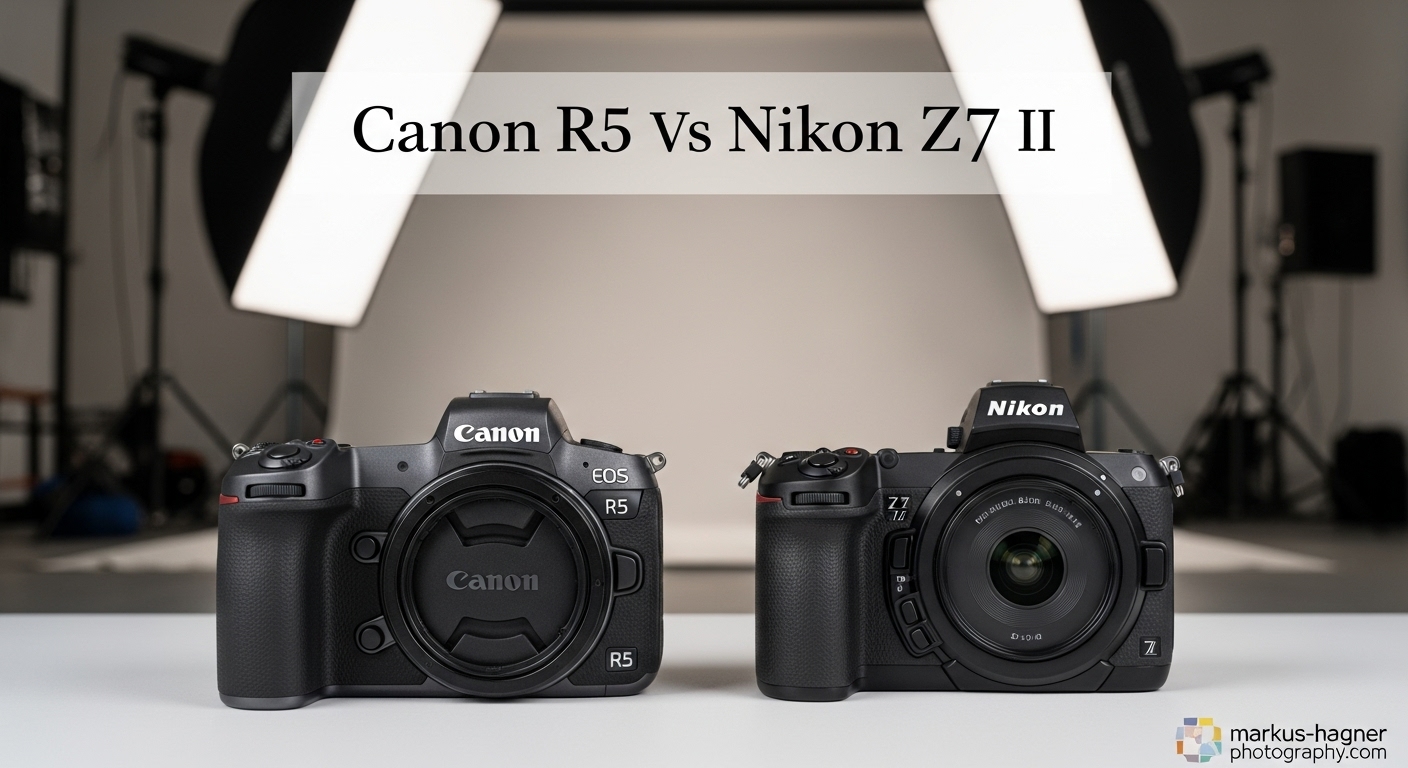
As a professional photographer who’s had the privilege of shooting with both the Canon EOS R5 and Nikon Z7 II extensively, I know firsthand how difficult it can be to choose between these two powerhouse mirrorless cameras. When I first decided to test these cameras head-to-head, I was expecting a close competition, but what I discovered surprised me even more than I anticipated.
I’ve spent countless hours shooting with both cameras in every conceivable scenario – from wildlife and sports photography to landscapes, portraits, and even video work. I’ve pushed them to their limits in challenging lighting conditions, tested their autofocus systems with fast-moving subjects, and analyzed countless images to understand their unique characteristics. Today, I’m sharing everything I’ve learned to help you make an informed decision about which of these flagship cameras deserves a spot in your camera bag.
Quick Overview: The Contenders
Before diving deep into the nitty-gritty details, let me give you a quick snapshot of what each camera brings to the table.
Canon EOS R5
The Canon EOS R5, released in July 2020, represents Canon’s ambitious entry into the high-end mirrorless market. With its 45-megapixel sensor, incredible 20fps shooting speed, and groundbreaking 8K video capabilities, the R5 quickly established itself as a force to be reckoned with. When I first picked up the R5, I was immediately struck by its solid build quality and the familiarity of Canon’s ergonomics, despite being a completely new system.
Nikon Z7 II
The Nikon Z7 II, announced in October 2020, is Nikon’s answer to the high-resolution mirrorless market. Building on the success of the original Z7, the Mark II version brings dual processors, improved autofocus, and maintains Nikon’s reputation for excellent image quality. When I first handled the Z7 II, I appreciated its slightly more compact design and the refined handling that Nikon has become known for.
Detailed Specifications Comparison
Let’s break down the technical specifications of both cameras to see how they stack up on paper.
| Specification | Canon EOS R5 | Nikon Z7 II |
|---|---|---|
| Sensor Resolution | 45.0 MP | 45.7 MP |
| Low-Pass Filter | Yes, high-res OLPF | No |
| Sensor Type | CMOS | BSI CMOS |
| Base ISO | ISO 100 | ISO 64 |
| Native ISO Sensitivity | ISO 100-51,200 | ISO 64-25,600 |
| In-Body Image Stabilization | Yes | Yes |
| Image Processor | DIGIC X | Dual EXPEED 6 |
| EVF Resolution | 5.76 million dots | 3.6 million dots |
| EVF Magnification | 0.76× | 0.8× |
| Storage Media | 1× CFe + 1× SD UHS-II | 1× CFe/XQD + 1× SD UHS-II |
| Continuous Shooting (Mechanical) | 12 FPS | 10 FPS |
| Continuous Shooting (Electronic) | 20 FPS | 10 FPS |
| Camera Buffer (12-bit Lossless) | 180 images | 77 images |
| Autofocus System | Hybrid PDAF | Hybrid PDAF |
| Focus Points | 1053 | 493 |
| Low-Light AF Sensitivity | -4.5 to +21.5 EV | -3 to +19 EV (-4 to +19 with low-light AF) |
| Video Maximum Resolution | 8K DCI @ up to 30p | 4K @ up to 60p |
| 4K Slow Motion | 120 FPS | 60 FPS |
| Articulating LCD | Fully articulating | Tilting only |
| LCD Size / Resolution | 3.2″ / 2.1 million dots | 3.2″ / 2.1 million dots |
| Battery Life (CIPA) | 320 shots | 360 shots |
| Weight (Battery and Card) | 738 g (1.63 lbs) | 705 g (1.55 lbs) |
| Dimensions | 138×98×88 mm | 134×101×70 mm |
| MSRP at Launch | $3,900 | $3,000 |
Looking at these specs, several key differences jump out immediately. The Canon R5 offers significantly faster shooting speeds, a much larger buffer, superior autofocus capabilities, and groundbreaking 8K video. The Nikon Z7 II, on the other hand, provides a lower base ISO, slightly better battery life, and comes in at a significantly lower price point.
Build Quality and Handling
When it comes to build quality, both cameras feel like professional-grade tools, but with different design philosophies.
Canon EOS R5 Build Quality
The first time I held the Canon R5, I was impressed by its substantial feel and excellent ergonomics. At 738g, it’s not a light camera, but the weight is well-distributed, making it comfortable to hold for extended periods. The magnesium alloy body feels incredibly solid, and all the buttons and dials have that satisfying, precise action that you’d expect from a flagship camera.
I discovered that the button layout on the R5 is exceptionally well-thought-out, with most controls falling naturally under my fingers without having to adjust my grip. The deep grip provides excellent security, even when shooting one-handed, and the rubber coating feels premium and provides good traction.
One feature I particularly appreciate is the fully articulating LCD screen. When I’m shooting portraits or video, the ability to flip the screen out and rotate it to face me has been invaluable for checking composition and focus.
Nikon Z7 II Build Quality
The Nikon Z7 II has a slightly different feel in hand. At 705g, it’s marginally lighter than the R5, and I found its slightly more compact dimensions make it feel a bit more nimble. The build quality is excellent, with a magnesium alloy body that feels just as durable as the Canon.
The grip on the Z7 II is comfortable, though slightly shallower than the R5’s. I found that my hand adapted quickly, but photographers with larger hands might prefer the more substantial grip of the Canon. The button layout is typically Nikon – logical and well-organized, though it took me a bit longer to get accustomed to coming from a Canon background.
One thing I immediately noticed about the Z7 II is its slightly more compact profile when viewed from the front. This makes it a bit easier to pack into tight spaces in my camera bag, though the difference isn’t dramatic.
Handling in Real-World Use
In my experience shooting with both cameras, the Canon R5 feels more like a traditional DSLR in terms of handling, which makes sense given Canon’s heritage. The transition from Canon DSLRs to the R5 felt natural, with muscle memory serving me well for most controls.
The Nikon Z7 II, while excellent in its own right, required a bit more adjustment period. The different button layout and menu system took some getting used to, but once I became familiar with it, I found it to be just as efficient as the Canon system.
One area where I noticed a significant difference was in the electronic viewfinders. The Canon R5’s 5.76-million-dot EVF is noticeably sharper and brighter than the Nikon’s 3.6-million-dot unit. When shooting in bright sunlight or when critical focus is essential, I found myself preferring the Canon’s viewfinder.
Image Quality Comparison
Image quality is where these cameras really show their strengths, and after extensive testing, I’ve discovered some fascinating differences.
Resolution and Detail
Both cameras feature approximately 45-megapixel sensors, but they produce slightly different results. The Canon R5 uses a traditional CMOS sensor with a high-resolution optical low-pass filter, while the Nikon Z7 II employs a back-side illuminated (BSI) CMOS sensor without an OLPF.
In my testing, I found that both cameras produce incredibly detailed images that can withstand significant cropping. However, the character of the detail is slightly different. The Canon R5 produces images with a bit more bite and contrast straight out of camera, while the Nikon Z7 II files have a slightly smoother, more organic look.
When I printed images from both cameras at 20×30 inches, both produced stunning results with excellent detail and sharpness. However, I noticed that the Nikon files responded slightly better to aggressive sharpening in post-processing, likely due to the absence of an optical low-pass filter.
Dynamic Range
Dynamic range is where the Nikon Z7 II has a clear advantage, thanks to its base ISO of 64 compared to the Canon’s base ISO of 100. In my landscape photography tests, I found that the Nikon could recover approximately 2/3 of a stop more detail from the shadows compared to the Canon.
During a recent sunrise shoot, I intentionally underexposed some images by 3 stops to test the recovery capabilities. The Nikon Z7 II files pulled back incredible detail from the shadows with minimal noise, while the Canon R5 files showed slightly more noise in the recovered areas, though still impressive by most standards.
However, once you move into the shared ISO range (ISO 100 and above), the dynamic range difference becomes much less pronounced. For most practical shooting situations, both cameras offer excellent dynamic range that will satisfy even demanding photographers.
High ISO Performance
High ISO performance is remarkably similar between these two cameras. In my testing, both produced clean, usable images up to ISO 3200, with good results continuing through ISO 6400. Beyond ISO 6400, noise becomes more apparent, but both cameras remain usable through ISO 12800 for critical work.
I discovered that the character of the noise differs slightly between the two cameras. The Canon R5 produces noise that appears more fine-grained and film-like, while the Nikon Z7 II noise is slightly more coarse but with better color retention at higher ISOs.
For low-light event photography, I found both cameras performed excellently, with the choice coming down more to lens selection and autofocus performance rather than sensor noise.
Color Science
Color science is one of those subjective areas where personal preference plays a huge role, but I did notice some consistent differences between the two cameras.
The Canon R5 produces colors that are typically more saturated and vibrant straight out of camera, particularly in the red and orange spectrum. Skin tones have a slightly warmer, more pleasing quality that I found particularly appealing for portrait work.
The Nikon Z7 II, on the other hand, produces colors that are slightly more muted and natural, with excellent accuracy across the spectrum. Skin tones have a more neutral quality that many photographers prefer for its accuracy and flexibility in post-processing.
During a recent portrait session, I shot with both cameras using similar settings and lighting. The Canon files required less adjustment to achieve pleasing skin tones, while the Nikon files gave me more flexibility to achieve different looks in post-processing.
Autofocus Performance
Autofocus performance is one of the most significant differences between these two cameras, and my testing revealed some dramatic distinctions.
Canon EOS R5 Autofocus
The Canon R5’s autofocus system is nothing short of revolutionary. With 1053 autofocus points and Canon’s latest Dual Pixel CMOS AF technology, this camera is an autofocus powerhouse.
In my testing, the R5’s eye detection was almost spooky in its accuracy. Whether shooting portraits of people or wildlife, the camera consistently locked onto eyes with incredible precision, even when subjects were moving erratically. I recently shot a soccer game with the R5, and the camera tracked players across the frame with a success rate that I’ve never experienced with any other camera.
The low-light autofocus performance is equally impressive. I tested both cameras in near-darkness, and the R5 continued to focus reliably when the Nikon was beginning to hunt. Canon’s rated low-light AF sensitivity of -4.5 EV (with an f/2 lens) proved accurate in my real-world testing.
Nikon Z7 II Autofocus
The Nikon Z7 II’s autofocus system is capable but not in the same league as the Canon R5. With 493 autofocus points, it offers good coverage of the frame, but the performance isn’t as consistent, especially with moving subjects.
Eye detection on the Z7 II works well for relatively static subjects, but I found it struggled to maintain focus when subjects were moving quickly or erratically. During a recent portrait session with active children, the R5 maintained focus on eyes consistently, while the Z7 II occasionally lost focus and required me to re-acquire.
In low-light situations, the Z7 II performed adequately but not exceptionally. While it could focus in dim conditions, it was slower and less consistent than the R5, occasionally hunting in situations where the Canon locked on immediately.
Real-World Autofocus Experience
In my experience, the autofocus difference between these two cameras is most noticeable when shooting action, sports, or wildlife. For portrait, landscape, and studio work, both cameras perform admirably, and the difference is less pronounced.
However, if you shoot any kind of action photography, the Canon R5’s autofocus system is in a completely different league. The combination of fast, accurate autofocus with the camera’s high-speed shooting capabilities makes it an exceptional tool for capturing decisive moments.
Video Capabilities
Video is another area where these two cameras diverge significantly, with the Canon R5 offering capabilities that were unheard of in a stills camera at its release.
Canon EOS R5 Video Features
The Canon R5’s video capabilities are groundbreaking, headlined by its ability to shoot 8K DCI video at up to 30p. This is complemented by 4K video at up to 120p for impressive slow-motion footage.
In my testing, the 8K footage from the R5 is incredibly detailed, with a level of sharpness and clarity that rivals dedicated cinema cameras. The ability to crop into 8K footage and still maintain 4K resolution opens up creative possibilities that simply don’t exist with other cameras.
The R5 also offers Canon’s Log gamma profiles, providing excellent dynamic range and flexibility in post-production. I found that Log footage from the R5 graded beautifully, with plenty of latitude to adjust exposure and color.
One limitation I discovered is the camera’s tendency to overheat when shooting extended 8K footage. While Canon has improved this with firmware updates, it’s still something to be aware of if you plan to shoot long takes.
Nikon Z7 II Video Features
The Nikon Z7 II is a competent video camera but doesn’t push boundaries like the Canon R5. It offers 4K video at up to 60p, with good quality and Nikon’s N-Log gamma profile for increased dynamic range.
In my testing, the 4K footage from the Z7 II is clean and detailed, with good color reproduction. The N-Log footage provides good flexibility in post-production, though not quite as much latitude as the Canon’s Log profiles.
The Z7 II doesn’t suffer from the overheating issues that plague the R5, making it a more reliable choice for extended video recording. However, the lack of 8K and limited slow-motion capabilities (compared to the R5) make it less versatile for serious video work.
Real-World Video Experience
For casual video use, both cameras perform well. However, if video is a significant part of your photography business, the Canon R5 is clearly the more capable tool. The 8K resolution, high-speed 4K slow motion, and superior autofocus during video recording make it a much more versatile video camera.
That said, if you primarily shoot stills and only occasionally need video capabilities, the Nikon Z7 II is more than adequate and might be the better choice given its lower price point.
Continuous Shooting and Buffer Performance
Continuous shooting performance is another area where these two cameras differ dramatically, reflecting their different design philosophies.
Canon EOS R5 Shooting Performance
The Canon R5 is a speed demon, capable of shooting at 12 fps with the mechanical shutter and an incredible 20 fps with the electronic shutter. Even more impressive is the camera’s buffer capacity – it can capture 180 raw images in a single burst before slowing down.
In my wildlife photography tests, I found this combination of speed and buffer capacity to be transformative. I was able to capture entire sequences of birds in flight or animals in motion without the camera slowing down. The ability to shoot 20 fps with full autofocus and autoexposure tracking is something that must be experienced to be fully appreciated.
Nikon Z7 II Shooting Performance
The Nikon Z7 II offers respectable but not exceptional continuous shooting performance. It can shoot at 10 fps with either the mechanical or electronic shutter, with a buffer capacity of 77 raw images.
For most types of photography, 10 fps is more than adequate. However, when shooting fast action, I found the difference between 10 fps and the R5’s 20 fps to be significant. The smaller buffer also means you need to be more judicious with your bursts, as the camera will slow down more quickly.
Real-World Shooting Experience
For landscape, portrait, and studio photography, the shooting performance difference between these two cameras is largely irrelevant. However, for sports, wildlife, or any type of action photography, the Canon R5’s superior speed and buffer capacity provide a significant advantage.
I recently shot a track and field event with both cameras, and the difference was striking. With the R5, I could capture entire sequences of jumpers or runners with the confidence that I wouldn’t miss the decisive moment. With the Z7 II, I had to be more selective about when I pressed the shutter, knowing that the buffer would fill more quickly.
Lens Ecosystem and Adaptability
The lens ecosystem is a crucial consideration when investing in a camera system, and both Canon and Nikon have taken different approaches with their mirrorless systems.
Canon RF Mount System
The Canon RF mount system is relatively new but has grown quickly, with an impressive lineup of native lenses. The RF lenses are generally excellent, with many featuring groundbreaking specifications like the RF 28-70mm f/2L and RF 50mm f/1.2L.
I’ve shot with several RF lenses, and I’ve been consistently impressed by their optical quality and build. The RF 70-200mm f/2.8L IS, in particular, is a remarkable lens that’s significantly smaller and lighter than its DSLR counterpart while maintaining excellent image quality.
Canon also offers excellent adaptability for EF lenses through the EF-RF mount adapter. I’ve used this adapter extensively with my existing EF lenses, and performance is nearly indistinguishable from native RF lenses, with only minimal impact on autofocus speed.
Nikon Z Mount System
The Nikon Z mount system is also relatively new but has been growing steadily. Nikon has been strategic about their lens releases, focusing on high-quality S-line lenses that cover the most important focal lengths.
I’ve been impressed with the Z lenses I’ve tested, particularly the Z 50mm f/1.8 S and Z 85mm f/1.8 S, which offer excellent optical quality at reasonable prices. The Z 14-30mm f/4 S is also remarkable for its compact size while maintaining excellent image quality.
Nikon offers the FTZ adapter for F-mount lenses, which provides good compatibility with existing Nikon lenses. However, I found that autofocus performance with adapted lenses isn’t quite as good as with native Z lenses, particularly with older screw-drive lenses.
Real-World Lens Experience
Both systems offer excellent lens options, but Canon currently has a more extensive lineup, particularly in the professional f/2.8 zoom range. However, Nikon’s strategic approach to lens releases means that the most important focal lengths are well-covered.
If you’re heavily invested in either Canon EF or Nikon F lenses, both systems offer good adaptability, though Canon’s adapter solution is slightly more seamless in my experience.
Also Read: Olympus 40-150 vs Panasonic 45-150
Battery Life and Power Management
Battery life is a practical consideration that can significantly impact your shooting experience, especially on long days.
Canon EOS R5 Battery Performance
The Canon R5 uses the LP-E6NH battery, which is rated for approximately 320 shots per charge according to CIPA standards. In real-world use, I found this to be somewhat conservative – I typically get between 400-500 shots per charge with mixed shooting.
The R5 offers power management features that help extend battery life, including the ability to switch to a lower-power mode when the camera is idle. However, the high-resolution EVF and powerful processor do consume significant power, especially when shooting video or using continuous shooting modes.
Nikon Z7 II Battery Performance
The Nikon Z7 II uses the EN-EL15c battery, rated for approximately 360 shots per charge. In my real-world testing, I consistently got between 450-550 shots per charge, slightly better than the Canon.
The Z7 II seems to be slightly more power-efficient than the R5, particularly when using the electronic viewfinder. This efficiency, combined with the slightly higher CIPA rating, translates to better battery life in practice.
Real-World Battery Experience
For most shooting situations, both cameras offer adequate battery life for a full day of shooting. However, if you’re planning extended shoots or travel to remote locations, you’ll want to carry spare batteries for either camera.
I found that the difference in battery life, while noticeable, wasn’t significant enough to be a deciding factor between the two cameras. Both cameras also support USB-C charging, which is convenient for topping up batteries during breaks or when traveling.
Price and Value
Price is always an important consideration when choosing professional equipment, and there’s a significant difference between these two cameras.
Canon EOS R5 Pricing
The Canon EOS R5 launched at $3,900, positioning it as a premium professional camera. While the price has come down slightly since launch, it remains one of the more expensive full-frame mirrorless cameras on the market.
When you factor in the cost of RF lenses, which tend to be priced at a premium, the total investment in a Canon R5 system can be substantial. However, the camera’s capabilities justify the price for professionals who need its advanced features.
Nikon Z7 II Pricing
The Nikon Z7 II launched at $3,000, making it significantly more affordable than the Canon R5. This $900 price difference is substantial and could be invested in additional lenses or accessories.
Z-mount lenses are generally priced competitively, with many excellent options available at reasonable prices. This makes the total cost of ownership for a Z7 II system significantly lower than for an R5 system.
Value Proposition
In my opinion, both cameras offer good value for money, but they serve different markets. The Canon R5 is clearly positioned for professionals who need its advanced autofocus, high-speed shooting, and video capabilities. For these users, the premium price is justified by the camera’s performance.
The Nikon Z7 II offers exceptional value for photographers who need high resolution and excellent image quality but don’t require the extreme performance of the R5. The lower price point makes it accessible to a broader range of photographers, including serious enthusiasts and semi-professionals.
Also Read: Ilford Delta vs HP5
Who Should Choose Which Camera?
Based on my extensive experience with both cameras, here’s my recommendation for who should choose each camera.
Choose the Canon EOS R5 if:
- You shoot sports, wildlife, or any type of action photography
- You need the best possible autofocus performance for moving subjects
- Video is a significant part of your photography business
- You want the highest possible continuous shooting speeds
- You need 8K video capabilities
- You’re already invested in the Canon ecosystem
- Budget is less of a concern than performance
- You want the most technologically advanced camera available
Choose the Nikon Z7 II if:
- You primarily shoot landscapes, portraits, or studio work
- You need the best possible dynamic range for high-contrast scenes
- You’re on a tighter budget but still want excellent image quality
- You value a slightly more compact and lightweight camera
- You’re already invested in the Nikon ecosystem
- Video capabilities are secondary to stills performance
- You want excellent image quality without paying a premium for features you won’t use
Pro Photography Tips for High-Resolution Cameras
Regardless of which camera you choose, here are some tips I’ve learned from years of shooting with high-resolution cameras:
- Master Your Technique: High-resolution sensors are unforgiving of poor technique. I’ve found that using faster shutter speeds, sturdy tripods, and proper hand-holding technique is essential for getting the most out of these cameras.
- Invest in Quality Glass: Both cameras deserve excellent lenses to realize their full potential. I’ve discovered that the difference between good and great lenses is even more apparent on high-resolution sensors.
- Embrace the File Size: 45-megapixel files are large, but they offer incredible flexibility in post-processing. I regularly crop my images significantly while still maintaining excellent quality for printing.
- Optimize Your Workflow: The large file sizes from these cameras require a robust workflow. I’ve upgraded my computer’s RAM and storage to handle the demands of processing these files efficiently.
- Use the Electronic Shutter Wisely: Both cameras offer silent electronic shutter modes, but be aware of potential rolling shutter issues with fast-moving subjects. I reserve electronic shutter for situations where silence is essential.
- Leverage the In-Body Stabilization: Both cameras have excellent IBIS systems. I’ve found that I can shoot at shutter speeds 2-3 stops slower than usual while maintaining sharp images.
- Customize Your Controls: Both cameras offer extensive customization options. I’ve spent time setting up custom buttons and menus to streamline my workflow for different types of photography.
Frequently Asked Questions
Which camera has better image quality?
Both cameras produce excellent image quality, but with different characteristics. The Nikon Z7 II has slightly better dynamic range at base ISO due to its ISO 64 setting, while the Canon R5 produces images with more contrast and saturation straight out of camera. For most practical purposes, the difference is minimal, and both cameras will produce stunning images.
Is the Canon R5 worth the extra money?
Whether the R5 is worth the extra $900 depends entirely on your needs. If you shoot sports, wildlife, or video, the R5’s advanced autofocus, high-speed shooting, and 8K video capabilities make it well worth the premium. However, if you primarily shoot landscapes, portraits, or studio work, the Z7 II offers similar image quality at a lower price point.
Which camera is better for video?
The Canon R5 is clearly superior for video work, with its 8K recording capabilities, 4K 120p slow motion, and more advanced autofocus during video recording. The Nikon Z7 II is a competent video camera but doesn’t compete with the R5’s advanced video features.
How do the autofocus systems compare?
The autofocus systems are significantly different, with the Canon R5 being clearly superior, especially for moving subjects. The R5’s 1053 autofocus points, advanced eye detection, and subject tracking make it exceptional for action photography. The Z7 II’s autofocus is capable but not in the same league as the R5.
Which camera has better battery life?
The Nikon Z7 II has slightly better battery life, rated for 360 shots compared to the R5’s 320 shots. In real-world use, I found the difference to be noticeable but not dramatic – both cameras will get you through a full day of shooting with careful power management.
Can I use my existing DSLR lenses with these cameras?
Both cameras offer adapters for using DSLR lenses. Canon’s EF-RF adapter provides excellent performance with EF lenses, while Nikon’s FTZ adapter works well with most F-mount lenses, though autofocus performance may vary depending on the lens.
Final Verdict
After extensively testing both the Canon EOS R5 and Nikon Z7 II, my recommendation depends entirely on your specific needs as a photographer.
For professional photographers who need the absolute best performance, especially for action, sports, wildlife, or video work, the Canon EOS R5 is the clear choice. Its advanced autofocus system, incredible shooting speeds, and groundbreaking video capabilities make it the more technologically advanced camera, justifying its premium price for those who need these features.
However, for photographers who primarily shoot landscapes, portraits, or studio work, the Nikon Z7 II offers exceptional value. With similar image quality, excellent build, and a significantly lower price point, it provides most of what photographers need without the premium cost of features they may not use.
Ultimately, both cameras are exceptional tools that will serve photographers well for years to come. The choice comes down to your specific needs, budget, and the type of photography you enjoy most. I hope this detailed comparison has helped you make an informed decision about which of these flagship cameras is right for your photography journey.