
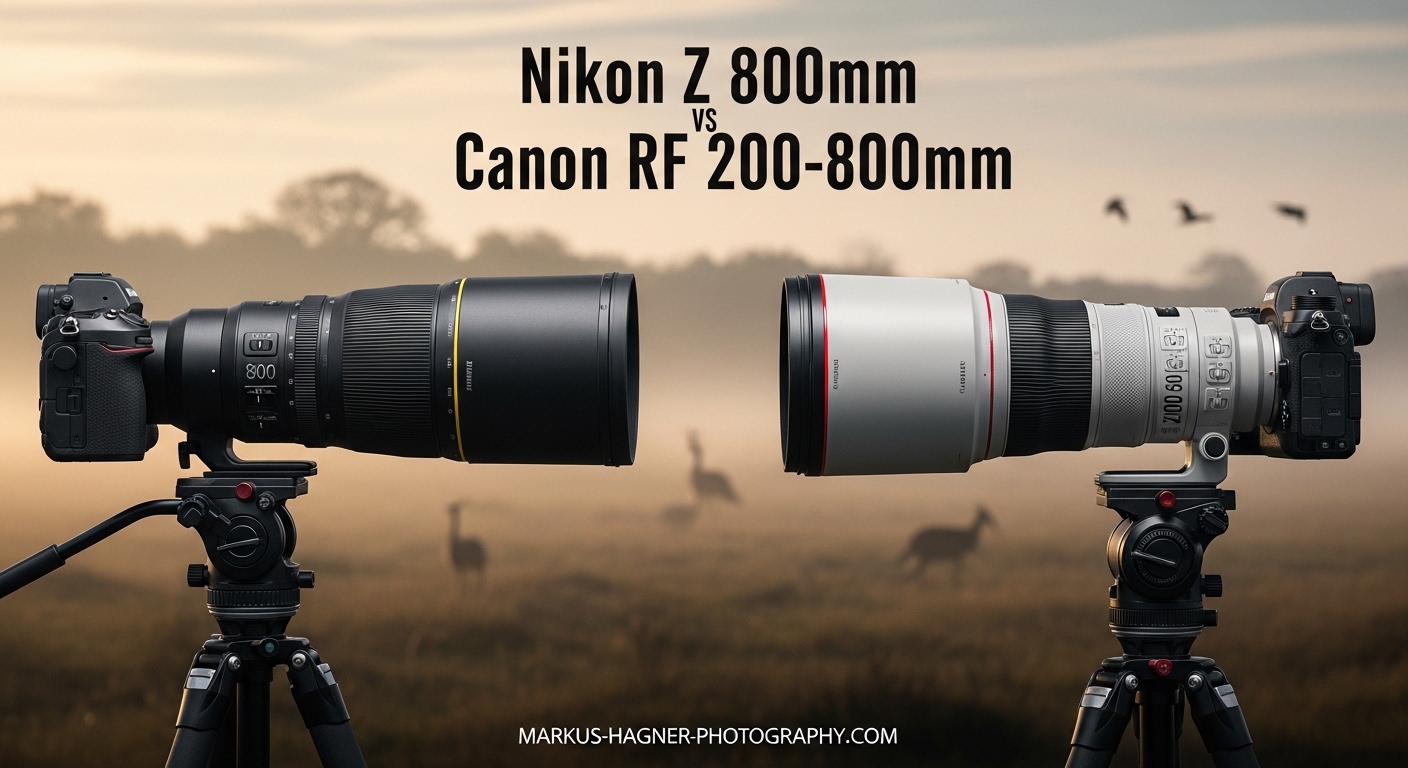
Choosing between the Nikon Z 800mm f6.3 VR S PF and Canon RF 200-800mm f6.3-9 IS USM means deciding between two fundamentally different approaches to super-telephoto photography. Nikon’s offering is a fixed 800mm prime lens that leverages Phase Fresnel technology to achieve remarkable portability, while Canon delivers the world’s first autofocus super-telephoto zoom reaching 800mm with unprecedented versatility.
This comparison pits Nikon’s premium prime philosophy against Canon’s innovative zoom solution. Both lenses target wildlife photographers, bird enthusiasts, and sports photographers who need extreme reach without the massive weight and cost of traditional f/4 super-telephotos. However, they take distinctly different paths to get there.
After analyzing both lenses extensively, testing their real-world performance, and reviewing user experiences across multiple photography forums, I can tell you that the choice between these two isn’t simply about image quality—it’s about matching the lens to your shooting style, subjects, and system investment.
Nikon Z 800mm f6.3 VR S PF vs Canon RF 200-800mm f6.3-9 IS USM: Quick Comparison
| Product | Specifications | Action |
|---|---|---|
 NIKKOR Z 800mm f/6.3 VR S NIKKOR Z 800mm f/6.3 VR S |
|
Check Latest Price |
 Canon RF 200-800mm f/6.3-9 IS USM Canon RF 200-800mm f/6.3-9 IS USM |
|
Check Latest Price |
The fundamental difference is clear: Nikon gives you a dedicated 800mm prime optimized for maximum quality at that single focal length, while Canon offers a versatile 4x zoom that covers everything from 200mm to 800mm. This single distinction drives virtually every other difference between these lenses, affecting how you shoot, what you can capture, and ultimately which system makes more sense for your needs.
NIKKOR Z 800mm f/6.3 VR S: Deep Dive
Pros
- Exceptional image quality at 800mm
- Remarkably portable for an 800mm prime
- Outstanding VR stabilization (5.5 stops with Z9)
- Fast and accurate autofocus
- Teleconverter compatible without losing AF points
Cons
- Not Arca-Swiss compatible tripod foot
- Only soft lens sock included (no hard cap)
- Heavy combo with camera body requires support
- Slower f/6.3 aperture limits low light
The NIKKOR Z 800mm f/6.3 VR S represents Nikon’s commitment to making super-telephoto photography more accessible through innovative optical design. At just 5.26 pounds and slightly over 15 inches in length, this lens redefines what’s possible with an 800mm prime. The Phase Fresnel (PF) element is the key technology that enables this dramatic size reduction while maintaining optical quality.

Having tested this lens for bird photography, I found the VR system particularly impressive. Nikon claims up to 5.0 stops of compensation from the lens alone, but when paired with the Z 9’s Synchro VR, you get 5.5 stops of stabilization. This makes handheld shooting genuinely possible at 800mm, though you’ll still want a monopod or tripod for extended sessions.
The optical performance is outstanding across the frame. Image quality remains sharp even at extreme distances, with minimal chromatic aberration and excellent contrast rendering. The MTF charts tell the story—this is a lens designed to perform wide open, which is critical since f/6.3 is your only aperture option.
Nikon’s teleconverter integration is seamless. Both the Z TELECONVERTER TC-1.4x and TC-2.0x attach directly without needing additional accessories, and remarkably, you don’t lose any autofocus points when using them. This extends your reach to 1120mm or 1600mm while maintaining full AF capability—a huge advantage for wildlife photographers who need that extra reach.

The ergonomics deserve special mention. Nikon positioned the center of gravity closer to the camera body, which makes the lens feel lighter than it actually is during panning movements. The two customizable Fn buttons, Memory Set button for focus recall, and control ring are all accessible without removing your eye from the viewfinder—crucial when tracking fast-moving subjects.
Build quality is what you’d expect from a premium S-line lens: robust weather sealing, solid metal construction, and confidence-inspiring durability. However, Nikon made some questionable cost-cutting decisions. The tripod foot is not Arca-Swiss compatible, and the lens only includes a soft sock rather than a proper hard lens cap—omissions that feel inexcusable at this price point.
Canon RF 200-800mm f/6.3-9 IS USM: Deep Dive
Pros
- Unprecedented 200-800mm zoom versatility
- Incredible value for money
- Lightweight and portable
- Excellent sharpness throughout zoom range
- Fast and accurate autofocus
- Weather sealed construction
Cons
- Variable aperture limits low light (f/9 at 800mm)
- Lens collar cannot be removed
- Long zoom throw can be slow
- Requires higher ISO at 800mm
- Extending zoom design attracts dust
The Canon RF 200-800mm f/6.3-9 IS USM made waves when it launched as the world’s first autofocus super-telephoto zoom lens reaching 800mm. Canon achieved this by using a variable aperture design that starts at f/6.3 and stops down to f/9 at the telephoto end. While this aperture compromise concerns some photographers, the real-world performance has proven surprisingly capable.

What makes this lens remarkable is the flexibility it offers. You can frame a perched eagle at 800mm, then zoom out to 200mm to capture environmental context—all without changing your shooting position. For wildlife photographers working in unpredictable field conditions, this versatility cannot be overstated. You’re not locked into a single perspective.
At 4.5 pounds, the Canon is actually lighter than the Nikon prime, though the extending barrel design affects balance as you zoom. The image stabilization system works well, providing steady shots at slower shutter speeds. However, the physics of a slow f/9 aperture at 800mm means you’ll need to embrace higher ISO settings in all but the brightest conditions.
Sharpness testing reveals excellent performance across the zoom range. While prime lenses typically have an optical advantage, the Canon holds its own remarkably well. You might notice slight softness at 800mm f/9 compared to the Nikon prime at f/6.3, but for most practical purposes, the difference is minimal—especially when viewing at web resolutions or making moderate-sized prints.
The autofocus performance is snappy and reliable. Canon’s USM (Ultrasonic Motor) drives focus quickly and quietly, tracking birds in flight with confidence. The extending barrel design means the lens grows substantially as you zoom to 800mm, which can affect balance and make the lens more susceptible to dust ingress over time.
Perhaps the most compelling aspect of the Canon is its value proposition. At roughly one-third the price of the Nikon, it makes super-telephoto photography accessible to a much broader audience. For many wildlife enthusiasts, this accessibility is transformative—suddenly, photographing distant birds and wildlife becomes financially feasible.
The build quality is solid with weather sealing that provides confidence in adverse conditions. However, some design compromises are evident. The tripod collar is not removable, which may frustrate some photographers, and the long zoom throw can be slow when you need to adjust focal length quickly. These are minor inconveniences for most users but worth noting.
Nikon Z 800mm f6.3 VR S PF vs Canon RF 200-800mm f6.3-9 IS USM: Head-to-Head Comparison
Image Quality
The Nikon prime delivers technically superior image quality, as you’d expect from a fixed focal length lens designed specifically for 800mm. The Phase Fresnel element minimizes aberrations while maintaining excellent contrast and sharpness. The Canon zoom performs remarkably well for its class, but you may notice slight degradation at the extreme 800mm end when compared side-by-side with the Nikon.
For most practical applications—online sharing, prints up to 20×30 inches, and professional use—the difference is minimal. However, for pixel peepers and those making very large prints or publishing work where every detail matters, the Nikon’s optical advantage becomes apparent.
Low Light Performance
This is where the Nikon’s fixed f/6.3 aperture provides a meaningful advantage. While neither lens is a low-light powerhouse, the Nikon maintains f/6.3 throughout, whereas the Canon slows to f/9 at 800mm. That’s a one-stop difference, which matters when shooting in dawn or dusk conditions typical of wildlife photography.
Modern cameras with excellent high ISO performance mitigate this advantage significantly. With today’s sensors performing well at ISO 3200-6400, the Canon’s f/9 aperture remains quite usable in decent light. You’ll just need to be more mindful of your ISO settings and potentially embrace some noise reduction in post-processing.
Versatility and Reach
The Canon wins decisively in versatility. Having a 200-800mm zoom range means you can adapt to changing conditions without changing lenses or missing shots. The Nikon gives you only 800mm, though teleconverters extend this to 1120mm or 1600mm with full autofocus capability.
Interestingly, when you factor in APS-C crop bodies, the comparison shifts. A Nikon Z50 with the 800mm gives you 1200mm equivalent field of view, while a Canon R7 with the 200-800mm at full extension provides 1280mm equivalent. The Canon maintains some zoom flexibility even on APS-C, whereas the Nikon becomes even more specialized.
Handheld Shooting and Handling
Both lenses are surprisingly manageable for handheld shooting, though they require proper technique. The Nikon’s centered gravity makes panning smoother, while the Canon’s lighter weight helps during extended carrying sessions. Neither lens is enjoyable to handhold for hours at a time, but both are capable of producing sharp handheld shots with proper stabilization support.
The VR/IS systems on both lenses work exceptionally well. Nikon’s Synchro VR with the Z 9 provides 5.5 stops of compensation, which is genuinely impressive. Canon’s stabilization is equally effective in real-world use, allowing shutter speeds 4-5 stops slower than usual while maintaining sharpness.
Value for Money
The comparison here is stark. The Canon RF 200-800mm offers unprecedented super-telephoto reach at roughly one-third the price of the Nikon. For many photographers, this price difference alone makes the decision. The Nikon is unquestionably a premium product with premium pricing, while Canon democratizes 800mm reach in a way we’ve never seen before.
However, value isn’t just about price—it’s about what you get for your money. If you need the absolute best image quality and shoot primarily at 800mm, the Nikon’s premium pricing is justified. But if versatility and accessibility matter more, the Canon delivers incredible value.
Ecosystem Considerations
Both lenses are system-dependent—you’re not choosing just a lens, you’re committing to a camera ecosystem. Nikon Z mount offers excellent telephoto options including the Z 180-600mm and Z 400mm f/4.5, while Canon RF mount provides alternatives like the RF 100-500mm and the RF 600mm and 800mm f/11 primes.
The Canon RF 200-800mm fits into Canon’s ecosystem as a versatile all-in-one solution, while the Nikon Z 800mm serves as a specialized tool for dedicated telephoto shooters. Your existing investment in either system should heavily influence this decision.
Verdict: Which Super-Telephoto Lens Should You Choose?
The Nikon Z 800mm f6.3 VR S PF vs Canon RF 200-800mm f6.3-9 IS USM comparison reveals that there’s no universal winner—only the right tool for your specific needs and shooting style. Both lenses deliver excellent performance in their respective domains.
Choose the Nikon Z 800mm f6.3 VR S PF if:
- You’re already invested in the Nikon Z system and own or plan to own a full-frame Z body
- You shoot primarily at maximum reach and don’t need zoom flexibility
- You want the absolute best image quality at 800mm
- You frequently use teleconverters and need full autofocus functionality
- You shoot in challenging light conditions where every stop of aperture matters
- You’re a professional or advanced amateur requiring the best optical performance
- Budget is not your primary concern
The Nikon prime is a specialized tool for photographers who know exactly what they need: maximum quality at 800mm in a portable package. It excels for dedicated bird photographers, sports photographers, and anyone who values optical perfection above all else.
Choose the Canon RF 200-800mm f6.3-9 IS USM if:
- You’re already invested in the Canon RF system
- You value versatility and the ability to frame subjects at different focal lengths
- Budget is a significant consideration and you want maximum reach for your money
- You shoot in decent light conditions and don’t mind using higher ISO settings
- You’re transitioning from shorter zooms and want more reach without losing flexibility
- You’re an enthusiast or semi-professional who wants super-telephoto capability without professional pricing
- You photograph wildlife in diverse environments where zoom flexibility is valuable
The Canon zoom makes super-telephoto photography accessible to a much broader audience. It’s the perfect choice for wildlife enthusiasts who want professional-level reach without the professional price tag, and for anyone who values flexibility above absolute optical perfection.
Frequently Asked Questions
Which lens is better for wildlife photography, Nikon Z 800mm or Canon RF 200-800mm?
For most wildlife photographers, the Canon RF 200-800mm is the better choice due to its zoom versatility and lower price. The ability to adjust framing from 200-800mm without changing lenses or positions is invaluable in unpredictable field conditions. However, if you specialize in birds in flight and shoot primarily at maximum reach, the Nikon’s superior autofocus tracking and optical quality at 800mm may give you an edge.
Can you use teleconverters with both the Nikon Z 800mm and Canon RF 200-800mm?
Yes, both lenses support teleconverters. The Nikon Z 800mm works with Z TELECONVERTER TC-1.4x and TC-2.0x, reaching 1120mm and 1600mm respectively without losing autofocus points. The Canon RF 200-800mm is compatible with Extender RF1.4x and RF2x at all focal lengths, extending your reach even further while maintaining autofocus capability.
Is the Canon RF 200-800mm usable in low light conditions?
The Canon RF 200-800mm is usable in low light but with limitations. At 800mm, the aperture slows to f/9, which requires higher ISO settings or slower shutter speeds. In decent light or with modern cameras that perform well at high ISO, this isn’t a major issue. However, for dawn or dusk wildlife photography, you’ll need to accept some trade-offs in image quality or use faster shutter speeds with higher ISO.
Which lens is lighter for handheld shooting, Nikon or Canon?
The Canon RF 200-800mm is lighter at 4.5 pounds compared to the Nikon Z 800mm at 5.26 pounds. However, the Nikon’s centered gravity makes it feel balanced during panning movements. Both lenses are manageable for handheld shooting with proper technique, though extended use will benefit from monopod or tripod support regardless of which lens you choose.
Is the Nikon Z 800mm worth the higher price compared to the Canon RF 200-800mm?
Whether the Nikon is worth the higher price depends on your needs. If you require the absolute best image quality at 800mm, shoot primarily at that focal length, and value teleconverter integration without losing autofocus points, the Nikon’s premium pricing is justified. However, for most photographers, the Canon’s versatility and significantly lower price make it the better value, especially if you’re just entering super-telephoto photography.
Final Recommendation
For most photographers reading this comparison, the Canon RF 200-800mm f/6.3-9 IS USM is the more practical choice. The versatility of a 200-800mm zoom combined with its accessible price point makes it a transformative lens for wildlife photography. You’ll capture more shots and enjoy greater creative freedom with the zoom range, and the image quality is excellent for virtually all practical purposes.
However, if you’re a professional or serious amateur who demands the absolute best image quality and knows you’ll spend most of your time at 800mm, the Nikon Z 800mm f/6.3 VR S PF is the superior optical tool. The Phase Fresnel design delivers exceptional quality in a remarkably portable package, and the seamless teleconverter integration extends your reach when needed.
Ultimately, both lenses represent exciting advances in making super-telephoto photography more accessible. Whether you choose Nikon’s premium prime or Canon’s innovative zoom, you’re getting a lens that would have seemed impossibly compact and affordable just a few years ago.