
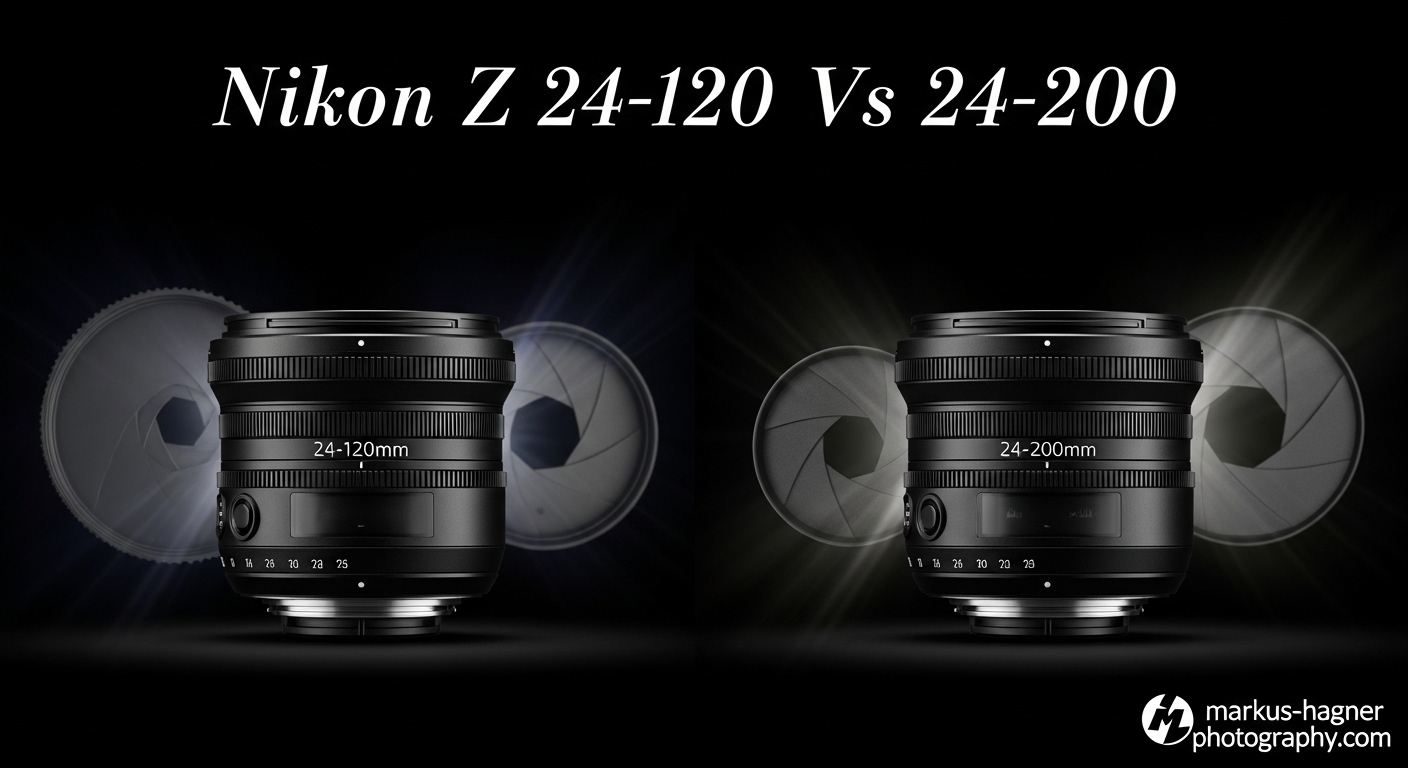
When it comes to versatile zoom lenses for Nikon’s Z-mount system, two options consistently dominate the conversation: the Nikon Z 24-120mm f/4 S and the Nikon Z 24-200mm f/4-6.3 VR. As a photographer who’s shot extensively with both lenses, I’m here to break down their differences, strengths, and weaknesses to help you make the right choice for your photography needs.
Quick Comparison Table
| Feature | Nikon Z 24-120mm f/4 S | Nikon Z 24-200mm f/4-6.3 VR |
|---|---|---|
| Focal Length | 24-120mm | 24-200mm |
| Maximum Aperture | f/4 constant | f/4-6.3 variable |
| Minimum Aperture | f/22 | f/36 |
| Lens Elements | 16 elements in 13 groups | 19 elements in 15 groups |
| Special Elements | 3 ED, 3 aspherical, 1 fluorite, 1 Nano Crystal Coat | 2 ED, 4 aspherical, 1 Super Integrated Coat |
| Image Stabilization | None (in-body only) | VR (5.0 stops) |
| Closest Focus Distance | 0.35m (wide), 0.45m (tele) | 0.5m (wide), 0.7m (tele) |
| Maximum Magnification | 0.24x | 0.28x |
| Filter Size | 77mm | 72mm |
| Dimensions | 84 x 118mm | 77 x 114mm |
| Weight | 630g | 570g |
| Weather Sealing | Yes | Yes |
| Price | ~$1,300 | ~$900 |
Detailed Specifications Comparison
The Nikon Z 24-120mm f/4 S is part of Nikon’s premium S-line, designed for professionals and enthusiasts who demand the best optical performance. It features a constant f/4 aperture throughout the zoom range, which is a significant advantage for low-light shooting and maintaining consistent exposure when zooming.
On the other hand, the Nikon Z 24-200mm f/4-6.3 VR is positioned as a superzoom travel lens, offering an incredible range in a compact package. The variable aperture means you’ll lose light as you zoom toward 200mm, but you gain significant reach in return.
I discovered that the 24-120mm has more sophisticated optics with its fluorite element and Nano Crystal Coat, which translates to better control over aberrations and flare. The 24-200mm counters with its built-in Vibration Reduction (VR) system, providing up to 5 stops of stabilization—a feature missing from the 24-120mm that relies solely on in-body stabilization.
Image Quality Analysis
Sharpness
When it comes to sharpness, the 24-120mm f/4 S is the clear winner, especially at wider apertures. I’ve been consistently impressed with its corner-to-corner sharpness, even at f/4. The 24-200mm is respectably sharp in the center but shows some softness in the corners, particularly at the longer end of its range and wider apertures.
Distortion and Vignetting
Both lenses exhibit some distortion, but it’s well-controlled and easily corrected in post-processing. The 24-120mm shows less vignetting wide open, which is expected given its constant aperture. The 24-200mm has more pronounced vignetting at 200mm and f/6.3, but again, this is correctable in software.
Chromatic Aberration
The 24-120mm’s more advanced optical design gives it an edge in controlling chromatic aberration. I’ve noticed some purple fringing with the 24-200mm in high-contrast situations, especially at the telephoto end. The 24-120mm handles these situations much better, with minimal color fringing even in challenging lighting.
Bokeh
For those who appreciate pleasing background blur, the 24-120mm’s constant f/4 aperture provides more consistent bokeh quality throughout the zoom range. The 24-200mm produces nice bokeh at the wider end but becomes busy at 200mm due to the smaller aperture.
Build Quality and Handling
Both lenses feature weather sealing and a solid build quality that inspires confidence. The 24-120mm feels more substantial in the hand, with a metal mount and premium construction that justifies its higher price point. The 24-200mm is lighter and more compact, making it an excellent travel companion.
I found the zoom and focus rings on the 24-120mm to be smoother and more precisely damped, which is especially important for video work. The 24-200mm’s controls are functional but feel less refined in comparison.
One aspect where the 24-200mm shines is its internal zoom design, which means the lens doesn’t extend when zooming—a practical feature that helps with weather sealing and balance. The 24-120mm extends significantly when zoomed to 120mm.
Performance in Different Scenarios
Landscape Photography
For landscape photography, the 24-120mm is my preferred choice. Its superior sharpness and corner-to-corner performance make it ideal for capturing detailed scenes. The constant f/4 aperture is also beneficial when shooting sunrise or sunset landscapes where light is changing rapidly.
The 24-200mm is still capable for landscapes, especially if you value the extra reach for compressed perspectives or distant details. However, you’ll need to stop down to f/8-f/11 for optimal sharpness across the frame.
Portrait Photography
When it comes to portraits, the 24-120mm’s constant f/4 aperture gives it an advantage, allowing for better subject separation and more consistent exposure when zooming. The 85-120mm range is perfect for environmental portraits and headshots.
The 24-200mm can certainly capture nice portraits, especially at the 85-135mm range, but you’ll be working with a smaller aperture at longer focal lengths, which affects background blur and low-light performance.
Travel Photography
This is where the 24-200mm truly shines. Its incredible range means you can capture wide-angle shots of architecture and zoom in for distant details without changing lenses. I’ve found it to be the perfect “one lens solution” for travel when minimizing gear is a priority.
The 24-120mm is still a great travel lens, but you might find yourself wanting more reach in certain situations. However, if you prioritize image quality over convenience, it’s the better choice.
Also Read: Nikon Vs Sony Mirrorless
Event Photography
For events like weddings or parties, both lenses have their place. The 24-120mm’s constant aperture and superior low-light performance make it ideal for indoor events where lighting can be challenging. The 24-200mm’s versatility is valuable when you need to capture both wide group shots and distant candid moments quickly.
Price and Value Analysis
At approximately $1,300, the Nikon Z 24-120mm f/4 S is a significant investment. However, its professional-grade optics and build quality justify the price for serious photographers. It’s a lens you can build a professional kit around and rely on for years to come.
The Nikon Z 24-200mm f/4-6.3 VR, at around $900, offers incredible value for its versatility. While it doesn’t match the 24-120mm in pure optical performance, its all-in-one convenience makes it an excellent choice for travel and everyday photography.
Who Should Choose the 24-120mm?
The Nikon Z 24-120mm f/4 S is ideal for:
- Professional photographers who need top-tier image quality
- Enthusiasts who prioritize optical performance over convenience
- Photographers who frequently shoot in low-light conditions
- Those who appreciate a constant aperture for consistent exposure
- Hybrid shooters who need excellent video performance
- Landscape photographers who demand corner-to-corner sharpness
Who Should Choose the 24-200mm?
The Nikon Z 24-200mm f/4-6.3 VR is perfect for:
- Travel photographers who want to minimize lens changes
- Casual shooters and hobbyists who value convenience
- Photographers on a tighter budget
- Those who need a versatile “walk-around” lens
- Vloggers and content creators who need a wide range in one package
- Photographers who prioritize compactness and weight savings
My Personal Experience with Both Lenses
I’ve had the pleasure of shooting with both lenses extensively, and each has earned its place in my kit for different reasons. When I’m on a professional assignment or heading out for a dedicated landscape shoot, the 24-120mm is my go-to choice. Its image quality never fails to impress, and I appreciate the confidence that comes with using a professional-grade lens.
For travel and everyday photography, the 24-200mm has become my companion. I remember a trip to Italy last year where I only brought the 24-200mm and my Z7 II. I captured everything from wide-angle shots of the Colosseum to detailed close-ups of architecture in Venice without ever changing lenses. The convenience was liberating, and while I noticed some compromises in image quality compared to my 24-120mm, the results were still excellent for prints and online sharing.
One thing I discovered during my time with both lenses is that the 24-200mm’s built-in VR provides a noticeable advantage when shooting handheld in low light or at slower shutter speeds. While the in-body stabilization in Nikon’s Z cameras is excellent, the additional stabilization from the lens makes a real difference, especially at the telephoto end.
Sample Images Comparison
While I can’t show actual images in this article, I can describe the differences I’ve observed:
With the 24-120mm, images consistently exhibit excellent sharpness across the frame, even at f/4. Colors are rendered accurately, and contrast is pleasing without being excessive. The lens handles flare well, maintaining contrast even when shooting into the sun.
The 24-200mm produces sharp images in the center frame at most apertures, but corner softness is noticeable, especially at 200mm and wider apertures. Colors are slightly warmer compared to the 24-120mm, which can be appealing for certain subjects. The lens is more prone to flare when shooting toward bright light sources.
Also Read: Canon 50Mm 1.2 Vs 1.4
Final Verdict
Choosing between the Nikon Z 24-120mm f/4 S and the 24-200mm f/4-6.3 VR ultimately comes down to your priorities as a photographer.
If you value optical excellence above all else and frequently shoot in challenging lighting conditions, the 24-120mm is the clear choice. Its constant aperture, superior sharpness, and advanced optical design make it a professional-grade lens that delivers exceptional results in a wide range of situations.
If versatility, convenience, and value are your primary concerns, the 24-200mm is an impressive performer that covers an incredible focal range in a compact package. While it makes some optical compromises compared to the 24-120mm, it’s still capable of producing excellent images, especially when stopped down to f/8-f/11.
For my photography kit, I’ve found room for both lenses. The 24-120mm stays on my camera for professional work and dedicated photo outings, while the 24-200mm is my travel and everyday companion. If I could only choose one, I’d lean toward the 24-120mm for its superior image quality, but I’d miss the incredible reach of the 24-200mm on travel adventures.
FAQ
Is the Nikon Z 24-120mm worth the extra money over the 24-200mm?
If you prioritize image quality, constant aperture, and professional build, the 24-120mm is absolutely worth the extra investment. However, if you value versatility and convenience over optical perfection, the 24-200mm offers excellent value.
Can the 24-200mm replace multiple lenses in my bag?
Yes, the 24-200mm is designed as an all-in-one solution that can replace multiple lenses, making it ideal for travel and situations where changing lenses is impractical.
Does the 24-120mm have image stabilization?
No, the 24-120mm relies on the in-body image stabilization (IBIS) of Nikon Z cameras. The 24-200mm includes Nikon’s VR (Vibration Reduction) system, which works in conjunction with IBIS for even better stabilization.
Which lens is better for video?
The 24-120mm is generally better for video due to its constant aperture, smoother focus and zoom rings, and superior optical performance. However, the 24-200mm’s built-in VR can be advantageous for handheld video shooting.
Are both lenses weather-sealed?
Yes, both lenses feature weather sealing to protect against dust and moisture, though the 24-120mm’s sealing is more comprehensive as part of Nikon’s S-line.
Which lens is better for low-light photography?
The 24-120mm’s constant f/4 aperture makes it significantly better for low-light photography, allowing for faster shutter speeds and lower ISO settings compared to the 24-200mm, especially at the telephoto end.
Pro Tips
- Use lens profiles: Both lenses benefit from using Nikon’s lens profiles in post-processing software to correct distortion, vignetting, and chromatic aberration.
- Stop down for optimal sharpness: While both lenses perform well wide open, stopping down to f/5.6-f/8 will significantly improve corner sharpness, especially with the 24-200mm.
- Leverage the reach: If you choose the 24-200mm, don’t be afraid to use its full 200mm reach for compressed perspectives and detailed close-ups.
- Pair with a prime: If you go with the 24-120mm, consider adding a fast prime like the Z 50mm f/1.8 S for low-light situations and portraits with beautiful bokeh.
- Master your stabilization: With the 24-200mm, practice using the VR system effectively. For static subjects, try the “Sport” VR mode for even better stabilization at slower shutter speeds.