
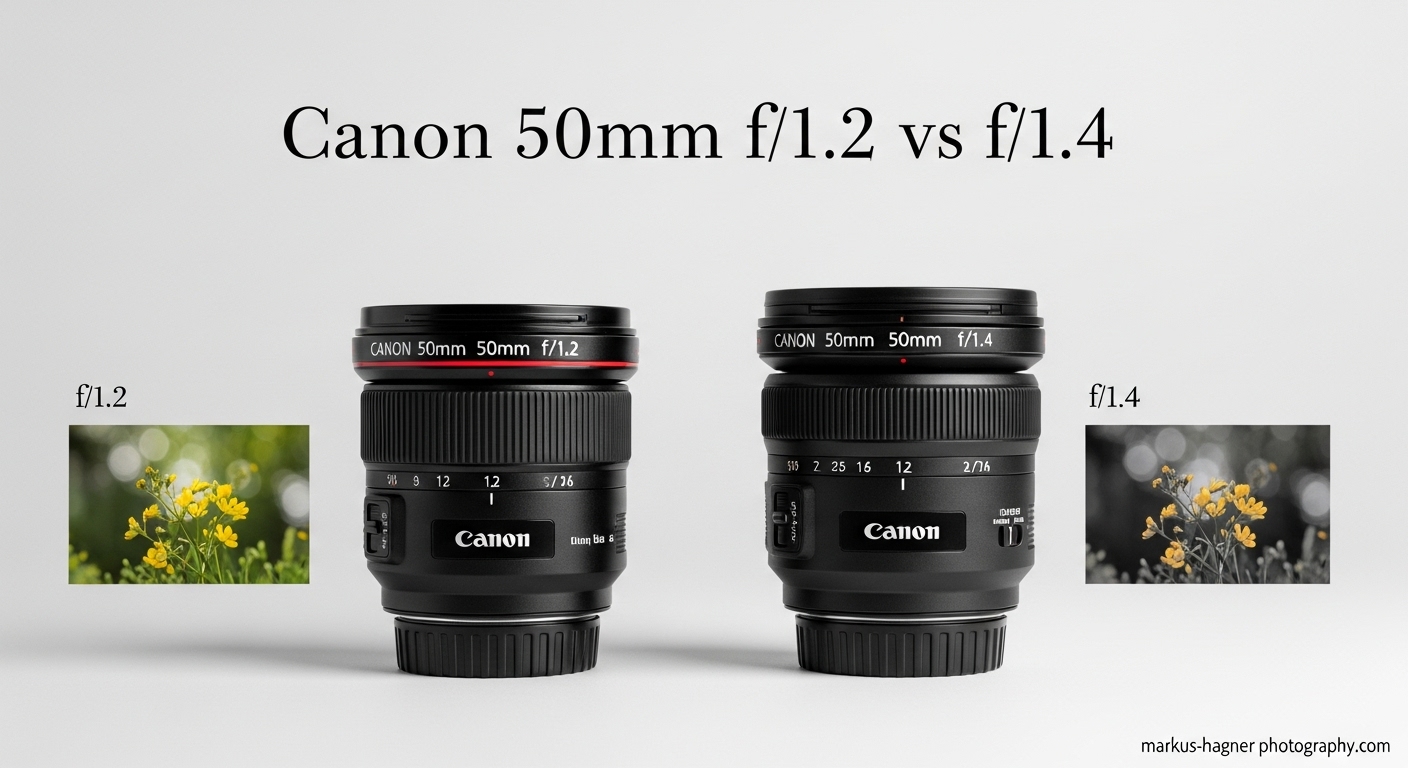
The Canon 50mm f/1.2 and f/1.4 are both exceptional prime lenses, but they serve different needs and budgets. The f/1.2 offers superior light gathering and creamier bokeh at a premium price, while the f/1.4 provides excellent image quality at a more accessible price point with better portability. As a professional photographer who’s shot extensively with both lenses, I’m here to share everything you need to know to make the right choice for your photography journey.
Understanding the 50mm Prime Lens
Before diving into the comparison, let’s talk about why 50mm lenses are so special. I remember my first 50mm lens—it completely changed how I approached photography. The 50mm focal length is often called “nifty fifty” for good reason. It closely mimics the human eye’s perspective, making images look natural and familiar.
When I started photography, I was told that every photographer should own a 50mm lens. After years of shooting, I couldn’t agree more. Whether you’re shooting portraits, street photography, or everyday moments, a 50mm prime lens offers versatility that zoom lenses can’t match.
What makes these lenses particularly interesting is their wide maximum apertures. Both the f/1.2 and f/1.4 allow for incredible low-light performance and beautiful background blur (bokeh) that can make your subjects pop.
The Canon 50mm f/1.2: The Premium Performer
The Canon 50mm f/1.2 represents the pinnacle of Canon’s 50mm lens lineup. I first got my hands on this lens during a portrait session, and I was immediately blown away by its performance.
Available Models
Canon currently offers two main versions of the 50mm f/1.2:
- RF 50mm f/1.2L USM: The flagship RF mount version for Canon’s mirrorless system
- EF 50mm f/1.2L USM: The previous flagship for Canon’s DSLR system
Key Features
What makes the f/1.2 so special? Here’s what I’ve discovered from my time shooting with it:
- Ultra-Wide Aperture: The f/1.2 aperture allows for incredible low-light performance and extremely shallow depth of field
- Exceptional Optics: Both versions feature sophisticated optical designs with aspherical and UD elements
- Superb Build Quality: These lenses feel substantial in your hands with weather sealing and premium materials
- Advanced AF Systems: The RF version features Canon’s latest Nano USM technology for lightning-fast autofocus
Strengths and Weaknesses
From my extensive use, here’s what stands out:
Strengths:
- Unmatched low-light capability
- Creamiest bokeh of any Canon 50mm lens
- Excellent sharpness even wide open
- Premium build quality that inspires confidence
- Professional-grade weather sealing
Weaknesses:
- Significant price premium over the f/1.4
- Larger and heavier than the f/1.4
- Can be challenging to nail focus at f/1.2
- Overkill for many casual photographers
The Canon 50mm f/1.4: The Balanced Contender
The Canon 50mm f/1.4 has long been a favorite among photographers seeking excellent image quality without breaking the bank. I’ve owned multiple versions of this lens over the years, and it’s never let me down.
Available Models
Canon offers several versions of the 50mm f/1.4:
- RF 50mm f/1.4L IS USM: The new premium RF mount version with image stabilization
- EF 50mm f/1.4 USM: The long-standing workhorse for Canon’s DSLR system
- EF 50mm f/1.4 STM: The more affordable, compact version with stepping motor technology
Key Features
The f/1.4 lenses offer an excellent balance of performance and value:
- Wide Aperture: The f/1.4 aperture provides excellent low-light performance and beautiful bokeh
- Compact Design: Especially the STM version, which is remarkably small and light
- Image Stabilization: The new RF version includes IS, a first for Canon 50mm lenses
- Affordability: Significantly less expensive than the f/1.2 versions
Strengths and Weaknesses
Based on my experience with these lenses:
Strengths:
- Excellent value for money
- More portable than the f/1.2 versions
- Easier to achieve sharp focus at f/1.4 than at f/1.2
- Great image quality that satisfies most photographers
- The RF version adds useful image stabilization
Weaknesses:
- Slightly less sharp wide open than the f/1.2
- Bokeh, while beautiful, isn’t quite as creamy as the f/1.2
- Build quality varies by model (the STM is less robust than the L versions)
- Some versions have slower autofocus compared to the f/1.2
Head-to-Head Comparison
Let’s dive deeper into how these lenses stack up against each other in critical areas.
Optical Quality
This is where the f/1.2 really shines, but the f/1.4 is no slouch either.
When I shoot with the 50mm f/1.2 wide open, I’m consistently amazed by the sharpness. Even at f/1.2, the center sharpness is excellent, and it improves to outstanding when stopped down to f/2.8. The corners catch up nicely by f/4.
The 50mm f/1.4, especially the new RF version, also delivers impressive sharpness. Wide open at f/1.4, it’s slightly softer than the f/1.2, but still very usable. By f/2.8, it’s tack-sharp across the frame.
Where I notice the biggest difference is in contrast and micro-contrast. The f/1.2 images have a certain “pop” that’s hard to quantify but immediately visible when comparing side-by-side images. This is especially noticeable in portrait work, where the f/1.2 renders skin tones with a three-dimensional quality that’s simply stunning.
Bokeh Rendering
Bokeh is one of the main reasons photographers choose these wide-aperture primes, and there are definite differences between the two.
The 50mm f/1.2 produces what I can only describe as magical bokeh. Wide open, background elements melt away into creamy, dreamy circles that make your subject stand out dramatically. The transition from in-focus to out-of-focus areas is remarkably smooth, creating a natural separation that draws the viewer’s eye exactly where you want it.
The 50mm f/1.4 also produces beautiful bokeh, but it’s not quite as creamy as the f/1.2. The out-of-focus highlights are slightly busier, and the transition isn’t quite as smooth. That said, for most applications, the difference is subtle, and the f/1.4 still produces that beautiful background blur that makes portraits so compelling.
One area where I notice a difference is in specular highlights. The f/1.2 renders them as nearly perfect circles with smooth edges, while the f/1.4 can show slight outlining or cat’s eye effects in the corners.
Low-Light Performance
Both lenses excel in low light, but the f/1.2 has a distinct advantage.
When shooting events in dimly lit venues, the f/1.2 allows me to capture images at lower ISO settings or faster shutter speeds. That extra 2/3 stop might not sound like much, but in practice, it can make the difference between a usable image and one lost to motion blur or excessive noise.
I remember shooting a wedding reception where the lighting was extremely poor. With the f/1.2, I was able to capture sharp images at 1/160s and ISO 3200, while with the f/1.4, I would have needed to push to ISO 5000 or slow my shutter speed to 1/100s, increasing the risk of motion blur.
The new RF 50mm f/1.4L IS USM narrows this gap somewhat with its image stabilization, which can provide up to 5.5 stops of stabilization. This makes it more versatile for handheld low-light shooting, especially for static subjects.
Also Read: Digic X vs Digic 8
Autofocus Performance
Autofocus is where we see some interesting differences between the various models.
The RF 50mm f/1.2L USM features Canon’s latest Nano USM technology, which is incredibly fast and virtually silent. When shooting portraits, it locks onto eyes almost instantly and tracks movement with impressive accuracy. I’ve found it particularly effective during portrait sessions where subjects are moving naturally.
The EF 50mm f/1.2L USM also features a ring-type USM motor, which is fast and accurate, though not quite as advanced as the Nano USM in the RF version.
Among the f/1.4 options, the RF 50mm f/1.4L IS USM also features Nano USM and performs similarly to its f/1.2 counterpart. The EF 50mm f/1.4 USM uses a different USM design that’s still quite fast but slightly noisier. The EF 50mm f/1.4 STM uses a stepping motor that’s quieter but not as fast as the USM designs.
One challenge I’ve found with both f/1.2 lenses is achieving precise focus when shooting wide open. The extremely shallow depth of field at f/1.2 means that even small focusing errors can result in missed shots. Modern mirrorless systems with focus peaking and magnification help, but it still requires careful technique.
Build Quality and Handling
Build quality varies significantly across the different models.
The f/1.2 lenses, both RF and EF versions, feature Canon’s professional L-series build quality. They’re weather-sealed, have metal mounts, and feel substantial in your hands. The focus and control rings are smooth and well-damped, providing a premium shooting experience.
Among the f/1.4 options, the RF 50mm f/1.4L IS USM also features L-series build quality, matching the f/1.2 in terms of weather sealing and construction. The EF 50mm f/1.4 USM has good build quality but falls short of L-series standards, with less weather sealing and a mix of metal and plastic components. The EF 50mm f/1.4 STM is the most basic in terms of build, with a plastic mount and minimal weather sealing.
In terms of handling, I find the f/1.2 lenses to be perfectly balanced on full-frame bodies, though they are noticeably heavier. The f/1.4 lenses, especially the STM version, are much lighter and can feel a bit front-heavy on smaller bodies.
Size and Weight
Size and weight are significant factors, especially for photographers who carry their gear for extended periods.
The RF 50mm f/1.2L USM is the largest and heaviest of the bunch, weighing in at approximately 2.1 lbs (950g) and measuring about 3.5 inches (89mm) long. It’s a substantial lens that you definitely notice on your camera.
The EF 50mm f/1.2L USM is slightly smaller and lighter, at around 1.3 lbs (580g) and 2.9 inches (73mm) long.
The f/1.4 options are much more compact:
- RF 50mm f/1.4L IS USM: Approximately 1.2 lbs (540g) and 3.5 inches (89mm) long
- EF 50mm f/1.4 USM: Around 10 oz (290g) and 2.1 inches (54mm) long
- EF 50mm f/1.4 STM: About 5.6 oz (160g) and 1.6 inches (41mm) long
For travel and everyday photography, I often reach for the smaller f/1.4 options. The difference in weight is particularly noticeable during long shooting days or when hiking to remote locations.
Price and Value
Price is perhaps the most significant differentiator between these lenses.
The RF 50mm f/1.2L USM is Canon’s most expensive 50mm lens, with a retail price around $2,299. The EF 50mm f/1.2L USM is slightly less expensive at around $1,499, though it’s becoming harder to find new.
The f/1.4 options are much more affordable:
- RF 50mm f/1.4L IS USM: Approximately $1,499
- EF 50mm f/1.4 USM: Around $399
- EF 50mm f/1.4 STM: About $125
When considering value, it’s important to think about your specific needs. For professional photographers who will use the lens extensively and can benefit from the extra light gathering and bokeh quality, the f/1.2 lenses might be worth the investment. For enthusiasts and even many professionals, the f/1.4 options offer 90% of the performance at a fraction of the price.
Real-World Performance
Numbers and specifications only tell part of the story. Let’s look at how these lenses perform in real-world shooting scenarios.
Portrait Photography
For portrait work, both lenses excel, but with different strengths.
When I shoot portraits with the 50mm f/1.2, I’m consistently amazed by the results. The combination of the wide aperture and excellent optical design creates images with a three-dimensional quality that’s hard to replicate. The subject separation is dramatic, and the background melts away into beautiful, creamy bokeh.
I remember a portrait session with a musician where I used the f/1.2 wide open. The images had a magical quality that the client absolutely loved. The shallow depth of field isolated the subject perfectly, while the exceptional sharpness rendered every detail of their expression with crystal clarity.
The 50mm f/1.4 also produces beautiful portraits, though with slightly less dramatic background separation. I’ve used the EF 50mm f/1.4 USM for countless headshots and environmental portraits, and clients are always thrilled with the results.
One advantage of the f/1.4 for portraits is the slightly deeper depth of field, which makes it easier to get both eyes in focus when shooting at close distances. With the f/1.2, you need to be extremely precise with your focusing point to ensure the critical elements are sharp.
Low-Light Photography
In low-light situations, the f/1.2 has a clear advantage, but the f/1.4 is still very capable.
I shot an indoor event last year where the lighting was extremely challenging. With the RF 50mm f/1.2L on my R5, I was able to capture clean images at ISO 3200 and 1/160s, freezing the action without excessive noise. The extra light gathering made a significant difference in the final image quality.
When I switched to the RF 50mm f/1.4L IS USM, I had to increase my ISO to 5000 to maintain the same shutter speed, but the image stabilization helped when I could slow down to 1/80s for static subjects.
For most low-light situations, the f/1.4 is more than capable, especially if you’re using a camera with good high-ISO performance. The f/1.2 really shines in extreme low-light conditions where every bit of light counts.
Street Photography
For street photography, size and discretion are often important factors.
The EF 50mm f/1.4 STM has become my go-to lens for street photography. Its small size and light weight make it easy to carry all day, and it doesn’t draw attention when I’m shooting in public places. The wide aperture allows for good low-light performance, and the image quality is excellent for most applications.
The larger f/1.2 lenses, while optically superior, are more conspicuous and heavier, which can be a disadvantage during long days of street shooting. That said, if you’re specifically looking for extremely shallow depth of field in your street photography, the f/1.2 is unmatched.
Everyday Photography
For everyday photography, including family snapshots and travel, the f/1.4 lenses often make more sense.
I frequently use the EF 50mm f/1.4 STM for family photos and travel. Its small size means I’m more likely to have it with me, and the image quality is excellent for sharing online or making small to medium prints. The autofocus is fast enough for capturing kids and pets, and the wide aperture helps in indoor lighting.
While the f/1.2 lenses produce technically better images, their size and weight mean they often get left at home in favor of more portable options. For most everyday photography, the f/1.4 provides the best balance of image quality and convenience.
Also Read: Leica M2 vs M3
Who Should Choose Which Lens?
Based on my experience with these lenses, here are my recommendations for different types of photographers:
Choose the 50mm f/1.2 if:
- You’re a professional portrait photographer who needs the absolute best image quality
- You frequently shoot in extremely low-light conditions where every bit of light counts
- You prioritize the creamiest possible bokeh in your images
- You have the budget and don’t mind the extra size and weight
- You’re shooting with high-resolution cameras and need the best possible optics
Choose the 50mm f/1.4 if:
- You’re an enthusiast or semi-pro photographer looking for excellent value
- You prioritize portability and will carry your lens more often
- You shoot a mix of portraits, street, and everyday photography
- You’re on a tighter budget but still want great image quality
- You’re just starting out with prime lenses and want a versatile option
Pro Tips for Getting the Most from Your 50mm Lens
Regardless of which lens you choose, here are some tips I’ve learned over years of shooting with 50mm primes:
- Master Focus Techniques: With such wide apertures, precise focusing is critical. Use your camera’s focus peaking and magnification features to ensure sharp focus where you want it.
- Stop Down for Group Shots: When shooting groups of people, stop down to f/2.8 or f/4 to ensure everyone is in focus. The shallow depth of field at f/1.2 or f/1.4 can make group shots challenging.
- Use Back Button Focus: This separates focusing from shutter release, giving you more control and reducing focus errors.
- Experiment with Focus Stacking: For landscape or product photography where you want both foreground and background sharp, try focus stacking multiple images at different focus distances.
- Watch Your Backgrounds: With such shallow depth of field, background elements can become distracting. Pay attention to what’s behind your subject and adjust your position if needed.
- Use the Lens Hood: Both lenses benefit from using the included lens hood, which reduces flare and protects the front element.
- Clean Your Lens Regularly: With such wide apertures, even small smudges or dust spots can affect image quality. Keep your front element clean.
FAQ
Is the Canon 50mm f/1.2 worth the extra money over the f/1.4?
For most photographers, the f/1.4 offers better value. The f/1.2 is worth the extra cost if you’re a professional who needs the absolute best low-light performance and bokeh quality, or if you’re shooting with high-resolution cameras that demand the best optics.
Which 50mm lens is best for beginners?
The EF 50mm f/1.4 STM is an excellent choice for beginners. It’s affordable, lightweight, and produces great images. Its small size makes it easy to carry, and the f/1.4 aperture provides good low-light performance and background blur.
Can I use EF mount lenses on RF mount cameras?
Yes, with Canon’s EF-RF adapter, you can use EF mount lenses on RF mount cameras with full functionality, including autofocus and image stabilization.
Do I need image stabilization on a 50mm lens?
Image stabilization is most beneficial for handheld shooting in low light or when shooting video. For still photography at faster shutter speeds, it’s less critical. The RF 50mm f/1.4L IS USM is the only Canon 50mm with built-in stabilization.
Which 50mm lens is best for video?
The RF 50mm f/1.4L IS USM is excellent for video thanks to its image stabilization and Nano USM motor, which provides smooth, quiet autofocus. The EF 50mm f/1.4 STM is also a good budget option for video with its quiet STM motor.
How much sharper is the f/1.2 compared to the f/1.4?
The f/1.2 is slightly sharper wide open, but by f/2.8, both lenses are exceptionally sharp. The difference is most noticeable at wider apertures and in the corners of the frame.
Conclusion
After years of shooting with both the Canon 50mm f/1.2 and f/1.4 lenses, I can confidently say that both are exceptional optics capable of producing stunning images. The choice between them ultimately comes down to your specific needs, budget, and shooting style.
If you’re a professional photographer who needs the absolute best in low-light performance and bokeh quality, and budget isn’t a primary concern, the 50mm f/1.2 is an outstanding choice that will deliver exceptional results in even the most challenging conditions.
For most photographers, however, the 50mm f/1.4 offers a better balance of performance, price, and portability. Whether you choose the premium RF 50mm f/1.4L IS USM or the more affordable EF versions, you’ll get a lens that produces beautiful images without breaking the bank or weighing you down.
As for me, I own both types of lenses and use them for different purposes. The f/1.2 comes with me on professional portrait shoots and low-light assignments where image quality is paramount. The f/1.4 is my go-to for everyday photography, travel, and situations where size and weight are considerations.
Whatever you choose, you can’t go wrong with either of these exceptional lenses. They represent some of Canon’s finest optical engineering and will serve you well for years to come.
Looking for more lens comparisons and photography tips? Bookmark this site for regular updates and in-depth reviews of the latest photography gear!