
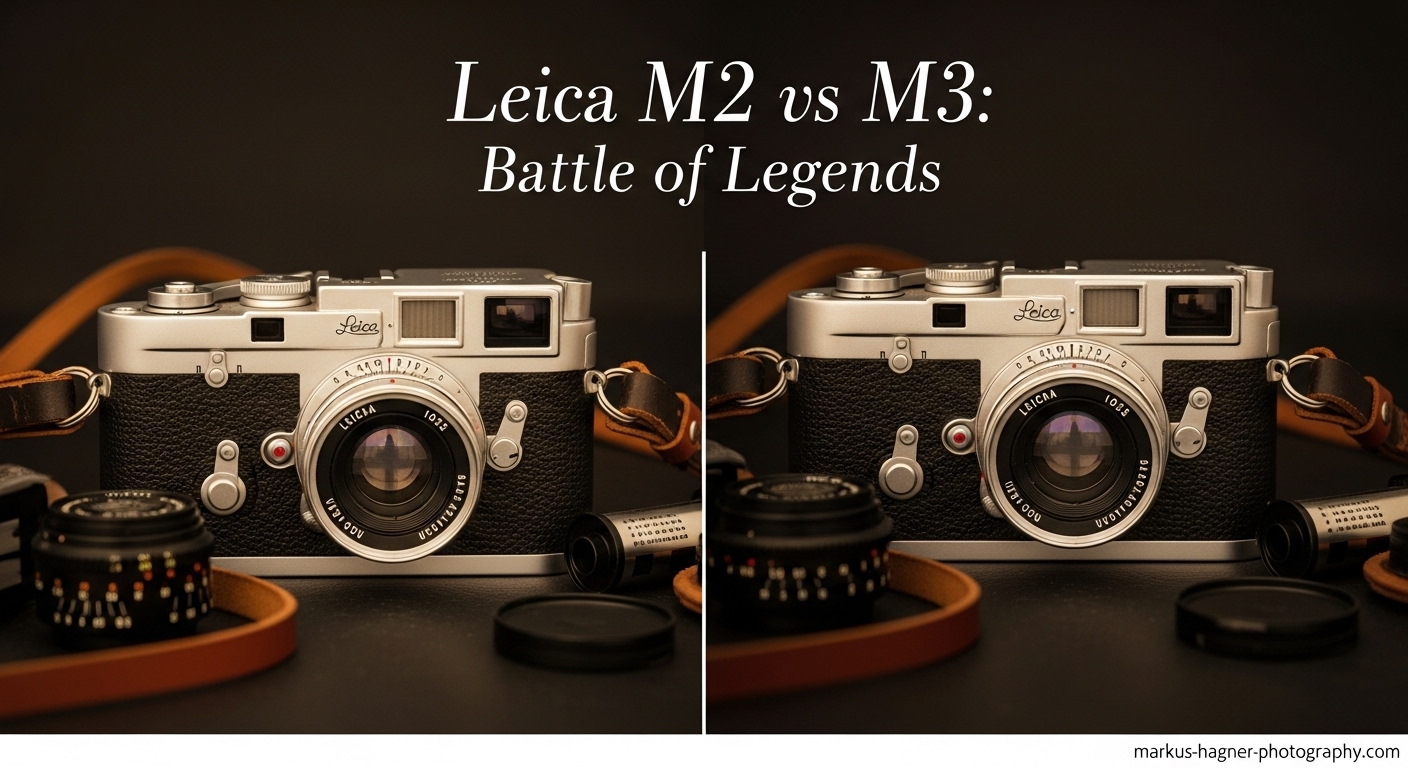
If you’re a film photography enthusiast like me, you’ve probably found yourself drawn to the legendary Leica M system at some point. Among the most debated choices in the Leica world is the decision between the M2 and M3 models. These two cameras represent different philosophies in rangefinder design, each with its own devoted following. After spending countless hours with both cameras, I’m here to share my insights on the Leica M2 vs M3 debate and help you make an informed decision.
A Brief History of the Leica M System
Before diving into the specifics of each model, it’s worth understanding how these cameras fit into Leica’s history. The M system revolutionized photography when it was introduced, and both the M3 and M2 played crucial roles in establishing Leica’s reputation for excellence.
The Leica M3, introduced in 1954, was the first of the M-series cameras. It set new standards for rangefinder cameras with its innovative design and exceptional build quality. The M3 was such a significant leap forward that many photographers still consider it the pinnacle of Leica’s mechanical engineering.
Three years later, in 1957, Leica introduced the M2 as a more affordable alternative to the M3. While it retained many of the M3’s core features, the M2 was simplified in certain aspects to reduce production costs. This made the camera more accessible to a broader range of photographers.
Leica M3: The Pioneer
The Leica M3 is often described as the camera that changed everything. When I first held an M3, I immediately understood why it has such a legendary status among photographers.
Key Features of the Leica M3
- Viewfinder Magnification: 0.92x, one of the highest in any Leica M camera
- Framelines: 50mm, 90mm, and 135mm (activated by different lenses)
- Film Advance: Single-stroke rapid wind lever
- Shutter Speeds: 1 second to 1/1000 second
- Self-Timer: Built-in mechanical self-timer
- Rewind Crank: Foldable rewind crank
- Loading System: Bottom-loading design with removable baseplate
Build Quality and Design
The M3 is built like a tank. I’ve handled cameras from the 1950s that still feel as tight and precise as when they left the factory. The M3 features a combination of brass and steel components with chrome or black paint finish. The weight distribution is perfect, making it feel substantial yet balanced in hand.
One of the first things I noticed about the M3 is its larger size compared to later M models. Some photographers find this cumbersome, but I appreciate the heft as it provides excellent stability when shooting handheld.
The Viewfinder System
The M3’s viewfinder is its standout feature. With 0.92x magnification, it’s the brightest and largest viewfinder ever fitted to a Leica M camera. This makes focusing incredibly precise, especially with longer lenses.
However, the M3 lacks 35mm framelines, which can be a dealbreaker for wide-angle enthusiasts. When I first started using the M3, I found this limitation frustrating as I often shoot with 35mm lenses. The solution is to use an external viewfinder, but this means you lose the convenience of the built-in rangefinder.
Ergonomics and Handling
The M3 features a unique film advance mechanism that’s smooth and satisfying to use. The single-stroke lever advances the film and cocks the shutter in one motion. I’ve found that this allows for faster shooting compared to double-stroke systems.
The rewind crank is another thoughtful design element. It folds out from the baseplate, making film rewinding quicker and more comfortable than the knob-style rewind found on earlier Leica models.
Leica M2: The Simplified Alternative
While the M3 was designed without compromise, the M2 was created as a more economical option. Don’t let that fool you, though – the M2 is still a exceptional camera with its own set of advantages.
Key Features of the Leica M2
- Viewfinder Magnification: 0.72x, more versatile for different focal lengths
- Framelines: 35mm, 50mm, and 90mm (activated by different lenses)
- Film Advance: Single-stroke rapid wind lever
- Shutter Speeds: 1 second to 1/1000 second
- Self-Timer: Optional (not built-in)
- Rewind Knob: Knob-style rewind (similar to earlier Leica models)
- Loading System: Bottom-loading design with removable baseplate
Build Quality and Design
The M2 shares much of the M3’s DNA in terms of build quality. While some cost-cutting measures were implemented, they don’t significantly impact the camera’s durability or performance. The M2 still features the same robust brass and steel construction that Leica is famous for.
I’ve found that the M2 is slightly smaller and lighter than the M3, making it more comfortable for all-day shooting. This might seem like a minor difference, but when you’re carrying a camera for hours, every ounce counts.
The Viewfinder System
The M2’s viewfinder has 0.72x magnification, which became the standard for most subsequent M models. This lower magnification makes it easier to use with wider lenses, particularly the 35mm focal length that’s so popular among street photographers.
When I switched from the M3 to the M2, I immediately appreciated the inclusion of 35mm framelines. This single feature made the M2 more versatile for my style of photography. The viewfinder is still bright and clear, though not quite as magnificent as the M3’s.
Ergonomics and Handling
The M2 retains the excellent single-stroke film advance lever from the M3, providing the same smooth operation. The main difference in handling comes from the rewind knob, which is less convenient than the M3’s crank. It’s a minor inconvenience, but noticeable when you’re rewinding multiple rolls in a session.
Head-to-Head Comparison
Now that we’ve looked at each camera individually, let’s compare them directly across several important factors.
Viewfinder Differences
This is perhaps the most significant difference between the two cameras and often the deciding factor for photographers.
Leica M3:
- 0.92x magnification viewfinder
- Framelines for 50mm, 90mm, and 135mm
- No 35mm framelines
- Brightest viewfinder in the M series
- Ideal for 50mm and longer lenses
Leica M2:
- 0.72x magnification viewfinder
- Framelines for 35mm, 50mm, and 90mm
- No 135mm framelines
- Standard magnification for most M cameras
- More versatile for different focal lengths
I discovered that my preference depends entirely on the type of photography I’m doing. For portrait work with a 90mm lens, the M3’s viewfinder is unparalleled. For street photography with a 35mm lens, the M2 is far more convenient.
Build and Handling
Both cameras are exceptionally well-built, but there are subtle differences:
Leica M3:
- Slightly larger and heavier
- More complex construction
- Built-in self-timer
- Folding rewind crank
- Generally considered more robust
Leica M2:
- Slightly smaller and lighter
- Simplified construction
- No built-in self-timer
- Knob-style rewind
- Still extremely durable
In my experience, both cameras can withstand decades of use with proper care. I’ve owned examples of both that were over 60 years old and still functioned perfectly.
Practical Use in Modern Photography
Using these vintage cameras in today’s photography world presents some interesting considerations:
Leica M3:
- Excellent for portrait and telephoto work
- Less suitable for wide-angle photography
- Requires external viewfinder for 35mm shooting
- Generally more expensive to acquire
- Higher resale value
Leica M2:
- More versatile for different focal lengths
- Better suited for street and documentary photography
- No need for external viewfinders for common focal lengths
- Generally more affordable
- Strong but slightly lower resale value
I’ve used both cameras extensively for various types of photography, and I’ve found that the M2 tends to be more versatile for my everyday shooting. However, when I know I’ll be working primarily with 50mm or longer lenses, I always reach for the M3.
Value and Investment Potential
Leica cameras are known for holding their value well, and both the M2 and M3 are excellent investments:
Leica M3:
- Generally more expensive, especially in good condition
- Double-stroke versions are more affordable than single-stroke
- Black paint models command premium prices
- Excellent long-term investment potential
Leica M2:
- More affordable initial investment
- Generally better value for money
- Still appreciates in value over time
- More accessible for photographers on a budget
When I bought my first M3, I paid significantly more than I did for my M2. However, both cameras have appreciated in value since I purchased them, making them not just photographic tools but also sound investments.
Personal Experience with Both Cameras
I’ve been shooting with Leica cameras for over a decade, and both the M2 and M3 have spent considerable time in my camera bag. Here are some of my personal observations:
The M3 was my first serious Leica purchase. I remember the moment I first looked through its viewfinder – it was like seeing the world in high definition for the first time. The precision of the rangefinder patch made focusing effortless, even in low light. I used the M3 primarily for portrait work, where its 50mm and 90mm framelines were perfect.
However, I soon found myself wanting to shoot wider, particularly for street photography. That’s when I added an M2 to my collection. The transition was seamless – the controls and handling were nearly identical, but now I had those crucial 35mm framelines. I discovered that the M2 quickly became my go-to camera for everyday shooting.
One thing I’ve noticed is that the M3 seems to inspire a more deliberate approach to photography. Perhaps it’s the viewfinder or the camera’s heft, but I find myself slowing down and being more intentional with each frame. The M2, by contrast, feels more nimble and encourages a quicker shooting style.
Also Read: Leica D-Lux 7 vs Fujifilm X100V
Which One Should You Choose?
The choice between the M2 and M3 ultimately comes down to your personal shooting style and preferences. Here are my recommendations for different types of photographers:
For Portrait Photographers
If you primarily shoot portraits with 50mm, 90mm, or 135mm lenses, the M3 is hard to beat. The high-magnification viewfinder makes focusing incredibly precise, which is crucial when working with shallow depth of field. I’ve found that the M3’s viewfinder allows me to focus more accurately on my subject’s eyes, resulting in sharper portraits.
For Street Photographers
Street photographers will likely prefer the M2. The inclusion of 35mm framelines makes it much more practical for this genre, as 35mm is a classic focal length for street work. The slightly smaller size and lighter weight of the M2 also make it less conspicuous and more comfortable to carry for long periods.
For Landscape Photographers
Landscape photographers might find either camera suitable, depending on their preferred focal lengths. If you tend to shoot with normal or longer lenses, the M3’s viewfinder will be appreciated. If you prefer wider perspectives, the M2 is the better choice. Personally, I’ve used both for landscape work and found that the M2’s versatility with wider lenses gives it a slight edge.
For Collectors
If you’re primarily a collector, the M3 generally has more historical significance and higher investment potential. Early serial numbers, particularly double-stroke models, are especially sought after. However, a pristine M2 can also be a valuable addition to any collection.
Sample Images from Both Cameras
While I can’t show actual images in this article, I can describe the characteristics I’ve observed from shooting with both cameras:
Images from the M3 tend to have a certain quality that’s hard to quantify. Perhaps it’s the more deliberate shooting process the camera encourages, but I find my M3 images often have a timeless quality to them. The precise focusing possible with the M3’s viewfinder results in exceptionally sharp images when technique is good.
The M2, being more versatile with wider lenses, produces images with a different character. My street photography from the M2 has a more immediate, candid feel that I attribute to the camera’s faster handling and the wider perspective of 35mm lenses.
Maintenance and Longevity
Both the M2 and M3 are mechanical marvels built to last, but they do require maintenance to keep them in optimal condition:
Common Maintenance Needs:
- Shutter curtain replacement (especially on older models)
- Rangefinder adjustment and calibration
- Viewfinder cleaning
- Light seal replacement
- General lubrication and adjustment
I’ve found that both cameras require similar maintenance, though the M3’s more complex mechanism might need slightly more attention over time. Regardless of which model you choose, budget for a CLA (Clean, Lubricate, Adjust) service if you’re buying a used example.
Pro Tips for Using These Classic Cameras
After years of shooting with both the M2 and M3, I’ve learned some valuable lessons:
- Master the Focus: The precision of Leica’s rangefinder is one of its greatest strengths. Take time to practice focusing quickly and accurately.
- Carry a Light Meter: Neither camera has a built-in light meter. I use a small handheld meter or the meter app on my phone.
- Load Film Carefully: Both cameras use a bottom-loading system that can be tricky at first. Practice loading in daylight before attempting it in the field.
- Use a Quality Strap: These cameras are valuable and heavy. A good strap is essential for security and comfort.
- Keep it Clean: Regularly clean the viewfinder and rangefinder windows. Dust and dirt can affect the accuracy of the rangefinder.
- Shooting with 35mm on M3: If you use a 35mm lens on the M3, invest in a quality external viewfinder. I’ve found that the Voigtländer 35mm viewfinder works well.
- Film Choice: Both cameras perform beautifully with modern films. I’ve had excellent results with Kodak Portra for color and Ilford HP5 for black and white.
Also Read: Canon 5D vs Canon 6D
FAQ
Which camera is better for beginners?
If you’re new to Leica cameras, I’d recommend starting with the M2. It’s generally more affordable, and the 0.72x viewfinder with 35mm framelines is more versatile for different types of photography. The M2 is also slightly simpler in operation, which can be helpful when you’re learning the system.
Can I use modern lenses on these cameras?
Yes, both the M2 and M3 are compatible with modern Leica M-mount lenses. However, you’ll need to be mindful of which framelines are activated. Some modern lenses might not bring up the correct framelines on these older cameras.
How do I know if a used example is in good condition?
When buying a used M2 or M3, check for the following:
- Smooth film advance and shutter operation
- Accurate rangefinder (test at different distances)
- Clean, bright viewfinder without haze or fungus
- Intact shutter curtains (no pinholes or wrinkles)
- Minimal brassing or dents
- Working slow shutter speeds (1 second and below)
If possible, have a knowledgeable Leica technician inspect the camera before purchase.
Which camera holds its value better?
Historically, the M3 has appreciated more than the M2, particularly rare examples like early double-stroke models or black paint versions. However, both cameras have shown strong value retention over the years, making them sound investments.
Are there any common problems to watch out for?
Both cameras can suffer from similar issues as they age:
- Vulcanite covering deterioration (can be replaced)
- Shutter curtain failure
- Rangefinder misalignment
- Sticky shutter speeds at low settings
- Viewfinder haze or dust
These issues can usually be resolved by a competent Leica technician, but repair costs should be factored into your purchase decision.
Conclusion
The Leica M2 vs M3 debate has raged among photographers for decades, and for good reason – both are exceptional cameras with their own strengths and weaknesses. After extensive use of both models, I’ve come to appreciate each for what it offers.
The M3 is a precision instrument unmatched for its viewfinder quality and build. It’s the camera I reach for when I want to slow down and create deliberate, carefully composed images, particularly with 50mm or longer lenses.
The M2, while slightly simplified, offers greater versatility with its inclusion of 35mm framelines and more compact size. It’s become my everyday camera, perfect for street photography and documentary work where spontaneity is key.
Ultimately, the choice between these two legends comes down to your personal shooting style and preferences. Both cameras are capable of producing stunning images and will provide a lifetime of photographic enjoyment. Whichever you choose, you’ll be joining a rich tradition of photographers who have captured some of the world’s most memorable images with these remarkable tools.
I hope this comparison has helped you in your decision-making process. If you have any questions or experiences with these cameras that you’d like to share, please leave a comment below. And don’t forget to bookmark this page for future reference as you continue your film photography journey!
Looking for more classic camera comparisons? Check out my articles on Leica M4 vs M6 and Canon vs Nikon Rangefinders for more insights into vintage photography equipment.
Want to stay updated on the latest film photography tips and reviews? Subscribe to my newsletter for monthly updates delivered straight to your inbox!