
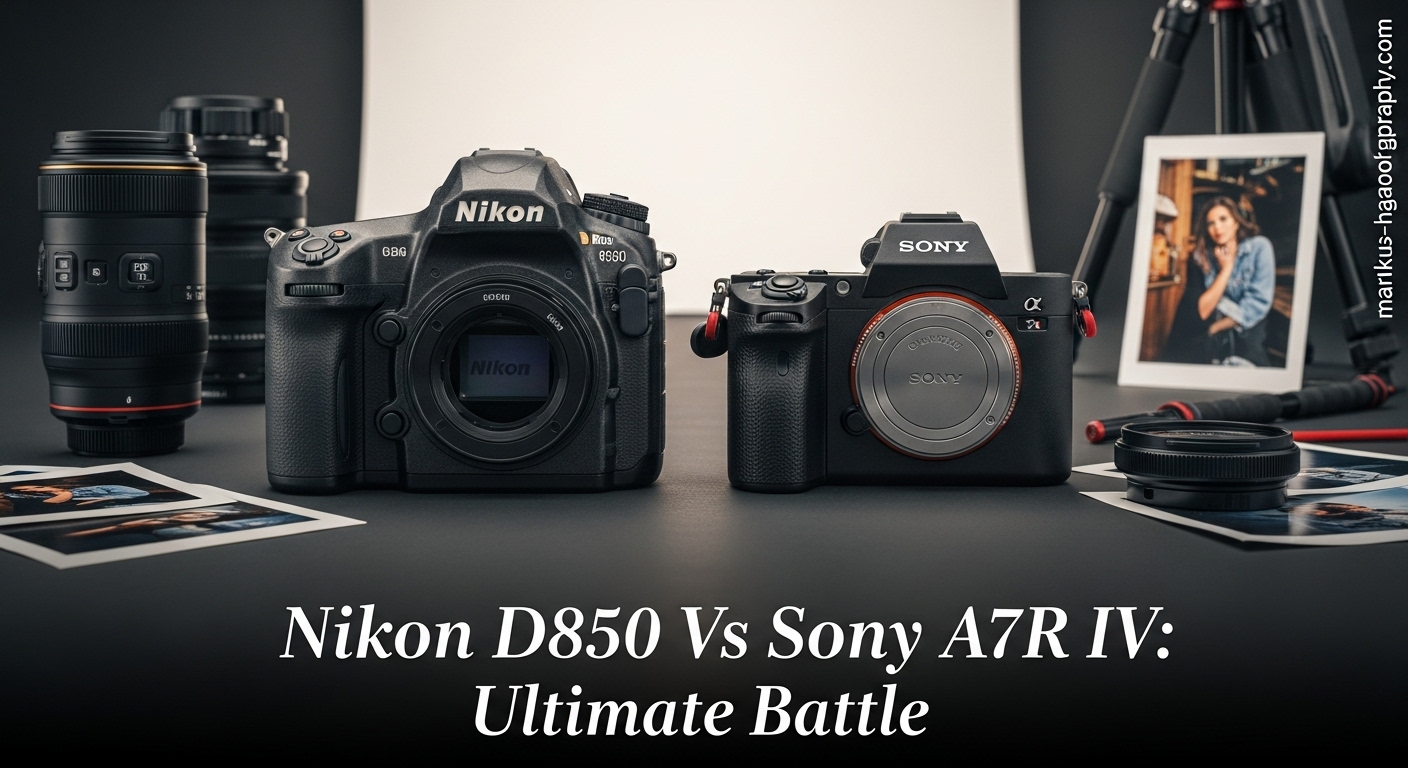
When it comes to high-resolution full-frame cameras, two models consistently dominate the conversation: the Nikon D850 and the Sony A7R IV. I’ve spent countless hours with both cameras, pushing them to their limits in various shooting conditions, and I’m here to share everything you need to know about these photography powerhouses. The Nikon D850, released in 2017, represents the pinnacle of DSLR technology, while the Sony A7R IV, launched in 2019, showcases the cutting edge of mirrorless innovation. Both cameras boast impressive specifications, but they cater to different shooting styles and preferences. In this comprehensive comparison, I’ll break down their differences, strengths, and weaknesses to help you make an informed decision about which camera deserves a place in your gear bag.
Quick Overview Comparison Table
| Feature | Nikon D850 | Sony A7R IV |
|---|---|---|
| Sensor Type | 45.7MP Full-Frame BSI CMOS | 61MP Full-Frame BSI CMOS |
| Camera Type | DSLR | Mirrorless |
| ISO Range | 64-25,600 (expandable) | 100-32,000 (expandable) |
| Continuous Shooting | 7 fps (9 fps with grip) | 10 fps |
| Autofocus System | 153-point AF, 99 cross-type | 567-point phase-detection AF |
| Viewfinder | Optical, 0.75x magnification | Electronic, 5.76M-dot OLED |
| LCD Screen | 3.2″ tilting touchscreen | 3.0″ tilting touchscreen |
| Video Capabilities | 4K UHD at 30p | 4K at 30p with full pixel readout |
| Battery Life | Approx. 1840 shots | Approx. 530 shots |
| Card Slots | XQD + SD | Dual SD UHS-II |
| Weather Sealing | Yes | Yes |
| Release Year | 2017 | 2019 |
| Body Weight | 1005g | 665g |
Detailed Sensor and Image Quality Comparison
The heart of any camera is its sensor, and both the D850 and A7R IV excel in this department, though with different approaches. The Nikon D850 features a 45.7-megapixel full-frame BSI CMOS sensor without an optical low-pass filter, which allows it to capture incredible detail and sharpness. I’ve found that the D850’s images have a certain “organic” quality that’s hard to describe but immediately recognizable.
On the other hand, the Sony A7R IV takes resolution to another level with its staggering 61-megapixel full-frame BSI CMOS sensor, also without an optical low-pass filter. When I first tested the A7R IV, I was blown away by the level of detail it could capture. The additional megapixels give you more cropping flexibility and larger print capabilities, which can be a game-changer for certain types of photography.
In terms of dynamic range, both cameras perform exceptionally well. The D850 has a slight edge at base ISO (64), which gives it about a third of a stop more highlight headroom. This makes it particularly impressive for landscape photography where preserving highlights is crucial. I’ve recovered what seemed like completely blown-out skies in post-processing with the D850 files, and the results were nothing short of remarkable.
The A7R IV, while starting at a higher base ISO of 100, still offers excellent dynamic range that’s only marginally behind the D850. Where the Sony pulls ahead is in its pixel-shift multi-shooting mode, which can produce images with up to 240 megapixels of resolution by combining multiple shots. I’ve used this feature for product photography and architectural work, and the results are astonishingly detailed.
Low-light performance is another area where these cameras differ. The D850’s lower base ISO gives it cleaner shadows at lower ISOs, while the A7R IV holds its own up to about ISO 1600. Beyond that, the D850 maintains slightly cleaner images, though the difference isn’t dramatic unless you’re pixel-peeping.
Autofocus Performance
Autofocus is where we see one of the most significant differences between these two cameras, largely due to their different technologies. The Nikon D850 uses a sophisticated 153-point autofocus system with 99 cross-type sensors. In my experience, this system is incredibly reliable, especially for tracking moving subjects. I’ve photographed everything from fast-paced sports to wildlife with the D850, and its autofocus rarely misses.
The Sony A7R IV employs a hybrid autofocus system with 567 phase-detection points and 425 contrast-detection points covering approximately 74% of the frame. What sets the Sony apart is its Real-time Eye AF for both humans and animals. I’ve found this feature to be nothing short of revolutionary for portrait photography. The camera locks onto the subject’s eye and maintains focus with uncanny accuracy, even when the subject is moving.
In low-light conditions, the D850’s dedicated AF sensor has a slight advantage, focusing reliably in dimmer conditions where the A7R IV might struggle slightly. However, the Sony’s low-light performance is still impressive and has improved significantly with firmware updates.
For video autofocus, the Sony is the clear winner. Its smooth, silent autofocus transitions and reliable subject tracking make it a much better choice for videographers who need to pull focus during recording. The D850, while capable, can’t match the Sony’s video AF performance.
Design and Ergonomics
The design and ergonomics of these cameras reflect their different technologies and target users. The Nikon D850 is a traditional DSLR with a substantial grip and deep body that feels incredibly solid in hand. I’ve used it for extended photoshoots, and its comfortable grip and well-placed controls reduce fatigue significantly. The optical viewfinder provides a natural, lag-free view of the scene, which many photographers, myself included, still prefer.
The Sony A7R IV, being a mirrorless camera, is significantly smaller and lighter. While this makes it more portable, I find that its grip isn’t as comfortable for extended shooting sessions, especially with larger lenses. That said, the electronic viewfinder is excellent, with high resolution and minimal lag. The ability to see exposure preview and other information in the viewfinder is a feature I’ve grown to appreciate.
Both cameras feature weather-sealed bodies that can withstand challenging shooting conditions. I’ve used both in light rain and dusty environments without any issues. The D850 feels slightly more robust, which might be important for photographers working in extreme conditions.
Control layout is another area where these cameras differ. The D850 has a more traditional DSLR layout with numerous physical buttons and dials, which I find intuitive and efficient. The Sony relies more on its touchscreen and menu system, which can be customized but may require more menu diving for certain functions.
Video Capabilities
While both cameras are primarily designed for still photography, they offer respectable video capabilities. The Nikon D850 can record 4K UHD video at up to 30p using the full width of its sensor, with no pixel binning. This results in sharp, detailed footage with minimal moiré and aliasing. I’ve used the D850 for documentary work, and the video quality is impressive, though the lack of in-body image stabilization can be limiting for handheld shooting.
The Sony A7R IV takes video capabilities a step further. It can record 4K video at 30p with full pixel readout and no pixel binning, resulting in exceptionally detailed footage. The camera also offers S-Log2 and S-Log3 gamma profiles for increased dynamic range in post-production. Combined with its excellent autofocus and in-body image stabilization, the A7R IV is a much more capable video camera.
One area where the Sony clearly outperforms the Nikon is in autofocus during video recording. The D850’s contrast-detect AF during video is slow and hunts, while the Sony’s hybrid system is smooth, fast, and reliable. For videographers who need to pull focus during recording, this difference alone might be worth choosing the Sony.
Battery Life
Battery life is one area where DSLRs still have a significant advantage over mirrorless cameras. The Nikon D850 uses the EN-EL15a battery, which is rated for approximately 1840 shots per charge. In my experience, I can easily shoot all day with the D850 on a single battery, even with extensive use of the rear LCD.
The Sony A7R IV uses the NP-FZ100 battery, which is rated for about 530 shots per charge. While this is an improvement over previous Sony mirrorless cameras, it’s still significantly less than the D850. During a full day of shooting with the A7R IV, I typically need to carry at least two spare batteries, especially if I’m using the electronic viewfinder extensively.
It’s worth noting that battery life can vary significantly based on shooting conditions and settings. Using the electronic viewfinder, continuous autofocus, and image stabilization will drain the battery faster on both cameras.
Lens Ecosystem
The lens ecosystem is a crucial consideration when choosing between these two cameras, as you’re not just buying a camera but investing in a system. Nikon’s F-mount system has been around for decades and offers an extensive range of lenses, from affordable third-party options to professional-grade Nikkor lenses. I’ve built up a collection of Nikon lenses over the years, and the compatibility with older lenses is a significant advantage.
However, it’s important to note that Nikon has transitioned to the Z-mount system for its mirrorless cameras. While the D850 is compatible with F-mount lenses, future Nikon lenses will likely focus on the Z-mount. This doesn’t diminish the current value of the F-mount system, but it’s something to consider for long-term investment.
Sony’s E-mount system is newer but has grown rapidly, with a wide range of native lenses available from Sony and third-party manufacturers. The ability to adapt lenses from other systems is also a significant advantage. I’ve used Canon EF lenses on the A7R IV with an adapter, and the performance is excellent.
For photographers who value compactness, the Sony system has an edge, as mirrorless lenses can be designed smaller than their DSLR counterparts. However, for specialized applications like super-telephoto lenses, both systems offer comparable options.
Also Read: Canon 18-55 STM Vs 18-55 IS II
Price and Value
As of 2026, the Nikon D850 typically retails for around $2,999 for the body only, while the Sony A7R IV is priced higher at approximately $3,499. This price difference reflects the newer technology and higher resolution of the Sony camera.
When considering value, it’s important to look beyond the initial purchase price. The D850, being an older model, offers incredible value for money, with performance that still rivals newer cameras. Its robust build quality and excellent battery life make it a reliable workhorse that can last for years.
The A7R IV, while more expensive, offers cutting-edge technology and features that might justify the additional cost for certain photographers. Its higher resolution, advanced autofocus, and video capabilities make it a more versatile camera for those who need these features.
It’s also worth considering the total cost of ownership, including lenses, accessories, and potential future upgrades. Both systems represent significant investments, and the right choice depends on your specific needs and budget.
Who Should Buy Which Camera?
After extensive use of both cameras, I’ve developed a clear understanding of which photographer might prefer each model.
The Nikon D850 is ideal for:
- Landscape photographers who value dynamic range and resolution
- Studio photographers who need reliable autofocus and color accuracy
- Sports and wildlife photographers who need fast autofocus and long battery life
- Photographers who prefer the optical viewfinder experience
- Those who already own Nikon F-mount lenses
- Budget-conscious photographers who want maximum value
The Sony A7R IV is better suited for:
- Portrait photographers who will benefit from the incredible resolution and eye AF
- Commercial photographers who need the highest possible resolution
- Hybrid shooters who need both high-quality stills and video
- Travel photographers who prioritize portability
- Those who want the latest technology and features
- Videographers who need advanced video capabilities
My Personal Experience and Verdict
Having spent significant time with both cameras, I can say that each has its strengths and weaknesses. The Nikon D850 feels like a refined tool that’s been perfected over years of development. Its image quality is exceptional, the autofocus is reliable, and the battery life is outstanding. I’ve taken it on numerous landscape photography trips, and it has never let me down.
The Sony A7R IV, on the other hand, represents the cutting edge of camera technology. The resolution is mind-boggling, the autofocus is revolutionary, and the video capabilities are impressive. I’ve used it for portrait sessions where the eye AF made my job significantly easier, and for commercial work where the extra resolution was invaluable.
If I had to choose just one camera for all-around use, I would lean toward the Nikon D850. Its combination of image quality, reliability, and battery life makes it a more versatile tool for my style of photography. However, if my work focused more on portraits or video, the Sony A7R IV would be my choice.
Ultimately, both cameras are exceptional tools that can produce stunning images in the right hands. The best choice depends on your specific needs, shooting style, and budget.
Also Read: 5D Mark III vs 80D
FAQ
Which camera has better image quality, the Nikon D850 or Sony A7R IV?
Both cameras produce excellent image quality, but in different ways. The Sony A7R IV has a higher resolution at 61MP compared to the D850’s 45.7MP, giving it more detail and cropping flexibility. However, the D850 has a slight edge in dynamic range at base ISO and produces files with a more “organic” look that many photographers prefer.
Is the Sony A7R IV better for video than the Nikon D850?
Yes, the Sony A7R IV is significantly better for video. It offers more advanced video features, including S-Log profiles, better autofocus during video recording, and in-body image stabilization. The D850 can record 4K video, but it lacks many of the advanced features that make the A7R IV a more capable video camera.
Which camera is better for low-light photography?
The Nikon D850 has a slight advantage in low-light photography due to its lower base ISO of 64 compared to the Sony’s ISO 100. This gives the D850 about a third of a stop more dynamic range at base ISO. However, both cameras perform exceptionally well in low-light conditions, and the difference is only noticeable when pixel-peeping or making large prints.
Can I use my existing Nikon lenses on the Sony A7R IV?
Yes, you can use Nikon F-mount lenses on the Sony A7R IV with the use of an adapter. However, autofocus performance may vary depending on the lens and adapter combination. Native Sony E-mount lenses will provide the best performance and compatibility.
Which camera has better battery life?
The Nikon D850 has significantly better battery life, rated for approximately 1840 shots per charge compared to the Sony A7R IV’s 530 shots. This is one of the advantages of DSLR technology, as the optical viewfinder consumes less power than an electronic viewfinder.
Is the Sony A7R IV worth the extra cost over the Nikon D850?
Whether the Sony A7R IV is worth the extra cost depends on your specific needs. If you require the highest possible resolution, advanced autofocus features like eye AF, or better video capabilities, then the A7R IV might be worth the investment. However, if you primarily shoot stills and value battery life and a more traditional shooting experience, the D850 offers excellent value for money.
Which camera is better for wildlife photography?
For wildlife photography, the Nikon D850 has several advantages, including better battery life for extended shooting sessions, a more comfortable grip for use with large telephoto lenses, and an optical viewfinder that provides a lag-free view of fast-moving subjects. However, the Sony A7R IV’s higher resolution and advanced autofocus could be beneficial for certain wildlife photography situations.
Pro Tips for Both Cameras
Nikon D850 Pro Tips:
- Use the electronic front-curtain shutter to reduce vibration when shooting on a tripod.
- Take advantage of the D850’s focus stacking feature for macro photography.
- Shoot in 14-bit lossless compressed RAW to get the most out of the dynamic range.
- Use the illuminated buttons for easy operation in dark conditions.
- Consider adding the battery grip for improved ergonomics and faster continuous shooting.
Sony A7R IV Pro Tips:
- Use the Real-time Eye AF for portrait photography to ensure sharp focus on the subject’s eyes.
- Take advantage of the silent shooting mode for situations where noise is a concern.
- Use the pixel-shift multi-shooting mode for maximum resolution in static subjects.
- Customize the function buttons to access frequently used settings quickly.
- Consider adding a battery grip for improved ergonomics and extended battery life.
Conclusion
The Nikon D850 and Sony A7R IV represent two different approaches to high-resolution photography, each with its own strengths and weaknesses. The D850 is a refined DSLR that offers exceptional image quality, reliable performance, and outstanding battery life. The A7R IV is a cutting-edge mirrorless camera that pushes the boundaries of resolution and autofocus technology.
Ultimately, the right choice depends on your specific needs, shooting style, and budget. Both cameras are capable of producing stunning images in the right hands, and you can’t go wrong with either option. I recommend handling both cameras if possible, as the ergonomics and user experience can be deciding factors.
Whatever you choose, remember that the camera is just a tool. The most important factor in creating great images is the photographer behind the lens. Both the D850 and A7R IV provide more than enough capability for most photographic applications, so focus on developing your skills and vision, and let the camera be an extension of your creativity.
I hope this comparison has been helpful in your decision-making process. If you have any questions or experiences with these cameras that you’d like to share, please leave a comment below. And don’t forget to bookmark this page for future reference, as I’ll be updating it as new firmware and accessories become available.
Happy shooting!