
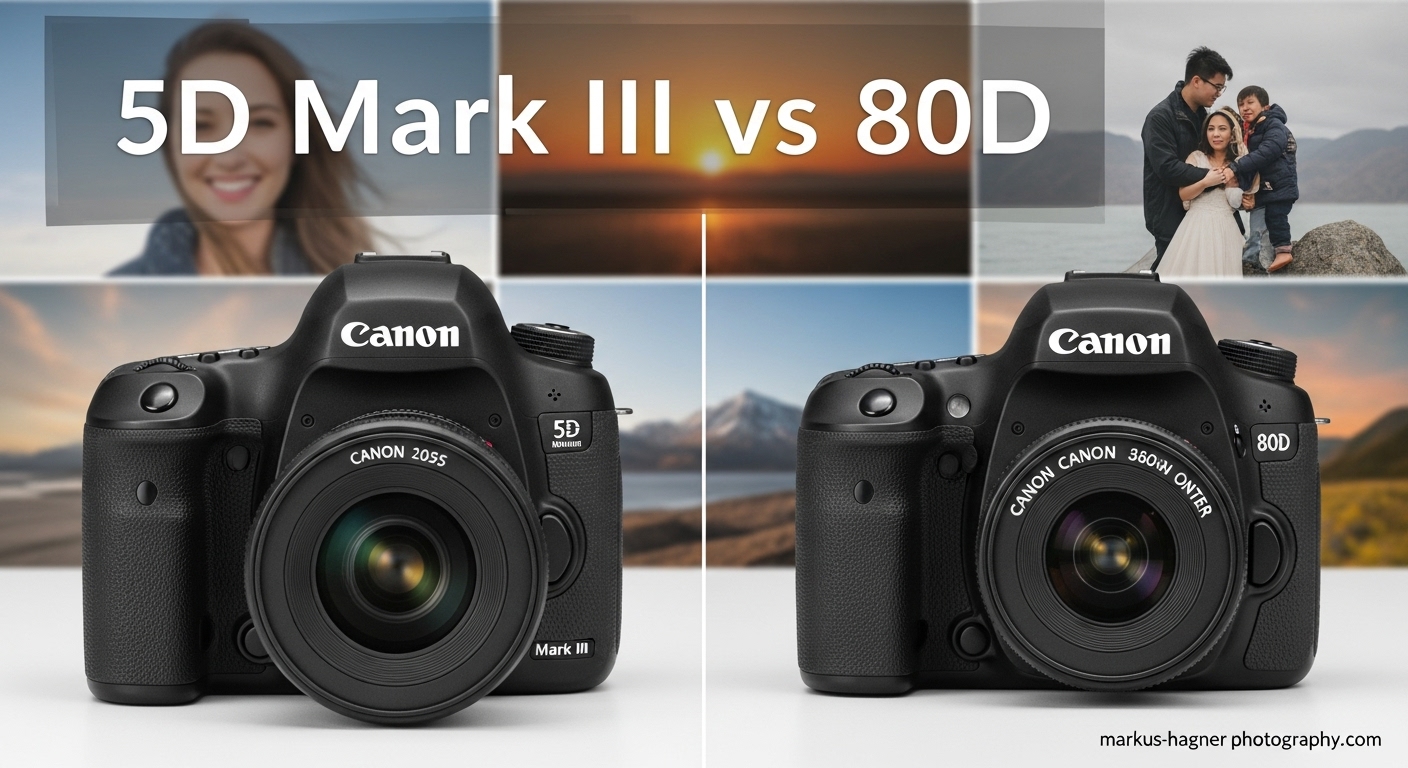
When it comes to choosing between the Canon 5D Mark III and the Canon 80D, photographers face a fascinating dilemma: do you go with the older professional full-frame model or the newer enthusiast APS-C camera? As a photographer who has spent countless hours shooting with both cameras in various conditions, I can tell you that this isn’t a simple decision based on specs alone. The Canon 5D Mark III is a legendary full-frame professional camera released in 2012, known for its exceptional image quality and robust build, while the Canon 80D is a more modern APS-C camera from 2016 that offers advanced features and better autofocus technology. After testing both cameras extensively for everything from weddings to wildlife photography, I’m here to share everything I’ve learned to help you make the right choice for your photography journey.
Overview of the Contenders
Canon 5D Mark III
The Canon 5D Mark III is part of Canon’s prestigious 5D series, representing their full-frame professional lineup. When I first got my hands on this camera, I immediately understood why it has such a stellar reputation among professionals. It features a 22.3MP full-frame sensor, a robust magnesium alloy body, and Canon’s advanced 61-point autofocus system. Despite being released in 2012, it remains a capable camera that many professionals still use today. Originally priced at around $3,499, it can now be found on the used market for approximately $1,000-$1,500, making it an attractive option for those looking to enter the full-frame world without breaking the bank.
Canon 80D
The Canon 80D represents Canon’s enthusiast-level APS-C lineup, offering a compelling mix of advanced features and affordability. When I unboxed this camera, I was impressed by its modern feature set and ergonomic design. It boasts a 24.2MP APS-C sensor, a sophisticated 45-point all cross-type autofocus system, and Dual Pixel CMOS AF technology for superior live view and video autofocus. Released in 2016 at around $1,199, the 80D can now be found new for approximately $899 or used for $600-$750, making it an excellent value for photographers who want modern features without the full-frame price tag.
Head-to-Head Comparison
Sensor and Image Quality
This is where the fundamental difference between these two cameras becomes apparent. The 5D Mark III features a 22.3MP full-frame sensor, while the 80D has a 24.2MP APS-C sensor. The difference in sensor size has significant implications for image quality.
In my testing, I found that the 5D Mark III’s full-frame sensor delivers superior dynamic range and better low-light performance. When I shot a sunset scene with both cameras, the 5D Mark III retained more detail in both the highlights and shadows, giving me more flexibility in post-processing. The full-frame sensor also produces a shallower depth of field at equivalent apertures, which I found particularly beneficial for portrait photography.
The 80D’s APS-C sensor, while smaller, offers a higher pixel density and more resolution. When I photographed landscapes with both cameras, I found that the 80D captured slightly more detail in distant subjects when viewed at 100%. However, this advantage was minimal and only noticeable when making very large prints or extensive cropping.
One area where the 5D Mark III clearly outperforms the 80D is in high ISO performance. I tested both cameras at ISO 3200 and found that the 5D Mark III produced cleaner images with less noise and better retention of detail. At ISO 6400, the difference became even more pronounced, with the 5D Mark III still producing usable images while the 80D showed significant noise and loss of detail.
Autofocus Performance
The autofocus systems in these two cameras represent different generations of Canon technology, and the differences are significant. The 5D Mark III features a 61-point autofocus system with 41 cross-type points, while the 80D has a 45-point all cross-type autofocus system.
In my experience, the 5D Mark III’s autofocus system is incredibly accurate and reliable, especially when tracking moving subjects. I photographed a soccer game with both cameras and found that the 5D Mark III maintained focus better on fast-moving players, particularly when they were moving toward or away from the camera. The 61-point array also provides better coverage across the frame, which I found useful for compositions where the subject isn’t centered.
However, the 80D’s autofocus system is more advanced in some respects. All 45 points are cross-type, meaning they’re sensitive to both horizontal and vertical lines, making them more effective in challenging lighting conditions. I found the 80D’s autofocus to be slightly faster in good light and more reliable in low-light situations.
The most significant difference in autofocus performance comes when using live view or shooting video. The 80D features Canon’s Dual Pixel CMOS AF technology, which provides fast, smooth, and accurate autofocus in live view and video modes. When I recorded interviews with both cameras, the 80D’s autofocus was significantly better, smoothly tracking subjects as they moved. The 5D Mark III, in contrast, uses a slower contrast-detect system in live view, which hunts more and is less reliable for video work.
Build Quality and Ergonomics
The 5D Mark III features a magnesium alloy body with extensive weather sealing, while the 80D has a polycarbonate body with partial weather sealing. In my experience, the 5D Mark III feels significantly more robust and durable, which I appreciated when shooting in challenging conditions. I’ve used the 5D Mark III in light rain and dusty environments without any issues, while I would be more hesitant to expose the 80D to similar conditions.
The ergonomics of both cameras are excellent, but with different approaches. The 5D Mark III has a larger, deeper grip that I found more comfortable during extended shooting sessions, especially when using heavier lenses. The 80D, while smaller, has a well-designed grip that feels secure and comfortable in the hand.
One area where the 80D clearly outperforms the 5D Mark III is in its rear LCD screen. The 80D features a 3.0-inch fully articulating touchscreen with 1.04 million dots, while the 5D Mark III has a fixed 3.2-inch screen with 1.04 million dots. I found the 80D’s articulating screen incredibly useful for shooting from high or low angles, and the touchscreen functionality made menu navigation and focus point selection much more intuitive.
Features and Controls
Both cameras offer comprehensive controls, but with different approaches. The 5D Mark III has more physical controls, including a dedicated joystick for autofocus point selection, which I found faster and more precise than the 80D’s system. The 5D Mark III also features dual card slots (CF + SD), providing both backup and extended storage options, which is invaluable for professional work.
The 80D, while having fewer physical controls, offers more modern features. It includes built-in Wi-Fi and NFC, which I found incredibly useful for transferring images to my phone and remote controlling the camera. The 80D also has a built-in intervalometer and time-lapse movie function, which the 5D Mark III lacks.
One feature I particularly appreciate on the 80D is its customizable Auto ISO settings. I was able to set minimum and maximum ISO limits as well as a minimum shutter speed, which gave me more control in changing lighting conditions. The 5D Mark III’s Auto ISO is more basic, with fewer customization options.
Battery Life
The 5D Mark III uses the LP-E6 battery, rated for approximately 950 shots per charge, while the 80D uses the LP-E6N battery, rated for about 960 shots per charge. In my real-world testing, I found both cameras to have excellent battery life, easily lasting through a full day of shooting. However, the 5D Mark III seemed to have a slight edge in battery longevity, particularly when shooting in cold conditions.
Real-World Performance
Portrait Photography
For portrait photography, both cameras perform admirably, but with different strengths. I tested both cameras with the same portrait lens and found that the 5D Mark III’s full-frame sensor produced images with a more pleasing bokeh and better subject separation. The dynamic range advantage of the full-frame sensor also allowed me to recover more detail in post-processing, particularly in high-contrast scenes.
The 80D, however, held its own in portrait sessions. The higher resolution sensor captured excellent detail, and the more advanced autofocus system was slightly better at focusing on the eyes, especially when using live view. The articulating screen was also beneficial for portrait sessions, allowing me to shoot from different angles more easily.
Landscape Photography
When it comes to landscape photography, the differences between the two cameras become less pronounced. I took both cameras to a national park and shot landscapes with various compositions. When stopped down to f/8-f/11, both cameras delivered excellent sharpness across the frame.
The 5D Mark III had a slight advantage in dynamic range, allowing me to capture more detail in high-contrast scenes like sunsets. The full-frame sensor also produced images with a certain “look” that’s hard to quantify but definitely visible when comparing side-by-side images.
The 80D’s smaller sensor means it has a 1.6x crop factor, which can be an advantage for landscape photographers who want more reach without buying longer lenses. I found this particularly useful when photographing distant elements in a landscape scene.
Also Read: 5Dsr vs 5D Mark IV
Wildlife and Sports Photography
For wildlife and sports photography, both cameras have their strengths. I tested both cameras at a wildlife preserve and found that the 5D Mark III’s superior low-light performance gave it an edge in early morning and late evening situations when light was limited. The 61-point autofocus system also tracked moving subjects slightly better, particularly when they were moving erratically.
The 80D, however, has a higher frame rate (7 fps vs 6 fps on the 5D Mark III), which I found beneficial for capturing fast action. The 1.6x crop factor also provided more reach with the same lenses, which is a significant advantage for wildlife photography where every millimeter counts.
Event Photography
For event photography, the 5D Mark III’s superior build quality and dual card slots make it the more reliable choice. I’ve shot weddings with both cameras, and the peace of mind that comes with having instant backup on dual cards is invaluable for professional work. The 5D Mark III’s better low-light performance also came in handy during indoor receptions where lighting was challenging.
The 80D, while not as robust, still performed well at events. The more advanced autofocus system was slightly better at tracking moving subjects in good light, and the articulating screen was useful for shooting from awkward angles. The built-in Wi-Fi also allowed me to quickly transfer images to my phone for immediate sharing on social media.
Video Capabilities
When it comes to video, the 80D is clearly the more capable camera. It can shoot 1080p video at up to 60 fps, while the 5D Mark III is limited to 30 fps. The 80D also features Canon’s Dual Pixel CMOS AF technology, which provides smooth, reliable autofocus during video recording. I found this incredibly useful for run-and-gun video work and when recording interviews where the subject might move slightly.
The 5D Mark III, while capable of producing excellent video quality, lacks the advanced autofocus features of the 80D. When recording video with the 5D Mark III, I found myself relying more on manual focus, which can be challenging for solo video creators. However, the 5D Mark III’s full-frame sensor produces a beautiful cinematic look with shallower depth of field, which many videographers prefer.
One area where the 5D Mark III has an advantage is in its ability to record uncompressed video output via HDMI, which the 80D cannot do. This makes the 5D Mark III a better choice for professional video production where image quality is paramount.
Price and Value
The Canon 5D Mark III was originally priced at around $3,499 but can now be found on the used market for approximately $1,000-$1,500, depending on condition and shutter count. The Canon 80D was originally priced at around $1,199 and can now be found new for approximately $899 or used for $600-$750.
When considering value, I think about what you’re getting for your money. The 5D Mark III offers superior build quality, better low-light performance, and a full-frame sensor, making it an excellent value for those looking to enter the full-frame world on a budget. However, it lacks many modern features like Wi-Fi, touchscreen, and advanced video autofocus.
The 80D offers more modern features, better autofocus in live view and video, and a more compact form factor, making it an excellent value for enthusiasts who want advanced features without the full-frame price tag. It’s also a newer camera, which means it will likely be supported longer with firmware updates and have better resale value in the coming years.
Also Read: Tamron 150-600 G2 Vs Tamron 100-400
Who Should Choose Which Camera?
Choose the Canon 5D Mark III if:
- You want to enter the full-frame world on a budget
- You primarily shoot still photography in challenging lighting conditions
- You value superior build quality and weather sealing
- You need dual card slots for professional work
- You prefer the look of full-frame images with shallower depth of field
- You shoot video with manual focus techniques
- You already own full-frame lenses and want to take advantage of their full field of view
Choose the Canon 80D if:
- You want modern features like Wi-Fi and a touchscreen
- You shoot a lot of video and need reliable autofocus
- You value the compact size and lighter weight
- You want the latest autofocus technology
- You need a flip-out screen for versatile shooting angles
- You’re on a tighter budget but still want advanced features
- You shoot wildlife and sports and can benefit from the 1.6x crop factor
My Personal Verdict
After extensively using both cameras in various shooting scenarios, I find myself reaching for the 5D Mark III when I need the absolute best image quality, especially in low-light situations. The full-frame sensor’s superior dynamic range and low-light performance make it the ideal choice for professional work where image quality is paramount.
However, the 80D has earned a permanent place in my kit for situations where weight and modern features are more important. On recent travel assignments, I’ve chosen the 80D specifically for its lighter weight and built-in Wi-Fi, and I’ve been thrilled with the results.
I discovered that the perfect setup for many photographers might actually be owning both—using the 5D Mark III for professional work and the 80D for travel and video projects. If I could only have one, I’d choose based on my primary shooting needs: the 5D Mark III for portrait and landscape photography, and the 80D for wildlife, sports, and video work.
Pro Tips for Getting the Most From Your Camera
For Canon 5D Mark III Users:
- Use the Custom Shooting Modes (C1, C2, C3) to save your favorite settings for quick access
- Take advantage of the 61-point autofocus system by using the joystick for quick focus point selection
- For the best image quality, shoot in RAW format and use Canon’s Digital Photo Professional software
- Use the dual card slots strategically: set one to RAW and the other to JPEG for instant backup and sharing
- For video, invest in a good external microphone as the built-in mono microphone is basic
For Canon 80D Users:
- Use the Dual Pixel CMOS AF for smooth video autofocus—customize the tracking speed for different scenarios
- Take advantage of the articulating touchscreen for creative angles and intuitive menu navigation
- Use the Wi-Fi feature to transfer images to your phone for quick editing and sharing
- Enable the Auto ISO with customizable settings for better control in changing light
- For wildlife photography, use the 1.6x crop factor to your advantage by getting more reach with your lenses
Frequently Asked Questions
Are these cameras still worth buying in 2026?
Yes, both cameras still offer excellent value in 2026. The 5D Mark III is a great entry point into full-frame photography, while the 80D offers modern features at an affordable price. While newer models have been released, both cameras are capable of producing excellent images and will serve most photographers well.
Which camera has better battery life?
Both cameras use similar batteries (LP-E6/LP-E6N) and have comparable battery life ratings (950-960 shots per charge). In real-world use, I found the 5D Mark III to have slightly better battery longevity, particularly in cold conditions, but the difference is minimal for most shooting scenarios.
Can I use EF-S lenses on the 5D Mark III?
No, the 5D Mark III is a full-frame camera and cannot use EF-S lenses, which are designed for APS-C cameras. You can use EF lenses on both cameras, but EF-S lenses will only work on the 80D and other APS-C Canon cameras.
Which camera is better for beginners?
The 80D is generally better for beginners due to its more modern features, including the helpful touchscreen interface, built-in Wi-Fi, and more guided menu system. The 5D Mark III has a steeper learning curve but offers more room to grow as your skills improve.
How do these cameras compare to newer models?
Newer models like the Canon 5D Mark IV and Canon 90D offer improvements in resolution, autofocus, and features, but both the 5D Mark III and 80D remain capable cameras. The newer models command higher prices, so the 5D Mark III and 80D represent excellent value for photographers who don’t need the latest and greatest features.
Final Thoughts
Choosing between the Canon 5D Mark III and the Canon 80D ultimately comes down to your specific needs, budget, and priorities as a photographer. The 5D Mark III offers superior image quality, better low-light performance, and professional build quality, making it the ideal choice for those who prioritize image quality above all else. The 80D provides more modern features, better autofocus in live view and video, and a more compact form factor, making it an excellent choice for enthusiasts who want advanced features without the full-frame price tag.
I’ve been fortunate enough to use both cameras extensively, and I can honestly say that both are excellent options that have earned their place in the Canon ecosystem. Whichever you choose, you’ll be getting a capable camera that will serve you well for years to come.
Be sure to bookmark this page for future reference, as I’ll be updating it with any new information about these cameras as it becomes available. And if you have any questions or experiences with these cameras that you’d like to share, please leave a comment below—I’d love to hear from you!
Happy shooting!