
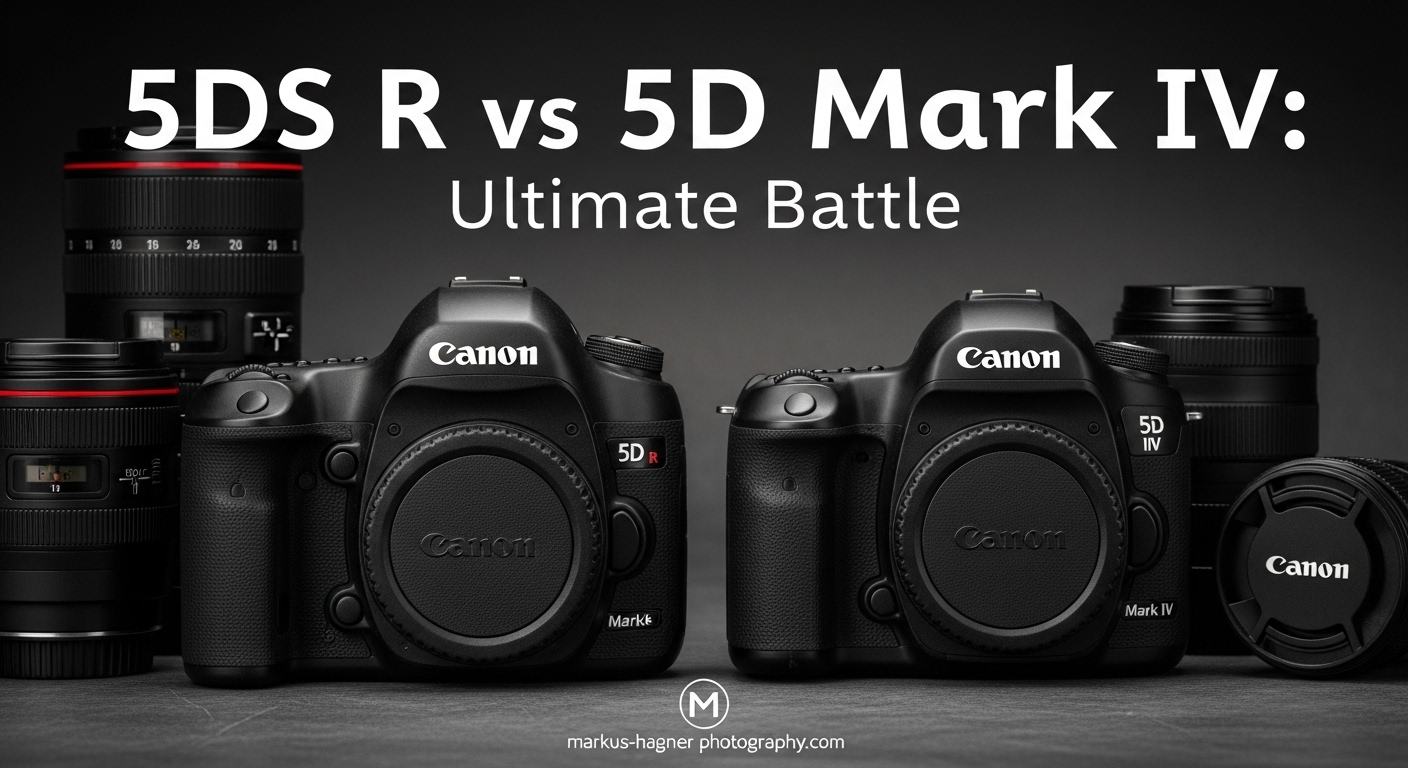
If you’re a serious photographer looking to invest in a high-end Canon DSLR, you’ve probably found yourself comparing the 5DS R and the 5D Mark IV. As someone who has spent countless hours shooting with both cameras, I understand the dilemma. These two powerhouses represent different philosophies in camera design, each excelling in specific areas. In this comprehensive comparison, I’ll break down everything you need to know to make an informed decision based on your unique photography needs.
Quick Overview: 5DS R vs 5D Mark IV at a Glance
Before diving into the nitty-gritty details, let’s start with a quick comparison table to give you an immediate sense of how these two cameras stack up against each other:
| Feature | Canon 5DS R | Canon 5D Mark IV |
|---|---|---|
| Sensor | 50.6MP Full-Frame CMOS | 30.4MP Full-Frame CMOS |
| Low-Pass Filter | Canceled (no OLPF) | Standard with self-cleaning |
| Image Processor | Dual DIGIC 6 | DIGIC 6+ |
| ISO Range | 100-6400 (expandable to 50-12800) | 100-32000 (expandable to 50-102400) |
| Autofocus | 61 points, 41 cross-type | 61 points, 41 cross-type, 21 dual cross-type |
| Continuous Shooting | 5 fps | 7 fps |
| Video | Full HD 1080p at 30fps | 4K at 30fps, Full HD 1080p at 60fps |
| LCD Screen | 3.2-inch, 1.04M dots | 3.2-inch, 1.62M dots, touchscreen |
| Built-in Flash | No | No |
| Weather Sealing | Excellent | Excellent |
| Battery Life | Approx. 700 shots | Approx. 900 shots |
| Weight | 845g (body only) | 890g (body only) |
| Release Date | February 2015 | August 2016 |
Sensor and Image Quality: Resolution vs Versatility
The most significant difference between these two cameras lies in their sensors, and this shapes everything about their performance and intended use.
The 5DS R boasts an incredible 50.6-megapixel full-frame sensor, making it one of the highest resolution DSLRs Canon has ever produced. What makes it even more special is the cancellation of the optical low-pass filter (OLPF), which allows for maximum sharpness and detail. I discovered that when shooting landscapes or studio portraits with the 5DS R, the level of detail captured is simply breathtaking. Fine textures in fabrics, intricate details in architecture, and subtle skin textures are rendered with stunning clarity.
On the other hand, the 5D Mark IV features a 30.4-megapixel sensor with a standard low-pass filter. While this might seem like a step down in resolution, there’s a method to this design choice. The lower pixel count means larger individual pixels, which contributes to better low-light performance. The low-pass filter helps prevent moiré patterns and aliasing, which can be problematic with the 5DS R when shooting certain patterns or textures.
In my experience, the 5DS R produces images with unparalleled detail and sharpness when used with high-quality lenses and proper technique. However, this comes at a cost: the files are enormous (approximately 70+ MB for a RAW image), which requires more storage space and more computing power for post-processing.
The 5D Mark IV, while not matching the 5DS R in pure resolution, still produces incredibly detailed images that are more manageable in terms of file size. I’ve found that for most applications, including printing large sizes, the 30.4MP resolution is more than sufficient.
Low-Light Performance: Where the 5D Mark IV Shines
If you frequently shoot in challenging lighting conditions, this is where the 5D Mark IV clearly outperforms the 5DS R.
The 5DS R has a native ISO range of 100-6400, expandable to 50-12800. While this might seem adequate on paper, in practice, I found that image quality begins to suffer noticeably above ISO 1600. At higher ISO settings, noise becomes more apparent, and fine details start to break down. This isn’t surprising given the high pixel density of the sensor.
The 5D Mark IV, with its larger pixels, offers a much wider native ISO range of 100-32000, expandable to an impressive 50-102400. I’ve shot with the 5D Mark IV in near-darkness conditions at ISO 12800 and still captured usable images with remarkable detail and relatively controlled noise. The noise pattern is also more organic and less distracting than on the 5DS R.
For wedding photographers, event photographers, or anyone who regularly shoots in variable lighting conditions, the 5D Mark IV’s superior low-light performance is a game-changer. I’ve captured moments in dimly lit venues with the 5D Mark IV that would have been nearly impossible with the 5DS R.
Autofocus System: Subtle but Important Differences
At first glance, both cameras feature a 61-point autofocus system with 41 cross-type points, but there are important differences that affect real-world performance.
The 5DS R uses the same autofocus system found in the 5D Mark III, which was excellent in its time but has been surpassed by newer systems. It’s accurate and reliable for most situations, but I found it can struggle with tracking fast-moving subjects, especially in low light.
The 5D Mark IV features an updated autofocus system with 61 points, 41 cross-type points, and crucially, 21 dual cross-type points at the center. These dual cross-type points are more sensitive and accurate, especially in low-light conditions. The 5D Mark IV also benefits from improved autofocus algorithms that provide better subject tracking and more reliable focus acquisition.
In my experience shooting sports and wildlife with both cameras, the 5D Mark IV’s autofocus system is noticeably more confident and accurate, especially when tracking erratically moving subjects. The difference might not be as apparent for portrait or landscape photography, but for action photography, the 5D Mark IV has a clear advantage.
Continuous Shooting Speed: Capturing the Action
For photographers who need to capture fast-paced action, continuous shooting speed is a critical factor.
The 5DS R offers 5 frames per second (fps), which is adequate for most general photography but can be limiting when trying to capture the perfect moment in fast-paced action. I’ve missed more than a few great shots because the 5DS R couldn’t keep up with the action.
The 5D Mark IV improves on this with 7 fps continuous shooting (or 8 fps in Live View mode with AF disabled). This might not seem like a huge difference, but in practice, it makes the 5D Mark IV much more capable of capturing fast-moving subjects. When I switched from the 5DS R to the 5D Mark IV for sports photography, my “keeper rate” increased significantly.
The 5D Mark IV also has a larger buffer, allowing you to shoot more frames in a single burst before the camera slows down. For action photographers, this is a game-changer.
Video Capabilities: A Generation Apart
If video is important to you, this is where the 5D Mark IV absolutely dominates the comparison.
The 5DS R offers Full HD 1080p video recording at up to 30fps. While the quality is good, it’s essentially the same video capability found in cameras from several years earlier. There’s no 4K option, and the frame rate options are limited. I found the 5DS R’s video functionality to be an afterthought rather than a primary feature.
The 5D Mark IV, on the other hand, brings Canon’s full-frame DSLRs into the modern video era with 4K recording at 30fps (with a 1.74x crop factor) and Full HD 1080p at up to 60fps. The 4K video is sharp and detailed, with good dynamic range and color science. The 5D Mark IV also features Dual Pixel CMOS AF, which provides smooth, reliable autofocus during video recording—a feature sorely missing on the 5DS R.
For hybrid shooters who need both high-quality stills and video capabilities, the 5D Mark IV is clearly the better choice. I’ve shot everything from interviews to event videos with the 5D Mark IV, and the results have consistently impressed clients.
Build Quality and Ergonomics: Familiar Feel with Refinements
Both cameras feature excellent build quality with magnesium alloy bodies and comprehensive weather sealing. I’ve shot with both cameras in light rain and dusty conditions without any issues, and they feel solid and professional in hand.
The ergonomics are very similar, as both follow Canon’s established DSLR design language. If you’re upgrading from a previous 5D series camera, you’ll feel right at home with either model.
There are, however, some subtle differences worth noting. The 5D Mark IV features a slightly refined grip design that I found more comfortable during extended shooting sessions. It also has a redesigned control layout with a more intuitive joystick placement and additional customizable buttons.
One significant improvement on the 5D Mark IV is the LCD screen. While both cameras have 3.2-inch screens, the 5D Mark IV’s has a higher resolution (1.62M dots vs 1.04M dots) and, crucially, it’s a touchscreen. The touchscreen functionality makes menu navigation, image review, and even focus point selection much more intuitive and efficient.
Real-World Performance: How They Handle Different Photography Genres
To truly understand these cameras, it’s important to see how they perform in various photography scenarios.
Landscape Photography
For landscape photography, the 5DS R’s incredible resolution is hard to beat. I’ve captured landscape images with the 5DS R that, when printed large, reveal details I couldn’t even see with the naked eye when taking the shot. The dynamic range is excellent, and when paired with high-quality lenses, the results are simply stunning.
That said, the 5D Mark IV is no slouch in the landscape department. While it doesn’t match the 5DS R in pure resolution, it still produces highly detailed images with excellent dynamic range. The 5D Mark IV also has an advantage in sunrise/sunset situations where light levels change rapidly, as its better low-light performance allows for cleaner images at higher ISOs.
Portrait Photography
For portrait photography, both cameras excel, but in different ways. The 5DS R captures every skin detail with stunning clarity, which can be both a blessing and a curse. It’s great for beauty and fashion portraits where texture is important, but might require more careful retouching for standard portraits.
The 5D Mark IV produces beautiful portraits with pleasing skin tones and slightly softer rendering that many portrait photographers prefer. Its superior autofocus system also helps ensure critical focus on the eyes, especially when shooting wide open.
Wedding and Event Photography
For wedding and event photography, the 5D Mark IV is the clear winner in my experience. Its better low-light performance, faster continuous shooting, and more reliable autofocus make it much better suited to the unpredictable and often challenging lighting conditions of weddings and events.
While the 5DS R can certainly be used for wedding photography, I found myself missing shots due to its limitations in low light and slower continuous shooting. The enormous file sizes also slow down the workflow, which can be problematic when delivering hundreds of images to a client on a tight deadline.
Sports and Wildlife Photography
For sports and wildlife photography, the 5D Mark IV’s faster continuous shooting and improved autofocus system give it a significant advantage. The 7 fps shooting speed allows you to capture more of the action, and the improved autofocus tracking helps keep sharp focus on fast-moving subjects.
The 5DS R can be used for sports and wildlife photography, but it’s not ideal. The slower continuous shooting means you’ll miss more moments, and the autofocus system, while accurate, isn’t as capable at tracking fast-moving subjects.
File Sizes and Storage Considerations
One practical consideration that’s often overlooked is the impact of file sizes on storage and workflow.
The 5DS R’s 50.6-megapixel sensor produces enormous RAW files (approximately 70+ MB each) and large JPEG files. This means you’ll need more storage space, both in-camera and for your archives. I found that my standard memory cards filled up much faster with the 5DS R, and I had to invest in larger capacity cards and additional hard drives for storage.
The 5D Mark IV’s 30.4-megapixel sensor produces more manageable RAW files (approximately 45-50 MB each), which still offer plenty of detail but with less impact on storage and workflow. This might not seem like a significant difference, but when you’re shooting thousands of images at a wedding or event, it adds up quickly.
The larger file sizes of the 5DS R also require more computing power for post-processing. I found that my computer struggled a bit when editing multiple 5DS R RAW files simultaneously, whereas it handled 5D Mark IV files with ease.
Battery Life: All-Day Shooting Potential
Both cameras use the LP-E6N battery, which is a slight improvement over the older LP-E6. However, there’s a noticeable difference in battery life between the two cameras.
The 5DS R is rated for approximately 700 shots per charge, while the 5D Mark IV is rated for approximately 900 shots. In real-world use, I found these ratings to be fairly accurate, with the 5D Mark IV consistently outlasting the 5DS R on a single battery.
This difference can be attributed to several factors, including the more efficient image processor in the 5D Mark IV and the additional power consumption required to process the 5DS R’s massive image files.
For all-day shooting events like weddings, this difference can be significant. With the 5D Mark IV, I can typically get through a full wedding day on two batteries, while with the 5DS R, I’d need at least three.
Price and Value: Getting the Most Bang for Your Buck
As of 2026, both cameras have been on the market for several years, and their prices have dropped accordingly. The 5DS R typically sells for around $2,300-2,500 (body only), while the 5D Mark IV commands a slightly higher price of around $2,500-2,700 (body only).
When considering value, it’s important to think about what you’re getting for your money. The 5DS R offers unparalleled resolution and detail, making it an excellent choice for studio, landscape, and fashion photographers who prioritize image quality above all else.
The 5D Mark IV, while more expensive, offers greater versatility with its better low-light performance, improved autofocus, faster continuous shooting, and advanced video capabilities. For photographers who need a single camera that can handle a wide range of situations, the 5D Mark IV represents better overall value.
Also Read: Canon 100-400 Vs Fuji 100-400
Who Should Buy the 5DS R?
Based on my experience with both cameras, the 5DS R is ideal for:
- Studio Photographers: If you primarily shoot in a controlled studio environment where lighting is consistent and you can maximize the incredible resolution, the 5DS R is hard to beat. I’ve shot countless studio portraits with the 5DS R, and the level of detail never fails to impress.
- Landscape Photographers: For landscape photographers who value ultimate detail and large printing capabilities, the 5DS R is an excellent choice. The resolution allows for significant cropping while still maintaining image quality.
- Commercial and Fashion Photographers: When shooting for commercial clients where image quality is paramount, the 5DS R delivers the goods. The ability to capture minute details in clothing and products can make the difference in a competitive industry.
- Fine Art Photographers: If you create large-format fine art prints, the 5DS R’s resolution provides the detail needed for impressive gallery-sized prints.
- Photographers with Specific High-Resolution Needs: If your photography requires extreme resolution for technical or creative reasons, the 5DS R is the obvious choice.
Who Should Buy the 5D Mark IV?
The 5D Mark IV, on the other hand, is better suited for:
- Wedding and Event Photographers: With its better low-light performance, faster continuous shooting, and reliable autofocus, the 5D Mark IV is perfect for capturing the unpredictable moments of weddings and events.
- Photojournalists: For documentary and photojournalism work, the 5D Mark IV’s versatility and performance in challenging conditions make it an excellent choice.
- Hybrid Shooters: If you need both high-quality stills and video capabilities, the 5D Mark IV’s 4K video and Dual Pixel CMOS AF make it the clear winner.
- Sports and Wildlife Photographers: The faster continuous shooting and improved autofocus system make the 5D Mark IV much better suited to capturing fast-moving subjects.
- Photographers Who Need One Camera for Everything: If you’re looking for a single camera that can handle everything from portraits to landscapes to sports to video, the 5D Mark IV’s versatility makes it the better choice.
My Personal Experience with Both Cameras
I’ve owned and extensively used both the 5DS R and the 5D Mark IV, and each has earned a special place in my photography journey.
I bought the 5DS R shortly after its release, primarily for studio and landscape work. The first time I opened the RAW files on my computer, I was blown away by the level of detail. I could zoom in on a landscape image and see details I didn’t even notice when taking the shot. For my commercial work, the 5DS R quickly became my go-to camera, and clients were consistently impressed with the image quality.
However, as my work evolved to include more weddings and events, I found myself reaching for the 5DS R less often. The limitations in low light and slower continuous shooting became more apparent, and I started missing shots that I should have captured.
When the 5D Mark IV was released, I was initially hesitant. Would the lower resolution be a step down? After shooting with it for a few weeks, all my doubts disappeared. While it didn’t match the 5DS R in pure resolution, it delivered excellent image quality across a much wider range of conditions. The improved autofocus and faster continuous shooting made a noticeable difference in my hit rate for action shots.
What I discovered is that these cameras serve different purposes in my photography. The 5DS R remains my camera of choice for studio portraits and commercial work where ultimate detail is paramount. The 5D Mark IV has become my workhorse for weddings, events, and any situation where versatility is key.
Also Read: Canon 60D Vs T3I
Pro Tips for Getting the Most Out of Either Camera
Whether you choose the 5DS R or the 5D Mark IV, here are some tips I’ve learned over the years to help you get the most out of your camera:
For 5DS R Users:
- Invest in the Best Glass: The 5DS R’s high-resolution sensor will reveal any weaknesses in your lenses. I discovered that investing in high-quality lenses made more difference to image quality than almost anything else.
- Use a Sturdy Tripod: To take full advantage of the 5DS R’s resolution, you need to eliminate camera shake. A high-quality tripod is essential for landscape and studio work.
- Master Your Technique: With such high resolution, even slight camera movement or inaccurate focus can be magnified. Perfect your handholding technique and focus accuracy.
- Manage Your Expectations in Low Light: Accept that the 5DS R has limitations in low light and plan accordingly. Use additional lighting when possible.
- Upgrade Your Computer: The large file sizes require a powerful computer for smooth editing. Make sure your system can handle the workload.
For 5D Mark IV Users:
- Customize Your Autofocus: Take the time to learn and customize the advanced autofocus settings. I’ve found that tailoring the AF settings to specific situations dramatically improves the hit rate.
- Embrace the Touchscreen: Don’t ignore the touchscreen functionality. It makes menu navigation, image review, and focus point selection much more intuitive.
- Explore 4K Video: Even if you don’t consider yourself a videographer, experiment with the 4K video capabilities. You might discover a new creative outlet.
- Utilize the Dual Pixel RAW Feature: The 5D Mark IV’s Dual Pixel RAW allows for post-processing adjustments like image micro-adjustment and bokeh shift. It’s a powerful tool when used correctly.
- Take Advantage of the High ISO Performance: Don’t be afraid to push the ISO when necessary. The 5D Mark IV handles high ISO settings remarkably well.
Final Verdict: 5DS R vs 5D Mark IV
After extensively using both cameras, I can tell you that there’s no clear “winner” in the 5DS R vs 5D Mark IV debate. The right choice depends entirely on your specific needs and shooting style.
If you prioritize ultimate resolution and detail above all else, and primarily shoot in controlled conditions like a studio or with a tripod for landscapes, the 5DS R is the camera for you. Its 50.6-megapixel sensor delivers unparalleled detail that’s still impressive by today’s standards.
If you need a versatile all-rounder that can handle everything from portraits to sports to video, the 5D Mark IV is the better choice. Its better low-light performance, improved autofocus, faster continuous shooting, and advanced video capabilities make it a more flexible tool for a wider range of photography situations.
For many professional photographers, the ideal solution is actually owning both cameras. I’ve used this combination for years, and it covers almost any shooting scenario I might encounter. The 5DS R handles studio and landscape work where resolution is paramount, while the 5D Mark IV takes care of weddings, events, and situations where versatility is key.
Ultimately, both cameras represent excellent value in 2026 and are capable of producing professional-quality results in the hands of a skilled photographer. Choose based on your specific needs, and you won’t be disappointed with either option.
FAQ: 5DS R vs 5D Mark IV
Which camera has better image quality?
Both cameras produce excellent image quality, but in different ways. The 5DS R has higher resolution and more detail, especially when paired with high-quality lenses and used with proper technique. The 5D Mark IV produces slightly less detailed images but with better dynamic range and cleaner files at higher ISOs.
Can I use my existing lenses with both cameras?
Yes, both cameras are full-frame and compatible with all Canon EF lenses. They are not compatible with EF-S lenses, which are designed for APS-C sensors.
Which camera is better for video?
The 5D Mark IV is significantly better for video, offering 4K recording at 30fps, Full HD at 60fps, and Dual Pixel CMOS AF for smooth autofocus during video recording. The 5DS R only offers Full HD 1080p at 30fps.
Is the 5DS R’s high resolution worth the trade-offs?
For photographers who prioritize detail and shoot primarily in controlled conditions, yes. For those who need versatility and frequently shoot in challenging lighting, the trade-offs might not be worth it.
Which camera has better autofocus?
While both cameras have 61-point autofocus systems, the 5D Mark IV’s is more advanced, with 21 dual cross-type points and improved algorithms for better subject tracking and low-light performance.
Can the 5DS R be used for wedding photography?
Yes, but it’s not ideal. Its limitations in low light and slower continuous shooting can be challenging for wedding photography. The 5D Mark IV is better suited for this type of work.
Which camera is better for landscape photography?
The 5DS R is generally better for landscape photography due to its higher resolution, which captures more detail and allows for larger prints. However, the 5D Mark IV is no slouch and might be preferable if you frequently shoot in low-light conditions like sunrise or sunset.
How do the file sizes compare?
The 5DS R produces significantly larger files (approximately 70+ MB for RAW) compared to the 5D Mark IV (approximately 45-50 MB for RAW). This impacts storage requirements and post-processing workflow.