
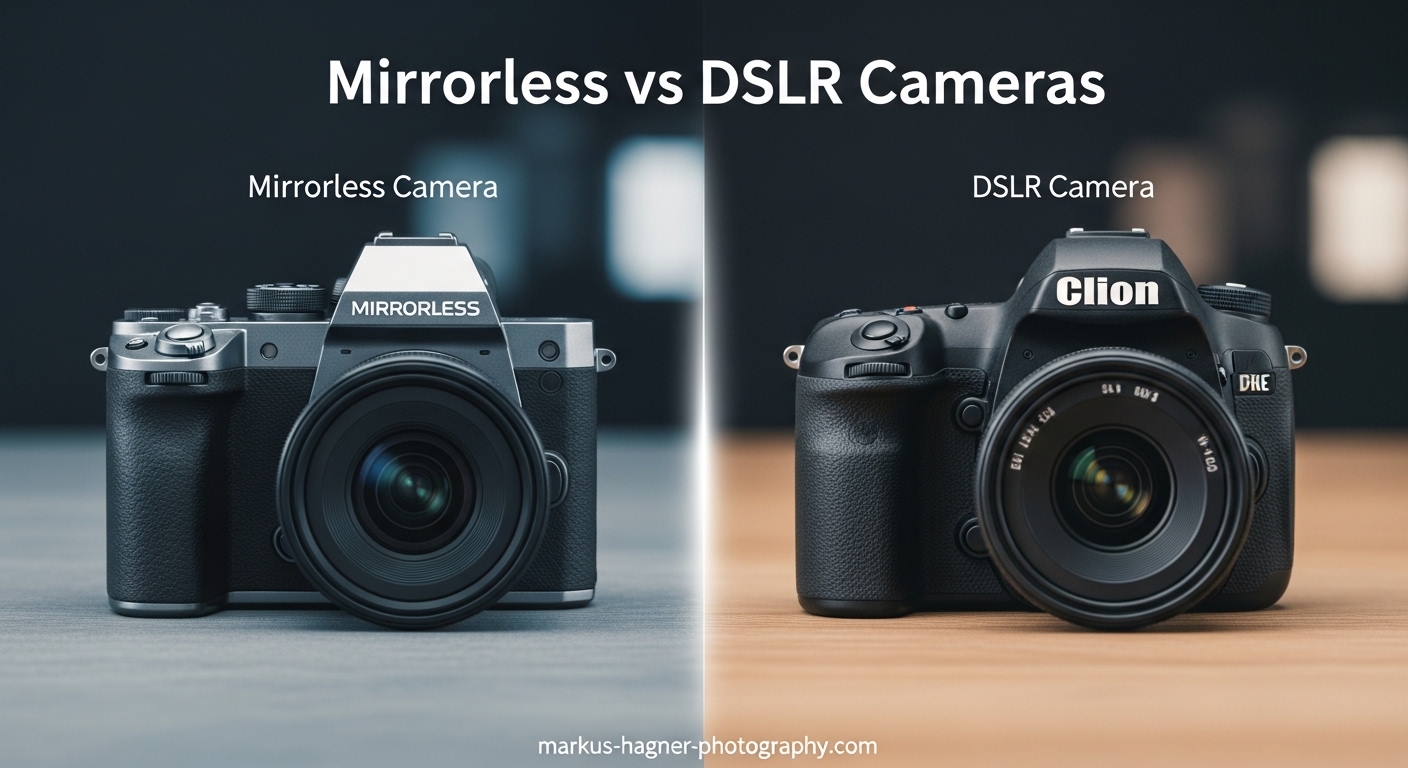
If you are shopping for a new camera in 2026, you have probably noticed that the photography world has fundamentally changed. Major manufacturers like Canon and Nikon have shifted nearly all their research and development toward mirrorless cameras, while DSLR development has largely stalled. Yet both camera types remain widely available, and many photographers still swear by their DSLRs.
So which should you choose? The answer depends entirely on your specific needs, shooting style, and budget. I have spent years shooting with both systems, and the truth is that each has genuine advantages that matter in real-world use.
This guide breaks down the technical differences between mirrorless vs DSLR cameras without the marketing hype. We will examine how each system works, compare their strengths and weaknesses across every category that matters, and help you make an informed decision based on your actual photography needs.
Quick Summary: Key Differences at a Glance
Before diving into the details, here is a quick overview of how these two camera types compare across the most important categories:
Mirrorless Advantages:
- Smaller, lighter bodies due to eliminated mirror box
- Electronic viewfinder with real-time exposure preview
- Superior autofocus with eye, face, and animal detection
- Faster continuous shooting rates (often 20+ fps)
- Better video capabilities including 4K and 8K options
- Silent electronic shutter shooting
- Where all manufacturer R&D is currently focused
DSLR Advantages:
- Significantly better battery life (often 2-3x more shots)
- Optical viewfinder with natural, lag-free viewing
- Larger, more ergonomic bodies for big hands
- Huge existing lens ecosystem at lower prices
- Proven durability and weather sealing
- Better value on the used market
Bottom line: If you prioritize cutting-edge technology, video features, or maximum portability, mirrorless is the clear choice. If you value battery life, prefer an optical viewfinder, or want maximum value for your investment, a DSLR remains a compelling option.
The Fundamental Difference: How Each System Works
Understanding mirrorless vs DSLR cameras starts with their fundamentally different internal architectures. This single design choice affects everything else about how each camera performs.
How a DSLR Works
In a DSLR (Digital Single Lens Reflex), light enters through the lens and immediately hits a 45-degree angled mirror positioned inside the camera body. This mirror reflects the light upward into a pentaprism or pentamirror, which then bounces the image into the optical viewfinder (OVF) where your eye looks through.
When you press the shutter button, that mirror flips up out of the way, allowing light to reach the image sensor for the duration of the exposure. This is why you see a brief blackout in the viewfinder when taking a photo with a DSLR.
The key benefit of this design is that you are seeing the actual light coming through your lens, reflected optically without any digital processing. There is zero lag, no resolution limit, and no battery consumption for the viewfinder itself.
How a Mirrorless Camera Works
A mirrorless camera eliminates that internal mirror entirely. Light passes straight through the lens and directly onto the image sensor. The sensor continuously captures this light and sends a live digital feed to either the rear LCD screen or an electronic viewfinder (EVF).
This design is simpler mechanically, which is why mirrorless bodies can be smaller and lighter. But it also means the sensor and processor must work constantly to generate that live view, which impacts battery consumption.
The tradeoff is significant capability. Because you are seeing a digital preview, the EVF can show you exactly what your final image will look like, including exposure, white balance, and depth of field. You can zoom in to check focus, display histograms and level gauges, and review images without taking your eye from the viewfinder.
Why This Matters
That mirror mechanism is the defining difference between these systems. Its presence or absence determines the camera’s size, viewfinder type, autofocus approach, battery consumption, and even sound during shooting. Every comparison that follows stems from this single architectural choice.
Size and Weight Comparison
One of the most touted advantages of mirrorless cameras is their compact size. Without the mirror box and pentaprism, manufacturers can build smaller camera bodies. But the real-world impact is more nuanced than marketing materials suggest.
The Body Size Advantage
Compare a typical full-frame DSLR like the Canon EOS 5D Mark IV to a comparable mirrorless camera like the Canon EOS R6. The DSLR body measures approximately 151mm wide and weighs around 890g. The mirrorless body is roughly 138mm wide and weighs about 670g with the same battery installed.
That represents meaningful savings, especially if you carry your camera all day. Wedding photographers, travel photographers, and hikers notice the difference in their bags and on their shoulders.
The Lens Size Caveat
Here is where things get complicated. While mirrorless bodies are smaller, professional-grade mirrorless lenses are often similar in size to their DSLR equivalents. A 70-200mm f/2.8 telephoto is large regardless of what camera it attaches to.
In fact, some mirrorless lenses are actually larger because manufacturers take advantage of the shorter flange distance (the space between the lens mount and sensor) to design more complex optical formulas. The result is often sharper lenses, but size savings are minimal.
Real-World Portability
If you primarily use compact prime lenses, mirrorless offers genuine size and weight advantages. Pair a small mirrorless body with a 35mm or 50mm prime, and you have a significantly more portable package than any DSLR equivalent.
But if you shoot with large telephoto lenses, the body size difference becomes almost irrelevant. A 400mm lens dwarfs the camera body regardless of format. Wildlife and sports photographers gain little portability benefit from mirrorless.
Optical vs Electronic Viewfinders: The Viewing Experience
The viewfinder difference is perhaps the most personal choice in the mirrorless vs DSLR debate. Photographers have strong preferences, and there is no objectively wrong answer.
Optical Viewfinders (DSLR)
An optical viewfinder shows you actual light reflected optically from the scene. This means zero lag, infinite resolution (limited only by your eye), and a natural viewing experience that many photographers find more pleasant.
The optical viewfinder also consumes no power, which contributes to the DSLR’s superior battery life. In cold weather or long shoots, this matters.
However, an OVF cannot show you exposure changes in real time. You need to rely on the camera’s metering and your experience to judge how your settings will affect the final image. Depth of field preview requires stopping down the lens, which darkens the viewfinder.
Electronic Viewfinders (Mirrorless)
An electronic viewfinder is essentially a tiny high-resolution screen. Modern EVFs offer 3.6 to 5.7 million dots and refresh rates up to 120Hz, providing a viewing experience that approaches optical quality.
The killer feature is exposure simulation. As you adjust aperture, shutter speed, or ISO, the EVF shows you exactly how bright or dark your image will be. This eliminates the guesswork from exposure and dramatically speeds up learning for beginners.
EVFs also display overlay information like histograms, focus peaking, and level gauges. You can review images without chimping on the back screen. For video shooters, the EVF provides a stable viewing platform even in bright sunlight.
Drawbacks of EVFs
Electronic viewfinders do have limitations. In very low light, they can become grainy or laggy as the sensor struggles to gather enough light. Some photographers find the digital look fatiguing over long shooting sessions. And EVFs drain battery continuously even when you are just composing shots.
Which is Better?
This comes down to personal preference. Many professionals who switched to mirrorless initially struggled with EVFs but now prefer them for the exposure preview. Others still reach for their DSLRs when they want the optical viewing experience. If possible, try both before committing to a system.
Autofocus Systems: Phase Detection vs On-Sensor AF
Autofocus performance is where mirrorless cameras have pulled decisively ahead. The technical reasons are fascinating, and the practical impact on your photography is substantial.
DSLR Autofocus Limitations
Traditional DSLRs use a separate phase detection autofocus module located in the bottom of the camera body. Light passes through a partially transparent area of the main mirror and reflects down to this dedicated AF sensor.
This system works well but has inherent limitations. The AF points must be clustered near the center of the frame because of the physical arrangement. Most DSLRs cannot focus accurately at the edges of the frame. And because the AF sensor is separate from the main image sensor, potential for calibration drift exists.
Mirrorless Autofocus Advantages
Mirrorless cameras integrate autofocus pixels directly onto the main image sensor. This means AF points can cover nearly the entire frame, and focus is measured at the exact plane where the image is captured.
Modern mirrorless cameras use sophisticated hybrid AF systems combining phase detection and contrast detection. This delivers both speed and accuracy without the calibration issues that can affect DSLRs.
Subject Recognition and Tracking
Where mirrorless really shines is subject recognition. Using AI-powered algorithms, mirrorless cameras can identify and track human eyes, faces, animals, birds, and even vehicles. The camera automatically locks onto these subjects and maintains focus even as they move around the frame.
For portrait photographers, this means tack-sharp eyes without manually selecting focus points. For wildlife photographers, bird-tracking AF can follow a bird in flight across the entire frame. This technology has fundamentally changed how many photographers work.
DSLRs Still Have Their Place
That said, high-end DSLRs still focus quickly and accurately for most situations. If you photograph stationary subjects or work primarily with center-frame compositions, you will not feel limited by DSLR autofocus. But for action, sports, wildlife, or any situation where subject tracking matters, mirrorless holds a significant advantage.
Continuous Shooting and Burst Rates
When photographing action, the ability to capture rapid bursts of images increases your chances of getting the perfect moment. Mirrorless cameras have opened new possibilities here.
Mechanical vs Electronic Shutter
DSLRs are limited by their mechanical shutters. The mirror must flip up and down between each frame, and physical shutter curtains have speed limitations. Most DSLRs max out around 6-10 frames per second with mechanical shutter.
Mirrorless cameras can use electronic shutters that read directly from the sensor without any mechanical movement. This enables burst rates of 20, 30, or even 40+ frames per second on some models. The electronic shutter is also completely silent, valuable for weddings, wildlife, and other situations where shutter noise is problematic.
The Rolling Shutter Tradeoff
Electronic shutters do have a downside: rolling shutter distortion. Because the sensor reads from top to bottom sequentially rather than all at once, fast-moving subjects can appear skewed. A race car might look like it is leaning, or a golf club might appear bent.
For most photography this is not an issue, but sports and action photographers should test electronic shutter behavior before relying on it for critical work.
Buffer Depth Considerations
High burst rates are only useful if your camera can sustain them. The buffer (temporary high-speed memory) fills quickly when shooting RAW files at 20+ fps. Look at how many shots a camera can capture before the buffer fills and how quickly it clears. A camera that shoots 30 fps but fills its buffer after 20 RAW files is less useful than one that shoots 15 fps for 100+ frames.
Video Capabilities: Which System is Better for Filmmakers?
For hybrid shooters who need both stills and video, mirrorless has become the clear winner. The technical advantages are substantial.
Why Mirrorless Excels at Video
Because mirrorless cameras already use the sensor in live view mode for still photography, video is a natural extension. The same autofocus system works seamlessly during video recording, maintaining focus on moving subjects without hunting.
Modern mirrorless cameras commonly offer 4K recording at 60fps or higher, 10-bit color for better grading flexibility, and advanced codecs like ProRes or H.265. Some flagship models even offer 8K recording. The electronic viewfinder provides a stable, bright viewing platform for video work in any lighting conditions.
DSLR Video Limitations
DSLRs can certainly record video, but the experience is less refined. When shooting video on a DSLR, the mirror must be locked up, meaning you cannot use the optical viewfinder. You must rely on the rear LCD screen, which is difficult to see in bright sunlight.
Autofocus during video on DSLRs has historically been slower and more prone to hunting. While recent models have improved, they still lag behind mirrorless offerings. Many video shooters end up using manual focus on DSLRs.
Heat Management
Extended video recording generates heat, and this is an area where both systems struggle. However, the larger bodies of DSLRs can sometimes dissipate heat better than compact mirrorless cameras. Some mirrorless cameras implement recording time limits to prevent overheating, though this has improved significantly in recent generations.
The Verdict for Video
If video is a significant part of your work, mirrorless is the obvious choice. The autofocus performance alone makes a massive difference, and the feature sets on modern mirrorless cameras often match or exceed dedicated video cameras.
Battery Life: The Enduring DSLR Advantage
If there is one area where DSLRs still hold a clear advantage, it is battery life. This matters more than many photographers realize until they are in the field.
Why DSLR Batteries Last Longer
The optical viewfinder on a DSLR consumes essentially no power. The sensor only activates when you actually take a photo. A DSLR can sit idle with the meter active for long periods with minimal battery drain.
In contrast, a mirrorless camera must power the sensor and EVF or LCD continuously whenever you are composing a shot. This constant power consumption is unavoidable.
Typical Shot Counts
A typical full-frame DSLR might capture 800-1,200 shots per charge. A comparable mirrorless camera often manages 300-500 shots, though newer models have improved to 500-700 shots. This 2-3x difference is significant for long events, travel days, or remote shoots where charging is not possible.
Real-World Impact
For studio work or casual photography, battery life differences matter little. You can charge between sessions or plug into AC power. But for wedding photographers shooting 12-hour days, wildlife photographers in the field for days, or travel photographers without reliable charging access, the DSLR’s battery advantage is genuinely valuable.
Managing Mirrorless Battery Life
Mirrorless shooters adapt by carrying multiple batteries. Most professionals carry 3-4 batteries for a full day of shooting. Using the EVF sparingly, reducing LCD brightness, and enabling power-saving modes also help extend shooting time.
Lens Ecosystem and Adaptability
The lens question is more complex than it initially appears. Both systems have compelling options, but the landscape is shifting rapidly.
DSLR Lens Advantages Today
DSLRs benefit from decades of lens development. Canon EF and Nikon F mounts have massive lens libraries covering every focal length, aperture, and specialty use case imaginable. Many excellent DSLR lenses are available used at significant discounts.
For specialized applications like tilt-shift, super-telephoto, or extreme macro, DSLR lens options remain more mature and often more affordable.
The Mirrorless Lens Revolution
While mirrorless lens libraries were initially limited, they have expanded rapidly. Canon’s RF mount, Nikon’s Z mount, Sony’s E mount, and Panasonic/Leica/Sigma’s L mount all now offer comprehensive lens ranges covering most photographer’s needs.
These new lenses often take advantage of the shorter flange distance to achieve better optical performance. They are typically sharper, focus faster, and offer more advanced features than their DSLR predecessors.
Using Adapters
Here is the good news for DSLR owners considering a switch: adapters let you use existing DSLR lenses on mirrorless bodies. Canon’s EF-EOS R adapter, Nikon’s FTZ adapter, and third-party options enable this transition.
Adapted lenses generally perform well, with minimal impact on image quality or autofocus speed. However, some older lenses may not support all autofocus modes or features. Always check compatibility for your specific lenses.
The Flange Distance Factor
Flange distance (the space between lens mount and sensor) is shorter on mirrorless cameras because there is no mirror box. Canon RF is 20mm versus 44mm for EF. Nikon Z is 16mm versus 46.5mm for F mount.
This shorter distance means you can adapt DSLR lenses to mirrorless but not vice versa. It also enables adapting legacy manual focus lenses from many older systems, expanding creative possibilities.
Image Quality: Is There Really a Difference?
Let us address a common misconception directly: sensor size and generation matter far more than whether the camera is mirrorless or DSLR.
Sensor Equivalence
A full-frame sensor produces similar image quality regardless of camera type. A 24-megapixel full-frame mirrorless camera and a 24-megapixel full-frame DSLR will produce virtually identical image files when using equivalent lenses and settings.
There is no “mirrorless look” or special image quality advantage inherent to either system. What matters is sensor size, pixel count, sensor generation, and lens quality.
Low-Light Performance
Low-light performance depends primarily on sensor size and design, not mirror mechanism. Modern mirrorless cameras sometimes show slight high-ISO advantages because their sensors are newer, but equivalent-generation DSLRs perform similarly.
Where mirrorless can help in low light is the EVF’s ability to amplify the scene, making it easier to compose and focus in darkness. This does not improve image quality, but it can help you get shots that would be difficult to frame through an optical viewfinder.
Dynamic Range and Color
Dynamic range and color reproduction are also sensor-dependent rather than system-dependent. Both mirrorless and DSLR cameras from major manufacturers deliver excellent results in these areas.
Future Outlook: Where Camera Technology is Headed
Understanding the industry direction helps inform long-term purchasing decisions. The writing on the wall is clear.
Manufacturer Focus
Canon, Nikon, and Sony have all shifted their research and development almost entirely to mirrorless systems. New lens releases, sensor innovations, and feature developments target mirrorless exclusively. When you buy a DSLR today, you are buying into a system with limited future development.
DSLR Discontinuation
Several high-profile DSLRs have been officially discontinued with no successors announced. The Canon EOS 5D series appears to have ended. Nikon has stated they are focusing on mirrorless. This does not mean DSLRs will stop working, but it does mean the technology has peaked.
Investment Protection
If you are investing heavily in a camera system today, consider the long-term implications. Mirrorless is where innovation is happening. Features like AI-powered autofocus, advanced video capabilities, and computational photography features will appear in mirrorless cameras first.
That said, DSLRs remain fully capable cameras that will work for decades. If a DSLR meets your needs today at a better price, the fact that it is a “dying” technology does not make it a bad purchase.
How to Choose: A Decision Framework
So which should you buy? Here is a framework for making this decision based on your specific situation.
Choose Mirrorless If:
- You want the most advanced autofocus with subject tracking
- Video capabilities are important to your work
- You photograph fast action, sports, or wildlife
- Portability matters for your shooting style
- You want exposure preview before taking the shot
- You are investing in a system for the long term
- You need silent shooting capabilities
Choose DSLR If:
- Battery life is critical for your shooting scenarios
- You prefer the optical viewfinder experience
- You have large hands and prefer substantial bodies
- You want maximum value on a limited budget
- You already own DSLR lenses you want to continue using
- You primarily photograph stationary subjects
- You want a system that is proven and familiar
Recommendations by Photography Type
Portrait Photography: Both work well. Mirrorless eye-AF is genuinely helpful, but excellent portraits have been made with DSLRs for decades.
Wedding Photography: Mirrorless advantages in low-light AF and silent shutter are valuable. Battery management required.
Sports and Action: Mirrorless has clear advantages in AF tracking and burst rates. Essential for professional sports work.
Wildlife: Mirrorless subject recognition for birds and animals is transformative. Battery life may require planning.
Landscape: Both work equally well. Image quality is similar. DSLR’s battery advantage useful for remote locations.
Street: Mirrorless compactness and silent shutter are valuable. Either works well.
Studio: Both excellent. Tethering and lighting control are comparable. DSLR’s battery advantage less relevant.
Video: Mirrorless is clearly superior. Essential for hybrid shooters.
Frequently Asked Questions
What are the main differences between DSLR and mirrorless cameras?
The fundamental difference is the mirror mechanism. DSLRs use an internal mirror to reflect light into an optical viewfinder, while mirrorless cameras send light directly to the sensor and display a digital preview on an electronic viewfinder or LCD screen. This affects size, weight, battery life, autofocus approach, and video capabilities. Mirrorless cameras are typically smaller, have faster autofocus with subject tracking, better video features, but shorter battery life. DSLRs offer optical viewfinders, better battery life, and larger, more ergonomic bodies.
Why are DSLRs being discontinued?
Major camera manufacturers have shifted research and development to mirrorless systems because they offer more innovation potential. Mirrorless technology enables advanced features like AI-powered autofocus, better video capabilities, and computational photography. With mirrorless now matching or exceeding DSLR capabilities in most areas, manufacturers see no reason to continue developing two separate systems. DSLRs remain functional and capable, but they represent mature technology with limited future development.
Why is everyone switching to mirrorless?
Photographers are switching to mirrorless primarily for the advanced autofocus capabilities, including eye, face, and animal detection that automatically tracks subjects across the frame. Additional reasons include better video features, smaller and lighter bodies, exposure preview in the electronic viewfinder, faster burst shooting rates, and silent shooting. Professional surveys indicate over 60% of working photographers now use mirrorless as their primary system.
Do professional photographers use mirrorless or DSLR?
Both systems are used by professionals, but mirrorless adoption has accelerated significantly. Industry surveys suggest approximately 63% of professional photographers now use mirrorless cameras as their primary system. However, many professionals still use DSLRs, particularly in genres where battery life and optical viewfinders provide advantages. Some photographers maintain both systems for different purposes. The split is largely generational and depends on specific shooting requirements.
Conclusion
The mirrorless vs DSLR cameras debate ultimately comes down to priorities. Both systems are fully capable of producing excellent images. Both have genuine advantages that matter in specific situations.
Mirrorless cameras represent the future of photography technology. Their advantages in autofocus, video, burst shooting, and portability are real and significant. For photographers who want cutting-edge features or who shoot action, video, or subjects that benefit from AI tracking, mirrorless is the clear choice.
DSLRs offer practical advantages in battery life, ergonomics, and value that still matter to many photographers. If you prefer optical viewfinders, need maximum battery endurance, or want the best bang for your buck, a DSLR remains a legitimate option.
The best camera is the one that works for your specific needs. Consider what you photograph, how you work, and what features actually matter to your creative process. Either choice can serve you well when it aligns with your photography goals.