
Camera shake ruins more photos than almost any other technical issue. After shooting with dozens of cameras over the past 15 years, I have learned that understanding image stabilization can make the difference between a blurry mess and a tack-sharp keeper. The IBIS vs OIS debate comes up constantly in photography forums, and for good reason. These two technologies approach the same problem from fundamentally different angles.
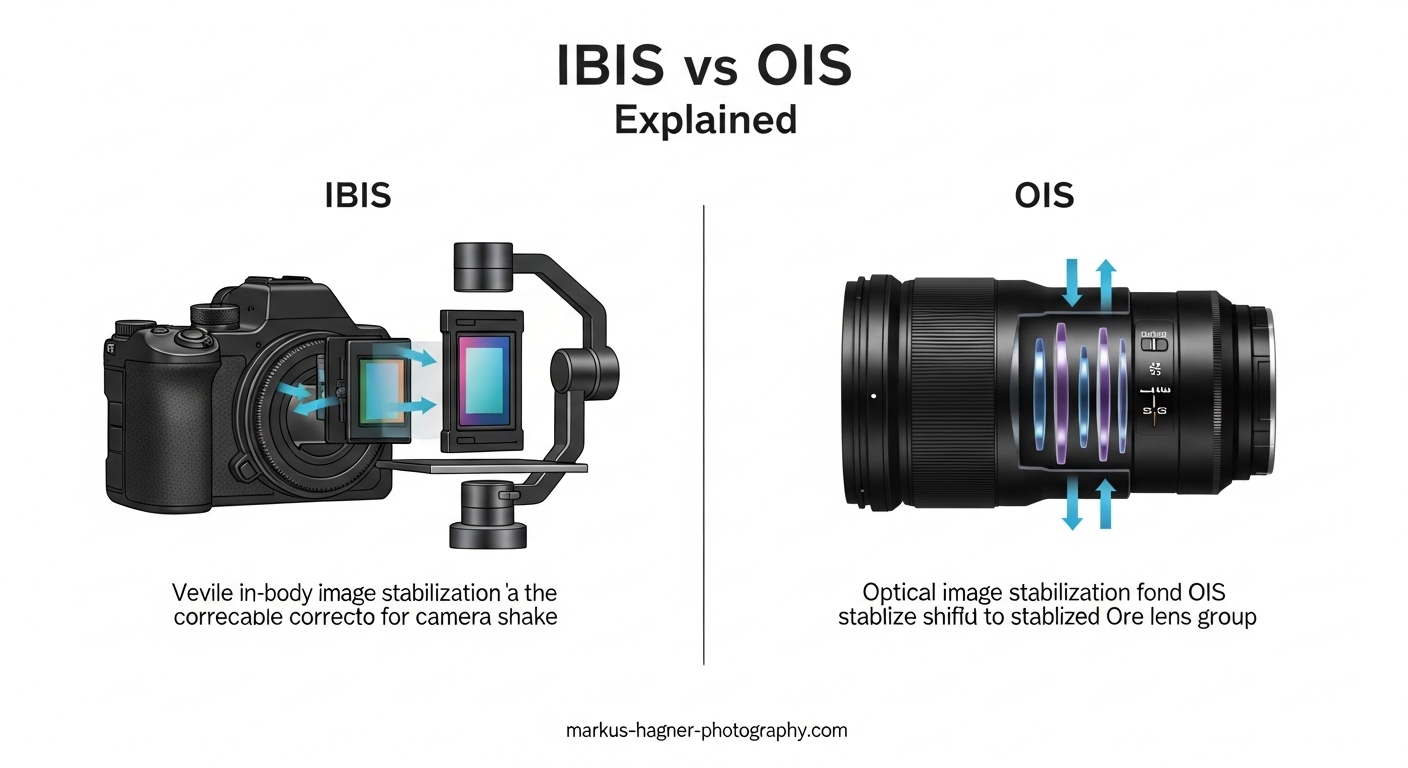
In-Body Image Stabilization (IBIS) moves your camera’s sensor to counteract shake. Optical Image Stabilization (OIS) moves elements inside your lens. Both help you capture sharper handheld images at slower shutter speeds, but they excel in different situations and work differently across camera brands.
In this guide, I will break down exactly how each system works, when to favor one over the other, and whether having both truly gives you the best of both worlds. By the end, you will know exactly which stabilization approach suits your shooting style.
What is IBIS (In-Body Image Stabilization)?
In-Body Image Stabilization, commonly called IBIS, is a camera technology that physically moves the image sensor to compensate for camera movement. Instead of stabilizing the image through the lens, the camera shifts its sensor in real-time to counteract shake. This approach has become standard in most modern mirrorless cameras from Sony, Nikon, Fujifilm, Olympus, and Panasonic.
The key advantage of IBIS is that it works with any lens you attach to your camera. Whether you are using a brand new autofocus lens, a vintage manual focus optic from the 1970s, or an adapted lens from a different mount entirely, IBIS provides stabilization. This flexibility makes IBIS incredibly valuable for photographers who enjoy using older or specialized lenses without built-in stabilization.
Understanding Five-Axis Stabilization
Most modern IBIS systems offer five-axis stabilization, which compensates for five distinct types of movement:
1. Pitch (X-axis rotation): Tilting the camera up or down, like nodding your head. This happens when you slightly point your lens upward or downward during handheld shooting.
2. Yaw (Y-axis rotation): Turning the camera left or right horizontally, like shaking your head. This is the most common type of camera shake during handheld photography.
3. Roll (Z-axis rotation): Rotating the camera around the lens axis, creating a slight clockwise or counterclockwise tilt. This often happens during longer handheld exposures.
4. X translation (horizontal shift): Moving the entire camera left or right without rotating it. This type of movement is more noticeable during macro photography or when shooting at higher magnifications.
5. Y translation (vertical shift): Moving the camera up or down without tilting. Like horizontal shift, this becomes more problematic with close-up work and longer focal lengths.
What Are “Stops of Stabilization”?
Manufacturers rate their stabilization systems in “stops,” which can be confusing if you are new to photography. One stop of stabilization means you can handhold your camera at a shutter speed twice as long (one stop slower) while maintaining acceptable sharpness. For example, if you could normally shoot sharp handheld at 1/60 second without stabilization, a 5-stop IBIS system theoretically lets you shoot at approximately 1/2 second.
In practice, stated stop values vary significantly based on focal length, shooting technique, and individual camera bodies. Real-world testing often shows IBIS delivering 3 to 6.5 stops of improvement depending on the system and conditions. My GFX50SII has delivered remarkably sharp results at shutter speeds I never thought possible handheld.
Which Cameras Feature IBIS?
Most current mirrorless cameras include IBIS, though implementation varies by brand. Sony Alpha series cameras (A7 III, A7 IV, A7R series, A1), Nikon Z-series (Z6, Z7, Z8, Z9), Fujifilm X and GFX series, Olympus OM System cameras, and Panasonic Lumix bodies all feature in-body stabilization. Canon has introduced IBIS in their R5 and R6 series, expanding from their traditional lens-based approach.
Entry-level mirrorless models sometimes omit IBIS to reduce cost, and most DSLRs (with rare exceptions like the Pentax K-1 series) rely exclusively on lens-based stabilization. This distinction matters if you are deciding between camera systems or upgrading from a DSLR.
What is OIS (Optical Image Stabilization)?
Optical Image Stabilization, known as OIS, stabilizes your image by moving optical elements inside the lens itself. A floating lens element shifts in real-time to counteract camera movement before light ever reaches the sensor. This lens-based approach has been around longer than IBIS and remains the primary stabilization method for telephoto and super-telephoto lenses.
You will typically find OIS on longer zoom lenses, telephoto primes, and some standard zooms. Most manufacturers mark stabilized lenses with specific branding: Canon uses “IS” (Image Stabilization), Nikon uses “VR” (Vibration Reduction), Sony uses “OSS” (Optical SteadyShot), Fujifilm uses “OIS,” and Panasonic uses “OIS” or “Power OIS.” When shopping for lenses, these designations indicate built-in stabilization.
How Lens-Based Stabilization Works
OIS systems use gyroscopic sensors to detect angular movement (pitch and yaw) and a floating lens element that shifts perpendicular to the optical axis. When the camera tilts upward, the lens element moves to redirect light and maintain a stable image on the sensor. This happens continuously and near-instantaneously while you shoot.
Most OIS lenses include a physical switch on the barrel to enable or disable stabilization. Some lenses offer multiple stabilization modes. Mode 1 typically provides standard stabilization for static subjects. Mode 2 often detects panning motion and only stabilizes vertical shake, allowing smooth horizontal tracking. Mode 3, found on some newer lenses, only activates stabilization during the actual exposure, which can make tracking erratically moving subjects easier through the viewfinder.
Advantages of Lens-Based Stabilization
OIS excels at longer focal lengths where sensor-based stabilization becomes less effective. The physics of magnification means that camera shake is amplified at telephoto ranges. A floating lens element positioned near the front of the optical path can counteract this shake more efficiently than moving the smaller image sensor at the back of the lens.
Another advantage is that you see a stabilized view through the optical viewfinder on DSLRs or an electronically stabilized view on mirrorless cameras before taking the shot. This helps with composition and tracking subjects. With IBIS alone on some older mirrorless cameras, the viewfinder image might appear less stable than the final captured image.
How IBIS and OIS Work: The Technical Details
Both stabilization systems rely on similar fundamental principles but execute them differently. Understanding the mechanics helps explain why each system performs better in specific scenarios.
The Detection Process
All modern stabilization systems, whether in-body or lens-based, use gyroscopes and accelerometers to detect camera movement. These sensors measure angular velocity (how fast the camera is rotating) and linear acceleration (how fast it is moving in any direction). Sophisticated algorithms process this data hundreds or thousands of times per second.
When you half-press the shutter button or begin recording video, the stabilization system activates and starts tracking your camera’s position and movement. The system continuously predicts where shake will occur based on detected motion patterns, allowing it to compensate before blur actually appears in your image.
IBIS Mechanics: Sensor Movement
Once movement is detected, IBIS physically shifts the image sensor using electromagnetic actuators. The sensor sits on a floating platform that can move in five directions to counteract detected shake. Here is the step-by-step process:
Step 1: Gyroscopes and accelerometers detect camera movement along five axes and feed this data to the camera’s image processor.
Step 2: The processor calculates the exact amount and direction of sensor shift needed to counteract the detected movement.
Step 3: Electromagnetic actuators physically move the sensor platform in the opposite direction of the shake, maintaining the image position.
Step 4: The system continuously adjusts sensor position up to thousands of times per second, compensating for ongoing camera movement.
Step 5: During the exposure, the sensor remains stabilized relative to the incoming image, producing a sharp result despite camera shake.
This approach works exceptionally well for wide-angle to normal focal lengths where the sensor has ample room to shift within the image circle projected by the lens.
OIS Mechanics: Lens Element Movement
OIS systems work similarly but move a floating lens element instead of the sensor. The process looks like this:
Step 1: Gyroscopes within the lens detect angular movement (primarily pitch and yaw).
Step 2: A dedicated processor in the lens calculates the necessary correction and determines which direction to shift the floating element.
Step 3: Voice coil motors or piezoelectric actuators shift the floating lens element perpendicular to the optical axis, redirecting light to maintain a stable image.
Step 4: The system continuously adjusts the element position, typically compensating at several thousand times per second.
Step 5: Light reaches the sensor already stabilized, producing a sharp image.
Because the correction happens optically before light reaches the sensor, OIS can handle the larger angular corrections needed at long focal lengths more effectively than sensor-based systems.
Why Focal Length Matters
The fundamental difference between IBIS and OIS effectiveness comes down to physics. At longer focal lengths, the same angular camera movement creates much larger image displacement at the sensor plane. A 400mm lens magnifies shake far more than a 24mm lens.
For IBIS to compensate, the sensor must physically travel further to counteract this magnified shake. At extreme telephoto ranges, the sensor can run out of travel distance within the lens’s image circle. OIS does not face this limitation because the floating element can make larger corrections without running into physical boundaries.
Conversely, at wide angles, IBIS often outperforms OIS because the required sensor movement is minimal. Many wide-angle lenses do not even include OIS, making IBIS essential for handheld shooting with these focal lengths.
IBIS vs OIS: Quick Comparison
Understanding the key differences between these stabilization approaches helps you choose the right tool for each situation. Here is a side-by-side breakdown:
| Feature | IBIS (In-Body) | OIS (Lens-Based) |
|---|---|---|
| Location | Inside camera body | Inside lens |
| Works with | Any attached lens | Only lenses with OIS |
| Best for focal lengths | Wide to normal (under 70mm) | Telephoto (over 70mm) |
| Number of axes | 5 axes standard | 2 axes typically |
| Adapted lens support | Excellent | N/A (lens-specific) |
| Battery drain | Moderate (always active) | Lower (only when enabled) |
| Cost | Built into camera price | Paid per stabilized lens |
| Viewfinder stability | Variable by camera | Stabilized in real-time |
Neither system is universally better. The right choice depends entirely on what you shoot and which lenses you use.
IBIS Pros and Cons
Pros of IBIS:
- Works with every lens, including vintage, manual focus, and adapted optics
- Provides five-axis stabilization including roll correction
- No additional cost per lens
- Consistent behavior across your entire lens collection
- Excellent for video with wide-angle lenses
- Enables handheld shooting at remarkably slow shutter speeds with wide primes
Cons of IBIS:
- Less effective at telephoto focal lengths (typically above 200mm)
- Contributes to battery drain when active
- Not available on all camera bodies (especially entry-level models)
- Cannot stabilize the viewfinder image on some older mirrorless cameras
- Potential for sensor dust when the sensor moves frequently
OIS Pros and Cons
Pros of OIS:
- Superior performance at telephoto and super-telephoto focal lengths
- Stabilized viewfinder image for easier composition and tracking
- Can be turned off via physical switch when not needed
- Panning modes available on many lenses for sports and wildlife
- Does not require camera body features (works on any compatible body)
Cons of OIS:
- Only available on specific lenses, adding cost and weight
- Typically only two-axis stabilization (pitch and yaw)
- Does not work with adapted lenses or unstabilized primes
- Some lenses have noisier OIS systems that can affect video audio
- Older OIS systems can produce a slight “floating” sensation when composing
When Each Type of Stabilization Matters More
The IBIS vs OIS question does not have a universal answer. Your shooting style, typical subjects, and lens choices determine which system serves you better. Here is how each scenario breaks down.
Wide-Angle Handheld Photography: IBIS Wins
For landscapes, architecture, street photography, and environmental portraits with focal lengths under 50mm, IBIS delivers superior results. The five-axis stabilization can handle the subtle movements that blur images at these focal lengths. I have captured sharp handheld images at 1/2 second with a 24mm lens thanks to modern IBIS systems.
Wide-angle lenses rarely include OIS because the image stabilization would provide minimal benefit. If you primarily shoot with 16mm, 24mm, 35mm, or 50mm primes, having a camera with IBIS transforms your handheld shooting capabilities.
Telephoto and Wildlife Photography: OIS Wins
When shooting with focal lengths above 200mm, especially for wildlife, sports, or distant subjects, OIS outperforms IBIS significantly. The physics of long lenses amplifies camera shake, and lens-based stabilization handles these larger corrections more effectively.
If you use 70-200mm zooms, 100-400mm lenses, or super-telephoto primes, prioritize lenses with quality OIS. Some systems combine OIS with IBIS for even better results at these focal lengths, which I will discuss shortly.
Low-Light Stills with Prime Lenses: IBIS Essential
Prime lenses rarely include built-in stabilization, yet they excel in low light due to their wider maximum apertures. This combination makes IBIS invaluable for available-light photography with primes. Shooting handheld at ISO 1600 instead of ISO 6400 makes a visible difference in image quality.
Street photographers, documentary shooters, and anyone who works in dim conditions with prime lenses benefits enormously from IBIS. The ability to shoot at 1/15 or even 1/8 second with a 35mm or 50mm prime opens creative possibilities that would otherwise require a tripod.
Street Photography: IBIS Favored
Street photography often demands discretion, speed, and available light. Small prime lenses keep your profile low, and IBIS lets you shoot at slower shutter speeds without raising ISO to noisy levels. The five-axis stabilization helps with the varied shooting angles and positions common in street work.
Most street photographers prefer compact, unstabilized primes. Without IBIS, you would need faster shutter speeds, higher ISOs, or larger apertures (reducing depth of field) to capture sharp images. IBIS gives you flexibility in this balance.
Wildlife and Sports: OIS Critical
Fast-moving subjects at long distances require telephoto lenses, and telephoto lenses benefit most from OIS. The stabilized viewfinder image also helps track erratic subjects, which is crucial for birds in flight or athletes in motion.
Many wildlife photographers use lenses in the 400mm to 600mm range, where IBIS alone struggles. Quality OIS (or combined IBIS+OIS) makes the difference between unusable blur and publication-worthy shots at these focal lengths.
Video Applications: Combined or IBIS Preferred
For video, the stabilization requirements differ from still photography. Roll correction becomes critical because horizontal lines in video accentuate any rotational movement. IBIS with five-axis stabilization handles roll automatically, which most OIS systems cannot address.
Walking shots and handheld video at wide angles work best with IBIS. For telephoto video, combined IBIS+OIS systems deliver the smoothest results. Some cameras also offer electronic stabilization (EIS) that crops the frame slightly but provides additional smoothing for video work.
Do IBIS and OIS Work Together?
This question comes up constantly in photography forums, and the answer varies by camera system. Yes, IBIS and OIS can work together, but how they coordinate depends entirely on your camera brand and specific gear combination.
How Combined Systems Coordinate
In systems where IBIS and OIS work together, the camera communicates with the lens to divide stabilization responsibilities intelligently. Generally, OIS handles pitch and yaw (the two axes it excels at), while IBIS handles roll correction and translational movements. This division leverages each system’s strengths.
Sony cameras with IBIS and Sony OSS lenses coordinate automatically. Panasonic’s Dual I.S. and Dual I.S. 2 systems combine in-body and lens stabilization for rated improvements up to 6.5 stops. Olympus (now OM System) pioneered coordinated stabilization with their Sync IS technology. Nikon’s system works similarly with VR lenses on Z-series bodies.
The communication happens in real-time. The lens detects angular shake and compensates with OIS while sending data to the body about focal length and compensation applied. The body then uses IBIS for any remaining correction needed, particularly roll and translational movements.
When Combined Stabilization Helps
Combined IBIS+OIS shines at telephoto focal lengths where neither system alone provides optimal performance. A 200mm or 300mm lens with OIS mounted on a body with IBIS can deliver more stabilization stops than either system alone. Landscape photographers working at sunset with telephoto zooms particularly benefit.
For video work at longer focal lengths, combined stabilization produces smoother footage. The OIS handles the large angular movements while IBIS smooths out roll and fine vibrations. This layered approach results in more professional-looking handheld video.
Potential Issues with Combined Systems
Not all camera-lens combinations coordinate smoothly. Some photographers report jittery or blurry images when both systems activate, particularly with older lenses or third-party optics. The systems may fight each other or introduce subtle oscillations that actually degrade image quality.
If you experience these issues, try disabling one system (usually by turning off OIS on the lens) to see which produces better results. Some firmware updates address coordination issues, so keeping your camera and lens firmware current matters.
Additionally, some photographers find that for static subjects at moderate focal lengths, IBIS alone produces better results than the combined system. Testing your specific gear combination helps determine the optimal setup for your shooting style.
Brand-Specific Behavior
Each manufacturer implements combined stabilization differently:
Sony: OSS lenses on Alpha bodies with IBIS coordinate automatically. The system generally works well, though some older lenses may not communicate optimally.
Panasonic: Dual I.S. requires compatible Lumix lenses. The system delivers some of the best combined stabilization performance available.
OM System/Olympus: Sync IS works with specific lenses and provides up to 7 stops of correction in some configurations.
Nikon: VR lenses on Z bodies can work together, with OIS handling some axes and IBIS handling others. The behavior varies by lens.
Canon: RF IS lenses on R5/R6 bodies coordinate through Coordinated IS, which optimizes the division of labor between systems.
Fujifilm: XF lenses with OIS on X-series bodies with IBIS (like X-T4, X-T5, X-H2) can work together, though users should test specific combinations for optimal results.
Practical Tips for Using Image Stabilization
Knowing when and how to use stabilization improves your results significantly. These practical guidelines come from years of real-world shooting with various systems.
When to Turn Off Stabilization
Image stabilization should be disabled when your camera is mounted on a tripod for static subjects. The stabilization system continues trying to detect and correct movement that does not exist, which can actually introduce blur or oscillation. Most modern cameras include tripod detection, but I recommend manually disabling stabilization for critical work.
Long exposures on tripods particularly suffer from active stabilization. If you are shooting 30-second landscapes or astrophotography with your camera locked down, turn off both IBIS and OIS. The systems are designed for handheld motion compensation, not the absolute stability of a good tripod.
Panning with moving subjects sometimes benefits from mode-specific stabilization rather than turning it off entirely. Use OIS Mode 2 (panning mode) when tracking horizontal motion, which disables horizontal stabilization while maintaining vertical correction.
Continuous vs Shooting-Only Modes
Many cameras offer different stabilization activation modes. Continuous mode keeps stabilization active whenever the camera is on, which provides a stable viewfinder image but drains battery faster. Shooting-only mode activates stabilization only when you half-press the shutter or begin recording.
For still photography, shooting-only mode usually works well and conserves battery. For video, continuous mode makes composing and tracking easier because you see a stabilized image at all times. Some cameras also offer separate settings for viewfinder stabilization versus capture stabilization.
Battery Life Considerations
Image stabilization draws power, and IBIS typically consumes more than OIS because it runs whenever the camera is active. If battery life matters for your shooting (travel, events, long days), consider these strategies:
- Use shooting-only stabilization mode for stills
- Turn off IBIS when shooting from a tripod
- Carry extra batteries for intensive stabilization use
- Disable continuous stabilization when not actively composing
The battery impact varies by camera, but you might notice 10-20% reduced battery life with IBIS running continuously.
Subject Motion vs Camera Shake: A Critical Distinction
One point that forum discussions frequently overlook: neither IBIS nor OIS prevents subject motion blur. These systems only counteract camera movement. If your subject moves during the exposure, it will still blur regardless of how effective your stabilization is.
This matters because many photographers misunderstand what stabilization does. IBIS lets you handhold at 1/8 second for a static landscape, but it will not freeze a running person at that shutter speed. For moving subjects, you still need appropriately fast shutter speeds regardless of your stabilization capabilities.
Think of stabilization as extending your handheld capabilities for static subjects, not as a universal blur prevention system. This understanding prevents disappointment when your stabilized camera still produces blurry images of moving subjects.
Testing Your Own System
Every camera-lens combination behaves differently. I recommend testing your gear to understand its real-world performance:
Step 1: Find a target with fine detail (text on signs works well) at a consistent distance.
Step 2: Start at a shutter speed you know you can handhold sharply (like 1/focal length).
Step 3: Take several shots, each time slowing the shutter speed by one stop.
Step 4: Review images at 100% to find the slowest shutter speed where most shots remain sharp.
Step 5: Compare with and without stabilization, with IBIS only, with OIS only, and with combined systems if applicable.
This testing reveals your practical stabilization benefit rather than relying on manufacturer claims.
IBIS vs OIS: Frequently Asked Questions
Which is better OIS or IBIS?
Neither system is universally better. IBIS excels with wide-angle lenses (under 70mm) and prime lenses without built-in stabilization. OIS performs better at telephoto focal lengths (above 200mm) where sensor-based correction faces physical limitations. The best approach depends entirely on your focal length choices and shooting style. Many photographers benefit from having both available.
Do you need OIS with IBIS?
You do not need OIS if you have IBIS, but having both provides advantages in specific situations. OIS becomes beneficial at longer focal lengths where it outperforms IBIS alone. Combined IBIS+OIS systems deliver better results than either system independently, particularly for telephoto photography and video work. For wide-angle and normal focal lengths with prime lenses, IBIS alone is sufficient.
Do IBIS and OIS work together?
Yes, IBIS and OIS can work together on many modern camera systems, though behavior varies by brand. In coordinated systems, OIS typically handles pitch and yaw correction while IBIS manages roll and translational movements. Sony, Panasonic, OM System, Nikon, and Canon all offer combined stabilization on compatible body-lens combinations. Some users report issues with certain lens-camera pairings, so testing your specific gear is recommended.
Is IBIS worth it for photography?
IBIS is definitely worth it if you shoot handheld with prime lenses, work in low light, photograph static subjects like landscapes and architecture, or use adapted and manual focus lenses. The ability to shoot at slower shutter speeds without raising ISO provides tangible image quality benefits. If you primarily use telephoto zooms with OIS or shoot from a tripod, IBIS becomes less critical. Consider your typical shooting scenarios when evaluating IBIS importance for your workflow.
When should I turn off image stabilization?
Turn off image stabilization when your camera is mounted on a tripod for static subjects. Active stabilization on a stable tripod can actually introduce blur as the system tries to correct non-existent movement. Also consider disabling stabilization for very long exposures, when panning with moving subjects (use panning mode instead), or when battery conservation is critical. Most other handheld shooting situations benefit from active stabilization.
IBIS vs OIS: Making the Right Choice for Your Photography
The IBIS vs OIS debate ultimately comes down to your equipment choices and shooting style rather than a clear winner. Both technologies solve the same problem through different approaches, and understanding when each excels helps you make informed decisions about your gear and technique.
For photographers who work with prime lenses, shoot handheld in low light, capture landscapes and architecture, or enjoy adapting vintage optics, IBIS transforms what is possible. The five-axis stabilization and universal lens compatibility make it invaluable for these applications.
For wildlife, sports, and anyone working at telephoto focal lengths, OIS delivers superior performance. The optical approach handles the magnified shake at long focal lengths more effectively than any sensor-based system.
The ideal scenario? A camera body with IBIS paired with telephoto lenses featuring OIS. This combination gives you stabilization with any lens while delivering peak performance when both systems coordinate at longer focal lengths. Most modern mirrorless systems offer this capability, making it easier than ever to have the best of both worlds.
Remember that stabilization extends your handheld capabilities but does not replace good technique or freeze moving subjects. Use it as a tool to push your boundaries, not as a crutch that substitutes for fundamentals. With this understanding, you can leverage IBIS and OIS effectively to capture sharper images in challenging conditions.