
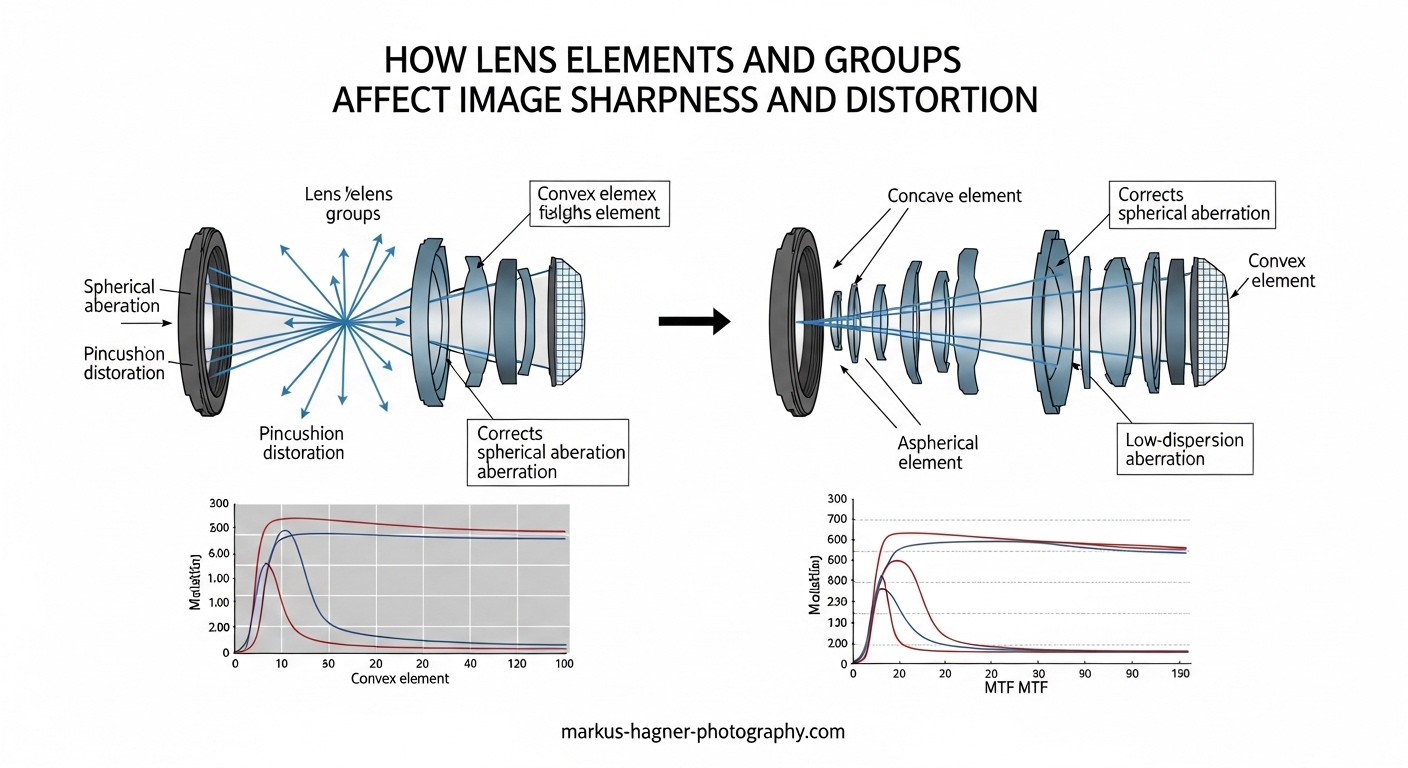
When you shop for camera lenses, you will often see specifications listing elements and groups. For example, a lens might be described as having “15 elements in 12 groups.” But what does this actually mean for your photography? Understanding lens elements and groups helps you evaluate optical quality and predict how a lens will perform in real-world shooting situations.
Lens elements are individual pieces of glass or optical material within a camera lens that bend and focus light. Lens groups are assemblies of two or more elements cemented or fixed together that function as a single unit within the optical system. The arrangement and quality of these elements directly determines image sharpness, distortion characteristics, and overall optical performance.
In this guide, I will explain how lens construction affects your images, debunk common myths about element counts, and help you understand what really matters when evaluating lens quality. Whether you shoot landscapes, portraits, or architecture, understanding lens optics will make you a more informed photographer.
What Are Lens Elements and Groups?
A lens element is a single piece of optical glass or synthetic material shaped to bend light in specific ways. Each element has at least two surfaces that refract light as it passes through. Modern camera lenses contain multiple elements working together to focus light precisely onto your camera sensor while minimizing optical flaws.
Lens groups refer to how these elements are arranged within the lens barrel. When two or more elements are cemented together or mounted as a fixed unit, they form a group. A lens with “12 elements in 10 groups” has 12 individual glass pieces organized into 10 separate assemblies.
Manufacturers group elements together for several reasons. Cemented elements can correct certain aberrations more effectively than separated elements. Grouping also simplifies the mechanical design and can reduce internal reflections. Zoom lenses typically have more groups because different element clusters need to move independently to change focal length while maintaining focus.
How Lens Elements Affect Image Sharpness
Image sharpness depends heavily on how well lens elements focus light onto a single point. Each element bends light at specific angles, and the cumulative effect of all elements determines whether light rays converge precisely at the focal plane. When elements work together perfectly, you get crisp details from center to corner.
Multiple elements allow designers to correct aberrations that would otherwise soften your images. A single lens element cannot focus all colors of light at the same point, causing chromatic aberration that reduces sharpness. By combining elements made from different glass types, designers can bring red, green, and blue light to the same focus point.
Sharpness varies across the image frame for several reasons. Light hitting the sensor at oblique angles near the corners can cause marginal ray falloff. Optical designs that prioritize corner sharpness often require more complex element arrangements. Some lenses sacrifice edge performance for a smaller size or lower cost, resulting in softer corners at wide apertures.
Glass quality matters more than element count for sharpness. Premium optical glass has fewer internal imperfections and more consistent refractive properties. High-quality elements transmit more light with less scattering, producing images with better contrast and micro-contrast. This is why professional-grade lenses often outperform consumer lenses despite having similar element counts.
Understanding Lens Distortion Types
Lens distortion occurs when a lens cannot render straight lines as perfectly straight. This geometric error results from how lens elements bend light differently across the image field. Understanding distortion types helps you choose the right lens for your subject and correct issues in post-processing when needed.
Barrel Distortion
Barrel distortion makes straight lines bow outward like the sides of a wooden barrel. This type of distortion is common in wide-angle lenses, where the field of view exceeds what a simple optical design can render accurately. Lines near the edges of the frame curve outward most noticeably, with the effect decreasing toward the center.
Barrel distortion occurs because wide-angle lenses must bend light from a wide field of view into a relatively narrow image circle. The magnification varies across the frame, with edge areas receiving less magnification than the center. Complex element designs with aspherical surfaces can reduce barrel distortion significantly.
Pincushion Distortion
Pincushion distortion does the opposite: straight lines bow inward toward the center of the frame. This pattern resembles the shape of a pincushion used for storing sewing pins. Pincushion distortion typically appears in telephoto lenses and at the long end of zoom lenses.
The cause is similar to barrel distortion but reversed. Edge areas receive more magnification than the center, causing lines to curve inward. Portrait photographers often tolerate slight pincushion distortion because it can make faces appear slightly slimmer.
Mustache Distortion
Mustache distortion, also called wavy or complex distortion, combines elements of both barrel and pincushion patterns. Lines bow outward near the center and inward near the edges, creating an S-shaped curve. This distortion type is harder to correct in post-processing because it varies across different zones of the image.
Some wide-angle zooms exhibit mustache distortion at certain focal lengths. The complex distortion pattern results from the lens design prioritizing other optical qualities at the expense of geometric accuracy. For architectural photography, mustache distortion can be particularly problematic.
Common Optical Aberrations and Their Causes
Beyond geometric distortion, lens elements can introduce various optical aberrations that affect image quality. These flaws result from the fundamental physics of light and how it interacts with glass. Modern lens designs use multiple elements specifically to minimize these aberrations.
Chromatic Aberration
Chromatic aberration occurs because different colors of light bend at different angles when passing through glass. Blue light refracts more than red light, causing color fringing around high-contrast edges. You will often see purple or green fringes along tree branches against a bright sky.
Lens designers combat chromatic aberration using low-dispersion glass elements. These special materials have more uniform refractive properties across the color spectrum. Achromatic doublets pair a regular glass element with a low-dispersion element to bring two colors to the same focus point. Apochromatic designs correct three colors simultaneously for even better results.
Spherical Aberration
Spherical aberration happens when light rays passing through the edge of a spherical lens element focus at a different point than rays passing through the center. This creates a soft, glowing effect that reduces overall sharpness and contrast. Fast lenses with large maximum apertures are particularly prone to spherical aberration.
Aspherical lens elements provide the primary solution. Unlike standard elements with uniformly curved surfaces, aspherical elements have varying curvature that focuses edge and center rays at the same point. This correction allows for faster maximum apertures without sacrificing sharpness.
Coma and Astigmatism
Coma aberration causes points of light near the edges of the frame to appear as comet-shaped streaks rather than round points. This flaw is especially noticeable in astrophotography when stars near the corners develop tails pointing toward or away from the image center.
Astigmatism occurs when a lens focuses horizontal and vertical lines at different distances. Points of light become elongated in one direction, and overall sharpness suffers. Both coma and astigmatism result from how oblique light rays interact with spherical lens surfaces.
Field Curvature and Vignetting
Field curvature describes when a lens focuses on a curved surface rather than a flat plane. The center and edges cannot both be in sharp focus simultaneously. Landscape photographers often stop down to smaller apertures to increase depth of field and mask this issue.
Vignetting causes the corners of an image to appear darker than the center. This occurs because light reaching the corners travels through the lens at more extreme angles, passing through less of the aperture opening. Some vignetting can be corrected in post-processing, but optical designs that minimize vignetting typically require larger front elements.
Special Lens Elements: Aspherical and Low-Dispersion Glass
Modern premium lenses often feature special element types that go beyond standard optical glass. These advanced materials and manufacturing techniques allow designers to achieve optical performance that would be impossible with conventional elements alone.
Aspherical Elements
Aspherical lens elements have surfaces that deviate from a perfect sphere. This non-uniform curvature allows a single element to correct spherical aberration that would otherwise require multiple conventional elements. Aspherical elements also help reduce distortion and improve corner sharpness.
Manufacturing aspherical elements is more expensive than standard elements. The complex surface requires precision molding or grinding processes. However, the optical benefits are substantial. Many fast prime lenses use aspherical elements to maintain sharpness at wide apertures where spherical aberration would otherwise cause softness.
Low-Dispersion Glass
Low-dispersion (LD, ED, or UD depending on the manufacturer) glass has special optical properties that reduce chromatic aberration. These materials spread different colors of light less than standard optical glass, allowing more accurate color correction across the spectrum.
Telephoto lenses benefit most from low-dispersion elements because chromatic aberration increases with focal length. A telephoto without adequate color correction will show significant purple fringing on high-contrast subjects. Professional telephoto lenses often incorporate multiple low-dispersion elements to eliminate this flaw.
Fluorite Elements
Fluorite is a naturally occurring crystal with exceptional optical properties. Synthetic fluorite elements have extremely low dispersion and partial dispersion characteristics that exceed even the best optical glass. Canon and other manufacturers use fluorite in their super-telephoto lenses for superior chromatic aberration correction.
Fluorite elements are expensive to manufacture and more fragile than glass. They require special handling and mounting to prevent damage. However, for demanding applications like wildlife and sports photography, the optical benefits justify the cost.
How Lens Coatings Impact Image Quality
Lens coatings are thin layers applied to element surfaces to control how light interacts with the glass. Without coatings, each glass-air interface would reflect approximately 4% of incoming light. A lens with 10 elements has 20 surfaces, potentially losing significant light to reflections.
Anti-reflective coatings work through destructive interference. The coating thickness is precisely calculated so that light reflected from the coating surface and light reflected from the glass surface cancel each other out. Modern multi-coating designs use multiple layers to reduce reflections across a broad range of wavelengths.
Coatings dramatically improve contrast and flare resistance. Uncoated lenses suffer from internal reflections that create veiling flare and reduce contrast. Multi-coated lenses maintain rich contrast even when shooting toward bright light sources. Ghost images, which appear as secondary reflections of bright points of light, are also minimized by effective coatings.
Manufacturers have developed specialized coatings for different purposes. Nano-crystal coatings use extremely fine structures to reduce reflections further. Water-repellent coatings help keep front elements clean. Some coatings also improve scratch resistance for greater durability in the field.
Debunking the “More Elements Is Better” Myth
Many photographers assume that lenses with more elements must be better. After all, more glass should mean more correction and better image quality. However, this assumption is often wrong. Element count alone tells you very little about actual optical performance.
Simple lens designs can produce excellent results. The classic Tessar design uses only four elements yet has produced sharp, contrasty images for over a century. Some of the most respected lenses in photography history have relatively few elements. The quality and arrangement of elements matters far more than the total count.
More elements create potential problems. Each additional air-glass surface introduces opportunities for reflections that reduce contrast. More elements also mean more weight, larger size, and higher manufacturing costs. A poorly designed 15-element lens will underperform a well-designed 8-element lens every time.
Zoom lenses and fast primes do require more elements. A 24-70mm f/2.8 zoom needs complex element arrangements to maintain image quality across the focal length range while offering a wide maximum aperture. Similarly, an f/1.4 prime requires more correction elements than an f/1.8 version. In these cases, element count reflects the design requirements rather than inherent quality.
What actually matters for lens quality? Glass quality and element types are more important than count. Look for aspherical and low-dispersion elements rather than focusing on total numbers. Coating quality significantly impacts contrast and flare resistance. Optical design skill determines how well all elements work together. Real-world reviews and sample images will tell you more about actual performance than specifications alone.
Frequently Asked Questions
What do elements and groups mean when considering camera lenses?
Elements are individual pieces of glass within a lens barrel, while groups are assemblies of two or more elements that are cemented or fixed together. For example, a lens described as ’15 elements in 12 groups’ has 15 separate glass pieces organized into 12 distinct groupings. The arrangement affects how light travels through the lens and ultimately impacts optical performance.
How do lens elements affect image quality?
Lens elements bend and focus light to form an image on your sensor. Multiple elements work together to correct optical aberrations like chromatic aberration, spherical aberration, and distortion. The quality of glass, precision of manufacturing, and coating effectiveness all influence final image quality. Well-designed elements produce sharp, contrasty images with accurate colors and minimal distortion.
Are more lens elements better?
Not necessarily. Element count alone does not determine optical quality. Simple designs like the four-element Tessar can produce excellent images, while poorly designed lenses with many elements may underperform. More elements are often needed for zoom lenses and fast apertures, but quality of glass, coating effectiveness, and overall design matter more than the total number of elements.
What causes barrel and pincushion distortion?
Barrel distortion occurs in wide-angle lenses when edge magnification is less than center magnification, causing straight lines to bow outward. Pincushion distortion appears in telephoto lenses when edge magnification exceeds center magnification, making lines bow inward. Both result from how lens elements bend light at different angles across the image field. Aspherical elements and complex designs can minimize these distortions.
How do aspherical lens elements improve image quality?
Aspherical elements have non-uniform curvature that corrects spherical aberration in a single element rather than requiring multiple conventional elements. They improve sharpness across the entire frame, especially at wide apertures where spherical aberration is most problematic. Aspherical elements also help reduce distortion and can make lens designs more compact while maintaining optical quality.
What is chromatic aberration in camera lenses?
Chromatic aberration is color fringing caused by different wavelengths of light focusing at different points. Because glass bends blue light more than red light, high-contrast edges may show purple or green fringes. Low-dispersion glass elements and apochromatic lens designs correct this aberration by bringing multiple colors to the same focus point.
How many elements should a good lens have?
There is no ideal element count. What matters is the optical design and quality of materials. A well-designed prime lens might have 6 to 12 elements, while a professional zoom could have 15 to 20 or more. Look for aspherical and low-dispersion elements rather than focusing on total numbers. Real-world performance matters more than specifications alone.
Conclusion
Understanding how lens elements and groups affect image sharpness and distortion gives you valuable insight into lens performance. Rather than counting elements, focus on the quality and types of glass used in construction. Aspherical elements correct spherical aberration, low-dispersion glass fights chromatic aberration, and effective coatings maintain contrast in challenging lighting.
Distortion patterns vary by lens type and focal length. Wide-angle lenses tend toward barrel distortion, while telephotos may show pincushion distortion. Most distortion can be corrected in post-processing, but lenses with minimal optical flaws save you editing time and preserve image quality.
When evaluating lenses, remember that specifications tell only part of the story. A well-designed lens with quality glass and coatings will outperform a lens with more elements but inferior materials. Read reviews, examine sample images, and consider your specific photography needs. For architectural work, prioritize low distortion. For portraits, slight softness at wide apertures may be acceptable or even desirable.
The best lens for your photography depends on how you shoot, not on element counts in specifications. Armed with this understanding of lens elements and groups, you can make more informed decisions and choose equipment that truly serves your creative vision in 2026 and beyond.