
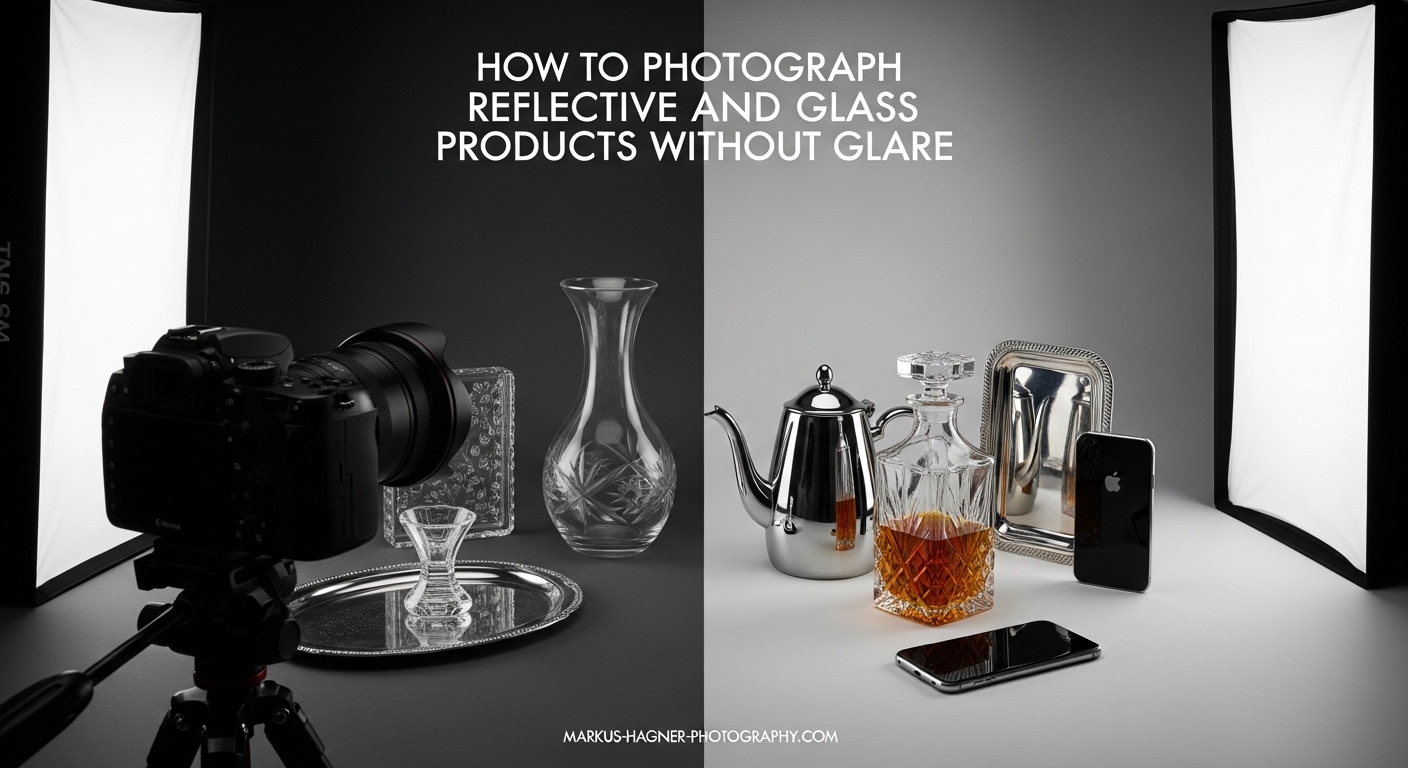
Glass and reflective surfaces present some of the most challenging obstacles in product photography. Whether you’re shooting elegant glassware for an e-commerce catalog, photographing sunglasses for a retail website, or capturing the sheen of a premium watch, unwanted glare and reflections can instantly undermine an otherwise professional image. The unique properties of glass make it simultaneously transparent and reflective, creating a photography challenge that separates amateur attempts from professional results.
The fundamental problem with glass and reflective products is their ability to reflect light from multiple directions simultaneously. Unlike matte surfaces that simply absorb or scatter light, glass acts as a complex mirror that can capture and reflect everything in its environment, including your camera, studio equipment, and any ambient light sources. This is why those first attempts at glass photography often result in images plagued by hot spots, unwanted reflections, and that dreaded glare that obscures the product’s true beauty.
The good news is that with the right techniques, equipment, and understanding of light behavior, you can consistently capture stunning glass and reflective product images that showcase your subjects in their best light. This comprehensive guide will walk you through everything from essential equipment selection to advanced lighting setups, camera settings, and post-processing techniques that professional product photographers use to eliminate glare and create beautiful, saleable images.
Essential Equipment for Glass Photography
Before diving into lighting techniques, let’s discuss the equipment you’ll need to achieve professional-quality glass photography. While professional studios use specialized gear, you can accomplish impressive results with a modest setup or even DIY alternatives.
Camera and Lens Requirements
Any modern camera with manual exposure controls will work for glass photography. The key requirement is the ability to control aperture, shutter speed, and ISO independently. A DSLR or mirrorless camera with a macro lens or a standard zoom lens (50mm to 105mm) provides the ideal focal length range for product photography. Avoid using wide-angle lenses as they can distort the proportions of your subject.
A tripod is absolutely essential for glass photography. Since you’ll be using narrow apertures and potentially slower shutter speeds, camera stability becomes critical. Additionally, a remote shutter release or your camera’s self-timer function eliminates camera shake caused by pressing the shutter button.
Lighting Equipment
For lighting, you have several options ranging from budget-friendly to professional studio equipment:
- Continuous lights: LED panels or professional continuous lighting kits allow you to see exactly how light falls on your subject before capturing the image. This makes them ideal for learning glass photography techniques.
- Strobe lights: Professional studio strobes offer more power and faster recycling times but require more setup to visualize your final result.
- Softboxes: These essential modifiers diffuse harsh light into soft, even illumination that minimizes reflections on glass surfaces.
- Diffusion material: White translucent fabric or professional diffusion panels soften your light sources and are critical for glass photography.
вспомогательные Tools: Foam Boards and Reflectors
Two of the most valuable tools for glass photography cost almost nothing. White foam boards (available at any craft store) serve as excellent reflectors, bouncing light into the shadow areas of your glass subject to reveal detail and form. Black foam boards perform the opposite function, absorbing light and controlling unwanted reflections through a technique called negative fill.
Always keep microfiber cloths and streak-free glass cleaner in your toolkit. Even the smallest fingerprints or dust particles will be painfully obvious in your final images, so thorough cleaning before each shoot is mandatory.
Understanding Light: The Key to Eliminating Glare
The secret to successful glass photography lies entirely in your understanding of light. Unlike opaque subjects where lighting is primarily about revealing form and texture, glass requires lighting that simultaneously reveals its transparency, creates attractive highlights, and avoids unwanted reflections. This requires a fundamentally different approach to lighting setup.
Backlighting Technique
Backlighting is the foundation of beautiful glass photography. By positioning your primary light source behind the subject, facing toward the camera, you create illumination that passes through transparent glass, revealing its volume and clarity. This technique creates those stunning bright edges and silhouettes that make glass products look elegant and professional.
The key to successful backlighting is ensuring the light itself is not visible in the frame. Your light source should be positioned below the camera’s line of sight, directed at the back of the set, with the glass product between the light and camera. This arrangement allows light to wrap around the glass while remaining invisible to the lens.
Side Lighting for Depth
While backlighting creates beautiful transparency, side lighting reveals the texture, form, and dimension of glass objects. A light positioned at 45 to 90 degrees to the side of your subject creates gradient highlights that show the curves and contours of glassware, bottles, and vases. This technique is particularly effective for thicker glass objects where you want to show depth and thickness.
The challenge with side lighting is avoiding harsh,集中 reflections that appear as bright spots on the glass surface. This is where diffusion becomes your best friend. Placing diffusion material between your light source and the subject softens the light, creating gentle transitions rather than harsh hotspots.
The Role of Diffusion
Diffusion is the process of spreading light rays to create soft, even illumination. For glass photography, harsh, direct light is your enemy because it creates obvious,集中 reflections that scream “amateur photography.” Diffused light, on the other hand, creates subtle,Wrap-around illumination that flatters glass subjects.
Professional photographers use various diffusion methods, from dedicated diffusion panels to simple solutions like shooting through a white bedsheet or using frosted shower curtains. The goal is to place diffusing material between your light source and the subject, creating light that appears to come from a large, soft source rather than a concentrated point.
Camera Settings for Glass and Reflective Products
With your lighting setup in place, camera settings become the final piece of the technical puzzle. Glass photography typically benefits from specific settings that maximize detail, minimize noise, and provide enough depth of field to keep the entire subject in focus.
Aperture Selection
For glass and reflective products, aperture selection involves balancing depth of field against sharpness. Apertures between f/8 and f/11 provide the ideal balance for most glass photography. At these settings, you’ll have sufficient depth of field to keep the entire glass product sharp while avoiding the diffraction softening that occurs at very narrow apertures.
Avoid using very wide apertures (f/1.8 to f/2.8) for glass product photography unless you’re specifically trying to isolate a single element with shallow depth of field. At wide apertures, only the plane of focus will be sharp, and glass surfaces at different depths will appear soft or blurred.
ISO and Noise Considerations
Always use the lowest ISO possible for your lighting conditions. For most studio glass photography with adequate lighting, ISO 100 provides the cleanest images with maximum detail. Higher ISOs introduce noise that is particularly problematic in the smooth gradients and subtle tones of glass photography. If your images appear noisy, address it by adding more light rather than increasing ISO.
White Balance for Glass
Glass can appear with unwanted color casts if your white balance isn’t set correctly. The best approach is to shoot in RAW format, which allows you to fine-tune white balance during post-processing. For jpeg shooters, manually set your white balance to daylight (around 5500K) or use a gray card to establish correct color temperature before shooting.
It’s worth noting that glass can pick up color reflections from its environment. A glass bottle photographed near a colorful background might appear to have a slight color cast. This is actually the glass faithfully transmitting environmental colors, and it can be both a challenge and an opportunity for creative photography.
Step-by-Step Lighting Setup
Now let’s put theory into practice with a detailed setup guide you can follow in your own studio or home workspace.
Basic Backlight Setup
Begin by positioning your primary light source behind your glass subject, approximately 2 to 3 feet away, pointing toward the camera. Place a diffusion panel between the light and the subject if using strobes, or use a diffused continuous light. Position your camera on a tripod directly facing the glass, and begin adjusting the height of your light until you achieve beautiful rim lighting on the edges of the glass.
Next, place a white foam board in front of the subject, angled to reflect light back into the shadow areas. The exact angle depends on your specific subject and desired look, but start with the board at approximately 45 degrees to the glass surface. This fill light should be subtle, revealing detail in the shadows without creating new reflections.
Adding Side Lights
For more dimension and visual interest, add a secondary light or reflector to one side of your setup. Position this light at approximately 45 to 90 degrees from your subject, again using diffusion to keep reflections soft. This side light creates a gradient highlight that shows the form and curves of your glass object.
The key is to test extensively. Move your lights incrementally, checking the camera’s LCD after each adjustment. What looks good to your eye in the studio may not translate perfectly to the camera, so always review your results on a calibrated monitor.
V-Shape Reflector Configuration
The V-shape reflector setup is a professional technique that provides beautiful, even illumination for glass products. Position two white foam boards in a V-shape behind your subject, with the open end facing your camera. This creates a continuous reflective surface that wraps around the back of the glass, providing even, attractive illumination on both edges.
Combine this with your diffused backlight, and you have a setup that consistently produces professional-quality glass photographs. The V-shape eliminates the need for complex lighting and allows you to work quickly while maintaining consistent results.
Advanced Techniques: Black Foam Board and Negative Fill
Once you’ve mastered basic lighting setups, negative fill techniques using black foam boards will elevate your glass photography to professional levels.
How Negative Fill Works
Negative fill is the opposite of reflection. Instead of adding light to shadow areas (which is what white reflectors do), black foam boards absorb light, creating deeper shadows and controlling reflections. In glass photography, this technique allows you to selectively block unwanted reflections while maintaining control over which parts of the glass are illuminated.
Place a black foam board opposite your main light source to control which reflections appear on the glass surface. By moving the black board closer or farther from the subject, you can eliminate specific unwanted reflections while preserving attractive highlights.
Practical Applications
The most common use for negative fill in glass photography is eliminating the reflection of your camera and photographer that inevitably appears on highly reflective glass surfaces. Position a black foam board at the edge of the frame, just outside the camera’s view, to absorb light that would otherwise reflect your equipment into the glass.
You can also use black foam boards to create more dramatic, high-contrast glass images. By selectively blocking fill light on one side of the subject, you create more dramatic shadows that emphasize form and dimension.
DIY Budget Solutions
Professional photography equipment isn’t necessary for excellent results. Black construction paper or black foam core board works perfectly for negative fill. White shower curtains or frosted plastic sheets provide excellent diffusion at a fraction of professional diffuser costs. Even white poster board can substitute for professional reflectors with acceptable results.
For positioning and raising glass products off surfaces, acrylic blocks (available at craft stores) or even clear plastic containers filled with water can lift your subjects to eliminate unwanted surface reflections and shadows.
Post-Processing Tips for Perfect Glass Photos
Even with perfect in-camera technique, post-processing helps finalize your glass images and address any remaining imperfections.
RAW Processing Basics
Always shoot in RAW format for glass photography. RAW files contain significantly more data than JPEGs, allowing you to make substantial adjustments to exposure, contrast, and white balance without degrading image quality. In post-processing, you can fine-tune the exposure to perfect the brightness of glass highlights and shadow details.
Removing Imperfections
Use the clone stamp and healing brush tools to remove dust particles, tiny scratches, or fingerprints that weren’t visible until post-processing. Glass is notoriously good at revealing every imperfection, so these tools are essential for creating flawless final images. Work at 100% zoom to ensure you’re removing rather than creating new problems.
Enhancing Glass Clarity
Subtle clarity and dehaze adjustments can enhance the transparency and definition of glass subjects. Be conservative with these adjustments, as too much clarity can create artificial-looking edges. The goal is to enhance the natural beauty of the glass, not to create an processed appearance.
Common Mistakes to Avoid
Understanding common mistakes helps you avoid the frustration of trial and error. Here are the most frequent errors photographers make when shooting glass and reflective products.
Lighting Mistakes
The most common mistake is placing lights where they can be seen in the glass or reflected in the frame. Always ensure your light sources are outside the camera’s field of view. Another frequent error is using harsh, undiffused light, which creates obvious,集中 reflections that ruin professional appearance. Never skip the diffusion step.
Camera Setting Mistakes
Using autofocus on reflective surfaces can cause your camera to hunt unsuccessfully. Switch to manual focus and carefully focus on the most important part of your glass subject. Additionally, forgetting to turn off image stabilization when using a tripod can actually introduce camera shake rather than preventing it.
Preparation Mistakes
Never underestimate the importance of cleaning your glass subjects thoroughly before shooting. Every fingerprint, dust particle, and streak will be visible in your final images. Take time to clean all sides of glass products, and check for new fingerprints before each shot. Also, ensure your background is appropriate and free of wrinkles if you’re shooting on seamless paper.
Frequently Asked Questions
How do I avoid glare when photographing glass?
The key is to use diffused lighting and position your light sources carefully. Avoid direct light hitting the glass surface, use backlighting or side lighting techniques, and employ black foam boards to absorb unwanted reflections.
What camera settings are best for glass photography?
Use a narrow aperture (f/8-f/11), low ISO (100-400), and a slow shutter speed (1/125 or slower) with a tripod. Shoot in RAW for maximum post-processing flexibility.
Why does glass reflect so easily in photos?
Glass is a highly reflective and transparent surface that reflects light from all directions. Any light source in your environment can create unwanted reflections and glare on glass surfaces.
Can I photograph glass without a professional studio setup?
Yes! You can achieve great results with DIY solutions like white poster boards as reflectors, window light with sheer curtains as diffusion, and black construction paper for negative fill.
Conclusion
Mastering glass and reflective product photography requires patience, practice, and a solid understanding of light behavior. The techniques covered in this guide provide a comprehensive foundation for creating professional-quality images without unwanted glare. Remember that the key principles are: use diffused light rather than direct light, position your primary light source behind the subject, employ white reflectors to fill shadows, and use black foam boards to control unwanted reflections.
Start with simple setups and progressively add complexity as your skills develop. The difference between amateur and professional glass photography often comes down to attention to detail in both lighting setup and post-processing. With practice, you’ll develop an intuitive understanding of how light interacts with glass surfaces, allowing you to consistently create beautiful images that showcase your products in their best light.
The most important tip is to never stop experimenting. Every glass product presents unique challenges and opportunities. By understanding the fundamental principles outlined in this guide, you’ll have the knowledge to tackle any glass photography situation with confidence and creativity.