
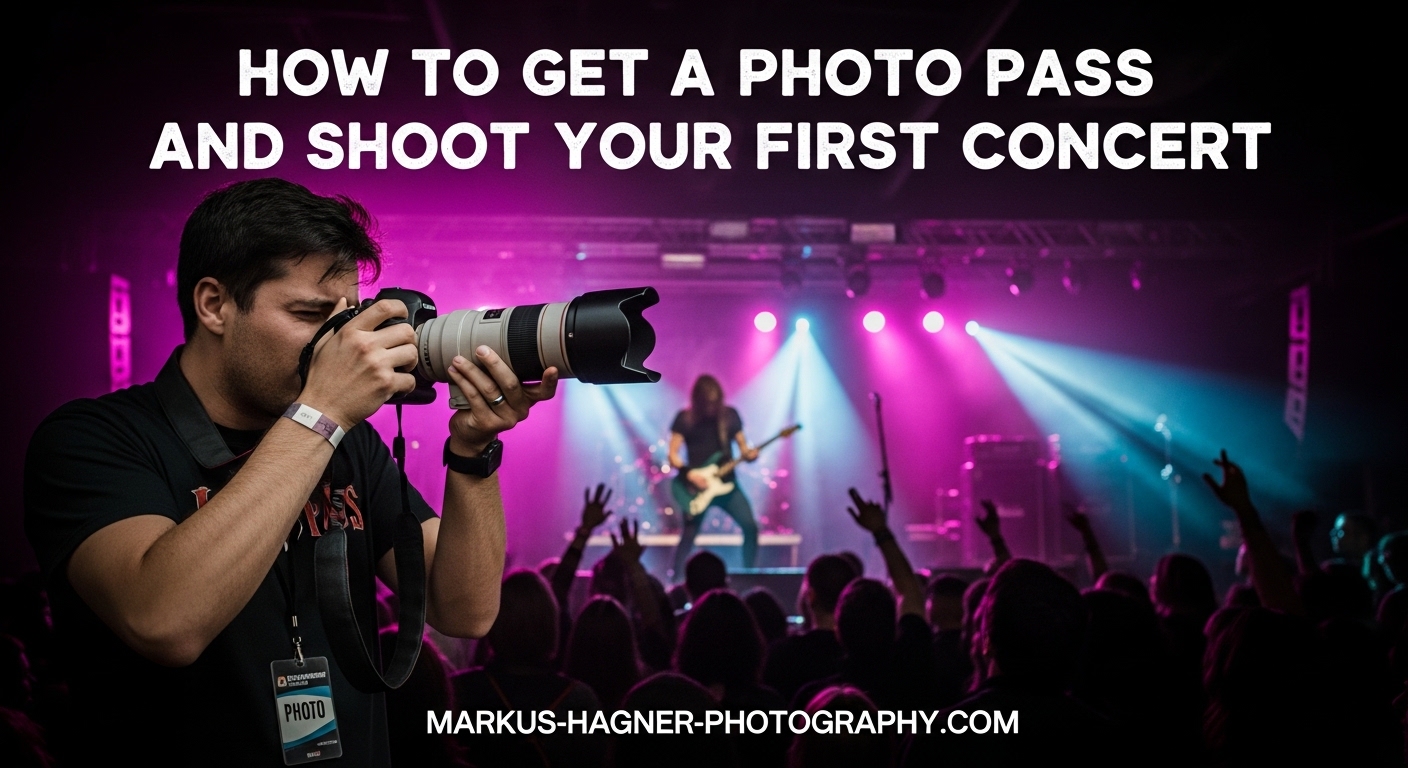
Standing in the photo pit at your first concert is unlike anything else. The bass hits your chest, lights flash across your viewfinder, and you have just three songs to capture the energy of a live performance. But getting there? That is where most aspiring concert photographers get stuck.
I remember sending my first photo pass request to a venue publicist. My hands were shaking as I hit send, convinced they would see right through my limited portfolio. But here is the truth: every working concert photographer started exactly where you are right now. The path to that first photo pass is more straightforward than you might think.
This guide walks you through exactly how to get a photo pass and shoot your first concert. You will learn how to build a portfolio without access, find the right contacts, write professional request emails, and handle every step of your first show. By the end, you will have everything you need to photograph live music with confidence.
What Is a Photo Pass and Why Do You Need One?
A photo pass (also called a media pass or press credentials) is an official credential that grants photographers access to photograph concerts from designated areas, typically the photo pit between the stage and the crowd. Without one, most medium to large venues will not allow you to bring professional camera equipment inside.
Photo passes exist because venues need to control who has backstage and stage access. They protect artists from unauthorized photography while ensuring legitimate photographers can do their jobs. Think of it as a professional agreement: you provide editorial coverage and publicity for the artist, and they give you access to capture compelling images.
Important distinction: a photo pass is not the same as a backstage pass or all-access credential. Photo passes typically only get you into the photo pit for the first three songs of each artist’s set. You will not be roaming freely backstage or staying for the entire show from the pit.
Building Your Portfolio When You Have No Access
Here is the chicken-and-egg problem every concert photographer faces: you cannot get a photo pass without a portfolio, but you cannot build a portfolio without access. Fortunately, there are several proven paths around this obstacle.
Start at Small Venues That Do Not Require Passes
Small venues, local bars, and independent clubs often allow any camera inside. These shows typically have fewer restrictions because the artists are emerging and hungry for exposure. I started at a 150-capacity venue where the doorman just waved me through with my camera bag.
Look for local venues hosting original bands rather than cover acts. Original artists need promotional photos far more than established touring acts. Call ahead and ask about their camera policy. Many smaller venues will welcome photographers who promise to share photos with the bands.
Network With Local Bands Directly
Bands at the local level often control their own promotional decisions. Reach out through social media or email offering to photograph their upcoming show at no cost. Most bands will jump at free professional-quality images they can use for promotion.
When I started, I messaged ten local bands on Instagram. Three responded, and one invited me to photograph their show that weekend. That single show gave me enough images to start building a portfolio. Be genuine in your approach and deliver on your promises.
Offer Value in Exchange for Access
The key to building your portfolio is understanding the value exchange. You are not asking for a favor. You are offering something valuable: high-quality promotional images the artist can use on their website, social media, and press materials.
Make this explicit in your communications. Tell bands or venues you will provide edited, high-resolution photos within 48 hours of the show at no cost. This professionalism separates serious photographers from fans with cameras.
Shoot at Churches, Community Centers, and Festivals
Churches and community centers often host concerts with excellent lighting and minimal restrictions. These venues typically do not require photo passes, and the smaller scale makes networking easier. Festival grounds frequently allow cameras during daytime sets before headliners perform.
These unconventional venues gave me some of my best early portfolio pieces. The lighting was often better than club shows, and the intimate atmosphere made it easier to get close without credentials.
Finding the Right Contact for Your Photo Pass Request
Once you have a portfolio, you need to find the right person to request a photo pass from. This varies by venue and artist size, so understanding the hierarchy saves you time and increases your success rate.
Artist Publicist
For touring artists, the publicist is typically your best contact. Publicists handle media relations and decide who receives credentials. You can find publicist contact information on the artist’s official website under the press or contact section, in press releases announcing the tour, or through music industry databases.
Search for the artist name plus “publicist” or “press contact” to find recent press releases. These documents often include direct email addresses for media inquiries.
Artist Manager
Smaller touring acts may not have a dedicated publicist. In these cases, the manager handles photo pass decisions. Manager contact information is often listed on the artist’s website or social media profiles. You can also try searching the artist name plus “management” or “booking.”
Venue PR or Marketing Department
For local shows or when artist contacts are unavailable, venue PR departments sometimes control photo passes. Check the venue website for a media or press contact. Call the venue box office and ask who handles photo pass requests.
Using Boolean Search to Find Contacts
Advanced search techniques help you find contact information that is not immediately obvious. Try these searches in Google: artist name + publicist + email, artist name + press release + contact, or site:artistwebsite.com press.
I have found countless publicist emails by searching for tour announcements and reading through the press release footer. Most publicists want to be found by legitimate media outlets.
How to Request a Photo Pass (Templates and Best Practices)
Writing a professional photo pass request is crucial. Your email represents you before anyone sees your portfolio. A poorly written request gets deleted immediately, while a thoughtful one opens doors.
Timing Your Request
Send your request two to four weeks before the show date. Earlier requests get lost in inboxes. Later requests face rushed decisions and potential credential caps. Week-of follow-ups are appropriate if you have not heard back.
Photo Pass Request Template for Freelancers
Subject: Photo Pass Request – [Artist Name] at [Venue] – [Show Date]
Dear [Publicist/Manager Name],
I am writing to request a photo pass for [Artist Name] at [Venue] on [Show Date].
About me: I am a concert photographer based in [City] with experience shooting live music at venues including [list 2-3 venues]. My work has been featured in [publication name or “my portfolio at website URL”].
I am seeking editorial coverage of this show for my portfolio and potential publication placement. I will provide high-resolution images for artist promotional use within 48 hours of the performance.
Portfolio: [URL to your concert photography]
Samples attached: [2-3 of your best concert images]
Thank you for your consideration.
Best regards,
[Your Name]
[Your Website]
[Phone Number]
Photo Pass Request Template for Publications
Subject: Photo Pass Request – [Publication Name] – [Artist Name] at [Venue] – [Show Date]
Dear [Publicist Name],
[Publication Name] is requesting a photo pass for [Artist Name] at [Venue] on [Show Date] for editorial coverage.
Publication details: [Publication Name] reaches [audience size] readers interested in [music genre/scene]. Our concert coverage has included [mention 1-2 similar artists you have covered].
Photographer: [Your Name] will be covering the show. Portfolio: [URL]
We will provide high-resolution images for artist promotional use and link to coverage upon publication.
Thank you for your consideration.
Best regards,
[Your Name]
[Your Title], [Publication Name]
[Email]
[Publication Website]
What Publicists Want to Know
Publicists evaluate requests based on several factors. First, will this coverage reach a relevant audience? Second, is the photographer professional and reliable? Third, will the artist receive usable promotional images?
Address these concerns directly. Mention your audience size if shooting for a publication. Include your best portfolio samples. Promise specific delivery timelines for photos. Being honest about your experience level actually helps. Publicists respect photographers who are building portfolios and often approve requests from beginners who communicate professionally.
CC Your Editor When Possible
If you are shooting for a publication, CC your editor on the request. This signals legitimacy to the publicist and shows organizational professionalism. It also creates accountability on your end to deliver quality work.
What to Do If You Get Rejected
Rejection is normal and not personal. Publicists have limited credentials and prioritize established outlets. If rejected, thank them politely and ask to be kept in mind for future shows. Then try again with a different artist or venue.
I was rejected for my first five photo pass requests. Each rejection taught me something about improving my pitch. Persistence matters more than talent when starting out.
Day of Show: What to Expect and Bring?
Your request was approved. Now what? The day of the show brings its own set of challenges and opportunities. Preparation separates professional photographers from stressed amateurs.
Arrival and Will Call Pickup
Arrive at the venue 60 to 90 minutes before doors open. Photo passes are typically held at will call, the ticket pickup window usually located at the main entrance. Bring a government-issued photo ID matching the name on your request.
Tell the will call attendant you are picking up a photo pass. They may ask for your ID and the name of the publicist who approved your request. Have this information written down or saved on your phone.
What to Bring in Your Camera Bag
Pack light but complete. You will be moving quickly in tight spaces. My essential concert photography kit includes: camera body capable of high ISO performance, fast prime lens (50mm f/1.8 or 35mm f/1.4), standard zoom lens (24-70mm f/2.8), extra batteries and memory cards, ear protection, and business cards.
Leave unnecessary gear at home. Telephoto lenses over 200mm are rarely useful in photo pits. Tripods are prohibited. Flash units are almost never allowed.
What to Wear and How to Prepare
Dress in dark, comfortable clothing that allows movement. Avoid bright colors or flashy accessories that distract from the performance. Wear closed-toe shoes you can stand in for hours. Earplugs are mandatory for long-term hearing protection.
Eat a substantial meal before arriving. You likely will not have time for food once the show begins. Hydrate but avoid excessive alcohol. You are there to work, not party.
Meeting Security and Finding the Photo Pit
After collecting your pass, locate the photo pit entrance. Ask venue staff where photographers enter. Introduce yourself to security personnel working the pit. They control your access and can make your experience smooth or difficult.
Be friendly and follow instructions immediately. Security deals with difficult people all night. Being the polite, cooperative photographer makes you memorable for the right reasons.
Photo Pit Etiquette
The photo pit is shared space with limited positions. Professional conduct matters. Do not block other photographers. Move between songs to give everyone access to different angles. Keep conversations quiet. Never touch the stage or performers. Stay aware of your surroundings and other photographers.
If you need to change positions, politely ask surrounding photographers. Most will accommodate reasonable requests. Return the favor when others need to move.
Day of Show Checklist
Before leaving home, verify you have: photo pass confirmation email, government-issued ID, camera body with charged battery, primary lens attached, backup lens, extra batteries and memory cards, earplugs, business cards, water bottle, comfortable dark clothing, and closed-toe shoes.
How to Get a Photo Pass and Shoot Your First Concert?
With preparation complete, it is time to actually photograph the show. These practical tips will help you make the most of your three songs in the pit.
The First Three Songs Rule
Most photo passes allow you to shoot only the first three songs of each artist’s set. This standard exists across the industry for safety and copyright reasons. After three songs, you must exit the photo pit.
Three songs is approximately 10 to 15 minutes of shooting time. This sounds short, but with preparation, it is enough for excellent images. Do not panic when the third song ends. Exit calmly and watch the rest of the show from your designated area.
No Flash Photography
Flash is almost universally prohibited at concerts. It distracts performers and ruins the lighting atmosphere. Learn to shoot in low light without artificial illumination. This is where fast lenses and high ISO capability become essential.
Camera Settings for Concert Photography
Shoot in manual mode for consistent results. Set your aperture to its widest opening (lowest f-number). Start with ISO 1600 to 3200 and adjust based on lighting. Use shutter speeds of at least 1/250 second to freeze motion. Switch to continuous autofocus mode for moving subjects.
Shoot in RAW format for maximum editing flexibility. Concert lighting creates challenging exposure situations, and RAW files recover details that JPEGs lose.
Positioning and Movement
Start in the center of the photo pit for the most balanced angles. Move to the sides for profile shots and backlighting opportunities. Kneel or crouch for dramatic low angles. Watch the lighting patterns and anticipate when artists will step into spotlights.
Do not stay in one position the entire time. Move deliberately between songs to capture variety. The best concert photos often come from unexpected angles.
What to Capture
Focus on capturing the artist’s energy and emotion. Wide shots showing the full stage provide context. Tight portraits capture expression and intensity. Detail shots of hands on instruments add visual variety. Include crowd reactions when possible for storytelling images.
After the Show: Delivering Photos and Building Relationships
Your work continues after the last song ends. Professional photographers deliver images promptly and build relationships for future opportunities.
Delivery Timeline and Format
Deliver edited photos within 24 to 48 hours of the show. Speed matters for time-sensitive promotional use. Select your 10 to 20 best images. Edit them for exposure, color correction, and cropping. Export high-resolution JPEGs (3000 pixels on the long edge at minimum) and deliver via cloud storage link or email attachment.
What to Provide
Include both web-ready images (1200 pixels wide, optimized for web) and high-resolution files suitable for print. Provide the publicist and artist social media handles with your delivery email so they can easily share and credit your work.
Follow-Up Etiquette
Send a brief thank you email to the publicist after delivering photos. Do not ask for feedback immediately. Let your work speak for itself. If you want to cover future shows by the same artist, mention your interest professionally without being pushy.
Building Long-Term Relationships
Photo passes are relationships, not one-time transactions. Publicists remember photographers who deliver quality work on time and behave professionally. Each successful show strengthens your reputation and makes future approvals easier.
Maintain a database of publicist contacts. Note their preferences and communication styles. Reference previous shows in future requests. Over time, you will develop a network of contacts who trust your work and approve requests quickly.
Frequently Asked Questions
How long before a concert should I request a photo pass?
Send your photo pass request two to four weeks before the show date. Earlier requests get lost in inboxes, while later requests face rushed decisions and potential credential caps. Follow up the week of the show if you have not received a response.
Can I get a photo pass without a publication?
Yes, you can request photo passes as a freelance photographer building your portfolio. Be honest about your status in your request email. Publicists often approve freelance requests when photographers demonstrate professionalism and offer value through quality promotional images.
How many songs can I photograph with a photo pass?
Most photo passes allow you to photograph only the first three songs of each artist’s set. This industry standard provides approximately 10 to 15 minutes of shooting time. After three songs, you must exit the photo pit.
What camera gear do I need for concert photography?
Essential concert photography gear includes a camera body with good high-ISO performance, a fast lens (f/2.8 aperture or wider), extra batteries and memory cards, and ear protection. A 50mm f/1.8 or 24-70mm f/2.8 lens covers most situations. Flash is typically prohibited.
What if my photo pass request is rejected?
Rejection is normal and not personal. Thank the publicist politely and ask to be considered for future shows. Continue building your portfolio at smaller venues and try again with different artists. Persistence and professionalism lead to eventual approval.
Do I need a photo pass for small venue concerts?
Many small venues and local bars do not require photo passes. These venues often allow any camera inside, making them excellent places to build your initial portfolio. Always call ahead to confirm the venue’s camera policy before bringing professional equipment.
Conclusion
Getting your first photo pass and shooting a concert is achievable with the right approach. Start by building your portfolio at small venues that welcome photographers. Network with local bands who need promotional images. Find the right contacts through publicists, managers, and venue PR departments.
Write professional request emails that clearly state your value. Arrive prepared with the right gear and professional conduct. Make the most of your three songs by knowing your camera settings and positioning strategies. Deliver quality images promptly to build relationships for future shows.
The path to becoming a concert photographer is not mysterious. It requires persistence, professionalism, and genuine passion for live music. Your first photo pass is waiting. You just need to ask for it.