
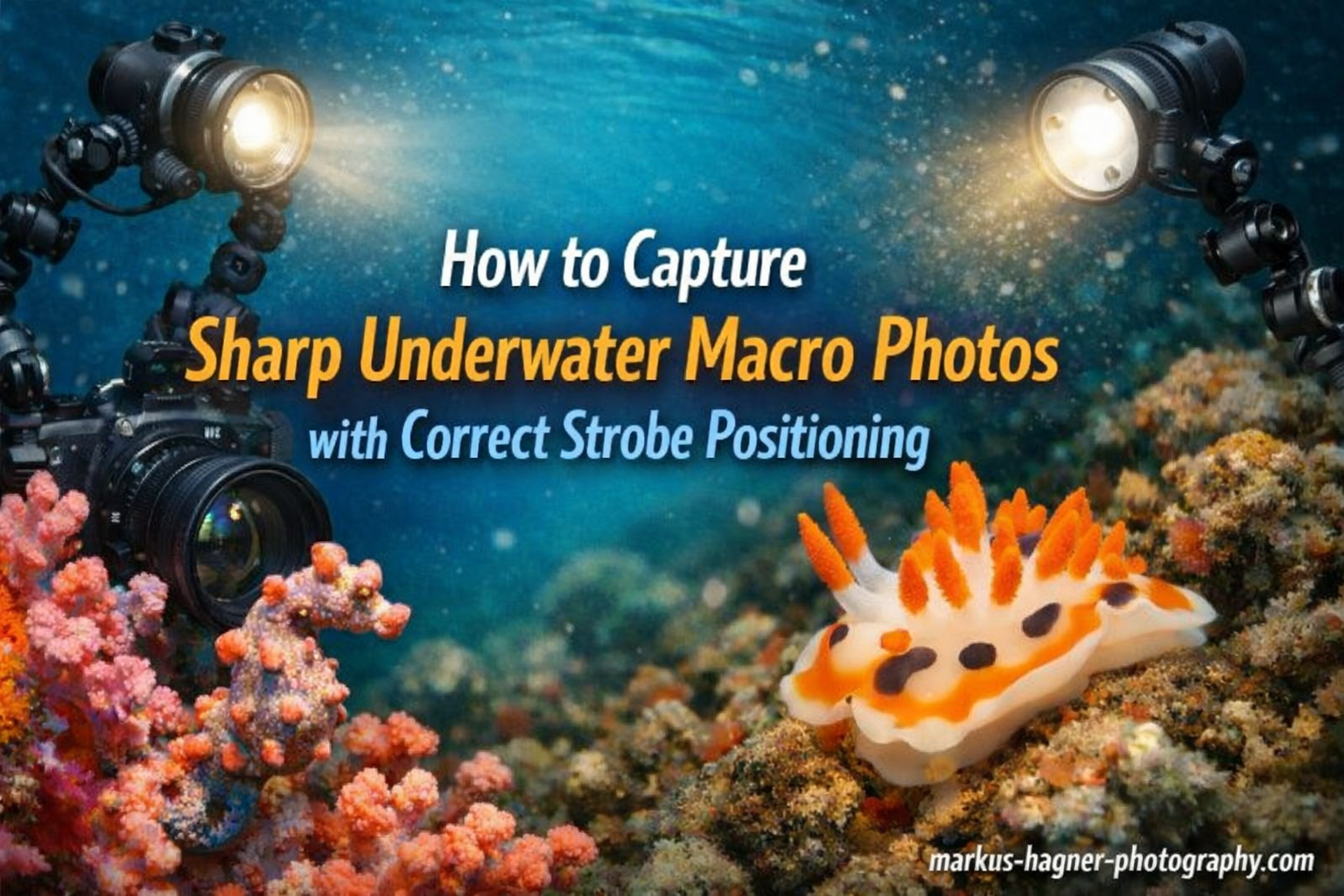
Capturing sharp underwater macro photos with correct strobe positioning is one of the most challenging yet rewarding skills in underwater photography. The difference between a muddy, backscatter-filled image and a crisp, vibrant macro shot often comes down to understanding how to position your strobes effectively. This guide will walk you through the essential techniques for underwater macro photography strobe positioning, helping you achieve professional-quality images of tiny marine subjects.
Understanding Underwater Macro Photography Strobe Positioning
Underwater macro photography presents unique lighting challenges that don’t exist on land. As light travels through water, it’s absorbed and scattered, creating the dreaded backscatter that ruins many otherwise perfect shots. Proper underwater strobe positioning is the key to overcoming these challenges and bringing out the brilliant colors of your macro subjects.
When you’re working at close distances with macro subjects—often just inches from your lens—the angle of your strobes becomes critical. A slight adjustment can mean the difference between perfectly illuminated detail and harsh glare or distracting particles. Mastering underwater macro photography strobe positioning requires understanding three fundamental positions that work for most situations, along with the knowledge of when and how to modify them for specific subjects and conditions.
Why Strobe Position Matters More Underwater
On land, photographers often use diffused, front-on lighting for macro subjects. Underwater, this approach fails because water particles between your lens and subject catch the light, creating those annoying white specks known as backscatter. The solution is to angle your strobes so that light hits your subject but not the water column directly in front of your lens.
This simple principle—angling light away from the lens axis—is the foundation of all underwater strobe positioning techniques. Whether you’re photographing nudibranchs, anemone fish, or tiny crustaceans, proper strobe placement ensures your subject pops while the water remains dark and clean.
The Three Essential Strobe Positions for Macro Photography
Professional underwater photographers rely on three primary strobe positions that cover most macro photography situations. Master these three, and you’ll handle 90% of your macro subjects with confidence.
Position 1: The Angled-Out Position (Your Go-To Setup)
The angled-out position is your default starting point for most macro photography. In this configuration, both strobes are positioned behind your camera port, angled outward at approximately 45 degrees, and pulled back slightly from the housing.
Setup Instructions:
- Position your strobes behind the port: Each strobe should be even with or slightly behind the front element of your macro port. This prevents light from directly entering the lens.
- Angle outward at 45 degrees: Think of your strobes as headlights on a car that’s turning—both lights point away from the center, creating a V-shape when viewed from above.
- Pull back from the housing: The strobe heads should be 6-12 inches back from the housing handles, depending on your arm length.
- Point slightly downward: Angle the strobe heads down 10-15 degrees so light hits your subject, not the water above it.
When to Use:
- General macro photography at standard working distances (12-24 inches)
- Subjects on open reef structure without busy backgrounds
- When you’re unsure which position to use—start here
Why It Works:
The angled-out position illuminates your subject from the sides while keeping the water column between your lens and subject in shadow. Since most backscatter-causing particles are directly in front of your lens, this natural shadow eliminates them from your image. Light wraps around your subject, creating natural modeling and dimensionality.
Position 2: The Super Macro Position (For Extreme Close-Ups)
When you’re working with supermacro setups—using diopters, wet lenses, or 100mm+ macro lenses at minimum focus distance—the angled-out position may not deliver enough light. The super macro position brings your strobes closer and narrows the angle for maximum light intensity on tiny subjects.
Setup Instructions:
- Move strobes forward: Position strobes alongside or slightly ahead of your port, but still behind the subject plane.
- Narrow the angle: Instead of 45 degrees, angle your strobes outward at 20-30 degrees.
- Close the distance: Bring strobe heads within 4-8 inches of your housing handles.
- Increase strobe power: You’ll need more power output for super macro due to the inverse square law.
When to Use:
- Shooting at 1:1 reproduction ratio or greater
- Using supermacro converter lenses or diopters
- Subjects smaller than 1 inch
- When you need maximum light on a tiny area
Important Warning:
The super macro position increases risk of backscatter because your strobes are closer to the lens axis. Use this position only in clear water with minimal particles. Consider using a snoot (see Creative Techniques) to further control light spread.
Position 3: The Black Background Position (Creating Dramatic Effects)
The black background position is beloved by underwater photographers for its ability to create dramatic, gallery-worthy images. By positioning your strobes very close to the subject and powering them appropriately, you can make the background go completely black even in daylight, making your subject appear to float in void space.
Setup Instructions:
- Close the distance completely: Bring strobes as close to your port as possible without appearing in the frame.
- Narrow the beam: If your strobes have removable diffusers or focusing accessories, use them to concentrate the light.
- Angle inward slightly: Unlike other positions, angle strobes slightly inward (5-10 degrees) toward the lens axis.
- Increase power significantly: You’ll need full power or close to it for most black background shots.
- Use appropriate camera settings: High shutter speed (1/250s or higher) and small aperture (f/22-f/32) to eliminate ambient light.
When to Use:
- Creating dramatic, artistic images
- Isolating subjects from distracting backgrounds
- Photographing in low-light conditions or deeper water
- Subjects with bright colors that contrast well with black
Pro Tip:
Black background images work best with subjects that have natural brightness—nudibranchs with orange or yellow coloration, clownfish in white anemones, or crabs with colorful shells. Dark subjects may get lost against the black background.
Strobe-to-Subject Distance Guidelines (2026)
Understanding strobe-to-subject distance is crucial for consistent exposures and preventing hotspots. The inverse square law states that light intensity decreases dramatically with distance—double the distance equals one-quarter the light intensity.
General Distance Rules:
- Standard macro (1:3 to 1:1): Position strobes 8-12 inches from your subject. This provides even illumination without hotspots.
- Super macro (beyond 1:1): Move strobes to 4-6 inches from your subject. You’ll need to increase power output.
- Black background technique: Get as close as possible—sometimes 2-4 inches—to maximize light intensity on the subject while leaving the background underexposed.
Avoiding Common Distance Mistakes:
- Too far away: Results in muddy, underexposed images and requires maximum strobe power, slowing your recycling time.
- Too close: Creates harsh hotspots and blown-out highlights on your subject. If you see white, featureless areas on your subject, back your strobes up.
- Inconsistent distances: If one strobe is closer than the other, you’ll get uneven lighting. Use the markings on your strobe arms to ensure symmetrical positioning.
How to Avoid Backscatter Through Proper Positioning In 2026?
Backscatter is the enemy of clean underwater images. These underwater photography strobe positioning techniques will help you minimize it:
The 45-Degree Rule
Never point your strobes directly at your subject. Instead, maintain at least a 45-degree angle between your strobe-to-subject line and your lens-to-subject line. This ensures that any light hitting particles in the water column bounces away from your lens rather than back into it.
Wide-Angle Diffusers
Use wide-angle diffusers on your strobes for macro work. They spread light over a broader area, reducing the intensity of individual light rays that can catch particles. Softer, more diffused light creates fewer visible backscatter specks.
Get Closer, Then Closer Still
The closer you are to your subject, the less water between you—and the fewer particles to cause backscatter. This is why wide-angle shooters can get away with more direct lighting, while macro photographers must be more careful. Use the longest macro lens appropriate for your subject to minimize working distance.
Test and Adjust
Before committing to a shot, take a test image and zoom in on the rear LCD. Look for backscatter in the shadow areas and dark portions of your frame. If you see significant backscatter, adjust your strobes—usually by angling them further outward or moving them slightly back.
Camera Settings That Work With Your Strobe Positioning
Your strobe positioning and camera settings work together to create the final image. Here are the settings that complement proper strobe placement:
Exposure Mode: Manual
Always shoot in manual mode for macro photography. Automatic modes will be confused by the bright strobe light and dark background, resulting in inconsistent exposures. Manual mode gives you complete control.
Aperture: f/22 to f/32
Macro photography requires significant depth of field to keep your entire subject in focus. Small apertures (higher f-numbers) provide this depth. Start at f/22 and adjust smaller if needed.
Shutter Speed: 1/160s to 1/250s
Choose a shutter speed that eliminates ambient light from the background but remains within your camera’s sync speed. For black background effects, use the fastest speed your camera-syncs with strobes (typically 1/250s). For more natural-looking backgrounds with blue water, try 1/160s or 1/200s.
ISO: 100 to 200
Keep ISO low to maintain image quality and reduce noise. Since your strobes provide the primary light, you don’t need high ISO. Only increase ISO if you’re struggling to get enough strobe power and have maxed out your settings elsewhere.
Strobe Power: Start at 1/4 or 1/2
Begin with your strobes at 1/4 or 1/2 power. This gives you room to adjust up or down. Starting at full power leaves no room for increase and slows your recycling time between shots.
Focus Mode: Continuous AF (AF-C)
Use continuous autofocus for moving subjects like tiny fish or shrimp in sway. For stationary subjects like nudibranchs, single-shot AF (AF-S) works fine. Consider back-button focus to separate autofocus from shutter release.
Single Strobe vs Dual Strobe Positioning for Macro
While dual strobes are ideal for macro photography, you can achieve excellent results with a single strobe if you understand how to adapt your technique.
Single Strobe Positioning
With one strobe, position it at approximately 10 o’clock (upper left) or 2 o’clock (upper right) relative to your lens. Create a triangle between your lens, subject, and strobe, with the strobe slightly above the lens-subject line. This creates natural, directional light with shadows that reveal texture.
Pros:
- More natural, directional lighting
- Simpler setup and faster adjustments
- Less equipment to manage
Cons:
- Harder to eliminate all shadows on complex subjects
- Less flexibility for creative lighting effects
- May require higher power output
Dual Strobe Positioning
Use the three positions described earlier (angled-out, super macro, black background) for dual strobe setups. Dual strobes provide even, shadow-free illumination when used correctly.
Pros:
- Even lighting across the entire subject
- Maximum flexibility for creative effects
- Better coverage for supermacro work
Cons:
- More complex setup and adjustment
- Increased risk of equipment collisions
- More gear to manage underwater
Quick Reference Setup Guide
Use this cheat sheet in the field to quickly set up your strobes for common macro photography scenarios:
STANDARD MACRO (General Purpose)
• Strobe position: Behind port, 45° outward
• Distance from subject: 8-12 inches
• Camera settings: f/22, 1/200s, ISO 100
• Strobe power: 1/4 to 1/2
• Best for: Reef fish, nudibranchs, small crustaceans
SUPER MACRO (Extreme Close-Up)
• Strobe position: Even with port, 20-30° outward
• Distance from subject: 4-6 inches
• Camera settings: f/32, 1/250s, ISO 100
• Strobe power: 1/2 to full
• Best for: Tiny subjects with diopters, supermacro converters
BLACK BACKGROUND (Dramatic Effect)
• Strobe position: Alongside port, 5-10° inward, as close as possible
• Distance from subject: 2-4 inches
• Camera settings: f/32, 1/250s, ISO 100
• Strobe power: Full
• Best for: Artistic shots, subjects with bright colors
SINGLE STROBE (Minimal Setup)
• Strobe position: 10 o’clock or 2 o’clock, 30° outward from lens axis
• Distance from subject: 6-10 inches
• Camera settings: f/22, 1/200s, ISO 100-200
• Strobe power: 1/2 to full
• Best for: Travel, streamlined setup, natural lighting
Creative Lighting Techniques for Macro
Once you’ve mastered the three essential positions, explore these creative techniques to add variety and drama to your macro portfolio:
Snoot Photography
A snoot is a tube that narrows your strobe’s beam to a small circle of light. This allows you to spotlight a tiny portion of your subject while letting the rest fade into darkness. Snoots create dramatic, eye-catching images that emphasize specific details—like the rhinophores of a nudibranch or the eye of a shrimp.
Setup: Attach a commercially available snoot or create a DIY version using tubing. Position your strobe close to the subject and use the narrowest beam angle your strobe offers. You’ll need to experiment with power and positioning to get the circle of light exactly where you want it.
Split Lighting
Position one strobe at 9 o’clock (far left) and one at 3 o’clock (far right) relative to your subject. This lights your subject from the sides while leaving the front and back in shadow. Split lighting emphasizes texture and form, creating a moody, dimensional look.
Works best for: Subjects with interesting textures—coral, crabs, starfish, and anything with surface detail you want to emphasize.
Rim Lighting
Place your strobes behind and slightly to the side of your subject, pointing back toward your camera position. This creates a bright outline or “rim” of light around your subject’s edges while the front remains in shadow. Rim lighting is particularly effective for translucent subjects like jellyfish, comb jellies, or shrimp.
Challenge: Rim lighting requires precise positioning and may result in lens flare. Use lens hoods or shields if necessary, and be prepared for many test shots as you refine the angle.
Princess Leia Position
Named for its resemblance to the iconic hairstyle, this position features strobes positioned high and wide—above the housing at 10 and 2 o’clock, angled inward toward the subject. This creates even, shadow-free lighting from above, mimicking sunlight filtering down from the surface.
Best for: Overhead shots of flat subjects like blennies, gobies, or stingrays in the sand.
Troubleshooting Common Strobe Positioning Issues
Even experienced photographers encounter issues with strobe positioning. Here are solutions to the most common problems:
Problem: Uneven Lighting (One Side Brighter Than the Other)
Cause: Strobes at different distances or power settings from the subject.
Solution: Check that both strobes are equidistant from your subject. Use the markings on your strobe arms to ensure symmetrical placement. Verify that both strobes are set to the same power output.
Problem: Hotspots (Bright, Featureless Areas on Subject)
Cause: Strobes too close to the subject or pointed too directly at it.
Solution: Move strobes further back or angle them more outward. Consider adding diffusers to soften the light.
Problem: Harsh Shadows
Cause: Strobes positioned too far apart or at too extreme an angle.
Solution: Bring strobes closer together and reduce the angle. For single strobe users, consider adding a small reflector or white card on the shadow side to fill in harsh shadows.
Problem: Backscatter Throughout Image
Cause: Strobes pointed too directly toward the lens axis or shooting in particulate water.
Solution: Angle strobes further outward from the lens. Consider the black background position which hides backscatter in the dark background. If possible, relocate to a different area with clearer water.
Problem: Dark Corners (Vignetting)
Cause: Strobes pulled too far back or port dome/shade blocking light.
Solution: Move strobes forward slightly. Check that your port shade isn’t extending into the frame. If using a dome port, be aware that it can block light from strobes positioned too far back.
Problem: Subjects Blown Out (Overexposed)
Cause: Strobes too powerful or too close to the subject.
Solution: Reduce strobe power. Move strobes further back. Check your aperture and increase the f-number if needed.
Problem: Consistent Underexposure
Cause: Strobes too far from subject or power too low.
Solution: Increase strobe power. Move strobes closer to the subject. If using supermacro positioning, remember that you need significantly more light at extreme close-ups.
Practice Exercises: Land and Water
You can improve your strobe positioning skills on land before your next dive trip:
Land Exercise 1: The Toy Macro Setup
- Place a small toy or object on a table.
- Set up your camera in a housing (or simulate with your actual gear).
- Practice the three positions: angled-out, super macro, and black background.
- Review your images and adjust based on what you see.
Land Exercise 2: Backscatter Simulation
- Add a small amount of flour or baby powder to the air in front of your lens.
- Photograph a subject with strobes pointed directly at it.
- Photograph again with strobes angled outward at 45 degrees.
- Compare the images to see the dramatic difference in backscatter.
Water Exercise 1: Static Subject Practice
- Find a stationary subject like a coral head or sponge.
- Set up using the angled-out position and take a test shot.
- Adjust strobe angle by 10 degrees outward and shoot again.
- Continue adjusting in 10-degree increments and review the sequence to find the optimal angle.
Water Exercise 2: Moving Subject Practice
- Find a cooperative subject like a blenny or small fish that returns to a perch.
- Practice quickly switching between angled-out and super macro positions.
- Time yourself—how fast can you transition between positions?
- Goal: Be able to adjust strobes in under 10 seconds without looking.
Equipment Considerations for Macro Strobe Positioning
Your equipment choices affect how easily you can achieve proper strobe positioning:
Strobe Arms
Ball-and-joint arm systems offer the most flexibility for precise positioning. Look for arms with multiple joints (at least 2 per strobe) and easy-to-adjust clamps. Longer arms (8-12 inches) provide more reach for supermacro work but may be cumbersome for standard macro.
Strobe Type
For macro work, consider strobes with:
– Wide beam angle: 100-110 degrees for even coverage
– Adjustable power: Manual control with 1/3 or 1/2 stop increments
– Focus light: Built-in focus light aids autofocus in low light
– Recycling speed: Faster recycling means more shots per subject
Diffusers
Diffusers soften light and reduce backscatter. Most strobes come with removable diffusers—use them for macro work. Remove them only when you need maximum power or a harder light for creative effects.
Tray and Handles
A single or dual handle tray provides stability and attachment points for your strobe arms. For macro photography, a compact tray with handles close to the housing is often preferable to a wide, spread-out system designed for wide-angle work.
Advanced Techniques: Combining Positions
As you gain experience, you’ll find situations that call for hybrid approaches combining elements from different positions:
The Shallow Black Background
In shallow water with strong ambient light, a full black background may not be possible even at 1/250s and f/32. Instead, accept a blue or green background but position your strobes for maximum subject isolation. Use the super macro position to concentrate light on your subject, letting the background fade into a pleasing blur.
The Asymmetric Setup
Position your primary strobe using the angled-out configuration, but place your secondary strobe high and to the side at 10 or 2 o’clock. This creates a main light with a softer fill light, adding dimension while maintaining shadow detail. Works well for subjects with interesting texture or form.
The Angled-Out-to-Super Macro Transition
Start with angled-out positioning to establish your composition and focus. Then, for your final shots, smoothly transition to super macro positioning by sliding your strobes forward along their arms. This technique works well when you’re photographing a shy subject that gradually tolerates closer approach.
Water Condition Adjustments
Your strobe positioning must adapt to water conditions:
Clear Water (Blue Water, Offshore)
In clear water with minimal particles, you have more flexibility. You can use more direct lighting if desired, though the angled-out position remains the best starting point. Consider the black background position for dramatic effect—clear water makes this easier to achieve.
Murky Water (Green Water, Runoff Conditions)
In particulate-filled water, backscatter is a constant threat. Exaggerate your strobe angles—aim for 50-60 degrees outward instead of 45. Consider using a single strobe positioned well to the side to minimize the number of particles between the light and your lens. Accept that some shots may be impossible and be ready to move to a different location.
Night Dives
At night, your strobes provide the only light source. The black background position becomes your default setup, as there’s no ambient light to compete with. Focus lights become essential for autofocus. Consider using red focus lights to avoid disturbing shy nocturnal creatures.
Common Beginner Mistakes to Avoid
Learn from these common errors that most underwater macro photographers make when starting out:
Mistake 1: Constantly Changing Position
New photographers often adjust their strobes after every shot, seeking nonexistent perfection. Pick a position based on your subject and conditions, then make minor adjustments only after reviewing test images. Constant changes make it impossible to learn what works.
Mistake 2: Ignoring the Background
Focusing entirely on your subject and forgetting about the background leads to messy images. Before shooting, check your frame for distracting elements. Use the black background position or adjust your angle to eliminate clutter behind your subject.
Mistake 3: Shooting Too Fast
Rapid-fire shooting means you don’t review your images and miss opportunities to improve. Slow down. Take a shot, check the LCD, adjust if needed, then shoot again. Quality over quantity.
Mistake 4: Wrong Port Choice
Using a flat port for macro work limits your working distance and affects how light reaches your subject. Use a dome port for fisheye or wide-angle macro, and a dedicated macro port for standard macro work. The right port improves both image quality and strobe effectiveness.
Mistake 5: Forgetting Strobe Arms
Many photographers carefully position their strobes at the start of a dive but never adjust them again. As you move through the water and encounter different subjects at different distances, your strobe positioning must change. Make strobe adjustment a routine part of your shooting process.
Frequently Asked Questions
What is the best strobe position for underwater macro photography?
The angled-out position is the best all-around strobe position for underwater macro photography. In this configuration, both strobes are positioned behind your camera port, angled outward at approximately 45 degrees, and pulled back 6-12 inches from the housing. This setup illuminates your subject from the sides while keeping the water column between your lens and subject in shadow, effectively eliminating backscatter. Start with this position for most macro subjects, then adjust based on your specific shooting conditions and subject.
How do I position underwater strobes to avoid backscatter?
To avoid backscatter, never point your strobes directly at your subject. Instead, maintain at least a 45-degree angle between your strobe-to-subject line and your lens-to-subject line. Use wide-angle diffusers on your strobes to soften and spread the light. Get as close as possible to your subject to minimize the amount of water between your lens and the subject—fewer particles mean less backscatter. Always test your setup by taking a shot and zooming in on your LCD to check for backscatter in shadow areas before committing to your final images.
How far should strobes be from the subject for underwater macro photography?
For standard macro photography (1:3 to 1:1 reproduction), position your strobes 8-12 inches from your subject. This provides even illumination without creating harsh hotspots. For super macro work (beyond 1:1 reproduction ratio), move strobes closer to 4-6 inches and increase power output to compensate. For black background effects, get as close as possible—2-4 inches—to maximize light intensity on the subject while leaving the background underexposed. Always maintain equal distance with both strobes to ensure even lighting.
What is the angled-out strobe position for macro photography?
The angled-out strobe position is the default setup for most underwater macro photography. In this configuration, strobes are positioned behind the camera port, angled outward at approximately 45 degrees away from the lens axis, and pulled back 6-12 inches from the housing handles. This V-shaped arrangement illuminates macro subjects from the sides while creating a natural shadow zone directly in front of the lens where most backscatter-causing particles exist. The result is clean, sharp images with even lighting and minimal backscatter. It works well for most subjects at standard macro working distances of 12-24 inches.
How to achieve black background in underwater macro photography?
To achieve a black background in underwater macro photography, position your strobes as close as possible to your camera port (2-4 inches from the subject), angle them slightly inward (5-10 degrees toward the lens axis), and use maximum strobe power. Combine this with camera settings that eliminate ambient light: high shutter speed (1/250s), small aperture (f/32), and low ISO (100). The intense, close strobe light exposes your subject while the fast shutter and small aperture underexpose the background to black. This technique works best with colorful subjects that contrast well against the dark background and is particularly effective in deeper water or low-light conditions.
What is single strobe positioning for underwater macro?
Single strobe positioning for underwater macro involves placing one strobe at approximately 10 o’clock (upper left) or 2 o’clock (upper right) relative to your lens. The strobe should be positioned to create a triangle between your lens, subject, and strobe, with the strobe slightly above the lens-subject line and angled 30-45 degrees outward from the lens axis. This creates natural, directional light that reveals texture through shadow. While dual strobes provide more even lighting, single strobe setups can produce excellent results with simpler equipment management. Single strobe photography requires more attention to shadow placement but often yields more dramatic, dimensional lighting.
How do I position strobes for super macro underwater photography?
For super macro underwater photography (shooting at 1:1 reproduction ratio or greater using diopters or wet lenses), position your strobes alongside or slightly ahead of your port. Angle them outward at 20-30 degrees (narrower than the standard 45 degrees), and bring the strobe heads within 4-6 inches of your housing handles. You’ll need to increase strobe power significantly—often to 1/2 or full power—due to the inverse square law and the close working distances involved. The super macro position delivers maximum light intensity to tiny subjects but increases backscatter risk, so use this setup primarily in clear water conditions.
What are the three strobe positions for underwater macro photography?
The three essential strobe positions for underwater macro photography are: (1) The Angled-Out Position—strobes behind the port at 45-degree angles, your default setup for general macro work; (2) The Super Macro Position—strobes pulled forward alongside the port at 20-30 degree angles for extreme close-ups with diopters; and (3) The Black Background Position—strobes positioned close to the port and angled slightly inward to create dramatic images with dark backgrounds. Master these three positions and you’ll handle 90% of underwater macro photography situations, from standard reef critters to supermacro subjects requiring specialty lenses.
What is backscatter in underwater photography?
Backscatter in underwater photography refers to the white specks or particles that appear in your images, typically visible in dark or shadow areas. These are caused by light from your strobes reflecting off particles in the water—plankton, sediment, detritus—between your lens and your subject. Backscatter is most problematic when strobes are pointed directly toward the lens axis, illuminating particles directly in front of your camera. The primary solution is proper strobe positioning: angle your strobes outward at least 45 degrees so light hits your subject but not the water column directly in front of your lens. Using diffusers, getting closer to your subject, and shooting in clearer water also help minimize backscatter.
How to position strobes for sharp underwater photos?
For sharp underwater photos, position your strobes using the angled-out configuration as your starting point: place strobes behind your camera port, angle them outward at 45 degrees, and position them 8-12 inches from your subject. This provides even lighting that reveals detail without harsh highlights or deep shadows. Combine this proper strobe positioning with sharp camera settings: small aperture (f/22 to f/32) for adequate depth of field, fast shutter speed (1/200s to 1/250s) to eliminate motion blur, and low ISO (100-200) for optimal image quality. Ensure your strobes are equidistant from the subject for even illumination, and always test your setup by checking images on your LCD before committing to critical shots.
Conclusion: Mastering Underwater Macro Photography Strobe Positioning
Underwater macro photography strobe positioning is a skill that develops with practice and patience. Start with the angled-out position as your default, then gradually explore the super macro and black background techniques as you encounter subjects that benefit from them. Remember that every shot is an opportunity to learn—review your images critically, identify what’s working and what isn’t, and make incremental adjustments.
The three essential positions—angled-out, super macro, and black background—will handle 90% of your macro photography needs. Master these first, then explore creative techniques like snoots, split lighting, and rim lighting to add variety to your portfolio. Pay attention to water conditions and adapt your positioning accordingly, and don’t be afraid to break the rules when the situation calls for it.
Most importantly, get out and dive. No amount of reading replaces time in the water with your camera. Each dive is an opportunity to refine your underwater macro photography strobe positioning skills, moving you closer to consistently capturing those sharp, colorful, professional-quality macro shots that make this challenging pursuit so rewarding.Conclusion: Mastering Underwater Macro Photography Strobe Positioning
Underwater macro photography strobe positioning is a skill that develops with practice and patience. Start with the angled-out position as your default, then gradually explore the super macro and black background techniques as you encounter subjects that benefit from them. Remember that every shot is an opportunity to learn—review your images critically, identify what’s working and what isn’t, and make incremental adjustments.
The three essential positions—angled-out, super macro, and black background—will handle 90% of your macro photography needs. Master these first, then explore creative techniques like snoots, split lighting, and rim lighting to add variety to your portfolio. Pay attention to water conditions and adapt your positioning accordingly, and don’t be afraid to break the rules when the situation calls for it.
Most importantly, get out and dive. No amount of reading replaces time in the water with your camera. Each dive is an opportunity to refine your underwater macro photography strobe positioning skills, moving you closer to consistently capturing those sharp, colorful, professional-quality macro shots that make this challenging pursuit so rewarding.