
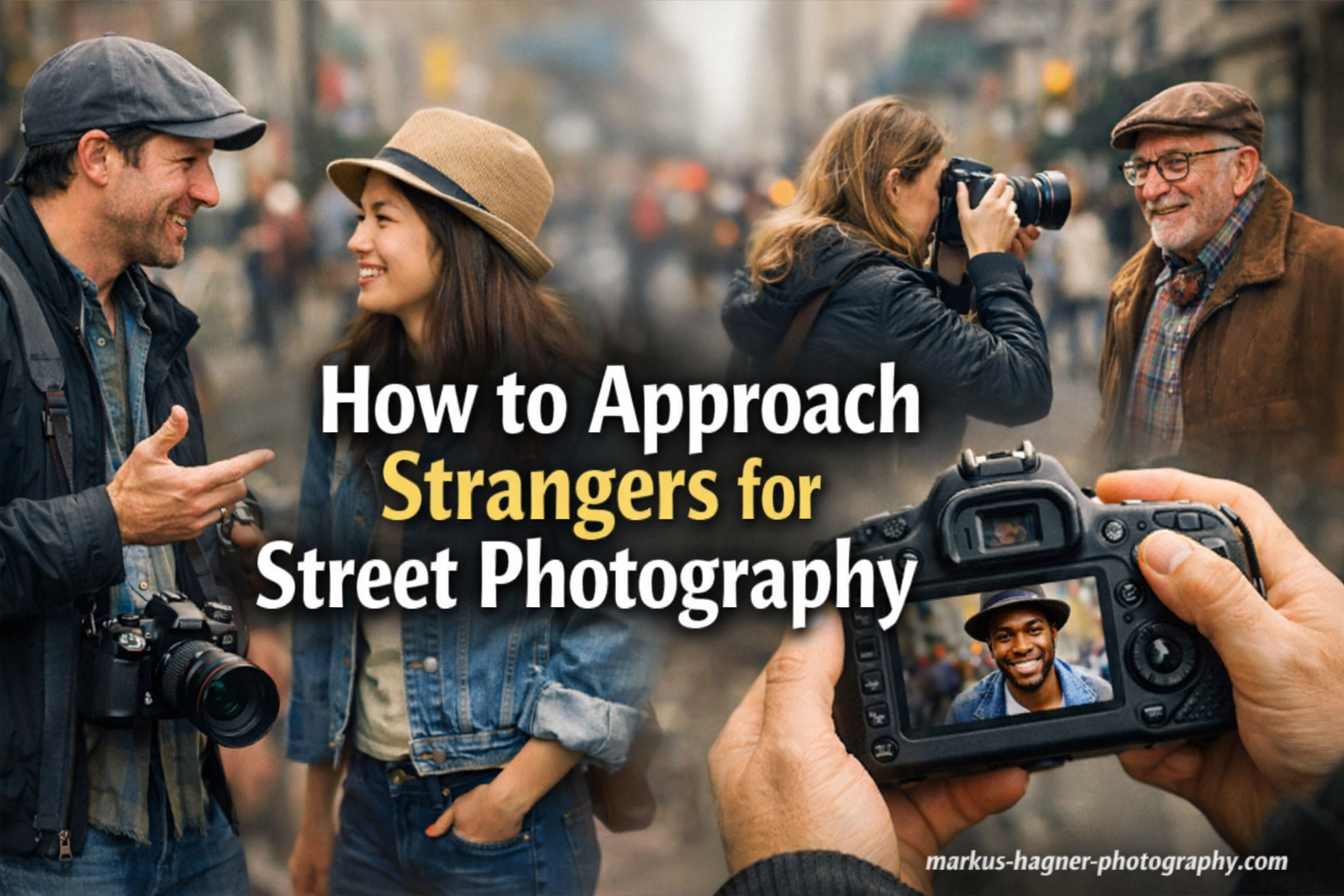
I’ve been there. Heart racing, palms sweaty, camera suddenly feeling heavy in my hands as I watched the perfect subject walk past. The moment passed, and I kicked myself for not saying anything. If you’ve ever wanted to capture a incredible street portrait but froze up, this guide will change how you approach strangers forever.
In this article, I’ll share the exact phrases that work, the body language cues that build instant trust, and the mindset shifts that helped me go from terrified beginner to someone who approaches dozens of strangers every shoot. Whether you’re new to street photography or you’ve been avoiding the “people” part entirely, these techniques will help you capture the human stories that make this genre so powerful.
Why Approaching Strangers Feels Awkward (And How to Push Past It)
That freeze response you feel? It’s completely normal. Our brains are wired to avoid potential social conflict. Approaching a stranger triggers the same uncertainty circuitry as facing a predator in early human history. Your nervous system literally can’t tell the difference between a stranger with a camera and a saber-toothed tiger.
Here’s what I want you to understand: that discomfort you’re feeling isn’t a sign you’re doing something wrong. It’s proof you’re pushing past your comfort zone, which is exactly where growth happens. The fear doesn’t disappear completely, but it gets quieter with practice.
Most people say yes when approached kindly. I repeat this to myself before every approach: “Most people say yes.” It’s a statistical fact that works as a confidence anchor. When you internalize that rejection is rare when you’re genuine and respectful, the fear loses its power.
Start by acknowledging the awkwardness instead of fighting it. Say something like, “I know this might seem strange, but…” This simple phrase does two things: it shows self-awareness and immediately makes you seem more approachable. People appreciate honesty about the unusual nature of the request.
The Exact Phrases That Work
Here’s the thing about approaching strangers for street photography: you don’t need to be clever or poetic. You need to be genuine and brief. Long explanations create suspicion. Short, confident requests get yeses.
The simple opener that works every time:
“Hey, I love your style. Would you mind if I took a quick portrait of you?”
That’s it. Three sentences maximum. Notice I said “portrait” instead of “photo” or “picture.” Using the word portrait signals that you’re doing something artistic, not just snapping a quick snapshot. It elevates the interaction.
When there’s something specific to compliment:
“That jacket is incredible. I’m a street photographer working on a series about people’s style. Would you mind if I took a photo?”
The compliment must be genuine. People can tell the difference between a sincere compliment and flattery that’s trying to get something. Focus on elements like their outfit, their hat, their beard, or even the way they carry themselves.
The confident direct approach:
“Hi, I’m a photographer. I’d love to take your portrait. Would you be interested?”
Being direct removes ambiguity. State who you are, what you want, and then let them decide. No lengthy justifications needed. Confidence here isn’t arrogance, it’s clarity.
If they’ve already noticed you:
“I’m sorry, I hope I didn’t startle you. I just thought you had a really interesting look. Would you be open to a quick photo?”
Acknowledging that you were spotted takes away the “caught doing something suspicious” vibe. Apologize briefly, then pivot to the request.
Body Language and Non-Verbal Cues That Build Trust
What you say matters, but how you say it matters more. Studies consistently show that communication is mostly non-verbal. When approaching strangers, your body language either supports your words or works against them.
The approach:
Stop walking when you start speaking. Coming to a complete halt shows you’re not in a rush and that this interaction matters to you. Keep your body relaxed, shoulders down, hands visible. Avoid crossing your arms, which creates a defensive barrier.
Eye contact:
Maintain steady but not intense eye contact. Look at them while speaking, briefly look away when listening, then back to them. Staring unblinkingly feels threatening. Never looking at them feels shifty. The rhythm should feel natural, like a conversation.
Camera positioning:
Hold your camera at your side or chest level, not raised to your eye. Raising the camera immediately creates a “taken” moment and can feel aggressive. Keep it relaxed until they say yes. Only then should you bring it up to shoot.
The smile:
Smile before you start talking. A genuine smile that’s present when you open your mouth immediately signals friendliness. Practice in a mirror if needed. Your smile should reach your eyes, not just show teeth.
Distance:
Respect personal space. Step back slightly from where you’d naturally stop. One to two arm lengths is comfortable. Invading someone’s bubble before asking creates instant discomfort.
What NOT to do:
Avoid pointing at them from a distance, which feels accusatory. Don’t hover or chase if they start walking away. Don’t keep your hand on your camera like it’s a weapon. Don’t speak while looking at your camera settings. Give them your full attention.
How to Handle Rejection Gracefully In 2026?
Here’s the truth that changed everything for me: rejection isn’t failure. It’s information. When someone says no, they’re not judging you as a person. They’re making a quick decision about an unusual request, and sometimes the answer is simply no.
The correct response to “no”:
“No worries at all, have a great day!”
That’s it. Smile, accept it immediately, and move on. Don’t argue, don’t persuade, don’t ask why. Pushing after a no creates discomfort for both of you and stains the interaction. Quick acceptance actually increases the chance they’ll change their mind if you see them again later.
What rejection tells you:
Most rejections have nothing to do with you. Maybe they’re having a bad day. Maybe they’re in a rush. Maybe they just don’t like having their photo taken. None of these reflect on your worth as a photographer or person.
The secret advantage of rejection:
Each rejection builds immunity. After 50 nos, a no no longer stings. You realize you survived the last one and you’ll survive this one. The fear of rejection becomes smaller than your desire to get the shot.
When someone hesitates:
If they seem unsure, offer a compromise: “Would it help if I showed you some of my previous work first?” or “I can show you the photo before I leave if you want.” Giving them control reduces hesitation.
Building Confidence Through Practice
Confidence in street photography isn’t a trait you’re born with. It’s a skill you develop through repetition. The more approaches you make, the more natural it becomes. Here’s how to build that practice into your routine.
Start with warm-up approaches:
Don’t start with your dream subject. Warm up by asking easier targets: people who are already looking at you, people in coffee shops who aren’t busy, people at tourist spots who expect cameras. Build momentum with small wins before tackling bigger challenges.
The five-approach rule:
Before leaving each shoot, commit to making at least five approaches. This removes the decision fatigue of constantly deciding whether to approach. You’ve already decided before you left home. Just execute five times.
Practice the opener until it’s automatic:
Role-play your phrases until they come out naturally. Practice in front of a mirror, practice with friends, practice on strangers. The goal is that the words flow without you having to think about them. This frees mental energy for reading the person’s response.
Track your results:
Keep a simple journal: approach made, result, what you said, what you’d change. After 50 approaches, you’ll have hard data on what works. Most photographers find their success rate is higher than they expected, which is incredibly validating.
Find your comfort zone edge:
Push slightly past your comfort zone each session. If you’re comfortable approaching people sitting alone, try approaching people walking. If that’s easy, try groups. Progressive exposure builds confidence faster than jumping into the deep end.
Special Scenarios: Groups, Children, and Businesses
General approaches work for most situations, but special cases require adjustments. Here’s how to handle the scenarios that cause the most hesitation.
Groups of people:
Address the entire group, not just one person. “Hey everyone, I love the energy in your group. Would it be okay if I took a photo?” If the group is mixed, look for the most enthusiastic response. Sometimes one person objects on behalf of everyone, and sometimes one person speaks up for the group. Wait for the consensus.
Children:
Always approach the guardian first. “Hi, I’m a photographer. I love your daughter’s style. Would it be okay if I took her portrait?” Never approach children directly without permission. If the guardian says yes, then you can address the child gently. Make it fun. Show them the back of your camera after.
Street vendors and business owners:
These people are working. Approach during slow moments and be prepared for a no. “I love your stand. Would you mind if I took a photo for my street photography series? I can send you a copy if you’d like.” Offering to share the photo is especially powerful for business owners who might want the exposure.
People in uniform or representing businesses:
Security guards, police, retail employees may have policies against being photographed. Ask permission first and accept their answer. “I understand, no problem at all.” Don’t sneak photos of people in professional roles without consent.
Following Up and Sharing Photos With Subjects
The interaction doesn’t end when you take the photo. Following up is where trust is built and where you become the photographer people actually want to work with.
Always offer to share:
“I’d love to send you a copy of this photo. What’s the best way to get it to you?” This simple offer transforms the interaction from extraction to exchange. Most people are delighted to receive a photo they didn’t expect.
Methods for sharing:
Ask for their email, Instagram handle, or offer to AirDrop right there if you have WiFi. Immediate sharing is powerful because the excitement is still fresh. “Let me send you this right now” creates a memorable positive experience.
Tag them on social media:
If they have Instagram, ask if you can tag them when you post. This gives them exposure and creates a connection. They might share with their followers, expanding your reach organically.
Build relationships for future shoots:
Some of my best portrait subjects became repeat collaborators. A great interaction leads to future opportunities. Treat every stranger like they could become a long-term creative partner.
Legal and Ethical Considerations
Understanding your rights and responsibilities makes you a better, more confident photographer. Here’s what you need to know.
Public spaces:
In most places, you can photograph people in public spaces where there’s no reasonable expectation of privacy. Streets, parks, and public buildings are generally fair game. However, this right comes with responsibility.
When not to photograph:
Avoid photographing people in vulnerable situations: homeless individuals, people in distress, or anyone who might face consequences from being photographed. Just because you can doesn’t mean you should.
Commercial use:
If you plan to sell or use photos commercially, be extra transparent about your intent. “This is for my personal portfolio” is honest. “This might be used in advertising” requires explicit permission and potentially model releases.
Cultural sensitivity:
Some cultures have stronger taboos around photography than others. When traveling or in diverse communities, observe first. If you’re unsure, ask. Respect always takes priority over the shot.
Frequently Asked Questions
How to do street photography without being awkward?
The key is being genuine, brief, and confident. Use simple phrases like ‘Hey, I love your style. Would you mind if I took a quick portrait?’ and remember that most people say yes when approached kindly. Focus on the interaction, not just the photo. Show genuine interest in the person before asking for their picture.
What is the 20-60-20 rule in photography?
The 20-60-20 rule in photography isn’t a widely established rule like the rule of thirds. However, some photographers use it to suggest that 20% of your shots will be exceptional, 60% will be usable, and 20% will be unusable. In street photography specifically, it reminds us to expect a high volume of attempts and not to be discouraged by average results.
What is the 300 rule in photography?
The 300 rule is a guideline for night photography. It suggests dividing 300 by your lens focal length to get the maximum shutter speed you can use before star trails appear. For example, with a 20mm lens, 300 divided by 20 equals 15 seconds. This helps beginners capture sharp stars without complex tracking equipment.
What do you say when approaching strangers for street photography?
Keep it simple and sincere. Try: ‘Hey, I love your style. Would you mind if I took a quick portrait?’ Or lead with a genuine compliment: ‘That jacket is amazing. I’m a street photographer working on a series. Would you be open to a photo?’ The key is being direct, brief, and showing genuine interest in them as a person.
How to overcome fear of street photography?
Start by accepting that fear is normal. Begin with warm-up approaches at easier targets like people in coffee shops or tourist areas. Make five approaches every session regardless of results. Track your successes to see that most people say yes. Each successful approach builds confidence and rewires your brain to associate approaching with positive outcomes.
Conclusion
Learning how to approach strangers for street photography is a journey, not a destination. Every photographer, no matter how experienced, still feels a flutter of nerves before making an approach. The difference is that they’ve trained themselves to act despite the feeling.
Start today. Pick one phrase from this guide, go to a busy street, and make five approaches. Accept every yes with gratitude and every no with grace. Track your progress. Watch your confidence grow.
The human stories waiting to be captured are worth the initial discomfort. Your next great portrait is just one friendly conversation away.