
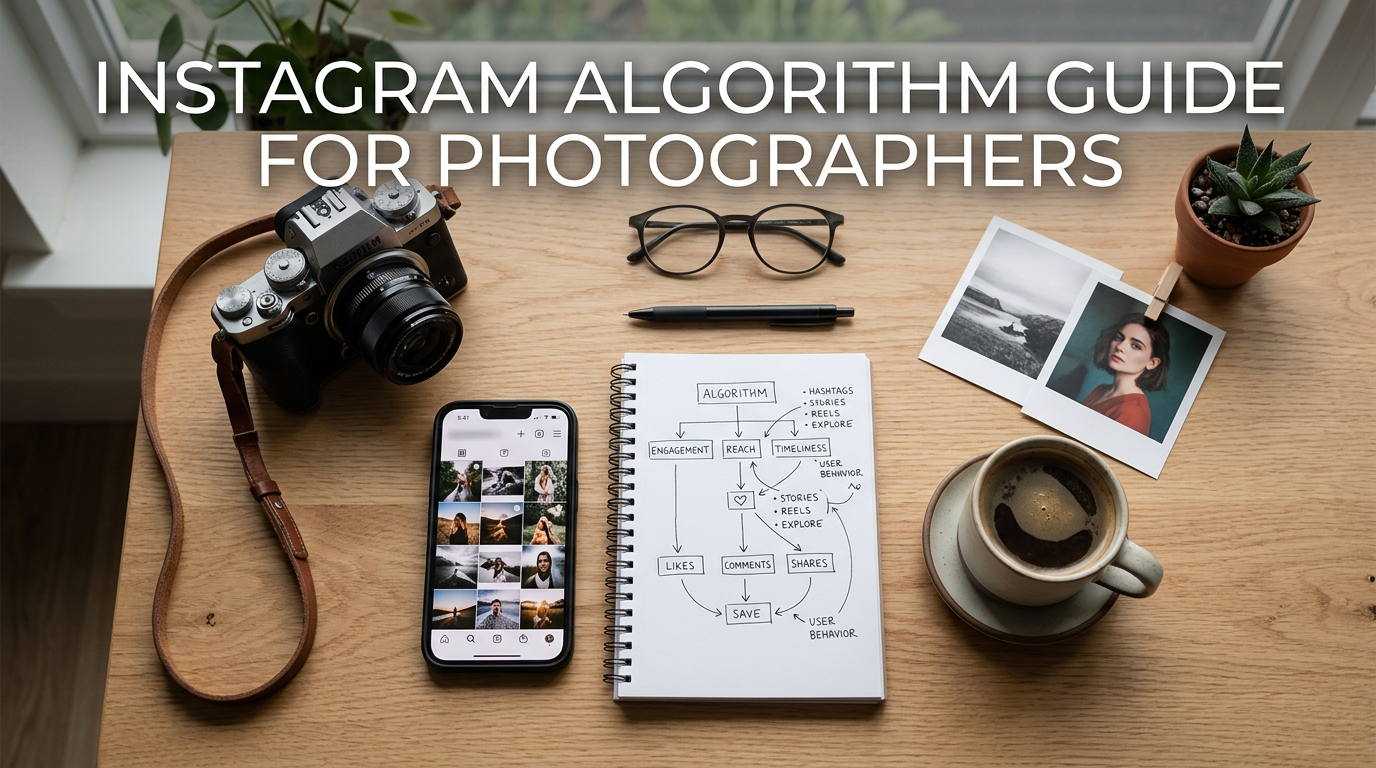
As a photographer, you’ve probably noticed your Instagram reach fluctuating wildly over the past year. One week your stunning landscape shots reach thousands, the next they barely make it past your loyal followers. You’re not imagining things. The Instagram algorithm for photographers in 2026 has shifted dramatically, and understanding these changes can mean the difference between a thriving photography business and feeling like you’re shouting into the void.
I’ve spent the last 12 months tracking how Instagram’s algorithm treats photography content specifically. After analyzing dozens of photographer accounts and testing different content strategies, I’ve discovered what actually moves the needle in 2026. The good news? Photography posts are making a comeback, but the rules have changed.
In this guide, I’ll break down exactly how the Instagram algorithm works for photographers in 2026, which ranking signals matter most, and how to create a sustainable Instagram strategy that builds your photography business without burning you out. Whether you’re a wedding photographer trying to attract local clients or a landscape photographer building a global audience, you’ll find actionable strategies you can implement today.
Table of Contents
How the Instagram Algorithm Works for Photographers in 2026
The Instagram algorithm in 2026 isn’t one single system. It’s actually multiple AI-powered ranking algorithms working across different parts of the app: Feed, Reels, Stories, and Explore. Each surface has its own set of rules, and understanding these differences is crucial for photographers who want to maximize their reach.
Instagram’s Head of Product, Adam Mosseri, has repeatedly emphasized that the platform prioritizes content that sparks genuine engagement. For photographers, this means the algorithm favors images and videos that make people stop scrolling, save your work for inspiration, or share it with others. The days of chasing likes are over. The algorithm now tracks deeper signals like watch time, completion rate, saves, and shares.
Here’s what changed in 2026 that directly impacts photographers:
Photo posts are recovering visibility. After years of Reels dominance, Instagram has started showing more single-image posts and carousels in feeds. Many photographers in our community report their static images are reaching more people than they did in late 2024 and early 2025. This doesn’t mean Reels are dead, but the gap is narrowing.
The “Your Algorithm” feature gives users control. Instagram now lets users see and adjust what the algorithm shows them. This means if someone engages with photography content, they’ll see more of it. For photographers, this is excellent news. Your ideal clients can train their algorithm to find you.
Trial Reels test content with non-followers. This new feature lets you create Reels that only appear to people who don’t follow you. It’s essentially a discovery tool built into the platform. Photographers can use Trial Reels to experiment with different content styles and see what resonates with new audiences before committing to a full strategy.
Shares now outweigh saves. In previous years, saves were the golden metric. Now, shares (sending content to friends via DM) carry more weight. For photographers, this means creating work so compelling that people want to show it to others. Think stunning compositions, surprising behind-the-scenes moments, or tips that help other photographers improve.
The algorithm also considers what I call “relationship signals.” If someone consistently comments on your posts, watches your Stories, or DMs you, Instagram will show them more of your content. This is why building genuine community matters more than follower count. A small, engaged audience will see your work more reliably than a large, passive one.
Key Instagram Ranking Signals Every Photographer Should Know
Understanding ranking signals is like learning the rules of a game. Once you know what the algorithm values, you can create content that performs better without gaming the system. Here are the signals that matter most for photographers in 2026, ranked by importance:
1. Watch Time and Completion Rate
For video content (Reels and video posts), watch time is king. But it’s not just about how long someone watches. The algorithm measures completion rate, which is the percentage of your video that viewers actually watch. A 15-second Reel that 80% of viewers finish will outperform a 60-second Reel that only 20% complete.
For photographers, this means keeping your Reels tight and engaging from the first frame. Hook viewers immediately with your best shot, then maintain momentum. Don’t drag out reveals. If you’re showing a photo editing process, speed it up. If you’re revealing a final image, show it early rather than building suspense.
2. Saves and Shares
Saves tell Instagram that your content is valuable enough to revisit. Shares tell them it’s worth sharing with others. Both matter, but shares now carry slightly more weight in 2026.
For photographers, saves often come from inspirational content, tutorials, or reference-worthy images. Shares come from emotionally resonant work, surprising reveals, or helpful tips. Create content that serves both purposes. A carousel showing “5 composition mistakes photographers make” can get saves from people who want to reference it later and shares from photographers helping their friends improve.
3. Engagement Speed
How quickly people engage with your post matters. Content that receives likes, comments, and shares within the first hour tends to get broader distribution. This doesn’t mean you should beg for engagement. It means posting when your audience is active and creating content that prompts immediate reactions.
For photographers targeting clients, this means understanding when your ideal clients scroll Instagram. Wedding photographers might find their audience most active on Sunday evenings when couples are planning. Portrait photographers might see better engagement during lunch hours when people are scrolling between tasks.
4. Relationship Signals
Instagram tracks how users interact with you over time. Do they regularly comment on your posts? Do they watch your Stories? Do they DM you? Accounts with strong relationship signals will see your content more often.
This is why responding to comments and DMs matters. Every genuine interaction strengthens the relationship signal. For photographers, this also means engaging with your ideal clients’ content. Not fake engagement, but real interest. If you’re a newborn photographer, engage authentically with new parents in your area. The algorithm notices these connections.
5. Content Type Preference
The algorithm learns what types of content each user prefers. Some people love Reels and rarely engage with static posts. Others prefer carousels and skip videos. Instagram shows users more of what they engage with.
For photographers, this means using multiple content formats. If you only post static images, you’ll miss people who primarily engage with Reels. If you only post Reels, you’ll lose followers who prefer photography posts. A balanced approach reaches more of your potential audience.
6. Recency and Account Standing
Newer posts get priority in feeds, so consistent posting matters. But account standing also plays a role. Accounts that violate community guidelines, use bots, or engage in spammy behavior get deprioritized. This is one reason buying followers or using engagement pods backfires. The algorithm detects inauthentic activity and reduces your reach.
For photographers, this means playing the long game. Build genuine engagement, follow the rules, and focus on creating valuable content. Shortcuts that worked in 2020 will hurt you in 2026.
Instagram Content Format Breakdown for Photographers
Each Instagram surface has its own algorithm quirks. Understanding these differences helps photographers choose the right format for each piece of content.
Feed Posts: The Comeback Story
After years of being deprioritized in favor of Reels, feed posts are recovering visibility in 2026. Single images and carousels now reach more followers than they did in 2024 and 2025. This is especially true for accounts that post consistently and maintain good engagement rates.
Best practices for photographers:
Use carousels to tell stories. A wedding photographer might show the ceremony setup in slide one, the couple’s first look in slide two, and the reception details in slide three. Each slide should be compelling on its own while contributing to a larger narrative.
Optimize your first image. The first image in a carousel determines whether people swipe. Make it your strongest shot. Save supporting images and details for later slides.
Write meaningful captions. Long captions that provide value, tell stories, or share insights perform better than short, generic ones. Use keywords naturally in your captions for Instagram SEO.
Reels: Still the Reach Champion
Reels still get the most reach on Instagram, especially for discovery. Non-followers are more likely to see your Reels than your feed posts. For photographers trying to grow their audience, Reels remain essential.
Best practices for photographers:
Hook viewers in the first second. Start with your best image or most interesting moment. Don’t waste time on logos or long introductions.
Show your process. Behind-the-scenes content performs exceptionally well. Show how you set up a shot, your editing workflow, or the story behind a famous image. These authentic moments connect with viewers more than polished final images.
Use trending audio strategically. Audio that’s trending gets more distribution. But choose audio that fits your brand. A landscape photographer might use cinematic music while a street photographer might prefer ambient sounds.
Keep it short. Reels under 30 seconds typically have higher completion rates. Save longer content for IGTV or feed videos.
Stories: The Engagement Engine
Stories are crucial for maintaining relationship signals with existing followers. Accounts that post Stories consistently get better distribution across all surfaces. The algorithm views active Story posters as engaged community members.
Best practices for photographers:
Post daily, even if it’s simple. A quick behind-the-scenes shot or a work-in-progress image keeps you visible in your followers’ Stories feeds.
Use interactive features. Polls, questions, and sliders prompt engagement. Ask your audience which edit they prefer, what location you should shoot next, or what camera settings they want to see explained.
Share user-generated content. When clients tag you in their posts, share them to your Stories. This builds community and shows social proof to potential clients.
Save your best Stories as Highlights. Organize them by category: Portfolio, Behind the Scenes, Client Love, Tips. New profile visitors will browse these to understand your work.
Explore Page: The Discovery Goldmine
Explore shows content to people who don’t follow you but might be interested based on their behavior. Getting featured on Explore can dramatically increase your reach. The Explore algorithm prioritizes content that gets strong engagement from similar accounts.
Best practices for photographers:
Create highly shareable content. Explore favors posts that get saves and shares quickly. Think about what would make someone send your post to a friend.
Use relevant hashtags and keywords. The Explore algorithm categorizes content by topic. Hashtags and caption keywords help it understand where to place your work.
Post consistently in your niche. If you’re a wedding photographer, consistently posting wedding content trains the algorithm to show your work to people interested in weddings. Mixed content confuses the algorithm.
Photographer-Specific Instagram Strategy for 2026
Generic Instagram advice doesn’t always apply to photographers. Your content has unique characteristics: it’s visual, often educational, and serves both artistic and business goals. Here’s how to adapt algorithm knowledge to photography specifically.
Content Ideas That Work for Different Photography Niches
Wedding Photographers: Share real wedding galleries as carousels, create Reels showing how you handle difficult lighting situations, post Stories from wedding days (with couple permission), and showcase the emotional moments clients love. Educational content about wedding photography tips for couples also performs well.
Portrait Photographers: Before-and-after edits show your skill. Behind-the-scenes of posing direction demonstrates your expertise. Client reveal Reels create emotional moments. Testimonials and client stories build trust.
Landscape Photographers: Location reveal Reels tap into wanderlust. Technical breakdowns of how you captured difficult shots educate and inspire. Weather and light prediction tips provide practical value. Multi-image carousels showing different angles of the same location work well.
Street Photographers: Quick reaction Reels showing how you spot and capture moments. Stories from the streets about interesting encounters. Carousels telling visual stories from a single outing. Discussion of ethics and approach in street photography.
Commercial Photographers: Behind-the-scenes of professional shoots shows your process. Case studies of how your images helped clients achieve goals. Gear reviews and recommendations. Lighting setup breakdowns.
Behind-the-Scenes Content That Builds Connection
Forum discussions and photographer communities consistently show that behind-the-scenes content outperforms polished final images. People want to see the person behind the camera, not just the results.
What works:
Show your editing process, even the messy parts. Explain your camera settings for difficult shots. Share the story of getting “the shot,” including failures. Introduce your team if you have one. Show your workspace and gear setup. Document your learning process and mistakes.
This content humanizes you and builds trust. Potential clients see that you’re a real person with expertise, not just a portfolio. It also gives the algorithm more content to work with, increasing your posting frequency without needing more finished images.
Building Authentic Community vs. Chasing Followers
The algorithm in 2026 rewards genuine community over raw follower counts. A smaller, engaged audience will see your content more reliably than a large, passive one. This is especially important for photographers seeking clients rather than fame.
How to build community:
Respond to every comment with thoughtful replies. Ask follow-up questions. Remember repeat commenters and reference past conversations. Engage genuinely with other photographers’ content. Create content that serves your community, not just showcases your work.
The 5-3-1 rule helps structure this approach: For every promotional post about your services, share three posts that build connection (behind-the-scenes, personal stories) and five posts that provide value (tips, education, inspiration). This ratio keeps your audience engaged without feeling sold to.
Converting Followers to Photography Clients
Many photographers complain that their follower count doesn’t translate to client inquiries. The algorithm alone won’t fix this. You need strategic content that moves followers from awareness to action.
The client conversion path:
Use Reels for discovery (reach new people), feed posts for portfolio (show your best work), Stories for nurturing (build relationship and trust), and DMs for conversion (answer questions and book clients).
Make it easy to work with you. Your bio should clearly state what you do and where you’re based. Include a link to your booking page or inquiry form. Occasionally remind followers that you’re taking clients. Share client testimonials and results.
Mental Health and Work-Life Balance
Here’s something most Instagram guides ignore: your mental health affects your content, which affects your algorithm performance. Burned-out photographers create mediocre content. Comparison with other photographers leads to inauthentic posts. Dopamine chasing keeps you scrolling instead of creating.
Healthy habits for photographers:
Set specific times for Instagram and stick to them. Consider the “post and ghost” strategy: upload your content, respond to initial comments for 15 minutes, then close the app. Don’t check analytics constantly. Focus on creating great photography first, Instagram content second.
Curate your feed to see less triggering content. Unfollow accounts that make you feel inadequate. Remember that Instagram success doesn’t equal photography success. Many incredible photographers have modest Instagram followings and thriving businesses.
Treat Instagram as one tool in your marketing arsenal, not your entire strategy. Your website, word of mouth, and real-world networking matter as much or more. Instagram is a means to an end, not the end itself.
Actionable Tips Checklist for Photographers
Here’s a practical checklist of actions you can implement today to work with the Instagram algorithm instead of against it:
Quick Wins (Implement Today)
Optimize your profile: Clear bio stating your niche and location, professional profile photo, link to booking or portfolio, highlights organized by category.
Audit your recent content: Which posts got the most saves and shares? Create more content like that. Which posts flopped? Understand why before repeating.
Set up consistent posting: Choose a sustainable schedule (3-4 posts per week is a good baseline). Add daily Stories. Use a content calendar to plan ahead.
Engage authentically: Spend 15 minutes before and after posting engaging with others’ content. Respond to every comment on your posts with thoughtful replies.
Content Strategy (Implement This Week)
Create a content mix: Plan for Reels (discovery), feed posts (portfolio), and Stories (nurturing). Aim for the 5-3-1 ratio: 5 value posts, 3 connection posts, 1 promotional post.
Batch create content: Dedicate one day to shooting and editing content for the week. This prevents burnout and ensures consistent posting.
Develop content series: Create recurring themes like “Monday Motivation” with inspiring shots, “Wednesday Wisdom” with tips, or “Friday Favorites” with recent work. Series build anticipation and give you a framework.
Common Mistakes to Avoid
Buying followers or using bots: This destroys account standing. The algorithm detects fake engagement and reduces your reach. It also damages trust with real followers who notice inauthentic comments.
Inconsistent posting: The algorithm rewards consistency. Long breaks followed by posting sprees confuse the algorithm and your audience. Better to post three times a week consistently than seven times one week and zero the next.
Ignoring analytics: Check your insights weekly. See when your audience is most active, which content performs best, and how your reach trends over time. Data should inform your strategy.
Copying trends blindly: Trends work when they fit your brand. A nature photographer forcing dance trends will look inauthentic. Adapt trends to your niche or skip them entirely.
Posting without engaging: Instagram is social media. If you only broadcast without engaging with others, the algorithm will deprioritize you. Genuine engagement matters.
Posting Frequency Recommendations
Consistency beats frequency. A sustainable posting schedule for most photographers is:
Feed posts: 3-4 per week
Reels: 2-3 per week
Stories: Daily (1-5 per day)
This totals about 30-40 posts per week across all formats, which sounds like a lot until you realize Stories take seconds to create. Batch your feed posts and Reels, then add quick Stories throughout the week.
Frequently Asked Questions
What is the 5-3-1 rule on Instagram?
The 5-3-1 rule is a content ratio strategy for Instagram. For every promotional post about your services, share three posts that build connection (behind-the-scenes, personal stories) and five posts that provide value (tips, education, inspiration). This ratio keeps your audience engaged without feeling sold to, which improves algorithm performance over time.
How does the Instagram algorithm work in 2026?
Instagram uses multiple AI ranking systems across Feed, Reels, Stories, and Explore. Key signals include watch time, completion rate, saves, shares, engagement speed, relationship signals, and content type preference. The algorithm shows users more content similar to what they’ve engaged with before, making consistent niche posting important for photographers.
Do Reels or posts work better for photographers?
Reels still get more reach, especially for discovery, but photo posts are making a comeback in 2026. The best strategy uses both: Reels for reaching new audiences and feed posts for showcasing your portfolio to existing followers. Carousels work particularly well for photographers because they let you tell visual stories across multiple images.
How often should photographers post on Instagram?
Consistency matters more than frequency. A sustainable baseline for most photographers is 3-4 feed posts per week, 2-3 Reels per week, and daily Stories. This totals about 30-40 pieces of content weekly across all formats. The key is choosing a schedule you can maintain long-term rather than burning out with aggressive posting.
What are Instagram’s ranking signals for photographers?
The main ranking signals are watch time and completion rate (for video), saves, shares, engagement speed (how quickly people interact), relationship signals (history of interaction), content type preference, recency, and account standing. For photographers specifically, saves and shares are most important because they indicate your work is valuable enough to save for later or share with others.
Why has my Instagram reach dropped?
Reach drops can happen for several reasons: algorithm changes, inconsistent posting, reduced engagement from followers, content that doesn’t match what your audience wants, or seasonal fluctuations. Check your analytics to identify the pattern. Often, returning to consistent posting and engaging authentically with your community restores reach over time.
Conclusion
The Instagram algorithm for photographers in 2026 rewards authenticity, consistency, and genuine engagement over hacks and shortcuts. While the technical signals matter (watch time, saves, shares, relationship indicators), the underlying principle is simple: create content that serves your audience, and the algorithm will help them find you.
Remember that Instagram is a tool, not your entire photography business. Focus on creating excellent work, building real relationships, and maintaining healthy boundaries with social media. The photographers who succeed on Instagram in 2026 are those who treat it as one part of a sustainable marketing strategy rather than an all-consuming pursuit.
Start with the quick wins in this guide: optimize your profile, establish a consistent posting schedule, and engage authentically with your community. Then layer in the deeper strategies: niche-specific content, behind-the-scenes stories, and a healthy relationship with the platform. Your photography deserves to be seen, and understanding the Instagram algorithm helps make that happen.