
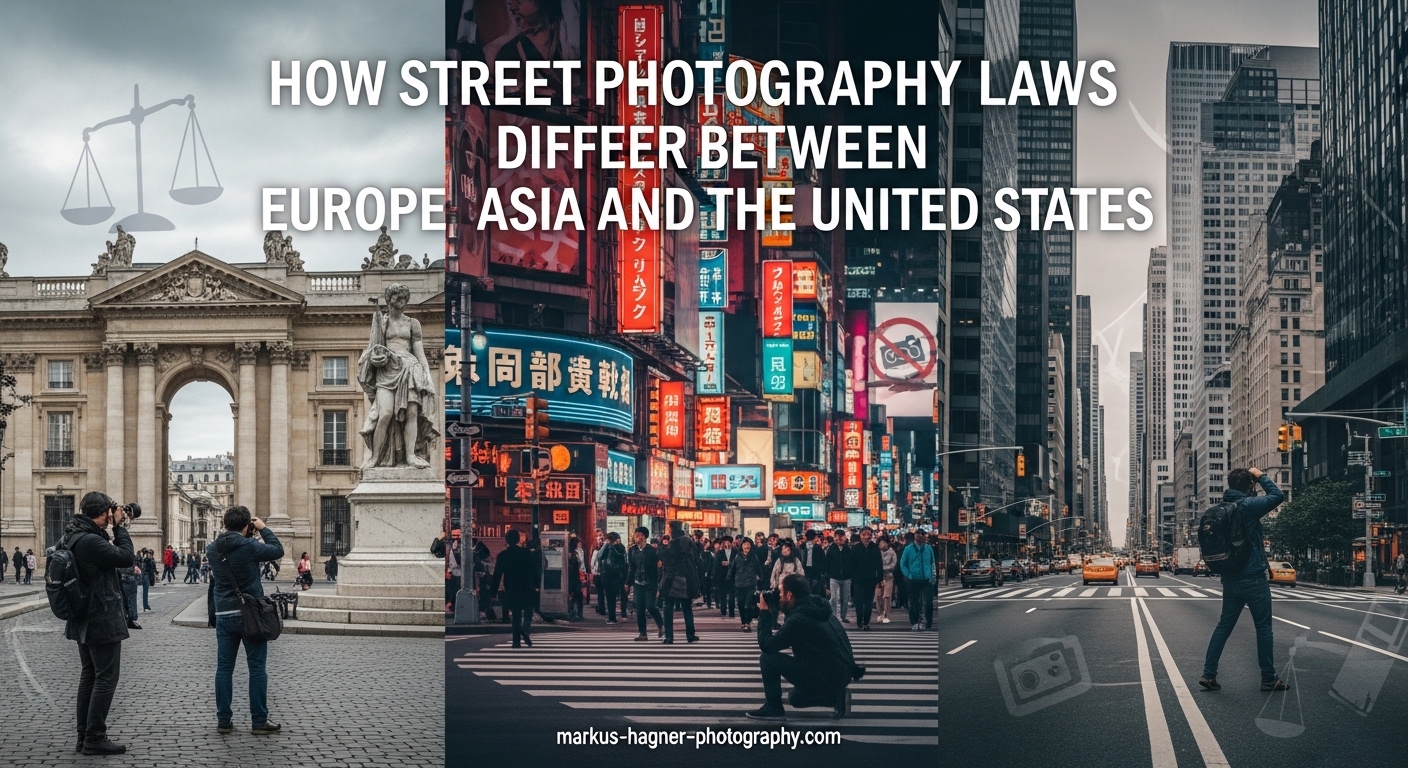
I remember standing on a busy street in Berlin, camera raised, when a woman stormed toward me demanding I delete her photo. I hadn’t even pressed the shutter yet. That moment taught me something crucial: understanding street photography laws isn’t just about avoiding lawsuits. It’s about knowing your rights, respecting others, and shooting with confidence no matter where you are in the world.
Street photography captures the raw energy of public life. But what’s perfectly legal in New York might get you into serious trouble in Paris or Tokyo. The rules shift dramatically across borders, and misinformation spreads fast among photographers.
In this guide, I’ll break down exactly how street photography laws differ between Europe, Asia, and the United States. I’ve spent years researching legal frameworks, talking to photographers worldwide, and navigating these regulations myself. You’ll learn what’s actually legal, where consent matters, and how to protect yourself while creating meaningful work.
Street Photography Laws in the United States
The United States offers some of the most permissive street photography laws in the world. That doesn’t mean anything goes, but the legal foundation strongly favors photographers shooting in public spaces.
First Amendment Protections
Photography counts as protected speech under the First Amendment. This means you generally have the right to photograph anything visible from a public place. Streets, sidewalks, parks, and public plazas are fair game. Courts have repeatedly upheld this principle, establishing that visual documentation of public life serves an important democratic function.
The key distinction in American law centers on location, not subject matter. If you’re standing on public property, you can photograph private buildings, people, and events happening in public view. The ACLU and numerous court cases have reinforced this position consistently over decades.
However, this protection has limits. You cannot trespass onto private property to get a shot. Government buildings, military installations, and certain infrastructure may have photography restrictions for security reasons. But these are specific exceptions, not the general rule.
Reasonable Expectation of Privacy
This legal concept shapes American privacy law fundamentally. People have a reasonable expectation of privacy in places where privacy is normally expected: bathrooms, dressing rooms, inside their homes with curtains drawn. Public streets? No expectation of privacy exists there.
This principle works in photographers’ favor. If someone is visible from a public space, they generally cannot claim privacy violations when photographed. Even candid shots of people eating at outdoor cafes, arguing on street corners, or sleeping on park benches typically fall within legal boundaries.
The line blurs with telephoto lenses. If you use extreme magnification to peer into someone’s apartment window from a public sidewalk, you might cross into illegal surveillance territory. The lens choice matters because it affects whether you’re documenting public life or invading private spaces.
Commercial vs Editorial Use
Here’s where American law gets more restrictive. Taking the photo and publishing it are different legal acts. Editorial use—news, documentaries, art exhibitions, educational content—enjoys broad protection. Commercial use—advertising, merchandise, stock photography—requires more careful navigation.
A street photo published in a newspaper needs no model release. That same photo used in an advertisement could trigger claims under right of publicity laws. These state-level laws protect individuals from having their likeness used commercially without permission.
California and New York have particularly strong right of publicity protections. A recognizable person in your street photo could potentially sue if you sell that image for commercial purposes without consent. Fine art prints typically fall into a gray area, with courts sometimes treating them as editorial and sometimes as commercial depending on context.
State-Specific Considerations
While federal law provides baseline protections, states add their own layers. Some states have considered legislation restricting street photography. Arkansas attempted to pass the Personal Rights Protection Act, which would have required consent for any photograph of a person in a public place. The bill faced strong opposition and ultimately failed, but it signaled ongoing tension between privacy advocates and photographers.
Photographers should also understand that security guards and police officers don’t always know the law. I’ve been told countless times that photographing buildings is illegal or that I need permission for street portraits. Both claims are false in most public situations. Carrying a copy of your rights—or knowing the relevant ACLU guidelines—helps in these confrontations.
Street Photography Laws in Europe
Europe presents a more complex landscape. Privacy protections run deeper here, and the European Union’s data protection regulations have created additional layers photographers must navigate. The result is generally more restrictive than the United States, though significant variation exists between countries.
GDPR and Photography
The General Data Protection Regulation transformed how Europeans think about personal data. Photographs of identifiable individuals count as personal data under GDPR. This means taking, storing, and publishing such images potentially triggers data protection requirements.
In practice, GDPR’s impact on street photography remains debated. The regulation includes exemptions for journalistic, artistic, and academic purposes. But these exemptions require interpretation, and the boundaries aren’t always clear. Street photographers operating in Europe should understand that GDPR creates potential liability even when local laws permit photography.
The key question becomes whether your street photography qualifies for artistic or journalistic exemptions. Documentary work and fine art photography have stronger claims than casual snapshots intended for social media. Context matters enormously under GDPR’s framework.
Germany: Recht auf eigenes Bild
Germany’s “right to your own image” law represents one of Europe’s strictest approaches. The German Civil Code (Kunsturhebergesetz) protects individuals’ rights to control images of themselves. This creates a split between taking photos and publishing them.
Taking street photographs in public spaces isn’t illegal in Germany. The criminal prohibition applies only in specific circumstances involving highly private situations. However, publishing recognizable images without consent opens photographers to civil liability.
The famous Espen Eichhöfer case in Berlin illustrated these tensions. The street photographer faced legal action over published images. The case highlighted how German law prioritizes individual privacy over artistic freedom in many situations. German street photographers often work around these restrictions by photographing crowds where individuals aren’t clearly identifiable or by seeking consent after shooting.
France: Strong Privacy Protections
France enforces particularly robust privacy rights. Article 9 of the French Civil Code establishes that everyone has the right to respect for their private life. Courts have interpreted this to include control over one’s image in many public contexts.
The distinction between public and private spaces matters, but so does the individual’s right to control their likeness. Photographing someone in a public place isn’t automatically illegal, but publishing that image without consent can trigger legal consequences. The burden falls on the photographer to justify publication.
French street photographers navigate these rules through various strategies. Some focus on crowded scenes where no single person dominates. Others approach subjects for consent after capturing candid moments. The legal environment encourages more intentional, relationship-based approaches to street photography.
United Kingdom: Balanced Approach
The UK occupies middle ground between American permissiveness and continental European restriction. There’s no general prohibition on photographing people in public places. The key concept is reasonable expectation of privacy, similar to American law but applied somewhat differently.
Photography in public spaces is generally legal. However, harassment, pursuit, or persistent photography of someone who objects could constitute a criminal offense. The Protection from Harassment Act provides recourse for people subjected to unwanted persistent attention.
The UK also has specific laws around photography in certain locations. Transportation hubs, government buildings, and some public spaces have designated photography policies. These aren’t always clearly posted, so photographers should research specific locations in advance.
Poland, Spain, and Hungary
Poland offers relatively permissive street photography laws. There’s no legal requirement for consent to photograph people in public spaces. Polish law does include a “small detail” exception—images where people appear as minor elements of a larger scene face fewer restrictions. This gives street photographers more flexibility than in many European countries.
Spain has tightened enforcement of privacy protections in recent years. Courts have increasingly required consent for publication of recognizable images, even from public spaces. Spanish photographers report growing caution around street work.
Hungary’s 2014 privacy law created one of Europe’s stricter frameworks. The law requires consent for photographing individuals, though interpretation and enforcement remain inconsistent. Street photographers report varying experiences depending on location and subject matter.
Freedom of Panorama in Europe
Beyond people photography, European laws vary significantly on photographing buildings and public art. Freedom of panorama refers to the right to photograph permanently installed public works without copyright infringement claims.
Some countries—like the UK and Germany—have broad freedom of panorama provisions. Others restrict this right, meaning photographing certain buildings or sculptures could theoretically violate copyright. The Eiffel Tower presents a famous example: photographing the tower by day is fine, but the illuminated tower at night is protected by copyright on the lighting design.
Street photographers focusing on urban landscapes should research specific country rules. What’s freely photographable in London might require permission in Paris or Brussels.
Street Photography Laws in Asia
Asia presents perhaps the most diverse legal landscape for street photography. From Japan’s complex cultural and legal framework to China’s government restrictions to India’s relatively permissive approach, photographers encounter dramatically different environments across the continent.
Japan: Cultural Complexity
Japan technically permits street photography in public spaces. There’s no comprehensive law prohibiting photography of people in public places. However, cultural norms and specific regulations create a more restrictive practical environment than the letter of the law suggests.
Japanese privacy consciousness runs deep. Many people object strongly to being photographed without consent, even in crowded public spaces. Photographers who ignore these cultural expectations face social censure even when operating legally.
Specific locations carry additional restrictions. Photography is often prohibited in train stations, shopping districts, and entertainment areas. These rules are posted in Japanese, making them easy for foreign photographers to miss. Enforcement varies, but officials can demand image deletion for violations.
The concept of “portrait rights” has gained traction in Japanese legal discourse. While not codified in the same way as European privacy rights, this principle increasingly influences how authorities handle photography disputes. Street photographers in Japan should prioritize discretion and cultural sensitivity.
China: Government Restrictions and Cultural Sensitivity
China’s legal framework for street photography exists within broader constraints on expression and documentation. Photographing in public spaces isn’t prohibited, but government buildings, military installations, and certain infrastructure are off-limits. Security personnel may object to photography even in nominally public areas.
Cultural attitudes toward photography vary significantly across China’s vast territory. In some regions, people react positively to being photographed. In others, suspicion of documentation runs deep. Political sensitivity adds another layer—images that could be interpreted as critical of government or society invite scrutiny.
Foreign photographers face additional considerations. Visa requirements, restricted areas, and government monitoring all affect street photography practice. Images leaving the country may attract attention if they depict sensitive subjects. Professional photographers often work with local fixers who understand unwritten rules.
India: Relatively Permissive
India offers more permissive street photography conditions than many Asian countries. There’s no comprehensive privacy law restricting photography in public spaces. The cultural attitude toward photography tends toward openness, with many people reacting positively or neutrally to cameras.
This doesn’t mean anything goes. Religious sites, military areas, and certain government buildings restrict photography. Additionally, photographing children in schools or vulnerable populations requires particular care and ideally consent.
Indian street photographers report generally positive experiences. The country’s vibrant public life and relative legal freedom make it attractive for documentary work. However, photographers should still exercise judgment around sensitive subjects and avoid situations that could be interpreted as exploitative.
Southeast Asia: Varying Regulations
Southeast Asian countries present a patchwork of legal frameworks and cultural attitudes. Thailand permits public photography but restricts images of the royal family under strict lèse majesté laws. This extends to incidental captures—street photos that happen to include royal imagery can create legal problems.
Vietnam, Cambodia, and Laos have varying restrictions on photography near government and military sites. Enforcement tends toward inconsistency, with local officials exercising significant discretion. Photographers should research specific destinations and remain flexible.
Singapore combines relatively clear laws with strict enforcement. Public photography is generally permitted, but specific locations have posted restrictions. The orderly nature of Singaporean society means violations are more likely to be noticed and addressed than in countries with more chaotic public spaces.
Key Differences Between Regions at a Glance
Understanding the broad patterns helps photographers quickly orient themselves when traveling. Here’s how the three regions compare on key issues:
Taking photos in public spaces: The United States broadly permits this under First Amendment protections. Europe allows photography but with country-specific variations—taking photos is generally legal, but restrictions may apply. Asia varies significantly by country, with Japan and China more restrictive and India more permissive.
Publishing without consent: The United States permits editorial and artistic publication; commercial use may require releases. Europe generally requires consent for recognizable individuals, with exemptions for journalism and art that vary by country. Asia varies, with cultural factors often mattering as much as legal frameworks.
Commercial use: All three regions impose stricter requirements for commercial applications. Model releases become essential for advertising, merchandise, and stock photography across virtually all jurisdictions.
Model releases: The United States doesn’t require releases for editorial use but increasingly requires them for commercial applications. Europe effectively requires releases for most identifiable subjects. Asia has varying formal requirements, but releases protect against both legal and cultural complications.
Practical Tips for Traveling Street Photographers
Knowing the law is one thing. Applying that knowledge while actually shooting is another. Here’s what I’ve learned from years of international street photography.
Before You Travel
Research your destination’s specific rules. General knowledge about regions helps, but individual countries have unique requirements. Check government travel advisories, photography forums, and local photography organizations for current information.
Prepare documentation. Carry business cards explaining who you are and what you’re doing—ideally in local languages for non-English destinations. Having something to hand subjects who question your presence often defuses tension before it escalates.
Consider insurance. Professional liability insurance that covers international photography protects against worst-case scenarios. Standard travel insurance may not cover equipment or legal issues arising from photography specifically.
Understand your equipment’s implications. Large cameras and telephoto lenses attract more attention and may trigger more objections than discreet setups. Match your gear to local norms and the type of work you’re doing.
Handling Confrontations
Confrontations happen even when you’re operating legally. Someone objects to being photographed. A security guard approaches with questions. A police officer demands you stop shooting. How you handle these moments matters enormously.
Stay calm and polite. Defensiveness escalates situations. Acknowledge the person’s concerns even while asserting your rights. Most confrontations stem from misunderstanding rather than actual legal violations.
Know when to delete and when to stand firm. If someone catches you photographing them and asks you to delete the image, consider whether that photo is worth the conflict. In many situations, the goodwill from simply complying outweighs the loss of one shot. But know your rights for situations where standing firm matters.
De-escalate before involving authorities. Most disputes can be resolved through conversation. Involving police or security rarely benefits photographers, even when legally in the right. The goal is to continue shooting, not to win an argument.
Publishing Your Work
Legal considerations don’t end when you put the camera away. Publishing street photography—especially online—creates additional exposure. Social media platforms operate globally, meaning images posted in one country may be viewed and challenged from another.
Distinguish between editorial, artistic, and commercial use. A street photo on your personal Instagram differs legally from the same image in a gallery exhibition or stock photography catalog. Each use case carries different consent requirements and risk levels.
Consider anonymization techniques. Blurring faces, shooting from angles that minimize recognition, or focusing on crowds rather than individuals reduces privacy concerns across all jurisdictions. These techniques sacrifice some artistic impact but increase legal safety.
Document consent when possible. If you approach subjects for permission after shooting, note the details. Digital records—screenshots of message exchanges, photos of signed releases, audio recordings of verbal consent—provide protection if disputes arise later.
Ethical Considerations Beyond the Law
Legal permission doesn’t always align with ethical practice. Street photographers navigate complex moral territory regardless of jurisdiction. Thinking beyond legal minimums produces better work and better relationships with subjects.
Respect and Common Sense
Just because you can photograph something doesn’t mean you should. People in vulnerable situations—homeless individuals, people experiencing medical emergencies, those in distress—deserve particular consideration. Legal right doesn’t justify exploitative imagery.
Consider how you’d feel if roles were reversed. Would you want a stranger photographing you during a difficult moment? Would you want that image published online without your knowledge? These questions guide ethical practice across legal frameworks.
The “trade photos” approach works well in some contexts. Offering to share images with subjects creates goodwill and often produces more engaged, authentic portraits. This strategy works particularly well in regions where consent norms are evolving.
Children and Vulnerable Individuals
Photographing children requires extra care across all jurisdictions. Even where legally permitted, images of children raise heightened privacy and safety concerns. Parents may object strenuously. Schools and youth organizations often have specific policies.
Vulnerable adults—elderly individuals, people with disabilities, those in medical distress—deserve similar consideration. Their ability to consent or object may be compromised. Photographers should err heavily toward protection rather than documentation in these situations.
Many stock photography platforms and publications have specific policies restricting images of recognizable children and vulnerable individuals. Even legally captured images may face distribution barriers without proper consent documentation.
Cultural Sensitivity
What’s acceptable in one culture may be deeply offensive in another. Religious ceremonies, traditional communities, and sacred spaces often have photography norms that differ from general public space rules. Research and respect these boundaries.
When in doubt, ask. Seeking permission demonstrates respect and often opens doors to more meaningful photographic opportunities. Many street photographers find that asking leads to better images than pure candid work, even when the asking happens after the initial capture.
Consider the broader impact of your images. Photography that reinforces stereotypes or presents communities in negative light causes harm beyond individual privacy concerns. Ethical street photography contributes to understanding rather than exploitation.
Frequently Asked Questions About Street Photography Laws
Is street photography legal in Europe?
Street photography is legal in Europe, but with significant restrictions. Taking photos in public spaces is generally permitted, but publishing recognizable images of individuals often requires consent under country-specific privacy laws and GDPR regulations. Germany, France, and Spain have particularly strict requirements, while Poland and some other countries offer more flexibility. The key distinction is between shooting and publishing—what you can capture differs from what you can share.
Is it illegal to do street photography in Japan?
Street photography is not illegal in Japan, but cultural and practical restrictions make it challenging. There’s no comprehensive law prohibiting photography of people in public places. However, specific locations like train stations, shopping areas, and entertainment districts often prohibit photography. Japanese cultural norms strongly value privacy, so even legal photography may draw objections. Photographers should prioritize discretion and respect cultural expectations rather than relying solely on legal permissions.
Do I need permission for street photography?
Whether you need permission depends on your location and intended use. In the United States, you generally don’t need permission to photograph in public spaces. In Europe, you often need consent to publish recognizable images even if taking the photo is legal. In Asia, requirements vary significantly by country. For commercial use—advertising, merchandise, stock photography—model releases are essential across virtually all jurisdictions. Editorial and artistic use faces fewer restrictions but still requires attention to local laws.
Can I publish street photography photos without consent?
Publishing street photography without consent depends on jurisdiction and use type. In the United States, editorial and artistic publication generally doesn’t require consent for images taken in public spaces. Commercial use typically requires model releases. European countries often require consent for any publication of recognizable individuals, with limited exemptions for journalism and art. Asia varies by country, with cultural factors complicating legal frameworks. Social media publishing faces scrutiny across all regions as platforms operate globally.
What is the difference between commercial and editorial use in street photography?
Commercial use involves leveraging images to sell products or services—advertising, merchandise, stock photography, corporate marketing. This typically requires model releases regardless of jurisdiction. Editorial use covers news, documentaries, educational content, and fine art exhibitions where the image itself is the product rather than a marketing tool. Editorial use enjoys broader protections under free speech and press freedom principles. The distinction matters because consent requirements differ significantly between these categories across all regions.
Conclusion: Navigating Street Photography Laws with Confidence
Street photography laws differ dramatically between Europe, Asia, and the United States, but understanding these differences empowers rather than restricts. The United States offers the broadest protections under First Amendment principles. Europe prioritizes individual privacy through country-specific laws and GDPR regulations. Asia presents diverse frameworks where cultural factors often matter as much as legal text.
Success in street photography comes from combining legal knowledge with ethical practice. Know the rules where you’re shooting. Respect subjects regardless of what the law permits. Build relationships when possible. Document consent when feasible. These principles serve photographers across all jurisdictions.
Most importantly, don’t let legal complexity paralyze your creativity. Street photography documents the human condition in all its variety. Done thoughtfully, it creates connection rather than conflict. The laws exist to balance artistic freedom with individual rights—understanding that balance makes you a better photographer and a better citizen of the global photography community.
Whether you’re shooting in New York, Paris, Tokyo, or anywhere in between, the fundamentals remain consistent: shoot with intention, respect your subjects, and know your rights. The rest is just capturing moments that matter.