
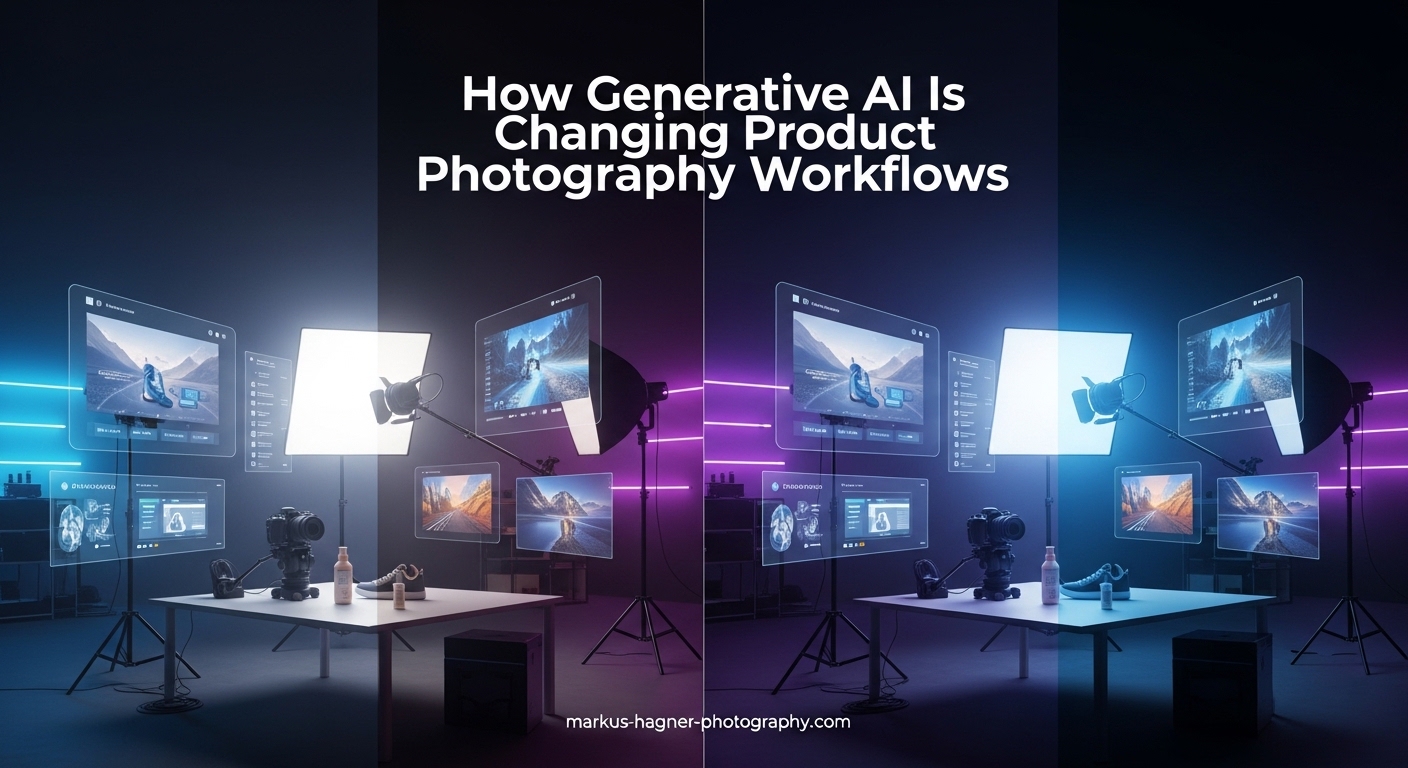
Product photography has always been expensive, time-consuming, and resource-intensive. Studios, lighting equipment, professional photographers, post-production editors, and multiple revision rounds quickly add up for e-commerce brands that need thousands of product images. Generative AI is fundamentally changing this equation, transforming what was once a bottleneck into a scalable, efficient creative engine.
If you manage product imagery for an e-commerce brand, work as a product photographer, or run a small business that needs professional visuals, understanding how generative AI changes these workflows is essential for staying competitive. This guide breaks down exactly what’s changing, where AI adds the most value, and how to build a workflow that combines the best of both worlds.
What Is Generative AI in Product Photography?
Generative AI in product photography uses machine learning models and computer vision technology to create, enhance, or transform product images without traditional photography equipment. Instead of scheduling studio time, setting up lighting, and capturing dozens of shots, you can now generate professional product imagery from text prompts, existing photos, or a combination of both.
The technology works through several interconnected processes. First, computer vision algorithms analyze the source product image to understand its shape, dimensions, and key features. Then, generative AI models apply style transfer, background replacement, and lighting simulation to produce studio-quality results. Finally, the system can generate unlimited variations in different settings, angles, and lighting conditions—all from a single reference image.
This isn’t just about removing backgrounds or applying filters. Modern generative AI can place your product in completely fictional environments, adjust lighting to match specific moods, generate lifestyle contexts you never photographed, and even create variations for seasonal campaigns in minutes rather than days. The technology understands product geometry, applies realistic shadows and reflections, and maintains visual coherence that rivals professionally shot imagery.
The Traditional Product Photography Workflow
To understand what generative AI changes, it helps to recognize what the traditional workflow actually involves. A typical product photography shoot requires planning sessions, studio rental, professional photographers and assistants, specialized equipment like lights and backdrops, post-production editing, and multiple rounds of revisions. For brands with large catalogs, this process repeats constantly throughout the year.
The costs add up quickly. Professional studio shoots can cost hundreds or thousands of dollars per product, depending on complexity. A clothing brand launching a new line might need 50 products photographed in multiple angles and color variations. That’s easily $10,000 to $30,000 just for initial shots, plus additional costs for seasonal variations and marketing campaigns. Electronics, furniture, and large items can cost even more due to the complexity of lighting and setup requirements.
Beyond money, there’s the time factor. Scheduling studio time, coordinating with photographers, waiting for edits, requesting revisions—each product can take days or weeks from start to finish. For brands that need to move fast or update imagery frequently, this creates a serious bottleneck. You might have a great new product but no timely way to get it photographed and ready for your website. Holiday seasons, product launches, and flash sales wait for no one, and traditional photography timelines often can’t keep pace with modern e-commerce demands.
Logistics present additional challenges. Organizing model releases for lifestyle shots, coordinating location permits for on-location photography, managing props and styling—each element adds complexity and potential points of failure. When something goes wrong on shoot day, rescheduling means lost time and additional costs that quickly spiral beyond budget.
How AI Transforms Each Stage of the Workflow In 2026?
Pre-Production Planning
Generative AI simplifies pre-production dramatically. Rather than storyboarding every shot and planning elaborate setups, you need only a clear reference image of your product and a well-crafted prompt describing your desired outcome. The AI handles the visual translation. This means you can plan campaigns in hours rather than weeks.
Prompt engineering becomes the new pre-production skill. Instead of scouting locations and arranging lighting rigs, teams craft detailed text descriptions that the AI translates into visuals. This shifts creative planning from logistical coordination to conceptual description—a fundamentally different and more efficient approach. Teams can visualize concepts instantly and iterate rapidly without any physical resources.
Image Capture and Generation
The capture stage sees the most dramatic transformation. Traditional photography requires physically capturing every angle, color variation, and lifestyle shot. With generative AI, you provide one high-quality reference image, and the technology generates unlimited variations from that single source. You can create multiple background scenarios, lighting setups, and compositions without additional photoshoots.
For example, a beauty brand can take one clean shot of a skincare bottle and generate variations showing it on a bathroom counter, in a morning routine scene, surrounded by related products, or in seasonal contexts—all from that single original image. The AI preserves product accuracy while placing it in any context you can describe.
This single-source-to-many-outputs approach applies across industries. A shoe brand photographs one角度 of a sneaker and immediately generates lifestyle shots on athletes, in urban settings, against various backgrounds, and in seasonal contexts. The savings in time and money are immediate and substantial.
Post-Production Enhancement
Post-production is where AI delivers immediate, measurable time savings. Tasks that previously took hours—like background removal, color correction, shadow addition, and object removal—now take minutes with generative fill tools. One photographer reported that AI reduced their post-production time from 8 hours to just 2 hours per major project, a 75% reduction in production time.
AI-powered retouching can also ensure consistency across your entire product catalog. Instead of relying on different editors with varying styles, AI applies your brand’s specific look uniformly across all images, maintaining visual coherence even when working with thousands of products. Color grading, shadow intensity, and lighting temperature can all be standardized and applied automatically.
The removal of unwanted elements becomes trivial. Dust, reflections, background distractions, and imperfections vanish with simple AI commands. What used to require skilled Photoshop work now happens with a text instruction. This democratizes professional post-production capabilities that were previously available only to highly trained specialists.
Delivery and Distribution
Getting product images ready for different platforms and markets becomes effortless with AI. You can instantly generate multiple aspect ratios for various e-commerce platforms, create region-specific imagery for international markets, and produce A/B testing variants to optimize conversion rates. A single product image can become dozens of optimized assets in the time it would previously take to export files.
Platform-specific optimization happens automatically. Instagram requires different dimensions than Facebook, which differs from your website’s hero banner. AI generates all required variations instantly, ensuring your product imagery looks perfect everywhere without manual resizing and cropping.
Key Benefits: Speed, Cost, and Scalability
The numbers behind AI-powered product photography are striking. Industry data shows that AI can reduce product photography costs by up to 90% while enabling unlimited background variations, angles, and lifestyle shots. For a brand that previously spent $20,000 on a seasonal campaign photoshoot, AI brings that cost down to $2,000 or less while dramatically expanding what’s possible.
Time savings are equally significant. The workflow transformation goes beyond simple speed. Rather than waiting days for a scheduled shoot and then waiting again for edited images, you can generate professional product imagery in hours. This accelerates your time-to-market dramatically, which matters especially for fast-moving e-commerce categories where being first often means better conversion rates. Products that used to take three weeks from photoshoot to website launch can now go live within days.
Scalability transforms completely. Traditional photography creates a linear relationship between the number of products you photograph and the cost and time required. AI breaks that relationship. Once you establish your brand’s visual style in prompts and guidelines, generating 100 product images takes barely more effort than generating 10. This makes it economically viable to photograph every product variation, seasonal item, and marketing asset you need.
Brand consistency also improves. When you define your visual parameters clearly, AI applies them uniformly across every image. This eliminates the subtle variations that creep in when working with multiple photographers or editing teams. Your product catalog looks cohesive, which builds customer trust and reinforces brand recognition. Every image meets the same exacting standards without manual quality control on every single photograph.
Resource allocation shifts dramatically. Teams that once spent significant time coordinating shoots, managing vendors, and overseeing post-production can redirect those efforts toward strategy, creative direction, and business growth. The technology handles execution while humans focus on higher-value creative decisions.
Practical Use Cases and Applications
E-commerce brands across industries are applying generative AI to transform their product imagery. Fashion retailers use AI to show clothing items in various lifestyle settings without organizing model shoots. A single product photo becomes a catalog image, a website hero shot, social media content, and email marketing imagery—all matching the appropriate context for each channel.
The ability to show products in context dramatically improves conversion. When customers see a jacket worn in an actual setting rather than simply hanging against a white background, they better understand how it fits into their lives. AI generates these contextual images instantly, making sophisticated marketing visuals accessible to brands of all sizes.
Home goods and furniture companies generate room scenes that would require expensive home staging or location photography. Rather than photographing a sofa in a studio and hoping customers can imagine it in their living room, AI places that sofa in beautifully rendered rooms with matching decor, lighting, and atmosphere. Different style options—modern, traditional, minimalist—become easy variations rather than separate photoshoots.
Beauty and cosmetics brands use AI to create variations showing products in use without the complexity of model shoots. A lipstick shade can be shown applied to lips, in pack shots, in bathroom settings, and in seasonal holiday gift arrangements—all generated from a single reference image. Testing different packaging designs or seasonal variations takes minutes rather than weeks.
Seasonal campaigns become dramatically easier. Rather than planning months in advance and shooting specifically for winter, spring, summer, or fall, you can generate seasonal variations of existing product imagery instantly. This allows for faster response to trends and more agile marketing execution. When a trend emerges, you can create relevant imagery within hours rather than months.
International markets benefit from AI’s ability to localize imagery. Rather than organizing separate photoshoots for different regions, you can generate product imagery featuring backgrounds, contexts, and even models appropriate for specific markets—all while maintaining your core brand identity. A product can appear in a Japanese-inspired setting, a European home, or an American lifestyle context, all generated from the same source material.
A/B testing imagery becomes practical at scale. Rather than guessing which images will convert better, brands can generate multiple variations and test them systematically. Different backgrounds, compositions, and contexts can be measured against each other to optimize conversion rates based on actual data rather than subjective preferences.
AI Product Photography vs Traditional Photography
Understanding the strengths and limitations of each approach helps you make informed decisions about your workflow. Both AI and traditional photography have distinct advantages that make them suitable for different applications within your overall strategy.
Traditional photography excels at capturing physical product details with absolute accuracy. Textures, colors, reflections, and true-to-life appearance remain areas where traditional photography maintains an advantage. For products where accurate representation directly impacts customer satisfaction—such as clothing where fit and fabric drape matter—authentic photography ensures customers know exactly what they’re getting.
AI excels at efficiency, scalability, and contextual variation. The technology transforms single reference images into unlimited variations at a fraction of the cost and time. Background changes, lifestyle contexts, seasonal variations, and platform-specific optimizations happen instantly. AI also never gets tired, never needs breaks, and can work around the clock to meet demanding timelines.
The ideal approach combines both. Use traditional photography for your core product shots—those that must represent your product with perfect accuracy. Then leverage AI to expand those foundation images into the full range of contexts, variations, and applications your marketing requires. This hybrid approach captures the best of both worlds while mitigating the limitations of each.
Prompt Engineering Best Practices
Success with generative AI for product photography depends heavily on your prompt quality. The better your prompts, the better your outputs. Learning to craft effective prompts becomes a core skill for anyone working with AI-powered imagery.
Start with clear product descriptions. Specify exactly what should appear in the image, including product placement, angle, and key features. The AI needs to understand both what to keep from your source image and what new elements to generate around it.
Include lighting and atmosphere details. Describe the quality of light you want—soft and diffused, dramatic and high-contrast, natural window light, or studio lighting. Specify the mood you’re trying to create—cozy and warm, bright and energetic, moody and sophisticated.
Reference specific styles when relevant. If you have a particular aesthetic in mind, describe it or reference comparable styles. Terms like “minimalist lifestyle,” “product on pedestal with gradient background,” or “casual home setting with natural light” help the AI understand your visual intent.
Iterate and refine. Don’t expect perfection on the first try. Generate multiple versions with variations in your prompts, then select and refine the best results. Building a library of successful prompts that work for your specific product types accelerates future workflows.
Maintain your brand voice. Develop standardized prompt elements that reflect your brand’s visual identity. Consistent use of these brand guidelines ensures all AI-generated imagery maintains cohesive appearance across your entire catalog.
Challenges and Ethical Considerations
Despite its benefits, generative AI in product photography raises important considerations that responsible brands must address. Perhaps most significantly, AI images may not accurately represent product details like fabric drape, texture, fit, or true color. A clothing item might look perfect in an AI-generated lifestyle shot but arrive at a customer’s door looking quite different from what they expected based on the imagery.
This authenticity concern has led to ongoing discussions about disclosure. Some jurisdictions are beginning to require that AI-generated imagery be labeled as such, and consumers increasingly expect transparency. The ethical approach is to use AI to enhance legitimate product representation while ensuring that core product details—the actual color, size, texture, and features—are accurately captured in real photography. Misleading customers damages trust and often leads to increased return rates.
Quality control remains essential. AI doesn’t always get details right, especially with complex products or unusual shapes. Hands, faces, and complex geometries sometimes appear distorted. A professional review process catches errors that could damage brand trust or lead to customer returns. The most effective approach uses AI for efficiency while maintaining human oversight to verify accuracy and quality. This human review step should never be skipped, regardless of how impressive the AI outputs appear.
Brand consistency requires intentional effort. While AI can apply consistent styles, you need to establish clear guidelines and regularly review outputs to ensure the technology is actually delivering on your brand standards. Without this intentional approach, it’s easy for AI-generated imagery to drift away from your intended visual identity over time.
Intellectual property considerations also matter. Understanding what you’re legally allowed to do with AI-generated imagery, particularly regarding training data and commercial usage rights, protects your brand from potential legal issues. Review terms of service for any AI tools you use and ensure commercial usage is clearly permitted.
Building a Hybrid Workflow: AI + Traditional Photography
The most effective strategy emerging among professional photographers and brands combines AI efficiency with traditional photography authenticity. Rather than choosing one approach exclusively, successful workflows integrate both methods strategically. This hybrid model recognizes that each approach serves different purposes optimally.
Start with real photography for your core product shots. Capture clean, accurate images that show your product’s true appearance—colors, textures, dimensions, and details. These become your foundation and reference material for AI generation. This step ensures customers see accurate representations of what they’re purchasing and establishes the source material that AI will transform.
Apply AI enhancement to expand from that foundation. Use generative AI to create lifestyle contexts, seasonal variations, different backgrounds, and marketing-specific compositions. This is where AI delivers enormous efficiency gains without compromising product accuracy. Your reference photograph ensures the product looks correct while the AI handles contextual generation.
Maintain human oversight throughout. Review AI-generated outputs for quality, accuracy, and brand alignment. This human-in-the-loop approach captures the efficiency benefits of AI while ensuring your imagery remains trustworthy and on-brand. Establish clear review checkpoints before publishing any AI-generated imagery.
Document your successful workflows. Build a library of prompts, settings, and processes that work well for your specific product types. This institutional knowledge accelerates future production and ensures consistent quality across your team.
This hybrid approach acknowledges what humans do best—capturing authentic product details, exercising creative judgment, and ensuring quality—while leveraging AI for what it does best—generating variations, creating contexts, and accelerating production timelines.
Future Trends and What Comes Next
The trajectory of generative AI in product photography points toward increasingly sophisticated capabilities. Current models already handle most common use cases effectively, and the technology continues advancing rapidly. Understanding emerging trends helps you prepare for what’s coming.
Real-time generation is improving dramatically. Soon, you’ll be able to generate and iterate on product imagery instantly during video calls or client meetings. This real-time capability will further accelerate creative workflows and enable more collaborative, responsive processes.
Integration with broader e-commerce platforms is expanding. Major e-commerce systems are building AI capabilities directly into their platforms, making generative product imagery accessible to more brands without requiring specialized tools or expertise.
3D and AR applications are emerging. Generative AI increasingly works with 3D product models, enabling dynamic imagery that can be manipulated and viewed from any angle. Combined with augmented reality, this will let customers interact with product visualizations in unprecedented ways.
Customization at scale will become standard. The ability to generate personalized imagery for different audience segments—showing products in contexts relevant to specific customer types—will become a mainstream capability rather than an advanced feature.
Frequently Asked Questions
What is the 20-60-20 rule in photography?
The 20-60-20 rule suggests allocating 20% of effort to planning, 60% to execution, and 20% to post-processing. In AI product photography, this shifts dramatically—most time goes into prompt engineering and quality control rather than physical shooting.
Is AI product photography good for beginners?
Yes, AI product photography is particularly valuable for beginners and small businesses. It eliminates the need for expensive studio equipment, lighting expertise, and technical skills while still producing professional-quality images that would otherwise require significant investment.
Is AI product photography ethical?
AI product photography raises ethical considerations around disclosure and authenticity. Brands should be transparent when using AI-generated imagery. The technology is ethical when used to enhance legitimate product representation, not to mislead customers about product details like fit, texture, or color accuracy.
Will product photography be replaced by AI?
AI is transforming product photography but is unlikely to fully replace human photographers. The hybrid approach—combining AI efficiency with traditional photography for authenticity—will become the standard. Complex products requiring accurate texture display and lifestyle contexts still benefit from human creativity and expertise.
Conclusion
Generative AI has transformed product photography from a constrained, expensive process into a flexible, scalable creative engine. The technology delivers measurable benefits—up to 90% cost reduction, dramatically faster time-to-market, unlimited variations, and improved brand consistency. For e-commerce brands and photographers willing to adapt their workflows, the competitive advantages are substantial.
However, success requires thoughtful implementation. The most effective approach combines AI efficiency with authentic product photography, maintains human quality control, and addresses ethical considerations around disclosure. As the technology continues advancing, the brands that master this hybrid workflow will be best positioned to create compelling product imagery at scale while maintaining the trust and authenticity that customers expect.
The transformation is already happening. Whether you’re a large e-commerce brand managing thousands of products or a small business needing professional imagery for the first time, understanding how generative AI changes product photography workflows is no longer optional—it’s essential for staying competitive in 2026.