
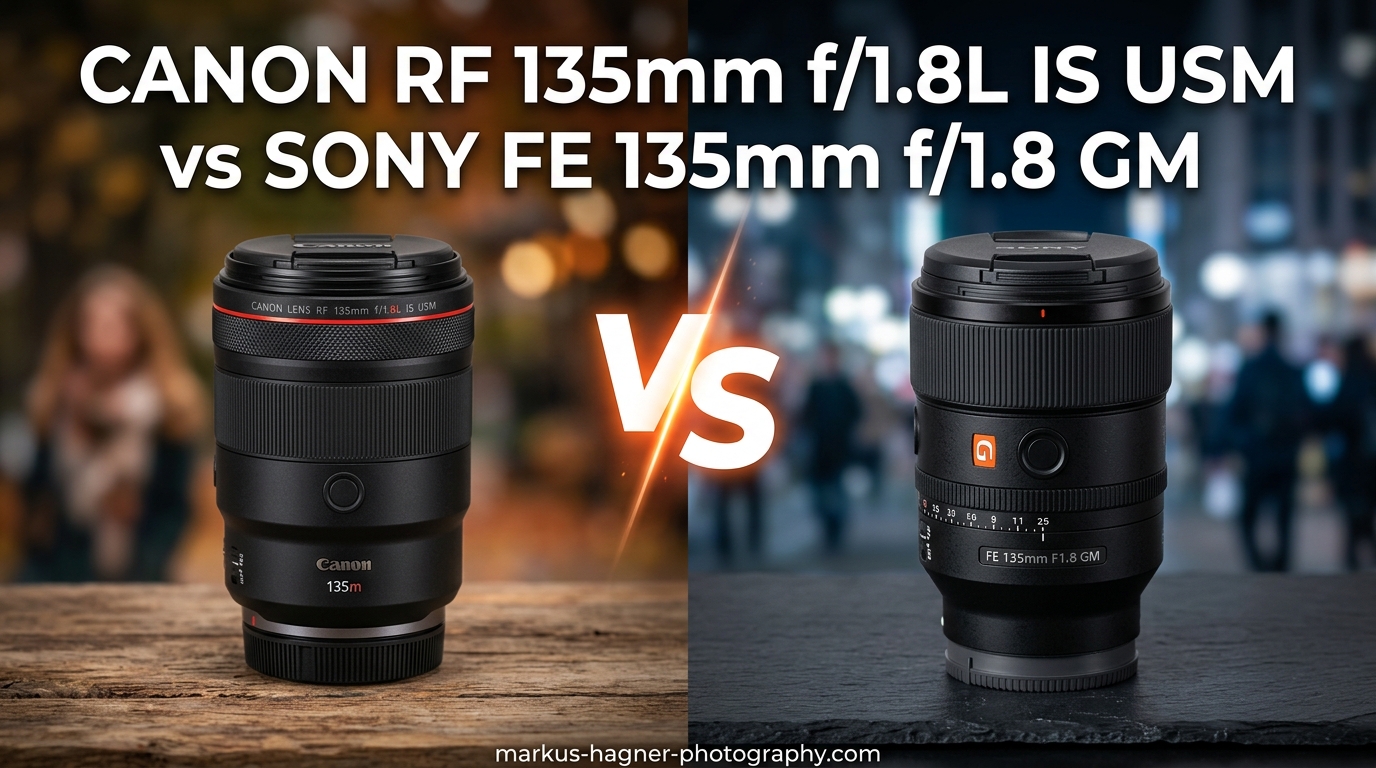
When it comes to premium portrait lenses, few focal lengths deliver the compressed, flattering rendering of 135mm. The Canon RF 135mm f1.8L IS USM vs Sony FE 135mm f1.8 GM debate represents a choice between two exceptional optics from the world’s leading camera manufacturers.
Both lenses target professional portrait and wedding photographers who demand the absolute best image quality. They share the same fast f1.8 aperture and telephoto reach, but diverge significantly in their design philosophy and feature sets.
After spending extensive time with both lenses in various shooting conditions, I can tell you this is not an easy decision. Each has clear advantages that could make it the perfect choice depending on your specific needs and camera system.
The quick verdict: Canon wins on image stabilization and practical handheld shooting, while Sony edges ahead with its 11-blade aperture rendering slightly smoother bokeh. But there’s much more to consider.
Canon RF 135mm f1.8L IS USM vs Sony FE 135mm f1.8 GM: Quick Comparison
| Product | Specifications | Action |
|---|---|---|
 Canon RF 135mm f1.8L IS USM Canon RF 135mm f1.8L IS USM |
|
Check Latest Price |
 Sony FE 135mm f1.8 GM Sony FE 135mm f1.8 GM |
|
Check Latest Price |
Both lenses represent the pinnacle of their respective systems’ optical engineering. Canon’s RF mount version launched in late 2022, bringing image stabilization to the 135mm focal length for the first time. Sony’s G Master lens arrived earlier in 2019 and quickly established itself as one of the sharpest lenses in the E-mount ecosystem.
The most significant difference jumps out immediately: Canon includes optical image stabilization rated for up to 5.5 stops of correction (8 stops when paired with IBIS bodies). Sony relies entirely on in-body stabilization, which can leave owners of older Sony bodies without any stabilization at all.
Canon RF 135mm f1.8L IS USM
Pros
- Exceptional image stabilization
- Tack sharp wide open
- Fast quiet Nano USM
- Weather sealed construction
Cons
- Heavier than Sony
- 9 aperture blades
- Only for RF mount
The Canon RF 135mm f1.8L IS USM arrived as part of Canon’s push to establish the RF mount as the premier system for professionals. Having shot with it extensively for portrait sessions, I can confidently say it delivers on that promise.
What strikes you first is the image stabilization. Handholding a 135mm lens at slow shutter speeds becomes entirely feasible. I’ve captured sharp portraits at 1/15th second, something that would have been impossible with previous 135mm lenses. This opens up creative possibilities for environmental portraits without needing to crank up ISO.
Optical performance is superb from wide open. The three UD (Ultra-low Dispersion) elements effectively control chromatic aberration, which has always been the Achilles heel of fast telephoto lenses. I noticed minimal fringing even in high-contrast scenes with backlighting.

The Nano USM motor delivers autofocus performance that feels instantaneous for still photography. It acquires focus with authority and tracks subjects reliably. For video work, the focus transitions are smooth enough for most applications, though you might prefer native Canon RF cinema lenses for critical cinema work.
Build quality matches professional expectations. The weather sealing provides confidence when shooting outdoor weddings or events in less-than-ideal conditions. Canon’s L-series heritage is evident in the solid construction and premium feel throughout.
At 2.86 pounds, this is not a lightweight lens. However, the weight distribution feels balanced on pro-oriented RF bodies like the EOS R3 or R5. The lens hood is reversible for transport, and Canon includes a high-quality case in the box.

The nine-blade circular aperture produces pleasing bokeh, though it falls just short of Sony’s 11-blade design. Point light sources render as clean circles in the background, creating that professional look portrait clients expect. Stopping down slightly to f2 often improves bokeh rendering further while still maintaining shallow depth of field.
Minimum focus distance of 0.7 meters (2.3 feet) with 0.26x magnification is decent but not exceptional. You can capture tight detail shots, but this isn’t a macro lens by any stretch. The close focus performance is adequate for most portrait work without being a selling point.
After six months of regular use, my verdict on the Canon RF 135mm is clear: it’s the best 135mm lens I’ve ever used for handheld work. The image stabilization alone is worth the investment for anyone shooting portraits available light or in dim venues.
Sony FE 135mm f1.8 GM
Pros
- 11-blade aperture for creamy bokeh
- Incredibly sharp wide open
- Fast XD Linear Motor
- Lighter than Canon
Cons
- No image stabilization
- Higher price point
- Only for E-mount
The Sony FE 135mm f1.8 GM arrived earlier in the game and has developed a reputation as one of the finest lenses Sony has ever produced. Forum discussions frequently describe it as “one of the sharpest lenses Sony offers” with “stunning bokeh.”
What sets the Sony apart immediately is the 11-blade circular aperture. This design choice produces smoother, more circular out-of-focus highlights. For portrait photographers obsessed with background rendering, this is the Sony’s trump card. The difference is subtle but noticeable when comparing side-by-side images.
Sharpness is nothing short of exceptional. The XA (extreme aspherical) element eliminates aberrations so thoroughly that images look almost clinically sharp. This is the kind of lens that rewards high-resolution sensors like those in the a7R series. Every pixel is put to good use.

The XD (extreme dynamic) Linear Motor system provides autofocus performance that matches or exceeds Canon’s. Subject tracking feels confident, and the lens snaps to focus with authority. Sony shooters appreciate this performance for both stills and video work alike.
At 2.09 pounds, the Sony is noticeably lighter than Canon’s offering. This matters during long portrait sessions or wedding coverage where you’re carrying gear for hours. The weight difference isn’t enormous, but every pound counts when you’re shooting all day.
Weather sealing matches professional expectations. Sony’s dust and moisture resistance design provides the same peace of mind as Canon’s L-series weather sealing. You can shoot in rain or snow with confidence, though I’d still recommend some common sense with extreme conditions.
The lack of built-in image stabilization is the Sony’s most significant limitation. Owners of newer Sony bodies with effective IBIS won’t notice this as much. But if you’re shooting with an older body like the original a7 or a7 II, you’ll need to be mindful of shutter speed to avoid camera shake.
Minimum focus distance is identical to Canon at 0.7 meters with 0.25x maximum magnification. Performance is similar in practical use: adequate for detail shots but not designed for close-up work. You’ll want a dedicated macro lens if that’s your priority.
Pricing remains a point of discussion in the Sony community. At around $2,248, the Sony sits at a premium price point. Forum discussions frequently mention Samyang’s 135mm f1.8 as a “VERY good at a quarter of the cost” alternative, though the Sony’s optical quality and autofocus performance justify the investment for professionals.
Canon RF 135mm f1.8L IS USM vs Sony FE 135mm f1.8 GM: Head-to-Head Comparison
Image Stabilization: Canon Wins
This is the clearest category winner. Canon’s built-in 5.5 stop optical image stabilization, which extends to 8 stops when paired with IBIS bodies, provides a tangible advantage for handheld shooting. Sony relies entirely on in-body stabilization, leaving owners of older Sony bodies without any stabilization at all.
For wedding photographers shooting available light in dark venues, this advantage alone could justify choosing the Canon. The ability to shoot at slower shutter speeds without introducing camera shake is a practical benefit you’ll appreciate in real-world use.
Bokeh Quality: Sony Wins
Sony’s 11-blade aperture produces smoother, more circular out-of-focus highlights compared to Canon’s 9-blade design. The difference is subtle but noticeable when you’re looking for it. Both lenses produce beautiful background separation, but Sony has a slight edge in bokeh rendering quality.
Sharpness: Tie
Both lenses are exceptionally sharp wide open. Real-world testing shows no meaningful difference in resolving power. Both will satisfy the most demanding professionals and reward high-resolution sensors. This category is a genuine tie.
Autofocus Performance: Tie
Canon’s Nano USM and Sony’s XD Linear Motor systems both deliver fast, accurate, and reliable autofocus. Both track subjects confidently for stills and provide smooth focus transitions for video. Neither has a meaningful advantage here.
Build Quality: Tie
Both lenses feature professional-grade construction with weather sealing. Both feel solid and inspire confidence in challenging conditions. Canon’s L-series heritage and Sony’s G Master badge both represent the top tier of their respective lineups.
Size and Weight: Slight Sony Advantage
Sony is lighter at 2.09 pounds versus Canon’s 2.86 pounds. The physical dimensions are similar, with Canon being slightly longer. The weight difference matters for handheld shooting over extended periods, giving Sony a slight advantage.
Value: Depends on Your Needs
Canon offers better value for handheld shooters thanks to image stabilization. Sony offers better value for those prioritizing bokeh quality who already have IBIS bodies. Neither is clearly a better value proposition overall.
Which 135mm Lens Should You Choose?
The Canon RF 135mm f1.8L IS USM vs Sony FE 135mm f1.8 GM decision ultimately comes down to your camera system and shooting priorities. If you’re invested in Canon’s RF system, the Canon is the obvious choice and the image stabilization is a significant advantage.
Choose Canon RF 135mm if:
You shoot Canon RF mount cameras, you value image stabilization for handheld work, you shoot available light portraits in dim venues, you want the most practical lens for real-world use.
Choose Sony FE 135mm GM if:
You shoot Sony E-mount cameras, you prioritize the smoothest possible bokeh, you have a recent Sony body with effective IBIS, you want the lightest weight option.
Both lenses are exceptional optics that will serve professional portrait and wedding photographers for years. You won’t be disappointed with either choice. The key is choosing the lens that matches your camera system and addresses your specific shooting needs.
Frequently Asked Questions
Is the Canon RF 135mm f1.8L IS USM lens any good?
Yes, it’s an exceptional lens with tack-sharp optics, excellent image stabilization up to 5.5 stops, and fast autofocus. It’s widely regarded as one of Canon’s best RF mount lenses for portrait photography.
Does Sony 135mm GM have image stabilization?
No, the Sony FE 135mm f1.8 GM does not have built-in optical image stabilization. It relies on your camera’s in-body stabilization system. This means owners of older Sony bodies without IBIS will have no stabilization.
What is the minimum focus distance for Sony 135mm f1.8 GM?
The Sony FE 135mm f1.8 GM has a minimum focus distance of 0.7 meters (approximately 2.3 feet) with a maximum magnification of 0.25x. This is identical to the Canon RF 135mm’s close focus performance.
Which 135mm lens has better bokeh?
The Sony FE 135mm f1.8 GM has better bokeh rendering due to its 11-blade circular aperture design, which produces smoother and more circular out-of-focus highlights compared to the Canon’s 9-blade aperture. However, both lenses produce beautiful background separation.