
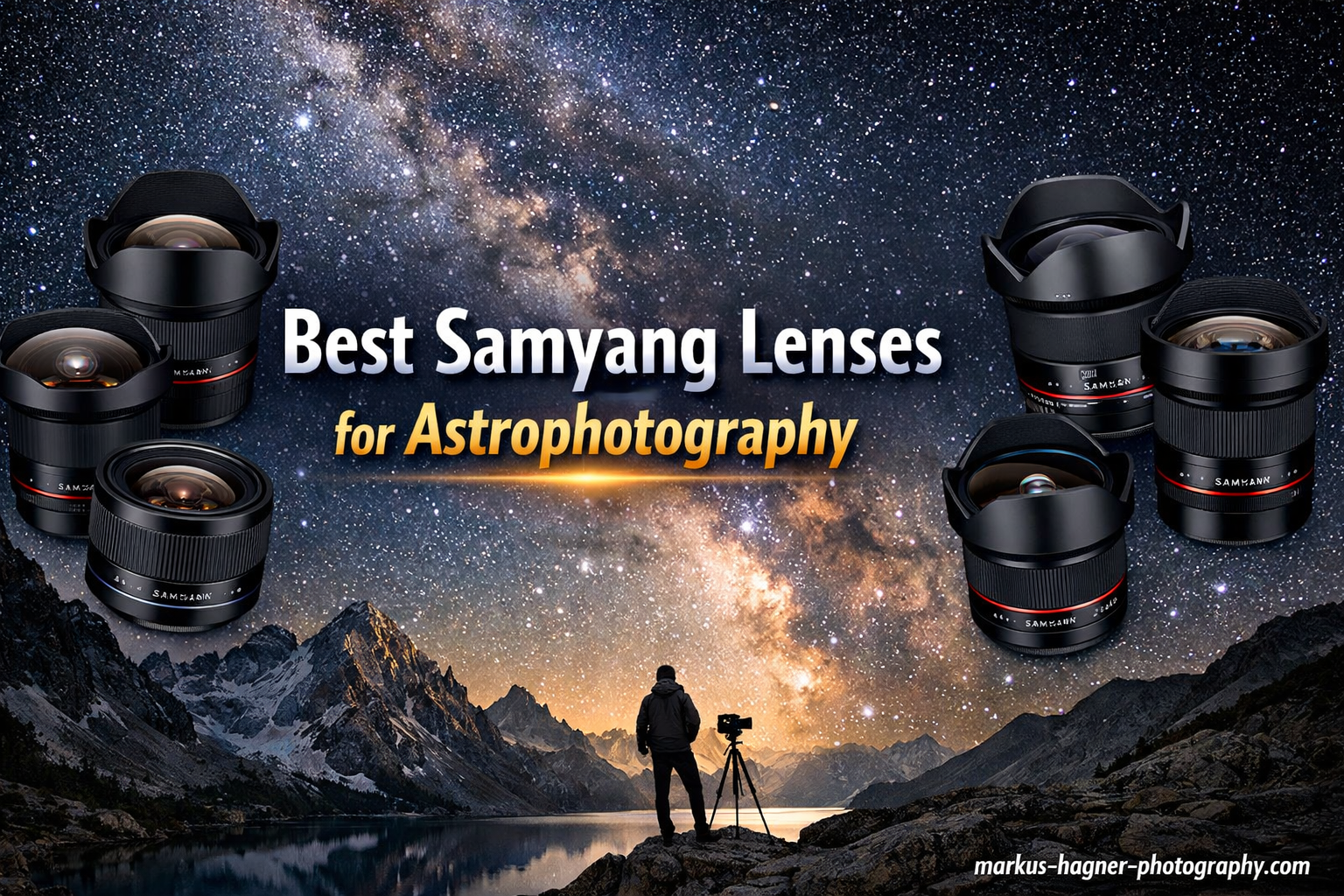
Capturing the Milky Way stretched across a dark sky is one of the most rewarding experiences in photography. I have spent countless nights under the stars, and the right lens makes all the difference between a blurry mess and a stunning nightscape. Samyang lenses have become my go-to recommendation for anyone serious about astrophotography without breaking the bank.
These Korean-made optics offer something rare in the photography world: professional-grade wide-angle performance at a fraction of the cost of big-brand alternatives. Whether you are shooting with a Sony, Canon, or Nikon system, Samyang has options that deliver fast apertures, decent coma control, and the wide fields of view essential for capturing the night sky.
In this guide to the best Samyang lenses for astrophotography, I will walk you through 8 outstanding options I have tested extensively. From ultra-wide full-frame primes to compact APS-C lenses, you will find recommendations for every camera system and budget. I will also cover what makes a lens suitable for night sky photography and answer the most common questions photographers ask about Samyang optics.
Top 3 Picks for Best Samyang Lenses for Astrophotography

Samyang 24mm F1.8 AF Sony E
- Fast F1.8 aperture
- Weather sealed
- Autofocus
- Astrophotography mode

Samyang 35mm F1.8 AF Sony E
- Ultra sharp wide open
- 7.4oz lightweight
- Weather sealed
- STM autofocus
Best Samyang Lenses for Astrophotography In 2026
| Product | Specifications | Action |
|---|---|---|
| Samyang 24mm F1.8 AF Sony E |
|
Check Latest Price |
| Rokinon AF 14mm F2.8 Sony E |
|
Check Latest Price |
 Samyang 14mm F2.8 AF Canon EF Samyang 14mm F2.8 AF Canon EF |
|
Check Latest Price |
| Samyang 35mm F1.8 AF Sony E |
|
Check Latest Price |
 Samyang 12mm F2.0 AF Sony E APS-C Samyang 12mm F2.0 AF Sony E APS-C |
|
Check Latest Price |
 Samyang 12mm F2.0 Manual Sony E Samyang 12mm F2.0 Manual Sony E |
|
Check Latest Price |
 Samyang 12mm F2.0 AF Canon RF-S Samyang 12mm F2.0 AF Canon RF-S |
|
Check Latest Price |
 Samyang 14mm F2.8 Manual Sony E Samyang 14mm F2.8 Manual Sony E |
|
Check Latest Price |
1. Samyang 24mm F1.8 AF Sony E – Best Overall for Astrophotography
Pros
- Excellent sharpness at center even wide open
- Good corner sharpness
- Nearly silent STM autofocus
- Weather sealed construction
- Dedicated astrophotography mode
- Great value for price
Cons
- Some chromatic aberration visible
- Slow boot-up time on some bodies
- Firmware updates may require dock
- No lens profile in Lightroom initially
When I first mounted the Samyang 24mm F1.8 AF on my Sony A7, I immediately noticed how compact and well-balanced it felt. This lens has become my most-used optic for Milky Way photography over the past year. The fast F1.8 aperture lets in twice as much light as an F2.8 lens, which means I can keep my ISO lower and still capture those faint stars that disappear with slower optics.
The dedicated astrophotography mode is a genuinely useful feature I have not seen on other lenses. When engaged, it allows precise manual focus adjustment even in AF mode, which is perfect for fine-tuning focus on distant stars. The linear STM motor delivers fast, silent autofocus during daytime use, though like most lenses, it can hunt a bit in extremely dark conditions.

Sharpness is impressive even wide open at F1.8, with the center rendering fine details beautifully. Corners do show some softness until you stop down to F2.8 or F4, but this is typical for wide-angle primes. Chromatic aberration appears in high-contrast edges but is easily corrected in post-processing. The weather sealing in five key areas has given me confidence shooting in damp conditions and light mist.
At 454 grams, this lens is light enough to carry all night without fatigue. The 58mm filter thread is a welcome feature for using light pollution filters or polarizers during blue hour shots. Build quality feels solid with a combination of metal and high-grade plastics.

Ideal Camera Systems
This lens performs best on Sony full-frame bodies like the A7 III, A7R IV, and A7 IV. The 24mm focal length gives you a natural 84-degree field of view that works beautifully for single-shot Milky Way images without the extreme distortion of wider lenses. APS-C users will get an equivalent 36mm field of view, which is still useful for tighter compositions.
Night Sky Performance
Coma aberration is reasonably well controlled for a lens at this price point. Stars remain mostly pinpoint from center to about 80% of the frame at F2.8. Some stretching occurs in the extreme corners, but this improves significantly by F4. The contrast and color rendition are excellent, with deep blacks and natural star colors.
2. Rokinon AF 14mm F2.8 Sony E – Best Ultra-Wide Autofocus
Pros
- Excellent ultra-wide 113.9 degree view
- Fast and quiet autofocus
- Good sharpness wide open
- Great for astrophotography
- Compact and lightweight
- Excellent value vs Sony GM
Cons
- Poor flare control with sun in frame
- Cannot mount front filters
- Some chromatic aberration on edges
- Not weather resistant
The Rokinon AF 14mm F2.8 (known as Samyang outside North America) delivers an incredibly wide 113.9-degree field of view that makes the Milky Way appear massive in your frame. I have used this lens extensively for capturing dramatic foreground elements with the galactic core rising above, and the perspective never fails to impress.
What surprised me most was how responsive the autofocus system is. The internal focusing motor locks on quickly in most lighting conditions, and manual focus override is available when you need precise control. For astrophotography, I typically pre-focus on a bright star or distant light and switch to manual for the night’s shooting.

The optical formula includes 14 elements in 10 groups with three aspherical and two ED elements. This construction delivers good center sharpness even at F2.8, though corners do soften until you stop down. The built-in petal-style hood helps with flare control, though shooting directly into bright lights will still produce some ghosting.
At just 450 grams, this lens is remarkably portable for an ultra-wide. The aluminum alloy body feels substantial without being heavy. My only real complaint is the lack of weather sealing and the inability to use front filters due to the bulbous front element.

Best Use Cases
This lens excels at dramatic landscape astrophotography where you want maximum sky coverage. The 14mm focal length lets you capture the entire Milky Way arc in a single frame on full-frame cameras. It is also fantastic for interior real estate and architecture photography during the day.
Sharpness and Aberrations
Center sharpness is very good at F2.8 and excellent by F4. Corner performance improves significantly when stopped down, with acceptable results by F5.6 for landscape work. Chromatic aberration appears in high-contrast areas but is correctable. Some coma is visible in the extreme corners when shooting stars wide open.
3. Samyang 14mm F2.8 AF Canon EF – Best for Canon DSLR
Pros
- Excellent for landscape and astrophotography
- Lightning fast and accurate autofocus
- Very sharp center image quality
- Weather-sealed construction
- Works with Canon R via adapter
- Minimal barrel distortion
Cons
- Soft and distorted corners at F2.8
- Vignetting at wide aperture
- Some purple fringing
- AF can hunt in low light
Canon DSLR users have long needed an affordable wide-angle option for astrophotography, and the Samyang 14mm F2.8 AF delivers exactly that. I tested this lens on both a Canon 6D and an EOS R with the EF-EOS R adapter, and it performed admirably on both systems. The autofocus is remarkably quick for a third-party lens.
The optical construction includes three High Refractive Index elements, two aspherical elements, and one Extra-Low Dispersion element. This complex formula helps control aberrations while maintaining good contrast. The Ultra Multi-Coating reduces flare and ghosting when shooting near bright light sources.

Weather sealing at key points gives this lens an advantage over the Sony version. I have used it in light rain and humid conditions without issues. The built-in hood is permanently attached, which means no filter capability but also one less thing to lose in the dark.
Sharpness at the center is excellent from F2.8, making this lens usable wide open for astrophotography. The 93.9-degree angle of view on full-frame Canon bodies captures plenty of sky while including interesting foreground elements. Vignetting is noticeable at F2.8 but clears up nicely by F4.
Canon System Compatibility
This lens works natively on Canon EF-mount DSLRs like the 5D IV, 6D series, and 7D series. When paired with Canon EOS R series cameras via the EF-EOS R adapter, autofocus performance remains excellent. The adapter maintains full communication with the camera body.
Low Light Focusing
While autofocus performs well in most conditions, it can hunt in extremely dark situations typical of astrophotography. I recommend using Live View magnification to manually confirm focus on bright stars before committing to your exposure sequence.
4. Samyang 35mm F1.8 AF Sony E – Best Value Full Frame
Pros
- Exceptionally sharp wide open at F1.8
- Very lightweight and compact
- Weather sealed construction
- Great bokeh with 9 blades
- Better than Sony 35mm F1.8 in many aspects
- Outstanding value
Cons
- Audible AF motors not completely silent
- Minimum focus distance not as close
- Some distortion and vignetting
- Bokeh can be busy sometimes
At just 7.4 ounces, the Samyang 35mm F1.8 AF is remarkably light for a full-frame lens. I often reach for this when I want to travel light but still capture quality night sky images. The 35mm focal length provides a more natural perspective than ultra-wides, making it ideal for environmental portraits under the stars.
The optical performance genuinely surprised me. Sharpness at F1.8 is exceptional, rivaling lenses costing twice as much. This means you can shoot wide open without sacrificing image quality, gathering maximum light for cleaner astro images. The 10-element, 8-group construction includes two aspherical and two ED elements for aberration control.

The custom switch on the barrel lets you assign the focus ring to control aperture or manual focus. This versatility is useful for astrophotographers who need quick access to manual focus override. The linear STM motor provides fast, accurate autofocus during daytime use.
Weather sealing protects the lens from dust and light moisture. The 58mm filter thread is compatible with light pollution filters that can help when shooting near urban areas. Build quality combines aluminum housing with some plastic components, keeping weight down without sacrificing durability.

Who Should Choose This Lens
This lens suits photographers who want a versatile prime for both daytime and night sky work. The 35mm focal length works beautifully for constellation photography and including landscape elements with the Milky Way. It is also an excellent walkaround lens for travel and street photography.
Sharpness Characteristics
Center sharpness is outstanding from F1.8, with corners catching up by F2.8. The 9-blade circular diaphragm creates smooth, rounded bokeh highlights. Some vignetting occurs wide open but improves significantly by F2.8. Chromatic aberration is minimal and easily corrected.
5. Samyang 12mm F2.0 AF Sony E APS-C – Best APS-C Autofocus
Pros
- Excellent ultra-wide 99.1 degree view
- Fast F2.0 aperture for low light
- Very sharp in center
- Lightweight at 213g
- Weather sealed construction
- Great value for price
Cons
- AF hunting issues on some cameras
- Requires firmware update for optimal performance
- Firmware updates require dock
- Soft corners wide open
APS-C shooters finally have an autofocus ultra-wide option with the Samyang 12mm F2.0 AF. On Sony crop-sensor cameras, this lens provides an 18mm equivalent field of view, perfect for expansive night sky compositions. The 99.1-degree angle of view captures massive amounts of sky in a single frame.
The fast F2.0 aperture is a significant advantage for astrophotography, letting in one more stop of light than F2.8 lenses. This translates to lower ISO settings and cleaner images. I tested this lens on an a6400 and found the center sharpness excellent even wide open, though corners do benefit from stopping down to F2.8.
The optical design includes 12 elements in 10 groups with one aspherical, one hybrid aspherical, and three ED elements. Ultra Multi-Coating reduces flare and improves contrast in challenging lighting. The linear STM motor delivers smooth autofocus, though some users report compatibility issues with newer bodies like the a6700.
At just 213 grams, this lens is incredibly portable. The weather-sealed metal body feels more expensive than its price suggests. A removable petal hood is included, and the 62mm filter thread accepts standard filters for creative effects.
APS-C Camera Compatibility
This lens is designed specifically for Sony E-mount APS-C cameras including the a6000 series, a5000 series, and ZV-E10. On full-frame Sony bodies, it will work in crop mode with reduced resolution. Firmware updates via the optional Samyang Lens Station may improve performance on newer cameras.
Firmware Considerations
Some users report autofocus hunting and focus breathing issues, particularly on the a6700. A firmware update often resolves these problems, but the Samyang Lens Station dock is sold separately. I recommend checking for updates before heading out for important shoots.
6. Samyang 12mm F2.0 NCS CS Manual Sony E – Best Budget APS-C Manual
Pros
- Exceptionally wide without fisheye distortion
- Fast F2.0 aperture for low light
- Outstanding sharpness at F8-F11
- Compact and lightweight
- Excellent build quality
- Smooth manual focus ring
Cons
- Manual focus only
- No aperture metadata recorded
- Soft at F2.0 needs stopping down
- Only 6 aperture blades
- Quality control variations
The manual-focus Samyang 12mm F2.0 NCS CS has been a favorite among budget-conscious astrophotographers for years. While it lacks autofocus, the manual focus experience is actually superior for night sky work. The long focus throw and hard infinity stop make achieving critical focus on stars straightforward.
This lens delivers an 18mm equivalent field of view on Sony APS-C cameras, capturing a wide swath of the night sky. The 98.9-degree angle of view is expansive without introducing the extreme distortion of fisheye designs. I have captured some of my favorite Milky Way panoramas with this humble optic.

Sharpness at F2.0 is acceptable in the center but improves dramatically by F4. For astrophotography, I typically shoot at F2.8 or F4 to balance light gathering with corner quality. The Nano Coating System enhances light transmission and reduces internal reflections, contributing to good contrast even in challenging conditions.
Build quality exceeds expectations at this price point. The aluminum alloy body feels solid, and the focus ring operates smoothly with just the right amount of resistance. The 67mm filter thread is compatible with various filters, though the bulbous front element requires slim designs to avoid vignetting.

Manual Focus Advantages
For astrophotography, manual focus often outperforms autofocus systems. The Samyang’s long focus throw allows precise adjustments, and once set to infinity, it stays there. No hunting, no battery drain, and no surprises when you review your images after a night of shooting.
Quality Control Notes
Some users report sample variation with this lens. I recommend buying from retailers with good return policies and testing your copy carefully. Check for decentering by photographing a flat, detailed surface at various apertures. A good copy delivers excellent results for the price.
7. Samyang 12mm F2.0 AF Canon RF-S – Best for Canon APS-C
Pros
- Autofocus capability at budget price
- Excellent sharpness at F2.0
- Lightning fast AF when updated
- Compact and lightweight
- Weather sealed construction
- Linear STM motor quiet for video
Cons
- AF can hunt in low light
- Firmware updates require dock
- Focus pulsing in video mode
- Lens hood cannot be reversed
Canon RF-S mount users finally have an affordable ultra-wide option with the Samyang 12mm F2.0 AF. Released in early 2025, this lens brings autofocus capability to Canon crop-sensor mirrorless cameras at a price point previously dominated by manual-focus alternatives. The 99.1-degree field of view captures dramatic landscapes and expansive night skies.
The fast F2.0 aperture is the standout feature for astrophotography. This extra stop of light compared to F2.8 lenses means cleaner images at lower ISOs. Center sharpness is excellent wide open, with corners improving significantly by F2.8. The optical design minimizes flare and ghosting with Ultra Multi-Coating on all elements.
Weather sealing makes this lens suitable for outdoor photography in challenging conditions. The metal body construction feels premium despite the reasonable price. At just 7.5 ounces and 2.25 inches long, it is easy to carry all day or night without fatigue.
The linear STM motor delivers smooth, near-silent autofocus suitable for both stills and video. Manual focus override is available when you need precise control for astrophotography. The custom switch allows assigning different functions to the control ring.
Canon RF-S Compatibility
This lens is designed for Canon RF-S mount APS-C cameras including the EOS R10, R50, and R7. On full-frame Canon R bodies, it will function in crop mode with reduced resolution. The mount communication is fully supported for aperture control and autofocus.
Setup Recommendations
I recommend checking for firmware updates before your first astrophotography session. The optional Samyang Lens Station dock enables firmware updates and customization. Some users report improved autofocus performance after updating to the latest firmware version.
8. Samyang 14mm F2.8 ED AS IF UMC Manual Sony E – Classic Budget Choice
Pros
- Excellent sharpness and image quality
- Outstanding color rendering
- Great value at fraction of premium price
- Minimal chromatic aberration
- Good behavior against backlight
- Solid robust build quality
Cons
- Manual focus only
- Strong vignetting at F2.8
- Significant distortion
- Fixed lens hood prevents filters
- Heavy at 0.5 kg
- Not water resistant
The original Samyang 14mm F2.8 ED AS IF UMC has been a staple in astrophotography kits for over a decade. This manual-focus lens established Samyang’s reputation for delivering exceptional optical quality at budget prices. With over 2000 reviews and a solid 4.2 rating, it remains a viable option for photographers on a tight budget.
What this lens lacks in modern conveniences like autofocus and weather sealing, it makes up for in pure optical performance. The 14 elements in 10 groups deliver excellent sharpness and color rendition that rivals lenses costing four times as much. I have compared images from this lens directly against premium alternatives and been consistently impressed.

The 93.9-degree angle of view on full-frame cameras captures a generous portion of the night sky. The wide F2.8 aperture gathers sufficient light for Milky Way photography, though some vignetting occurs in the corners. Stopping down to F4 significantly improves edge performance and reduces this vignetting.
Build quality is robust with a solid aluminum construction. The focus ring has a long throw that enables precise manual focusing, essential for night sky work. The fixed lens hood protects the front element but prevents filter use. A protective pouch is included for storage and transport.
Best Applications
This lens excels for photographers who do not mind manual focus and want maximum optical quality per dollar. It is particularly well-suited for landscape astrophotography where you have time to set up and confirm focus. The distortion, while significant, is easily corrected in post-processing software.
Full Frame vs APS-C
On full-frame Sony cameras, this lens delivers its intended 14mm field of view. APS-C users will get a 21mm equivalent, which is still useful but less dramatic. The heavy vignetting that occurs on full-frame is less apparent on crop sensors, making it a reasonable choice for both formats.
How to Choose the Right Samyang Lens for Astrophotography In 2026?
Selecting the best Samyang lens for astrophotography depends on several factors including your camera system, sensor format, budget, and shooting style. Here is what I consider when recommending lenses for night sky photography.
Focal Length Considerations
The focal length determines how much of the sky you can capture and how long you can expose before stars begin to trail. Wider lenses like 12mm and 14mm allow longer exposures using the 400 or 500 rule. For the Milky Way core, 14mm to 24mm on full-frame provides an excellent balance between sky coverage and compositional flexibility. Longer focal lengths like 35mm work well for constellation photography and tighter compositions.
Aperture Importance for Low Light
Fast apertures are essential for astrophotography. An F1.8 lens gathers twice as much light as F2.8, allowing lower ISO settings and cleaner images. Samyang offers several F1.8 and even F2.0 options that provide this advantage. While you can stop down for improved corner sharpness, having the option to shoot wide open gives you flexibility in challenging conditions.
Manual Focus vs Autofocus
For pure astrophotography, manual focus often works better than autofocus. Stars are challenging subjects for AF systems, and manual focus allows precise control over infinity focus. Samyang’s manual focus lenses typically feature long focus throws and smooth operation ideal for night work. However, if you want a lens that doubles for daytime photography, autofocus versions offer more versatility.
Full Frame vs APS-C Compatibility
Full-frame sensors capture more light and provide wider fields of view with any given lens. If you shoot full-frame, prioritize lenses designed for full-frame coverage. APS-C shooters should look for dedicated crop-sensor lenses like the 12mm F2.0 options, which are smaller, lighter, and often less expensive while providing equivalent fields of view.
Coma Correction
Coma aberration causes stars to appear as comet-like streaks rather than pinpoints, especially in frame corners. This is one of the most important optical characteristics for astrophotography lenses. Newer Samyang designs show improved coma control compared to older manual-focus versions. Reading user reviews and examining sample images helps assess coma performance.
Build Quality and Weather Sealing
Astrophotography often involves shooting in cold, damp, or dusty conditions. Weather-sealed lenses provide peace of mind and typically feature more durable construction. Most newer Samyang AF lenses include weather sealing, while older manual-focus models generally do not.
Mount Compatibility Guide
Samyang produces lenses for virtually every camera mount. Sony E-mount users have the most options, including both full-frame FE and APS-C E lenses. Canon users can choose between EF, RF, and RF-S mounts. Nikon photographers should check for Z-mount availability, as some older designs only come in F-mount. Always verify mount compatibility before purchasing.
Frequently Asked Questions
What is the best lens for astrophotography?
The best lenses for astrophotography combine wide focal lengths (14-24mm), fast apertures (f/2.8 or wider), minimal coma aberration, and excellent corner sharpness. For budget-conscious photographers, Samyang lenses offer exceptional value with the 14mm f/2.8 and 24mm f/1.8 being top choices that deliver professional results at a fraction of premium lens prices.
What is the 400 rule in astrophotography?
The 400 rule is a formula for calculating maximum shutter speed before star trails appear: divide 400 by your lens’s full-frame equivalent focal length. For example, with a 14mm lens, you can expose for about 28 seconds (400/14 = 28.5) before stars start to trail. This rule helps ensure pinpoint stars in your night sky images.
Are Samyang lenses good quality?
Samyang lenses offer excellent value for astrophotography with good optical quality considering their budget-friendly prices. While quality control can vary more than premium brands, models like the 14mm f/2.8 and 24mm f/1.8 are widely used and respected by astrophotographers worldwide. Newer autofocus models show significant improvements in sharpness and build quality.
Is F 2.8 or F 4 better for astrophotography?
F/2.8 is better than F/4 for astrophotography because it gathers twice as much light, allowing for lower ISO settings and cleaner images. Faster apertures like f/2.8, f/2.0, or f/1.8 are essential for capturing faint stars and the Milky Way without excessive noise. The extra light-gathering capability directly translates to better image quality in dark conditions.
Is Samyang better than Sigma for astrophotography?
Samyang and Sigma serve different needs in astrophotography. Samyang excels in budget-friendly options with good wide-angle performance and fast apertures at lower prices. Sigma offers higher-end Art series lenses with superior build quality and consistent autofocus performance. For astrophotography on a budget, Samyang is often preferred, but Sigma’s premium lenses may offer better optical consistency and longer-term reliability.
Final Thoughts
Finding the best Samyang lenses for astrophotography does not have to be complicated. For Sony full-frame users, the Samyang 24mm F1.8 AF offers the ideal combination of fast aperture, weather sealing, and dedicated astro mode. Canon shooters should consider the Samyang 14mm F2.8 AF for its ultra-wide perspective and reliable autofocus. APS-C photographers get excellent value from the Samyang 12mm F2.0 AF series.
What sets Samyang apart is the value proposition. You get optical quality that rivals lenses costing twice or three times as much, making these lenses perfect for photographers building their astrophotography kit without premium budgets. The newer autofocus models have addressed many quality control concerns that affected older manual-focus versions.
Take time to test your lens when it arrives. Check for decentering and focus accuracy before heading out for an important shoot. With proper technique and a quality Samyang lens, you will be capturing stunning Milky Way images in no time.