
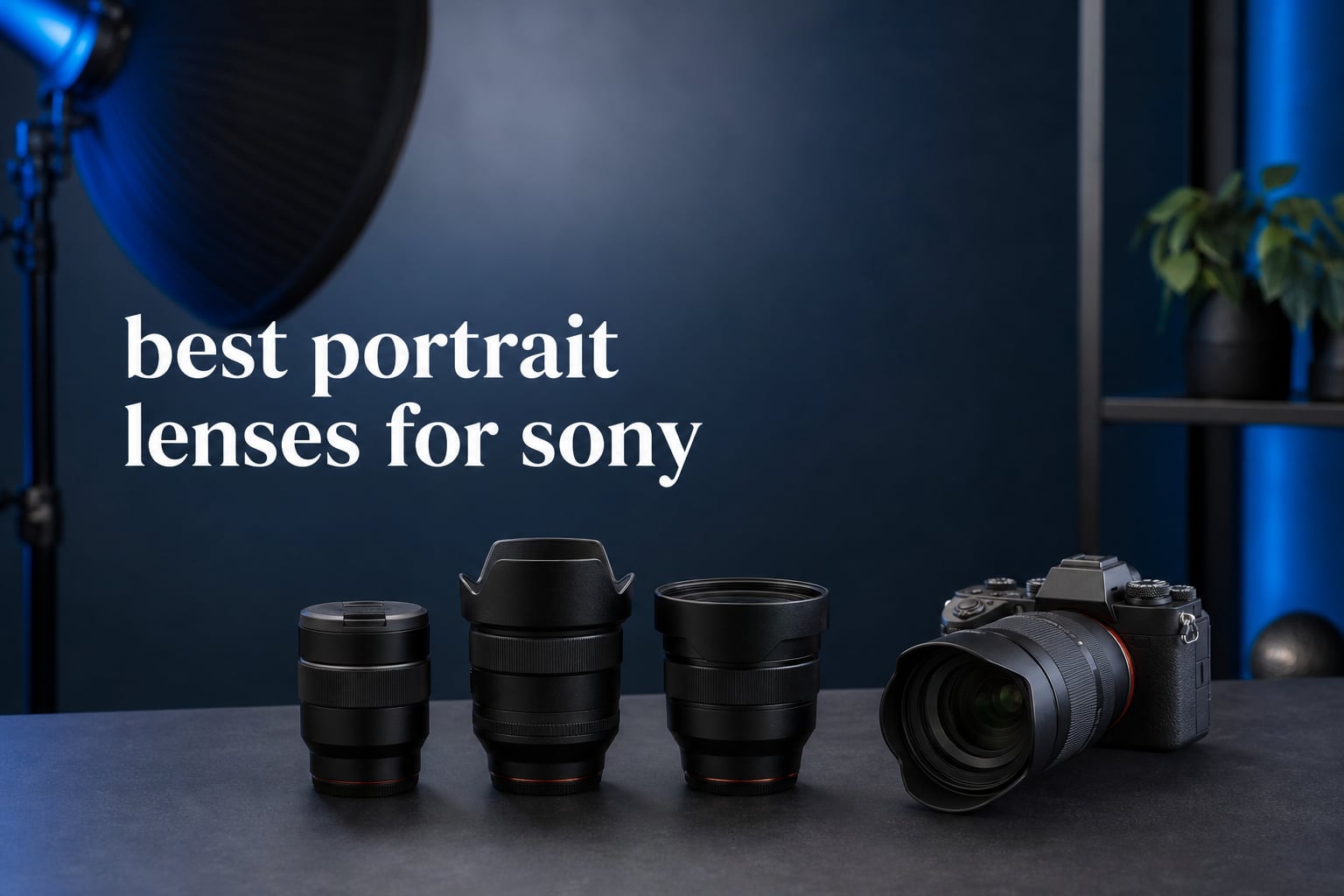
The best portrait lenses for Sony pair a useful focal length with a wide aperture, dependable autofocus, and a rendering style that suits the person in front of the camera. For most full-frame Alpha photographers, an 85mm prime is the easy starting point because it gives flattering perspective and strong subject separation without forcing you too far away.
I built this guide around eight currently analyzed Sony E-mount lenses, covering 35mm, 50mm, 85mm, and 135mm focal lengths. The selection includes Sony, Viltrox, TTArtisan, and Meike options, so a photographer can compare a G Master 85mm with simpler third-party primes without treating every portrait session as the same job.
My recommendations here draw on the supplied specifications, listed features, and customer-review snapshots rather than a claimed hands-on test. That matters: the reported data can show aperture, weight, optical construction, compatibility, and review patterns, while your camera body, firmware, distance from the subject, and lighting still shape the result.
For a quick answer, choose the Sony FE 85mm F1.4 GM II for a high-end full-frame 85mm, the Viltrox AF 85mm F1.8 II FE when you want a lighter 85mm alternative, and the Meike 50mm F1.8 when a normal-length full-frame prime fits your portraits. The rest of this guide explains where 35mm environmental work and 135mm compression make more sense.
The top 3 picks cover premium 85mm, practical 85mm, and flexible 50mm portraits
These three lenses make the shortest useful answer to “which lens is best for portrait photos?” Each has autofocus and a wide aperture, but they serve noticeably different working distances and shooting styles.
Sony FE 85mm F1.4 GM II: a full-frame 85mm f/1.4 with 11 diaphragm blades and XD linear-motor autofocus for dedicated portrait work.
Viltrox AF 85mm F1.8 II FE: a 484g, metal-body 85mm f/1.8 that supports Sony Eye Focus and uses STM autofocus.
Meike 50mm F1.8: a full-frame-compatible 50mm f/1.8 with quiet STM autofocus for closer, more conversational compositions.
The full shortlist compares the best portrait lenses for Sony in 2026
This overview puts every analyzed lens in one place. I would use it first to narrow the field by sensor format and focal length, then read the individual notes for the autofocus, handling, and firmware details that matter to your workflow.
| Product | Specifications | Action |
|---|---|---|
 Sony FE 85mm F1.4 GM II Sony FE 85mm F1.4 GM II |
|
Check Latest Price |
 Viltrox AF 85mm F1.8 II FE Viltrox AF 85mm F1.8 II FE |
|
Check Latest Price |
 Meike 50mm F1.8 Meike 50mm F1.8 |
|
Check Latest Price |
 Sony FE 35mm F1.4 GM Sony FE 35mm F1.4 GM |
|
Check Latest Price |
 Viltrox AF 85mm F1.4 Pro FE Viltrox AF 85mm F1.4 Pro FE |
|
Check Latest Price |
 Viltrox AF 135mm F1.8 LAB FE Viltrox AF 135mm F1.8 LAB FE |
|
Check Latest Price |
 TTArtisan AF 35mm F1.8 II TTArtisan AF 35mm F1.8 II |
|
Check Latest Price |
 Viltrox 35mm F1.7 E Viltrox 35mm F1.7 E |
|
Check Latest Price |
1. The Sony FE 85mm F1.4 GM II is the leading full-frame portrait choice
Pros
- G Master edge sharpness
- Fast quiet autofocus
- Compact for its class
Cons
- No image stabilization
- Sony E mount only
The Sony FE 85mm F1.4 GM II is the lens I would put first on a full-frame Sony shortlist when headshots, couples, and polished event portraits are the priority. Its 85mm focal length gives you the comfortable working distance and gentle compression that make faces look natural, while the f/1.4 maximum aperture gives the photographer strong control over background blur.
The listed 11-blade diaphragm and G Master optics point toward a smooth out-of-focus presentation, not merely a bright specification on paper. The product data also calls out edge-to-edge sharpness, so it is a sensible candidate when a face is off-center rather than always placed in the middle of the frame.
Autofocus is a major reason to consider this lens for moving subjects. Sony specifies two XD linear motors for fast, precise, quiet autofocus, and the customer-review snapshot records a 4.7 rating from 49 reviews, with 87% five-star ratings.
I would not assume the lack of image stabilization is irrelevant, though. The lens itself has none, so photographers using bodies without effective in-body stabilization need to match shutter speed to their subject movement and their own handholding.
A full-frame Sony body is the right match for this 85mm
This is an FE-mount lens designed for Sony E-mount full-frame use, and the supplied compatibility list includes the A1, A7 IV, A7CR, A7R V, and FX3. It can also be mounted on APS-C E-mount bodies, where the field of view becomes much tighter, so I would choose it there only if that longer framing fits your work.
At 85mm on full frame, it works especially well for head-and-shoulders portraits and wedding portraits where you want to give people space. In a small indoor room, a 50mm or 35mm option can be easier because you will not need to back into the wall.
A photographer who wants quiet eye-AF work should choose this design
The XD linear-motor system is the reported autofocus advantage for this model, particularly for Sony Alpha portrait photography with moving people. It is also described as suitable for filmmaking, which makes the quiet-focus claim useful for shooters who make both stills and short portrait clips.
The product listing does not provide a measured focus-breathing figure, so I would not make a video purchase decision on breathing alone. Test it with your own body and current firmware if rack focus is central to your work.
2. The Viltrox AF 85mm F1.8 II FE is the practical 85mm alternative
Pros
- Sony Eye Focus support
- Metal construction
- 484g weight
Cons
- No stepless aperture ring
- Older-body limits noted
The Viltrox AF 85mm F1.8 II FE makes the classic portrait focal length available in a relatively straightforward package: an 85mm f/1.8 prime, a nine-blade aperture, and a stated weight of 484g. For photographers who want the perspective of an 85mm but do not need f/1.4, that combination is easy to understand.
Its 10-element, seven-group optical design is paired with Nano AR coating, and the listing says the lens supports Sony Eye Focus. I like that this lens keeps the decision centered on portrait essentials rather than extra controls that some photographers may never use.
Customer feedback in the supplied analysis is strong, with a 4.7 rating across 372 reviews and 85% five-star ratings. The recurring positives are value, eye autofocus, and the metal body, which aligns with what people in Sony-focused forums often say about an 85mm f/1.8 being a sensible first portrait prime.
The cautions are equally useful. The listing flags potential compatibility limitations with older camera models and does not include a stepless aperture ring, so videographers and owners of older bodies should check their exact camera and firmware before committing.
A first full-frame 85mm is where this lens fits best
This lens suits half-length and full-length portraits, along with headshots where you can keep some distance from the subject. The f/1.8 aperture still gives meaningful background separation, especially when the background sits several feet behind the person.
On an APS-C body, 85mm gives a much narrower field of view, which can be attractive for distant headshots but restrictive indoors. I would favor it on full frame for a more flexible portrait lens focal length.
A Sony Eye Focus workflow is the deciding compatibility check
Viltrox states that the lens supports Sony Eye Focus and uses an STM motor for smooth, quick autofocus. That is the feature set I would prioritize for casual sessions, family portraits, and single-person work where the subject might shift slightly between frames.
Forum discussions repeatedly raise third-party autofocus compatibility as a concern, and that is a reasonable concern rather than a reason to reject every third-party lens. Keep the firmware current, confirm your camera model, and test eye detection before an important paid session.
3. The Meike 50mm F1.8 is the compact full-frame normal-length choice
Pros
- Full-frame and APS-C fit
- Quiet STM motor
- USB-C firmware port
Cons
- Android-only updates reported
- Some AF reports need firmware
The Meike 50mm F1.8 is the full-frame-compatible choice for photographers who want to stay physically closer to their subject than an 85mm allows. A 50mm portrait lens Sony setup is useful for seated portraits, small rooms, casual couples, and waist-up images that include a little of the setting.
Meike lists an f/1.8 aperture, nine diaphragm blades, a 300g weight, and an STM stepping motor designed for quiet autofocus. The lens also uses an 11-group, seven-element construction and a multi-layer coating intended to reduce flare, which are meaningful details for backlit outdoor portraits.
The review snapshot is more mixed than the 85mm Viltrox results, but still positive overall: 4.5 from 66 reviews, with 75% five-star ratings. Customers mention smooth background blur and solid build quality, while some report autofocus issues that needed a firmware update.
I would treat the Type-C firmware interface as part of the ownership experience, not an obscure detail. The supplied data says firmware updates are supported online through Android devices only, which is a practical limitation for photographers who do not have that update route.
A small shooting space is where 50mm becomes more useful than 85mm
Fifty millimeters gives a more natural, wider view than 85mm, which helps when the room is tight or you want a portrait with hands, clothing, and surroundings in the composition. It does not produce the same compression as an 85mm, but it can feel less formal and more immediate.
On APS-C, the 50mm field of view becomes tighter, making it more suitable for headshots and distant half-body compositions. That makes the full-frame and APS-C decision especially important before you choose this lens.
A firmware-aware owner is the best fit for this autofocus system
The STM motor is specified as quiet, which is welcome for discreet portrait work and simple video. Still, customer reports about autofocus and the documented firmware-update path mean I would update the lens before a major shoot instead of waiting for a problem.
This is also a useful reminder that third-party lenses should be judged by current compatibility, not just their original release behavior. A short at-home eye-AF and continuous-AF check with your camera can save uncertainty later.
4. The Sony FE 35mm F1.4 GM is the strong environmental-portrait option
Pros
- Compact fast prime
- Strong resolution
- Weather-resistant build
Cons
- No image stabilization
- Full-frame wide perspective
The Sony FE 35mm F1.4 GM is the right pick when the location belongs in the portrait as much as the face does. A 35mm full-frame view can show a musician in a studio, a traveler in a city scene, or a family in a meaningful home environment without losing the sense of place.
Sony specifies an f/1.4 aperture, 11 diaphragm blades, two XA elements, one ED glass element, and Nano AR Coating II. That recipe is intended to pair high resolution with background blur while controlling chromatic aberration, flare, and ghosting in challenging light.
The review data is excellent: a 4.8 average from 357 reviews, with 90% five-star ratings. People praise the compact design, resolution, and bokeh, though its wider focal length means the photographer needs to think harder about camera position around a face.
I would not use 35mm inches from a person’s face and expect an 85mm look. Step back and keep the subject near the center when possible, because perspective comes from camera-to-subject distance rather than the lens label alone.
An environmental story is the reason to choose 35mm
This Sony E-mount portrait lens shines when a close background, workplace, landscape, or party atmosphere adds context. The f/1.4 aperture gives you a way to separate the subject even at a wider focal length, although the blur will be less dramatic than an 85mm at the same distance.
For full-body portraits, 35mm can be a natural choice if you leave enough space around the subject. It also gives wedding and documentary photographers a practical way to record candid portraits without stepping far away.
A photographer who works in changing weather benefits from this build
The supplied data describes a dust- and moisture-resistant design plus a fluorine-coated front element. Those features are useful for outdoor portraits where a light rain, dust, or frequent front-element cleaning could interrupt the session.
There is no optical image stabilization listed, so body stabilization and shutter discipline still matter in low light. The wide f/1.4 aperture can help you hold a faster shutter speed, but it will not freeze a moving child or dancing couple by itself.
5. The Viltrox AF 85mm F1.4 Pro FE is the feature-rich third-party f/1.4
Pros
- Weather-sealed metal body
- Face and eye detection
- Control ring and Fn button
Cons
- No image stabilization
- Larger than f/1.8 lens
The Viltrox AF 85mm F1.4 Pro FE is for photographers who want an 85mm f/1.4 with more direct control than a bare-bones prime. Its stepless aperture ring, customizable Fn button, AF/MF switch, and USB-C firmware port give it a more hands-on control layout than the f/1.8 alternative.
The optical specification is substantial: 15 elements in 11 groups, including three ED, nine high-refractive, and one aspherical element. Viltrox also lists an 11-blade aperture, a weather-sealed metal body, and dual Hyper VCM autofocus motors with face and eye detection.
The supplied customer-review snapshot shows a 4.7 rating from 372 reviews and identifies fast autofocus, portrait output, and the feature set as common positives. The recurring tradeoff is size: reviewers describe it as heavier, and the listing also confirms no image stabilization.
In Sony discussion communities, the Sigma 85mm f/1.4 DG DN Art is often named as a third-party benchmark, while this product catalog gives us this Viltrox f/1.4 to compare on documented features. I would evaluate the Viltrox on its actual body controls, current firmware support, and 85mm framing rather than assuming any two third-party 85mm lenses behave identically.
A control-focused portrait shooter is the best match for this lens
The stepless aperture ring can be appealing for video, while the clickable setting offers a more tactile aperture change for stills. Two control styles in one lens are useful when you alternate between a portrait session and short-form video work.
The custom Fn button and AF/MF toggle also reduce the need to move through camera menus. I would assign the Fn button only after a few real sessions, because a control is most helpful when it matches an action you make often.
A weather-aware outdoor portrait workflow suits the metal body
The weather-sealed metal body is a real practical distinction for photographers who work outside regularly. It does not make the lens invulnerable, but it adds confidence when dust or a light splash is part of the day.
The product data does not give a weight figure, yet it specifically notes that the lens is larger and heavier than the f/1.8 variant. If all-day comfort is your priority, hold the lens on your own camera body before deciding that an extra stop is worth the bulk.
6. The Viltrox AF 135mm F1.8 LAB FE is the compression specialist
Pros
- Strong subject compression
- LCD distance display
- Weather-sealed body
Cons
- No image stabilization
- Large telephoto form
The Viltrox AF 135mm F1.8 LAB FE is the lens to consider when compression and subject isolation matter more than working close to people. A 135mm portrait lens puts the camera farther from the subject, which can simplify backgrounds and create a flattering, compressed look for outdoor headshots and fashion-style portraits.
Its specification lists an f/1.8 aperture, an 11-blade diaphragm, 14 elements in nine groups with four ED elements, and a 0.72m minimum focusing distance. The lens also has a Quad Hyper VCM autofocus motor, face and eye detection, dual Fn buttons, an aperture ring, and an LCD display for aperture and distance information.
Customer feedback in the supplied record is a 4.7 rating from 372 reviews, with praise for resolution, bokeh, and autofocus. The same record warns that this is a larger, heavier telephoto lens without image stabilization, which is not a small footnote for a long session.
Forum users often praise Sony’s 135mm f/1.8 GM for compression and bokeh; this Viltrox LAB model belongs in the same focal-length conversation because it brings a comparable f/1.8 specification and an 11-blade aperture. I would keep the comparison honest by judging this exact lens on its listed controls, handling, and current camera compatibility.
A roomy location is required for 135mm portraits
One hundred thirty-five millimeters is excellent outside, in a large studio, or across a ceremony aisle, where you can let the background fall away behind the subject. It is much less comfortable in a living room, where you may not have enough distance to frame more than a tight headshot.
Choose this focal length for clean backgrounds, close headshots, and a compressed fashion portrait look. Choose 50mm or 85mm if you regularly photograph full-body portraits in confined spaces.
A dedicated subject-isolation look is this lens’s main appeal
The f/1.8 aperture and 11-blade diaphragm are the reported ingredients that support smooth bokeh, while the longer focal length adds compression. This combination can make an ordinary distant background look calmer without needing to move the subject right against a wall.
The LCD display and two bidirectional Fn buttons are practical extras for a lens used at a deliberate pace. I would see them as welcome handling aids, not substitutes for checking focus accuracy and shutter speed at 135mm.
7. The TTArtisan AF 35mm F1.8 II is the light APS-C environmental option
Pros
- Very light 176g
- Eye recognition support
- USB-C firmware updates
Cons
- APS-C only
- Not water resistant
The TTArtisan AF 35mm F1.8 II is aimed at APS-C Sony photographers who want a very light everyday lens that can also handle people pictures. On APS-C, its 35mm focal length gives roughly a 53mm full-frame-equivalent view, placing it close to the normal perspective that works well for relaxed half-body and environmental portraits.
TTArtisan lists a 176g weight, f/1.8 aperture, 0.4m minimum focusing distance, and a seven-group, 10-element design with two high-refractive and two ED elements. The autofocus uses an STM and lead screw-type stepping motor, and the product data says it supports eye, animal, and car recognition.
The current review snapshot is 4.8 from 44 reviews, with 85% five-star ratings. Reviewers highlight sharpness, quiet autofocus, and small size, which makes sense for an APS-C photographer who does not want a large lens to turn every portrait outing into a gear-heavy task.
There are clear limits: it is APS-C only, has no image stabilization, and is not water resistant. I would see it as a compact everyday portrait-and-life lens, not a replacement for a weather-ready full-frame 85mm.
An APS-C Sony owner gets a normal portrait view from this 35mm
The 35mm field of view becomes approximately 53mm equivalent on an APS-C body, according to the supplied feature data. That is wider than the classic 85mm portrait look, yet it is narrow enough to frame people without the exaggerated near-face perspective of a very wide lens.
It is a useful focal length for a photographer who shoots a mix of friends, travel, street scenes, and informal portraits. The 0.4m minimum focus distance also helps when you want a tighter detail of hands, flowers, or a small product within a portrait story.
A lightweight walkaround kit is the strongest reason to choose it
At 176g, this is one of the lightest lenses in the roundup. That makes a difference when the camera stays with you all day, and it may encourage more candid portrait work than a large telephoto left at home.
The USB-C firmware update interface is another practical feature for an autofocus third-party lens. I would update it before relying on eye recognition for a session, particularly after changing to a newer Sony camera body.
8. The Viltrox 35mm F1.7 E is the smallest APS-C portrait companion
Pros
- Very light 170g
- Bright aperture
- USB upgrade support
Cons
- APS-C format
- No image stabilization
The Viltrox 35mm F1.7 E is another APS-C 35mm option, and it is especially attractive on paper when keeping a kit light is the first concern. The product record lists a 170g weight, f/1.7 maximum aperture, nine-blade diaphragm, near-silent operation, EXIF transmission, and USB upgrade capability.
For portraits, it gives the same general normal-view idea as the TTArtisan 35mm on APS-C: enough scene for a person in context without needing to use a much wider lens. The bright aperture helps in dim rooms and lets you soften backgrounds, though a 35mm perspective still asks you to watch your distance from the subject.
Its customer-review snapshot is 4.6 from 41 reviews, with 82% five-star ratings. The listed strengths are low weight, quiet autofocus behavior, and flexibility for portraits, travel, landscapes, and street work.
The restrictions are straightforward: the analysis describes it as APS-C format, with no image stabilization and no water resistance. That makes it a focused choice for an APS-C kit rather than a lens I would buy to cover future full-frame use.
An APS-C everyday portrait kit is the intended use case
This lens is best for photographers who bring the camera along often and want a single small prime for people, travel, and ordinary life. At 170g, it supports that goal without adding much weight to an APS-C Sony body.
A 35mm APS-C lens can make a portrait feel more connected to the room or landscape than an 85mm. Use it for full-body portraits and candid scenes, then move back slightly for tighter portraits to keep facial perspective comfortable.
A quiet autofocus setup is the benefit for candid work
The listing calls out near-silent operation and USB upgrade support, along with EXIF transmission. Those are practical everyday features when you want to shoot quietly and maintain a record of lens settings in your image files.
As with other third-party autofocus lenses, firmware remains part of the decision. I would confirm that the current lens firmware and camera firmware work together before an assignment where eye tracking cannot fail.
The right focal length and camera format decide the best portrait lens
The clearest way to narrow this list is to decide whether you want context, a normal view, classic compression, or strong compression. I use that question before looking at aperture, because a fast lens at the wrong focal length can still make the job harder.
An 85mm lens gives the classic portrait perspective
An 85mm portrait lens Sony setup is the most direct answer for headshots, couples, and flattering half-length portraits on full frame. It lets you stand far enough away to keep facial features natural while producing stronger subject compression and background blur than a 35mm or 50mm.
Choose the Sony FE 85mm F1.4 GM II when top-tier Sony autofocus and G Master optics are your focus. Choose the Viltrox 85mm f/1.8 when a simpler 85mm suits the job, or the Viltrox 85mm f/1.4 Pro FE when direct lens controls and a weather-sealed metal body matter more.
A 50mm lens gives the most flexible indoor portrait framing
Fifty millimeters is often better than 85mm when you cannot take many steps backward. It works for seated portraits, couples at a table, waist-up frames, and documentary-style people photography where you want to show more of the setting.
The Meike 50mm F1.8 is the relevant analyzed option here because it works with both full-frame and APS-C Sony E-mount cameras. On an APS-C body it becomes a tighter view, so it shifts closer to a traditional portrait framing.
A 35mm lens makes the surroundings part of the portrait
Thirty-five millimeters is the right choice for environmental portraits, full-body frames, and stories where the background says something about the person. The Sony FE 35mm F1.4 GM is a full-frame option with weather resistance, while the TTArtisan and Viltrox 35mm primes are APS-C-specific, lightweight alternatives.
Be deliberate with position at 35mm. If you stand too close, facial features can look stretched; if you step back and frame thoughtfully, a 35mm can produce engaging portraits that feel present rather than distant.
A 135mm lens gives the strongest compression in this selection
The Viltrox AF 135mm F1.8 LAB FE is for outdoor portraits, large studios, and situations where you can create distance. Its longer view isolates a subject from a busy faraway background and is especially appealing for fashion, performers, and tightly framed headshots.
The tradeoff is practical space and handling. Longer focal lengths magnify camera movement and need more room, so use a shutter speed that fits the focal length and subject movement, particularly because this lens has no image stabilization listed.
A wide aperture shapes blur, but distance shapes portraits too
F/1.4, f/1.7, and f/1.8 all let in more light than a slower lens and make shallow depth of field easier. They do not create the same result at every focal length: an 85mm or 135mm lens at the same aperture generally gives stronger background blur than a 35mm when framing a person similarly.
Bokeh describes the visual character of out-of-focus areas, while subject compression describes how foreground and background appear closer together at a longer shooting distance. Both affect a portrait, but neither replaces good light, a clean background, or thoughtful posing.
An 11-blade diaphragm can support smoother out-of-focus highlights
The Sony 35mm f/1.4 GM, Sony 85mm f/1.4 GM II, Viltrox 85mm f/1.4 Pro FE, and Viltrox 135mm f/1.8 LAB FE each list an 11-blade diaphragm. That is a useful specification for photographers who care about the shape and smoothness of defocused highlights.
The Viltrox 85mm f/1.8 II and Meike 50mm f/1.8 list nine blades, which can still produce pleasing blur. I would choose focal length and autofocus reliability first, then use blade count as one piece of the rendering preference.
A small subject-to-background gap reduces the blur advantage
For the strongest background separation, put distance between the subject and the background rather than placing someone against a wall. A modest f/1.8 lens can look very isolated in that setup, while even f/1.4 has limited room to work when the background is immediately behind the subject.
This is why I would not choose a lens from aperture alone. Working distance, background distance, and camera format determine much of the final look.
Current autofocus and firmware matter more than brand labels
Sony’s 85mm GM II lists XD linear motors, Viltrox’s f/1.4 85mm lists Dual Hyper VCM, and the Viltrox 135mm lists Quad Hyper VCM. The smaller third-party lenses in this selection use STM autofocus or stepping-motor systems, with several including a USB or USB-C firmware-update option.
That does not produce a universal ranking because autofocus performance can change with the body, shooting mode, firmware, subject contrast, and light. Forum conversations rightly point out the concern, so I would test single AF, continuous AF, and eye detection on your exact camera before a once-only shoot.
A stills-first photographer should check eye detection on the chosen body
The Viltrox 85mm f/1.8 lists Sony Eye Focus support, the Viltrox f/1.4 and 135mm list face and eye detection, and TTArtisan lists eye-recognition support. Those features make a lens more promising for portraits with a moving subject, but they are not a promise that every camera generation performs the same way.
My practical routine would be simple: update the lens if the maker provides an update, set the camera to the focus mode you use, and photograph a person walking toward you in similar light. That check is more useful than choosing a lens based solely on a motor name.
A video shooter should treat breathing as an unconfirmed variable
The product data here does not publish focus-breathing measurements for these eight lenses. Do not assume a lens has low breathing because it has quiet autofocus, a stepless aperture ring, or a video-related feature.
The Sony 35mm f/1.4 GM lists 4K video capture format, and the Viltrox 135mm lists 4K and above, but those details do not measure breathing. Record a short focus pull at your intended framing before using any of these lenses for a portrait interview or a cinematic sequence.
An APS-C owner should choose for the crop before choosing by aperture
A full-frame lens can mount on many APS-C Sony E cameras, but its angle of view becomes tighter. An 85mm full-frame lens behaves like roughly a 127.5mm equivalent view on APS-C, which can be excellent for distant faces but hard to use indoors.
The TTArtisan 35mm f/1.8 II explicitly lists a 53mm full-frame-equivalent view on APS-C, making it one of the most natural everyday portrait choices in this roundup for crop-sensor photographers. The Viltrox 35mm f/1.7 is likewise described as an APS-C-format lens and offers a similarly useful normal-view role.
A full-frame body gives 50mm and 85mm their familiar roles
On full frame, 50mm is the versatile normal lens, 85mm is the classic portrait lens, and 135mm is the specialist compression lens. That makes the Sony FE and Viltrox full-frame choices easy to organize around the way you shoot rather than around specifications alone.
Full-frame bodies also let you use the Sony 35mm GM as a true 35mm environmental lens. If environmental portraits are central to your work, that view is far easier to achieve on full frame than by mounting 50mm or 85mm lenses on APS-C.
An APS-C body makes the compact 35mm primes especially sensible
The 176g TTArtisan and 170g Viltrox are the convenient APS-C options for photographers who want to carry a camera daily. Both bring a bright aperture and firmware-update support, and neither asks you to use an oversized full-frame lens just to get an everyday perspective.
For tighter portrait work on APS-C, the Meike 50mm becomes a reasonable option because it gives a narrower view. For outdoor headshots, an 85mm full-frame lens becomes tighter still, so leave extra room to work.
These FAQs answer the key Sony portrait-lens buying questions
Is 50mm or 85mm better for portraits?
An 85mm lens is usually better for classic headshots and flattering compression on full frame, while 50mm is better in small rooms and for portraits that include more of the setting. Choose 85mm for stronger background separation and 50mm for a closer, more flexible working distance.
Which lens is best for portrait photos?
The Sony FE 85mm F1.4 GM II is the leading full-frame choice in this selection because it combines an 85mm focal length, f/1.4 aperture, 11-blade diaphragm, and XD linear-motor autofocus. The Viltrox AF 85mm F1.8 II FE is the simpler 85mm alternative, while the Meike 50mm F1.8 fits smaller spaces.
Is 85mm or 70-200mm better for portraits?
An 85mm prime is usually easier for dedicated portraits because it is compact and gives a classic working distance. A 70-200mm zoom is more flexible when framing changes quickly, but no 70-200mm lens is included in this analyzed selection; the Viltrox 135mm F1.8 is the longer focal-length option here.
Which Sony lens is best for portraits?
The Sony FE 85mm F1.4 GM II is the best Sony-branded portrait lens in this guide for full-frame shooters who want an 85mm f/1.4 prime with G Master optics, an 11-blade diaphragm, and two XD linear motors. Choose the Sony FE 35mm F1.4 GM instead when environmental portraits matter more than classic compression.
What is the Holy Trinity of Sony lenses?
Sony’s Holy Trinity usually means the 16-35mm f/2.8, 24-70mm f/2.8, and 70-200mm f/2.8 zoom lenses. They cover wide, standard, and telephoto views for working photographers, but fast portrait primes such as 85mm f/1.4 and 135mm f/1.8 give shallower depth of field and a different portrait look.
The Sony 85mm GM II is the best portrait-lens choice for dedicated full-frame work
The best portrait lenses for Sony are not all trying to do the same thing. I would select the Sony FE 85mm F1.4 GM II for a dedicated full-frame portrait prime, the Viltrox AF 85mm F1.8 II FE for a straightforward 85mm, the Meike 50mm F1.8 for more flexible indoor framing, and the Viltrox 135mm F1.8 LAB FE for distance and compression.
For APS-C photographers, the TTArtisan AF 35mm F1.8 II and Viltrox 35mm F1.7 E make more sense as compact normal-view lenses than an oversized 85mm. Start with the focal length that fits your locations, verify autofocus with your own Sony body, and then choose the aperture and controls that support the way you photograph people in 2026.