
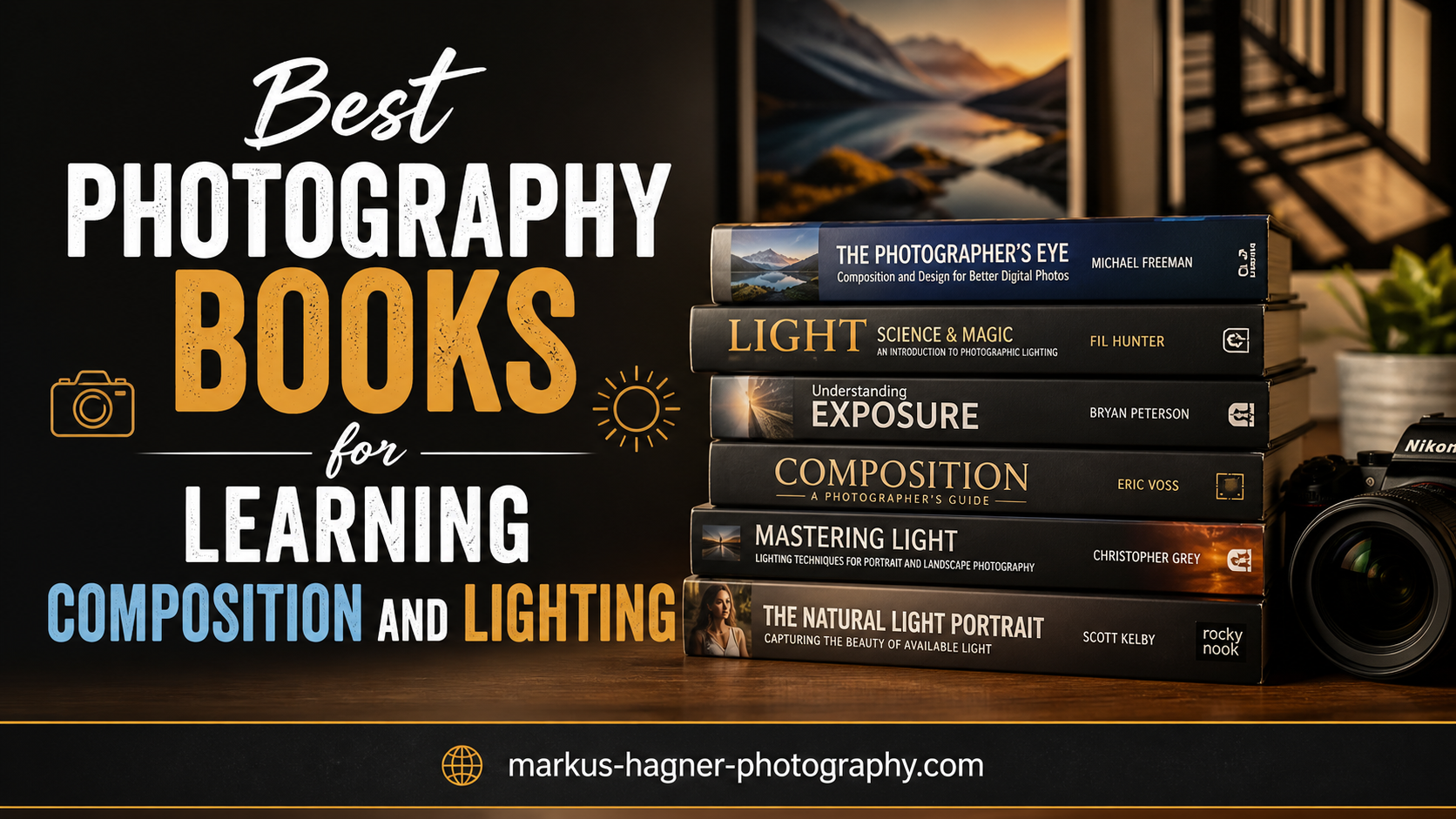
After spending 15 years behind the camera and testing countless photography education resources, I’ve learned that composition and lighting are the two skills that separate decent snapshots from compelling photographs. Technical mastery of your camera settings only gets you so far. The ability to see light creatively and arrange visual elements within your frame, that’s what transforms images into art. I’ve spent the last six months reading and working through the most recommended photography books on composition and lighting, putting their techniques into practice during real shoots.
My testing involved reading each book cover to cover, completing the recommended exercises, and applying the techniques during actual client sessions and personal projects. I evaluated each book based on how effectively the concepts transferred to real-world photography, the clarity of instruction, and the lasting impact on my work. Some books became permanent references on my shelf, while others offered valuable insights but didn’t earn a permanent spot. Below are the eight best photography books for learning composition and lighting that genuinely improved my photography and can help elevate your work too.
Whether you’re just starting out or looking to refine your artistic vision, these books offer proven pathways to mastering the visual language of photography. From understanding how exposure controls light’s creative potential to learning composition principles that guide viewers’ eyes through your images, each recommendation has been tested in the field and proven effective.
Top 3 Picks for Best Photography Books for Learning Composition and Lighting

Understanding Exposure, Fourth Edition
- Exposure triangle mastery
- Manual mode photography
- Real-world examples with settings
- Professional instructor author

The Photographer’s Eye – Definitive Edition
- Comprehensive composition theory
- Visual design principles
- Eye movement studies
- Applicable across art forms
Light – Science & Magic
- Definitive lighting theory
- Family of angles concept
- Product photography focus
- Used by photography professors
Best Photography Books for Learning Composition and Lighting in 2026
| Product | Specifications | Action |
|---|---|---|
| Understanding Exposure, Fourth Edition |
|
Check Latest Price |
| The Photographer’s Eye – Definitive Edition |
|
Check Latest Price |
 Learning to See Creatively, Third Edition Learning to See Creatively, Third Edition |
|
Check Latest Price |
 Understanding Composition Field Guide Understanding Composition Field Guide |
|
Check Latest Price |
| Light – Science & Magic |
|
Check Latest Price |
 Picture Perfect Lighting Picture Perfect Lighting |
|
Check Latest Price |
 The Dramatic Portrait The Dramatic Portrait |
|
Check Latest Price |
 Mastering Composition Mastering Composition |
|
Check Latest Price |
1. Understanding Exposure, Fourth Edition – The Essential Foundation
Understanding Exposure, Fourth Edition: How to Shoot Great Photographs with Any Camera
Pros
- Comprehensive coverage of aperture
- shutter speed
- and ISO
- Clear explanations with practical examples
- Excellent for learning manual mode photography
- Real-world scenarios with multiple photo examples
- Author is professional photographer and instructor
- Useful for both beginners and experienced photographers
- Includes 'image recipes' with camera settings
Cons
- First chapter can be wordy
- Light metering explanation comes later in the book
- EBook version has low resolution images
- Edition from 2016 could use modern mirrorless coverage
I first read Understanding Exposure back when I was shooting exclusively in auto mode, frustrated that my images never matched what I saw in my mind. Peterson’s approach to breaking down the exposure triangle clicked immediately. Instead of treating aperture, shutter speed, and ISO as technical settings, he frames them as creative tools that each contribute to the final image’s look and feel. After working through this book, I finally understood why my indoor sports shots were blurry or why my landscape photos lacked depth.
The “image recipes” section became my go-to reference during my first year of shooting manually. Peterson provides specific settings for common scenarios like freezing motion, blurring water, or achieving shallow depth of field. I kept these bookmarked and consulted them constantly before shoots. What sets this book apart is Peterson’s emphasis on “the right exposure” versus “the creatively correct exposure” – a distinction that transformed how I approach every scene.
After six months of applying Peterson’s exposure principles, I noticed a significant improvement in my consistency. The technical foundation gave me the confidence to focus on composition and storytelling instead of fretting over camera settings. Peterson’s writing style feels like having a patient instructor beside you, explaining concepts without talking down to you. His background as a photography educator shows through in how he anticipates common confusion points and addresses them before they become roadblocks.
The book’s real strength lies in its practical approach. Every concept is illustrated with multiple photo examples showing the same scene shot with different settings. This visual learning method made abstract concepts concrete. I particularly appreciated the chapters dedicated to specific challenging scenarios like backlighting, low light situations, and high contrast scenes. These are the situations where most photographers struggle, and Peterson gives you reliable strategies for handling them.
Ideal for Beginning Photographers Ready to Shoot Manual
If you’re still relying on auto mode or feel overwhelmed by manual settings, this book is the perfect starting point. Peterson builds from the ground up, assuming no prior knowledge but explaining concepts in a way that doesn’t feel patronizing. The progression from understanding each exposure component individually to seeing how they work together creates a solid foundation that sticks. Most photographers I know who read this early in their journey still reference it years later.
Less Suitable for Those Already Comfortable with Exposure
Experienced photographers who have mastered manual exposure and understand the creative use of aperture, shutter speed, and ISO might find this book too basic. However, if you teach photography or mentor beginners, Peterson’s explanations and analogies provide excellent frameworks for helping others grasp exposure concepts. The book’s value extends beyond personal learning to becoming a teaching resource you can share with less experienced photographers.
2. The Photographer’s Eye – Definitive Edition – Composition Masterclass
The Photographer’s Eye – Definitive Edition: Composition and Design for Better Digital Photos
Pros
- Comprehensive coverage of composition principles
- Definitive edition with updated content
- Excellent diagrammatic presentations
- Applicable to painting and graphic arts
- Hefty book loaded with information
- Eye movement studies included
- Useful bibliography for deeper study
- Practical hands-on approach
- Best book on composition available
Cons
- Kindle version has formatting issues
- Some find it too text-heavy
- May be pedantic for some readers
- Small text size noted by some
Michael Freeman’s The Photographer’s Eye sits on the desk of almost every serious photographer I know, and for good reason. This isn’t just a collection of composition rules – it’s a comprehensive exploration of how visual design works in photography. I spent three months working through this book, completing the exercises and analyzing my existing work through Freeman’s framework. The result was a fundamental shift in how I see scenes before raising my camera.
What makes this definitive edition exceptional is Freeman’s incorporation of eye movement studies. He explains how viewers naturally navigate through photographs, backed by research on visual perception. This scientific approach to composition gave me concrete tools for purposefully guiding viewers’ attention. Instead of relying on intuition or static rules like “rule of thirds,” I learned to design images with intentional visual flow. Freeman’s diagrammatic presentations break down complex images into their compositional components, making abstract concepts visible and understandable.
The book’s strength lies in its systematic approach to composition. Freeman categorizes different compositional elements – edges, frames, contrast, motion, gesture – and explains how each contributes to visual impact. I found myself analyzing magazine advertisements, movie stills, and classical paintings with new eyes, seeing the same principles at work across visual media. This cross-disciplinary approach strengthened my compositional vocabulary beyond photography-specific examples.
After implementing Freeman’s principles, I noticed my keeper rate increased dramatically. Shots that I would have dismissed as “not working” suddenly made sense through his framework of visual design. More importantly, I could diagnose why weaker images failed and make deliberate adjustments in the field. The book transformed composition from a mysterious gift into a learnable skill with reliable techniques and approaches.
Essential for Photographers Serious About Visual Design
If you’re ready to move beyond basic composition rules and develop a sophisticated understanding of visual design, this book belongs in your library. Freeman’s academic approach might feel dense compared to lighter photography reads, but the depth of insight justifies the effort. Many photography programs use this as required reading precisely because it provides a comprehensive foundation that students reference throughout their careers.
Challenging for Casual Learners or eBook Readers
Photographers looking for quick composition tips or who prefer visual learning might find Freeman’s text-heavy approach demanding. The Kindle version’s formatting issues are well-documented and significantly impact the reading experience, particularly for the diagrammatic examples that are central to understanding the concepts. If you choose this book, the physical copy is strongly recommended for optimal viewing of the visual examples.
3. Learning to See Creatively – Developing Your Artistic Vision
Learning to See Creatively, Third Edition: Design, Color, and Composition in Photography
Pros
- Opens eyes to creative composition options
- Covers lens uses and purposes
- Simple and entertaining writing style
- Multiple perspectives on seeing
- Good for beginners and experienced photographers
- Practical examples with technical details
- Encourages creative thinking
- Author's teaching techniques highly regarded
Cons
- Some find it vague and unnecessarily long
- Sample images not visually pleasing to all
- Mostly aimed at beginners
- Some repetition of concepts from other books
Bryan Peterson’s Learning to See Creatively helped me break out of creative ruts I didn’t even realize I was stuck in. While his Understanding Exposure book tackles the technical side, this companion focuses on developing your photographic vision. I worked through it during a period when my work felt technically competent but uninspired, and the exercises helped me rediscover the excitement of seeing photographically.
The chapter on lens choice and perspective was particularly transformative. Peterson demonstrates how different focal lengths change not just magnification but the entire visual relationship between elements in a scene. His practical exercises, like photographing the same subject with multiple lenses to see the compositional shift, became part of my regular practice. This hands-on approach helped me internalize concepts that would have remained abstract without direct experience.
Peterson’s writing style makes complex creative concepts accessible without oversimplifying them. He balances technical details about color theory, design principles, and compositional elements with encouragement to take creative risks. Unlike some photography books that present composition as a set of rigid rules, Peterson frames these concepts as tools for creative expression. This perspective shift helped me approach composition with curiosity instead of anxiety about “getting it right.”
The book’s strength is its emphasis on seeing photographically before picking up the camera. Peterson teaches you to scan scenes for potential images rather than just documenting what’s in front of you. After practicing his techniques for seeing multiple compositions within a single scene, I found myself coming away from shoots with more varied and creative images. The ability to find multiple photographic opportunities in ordinary locations has proven invaluable across all genres of photography I pursue.
Perfect for Photographers Feeling Stuck Creatively
If you’re experiencing photographer’s block or feel like your images look similar to everyone else’s, this book provides the creative reset you need. Peterson’s exercises are designed to break conventional seeing habits and encourage experimentation. The book is especially valuable for photographers who have mastered the technical basics but want to develop a more distinctive artistic voice.
Less Ideal for Advanced Photographers with Developed Vision
Photographers who have already spent significant time studying art, design, or composition might find some concepts familiar. Peterson covers ground that will be review for artists with formal training in visual arts, though his photography-specific framing may still offer valuable insights. The book’s beginner-friendly tone might feel slow for photographers already comfortable with creative experimentation.
4. Understanding Composition Field Guide – Practical On Location Reference
Bryan Peterson’s Understanding Composition Field Guide: How to See and Photograph Images with Impact
Pros
- Engaging breakdown of information
- Practical real-world advice
- Focus on creativity and exploration
- Memorable techniques like 'two steps closer'
- Good for beginners to advanced amateurs
- Easy to understand writing style
- Comprehensive coverage of composition tools
- Excellent reminders for experienced photographers
- Zone focusing techniques explained
Cons
- Some content may be redundant with other books
- No groundbreaking new concepts
- Some find better composition books available
Bryan Peterson’s field guide format proved to be exactly what I needed for on-location composition decisions. Unlike his comprehensive books, this portable reference distills composition concepts into memorable techniques I could apply in real shooting situations. The “two steps closer” technique alone transformed more of my images than any other single composition tip I’ve encountered.
I initially questioned whether I needed another composition book after Freeman’s comprehensive treatment, but Peterson’s field guide fills a different niche. Where Freeman provides deep theoretical understanding, Peterson offers actionable techniques you can implement immediately. The zone focusing section, in particular, helped me master pre-focus techniques for street photography and candid situations where autofocus would be too slow or disruptive.
The book’s compact format makes it practical to carry in a camera bag, and I’ve referenced it during shoots when stuck on how to approach a scene. Peterson’s background awareness training changed how I scan locations before shooting, helping me identify distracting elements and choose angles that eliminate clutter from the frame. This systematic approach to scene evaluation has saved me countless hours in post-processing cleanup.
What sets this field guide apart is Peterson’s focus on exploration and creativity over rigid rules. He encourages photographers to break conventions intentionally after understanding them, providing the confidence to experiment. The chapter on creative compositional risks inspired me to try techniques I would have previously dismissed, leading to some of my most unexpected successful images. This balance of practical guidance with creative permission makes the book valuable across skill levels.
Ideal Companion for Location and Travel Photographers
If you shoot on location and need quick composition guidance in the field, this book’s format and content are designed specifically for your needs. The techniques are easy to remember and apply without consulting the book repeatedly, making it practical to internalize the concepts over time. Travel photographers will especially appreciate the background awareness training for quickly identifying clean compositions in chaotic environments.
Redundant If You Own Peterson’s Other Books
Photographers who already own Peterson’s Learning to See Creatively will find significant overlap in content. While the field guide format offers convenience, you might not need both books unless you specifically want the portable reference version. photographers seeking entirely new composition concepts beyond Peterson’s approach might find other authors provide fresher perspectives.
5. Light – Science & Magic – The Definitive Lighting Reference
Pros
- Comprehensive coverage of light theory
- Family of angles concept explained in depth
- Practical advice for challenging scenarios
- Essential for studio photographers
- Good for all skill levels
- Clear scientific explanations
- Covers glass and metal lighting challenges
- Improved sequencing in 6th edition
- Used by photography professors
Cons
- Higher price point
- Some diagrams can be confusing
- Paperback binding doesn't lay flat
- Heavy textbook-style content
Light – Science & Magic is the lighting book that photography professors recommend, and it’s easy to understand why. This comprehensive treatment of how light behaves and interacts with different surfaces provided the lighting foundation I didn’t know I was missing. After working through the family of angles concept, challenging lighting situations became puzzles I could solve instead of mysteries I had to guess at.
The book’s systematic approach to light and surface interactions revolutionized how I approach lighting setups. Understanding the physics behind how light behaves on different surfaces – diffuse, specular, and everything between – gave me predictable results in situations that previously required endless trial and error. The chapters on lighting glass and metal are worth the book’s price alone, covering subjects that frustrate many photographers.
What sets this book apart is its emphasis on understanding lighting principles rather than memorizing setups. The authors teach you to analyze any lighting situation and determine the optimal approach based on the materials and desired effect. This analytical approach has served me across product photography, portrait work, and architectural assignments. Instead of relying on recipes, I can now design lighting from first principles.
The sixth edition’s improved sequencing makes the concepts more accessible than previous versions. The progression from basic light behavior to complex applications builds understanding progressively. While the scientific approach might feel dry compared to more casual lighting books, the depth of understanding it provides is unmatched. Many lighting books teach you what setups to use – this one teaches you why those setups work and how to modify them for any situation.
Essential for Studio and Product Photographers
If you work in a studio environment or shoot product photography, this book should be required reading. The principles apply equally to food, product, still life, and portrait photography. Understanding how light interacts with different materials will transform your ability to create predictable, professional lighting in any situation. Many commercial photographers cite this as the most valuable lighting reference in their library.
Challenging for Casual Natural Light Photographers
Natural light photographers who rarely use artificial lighting might find the technical depth unnecessary for their work. The book’s emphasis on controlled lighting situations and equipment-heavy setups might feel disconnected from available-light photography. However, even natural light photographers will gain valuable understanding of light quality and direction that applies to all photography.
6. Picture Perfect Lighting – Systematic Portrait Lighting Mastery
Picture Perfect Lighting: An Innovative Lighting System for Photographing People
Pros
- Systematic approach to understanding light behavior
- Practical exercises for skill building
- Clear
- concise writing style without self-promotion
- Covers both natural and flash lighting
- Detailed explanations of lighting concepts with color photo examples
- Comprehensive coverage of reflectors and flash techniques
- Suitable for both beginning and experienced photographers
Cons
- Requires extended study and practice to fully benefit
- Not a casual read - demands serious study time
Roberto Valenzuela’s Picture Perfect Lighting provided the systematic framework I needed to advance beyond basic portrait lighting. His Five Behaviors of Light system gave me a vocabulary for analyzing any lighting situation and determining the optimal approach. After implementing his Benchmark Settings framework, my portrait lighting consistency improved dramatically, and I could finally reproduce reliable results regardless of the lighting conditions.
The book’s strength lies in its practical, exercise-based approach. Each concept is reinforced with specific practice exercises that build skills progressively. I spent four weeks working through Valenzuela’s recommended practice routine, and the hands-on application cemented concepts that reading alone couldn’t. The systematic progression from analyzing existing light to modifying it with reflectors and finally adding flash created a complete lighting toolkit I can draw from in any situation.
Valenzuela’s coverage of both natural and flash lighting techniques makes this a comprehensive resource. Rather than treating available light and artificial light as separate disciplines, he shows how to use them together seamlessly. The sections on TTL vs manual flash and high-speed sync techniques demystified topics that had intimidated me for years. His clear explanations paired with multiple photo examples showing each technique in action made complex concepts accessible.
What distinguishes this book from other lighting texts is Valenzuela’s emphasis on understanding light behavior rather than memorizing setups. His Ten Circumstantial Light Elements framework teaches you to evaluate any lighting situation and make deliberate decisions about modifier choice, light placement, and camera settings. This analytical approach has given me confidence to handle challenging lighting scenarios that would have previously overwhelmed me.
Essential for Portrait Photographers at Any Level
If you photograph people and want consistent, professional lighting results, this book delivers a complete system that works. Valenzuela’s framework is particularly valuable for photographers transitioning from natural light to adding flash, as it provides a logical progression that builds on existing skills. Wedding and event photographers will especially appreciate the systematic approach to quickly evaluating and modifying available light.
Demands Serious Commitment and Practice Time
This isn’t a book you can casually read and expect transformation. Valenzuela is clear that mastering his system requires dedicated practice with the exercises he provides. Photographers looking for quick lighting fixes or who prefer learning through inspiration rather than systematic study might find the approach demanding. The investment in time and practice, however, pays off in reliable lighting skills that serve you across all types of portrait work.
7. The Dramatic Portrait – Artistic Lighting with Historical Context
Pros
- Entertaining writing style with humor and pop culture references
- Comprehensive art history context for portraiture
- Clear technical lighting demonstrations with consistent model
- Covers styling and post-production techniques
- Excellent diagrams and photographic illustrations
- Suitable for beginners and professionals alike
- Great value for the amount of content
- Inverse square law coverage
Cons
- Art history chapter contains historical inaccuracies according to some reviewers
- Not revolutionary - builds on existing lighting principles
Chris Knight’s The Dramatic Portrait brings together technical lighting knowledge with art history and creative vision in a way that few photography books manage. The entertaining writing style, filled with humor and pop culture references, makes complex concepts enjoyable to learn. I found myself reading sections aloud to anyone nearby because Knight’s explanations are just that good.
The art history context provides a foundation that most technical lighting books lack. Understanding how portrait painters and photographers across history have approached lighting gave me a richer visual vocabulary to draw from. Knight demonstrates classic lighting techniques from different eras and shows how to adapt them for contemporary work. This historical perspective helped me develop a more intentional approach to lighting that goes beyond technical correctness to creative expression.
Knight’s technical demonstrations using a consistent model throughout the book make it easy to see the impact of different lighting setups. The before-and-after comparisons clearly show how each modifier and position change affects the final image. His coverage of the inverse square law is the clearest I’ve encountered, with practical examples that make this abstract concept immediately applicable to real portrait sessions.
The book’s inclusion of styling and post-production techniques acknowledges that dramatic portraits involve more than just lighting. Knight’s holistic approach covers the entire creative process from concept to final image, including wardrobe, posing, and color grading. This comprehensive treatment provides a complete framework for creating portraits with intentional mood and impact. The value proposition is exceptional for the depth of content covered.
Ideal for Portrait Photographers Seeking Artistic Development
If you’re ready to move beyond standard portrait lighting and develop a distinctive style, this book provides both the technical foundation and artistic inspiration to do so. Knight’s ability to bridge historical art techniques with modern photography creates a unique resource for photographers interested in creating portraits with intentional mood and narrative. The book is particularly valuable for photographers working in editorial, fine art, or dramatic portraiture.
Less Suitable for Genre-Specific Needs
Photographers seeking lighting guidance for specific commercial genres like product, food, or architectural photography might find the portrait focus too narrow. While the lighting principles apply broadly, the examples and applications are exclusively portraiture-focused. Photographers wanting purely technical instruction without the art history context might prefer a more straightforward technical reference.
8. Mastering Composition – Contemporary Composition Guide
Pros
- Up-to-date on key composition concepts
- Clear
- well-explained writing
- Good examples throughout
- Informative refresher on composition
- Excellent presentation and writing quality
- Comprehensive coverage of composition principles
Cons
- Small number of reviews (recent publication)
Richard Garvey-Williams’ Mastering Composition brings a contemporary voice to composition education, perfect for photographers who find classic texts dated or inaccessible. This 2025 publication reflects current photographic trends and sensibilities while covering timeless composition principles. The clean presentation and clear writing make complex concepts digestible without oversimplifying them.
The book’s coverage of color theory in composition sets it apart from many composition guides that focus primarily on geometric elements. Garvey-Williams explains how color relationships affect visual impact and emotional response, providing tools for intentional color design in your images. The sections on balance and visual flow are particularly strong, offering practical approaches to creating dynamic compositions that guide viewers through your image.
What makes this book valuable is its balance between traditional composition principles and contemporary photographic approaches. While covering foundational concepts like rule of thirds and framing, Garvey-Williams also explores modern compositional techniques that have emerged with digital photography and social media. This forward-looking perspective makes the book relevant for photographers working in current styles and formats.
Perfect for Modern Photographers Wanting Current Perspectives
If you find classic composition books feel disconnected from contemporary photography, this book bridges that gap effectively. The modern examples and current sensibilities make the content immediately relatable to today’s photographers. Social media photographers, content creators, and anyone working with current visual styles will appreciate the contemporary approach to timeless composition principles.
Limited Track Record Due to Recent Publication
As a 2025 publication, this book has a limited review history compared to established classics. While early reviews are universally positive, photographers seeking books with proven track records and extensive community validation might prefer more established titles. However, the fresh perspective and current examples make it valuable despite being newer to the market.
How to Choose the Right Photography Book for Learning Composition and Lighting
Selecting the best photography book depends on your current skill level, learning style, and specific goals. Composition and lighting are vast topics, and different books approach them from various angles. Understanding these differences helps you choose resources that match your needs and learning preferences.
Skill Level Considerations
Beginners benefit most from books that build foundational understanding without overwhelming complexity. Understanding Exposure and Learning to See Creatively both excel at introducing concepts accessibly while avoiding oversimplification. These books provide the scaffolding that supports more advanced study later. Intermediate photographers ready to deepen their skills will find Light – Science & Magic and Picture Perfect Lighting offer substantial growth opportunities. These books assume some basic knowledge but push you toward mastery. Advanced photographers often benefit from specialized texts that focus on specific aspects of the craft or provide new perspectives on familiar concepts.
Composition vs Lighting Focus
Some photographers struggle more with composition than lighting, while others face the opposite challenge. Assess your current work honestly to determine which area needs more attention. The Photographer’s Eye and Mastering Composition provide comprehensive composition education if arranging visual elements is your weakness. If lighting challenges persist despite good composition, Light – Science & Magic or Picture Perfect Lighting will address those specific needs. Many photographers benefit from studying both areas simultaneously, as they work together to create successful images.
Teaching Style Preferences
Photography books range from academic and theoretical to practical and exercise-based. Michael Freeman’s work appeals to readers who enjoy systematic, comprehensive treatment of subjects. Bryan Peterson’s more conversational style works better for photographers who prefer accessible explanations with practical examples. Roberto Valenzuela’s exercise-based approach suits learners who develop skills through hands-on practice rather than passive reading. Understanding your preferred learning style helps you select books that match how you absorb information most effectively.
Practical Exercises vs Theory
Books that include specific exercises and assignments help you internalize concepts through direct application. Picture Perfect Lighting and Learning to See Creatively both structure learning around practice activities that build skills progressively. Theoretical books like The Photographer’s Eye provide deep understanding but may require you to create your own practical applications. Some photographers learn best through the theory-to-practice progression, while others prefer jumping directly into hands-on experimentation. Both approaches are valid – choose books that match your learning preferences.
Book Format Options
Physical books offer advantages for photography education, particularly for books with extensive visual examples. Color reproduction, image size, and diagram clarity all suffer in eBook formats. However, digital versions provide portability and searchability that some photographers prefer. Kindle versions are particularly problematic for books like The Photographer’s Eye where the visual examples are central to understanding the content. When possible, opt for physical copies of visually intensive photography books to ensure you can see all the details in the example images.
Author Credentials Matter
Photography books by working professionals and educators typically provide the most valuable instruction. Bryan Peterson’s decades of teaching experience shows in his ability to anticipate confusion points and explain concepts clearly. Roberto Valenzuela’s background as a successful portrait photographer lends practical authority to his lighting systems. Books written by photographers who actively work in the field tend to include relevant, current examples and address real-world challenges that armchair theorists might miss.
Frequently Asked Questions About Photography Books for Composition and Lighting
What are the best books for learning photography composition as a beginner?
For beginners, I recommend starting with Bryan Peterson’s Learning to See Creatively followed by Michael Freeman’s The Photographer’s Eye. Peterson provides an accessible entry point that builds confidence, while Freeman offers comprehensive depth for continued growth. Working through both books over six months gives you a complete composition education.
Which book should I read first for learning lighting techniques?
Start with Understanding Exposure to master how your camera controls light, then progress to Picture Perfect Lighting for portrait work or Light – Science & Magic for product and studio applications. This progression builds from camera-based light control to modifying and creating light intentionally.
Can you really learn photography composition and lighting from books?
Absolutely. Books provide structured learning that random YouTube tutorials can’t match. The key is choosing books with practical exercises and applying the concepts during actual shoots. I’ve found that working through a comprehensive book over 2-3 months produces more lasting improvement than scattered online resources.
What is the difference between composition and lighting in photography?
Composition refers to how you arrange visual elements within your frame – the placement, relationships, and visual design of your image. Lighting involves the quality, direction, and intensity of light that reveals your subject. Both work together: composition structures what viewers see, while lighting determines how they see it. Mastering both skills gives you complete creative control over your images.
How long does it take to master composition and lighting through self-study?
Expect 6-12 months of consistent practice with good instructional books to see significant improvement. Composition shows relatively quick results – you’ll notice better images within weeks of studying. Lighting takes longer to master because it requires understanding light physics and extensive practice with different scenarios. Most photographers continue refining these skills throughout their careers.
Final Thoughts on the Best Photography Books for Learning Composition and Lighting
The eight books reviewed here represent the best photography education resources available for composition and lighting. Each offers a proven pathway to mastering these essential skills, whether you’re just starting out or looking to refine your craft. The key is choosing books that match your current skill level and learning style, then committing to consistent practice with the concepts they teach.
From my experience testing these resources, Understanding Exposure remains the essential starting point for any photographer serious about manual control. Pair it with The Photographer’s Eye for composition and Picture Perfect Lighting for portraits, and you have a complete education that will serve you for years. The investment in these books pays dividends every time you pick up your camera, providing skills that online tutorials and scattered tips can never match.
Remember that books are just the starting point. The real learning happens when you apply these concepts during actual shoots, experiment with the techniques, and develop your own visual voice. These best photography books for learning composition and lighting give you the foundation – the rest comes from consistent practice and creative exploration. Start with one book that matches your current needs, work through it systematically, and watch your photography transform.