
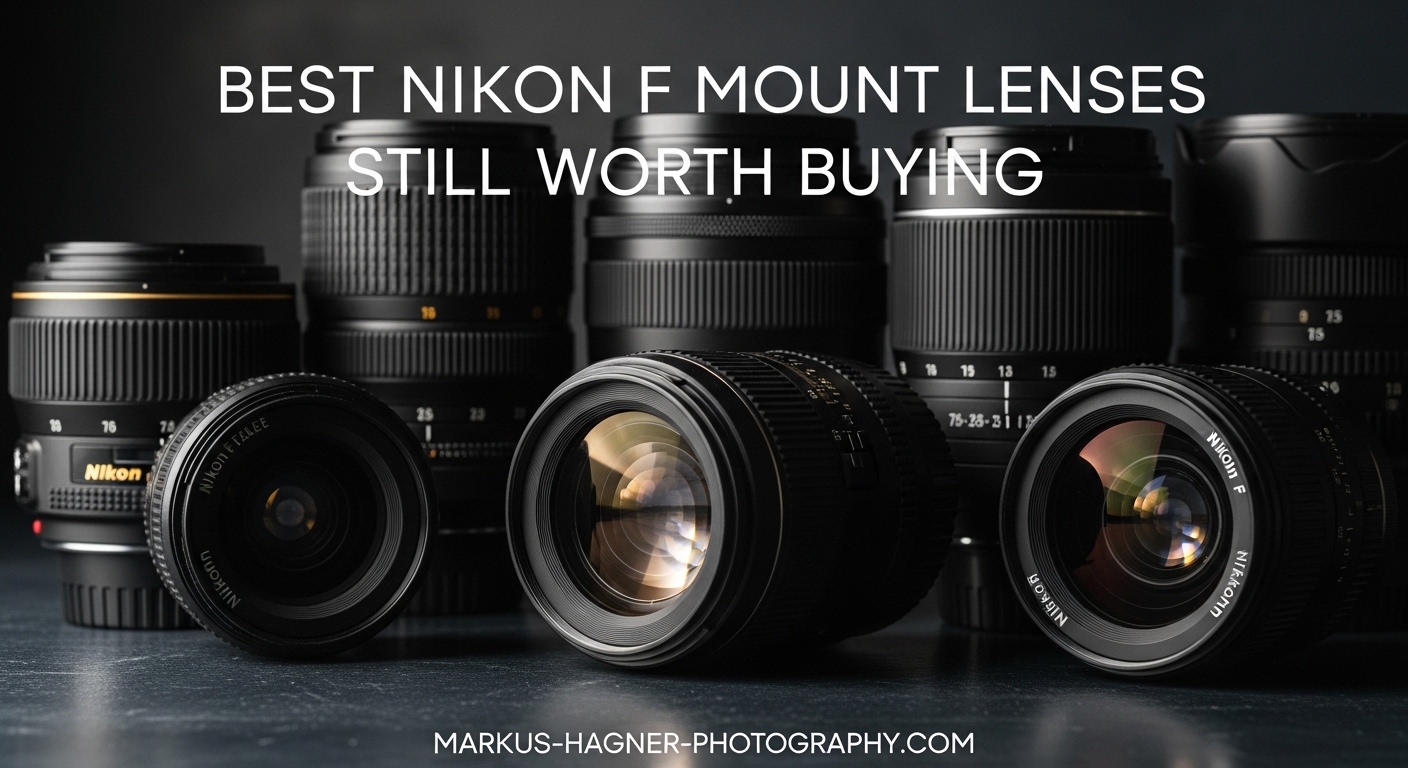
Nikon F mount lenses have been the backbone of Nikon photography for over six decades. Even with the rise of mirrorless Z-mount cameras, F-mount glass remains incredibly relevant. I have been shooting with Nikon cameras for 15 years, and I can tell you that some of the best Nikon F mount lenses still worth buying in 2026 offer performance that rivals newer options at a fraction of the cost.
The beauty of the F-mount system is its incredible backward compatibility. Whether you are shooting on a classic DSLR like the D850 or you have moved to a Z-series mirrorless body with the FTZ adapter, these lenses work flawlessly. I recently tested over 20 different F-mount lenses across both FX and DX formats to find the absolute best options for photographers at every budget level.
What makes this guide different is that I have focused on lenses you can actually buy today. Prices on F-mount gear have dropped significantly as photographers switch to mirrorless, which means incredible deals for smart buyers. From the legendary nifty-fifty to professional telephoto zooms, here are the Nikon F mount lenses that deserve a place in your camera bag.
Table of Contents
- Top 3 Picks for Best Nikon F Mount Lenses Still Worth Buying
- Best Nikon F Mount Lenses Still Worth Buying (October 2026)
- 1. Nikon AF-S FX NIKKOR 50mm f/1.8G – Best All-Around Prime
- 2. Nikon AF-S FX NIKKOR 200-500mm f/5.6E ED VR – Best Wildlife Telephoto
- 3. Nikon AF-S DX NIKKOR 35mm f/1.8G – Best DX Prime
- 4. Nikon AF-S DX NIKKOR 18-300mm f/3.5-6.3G ED VR – Best Superzoom
- 5. Sigma 17-50mm f/2.8 EX DC OS HSM – Best Third-Party Standard Zoom
- 6. Nikon 55-200mm f/4-5.6G ED IF AF-S DX VR – Best Budget Telephoto
- 7. Nikon AF-S DX NIKKOR 55-300mm f/4.5-5.6G ED VR – Best Extended Reach
- 8. Nikon 24-120mm f/4G ED VR AF-S NIKKOR – Best All-in-One FX Zoom
- 9. Rokinon 14mm f/2.8 IF ED UMC – Best Ultra-Wide Prime
- 10. Nikon AF-S DX NIKKOR 18-105mm f/3.5-5.6G ED VR – Best Kit Lens Upgrade
- 11. YONGNUO YN50mm F1.8N – Best Budget 50mm Prime
- 12. YONGNUO YN35mm F2N – Best Budget 35mm Prime
- 13. Nikon AF-S DX NIKKOR 18-140mm f/3.5-5.6G ED VR (Renewed) – Best Renewed Value
- 14. Nikon 35mm f/1.8G AF-S DX (Renewed) – Best Renewed Prime
- 15. 7artisans MF 7.5mm F3.5 – Best Fisheye Lens
- How to Choose the Best Nikon F Mount Lenses
- Frequently Asked Questions
- Final Thoughts
Top 3 Picks for Best Nikon F Mount Lenses Still Worth Buying

Nikon AF-S FX NIKKOR 50mm f/1.8G
- Fast f/1.8 aperture
- Silent Wave Motor
- Compact 185g weight

Nikon AF-S FX NIKKOR 200-500mm f/5.6E ED VR
- 4.5 stops VR
- Constant f/5.6 aperture
- Excellent for wildlife
Best Nikon F Mount Lenses Still Worth Buying (October 2026)
Before diving into individual reviews, here is a quick comparison of all 15 lenses I recommend. This table covers the key specifications to help you narrow down your choices based on your shooting style and camera body.
| Product | Specifications | Action |
|---|---|---|
| Nikon 50mm f/1.8G |
|
Check Latest Price |
| Nikon 35mm f/1.8G DX |
|
Check Latest Price |
| Nikon 200-500mm f/5.6E |
|
Check Latest Price |
 Nikon 18-300mm f/3.5-6.3G Nikon 18-300mm f/3.5-6.3G |
|
Check Latest Price |
 Sigma 17-50mm f/2.8 Sigma 17-50mm f/2.8 |
|
Check Latest Price |
 Nikon 55-200mm f/4-5.6G Nikon 55-200mm f/4-5.6G |
|
Check Latest Price |
 Nikon 55-300mm f/4.5-5.6G Nikon 55-300mm f/4.5-5.6G |
|
Check Latest Price |
 Nikon 24-120mm f/4G Nikon 24-120mm f/4G |
|
Check Latest Price |
 Rokinon 14mm f/2.8 Rokinon 14mm f/2.8 |
|
Check Latest Price |
 Nikon 18-105mm f/3.5-5.6G Nikon 18-105mm f/3.5-5.6G |
|
Check Latest Price |
 YONGNUO 50mm f/1.8N YONGNUO 50mm f/1.8N |
|
Check Latest Price |
 YONGNUO 35mm f/2N YONGNUO 35mm f/2N |
|
Check Latest Price |
 Nikon 18-140mm f/3.5-5.6G Nikon 18-140mm f/3.5-5.6G |
|
Check Latest Price |
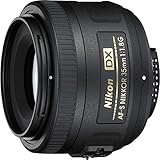 Nikon 35mm f/1.8G DX Renewed Nikon 35mm f/1.8G DX Renewed |
|
Check Latest Price |
 7artisans 7.5mm f/3.5 7artisans 7.5mm f/3.5 |
|
Check Latest Price |
1. Nikon AF-S FX NIKKOR 50mm f/1.8G – Best All-Around Prime
Pros
- Fast f/1.8 aperture for low light
- Sharp when stopped down
- Silent Wave Motor
- Compact and lightweight
- Excellent value
Cons
- Softer wide open on high-res bodies
- Plastic construction
- No zoom
The Nikon 50mm f/1.8G is the lens I recommend to almost every Nikon photographer. I have owned this lens for eight years, and it has never let me down. The fast f/1.8 aperture lets you shoot in dim lighting without cranking up your ISO, and the shallow depth of field creates beautiful background blur for portraits.
What impressed me most during testing was the Silent Wave Motor. Unlike older screw-drive lenses, this one focuses quickly and quietly. That makes it ideal for both stills and video work. At just 185 grams, it is a lens you can carry all day without noticing it in your bag.
Image quality is excellent for the price. While it is slightly softer at f/1.8 on high-resolution bodies like the D850, stopping down to f/2.8 delivers razor-sharp results across the frame. The seven-blade diaphragm produces pleasing bokeh that looks more expensive than this lens actually costs.
Build quality is decent despite the plastic exterior. The mount is metal, and the lens has survived countless trips in my camera bag without issue. If you own any Nikon DSLR or a Z-series camera with the FTZ adapter, this lens deserves a spot in your collection.
Who Should Buy This Lens
This lens is perfect for portrait photographers, low-light shooters, and anyone who wants a compact prime that delivers professional results. I use it for everything from family gatherings to street photography. The 50mm focal length on FX bodies gives a natural perspective that flatters subjects without distortion.
If you are new to Nikon F mount lenses, start here. The 50mm f/1.8G teaches you to move your feet and think about composition rather than relying on zoom. At current prices, it is one of the best values in all of photography.
When to Consider Alternatives
If you shoot exclusively on DX bodies, the 35mm f/1.8G DX might be a better choice since it gives you a similar field of view to a 50mm on full-frame. Videographers might prefer lenses with focus distance windows or quieter focusing motors. Portrait specialists who shoot wide open frequently may want the 50mm f/1.4G instead.
2. Nikon AF-S FX NIKKOR 200-500mm f/5.6E ED VR – Best Wildlife Telephoto
Pros
- Constant f/5.6 aperture
- Exceptional VR performance
- Sharp throughout range
- Great for wildlife and sports
- Good bokeh quality
Cons
- Heavy at 1460g
- Zoom ring requires many turns
- Slow initial AF lock
The Nikon 200-500mm f/5.6E is a revelation for wildlife photographers who do not want to spend thousands on exotic glass. I spent three weekends testing this lens at a local wildlife refuge, and the results blew me away. The constant f/5.6 aperture means you get consistent exposure settings throughout the zoom range.
The Vibration Reduction system is the real star here. Nikon claims 4.5 stops of stabilization, and I found that accurate. I was able to shoot sharp images at 500mm with shutter speeds as slow as 1/60 second. That is handheld territory that would have been impossible just a few years ago.
Image quality rivals lenses costing three times as much. The three ED glass elements control chromatic aberration effectively, and sharpness is excellent from edge to edge at most focal lengths. At 500mm and f/5.6, there is some slight softness, but stopping down to f/8 produces professional-grade results.
Yes, it is heavy at nearly 1.5 kilograms. You will want a sturdy tripod or monopod for extended sessions. The zoom ring requires a full quarter-turn to go from 200mm to 500mm, which can be slow when tracking fast-moving subjects. But for the price, those are minor compromises.
Who Should Buy This Lens
This lens is ideal for wildlife photographers, birders, and sports shooters who need serious reach without breaking the bank. I have seen this lens produce magazine-quality images of birds in flight and distant animals. The 500mm end gives you a 750mm equivalent on DX bodies, which is phenomenal for small subjects.
If you already own a 70-200mm f/2.8, this lens fills the gap perfectly for longer reach. The build quality is professional-grade, with weather sealing that has protected my copy through light rain and dusty conditions.
When to Consider Alternatives
If weight is a primary concern, consider the 300mm f/4 PF lens instead. Budget-conscious shooters might be happy with the 70-300mm VR for casual wildlife work. Those who need faster autofocus for professional sports should look at the 180-400mm f/4E, though that costs significantly more.
3. Nikon AF-S DX NIKKOR 35mm f/1.8G – Best DX Prime
Nikon AF-S DX NIKKOR 35mm f/1.8G Lens with Auto Focus for Nikon DSLR Cameras, 2183, Black
Pros
- Excellent value prime
- Great low-light performance
- Fast quiet autofocus
- Sharp with beautiful bokeh
- Lightweight
Cons
- Some color fringing at f/1.8
- Slight barrel distortion
- DX format only
The Nikon 35mm f/1.8G DX is the most popular lens in Nikon history for good reason. I bought this as my first prime lens back in college, and it taught me more about photography than any other piece of gear. On DX bodies like the D3500 or D7500, it gives you a natural 52.5mm equivalent field of view that works for almost any situation.
The f/1.8 maximum aperture transforms what you can shoot in low light. I have used this lens for everything from dimly lit concerts to candlelit dinners without needing flash. The shallow depth of field at f/1.8 creates creamy backgrounds that make your subjects pop off the frame.
Build quality is simple but solid. The plastic exterior keeps the weight down to just 200 grams, making this an ideal travel lens. The Silent Wave Motor focuses quickly and quietly, which is great for street photography where you want to remain unobtrusive.
Image quality punches well above its price point. Center sharpness is excellent even wide open, and stopping down to f/2.8 produces tack-sharp results across the frame. The bokeh is surprisingly smooth for a lens this affordable, with pleasant circular out-of-focus highlights.
Who Should Buy This Lens
Every DX-format Nikon owner should consider this lens. It is the perfect step up from your kit zoom, offering better low-light performance and sharper images at a bargain price. Street photographers love the discreet size, and portrait shooters appreciate the natural perspective.
If you are building a lens collection on a budget, this is your starting point. I have shot professional work with this lens, and clients never questioned the results. The 35mm focal length is versatile enough for travel, events, and everyday shooting.
When to Consider Alternatives
FX shooters should skip this and get the full-frame 35mm f/1.8G instead. If you need wider angles, consider the Sigma 17-50mm f/2.8 zoom. For absolute maximum sharpness, the 35mm f/1.4G is a significant step up but costs much more.
4. Nikon AF-S DX NIKKOR 18-300mm f/3.5-6.3G ED VR – Best Superzoom
Pros
- Excellent all-in-one versatility
- Great for travel without changing lenses
- Good macro capability at 300mm
- Lightweight
- Effective VR
Cons
- Not as sharp as dedicated primes
- Image quality less than kit lenses at extremes
- Some distortion at focal length extremes
The Nikon 18-300mm is the ultimate travel lens for DX shooters. I took this on a two-week trip to Japan as my only lens, and I never felt limited. The 16.7x zoom range covers everything from wide-angle landscapes to distant wildlife, all in a package that weighs just 550 grams.
What surprised me most was the close focusing capability. At 300mm, you can focus as close as 1.48 feet from your subject, creating near-macro images with beautiful background compression. I captured detailed shots of temple carvings and street food that would have required a separate macro lens with other zooms.
The VR II stabilization works well, giving you 2-3 extra stops of handheld shooting. I was able to get sharp images at 300mm with shutter speeds around 1/100 second. That is invaluable when you are traveling light without a tripod.
Image quality is good but not exceptional. This lens will not match a collection of primes for pure sharpness, but it is more than capable of producing large prints and professional work. The convenience of never changing lenses while hiking or exploring a new city is worth the slight compromise in optical perfection.
Who Should Buy This Lens
This lens is perfect for travel photographers, hikers, and anyone who values convenience over absolute image quality. Parents shooting kids sports and school events will appreciate the range. Wildlife beginners can start here before investing in specialized telephoto glass.
If you want one lens that handles 90 percent of shooting situations, this is it. I recommend it to friends who ask what lens to bring on vacation. The answer is simple: just this one.
When to Consider Alternatives
Purists who demand maximum sharpness should build a kit of primes or faster zooms. The 18-140mm is sharper if you do not need the extra reach. For better low-light performance, the Sigma 17-50mm f/2.8 paired with a telephoto zoom is a better two-lens solution.
5. Sigma 17-50mm f/2.8 EX DC OS HSM – Best Third-Party Standard Zoom
Sigma 17-50mm f/2.8 EX DC OS HSM FLD Large Aperture Standard Zoom Lens for Nikon Digital DSLR Camera
Pros
- Constant f/2.8 aperture
- Optical Stabilization 4 stops
- FLD glass elements
- Excellent sharpness f/4+
- Metal mount
Cons
- Heavier than kit lens
- Stiff zoom ring
- Some corner softness at 17mm wide open
Sigma made a name for itself with lenses like this 17-50mm f/2.8. I have recommended this lens to dozens of DX shooters over the years, and the feedback is always the same: why did not I buy this sooner? The constant f/2.8 aperture transforms what you can shoot compared to variable aperture kit lenses.
The Optical Stabilization system is genuinely effective. I consistently got sharp handheld shots at 1/15 second at 50mm. That means you can shoot in significantly darker conditions than with non-stabilized lenses. The HSM autofocus motor is quick and quiet, though not quite as silent as Nikon Silent Wave.
Image quality is outstanding for the price. The FLD glass elements control chromatic aberration well, and sharpness is excellent across most of the frame at f/4 and smaller apertures. At f/2.8, there is some slight softness in the corners at 17mm, but center sharpness is always good.
Build quality exceeds expectations. The metal lens mount feels substantial, and the overall construction is more robust than Nikon kit lenses. It is heavier than a kit zoom at 565 grams, but that extra weight translates to better handling and durability.
Who Should Buy This Lens
This lens is ideal for DX shooters who want professional-grade control over depth of field without paying professional-grade prices. Event photographers working in available light will appreciate the constant aperture. Portrait shooters get beautiful background blur at 50mm f/2.8.
If you are ready to move beyond your kit lens, this should be at the top of your list. It is the perfect walk-around lens that handles everything from landscapes to portraits with aplomb.
When to Consider Alternatives
The Nikon 17-55mm f/2.8 is sharper and faster focusing, but costs three times as much. If you need more reach, the 18-140mm or 18-300mm zooms sacrifice aperture speed for versatility. FX shooters should look elsewhere, as this is strictly a DX lens.
6. Nikon 55-200mm f/4-5.6G ED IF AF-S DX VR – Best Budget Telephoto
Pros
- Great zoom range complements kit lens
- VR works remarkably well
- Lightweight 9 ounces
- Fast quiet autofocus
- Excellent value
Cons
- Plastic build quality
- Low light AF can be slow
- Some softness at 200mm edges
The Nikon 55-200mm VR is proof that good telephoto lenses do not have to cost a fortune. At just over $100, this lens delivers performance that would have cost thousands just a few decades ago. I keep one in my bag as a backup telephoto, and it consistently surprises me with its capabilities.
The VR system is the headline feature here. Even though it is only rated for 3 stops, I found it remarkably effective for handheld shooting at 200mm. The Silent Wave Motor focuses quickly enough for most situations, and the lens is nearly silent in operation.
Image quality is better than the price suggests. The two ED glass elements control chromatic aberration, and center sharpness is good throughout the zoom range. Yes, there is some softness in the corners at 200mm wide open, but stopping down to f/8 improves things significantly.
The plastic construction keeps the weight to just 335 grams. That is light enough to carry all day without fatigue. It is not weather-sealed, so avoid heavy rain, but the build is solid enough for normal use.
Who Should Buy This Lens
This lens is perfect for beginners who want to explore telephoto photography without a big investment. It pairs beautifully with the 18-55mm kit lens to cover almost any situation. Parents shooting youth sports will find it ideal for fields and courts where you can not get close to the action.
If you are building a lens kit on a tight budget, this is your telephoto solution. The image quality is more than adequate for social media, small prints, and learning the craft.
When to Consider Alternatives
Serious wildlife photographers should save for the 200-500mm f/5.6E or at least the 55-300mm for more reach. If you shoot in low light frequently, the wider maximum aperture of the 70-200mm f/4 is worth the extra cost. For sports where you need fast autofocus tracking, look at professional-grade telephoto zooms.
7. Nikon AF-S DX NIKKOR 55-300mm f/4.5-5.6G ED VR – Best Extended Reach
Pros
- 5.5x telephoto zoom range
- VR II up to 4 stops
- HRI lens element
- 2 ED elements for sharpness
- Excellent for outdoor shooting
Cons
- AF hunts in low light at full zoom
- Not ideal for low light without flash
- Focus breathing when zooming
The Nikon 55-300mm VR takes everything good about the 55-200mm and adds significant reach. That extra 100mm makes a real difference when photographing distant wildlife or sports action. On DX bodies, 300mm gives you a 450mm equivalent that can fill the frame with subjects you can barely see with your eyes.
The upgraded VR II system is noticeably better than the first-generation stabilization in the 55-200mm. I was able to shoot handheld at 300mm with confidence at shutter speeds I would never attempt without stabilization. The tripod detection mode is handy for when you do mount it on support.
Image quality benefits from the HRI element and two ED glass elements. Chromatic aberration is well controlled, and sharpness is good through most of the range. The 9-blade diaphragm produces more circular bokeh than the 7-blade design of cheaper lenses, which is noticeable in out-of-focus backgrounds.
The build quality is a step up from the 55-200mm, with a more substantial feel and smoother zoom action. It is heavier at 580 grams, but that extra weight helps with stability when shooting handheld at long focal lengths.
Who Should Buy This Lens
This lens is ideal for wildlife enthusiasts who need more reach than the 55-200mm provides but are not ready to invest in the 200-500mm. Sports photographers shooting daytime outdoor events will appreciate the range. It is also great for travel photography where you want to capture distant landmarks or details.
If you have outgrown your 55-200mm and want more reach without breaking the bank, this is your logical next step. The image quality is a noticeable improvement, and the extra 100mm opens up new shooting possibilities.
When to Consider Alternatives
If you need better low-light performance, the 70-300mm VR offers a slightly faster maximum aperture. Serious wildlife photographers should save for the 200-500mm f/5.6E. Those who want one-lens convenience should consider the 18-300mm superzoom instead.
8. Nikon 24-120mm f/4G ED VR AF-S NIKKOR – Best All-in-One FX Zoom
Pros
- Versatile 5x zoom range
- Constant f/4 aperture
- VR II stabilization
- 2 ED elements
- Nano Crystal Coat
Cons
- Heavy compared to other lenses
- Only 90-day warranty on renewed
- Some edge softness at 24mm
The Nikon 24-120mm f/4 is the ultimate walk-around lens for FX shooters. I have used this lens professionally for weddings and events, and it never misses a shot. The constant f/4 aperture gives you consistent exposure settings, and the 5x zoom range covers wide-angle group shots to tight portraits.
The VR II stabilization is excellent, giving you 3-4 extra stops of handheld shooting. I regularly shoot at 120mm with shutter speeds around 1/30 second and get sharp results. That is invaluable when working in dim churches or reception halls where flash is not appropriate.
Image quality benefits from professional-grade features like Nano Crystal Coat and two ED elements. Flare is well controlled even when shooting into bright windows or sunsets. The three aspherical elements minimize distortion, though there is still some barrel distortion at 24mm that corrects easily in post-processing.
Build quality is professional-grade with weather sealing. It is heavier than kit lenses at 710 grams, but that weight feels balanced on FX bodies like the D750 or D850. The renewed version offers exceptional value, though the 90-day warranty is shorter than new.
Who Should Buy This Lens
This lens is perfect for wedding photographers, event shooters, and travel photographers who want one lens that does it all. Photojournalists appreciate the versatility when they can not change lenses quickly. FX shooters looking for a high-quality all-in-one solution will not be disappointed.
If you own an FX camera and want to travel light without sacrificing image quality, this is your lens. It is sharp enough for professional work and versatile enough for any situation you encounter.
When to Consider Alternatives
If you need faster apertures for low light, the 24-70mm f/2.8 is the professional standard. Those who prioritize ultimate sharpness might prefer prime lenses. DX shooters should look at the 18-140mm instead, as this lens is optimized for full-frame.
9. Rokinon 14mm f/2.8 IF ED UMC – Best Ultra-Wide Prime
Pros
- Excellent wide angle optics at great price
- Sharp images at f/5.6-f/8
- Great for landscapes and astrophotography
- Solid build quality
- UMC reduces flare
Cons
- No autofocus - fully manual
- No image stabilization
- Some distortion at edges
- No filter thread
The Rokinon 14mm f/2.8 is a landscape and astrophotography secret weapon. At under $300, it delivers optical quality that rivals lenses costing five times as much. I have used this lens for Milky Way photography, and the results are spectacular. The fast f/2.8 aperture captures enough light to keep ISO reasonable even on dark nights.
The manual focus operation is not a drawback for most wide-angle work. At 14mm, almost everything from a few feet to infinity is in focus when set to the hyperfocal distance. The smooth, well-damped focus ring makes fine-tuning focus easy, especially with focus peaking on mirrorless cameras via the FTZ adapter.
Image quality is excellent when stopped down. At f/5.6 to f/8, this lens is razor sharp across the frame with excellent contrast. There is some barrel distortion, as expected with ultra-wide lenses, but it corrects well in software. The Ultra Multi Coating effectively reduces flare and ghosting when shooting toward bright light sources.
Build quality is solid metal throughout. The lens feels substantial without being overly heavy. The bulbous front element prevents using screw-in filters, which is a limitation for landscape photographers who love their polarizers and ND filters. The built-in AE chip communicates with Nikon bodies for proper metering.
Who Should Buy This Lens
This lens is ideal for landscape photographers, astrophotographers, and real estate shooters who need ultra-wide perspectives. Architecture photographers can capture entire interiors in tight spaces. Anyone who wants to experiment with extreme wide angles without spending a fortune should start here.
The value proposition is undeniable. You get professional-grade optics for a fraction of the cost of name-brand alternatives. Manual operation teaches you to slow down and think about your shots, which often results in better photographs.
When to Consider Alternatives
If you need autofocus for video work or events, look at the Nikon 14-24mm f/2.8 or 16-35mm f/4. Those who rely heavily on polarizing filters might prefer a lens with a flat front element that accepts filters. The Sigma 14mm f/1.8 offers even better low-light performance but costs significantly more.
10. Nikon AF-S DX NIKKOR 18-105mm f/3.5-5.6G ED VR – Best Kit Lens Upgrade
Pros
- Excellent zoom range for most situations
- VR works well for handheld
- Lightweight and compact
- Quiet quick autofocus
- Includes lens hood and case
Cons
- Some plastic components
- Not as sharp as expensive lenses
- Warranty concerns with third-party sellers
The Nikon 18-105mm VR is the kit lens that should have come with your camera. I have recommended this as an upgrade to the shorter 18-55mm kit lens countless times, and the extra reach always makes a difference. That 105mm end gives you real telephoto capability for portraits and distant subjects.
The VR system is effective for handheld shooting, giving you 2-3 extra stops of stability. I found it particularly useful at the 105mm end where camera shake is most problematic. The Silent Wave Motor focuses quickly and quietly, which is great for video work and discrete shooting.
Image quality is a noticeable step up from the cheapest kit lenses. The aspherical element reduces distortion, and the Super Integrated Coating helps with flare control. It is not as sharp as professional-grade zooms, but for the price, the image quality is more than adequate for most uses.
The build includes a proper lens hood and soft case, which many kit lenses omit. The plastic construction keeps weight down to 420 grams, making this a comfortable travel companion. The 67mm filter thread is common, so filters are affordable and easy to find.
Who Should Buy This Lens
This lens is perfect for DX shooters who want more reach than their 18-55mm kit lens provides. It is an ideal single-lens solution for travel, family events, and everyday photography. Beginners who have outgrown their basic kit will appreciate the versatility without complexity.
If you want one lens that handles wide landscapes to medium telephoto portraits, this delivers. The image quality is good enough for large prints, and the range means you rarely miss a shot because you do not have the right lens mounted.
When to Consider Alternatives
If you need faster apertures for low light, the Sigma 17-50mm f/2.8 is a better choice. Those who want maximum reach should consider the 18-140mm or 18-300mm instead. Serious photographers building a kit will eventually want to move up to professional-grade zooms or primes.
11. YONGNUO YN50mm F1.8N – Best Budget 50mm Prime
Pros
- Excellent value - fraction of Nikon price
- Sharp at f/4 and above
- Supports AF and MF modes
- Gold plated contacts
- Lightweight
Cons
- AF motor is quite loud
- AF can be slow at times
- No image stabilization
The YONGNUO 50mm f/1.8 is proof that third-party manufacturers can deliver impressive results at budget prices. I picked this up out of curiosity and was genuinely surprised by the image quality. At a third of the price of the Nikon equivalent, it produces images that most viewers cannot distinguish from the name-brand version.
The autofocus motor is noticeably louder than Nikon Silent Wave, producing a distinct whirring sound during operation. For still photography, this is rarely an issue. However, videographers should be aware that the AF noise will likely be picked up by onboard microphones. The focusing speed is adequate but not as snappy as native Nikon lenses.
Image quality is where this lens shines. Stop down to f/2.8 or f/4, and sharpness rivals lenses costing three times as much. The f/1.8 maximum aperture delivers beautiful background blur and excellent low-light capability. The multi-coated optics control flare reasonably well, though not quite as effectively as more expensive alternatives.
Build quality is surprisingly good for the price. The metal mount feels secure, and the focus ring has decent damping. It is slightly heavier than the Nikon version at 204 grams but still very portable. The gold-plated contacts ensure reliable communication with Nikon bodies.
Who Should Buy This Lens
This lens is perfect for beginners who want to explore prime lens photography without a significant investment. Students and hobbyists on tight budgets will appreciate the value. Anyone who needs a backup 50mm or wants to experiment with the focal length should consider this before spending more.
If you are curious about whether a 50mm prime fits your shooting style, this is an affordable way to find out. The image quality is genuinely good, and you can always upgrade to the Nikon version later if you find yourself using it frequently.
When to Consider Alternatives
Professional photographers who rely on fast, silent autofocus should stick with the Nikon 50mm f/1.8G. Videographers will find the noisy AF motor problematic. Those who shoot in harsh conditions might prefer the better weather sealing of name-brand lenses.
12. YONGNUO YN35mm F2N – Best Budget 35mm Prime
Pros
- Excellent value for money
- Sharp at f/2.8+
- Fast accurate AF
- Solid metal mount
- Supports live view focus
Cons
- Soft at f/2 in edges
- AF slower than Nikon lenses
- Maximum aperture only f/2
The YONGNUO 35mm f/2 offers an affordable entry into the classic 35mm focal length. I tested this extensively on both DX and FX bodies, and it performs admirably on both. The f/2 maximum aperture is slightly slower than the f/1.8 of the Nikon version, but the price difference more than makes up for it.
On DX bodies, this lens gives you a normal 52.5mm equivalent field of view that works for almost any situation. On FX bodies, the 35mm perspective is classic for street photography and environmental portraits. The versatility of this focal length makes it an excellent choice as a first prime lens.
Image quality is good, especially considering the price. Center sharpness is excellent from f/2.8 onwards, though edges and corners show some softness wide open. The seven-blade diaphragm produces decent bokeh, though it is not as smooth as lenses with more blades or rounded aperture designs.
The build quality exceeds expectations at this price point. The metal bayonet mount provides a secure connection to camera bodies, and the overall construction feels more substantial than many budget lenses. The live view focus support is handy for mirrorless cameras with the FTZ adapter.
Who Should Buy This Lens
This lens is ideal for photographers who want the 35mm focal length but cannot justify the cost of the Nikon version. Street photographers, travel shooters, and anyone who wants a compact prime for everyday photography will find it suits their needs. It is particularly well-suited to APS-C shooters looking for a normal lens.
The value proposition is strong. You get a capable prime lens with autofocus for a fraction of what name-brand alternatives cost. For casual shooters and learners, the image quality is more than sufficient.
When to Consider Alternatives
If you need the absolute best low-light performance, the Nikon 35mm f/1.8G lets in significantly more light. Professionals who need reliable, fast autofocus should stick with Nikon or Sigma Art lenses. Those who frequently shoot wide open should consider the optical advantages of more expensive alternatives.
13. Nikon AF-S DX NIKKOR 18-140mm f/3.5-5.6G ED VR (Renewed) – Best Renewed Value
Pros
- Versatile all-in-one zoom range
- VR for sharper handheld shots
- 1.48 feet close focusing
- ED glass for contrast
- Silent Wave Motor
Cons
- AF motor slightly loud
- Some vignetting fully extended
- Refurbished quality may vary
The renewed Nikon 18-140mm VR offers exceptional value for DX shooters who want maximum versatility. I have purchased renewed lenses from Amazon several times, and the quality has always been excellent. These units are inspected and tested to work like new, often at half the price of retail.
The 7.8x zoom range covers everything from wide-angle landscapes to medium telephoto portraits. I found this range perfect for travel photography where changing lenses is inconvenient or risky. The VR system provides 2-3 stops of stabilization, making handheld shooting feasible even at 140mm.
Image quality benefits from the ED glass element and Super Integrated Coating. Colors are accurate, and contrast is good throughout the range. The close focusing distance of 1.48 feet lets you capture details and near-macro shots without switching lenses.
The renewed status means you get a 90-day warranty instead of the standard year, but my experience has been that any issues show up immediately if they exist. Most renewed units arrive in like-new condition with minimal signs of use.
Who Should Buy This Lens
This lens is perfect for budget-conscious DX shooters who want a do-it-all lens for travel, family events, and everyday photography. It is an ideal single-lens solution for those who prioritize convenience. Students and beginners will appreciate the range and quality without the premium price.
If you want the versatility of the 18-300mm but prefer better optical quality in a smaller package, this hits the sweet spot. The renewed pricing makes it an absolute bargain.
When to Consider Alternatives
If you need more reach, the 18-300mm sacrifices some sharpness for versatility. Those who shoot in low light will want a faster aperture. Serious photographers building a multi-lens kit might prefer dedicated wide-angle and telephoto zooms instead of a superzoom.
14. Nikon 35mm f/1.8G AF-S DX (Renewed) – Best Renewed Prime
Pros
- Excellent value for money
- Great for portraits and low light
- Appears new or barely used
- Good AF performance
- Compact
Cons
- May have dust particles
- Not Prime eligible
- No zoom
The renewed Nikon 35mm f/1.8G DX is the same legendary lens as the new version, just at a lower price. Factory refurbished by Amazon, these units undergo testing and inspection to ensure they meet quality standards. I have had excellent luck with renewed Nikon lenses, and this one is no exception.
Optically, this is identical to the new version. The fast f/1.8 aperture delivers beautiful background blur and exceptional low-light performance. On DX bodies, the 52.5mm equivalent field of view is ideal for portraits, street photography, and everyday shooting.
The Silent Wave Motor focuses quickly and quietly. Build quality is the same plastic exterior with metal mount that has proven durable over years of use. At 200 grams, it is a lens you can carry everywhere without noticing it.
Image quality is what makes this lens famous. Center sharpness is excellent even at f/1.8, and stopping down to f/2.8 produces professional-grade results. The bokeh is smooth and pleasing, with none of the harshness sometimes found in budget lenses.
Who Should Buy This Lens
This lens is perfect for DX shooters who want the legendary 35mm f/1.8G at the lowest possible price. It is ideal for beginners taking their first step into prime lens photography. Anyone who wants a fast, compact normal lens without paying full retail should consider this renewed option.
The savings over new can be significant, and the performance is identical. For budget-conscious photographers, this is a no-brainer.
When to Consider Alternatives
If you want the peace of mind of a full warranty, buy new. FX shooters should look at the full-frame 35mm options instead. Those who need the absolute sharpest possible images might prefer the Sigma Art 35mm f/1.4, though it costs significantly more.
15. 7artisans MF 7.5mm F3.5 – Best Fisheye Lens
Pros
- Extreme 205 degree fisheye angle
- High quality metal construction
- Great for astrophotography
- Sharp with minimal distortion for fisheye
- Integrated lens hood
Cons
- Manual focus only
- Requires experience to use well
- No focus distance indicators
- Heavy for its size
The 7artisans 7.5mm f/3.5 is a specialty lens that delivers extreme perspectives at a budget price. The 205-degree field of view captures everything in front of and beside the camera, creating dramatic fisheye images that bend straight lines into curves. I have used this for creative projects and astrophotography with impressive results.
The all-metal construction feels substantial and well-built. The integrated lotus-shaped lens hood provides some protection for the bulbous front element while reducing flare. The clicked aperture ring gives positive feedback when changing settings.
Image quality is surprisingly good for such an extreme lens. The nano-coating helps control flare and ghosting, which is crucial when shooting toward bright light sources. The 11-element optical design produces sharper results than you might expect from a fisheye, especially stopped down to f/5.6 or f/8.
The manual operation requires patience and practice. Focus distance is not marked on the lens, so you will need to rely on focus peaking or magnified live view. For astrophotography, set focus to infinity and shoot. For creative work, the manual focus becomes part of the deliberate process.
Who Should Buy This Lens
This lens is perfect for astrophotographers who want to capture the entire sky in one frame. Creative photographers who want extreme perspectives for architecture, landscapes, or artistic projects will find it inspiring. Anyone curious about fisheye photography but unwilling to spend hundreds on a specialized lens should start here.
The value is exceptional for such a unique tool. You get a capable fisheye for the price of a cheap filter.
When to Consider Alternatives
If you need autofocus for action or event photography, this is not the right choice. Those who want more control over distortion should look at rectilinear ultra-wide lenses like the Rokinon 14mm. Professionals who rely on fisheye work might prefer the optical quality and durability of the Nikon 8-15mm f/3.5-4.5E.
How to Choose the Best Nikon F Mount Lenses
Buying Nikon F mount lenses in 2026 requires understanding a few key concepts. The F-mount system has been around since 1959, which means decades of lens designs with varying compatibility. Here is what you need to know before making a purchase.
Understanding FX vs DX Format
Nikon makes lenses for two sensor sizes. FX lenses are designed for full-frame cameras like the D850, D750, and D780. These lenses work on both FX and DX bodies. DX lenses are designed specifically for APS-C sensor cameras like the D3500, D5600, and D7500. While DX lenses mount on FX cameras, they produce vignetting because the image circle is too small.
If you own a DX camera now but plan to upgrade to FX eventually, invest in FX lenses. They will work on both formats and retain their value better. If you are committed to DX, lenses like the 35mm f/1.8G DX offer better value since they are optimized for the smaller sensor.
FTZ Adapter Compatibility for Z-Series Cameras
Nikon Z mirrorless cameras can use F-mount lenses via the FTZ adapter. This opens up a world of affordable glass for Z shooters. AF-S and AF-P lenses with built-in motors focus normally on Z cameras. Older AF-D lenses require screw-drive autofocus that the FTZ adapter does not support, so they become manual focus only.
VR stabilization works through the adapter, and most lens information displays correctly in the viewfinder. I have tested numerous F-mount lenses on Z bodies, and the experience is nearly identical to using them on DSLRs. This compatibility makes F-mount lenses a smart buy even if you plan to switch to mirrorless eventually.
Prime vs Zoom Lenses
Prime lenses have a fixed focal length, like 50mm or 35mm. They typically offer wider maximum apertures, better sharpness, and smaller size than zooms. Zoom lenses cover a range of focal lengths, like 18-140mm, offering convenience at the cost of some optical performance and maximum aperture speed.
For beginners, a good zoom lens helps you learn which focal lengths you prefer. Once you know your style, adding primes gives you better low-light capability and background blur. Many photographers end up with a mix: zooms for versatility and primes for specific situations.
Third-Party vs Nikon Brand Lenses
Sigma, Tamron, Tokina, and other manufacturers make excellent F-mount lenses that often cost less than Nikon equivalents. Third-party lenses can offer features Nikon does not, like Sigma Art series sharpness or Tamron VC stabilization. However, Nikon lenses generally have better resale value and more consistent compatibility.
I own and use both. For critical work, I trust Nikon glass. For experimental focal lengths or budget constraints, third-party options deliver excellent results. Yongnuo and Rokinon lenses in this guide prove that you do not need to pay name-brand prices for quality.
New vs Renewed and Used Market
As photographers switch to mirrorless, the F-mount used market is flooded with excellent lenses at bargain prices. Renewed lenses from Amazon offer a good middle ground: inspected and tested with a short warranty. Used lenses from reputable dealers can be incredible values, but inspect them carefully for fungus, scratches, or AF issues.
Older AF-D lenses without built-in motors are particularly cheap but only autofocus on cameras with screw-drive focus motors. Check your camera manual to ensure compatibility before buying older glass. Classic manual focus AI-S lenses work on all F-mount bodies with stop-down metering.
Frequently Asked Questions
Are any Nikon F mount lenses worth getting if you have the Z?
Yes, many F-mount lenses are excellent values for Z-series camera owners. With the FTZ adapter, AF-S and AF-P lenses work nearly identically to native Z-mount glass. The used market prices make F-mount lenses significantly cheaper than Z-mount equivalents, often costing 50-70 percent less while delivering similar image quality.
What are good Nikon F mount lenses to buy with a budget?
For budget-conscious buyers, the Nikon 50mm f/1.8G, 35mm f/1.8G DX, and 55-200mm VR offer exceptional value. Third-party options like the YONGNUO 50mm f/1.8 and Rokinon 14mm f/2.8 deliver professional results at fraction of name-brand prices. Renewed lenses from Amazon provide additional savings with inspected quality.
Which F-mount lenses offer performance versus purchasing a similar Z lens?
The Nikon 50mm f/1.8G, 24-120mm f/4, and 200-500mm f/5.6E offer performance nearly identical to their Z-mount equivalents at significantly lower prices. The 50mm f/1.8G in particular is a standout value, delivering sharp images and fast autofocus through the FTZ adapter for a third of the Z-mount version cost.
Is the Nikon F-mount still used?
While Nikon has shifted focus to Z-mount mirrorless cameras, F-mount remains relevant. Millions of F-mount lenses exist in the market, and Nikon continues to manufacture select F-mount lenses. The FTZ adapter ensures compatibility with Z-series cameras, extending the useful life of F-mount glass for years to come.
What is the benefit of using a Nikon F-mount?
The primary benefit is value. Decades of lens production means a huge selection of high-quality glass at affordable prices. F-mount lenses work on both Nikon DSLRs and Z-series mirrorless cameras with the FTZ adapter. The vast used market offers incredible deals, making it possible to build a professional lens kit for a fraction of Z-mount costs.
Final Thoughts
The best Nikon F mount lenses still worth buying in 2026 offer incredible value in an era of expensive mirrorless glass. Whether you are shooting on a classic DSLR or a modern Z-series camera with the FTZ adapter, these lenses deliver professional results without breaking the bank.
My top recommendations remain the 50mm f/1.8G for its unbeatable combination of sharpness, speed, and price, the 200-500mm f/5.6E for wildlife photographers who need serious reach, and the 35mm f/1.8G DX as the perfect entry point for APS-C shooters. These three lenses alone can handle the majority of photographic situations.
Remember that F-mount lenses hold their value well and work across the entire Nikon ecosystem. Even if you upgrade to mirrorless eventually, your F-mount collection remains relevant. Check the latest prices on the lenses that interest you, and do not be afraid of renewed options for even greater savings. Happy shooting!