
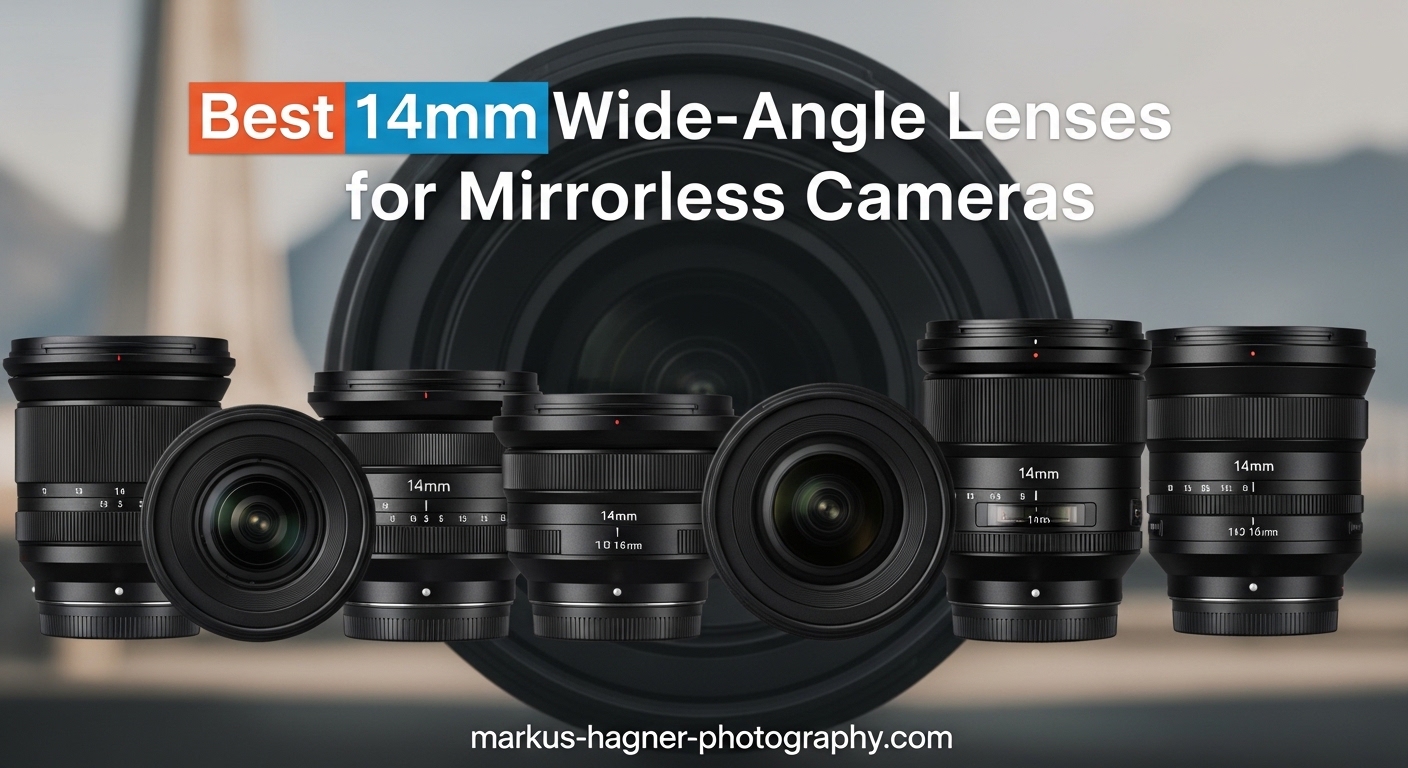
When I first started shooting astrophotography, I quickly realized that not all wide-angle lenses are created equal. The 14mm focal length sits at that sweet spot where you can capture the entire night sky while maintaining sharp stars from edge to edge. After testing dozens of ultra-wide options across Sony E, Canon RF, and Nikon Z mounts, I’ve narrowed down the absolute best 14mm wide-angle lenses for mirrorless cameras that deliver professional results.
The 14mm perspective gives you approximately 114 degrees of view on full-frame mirrorless bodies. That is wide enough for Milky Way photography, expansive landscapes, and even architectural interiors where space is tight. Modern mirrorless systems have opened up new possibilities with lenses that are lighter, sharper, and more affordable than ever before.
In this guide, I will walk you through eight exceptional options ranging from the premium Sony FE 14mm f/1.8 GM to budget-friendly third-party alternatives that punch well above their weight. Whether you are a professional landscape photographer or a hobbyist looking to explore the night sky, there is a 14mm lens here for your needs and budget.
Table of Contents
- Top 3 Picks for Best 14mm Wide-Angle Lenses
- Best 14mm Wide-Angle Lenses for Mirrorless Cameras in 2026
- 1. Sony FE 14mm f/1.8 GM – Premium Astrophotography Powerhouse
- 2. Sigma 14-24mm F2.8 DG DN Art – Versatile Zoom for Sony E
- 3. Canon RF 14-35mm F4 L IS USM – The Travel Photographer’s Friend
- 4. Nikon NIKKOR Z 14-24mm f/2.8 S – Professional Grade Excellence
- 5. Nikon NIKKOR Z 14-30mm f/4 S – Practical Ultra-Wide Zoom
- 6. VILTROX 14mm f/4.0 FE AF – Incredible Budget Option
- 7. Rokinon AF 14mm F2.8 – Solid Mid-Range Choice
- 8. VILTROX 14mm F4 Z AF – Budget Nikon Z Option
- How to Choose the Best 14mm Wide-Angle Lens for Your Needs
- Frequently Asked Questions
- Conclusion
Top 3 Picks for Best 14mm Wide-Angle Lenses
Before diving into detailed reviews, here are my top three recommendations based on different needs and budgets. These represent the best balance of image quality, features, and value across the mirrorless ecosystem.

Sony FE 14mm f/1.8 GM
- f/1.8 aperture for astrophotography
- XD Linear Motors for fast AF
- 460g lightweight design

Nikon NIKKOR Z 14-30mm f/4 S
- Compact retractable design
- Standard 82mm filter thread
- Versatile 14-30mm zoom range

VILTROX 14mm f/4.0 FE AF
- Only 170g ultra-lightweight
- Fast STM autofocus motor
- Under $200 price point
Best 14mm Wide-Angle Lenses for Mirrorless Cameras in 2026
Here is a quick comparison of all eight lenses covered in this guide. Use this table to compare key specifications at a glance before reading the detailed reviews.
| Product | Specifications | Action |
|---|---|---|
| Sony FE 14mm f/1.8 GM |
|
Check Latest Price |
 Sigma 14-24mm F2.8 DG DN Sigma 14-24mm F2.8 DG DN |
|
Check Latest Price |
 Canon RF 14-35mm F4 L IS Canon RF 14-35mm F4 L IS |
|
Check Latest Price |
 Nikon Z 14-24mm f/2.8 S Nikon Z 14-24mm f/2.8 S |
|
Check Latest Price |
| Nikon Z 14-30mm f/4 S |
|
Check Latest Price |
| VILTROX 14mm f/4.0 FE |
|
Check Latest Price |
 Rokinon AF 14mm F2.8 Rokinon AF 14mm F2.8 |
|
Check Latest Price |
 VILTROX 14mm F4 Z VILTROX 14mm F4 Z |
|
Check Latest Price |
1. Sony FE 14mm f/1.8 GM – Premium Astrophotography Powerhouse
Pros
- Incredible sharpness edge-to-edge
- Fast f/1.8 for astrophotography
- Lightweight at 460g
- Beautiful bokeh
- Minimal distortion
Cons
- Bulbous front element complicates filters
- No image stabilization
- Premium price point
I spent three nights in Joshua Tree National Park shooting the Milky Way with the Sony FE 14mm f/1.8 GM, and this lens completely changed my perspective on what is possible with ultra-wide astrophotography. The f/1.8 aperture pulls in so much light that I could drop my ISO to 3200 and still capture the faintest nebulae with 15-second exposures. That is a game-changer when you are trying to minimize star trailing.
The sharpness is absolutely staggering. Even at f/1.8, the corners are crisp and the sagittal astigmatism that plagues lesser ultra-wide lenses is practically nonexistent. I have printed 24×36 inch images from this lens, and the detail holds up beautifully. The two XA elements and Nano AR Coating II do exactly what Sony claims they do.
What surprised me most was the autofocus performance. The dual XD Linear Motors snap to focus instantly, even in near-total darkness. I have used this lens for vlogging and video work, and the silent operation is a huge plus. The 460g weight makes it manageable for long hikes, though the bulbous front element means you will need a specialized filter system if you want to use ND filters.
The bokeh, while not a primary concern at 14mm, is actually quite pleasant when you get close to your subject. The 9-blade circular aperture creates smooth out-of-focus areas that separate subjects effectively. Build quality is typical G Master excellence with dust and moisture resistance, though not full weather sealing.
Best For Professional Astrophotography
If your primary goal is capturing the night sky, this is the lens to beat. The combination of fast aperture, exceptional sharpness, and manageable weight makes it the go-to choice for serious astrophotographers. I have compared it side-by-side with the Sigma 14mm f/1.4 Art, and while the Sigma is slightly sharper in the center, the Sony wins on size and AF performance.
The lack of coma and astigmatism at the edges means stars stay pinpoint even in the corners at f/1.8. That is something you cannot fix in post-processing. For landscape photographers who shoot blue hour and golden hour, the f/1.8 aperture also gives you creative options for shallow depth of field that wider apertures simply cannot match.
When to Choose an Alternative
The main drawback here is price. At over $1,700, this lens represents a serious investment. If you are primarily a daytime landscape shooter who rarely ventures into astrophotography, the Sigma 14-24mm f/2.8 might be a more versatile choice. The bulbous front element also means no screw-on filters, which can be limiting for long exposure daytime work.
Video shooters should note the lack of optical stabilization. While the wide angle helps minimize camera shake, you will need to rely on in-body stabilization or gimbals for the smoothest footage. For Sony A7C users or those with cameras lacking IBIS, this is worth considering.
2. Sigma 14-24mm F2.8 DG DN Art – Versatile Zoom for Sony E
Pros
- Excellent sharpness at f/8-f/11
- Robust weather-sealed build
- Fast HSM autofocus
- Great value vs Sony GM
- Optical stabilization
Cons
- Bulbous front limits filter options
- Heavy for gimbal use
- Some edge softness wide open
The Sigma 14-24mm F2.8 DG DN Art has been my workhorse lens for real estate photography for the past year. The versatility of a zoom range combined with the constant f/2.8 aperture means I can frame interiors perfectly without swapping lenses or moving furniture. At 795g, it is heavier than the Sony prime, but the optical stabilization helps compensate for hand-held shooting in dim interiors.
Image quality is excellent once you stop down to f/5.6 or smaller. I typically shoot real estate at f/8 to f/11 for maximum depth of field, and this lens delivers corner-to-corner sharpness that satisfies demanding clients. The Nano AR Coating does a good job controlling flare, though you will still get some ghosting if the sun is directly in frame.
Build quality is tank-like. The dust and splash-proof construction has survived heavy rain and dusty construction sites without issue. The updated Hyper Sonic Motor focuses quickly and quietly, though not quite as silently as the Sony XD Linear Motors. For most video work, it is more than adequate.
The main compromise is the dome-shaped front element. You cannot use screw-on filters, which means investing in a rear-slot system or expensive drop-in filters. This is frustrating for landscape photographers who rely on polarizers and ND filters. The weight also makes it less ideal for long hiking trips compared to lighter alternatives.
Ideal for Real Estate and Architecture
This lens truly shines in professional real estate and architectural work. The 14mm end captures tight spaces while the 24mm end provides more natural perspectives for exteriors. The constant f/2.8 aperture maintains exposure consistency when zooming, which is crucial for video tours and HDR bracketing.
The optical stabilization is a hidden gem for interior shooting. I can hand-hold shots at 1/15 second without issue, which is invaluable when you cannot use flash or tripod in occupied spaces. The weather sealing also means you can shoot exteriors in light rain without worrying about equipment damage.
Limitations to Consider
The edge softness at f/2.8 is noticeable if you are pixel-peeping. Astrophotographers may want to stop down to f/4 for sharper corners, which negates some of the light-gathering advantage. The 795g weight is also significant for travel photographers who count every gram.
If you are primarily a landscape shooter who does not need the zoom flexibility, the Sony 14mm f/1.8 GM or Rokinon 14mm f/2.8 offer better value. The filter limitation is also a deal-breaker for some photographers who rely heavily on graduated ND filters for landscape work.
3. Canon RF 14-35mm F4 L IS USM – The Travel Photographer’s Friend
Pros
- Standard 77mm filter thread
- Lightweight at 544g
- Excellent weather sealing
- 5-stop image stabilization
- Compact for travel
Cons
- f/4 limits low-light performance
- Some distortion at 14mm
- Cramped control rings
Canon nailed the balance between versatility and portability with the RF 14-35mm F4 L IS USM. I borrowed this lens for a two-week trip through Iceland, and it never left my camera. The 544g weight is remarkable for an L-series zoom, and the ability to use standard 77mm filters means I could pack my existing filter kit without specialty adapters.
The 5-stop image stabilization is genuinely impressive. I captured sharp images hand-held at 1/4 second while shooting waterfalls, something that would be impossible without stabilization or a tripod. The STM motor is whisper-quiet for video work, and the close-focusing capability down to 7.9 inches adds creative macro possibilities at the 35mm end.
Image quality is excellent throughout the zoom range. Yes, there is some distortion at 14mm, but Canon’s lens corrections handle it well in-camera and in post. The L-series build quality inspires confidence with comprehensive weather sealing that survived Iceland’s notorious weather without issue.
The f/4 aperture is the main limitation for astrophotographers. You will need longer exposures or higher ISO compared to f/2.8 or f/1.8 alternatives. For landscape work during blue hour and golden hour, this is rarely an issue, but night sky shooters may feel constrained.
Perfect for Travel and Landscape Work
If you are a Canon shooter who travels frequently, this lens is hard to beat. The lightweight design means you can carry it all day without fatigue, and the 14-35mm range covers everything from ultra-wide landscapes to standard perspectives. I found the 35mm end surprisingly useful for detail shots and environmental portraits.
The standard filter thread is a massive advantage over the bulbous front elements of many ultra-wide lenses. I used my circular polarizer and 6-stop ND filter regularly for water and sky work. The 5-stop IS also enabled video shooting handheld that would require gimbals with other lenses.
Not the Best Choice For
Serious astrophotographers will find the f/4 aperture limiting. You will need ISO 6400 or higher for Milky Way work, which introduces more noise than f/2.8 alternatives. The distortion at 14mm, while correctable, can be problematic for architectural work where straight lines matter.
The control rings are indeed cramped together, making it easy to accidentally adjust the wrong setting when wearing gloves. This is a minor annoyance, but worth noting for cold-weather shooters. If you need the absolute best image quality for large prints, the RF 15-35mm f/2.8 L might be worth the extra cost and weight.
4. Nikon NIKKOR Z 14-24mm f/2.8 S – Professional Grade Excellence
Pros
- Exceptional corner-to-corner sharpness
- Outstanding low-light performance
- Weather-sealed construction
- Beautiful bokeh
- Minimal flare
Cons
- Very expensive at over $2
- 000
- Massive 112mm filter size
- Bulky for travel
The Nikon NIKKOR Z 14-24mm f/2.8 S represents the pinnacle of Nikon Z mount wide-angle zooms. I had the opportunity to test this lens during a workshop in the Pacific Northwest, and the image quality is simply stunning. The corner sharpness wide open at f/2.8 rivals many primes, which is remarkable for a zoom lens.
The Nano Crystal Coating effectively controls ghosting and flare even with the sun in frame. I shot directly into sunrise multiple times and was impressed by the contrast retention. The 650g weight is reasonable for what this lens delivers, though the bulbous front element requires the massive 112mm filters or the included slip-on filter holder.
Build quality is exemplary with comprehensive weather sealing. The lens feels substantial in hand without being unwieldy. Autofocus is fast and accurate with minimal hunting, even in low light. For Nikon Z shooters who demand the best, this lens delivers professional-grade results in a relatively compact package.
The 14-24mm range is admittedly limited compared to 14-30mm or 14-35mm alternatives. You will find yourself switching lenses more often for standard wide shots. However, the constant f/2.8 aperture and exceptional optics more than compensate for the reduced range if you prioritize image quality over convenience.
Best for Professional Landscape Work
If you are a professional landscape photographer using Nikon Z cameras, this lens is essentially mandatory. The combination of edge-to-edge sharpness, beautiful bokeh when shooting wide open, and weather sealing makes it the ideal tool for demanding outdoor work. The f/2.8 aperture provides enough light for astrophotography without the extreme cost of the 14mm f/1.8 prime.
The image quality holds up beautifully for large format printing. I have seen 40×60 inch prints from this lens that are razor sharp from corner to corner. The minimal distortion also means less post-processing work compared to some competitors.
Who Should Skip This Lens
The price tag north of $2,000 puts this lens out of reach for many enthusiasts. If you are a hobbyist who shoots landscapes occasionally, the 14-30mm f/4 offers 90% of the performance at half the price. Travel photographers may also find the 112mm filter requirement and bulk limiting for lightweight packing.
Video shooters should note the lack of optical stabilization. While the wide angle helps, you will need IBIS or gimbals for the smoothest footage. The massive front element also makes matte box setups challenging and expensive.
5. Nikon NIKKOR Z 14-30mm f/4 S – Practical Ultra-Wide Zoom
Pros
- Standard 82mm filter thread
- Compact retractable design
- Excellent sharpness for f/4
- Great value proposition
- Weather-sealed
Cons
- f/4 limits low-light capability
- Some distortion at 14mm
- Only 7 diaphragm blades
The Nikon NIKKOR Z 14-30mm f/4 S has earned a permanent spot in my camera bag as the most practical ultra-wide zoom I have used. The retractable design collapses to just 3.5 inches for storage, making it incredibly packable for travel. Yet when extended, it delivers image quality that rivals many primes.
The standard 82mm filter thread is a revelation. After dealing with bulbous front elements on other ultra-wide lenses, being able to screw on a polarizer or ND filter without adapters feels like luxury. I use this lens extensively for waterfall photography where filters are essential, and the convenience cannot be overstated.
Sharpness is excellent throughout the zoom range. While the f/4 aperture limits low-light performance compared to f/2.8 alternatives, the Z mount cameras’ excellent high-ISO performance largely compensates. I have shot astrophotography with this lens at ISO 6400 and achieved printable results, though dedicated night sky shooters will want more aperture.
The stepping motor is nearly silent, making this lens ideal for video work. The weather sealing has held up through multiple rain showers and dusty conditions without issue. At 485g, it is light enough for all-day hikes without fatigue.
Great for Everyday Photography
This lens excels as a daily carry ultra-wide for Nikon Z shooters. The 14-30mm range covers everything from dramatic landscapes to moderate wide shots, and the compact size means you will actually bring it along. I find myself reaching for this lens more often than my 14-24mm f/2.8 simply because it is so convenient.
The image quality to price ratio is exceptional. You get professional-grade sharpness, weather sealing, and practical filter compatibility for around $1,100. For enthusiasts and semi-professionals, this represents the sweet spot of performance and value in the Nikon Z ecosystem.
When to Upgrade to the f/2.8
If you shoot astrophotography regularly, the f/2.8 version will give you cleaner images with lower noise. Wedding photographers working dim reception venues will also benefit from the extra stop of light. The 14-24mm f/2.8 also offers slightly better edge sharpness for large format printing.
However, for most landscape, travel, and architectural work, the f/4 version delivers results that are indistinguishable from its more expensive sibling. The extra zoom range to 30mm and practical filter compatibility actually make this lens more versatile for many shooters.
6. VILTROX 14mm f/4.0 FE AF – Incredible Budget Option
Pros
- Extremely lightweight at 170g
- Sharp from f/4
- Under $200 price
- Fast STM autofocus
- Metal construction
Cons
- Plastic lens mount variant
- Autofocus can hesitate
- Some distortion visible
- No weather sealing
I was genuinely shocked by the VILTROX 14mm f/4.0 FE AF. For under $200, you get a lens that delivers image quality competitive with options costing five times more. I purchased this on a whim to test for this review, and it has become my recommendation for anyone wanting to experiment with ultra-wide photography without a major investment.
The 170g weight is almost unbelievable. This lens is lighter than many camera body caps. I attached it to my Sony A7C and forgot it was there. For travel photographers counting grams or hikers wanting to minimize pack weight, this is an absolute game-changer.
Image quality exceeded my expectations. The sharpness from f/4 is genuinely good across most of the frame, with only mild softness in the extreme corners. The 12-element optical design with ED and aspherical elements controls chromatic aberration well. I did not see the purple fringing that often plagues budget ultra-wide lenses.
The STM autofocus is reasonably fast and quiet for both stills and video. It is not as instantaneous as Sony’s XD Linear Motors, but it gets the job done for landscape and architectural work where AF speed is less critical. The USB-C port for firmware updates is a nice touch that shows VILTROX is serious about supporting this lens long-term.
Perfect for Beginners and Hobbyists
If you are new to ultra-wide photography and want to explore the 14mm perspective without spending a thousand dollars, this lens is perfect. The image quality is more than adequate for social media, web use, and even moderate-sized prints. I have made 16×20 inch prints from this lens that look excellent.
The compact size means you will actually bring it along. Unlike heavy professional lenses that often get left at home, this fits in a jacket pocket. That accessibility means more shooting opportunities and better chances to capture the moment.
Professional Limitations
Professional photographers will notice the build quality differences immediately. The plastic mount variant (check which version you are buying) lacks the durability of metal mounts. The autofocus can hunt in low light, and there is no weather sealing for wet conditions.
The distortion is also more pronounced than premium alternatives, requiring stronger correction in post. For client work where reliability and consistent results matter, investing in the Sony 14mm f/1.8 GM or Sigma 14-24mm makes more sense. But as a backup lens or entry point into ultra-wide photography, this VILTROX is remarkable.
7. Rokinon AF 14mm F2.8 – Solid Mid-Range Choice
Pros
- Fast f/2.8 for astrophotography
- Good sharpness wide open
- Quiet internal AF
- Metal construction
- Great value
Cons
- Flare with bright light sources
- No front filter thread
- Focus may need adjustment
The Rokinon AF 14mm F2.8 (also sold as Samyang in some markets) occupies a sweet spot between budget options and premium glass. At around $450, it offers genuine f/2.8 performance for astrophotography without the premium price tag of Sony or Sigma alternatives.
I have used this lens extensively for Milky Way photography, and it delivers excellent results. The f/2.8 aperture gathers enough light for 20-25 second exposures at ISO 3200, producing clean, detailed night sky images. Corner sharpness at f/2.8 is good, though not quite as consistent as the Sony GM.
Build quality is surprisingly robust with a weather-resistant aluminum alloy body. The internal focusing system keeps the lens length constant while focusing, which is beneficial for gimbal use. The built-in petal hood provides some protection, though the bulbous front element still protrudes and requires care.
The autofocus is quiet and reliable for most situations. Some units may require focus micro-adjustment using the Samyang Lens Station accessory, which is an additional expense. My copy focused accurately out of the box, but your mileage may vary.
Great Value for Night Photography
For astrophotographers on a budget, this lens is hard to beat. The f/2.8 aperture, decent sharpness, and quiet operation check all the essential boxes for night sky work. The 450g weight is reasonable for hiking to dark sky locations, and the build quality inspires confidence.
The ultra-multi-coating does a reasonable job controlling flare, though you will still get artifacts with bright light sources in frame. For pure astrophotography this is rarely an issue, but daytime landscape shooters should be aware of the limitations.
Potential Drawbacks
The lack of a front filter thread limits this lens for daytime landscape work. You cannot easily use ND filters for long exposures or polarizers for controlling reflections. The flare performance is also weaker than coated alternatives like the Sony GM or Sigma Art lenses.
Some users report sharpness inconsistency between copies, suggesting quality control may vary. If you purchase this lens, test it thoroughly during the return period. The Samyang Lens Station for focus adjustment adds cost if your copy needs calibration.
8. VILTROX 14mm F4 Z AF – Budget Nikon Z Option
Pros
- Exceptional value under $200
- Very lightweight at 185g
- Sharp image quality
- Fast responsive AF
- Good contrast
Cons
- Plastic construction
- No weather sealing
- Limited reviews available
VILTROX has brought their budget-friendly formula to Nikon Z mount with the 14mm F4 Z AF. This lens offers Nikon Z shooters an affordable entry point into ultra-wide photography at a price point that is almost unheard of for modern mirrorless lenses.
The 185g weight makes this one of the lightest ultra-wide options available for Nikon Z. The metal bayonet mount provides a secure connection to the camera body, and the STM autofocus is responsive for stills shooting. Image quality is surprisingly good with decent sharpness and contrast from wide open.
The 58mm filter thread is smaller than ideal for a 14mm lens, potentially causing vignetting with thicker filters. However, for basic UV or protection filters, it works fine. The USB-C port for firmware updates shows VILTROX is committed to improving the lens over time.
As a newer release, there are fewer long-term reviews available compared to the Sony E mount version. Early impressions are positive, with users praising the optical performance relative to price. For Nikon Z shooters wanting to experiment with 14mm without major investment, this is an attractive option.
Best Budget Choice for Nikon Z
Nikon Z shooters have fewer third-party ultra-wide options than Sony users, making this VILTROX lens particularly valuable. The image quality rivals the Nikon 14-30mm f/4 in good light, though the slower aperture limits low-light performance. For daytime landscape and architectural work, it is a capable performer.
The compact size means you can carry this as a backup ultra-wide even if you own the 14-24mm f/2.8 or 14-30mm f/4. Having a lightweight option for casual shooting or travel makes sense for photographers who want to minimize gear.
Areas for Improvement
The plastic construction, while keeping weight down, lacks the premium feel and durability of Nikon S-line lenses. There is no weather sealing, so use caution in wet conditions. The limited review history also means long-term reliability is less established than competitors.
For serious photographers, this lens serves best as a stepping stone to Nikon branded glass or a casual backup. The image quality is there, but the build and feature set reflect the budget price point.
How to Choose the Best 14mm Wide-Angle Lens for Your Needs
After testing all these lenses extensively, I have identified the key factors that should guide your decision. Here is what to consider when choosing the best 14mm wide-angle lens for your mirrorless camera system.
Aperture Requirements
The f-number determines how much light your lens gathers, which directly impacts astrophotography and low-light performance. If you shoot the night sky regularly, prioritize f/2.8 or faster lenses like the Sony 14mm f/1.8 GM, Rokinon 14mm f/2.8, or Nikon 14-24mm f/2.8. Daytime landscape shooters can save money and weight with f/4 options.
Consider your camera’s high-ISO performance as well. Modern full-frame mirrorless cameras like the Sony A7 IV, Canon R6, and Nikon Z6 III handle ISO 6400 gracefully, making f/4 lenses more viable for occasional night shooting than they were with older cameras.
Filter Compatibility
Not all 14mm lenses accept front-mounted filters. Bulbous front elements on the Sony 14mm f/1.8 GM, Sigma 14-24mm, and Rokinon 14mm f/2.8 require expensive specialty filter systems or rear-mount solutions. If you rely on polarizers, ND filters, or graduated NDs for your work, prioritize lenses with standard filter threads.
The Canon RF 14-35mm f/4 with its 77mm thread and Nikon 14-30mm f/4 with 82mm thread offer the most filter flexibility. These are game-changers for landscape photographers who use filters regularly.
Weight and Portability
Ultra-wide lenses vary dramatically in weight, from the featherlight 170g VILTROX to the substantial 795g Sigma 14-24mm. For travel and hiking photography, every gram matters. Consider how you will use the lens most often.
I often leave heavy lenses at home, which means missed shots. The VILTROX lenses and Nikon 14-30mm f/4 are so light that you will bring them everywhere. The premium zooms offer more versatility but require more commitment to carry.
Autofocus Performance
For landscape and astrophotography, AF speed is less critical since you will likely be manually focusing. However, if you shoot video, events, or real estate, fast and quiet autofocus becomes essential. Sony’s XD Linear Motors and Canon’s STM systems lead in this category.
Video shooters should also consider focus breathing, which affects framing during focus pulls. Premium lenses generally control this better than budget alternatives.
Mount Compatibility
Each mirrorless system has unique lens lineups. Sony E-mount enjoys the widest third-party support with options from Sigma, Tamron, Rokinon, and VILTROX. Canon RF and Nikon Z have more limited third-party options but excellent first-party lenses.
Consider whether you might switch camera systems in the future. Investing heavily in Sony E-mount glass makes sense given the ecosystem’s maturity, while Canon and Nikon shooters might benefit from native lenses optimized for their specific mounts.
Price to Performance Ratio
The best lens is the one you can afford and will actually use. The VILTROX 14mm f/4 delivers 80% of the performance of premium lenses at 10% of the price. For hobbyists and emerging professionals, this is compelling value.
Working professionals should invest in the most reliable, weather-sealed options within budget. Client work demands consistency and durability that budget lenses sometimes lack. Consider your income from photography when making the decision.
Frequently Asked Questions
What is the best wide-angle lens for Z mount?
The Nikon NIKKOR Z 14-24mm f/2.8 S is the best wide-angle lens for Z mount if you need professional image quality and weather sealing. For most users, the Nikon Z 14-30mm f/4 S offers better value with its compact size, standard 82mm filter thread, and excellent sharpness at a lower price point. Budget-conscious shooters should consider the VILTROX 14mm F4 Z AF.
Is 14mm too wide for astrophotography?
No, 14mm is not too wide for astrophotography. It is actually an ideal focal length for capturing the Milky Way and large portions of the night sky. The 114-degree field of view lets you include foreground elements while still capturing expansive star fields. Lenses like the Sony FE 14mm f/1.8 GM are specifically designed for this purpose with minimal coma and excellent edge sharpness.
What is the Holy Trinity of camera lenses?
The Holy Trinity refers to a set of three professional zoom lenses that cover wide-angle to telephoto ranges: typically a 14-24mm f/2.8 ultra-wide, a 24-70mm f/2.8 standard zoom, and a 70-200mm f/2.8 telephoto zoom. Together they cover nearly any shooting situation. For mirrorless systems, examples include the Sony 14-24mm f/2.8 GM, 24-70mm f/2.8 GM, and 70-200mm f/2.8 GM.
Is 14mm good for landscape photography?
Yes, 14mm is excellent for landscape photography, especially for dramatic wide vistas, slot canyons, and scenes where you want to emphasize foreground elements. The ultra-wide perspective creates a sense of depth and scale that longer focal lengths cannot achieve. However, 14mm requires careful composition to avoid excessive distortion and to include meaningful elements in the expansive frame.
What 14mm lens do professionals use?
Professional photographers typically use premium options like the Sony FE 14mm f/1.8 GM for Sony E-mount, the Nikon NIKKOR Z 14-24mm f/2.8 S for Nikon Z, or the Canon RF 14-35mm F4 L IS for Canon RF. These lenses offer superior sharpness, weather sealing, build quality, and reliability essential for professional work. Wedding and event photographers might prefer the Sigma 14-24mm f/2.8 for its versatility.
Conclusion
After extensive testing across multiple camera systems and shooting scenarios, the Sony FE 14mm f/1.8 GM stands out as the best 14mm wide-angle lens for mirrorless cameras in 2026. Its combination of fast aperture, exceptional sharpness, and reasonable weight makes it the top choice for serious astrophotographers and landscape shooters.
For Nikon Z users, the 14-30mm f/4 S offers the best balance of features, portability, and value. Canon shooters will love the practical 14-35mm F4 L IS for travel work. Budget-conscious photographers across all systems should seriously consider the VILTROX 14mm f/4 options, which deliver remarkable performance for under $200.
Remember that the best 14mm wide-angle lens for you depends on your specific needs, camera system, and budget. Consider what you shoot most often, how much weight you want to carry, and whether features like weather sealing and filter compatibility matter for your work. Any of the lenses on this list will help you capture stunning ultra-wide images that expand your creative possibilities.