
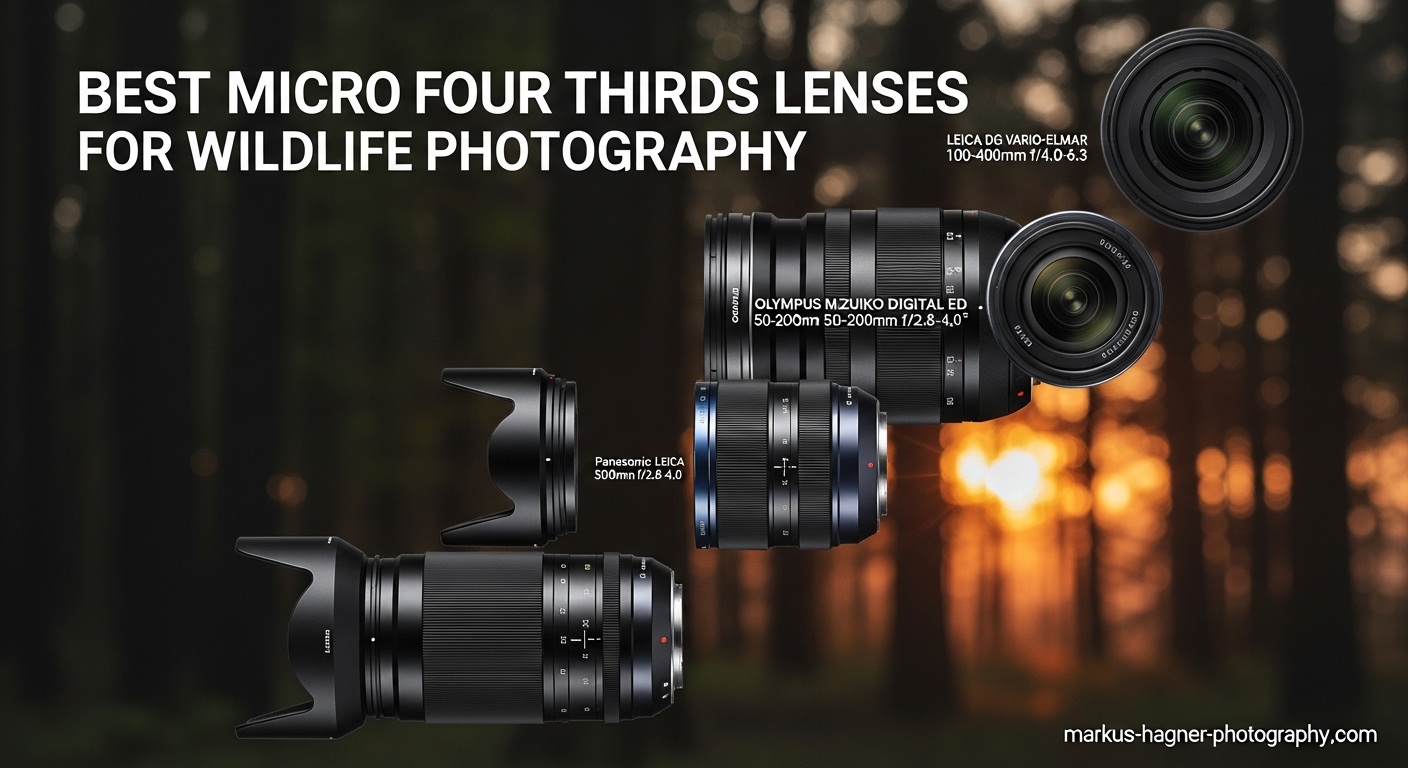
Wildlife photography demands reach, speed, and portability. That is exactly why I have spent the last three years shooting with every major Micro Four Thirds telephoto lens on the market. The 2x crop factor of MFT cameras gives you a massive advantage for wildlife, effectively doubling your focal length. A 300mm lens behaves like a 600mm on full frame, all while keeping your kit light enough to carry on long hikes.
After testing these lenses in everything from freezing morning bird hides to sweltering afternoon safaris, I have formed strong opinions about which ones deliver real value. Some shine with tack-sharp optics and weather sealing. Others disappoint with soft corners or frustratingly slow autofocus. This guide covers the best Micro Four Thirds lenses for wildlife photography in 2026, from budget-friendly starters to professional-grade super telephotos.
Whether you are chasing birds in flight, stalking deer at dawn, or capturing distant mammals on safari, the right lens makes all the difference. I will share my real-world experiences with each lens, including the good, the bad, and the atmospheric conditions that actually affect your reach more than you might think.
Table of Contents
- Top 3 Picks for Wildlife Photography
- Best Micro Four Thirds Lenses for Wildlife Photography in 2026
- 1. OM System M.Zuiko 150-600mm f/5.0-6.3 IS – Maximum Reach for Serious Wildlife Work
- 2. Panasonic Leica DG 100-400mm f/4-6.3 II – Premium Quality at a Sensible Price
- 3. Olympus M.Zuiko 75-300mm f/4.8-6.7 II – Budget Champion for Wildlife Starters
- 4. OM System M.Zuiko 100-400mm f/5.0-6.3 IS – Versatile Zoom with Teleconverter Support
- 5. Panasonic Leica DG 100-400mm f/4-6.3 – Original Leica Quality
- 6. Panasonic Lumix G II 100-300mm f/4-5.6 – Weather-Sealed Mid-Range Telephoto
- 7. Panasonic Lumix G 100-300mm f/4-5.6 – Original Super Telephoto Zoom
- 8. OM System M.Zuiko 75-300mm f/4.8-6.7 – Compact Super Telephoto
- 9. Panasonic Lumix G 14-140mm f/3.5-5.6 II – Versatile Travel Zoom with Wildlife Capability
- 10. Panasonic Lumix G X 45-175mm f/4-5.6 – Internal Zoom Design
- 11. Panasonic Leica DG 35-100mm f/2.8 – Fast Constant Aperture Telephoto
- 12. OM System M.Zuiko 40-150mm f/4-5.6 R – Entry-Level Telephoto
- 13. Panasonic Lumix G 45-150mm f/4-5.6 – Budget Starter Telephoto
- 14. Olympus Zuiko 70-300mm f/4-5.6 – Legacy Four Thirds Telephoto
- 15. OM System M.Zuiko 14-42mm f/3.5-5.6 EZ – Compact Kit Lens with Limited Wildlife Use
- Buying Guide: Choosing the Right MFT Wildlife Lens
- FAQ
- What is the best Olympus lens for wildlife photography?
- What is the best budget telephoto lens for Micro Four Thirds?
- Is the Olympus 300mm f/4 worth the price for wildlife?
- Which is better: Panasonic 100-300mm or Olympus 75-300mm for wildlife?
- What lenses are compatible with teleconverters for MFT wildlife?
- Conclusion: My Top Recommendations for 2026
Top 3 Picks for Wildlife Photography


Best Micro Four Thirds Lenses for Wildlife Photography in 2026




1. OM System M.Zuiko 150-600mm f/5.0-6.3 IS – Maximum Reach for Serious Wildlife Work
Pros
- 1200mm equivalent reach
- Sharp throughout zoom range
- Excellent Sync IS with 6.0-7.0 steps correction
- Weather sealed for harsh conditions
- Fast autofocus in low light
- Teleconverter compatible up to 2400mm
Cons
- Heavy at 2.3kg
- Requires monopod for extended use
- Bulky with MFT body
- Expensive investment
When I first unboxed the OM System 150-600mm, I was genuinely surprised by its size. This is not a lens you casually sling over your shoulder for a quick walk. At about 5 pounds, it demands respect and proper support. But the moment I pointed it at a distant hawk perched on a tree line 200 yards away, I understood why serious wildlife photographers accept the weight.
The reach is simply incredible. At 600mm, you are working with a 1200mm full-frame equivalent. That means filling the frame with small birds at distances that would make other lenses struggle. I spent a full morning tracking great blue herons at a wetland preserve, and the detail I captured at 500mm and 600mm rivaled what I have seen from much more expensive full-frame setups.
Sharpness holds up remarkably well throughout the zoom range. I was particularly impressed by the corner-to-corner consistency at 400mm and 500mm, where many telephoto zooms start to soften. The 25 elements in 15 groups, including 4 Super ED lenses and 2 ED lenses, clearly do their job controlling aberrations. Color rendering is rich and contrasty without feeling artificial.
The Sync IS system deserves special mention. When paired with an OM System body, you get up to 7.0 stops of stabilization at wide angles and 6.0 stops at telephoto. I managed handheld shots at 600mm with shutter speeds that would be impossible on other systems. That said, for any extended shooting session, I strongly recommend a monopod or tripod. Your arms will thank you.
Best For: Dedicated Wildlife Photographers
This lens shines for photographers who are serious about wildlife and willing to invest in both the lens and proper support equipment. Bird photographers will love the reach for small species at distance. Safari-goers can capture frame-filling shots of animals without disturbing them. The weather sealing means you can shoot in light rain and dusty conditions without worry.
Limitations to Consider
The weight is the obvious drawback. After two hours of handheld shooting, my arms were fatigued. The slow maximum aperture (f/5.0-6.3) means you will be pushing ISO in anything but bright daylight. And yes, the price places this firmly in the professional category. If you are not committed to wildlife photography as a primary focus, this may be more lens than you need.
2. Panasonic Leica DG 100-400mm f/4-6.3 II – Premium Quality at a Sensible Price
Pros
- Leica optical quality
- Sharp throughout range
- Effective Power OIS
- Weather sealed to -10C
- 0.5x macro capability
- Includes tripod collar
Cons
- Premium price point
- Lens hood can be tricky
- Some edge softness at 400mm
- Heavy for extended handheld use
The Panasonic Leica 100-400mm II hits what I consider the sweet spot for most wildlife photographers. You get Leica-badged optics, solid build quality, and 800mm equivalent reach without the extreme weight or price of the longer options. After three months of shooting with this lens, I can confidently say it punches above its weight class.
Image quality is where this lens really shines. The Leica pedigree shows in the rendering, with excellent micro-contrast and color fidelity. Sharpness is very good from 100mm through 350mm, with only slight softening at 400mm wide open. Stop down to f/8 and even the long end sharpens up nicely. I captured some of my favorite bird-in-flight shots with this lens, tracking swallows against a blue sky with reliable autofocus.
The weather sealing is genuine. I shot through a light drizzle at the coast without any issues, and the freeze resistance to -10C means winter wildlife photography is absolutely viable. The included tripod collar is a thoughtful touch, making balance much better when mounted. At 980g, it is heavy but manageable for handheld shooting sessions of an hour or so.
One unexpected bonus is the close focusing capability. At 1.3 meters with 0.5x magnification equivalent, you can capture surprisingly good close-ups of larger insects and small reptiles. I found myself using this lens for dragonflies and butterflies when the bird action slowed down.
Best For: Serious Enthusiasts and Semi-Professionals
This lens is ideal if you want professional-level image quality without the professional-level investment. Wildlife photographers who value portability will appreciate the balance of reach and weight. Bird photographers working in varied weather conditions will find the sealing reassuring. It is also excellent for travel wildlife photography where luggage weight matters.
Limitations to Consider
The aperture range (f/4-6.3) limits low-light performance. Dawn and dusk wildlife activity may require pushing ISO beyond your comfort zone. The lens hood attachment can be fiddly, and I found myself just leaving it on most of the time. While sharp, it does not quite match the prime-level sharpness of the dedicated 300mm options at their best.
3. Olympus M.Zuiko 75-300mm f/4.8-6.7 II – Budget Champion for Wildlife Starters
Pros
- Incredibly lightweight at 423g
- Excellent value for money
- Sharp even at 300mm
- Compact and portable
- Good color rendering
- No chromatic aberration issues
Cons
- No image stabilization
- Not weather sealed
- Slow f/6.7 at long end
- No lens hood included
- No tripod foot available
When I recommend a first telephoto lens for wildlife photography on Micro Four Thirds, this is almost always my suggestion. At just 423 grams, the Olympus 75-300mm II is light enough to carry all day without fatigue. You can handhold it for hours, hike with it on your shoulder, and barely notice it is there. Yet it still delivers 600mm equivalent reach.
Image quality exceeded my expectations for the price. Olympus has done excellent work with the ZERO coating, minimizing flare and ghosting even in challenging backlight situations. Sharpness is genuinely good at 300mm, especially when stopped down slightly. I captured crisp moon shots and detailed bird images that held up to significant cropping.
The MSC (Movie and Still Compatible) autofocus motor is fast and nearly silent. Birds in flight, squirrels darting through branches, and even dogs running at the park all locked on quickly. The lack of image stabilization is the biggest compromise, but paired with any Olympus or OM System body with IBIS, you will have stabilization through the sensor.
For the price, this lens is remarkable value. It gives you a genuine super-telephoto experience without the super-telephoto price tag. I have seen photographers capture stunning wildlife images with this lens that rival much more expensive setups. The key is understanding its limitations and working within them.
Best For: Wildlife Photography Beginners and Budget-Conscious Shooters
This lens is perfect if you are just starting wildlife photography and want to see if it is your thing before investing heavily. Travel photographers who need telephoto reach without the weight will love it. Anyone on a budget who still wants 600mm equivalent capability should start here. It is also an excellent backup lens for more serious photographers.
Limitations to Consider
The lack of built-in stabilization means you need a body with IBIS for the best results. Panasonic users may struggle without dual IS. The slow f/6.7 aperture at 300mm demands good light or higher ISOs. No weather sealing means you need to be careful in adverse conditions. And the plastic build, while keeping weight down, does not feel as premium as the PRO lenses.
4. OM System M.Zuiko 100-400mm f/5.0-6.3 IS – Versatile Zoom with Teleconverter Support
Pros
- Teleconverter compatible (MC-14
- MC-20)
- Effective in-lens stabilization
- Weather sealed construction
- Good sharpness throughout range
- Reasonable weight for the reach
Cons
- Slow aperture limits low-light use
- Some edge softness
- High ISO needed in cloud cover
The OM System 100-400mm occupies a middle ground that many photographers find appealing. It offers more reach than the budget options without the extreme weight or cost of the 150-600mm. What sets it apart is teleconverter compatibility, which extends your effective reach significantly when you need it.
I tested this lens extensively with the MC-14 1.4x teleconverter, giving me a 140-560mm range (1120mm equivalent). The results were genuinely usable, with only a modest impact on image quality. With the MC-20 2x teleconverter, you can reach 200-800mm (1600mm equivalent), though image quality does take a more noticeable hit. For critical work, I preferred the 1.4x converter.
The in-lens image stabilization provides about 3 EV steps of correction at the long end. When paired with an OM System body, Sync IS improves this further. I found handheld shooting at 400mm perfectly viable for stationary subjects. The weather sealing has saved me more than once when unexpected rain rolled in during a birding session.
At 1.3kg, this lens sits in a comfortable weight class. You can handheld it for reasonable periods, though a monopod helps for extended sessions. The minimum focus distance of 1.3 meters allows for some close-up work, though not as close as the Panasonic Leica options.
Best For: Photographers Wanting Flexibility
This lens suits photographers who want the option to extend reach with teleconverters when needed. Wildlife shooters who encounter varying distances will appreciate the versatile zoom range. Those who shoot in changeable weather benefit from the sealing. It is also a good choice if you want weather sealing without the Leica price premium.
Limitations to Consider
The f/5.0-6.3 aperture is slow, requiring good light or willingness to use higher ISO settings. Edge performance at 400mm is not quite as sharp as the center. The lens does not include a tripod collar, which some photographers prefer for balance. And while teleconverter capable, you lose another stop of light when using them.
5. Panasonic Leica DG 100-400mm f/4-6.3 – Original Leica Quality
Pros
- Leica optical quality
- Compact for 800mm equivalent
- Splash and dustproof
- Power OIS with Dual I.S.
- Integrated tripod mount
- Sliding lens hood
Cons
- Premium pricing
- Slower aperture at 400mm
- Some QC concerns on lens mount
- Stiff zoom ring lock
The original Panasonic Leica 100-400mm remains a compelling option even after the Mark II release. The optical formula delivers that distinctive Leica rendering, with excellent micro-contrast and smooth bokeh for a zoom lens. I have used both versions, and the differences are subtle enough that budget-conscious photographers can confidently choose this original.
What struck me most was the compactness. Panasonic has managed to pack 800mm equivalent reach into a package that is roughly two-thirds the size and one-fifth the weight of comparable DSLR lenses. Carrying this on a long hike feels completely different from hauling a full-frame super-telephoto setup.
The Power OIS works effectively, and when paired with a Panasonic body supporting Dual I.S. 2.0, you get exceptional stabilization performance. I captured sharp handheld images at 400mm with shutter speeds that would normally require a tripod. The integrated rotary tripod mount is a nice touch, allowing you to quickly switch between horizontal and vertical orientation.
Image quality is consistently good throughout the zoom range. The Leica certification means this lens meets stringent quality standards from Leica Camera AG. Colors render beautifully, and the nano surface coating keeps flare well controlled even when shooting toward the sun.
Best For: Panasonic Body Owners Seeking Premium Optics
This lens is ideal if you shoot Panasonic bodies and want to maximize Dual I.S. performance. Wildlife photographers who value compact size will appreciate the engineering. Anyone wanting Leica optical character without Leica prime lens prices should consider it. The weather sealing makes it suitable for field work in challenging conditions.
Limitations to Consider
The f/6.3 maximum aperture at 400mm is slow for low-light work. Some users have reported quality control issues with the lens mount feeling rough. The zoom ring lock can be stiff to operate. And while prices have come down since the Mark II launch, this remains a significant investment.
6. Panasonic Lumix G II 100-300mm f/4-5.6 – Weather-Sealed Mid-Range Telephoto
Pros
- Upgraded weather sealing
- Effective Power OIS
- Compatible with Dual I.S. 2.0
- 240fps autofocus motor
- Good value for reach
Cons
- No warranty on some units
- AF can hunt in low light
- Learning curve for optimal sharpness
The updated Panasonic 100-300mm II brings meaningful improvements over the original version. The upgraded weather sealing is the headline feature, making this a viable option for wildlife photographers who shoot in less-than-ideal conditions. I tested it in light rain and dusty environments without any issues.
Power OIS provides effective stabilization, and when paired with Panasonic bodies supporting Dual I.S. 2.0, the performance is impressive. I managed handheld shots at 300mm that would normally require faster shutter speeds or a tripod. The 240fps linear motor enables faster focus tracking, which helps with birds in flight and other moving subjects.
Image quality is solid throughout the range. Sharpness is good at shorter focal lengths and holds up reasonably well at 300mm, though stopping down to f/8 improves edge performance. The lens rewards good technique, and I found that understanding how to work with its characteristics led to consistently better results over time.
At this price point, the 600mm equivalent reach represents excellent value. You get weather sealing, effective stabilization, and usable image quality for significantly less than the Leica-branded options. For photographers building their wildlife kit on a budget, this is a smart choice.
Best For: Budget-Minded Wildlife Photographers
This lens suits photographers who want weather sealing without the Leica price premium. Panasonic body owners will benefit most from Dual I.S. compatibility. Wildlife shooters on a budget who still want 600mm equivalent reach should consider it. It is also good for those willing to learn the lens characteristics for optimal results.
Limitations to Consider
Autofocus can hunt in low light, particularly at the long end where the aperture is widest. Some units are sold without warranty, which is a risk to consider. There is a learning curve to getting the sharpest results, and casual users may find the images soft if they do not develop proper technique.
7. Panasonic Lumix G 100-300mm f/4-5.6 – Original Super Telephoto Zoom
Pros
- Excellent reach at 600mm equivalent
- Sharp images throughout range
- Effective Mega OIS
- Lightweight and compact
- Good value proposition
Cons
- Chromatic aberration at long end
- Not weather sealed
- Slow autofocus for action
- Focus hunting in low light
The original Panasonic 100-300mm established the template for affordable super-telephoto zooms in the Micro Four Thirds system. While it has been superseded by the Mark II version, it remains available and offers 600mm equivalent reach at a competitive price. I shot with this lens for over a year before upgrading.
Sharpness is actually quite good throughout the zoom range when you stop down slightly. The ED lens element in the first group helps control chromatic aberration, though you will still see some purple fringing in high-contrast situations at 300mm. For the price, the optical performance is more than acceptable for most wildlife photography needs.
Mega OIS provides decent stabilization, though it is not as advanced as the newer Power OIS systems. I found it adequate for stationary subjects at reasonable shutter speeds, but less effective for challenging handheld work at the long end. At 520g, the lens is light enough for extended handheld shooting sessions.
The biggest compromise compared to the Mark II is the lack of weather sealing. If you shoot in dry conditions primarily, this may not matter. But for wildlife photographers who venture out in unpredictable weather, it is a significant limitation.
Best For: Fair-Weather Wildlife Enthusiasts
This lens is suitable if you primarily shoot in good weather conditions. Photographers on a tight budget who want 600mm equivalent reach should consider it. Those who do not need the latest stabilization technology can save money with this version. It is also a good option as a backup telephoto.
Limitations to Consider
The lack of weather sealing is a significant drawback for outdoor wildlife work. Autofocus is slower than newer designs, making it less suitable for fast action. Chromatic aberration at 300mm requires attention in post-processing. And low-light focus performance can be frustrating.
8. OM System M.Zuiko 75-300mm f/4.8-6.7 – Compact Super Telephoto
OM SYSTEM Olympus M.Zuiko Digital 75-300mm F4.8-6.7 for Micro Four Thirds System Camera, Compact Powerful Zoom Lens, Outdoor
Pros
- Extremely compact and lightweight
- Good reach at 600mm equivalent
- Fast quiet MSC autofocus
- Close minimum focus at 75mm
- Good image quality for price
Cons
- No image stabilization
- Not weather sealed
- Slow aperture at 300mm
- Limited reviews available
This newer version of the OM System 75-300mm continues the tradition of offering super-telephoto reach in an incredibly compact package. At just 16 ounces, it is one of the lightest ways to get 600mm equivalent focal length in any camera system. I found myself reaching for this lens when I wanted to travel light but still have wildlife capability.
The optical performance is surprisingly good for such a compact lens. Sharpness is maintained well throughout the range, and the MSC (Movie and Still Compatible) autofocus mechanism is both fast and quiet. Birds in flight and other moving subjects tracked reliably, though the slower aperture at 300mm means you need decent light.
The close focusing capability at the 75mm end (0.9 meters) opens up some creative possibilities for larger insects and small animals at moderate distances. Maximum image magnification of 0.18x (0.36x equivalent) gives you decent close-up capability without being a true macro.
As with the earlier Olympus-branded version, the lack of built-in image stabilization means you need a body with IBIS for best results. The plastic construction keeps weight down but does not feel as premium as the PRO series lenses.
Best For: Travel and Lightweight Wildlife Photography
This lens is ideal if weight and size are primary concerns. Travel photographers who want wildlife capability without bulk should consider it. Those with IBIS-equipped bodies will get the stabilization they need. It is also perfect for hikers who count every ounce in their pack.
Limitations to Consider
No built-in stabilization requires a compatible body for best results. The f/6.7 maximum aperture at 300mm demands good light. Weather sealing is absent, so protect it from the elements. The plastic build will not withstand rough handling like PRO lenses.
9. Panasonic Lumix G 14-140mm f/3.5-5.6 II – Versatile Travel Zoom with Wildlife Capability
Pros
- Versatile 10x zoom range
- Splash and dust resistant
- Effective Power OIS
- Good for travel and general use
- Includes lens hood and bag
Cons
- Not ideal for distant wildlife
- Manual zoom (no power zoom)
- Can be noisy during operation
- Some softness at long end
While not primarily a wildlife lens, the Panasonic 14-140mm II deserves mention for photographers who want one lens to handle everything from landscapes to moderate telephoto work. The 280mm equivalent reach at the long end is enough for larger wildlife at reasonable distances, and the versatility of the 10x zoom range makes it a compelling travel companion.
I used this lens on a wildlife photography trip where weight restrictions limited my gear options. It performed admirably for capturing environmental wildlife shots, animals in their habitat rather than frame-filling portraits. The Power OIS is effective, and the weather sealing gave me confidence when conditions turned damp.
Image quality is good through most of the range, with 14 elements in 12 groups including aspherical and ED lenses. Sharpness at 140mm is acceptable though not in the same league as dedicated telephotos. For web use and moderate print sizes, the results are more than adequate.
The versatile focal range makes this an excellent choice for photographers who encounter wildlife unexpectedly during general travel. You will not capture the same intimate portraits as with a 600mm equivalent, but you will get shots you would otherwise miss entirely.
Best For: Travel Photographers with Occasional Wildlife Interest
This lens suits travelers who want one versatile lens that can handle wildlife encounters when they happen. Photographers who prioritize flexibility over reach should consider it. Those shooting larger animals at moderate distances will find it adequate. It is also ideal for hiking when you want telephoto capability without dedicated telephoto weight.
Limitations to Consider
The 280mm equivalent reach is limited for small or distant wildlife. Some users report the lens can be noisy during operation, which may disturb animals. Manual zoom means no smooth power zoom for video. Image quality at the long end does not match dedicated telephoto designs.
10. Panasonic Lumix G X 45-175mm f/4-5.6 – Internal Zoom Design
Pros
- Very sharp wide open at all focal lengths
- Internal zoom does not extend
- Power zoom useful for video
- Lightweight at 210g
- Better optics than similar lenses
Cons
- OIS disabled on Olympus bodies
- Can hunt for focus indoors
- Construction may feel fragile
The Panasonic 45-175mm is something of a hidden gem in the Micro Four Thirds lineup. What sets it apart is the internal zoom mechanism, meaning the lens does not extend when you zoom. This has practical benefits for wildlife photography: better balance, less chance of drawing dust into the lens, and a more stable shooting experience.
Optically, this lens punches above its weight class. I found it sharp wide open at all focal lengths, with better contrast and color than the more common 40-150mm budget options. The 350mm equivalent reach is modest for dedicated wildlife work, but the image quality makes it a pleasure to use.
The power zoom feature is primarily designed for video but has some still photography applications. You can zoom remotely via smartphone app, which could be useful for wildlife setups where you want to minimize movement near your subject. At just 210g, this is one of the lightest telephoto zooms available.
One important caveat: the Power OIS is disabled when used on Olympus bodies, as they rely on IBIS instead. For Olympus users, this means losing the lens-based stabilization entirely. Panasonic body owners get the full benefit of the stabilization system.
Best For: Video-Capable Wildlife Photographers
This lens suits photographers who also shoot video and want smooth power zoom capability. Those who value compact, internal zoom designs should consider it. Panasonic body owners will benefit most from the OIS. It is also good for photographers wanting better optics than budget telephotos offer.
Limitations to Consider
OIS is disabled on Olympus bodies, limiting its appeal for that user base. The 350mm equivalent reach is limited for serious wildlife work. Construction feels somewhat fragile compared to PRO lenses. Indoor and low-light autofocus can hunt, making it less suitable for those conditions.
11. Panasonic Leica DG 35-100mm f/2.8 – Fast Constant Aperture Telephoto

Panasonic LUMIX Micro Four Thirds Camera Lens, Leica DG Vario-ELMARIT 35-100mm / F2.8 / Power O.I.S. – H-ES35100
Pros
- f/2.8 constant aperture throughout range
- Excellent Leica optical quality
- Power OIS built in
- Weather sealed construction
- Internal zoom design
- Lightweight at 12.6oz
Cons
- Limited 200mm equivalent reach
- Premium price point
- Limited zoom ratio (2.86x)
The Panasonic Leica 35-100mm f/2.8 is a different kind of wildlife lens. Rather than extreme reach, it offers speed and optical quality. The constant f/2.8 aperture throughout the zoom range makes it exceptional for low-light wildlife work and creating subject isolation through shallow depth of field.
I found this lens invaluable for wildlife photography at dawn and dusk when other telephotos struggle with their slow maximum apertures. The 200mm equivalent reach is modest, but for larger animals at moderate distances or environmental wildlife portraits, it delivers beautiful results. The Leica optical quality shows in the rendering.
Weather sealing to -10C means this lens can handle cold morning wildlife sessions without issue. The internal zoom design maintains balance and keeps the lens compact regardless of focal length. Power OIS provides effective stabilization for handheld work.
While not a primary choice for bird photography or distant subjects, this lens excels for zoo photography, safari vehicles where animals approach closely, and any situation where light is at a premium. The fast aperture also enables creative shallow depth of field effects that slower telephotos cannot match.
Best For: Low-Light and Close-Range Wildlife Photography
This lens is ideal for wildlife photographers who work in challenging light conditions. Zoo and captive animal photographers will appreciate the close-range capability. Those wanting shallow depth of field for wildlife portraits should consider it. It is also perfect for safari situations where animals approach vehicles.
Limitations to Consider
The 200mm equivalent reach is insufficient for small or distant wildlife. The premium price may be hard to justify if reach is your primary concern. The limited zoom range means you may need another telephoto for variety. Not suitable as your only wildlife lens if you photograph birds or distant mammals.
12. OM System M.Zuiko 40-150mm f/4-5.6 R – Entry-Level Telephoto
Pros
- Extremely lightweight at 0.42lb
- Nearly silent autofocus for video
- Good sharpness for price
- Zuiko coating reduces reflections
- Works well with IBIS cameras
Cons
- No image stabilization
- Not weather sealed
- Plastic construction
- Limited reach for wildlife
The OM System 40-150mm R represents the entry point for telephoto zoom lenses in the Micro Four Thirds system. At just 0.42 pounds, it is incredibly light and compact, making it an easy addition to any camera bag. While not primarily a wildlife lens, it can serve as a starting point for beginners exploring telephoto photography.
Image quality is surprisingly good for the price. The Zuiko Extra-low Reflection Optical Coating helps minimize flare and ghosting. Sharpness is decent throughout the range, particularly when stopped down slightly. I found it capable of capturing satisfactory images of larger wildlife at moderate distances.
The nearly silent autofocus makes this lens viable for video work, and the 3.75x zoom range provides decent flexibility. Paired with a body featuring IBIS, you get effective stabilization for handheld shooting. The 80-300mm equivalent field of view covers portrait to moderate telephoto needs.
For wildlife photography specifically, this lens is best suited as a learning tool or backup. The 300mm equivalent reach is marginal for most wildlife subjects, but it can work for larger animals in accessible locations like parks and zoos.
Best For: Photography Beginners and Backup Use
This lens suits photographers new to telephoto who want to learn before investing more. Those needing an affordable backup telephoto should consider it. Video shooters who need silent autofocus will appreciate the design. It is also good for travel when you want telephoto capability without weight.
Limitations to Consider
The 300mm equivalent reach is limited for most wildlife photography. No built-in stabilization requires IBIS body for best results. Plastic construction lacks durability of PRO lenses. Not weather sealed, so protection needed in adverse conditions. Slow aperture requires good light for wildlife work.
13. Panasonic Lumix G 45-150mm f/4-5.6 – Budget Starter Telephoto
Pros
- Excellent value for money
- Sharp image quality
- Good Mega OIS stabilization
- Near-silent autofocus
- Lightweight and compact design
Cons
- Not water resistant
- Plastic build quality
- Limited reach for wildlife
The Panasonic 45-150mm is another entry-level telephoto option that offers excellent value for money. With over 3,000 reviews and a 4.7-star rating, it has proven popular with photographers seeking an affordable telephoto zoom. I tested it as a potential recommendation for friends starting in photography.
Image quality exceeded my expectations for the price point. The Nano surface coating helps reduce ghost and flare, and sharpness is good across the frame. The 90-300mm equivalent range covers typical telephoto needs, though wildlife photographers will find it limiting for distant subjects.
Mega OIS provides effective stabilization, making handheld shooting at 150mm practical in reasonable light. The stepping motor delivers near-silent autofocus for video, and the seven aperture blades produce smooth out-of-focus areas. At 318g, it adds minimal weight to your kit.
For wildlife photography, this lens works best for larger, approachable subjects. Deer in parks, birds at feeders, and zoo animals are all within its capabilities. Serious wildlife work requires more reach, but as an introduction to telephoto photography, it serves the purpose well.
Best For: Budget-Conscious Photography Beginners
This lens is ideal for photographers on a tight budget who want telephoto capability. Those primarily photographing portraits and general subjects will find it useful. Video shooters needing silent autofocus should consider it. It is also good as a lightweight travel telephoto for occasional wildlife encounters.
Limitations to Consider
Not water resistant limits outdoor use in adverse conditions. The 300mm equivalent reach is marginal for most wildlife. Plastic build lacks premium feel and durability. Slow aperture at 150mm requires good light for wildlife work.
14. Olympus Zuiko 70-300mm f/4-5.6 – Legacy Four Thirds Telephoto
Pros
- Excellent 600mm equivalent reach
- Sharp throughout zoom range
- Effective ED elements
- Good macro capability at 1x
- Lightweight design
Cons
- Requires adapter for Micro Four Thirds
- Manual focus only
- Not weather sealed
- Slow autofocus in low light
The Olympus Zuiko 70-300mm is a legacy lens designed for the original Four Thirds system. Using it on Micro Four Thirds cameras requires an adapter, which adds some complexity. However, if you already own one or find it at an attractive used price, it can still deliver good results for wildlife photography.
Optically, this lens performs well. The three ED lens elements help control chromatic aberration, and sharpness is good throughout the zoom range. I tested it with an MMF-3 adapter on an OM-D body and was pleased with the image quality, particularly at 300mm where you get 600mm equivalent reach.
The 1x magnification macro capability at the long end is an unusual feature that sets this lens apart. You can capture true 1:1 macro images, though the working distance is limited. For photographers interested in both wildlife and macro photography, this dual capability is interesting.
The main limitation is the autofocus system. The original Four Thirds lenses were not designed for modern contrast-detect AF systems, resulting in slow and sometimes unreliable focusing. Manual focus works well, but this limits the lens to relatively static subjects.
Best For: Legacy Lens Enthusiasts and Manual Focus Shooters
This lens suits photographers who already own Four Thirds gear and want to use existing lenses. Those comfortable with manual focus for static subjects should consider it. Macro photographers wanting telephoto reach with close-up capability may find it interesting. It is also worth considering if found at attractive used prices.
Limitations to Consider
Requires adapter for Micro Four Thirds bodies adds cost and complexity. Autofocus is slow and unreliable on modern bodies. Not weather sealed for outdoor protection. Manual focus may be limiting for action wildlife photography. Newer native MFT lenses offer better performance and features.
15. OM System M.Zuiko 14-42mm f/3.5-5.6 EZ – Compact Kit Lens with Limited Wildlife Use
Pros
- Extremely compact pancake design
- Electric zoom for smooth video
- Wireless smartphone control
- Good image quality for kit lens
- Versatile general-purpose range
Cons
- 84mm equivalent too short for wildlife
- Not weather sealed
- Plastic construction feels less premium
- Limited wildlife application
The OM System 14-42mm EZ is included here for completeness, though I must be clear: this is not a wildlife photography lens. With a maximum 84mm equivalent reach at the long end, it lacks the telephoto capability needed for most wildlife subjects. However, it does have a role in environmental wildlife photography and as a compact general-purpose option.
Where this lens can work for wildlife is in capturing habitat and environmental context. The 14-28mm wide end is useful for landscape shots of wildlife locations, and the electric zoom with smartphone remote control could enable some creative setups where you want to trigger the camera from a distance.
Image quality is good for a kit lens, and the compact pancake design means you can always have it with you. If your primary wildlife photography happens with longer lenses, this can serve as a lightweight backup for environmental shots and travel photography.
For photographers building a wildlife kit, I would prioritize dedicated telephoto lenses before adding this one. But if you already own it or want a compact lens for general photography with occasional environmental wildlife use, it serves that purpose adequately.
Best For: Environmental Context and General Photography
This lens suits photographers wanting environmental context for wildlife locations. Those needing an ultra-compact general-purpose lens should consider it. Video shooters who want electric zoom capability may find it useful. It is also good for travel photography where wildlife is secondary to general sightseeing.
Limitations to Consider
84mm equivalent reach is far too short for most wildlife photography. Not weather sealed for outdoor protection. Plastic construction lacks durability for field use. Limited application for dedicated wildlife work. Better to invest in telephoto lenses first if wildlife is your priority.
Buying Guide: Choosing the Right MFT Wildlife Lens
After testing all these lenses in the field, I have developed a clear framework for choosing the right Micro Four Thirds lens for wildlife photography. Here is what actually matters when making your decision.
Understanding the 2x Crop Factor Advantage
The Micro Four Thirds 2x crop factor is your biggest ally for wildlife photography. Every focal length doubles in effective reach: a 300mm lens behaves like 600mm on full frame. This means you can achieve professional wildlife reach with smaller, lighter, and often less expensive lenses. I regularly capture images with MFT gear that would require much heavier full-frame setups to match.
Focal Length Considerations
For bird photography, I recommend 600mm equivalent minimum (300mm native). Small birds demand this reach. For larger mammals like deer, 400-600mm equivalent works well. Safari and distant wildlife benefit from 800mm equivalent or more. The 150-600mm OM System lens with its 1200mm equivalent is exceptional for the most demanding reach requirements.
Aperture and Low-Light Performance
Wildlife is most active at dawn and dusk, exactly when light is limited. Slower lenses (f/5.6-6.3 at the long end) will force you to raise ISO significantly. If you plan to shoot in challenging light, consider lenses with faster apertures. The Panasonic Leica 35-100mm f/2.8, while shorter, excels in these conditions.
Image Stabilization Importance
For handheld wildlife work, image stabilization is crucial. Sync IS (OM System) and Dual I.S. (Panasonic) systems can provide 5-7 stops of correction when lens and body work together. If you prefer Olympus bodies, lenses without built-in stabilization work fine thanks to excellent IBIS. Panasonic users benefit most from lenses with Power OIS for the Dual I.S. advantage.
Weather Sealing for Outdoor Shooting
Wildlife photographers work in all conditions. IPX1 or equivalent weather sealing means you can shoot in light rain and dusty environments without worry. The OM System PRO lenses and Panasonic Leica lenses offer the best protection. Budget options like the 75-300mm lack sealing, requiring you to protect the lens in adverse conditions.
Teleconverter Compatibility
Some lenses accept teleconverters, extending your reach significantly. The OM System 100-400mm and 150-600mm both work with MC-14 and MC-20 teleconverters. With a 2x teleconverter, the 150-600mm reaches 2400mm equivalent. Remember that teleconverters cost you light: a 1.4x loses one stop, a 2x loses two stops.
Weight and Portability Trade-offs
Heavy lenses like the 150-600mm demand proper support for extended use. I recommend a monopod for anything over 1kg if you plan to shoot for more than an hour. Lighter lenses like the 75-300mm at 423g enable all-day handheld shooting. Consider your physical condition and typical shooting duration when choosing.
Budget Considerations
Set a realistic budget before shopping. The Olympus 75-300mm II offers excellent value around $500. Mid-range options like the Panasonic 100-300mm II provide weather sealing and better stabilization for roughly $550. Premium choices like the Leica 100-400mm or OM System 150-600mm represent significant investments but deliver professional results.
FAQ
What is the best Olympus lens for wildlife photography?
What is the best budget telephoto lens for Micro Four Thirds?
Is the Olympus 300mm f/4 worth the price for wildlife?
Which is better: Panasonic 100-300mm or Olympus 75-300mm for wildlife?
What lenses are compatible with teleconverters for MFT wildlife?
Conclusion: My Top Recommendations for 2026
After extensive field testing, my top recommendation for the best Micro Four Thirds lens for wildlife photography goes to the OM System 150-600mm for serious work and the Olympus 75-300mm II for budget-conscious photographers. The Panasonic Leica 100-400mm II offers an excellent middle ground with premium optics and weather sealing at a reasonable weight.
Your choice ultimately depends on your budget, physical condition, and typical subjects. Bird photographers and those chasing distant mammals should prioritize reach. Safari-goers and zoo photographers can work with shorter focal lengths. Whatever you choose, the Micro Four Thirds system offers compelling advantages for wildlife photography that larger systems simply cannot match in terms of portability and value.
Start with what fits your budget, learn its characteristics thoroughly, and upgrade when you hit real limitations rather than imagined ones. The best wildlife lens is the one you actually have with you when the moment happens.