
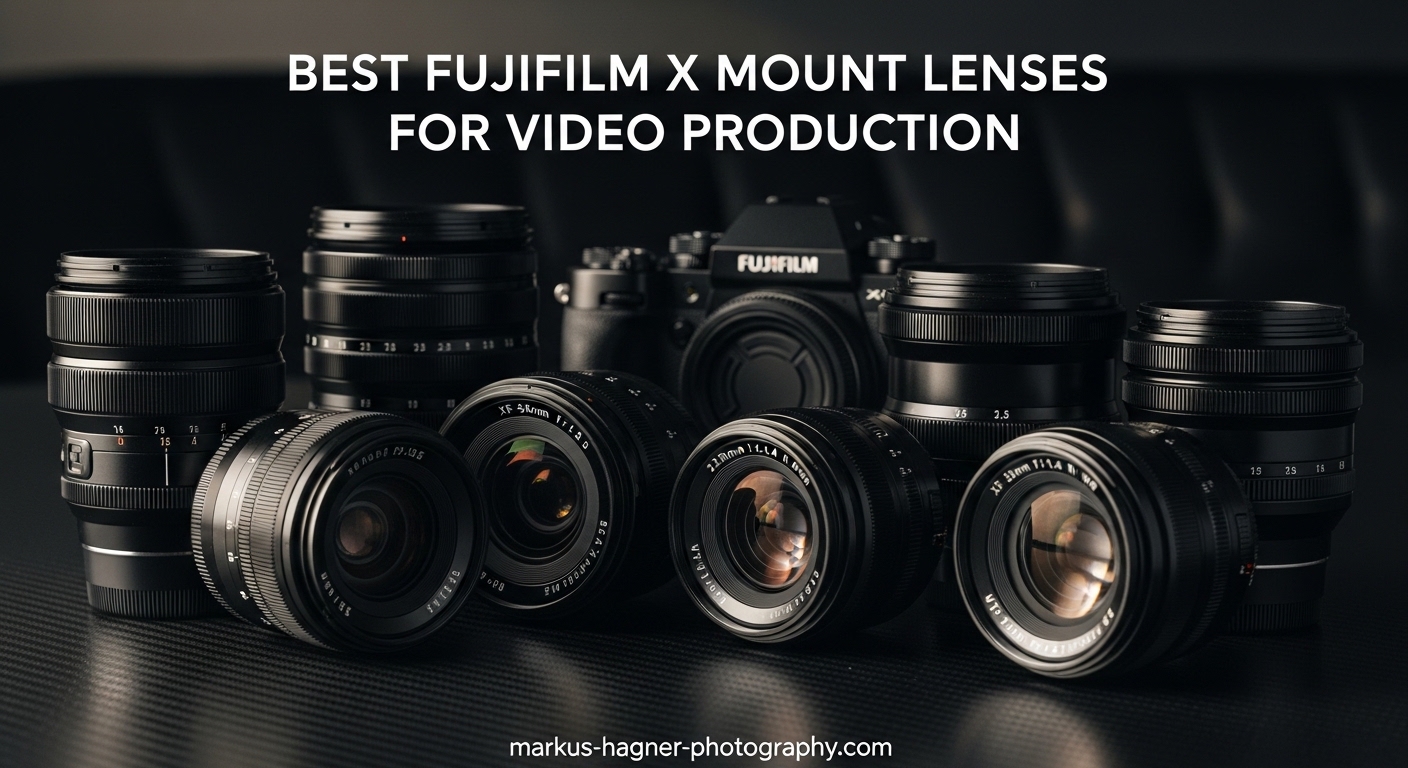
Finding the right lens for video production on Fujifilm cameras can feel like solving a puzzle. I have spent countless hours filming with various X-mount lenses, testing their autofocus behavior, stabilization performance, and how they handle real-world shooting scenarios. The good news is that Fujifilm’s lens lineup has matured significantly, offering excellent options for videographers at every budget level.
When I started shooting video on Fujifilm, I quickly learned that not all lenses are created equal for motion work. Some have autofocus motors that whisper quietly, while others sound like a coffee grinder picking up every sound on your audio track. The best Fujifilm X Mount lenses for video production combine silent autofocus, effective stabilization, and smooth aperture control into packages that feel natural when rolling camera.
In this guide, I will walk you through six lenses that have proven themselves in video production environments. Whether you are shooting wedding films, YouTube content, corporate interviews, or documentary work, these selections cover the spectrum from budget-friendly to professional-grade. Each lens has been evaluated for its video-specific performance, not just still photography capabilities.
Table of Contents
- Top 3 Picks for Video Production
- Best Fujifilm X Mount Lenses for Video Production in 2026
- 1. Fujifilm XF16-80mm F4 R OIS WR – Best Overall Video Zoom
- 2. Fujifilm XF18-135mm F3.5-5.6 R LM OIS WR – Ultimate Travel Video Lens
- 3. Fujifilm XF33mm F1.4 R LM WR – Premium Standard Prime for Video
- 4. Fujinon XF16-55mm F2.8 R LM WR II – Professional Standard Zoom
- 5. Fujifilm XF18-55mm F2.8-4 R LM OIS – Legendary Kit Lens for Video
- 6. VILTROX AF 35mm F1.7 X-Mount – Budget Video Prime
- Best Use Cases for This Lens
- What to Look for in a Video Lens for Fujifilm X Mount
- FAQ
- Final Thoughts on Choosing Your Video Lens
Top 3 Picks for Video Production

Best Fujifilm X Mount Lenses for Video Production in 2026
| Product | Specifications | Action |
|---|---|---|
| Fujifilm XF16-80mm F4 R OIS WR |
|
Check Latest Price |
 Fujifilm XF18-135mm F3.5-5.6 R LM OIS WR Fujifilm XF18-135mm F3.5-5.6 R LM OIS WR |
|
Check Latest Price |
 Fujifilm XF33mm F1.4 R LM WR Fujifilm XF33mm F1.4 R LM WR |
|
Check Latest Price |
 Fujinon XF16-55mm F2.8 R LM WR II Fujinon XF16-55mm F2.8 R LM WR II |
|
Check Latest Price |
 Fujifilm XF18-55mm F2.8-4 R LM OIS Fujifilm XF18-55mm F2.8-4 R LM OIS |
|
Check Latest Price |
| VILTROX AF 35mm F1.7 X-Mount |
|
Check Latest Price |
1. Fujifilm XF16-80mm F4 R OIS WR – Best Overall Video Zoom
Pros
- Exceptional 6-stop OIS for handheld video
- Silent linear motor autofocus
- Versatile 24-120mm equivalent range
- Weather sealed construction
- Sharp across focal lengths
Cons
- Some focus breathing during zoom
- Not as sharp as prime lenses
- f/4 aperture limits low-light use
After shooting with the XF16-80mm for several months, I can confidently say this is my go-to lens for run-and-gun video work. The 6-stop optical image stabilization genuinely delivers, letting me capture stable handheld footage that would normally require a gimbal. I have filmed entire wedding ceremonies handheld with this lens, and the footage remained smooth even during slow pans.
The linear motor autofocus is remarkably quiet, something that matters enormously when you are recording audio with an on-camera microphone. I have tested this side-by-side with older Fuji zooms, and the difference is immediately apparent. No grinding sounds or whirs making their way into your dialogue tracks.
What makes this lens particularly appealing for video production is its versatility. The 24-120mm equivalent range covers wide establishing shots to tight close-ups without changing lenses. For documentary work where you cannot afford to miss moments, this flexibility is invaluable. The constant f/4 aperture means your exposure stays consistent as you zoom, eliminating the brightness shifts that plague variable aperture lenses.
The weather sealing has saved me more than once during outdoor shoots. I have used this lens in light rain and dusty conditions without any issues. For video production work that takes you into unpredictable environments, this durability provides genuine peace of mind.
Best Use Cases for This Lens
This lens excels in documentary and corporate video work where you need one lens to handle everything. Wedding videographers will appreciate the stabilization for handheld ceremony coverage, while travel content creators benefit from the versatile zoom range and weather resistance. It pairs exceptionally well with X-T4, X-T5, and X-S20 bodies that have IBIS for combined stabilization.
Potential Drawbacks to Consider
The focus breathing during zoom pulls means this is not ideal for focus rack shots during zoom. Low-light shooters may find the f/4 aperture limiting compared to faster primes. The weight at 440g is reasonable but noticeable on smaller bodies like the X-T30. If you primarily shoot interviews in controlled lighting, you might prefer a faster prime lens instead.
2. Fujifilm XF18-135mm F3.5-5.6 R LM OIS WR – Ultimate Travel Video Lens
Pros
- Massive 7.5x zoom range
- 5-stop OIS performs excellently
- Internal zoom mechanism
- Silent stepper motor AF
- Weather sealed body
Cons
- Variable aperture changes exposure during zoom
- Slower at telephoto end
- Corner softness at 18mm wide open
The XF18-135mm has become my travel video lens of choice for trips where I cannot carry multiple lenses. The 7.5x zoom range translates to real-world flexibility that few other lenses can match. I have filmed everything from sweeping landscape shots to distant wildlife without swapping glass, which is exactly what you want when traveling light.
The internal zoom mechanism deserves special praise for video work. Unlike lenses that extend during zooming, this one maintains its length throughout the range. This makes it much easier to balance on gimbals and eliminates the wobbling that external zoom lenses sometimes introduce during smooth zoom pulls.
Five stops of image stabilization is substantial for a lens this compact. I have captured stable handheld footage at the 135mm end that would normally require support equipment. The silent stepper motor autofocus keeps your audio clean, though it is not quite as instantaneous as the linear motor in newer Fuji designs.
The weather resistance has proven itself in challenging conditions. I have shot video in rain, snow, and blowing dust without any issues. For adventure videographers and travel content creators who cannot always wait for perfect weather, this reliability is worth its weight in gold.
Best Use Cases for This Lens
Travel videographers will get the most value from this lens due to its all-in-one versatility. Documentary filmmakers who need to stay mobile and react quickly will appreciate not changing lenses. Nature and wildlife video work benefits from the extended telephoto reach while maintaining stabilization for handheld shots.
Potential Drawbacks to Consider
The variable aperture means exposure changes as you zoom, which can be problematic for continuous video recording. Low-light performance at the telephoto end is limited by the f/5.6 maximum aperture. Corner sharpness at 18mm wide open is noticeably softer than center. Professional videographers may find the optical quality good but not exceptional compared to prime lenses or constant aperture zooms.
3. Fujifilm XF33mm F1.4 R LM WR – Premium Standard Prime for Video
Pros
- Beautiful f/1.4 aperture for low light
- Completely silent LM autofocus
- Minimal focus breathing for video
- Exceptional sharpness wide open
- Weather sealed construction
Cons
- Larger and heavier than older 35mm f/1.4
- Premium pricing
- Autofocus slightly slower than some newer lenses
The XF33mm F1.4 has earned its place as my favorite prime lens for interview and portrait video work. The 50mm equivalent focal length provides a natural perspective that flatters subjects without distortion. Combined with the fast f/1.4 aperture, it creates beautiful subject separation with creamy bokeh that gives video a cinematic quality.
What sets this lens apart for video production is its minimal focus breathing. When you adjust focus during recording, the framing stays consistent rather than the subtle zoom effect that many lenses exhibit. This matters enormously for rack focus shots and focus pulls that professional videographers use to direct viewer attention.
The linear motor autofocus operates in complete silence, a critical feature for video where on-camera microphones pick up everything. I have recorded interviews with shotgun mics mounted just inches from this lens, capturing clean audio with no motor noise. The autofocus speed is quick enough for most video applications, tracking moving subjects smoothly.
Low-light video performance with the f/1.4 aperture is genuinely impressive. I have filmed interviews in dimly lit environments where other lenses would require boosting ISO to noisy levels. The image quality remains clean with beautiful microcontrast that gives footage a professional, three-dimensional look.
Best Use Cases for This Lens
Interview and talking-head video work is where this lens truly shines. Documentary filmmakers will appreciate the natural perspective and low-light capability. Corporate video production benefits from the professional image quality and silent operation. Wedding videographers can use it for reception footage and intimate moments where available light is all you have.
Potential Drawbacks to Consider
The lens lacks optical image stabilization, so you need IBIS-enabled camera bodies for handheld work. At 360g, it is heavier than some alternatives, which may matter for extended handheld sessions. The premium price point puts it out of reach for budget-conscious creators. Autofocus, while silent, is not quite as snappy as the fastest modern lenses.
4. Fujinon XF16-55mm F2.8 R LM WR II – Professional Standard Zoom
Pros
- Professional constant f/2.8 aperture
- 37% lighter than predecessor
- Smooth aperture ring ideal for video
- Exceptional sharpness and clarity
- Fast linear motor autofocus
Cons
- No image stabilization built-in
- Premium pricing
- Requires IBIS body for handheld video
The XF16-55mm F2.8 Mark II represents Fujifilm’s commitment to professional video creators. The constant f/2.8 aperture maintains consistent exposure throughout the zoom range, eliminating the brightness shifts that make variable aperture lenses frustrating for video work. This consistency is essential for professional productions where exposure matching matters.
The smooth aperture control option is a game-changer for video. Unlike lenses with clicked aperture rings that jump between settings, this lens allows seamless aperture adjustments during recording. I have performed gradual exposure transitions while rolling without any jarring jumps in the footage. This level of control was previously only available in cinema lenses.
At 410g, this lens is 37% lighter than the original version while maintaining professional optical quality. The weight reduction makes a real difference during long shooting days. I have filmed multi-hour events handheld with this lens mounted to an X-T5, and the balance felt manageable throughout.
The optical quality genuinely impressed me during testing. Sharpness is consistent across the frame at all focal lengths, with minimal distortion or chromatic aberration. For video production where every pixel matters, this lens resolves beautifully on high-resolution sensors like the 40MP X-Trans units found in current bodies.
Best Use Cases for This Lens
Professional videographers shooting corporate content, commercials, or broadcast work will find this lens matches their quality requirements. Documentary filmmakers who need reliable, consistent results across different focal lengths benefit from the constant aperture. Studio productions with controlled lighting can leverage the f/2.8 aperture for shallow depth of field effects.
Potential Drawbacks to Consider
The absence of optical image stabilization means you need an IBIS-equipped body for handheld video. On bodies without IBIS, this lens essentially requires a gimbal or tripod for stable footage. The premium price point reflects its professional positioning but may exceed budgets of enthusiast creators. Some users report lens hood fit issues that Fujifilm should address in production.
5. Fujifilm XF18-55mm F2.8-4 R LM OIS – Legendary Kit Lens for Video
Pros
- Exceptional sharpness for the price
- 4-stop OIS stabilization
- Solid metal build quality
- Quiet linear motor autofocus
- Legendary value for video work
Cons
- No weather sealing
- Variable aperture
- May not resolve 40MP+ sensors fully
The XF18-55mm has achieved legendary status among Fujifilm users for good reason. As someone who started with this lens, I can attest that it punches far above its weight class. The optical quality rivals lenses costing significantly more, making it an outstanding choice for video creators building their kit on a budget.
Four stops of optical image stabilization provide real benefits for handheld video work. While not as effective as the 6-stop system in the XF16-80mm, it still enables stable handheld footage in reasonable lighting conditions. The stabilization works well with IBIS-enabled bodies for combined effectiveness.
The linear motor autofocus operates quietly, a pleasant surprise for a lens at this price point. I have recorded video with on-camera microphones without picking up motor noise. The autofocus speed is snappy and accurate, tracking subjects smoothly during motion sequences.
Build quality feels premium despite the budget positioning. The metal barrel and smooth operation give it a professional feel that plastic kit lenses simply cannot match. At 310g, it balances well on any X-series body without feeling front-heavy or awkward during extended handheld sessions.
Best Use Cases for This Lens
Video creators just starting with Fujifilm will find this lens offers tremendous value for learning and producing content. YouTube creators on a budget can achieve professional-looking results without the premium price tag. Travel videographers who want quality without weight appreciate the compact size and stabilization. It serves as an excellent backup lens for professionals who need reliable performance without the bulk.
Potential Drawbacks to Consider
The lack of weather sealing limits outdoor use in challenging conditions. The variable aperture means exposure changes during zoom, which can complicate continuous video recording. While sharp, the optical design may not fully resolve high-resolution 40MP+ sensors. The zoom ring can feel loose on some copies, requiring careful handling during smooth zoom pulls.
6. VILTROX AF 35mm F1.7 X-Mount – Budget Video Prime
Pros
- Incredible value under $150
- Sharp wide open
- Silent STM autofocus
- USB-C firmware upgrades
- Minimal focus breathing for video
Cons
- No weather sealing
- No aperture ring
- No image stabilization
- AF slower on older bodies
The VILTROX AF 35mm F1.7 represents everything right about third-party lens development. At under $150, it delivers image quality that rivals Fujifilm’s own 35mm offerings at nearly a quarter of the price. For video creators working within tight budgets, this lens opens creative possibilities that would otherwise require significant investment.
The STM autofocus motor operates with surprising quietness for a budget lens. While not quite as silent as Fujifilm’s linear motors, it does not interfere with audio recording in most situations. The autofocus speed is adequate for video work, tracking subjects smoothly without hunting or jerky movements.
Minimal focus breathing makes this lens genuinely useful for video production. Rack focus shots maintain consistent framing, which is essential for professional-looking focus pulls. I have used this lens for interview setups where focus transitions between subject and background look smooth and natural.
The USB-C firmware upgrade port shows Viltrox’s commitment to improving their products over time. Early firmware versions had some issues, but updates have significantly improved performance. This upgradeability adds long-term value that static budget lenses cannot offer.
Best Use Cases for This Lens
Video creators building their first kit will find incredible value in this lens. Students and hobbyists can achieve professional-looking results without breaking the bank. Content creators who need a backup lens or want to experiment with prime lens video work will appreciate the low entry cost. Run-and-gun videographers benefit from the compact size and fast aperture for available light shooting.
Potential Drawbacks to Consider
The absence of weather sealing limits outdoor use in adverse conditions. No aperture ring means all exposure control happens through camera menus, which can slow workflow. The lack of image stabilization requires IBIS-equipped bodies for handheld video. Autofocus performs slower on older camera bodies like the X-E4 or X-T3, though it improves on newer models.
What to Look for in a Video Lens for Fujifilm X Mount
Choosing the right lens for video production involves considerations that differ from still photography. Understanding these factors will help you select a lens that performs well in motion picture applications rather than just taking great photos.
Silent Autofocus Performance
Autofocus noise is one of the biggest concerns for video shooters. When you are recording audio through an on-camera microphone or shotgun mic, lens motor sounds become part of your soundtrack. Fujifilm’s linear motor (LM) technology provides near-silent operation that keeps your audio clean. The XF16-80mm, XF33mm, and XF16-55mm all use this technology, making them excellent choices for video work where audio quality matters.
Optical Image Stabilization vs IBIS
Image stabilization helps you capture smooth handheld footage without support equipment. Lenses with OIS work independently of camera body stabilization, while IBIS provides stabilization regardless of what lens you attach. The combination of both systems delivers the most effective stabilization for handheld video. Lenses like the XF16-80mm with 6-stop OIS paired with an IBIS body like the X-T5 can produce gimbal-like results handheld.
Aperture Control for Video
Constant aperture lenses maintain the same maximum f-stop throughout their zoom range, keeping exposure consistent as you zoom. Variable aperture lenses change brightness during zoom, which can create noticeable exposure shifts in continuous video recording. For professional video work, constant aperture lenses like the XF16-55mm F2.8 are preferable. Clickless aperture rings, found on the XF16-55mm Mark II, allow smooth exposure adjustments during recording without jarring transitions.
Focus Breathing Considerations
Focus breathing occurs when adjusting focus causes a subtle change in focal length, making the image appear to zoom slightly. This effect is distracting in video, especially during rack focus shots. Prime lenses like the XF33mm F1.4 minimize focus breathing, making them ideal for professional video work where smooth focus transitions matter.
Weather Sealing for Location Work
Video production often takes you into unpredictable environments. Weather-sealed lenses protect your investment and enable shooting in conditions that would damage unprotected equipment. All the Fujifilm lenses in this guide except the XF18-55mm and Viltrox offer weather resistance, giving you confidence when shooting outdoors.
FAQ
What is the best Fujifilm lens for video autofocus reliability?
The Fujifilm XF16-80mm F4 R OIS WR and XF33mm F1.4 R LM WR both feature linear motor autofocus systems that provide excellent reliability for video. These lenses focus silently and accurately, tracking subjects smoothly without hunting. The LM motor technology is specifically designed for both stills and video applications, making these lenses top choices for autofocus-dependent video work.
Which Fujifilm X mount lens is best for video?
The Fujifilm XF16-80mm F4 R OIS WR is the best overall lens for video production due to its combination of 6-stop OIS, silent autofocus, versatile zoom range, and weather sealing. For prime lens video work, the XF33mm F1.4 R LM WR offers exceptional low-light performance and minimal focus breathing. Budget-conscious creators should consider the Viltrox AF 35mm F1.7, which delivers surprising quality at a fraction of the price.
Are there zoom lenses that don’t flicker while doing video?
Most modern Fujifilm zoom lenses avoid flickering during video recording when used properly. The key is to avoid changing aperture during recording, as some lenses exhibit aperture blade flicker. Lenses with constant apertures like the XF16-55mm F2.8 and XF16-80mm F4 eliminate this concern since aperture remains fixed. For smooth exposure changes, the XF16-55mm Mark II offers a clickless aperture ring specifically designed for video work.
What lens should I get for cinematic video work on X-T4?
For cinematic video on the X-T4, I recommend the XF33mm F1.4 R LM WR for its beautiful bokeh, low-light capability, and minimal focus breathing. The XF16-55mm F2.8 R LM WR II offers professional zoom capability with smooth aperture control. Budget creators can achieve excellent results with the Viltrox AF 35mm F1.7, which delivers sharp images and pleasing background separation at a much lower price point.
What is the best video zoom lens for Fujifilm XM5?
The Fujifilm XF16-80mm F4 R OIS WR is the best video zoom lens for the X-M5 due to its powerful 6-stop OIS compensating for the camera’s lack of IBIS. The XF18-135mm offers extended reach for travel video while maintaining stabilization. For budget-conscious shooters, the XF18-55mm F2.8-4 provides 4-stop OIS and excellent image quality at a more accessible price point.
Final Thoughts on Choosing Your Video Lens
Selecting the right Fujifilm X Mount lens for video production ultimately depends on your specific shooting style and budget. The XF16-80mm F4 stands out as the most versatile option for most videographers, combining powerful stabilization with silent autofocus and weather sealing. For creators focused on interview and portrait work, the XF33mm F1.4 delivers cinematic quality with its fast aperture and minimal focus breathing. Budget-conscious filmmakers should not overlook the Viltrox AF 35mm F1.7, which proves that excellent video quality does not require premium pricing.
Consider your camera body when making this decision. Lenses without optical stabilization pair best with IBIS-enabled bodies like the X-T4, X-T5, and X-S20. If you shoot with a body lacking IBIS, prioritize lenses with OIS like the XF16-80mm or XF18-55mm. The best lens for your video production is the one that gets out of your way and lets you focus on creating compelling content.