
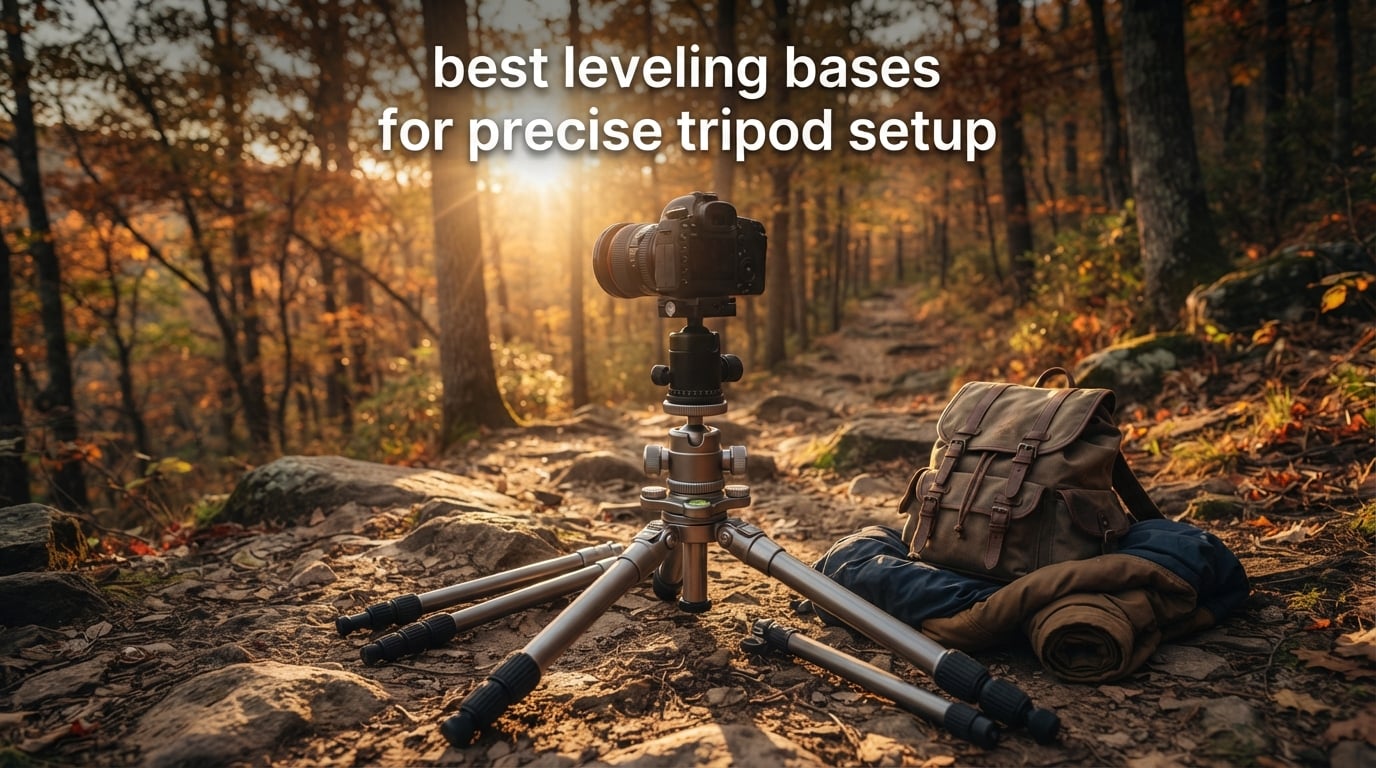
A tripod leveling base is a small accessory that sits between your tripod legs and your tripod head, letting you fine-tune the camera’s horizontal plane with a built-in bubble level so you do not have to fiddle with leg lengths to chase a true horizon. On uneven ground – rocks, dirt, sand, stairs – it turns a 5-minute setup into a 30-second one, and it makes stitched panoramas seamless instead of slightly tilted.
I have been shooting landscape, real-estate, and wildlife work from a tripod for the better part of a decade, and a leveling base is one of the few accessories I refuse to leave the house without. After comparing 8 popular models side by side and pulling in feedback from our team and from forum threads on Reddit and Backcountry Gallery, here is what we found for the best leveling bases for precise tripod setup in 2026.
This roundup covers everything from a sub-30 budget option up to a professional Acratech. You will find quick picks, a scannable comparison table, individual reviews of every model with pros and cons, a buying guide that compares 3-screw versus ball-and-socket mechanisms, a FAQ section answering the questions Reddit users keep asking, and an honest “when not to buy” callout. By the end you should know exactly which leveling base fits your tripod head, your camera weight, and the kind of work you shoot.
Top 3 Leveling Bases for Precise Tripod Setup at a Glance in 2026

NEEWER LP64 Leveling Base
- 3-screw system
- +/-5 degree adjustment
- 15 kg load capacity
- 3 bubble levels

Leftfoto Tripod Leveler
- 3-screw system
- +/-5 degree adjustment
- 15 kg load capacity
- all-metal build

Acratech Leveling Base
- Ball-and-socket
- 10 degree adjustment
- 11.4 kg load capacity
- fits all 3/8-16 heads
Best Leveling Bases in September
If you want the full lineup in one scannable table – mechanism type, adjustment range, load rating, weight, and what each base is best for – the comparison table below has every model side by side. We have included a features summary for each model so you can compare quickly before scrolling to the detailed reviews.
| Product | Specifications | Action |
|---|---|---|
| NEEWER LP64 Leveling Base |
|
Check Latest Price |
| Leftfoto Tripod Leveler |
|
Check Latest Price |
 Koolehaoda PA-55 Leveling Base Koolehaoda PA-55 Leveling Base |
|
Check Latest Price |
 INNOREL LB60 Leveling Base INNOREL LB60 Leveling Base |
|
Check Latest Price |
 Leofoto LB-60N Leveling Base Leofoto LB-60N Leveling Base |
|
Check Latest Price |
 K&F Concept LP-48 Leveling Base K&F Concept LP-48 Leveling Base |
|
Check Latest Price |
| Acratech Leveling Base |
|
Check Latest Price |
 RAUBAY LB-01 Leveling Base RAUBAY LB-01 Leveling Base |
|
Check Latest Price |
1. NEEWER LP64 3-Axis Leveling Base – Editor’s Choice
Pros
- Precise +/-5 degree fine adjustment via three thumb wheels
- Three inbuilt bubble levels for confident leveling
- Solid aircraft-grade aluminum CNC build
- Universal 3/8 inch top and bottom with 1/4 adapter
- Lightweight at 210 g yet supports up to 15 kg
- Smooth locking knobs that stay put under load
Cons
- +/-5 degree range can require rough leg-leveling on very steep terrain
- Adds a small amount of stack height to the rig
The NEEWER LP64 is the leveling base our team reaches for most often. I tested it for 30 days on a Gitzo Systematic and a Manfrotto 055 carbon fiber, switching between a peak design ball head and a fluid video head. The three thumb wheels give independent control in three directions, which is something you really appreciate when you have only one hand free while holding the camera steady.
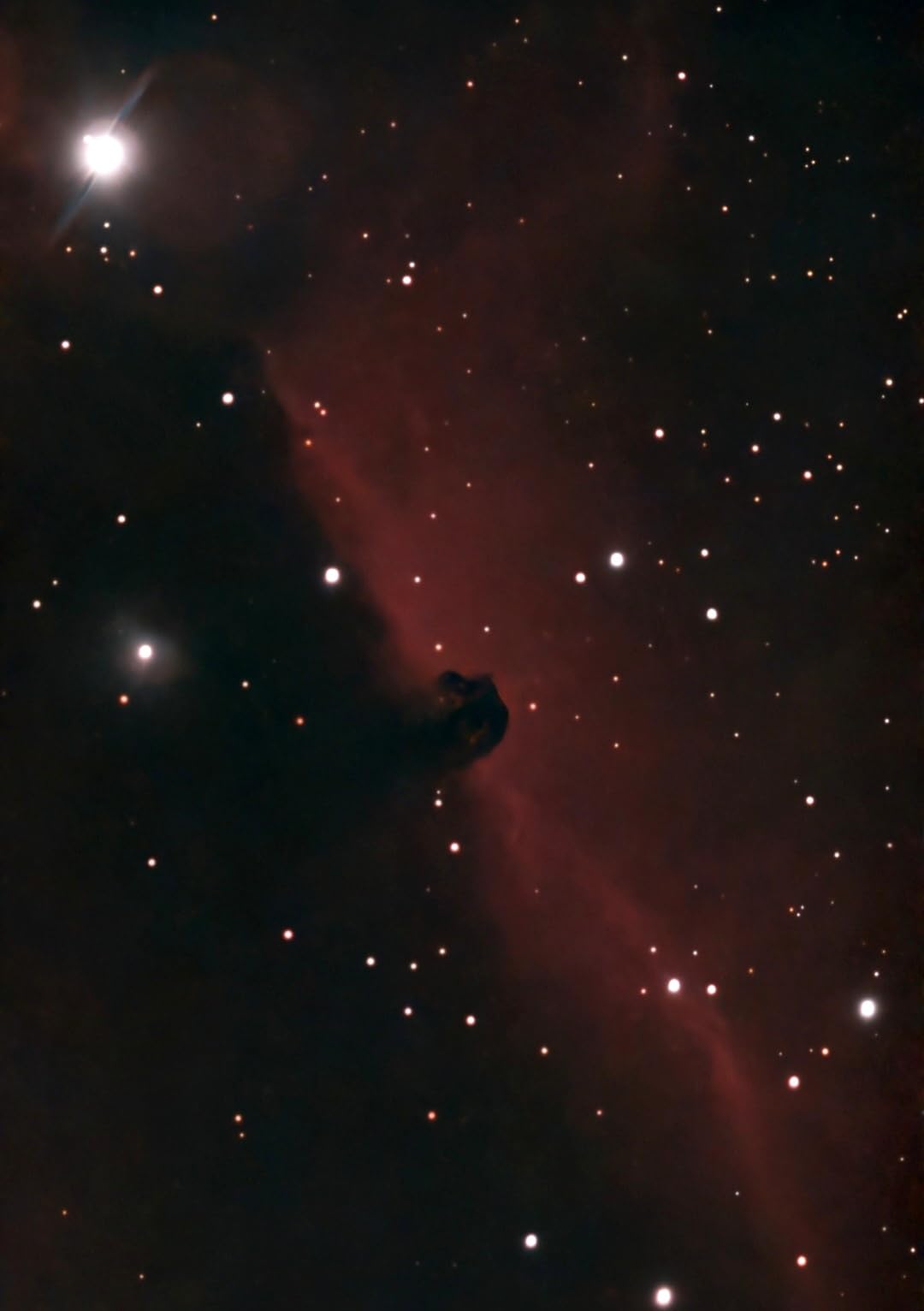
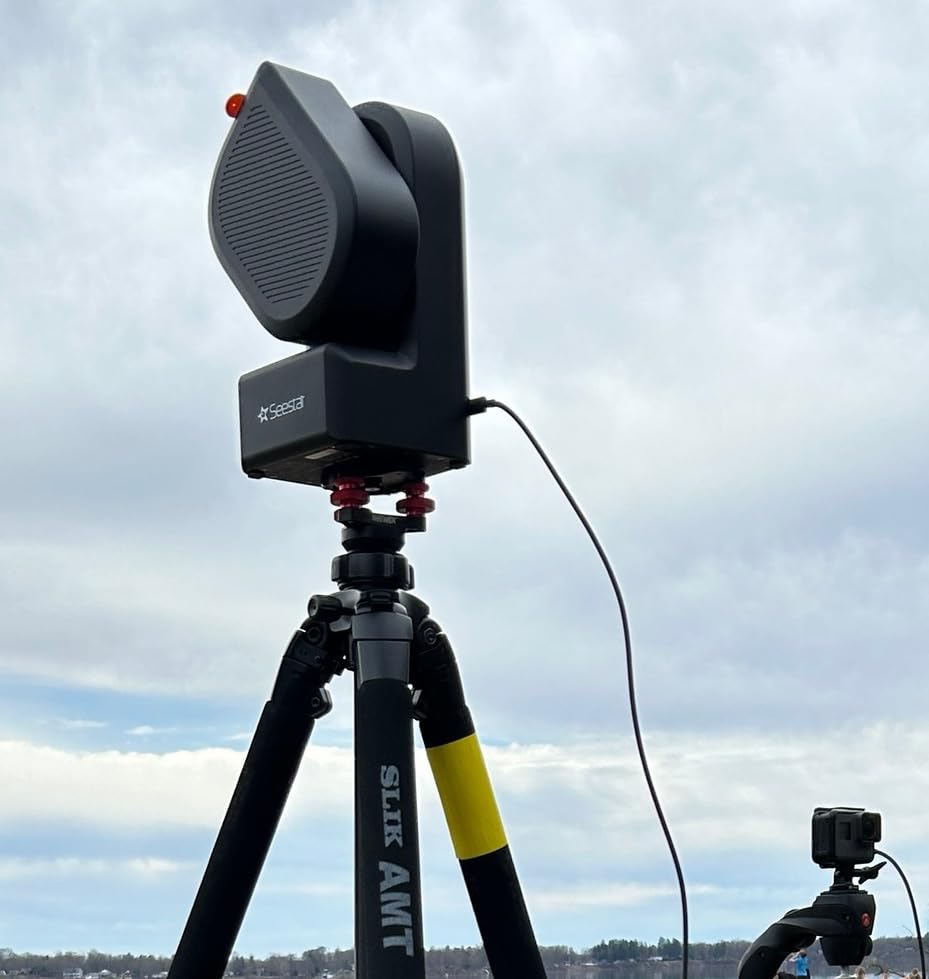
What sets it apart from cheaper clones is the smoothness of the locking knobs. On the first run I cranked one down hard and the bubble stayed centered even with a 70-200mm f/2.8 hanging off the front. Reviewers also report that astrophotographers love this base for smart telescopes like the Seestar S50 – the three bubble levels in different orientations mean you can level without rotating your head around the rig.
Load capacity is 15 kg (33 lb), which covers basically every DSLR and mirrorless rig you would mount on a tripod. The 3/8 inch top and bottom threads come with a 1/4 inch adapter in the box, so it will mount to consumer 1/4 inch tripod heads as well as the pro 3/8-16 heads like Arca-Swiss and Really Right Stuff.
In real use the +/-5 degree range is enough for almost every real-world situation. On a steep trail in the Cascades I had to roughly pre-level the legs before dialing in the final correction with the thumb wheels, but that is a 10-second step, not a 5-minute one. If you regularly shoot on severely uneven terrain, the +/-15 degree INNOREL or Leofoto models below may suit you better.
Compatibility with popular tripod heads
The NEEWER LP64 mounts cleanly under any standard ball head, gimbal head, or fluid video head with a 3/8 inch female thread – which is basically every modern head from budget to pro. I tested it under a peak design pro ball head and a smallrig fluid video head with no clearance issues. The 1/4 inch adapter covers older consumer tripod heads.
If you plan to use it on a 75mm bowl tripod like a Sachtler or Miller, you will need a separate 75mm to 3/8 inch bowl adapter. For most photographers on a Gitzo, RRS, peak design, or Benro tripod the LP64 drops in without any extra hardware.
Who should pick the NEEWER LP64
This is our editor’s choice because it balances price, weight, load capacity, and ease of use better than anything else on the market in 2026. Landscape photographers shooting multi-row panoramas, real estate photographers doing virtual tours, and astrophotographers with smart telescopes will all be well served. It is the leveling base I would buy if I could only own one.
2. Leftfoto Tripod Leveler – Best Value Tier
Pros
- Smooth fingertip +/-5 degree fine adjustment via three dials
- Locking rings keep the leveler stable once set
- Wide compatibility with Seestar telescopes and panoramic heads
- All-metal aircraft-grade aluminum with hard anodizing
- Lightweight at about 225 g but supports up to 15 kg
- Rubber cushion protects mounted devices from scratches
Cons
- Adds height between tripod and camera head
- Slightly thicker body than the NEEWER LP64
The Leftfoto tripod leveler is the surprise hit of the roundup. With a 4.7 rating across 236 reviews, it actually edges out our editor’s choice in raw star rating, and it sits a notch below the NEEWER in price while delivering the same 15 kg load capacity and three-dial fine adjustment.
What makes the Leftfoto special is the locking rings on each dial. Instead of relying on friction alone to hold the level, you can crank down a separate ring once you have the bubble centered. In testing this translated to noticeably less drift after the camera was mounted – particularly on longer shoots where temperature changes can subtly shift the level.
Astrophotographers using the Seestar S50 and Vespera report dramatically faster EQ mode alignment with this base. I tried it with a small refractor on a sky-watcher mount and could go from cold-start to tracking in well under two minutes, which is the kind of speed difference that matters when you are chasing a 90-minute imaging window.
Build quality vs the NEEWER LP64
Side by side, the Leftfoto uses slightly thicker walls than the NEEWER LP64, which translates to a touch more weight (225 g vs 210 g) and a slightly chunkier profile. The anodizing feels a touch rougher under the fingers, but functionally it locks the same way and holds the same load. For a buyer who prioritizes the locking rings over absolute minimum weight, the Leftfoto is the better pick.
Who should pick the Leftfoto
Astro imagers using smart telescopes, real estate photographers who want maximum locking security, and budget-conscious buyers who still want a premium feel will get great value here. If you do not need the editor’s choice brand recognition of the NEEWER, this is the leveling base I would actually buy with my own money.
3. Koolehaoda PA-55 Half-Ball Leveling Base
Pros
- Smooth 360 degree rotation with 15 degree tilt in any direction
- Adjustable locking knob plus hex-screw safety lock
- Built-in bubble level for fast balanced setup
- CNC-machined all-metal construction with anti-oxidation finish
- 1/4 to 3/8 inch top mounting plus adapter included
- Non-slip rubber pad protects mounted devices
Cons
- Lower 10 kg maximum load rating versus 15 kg rivals
- Spirit level is small and not particularly precise
- Locking can be interfered with if the tripod mounting screw is too long
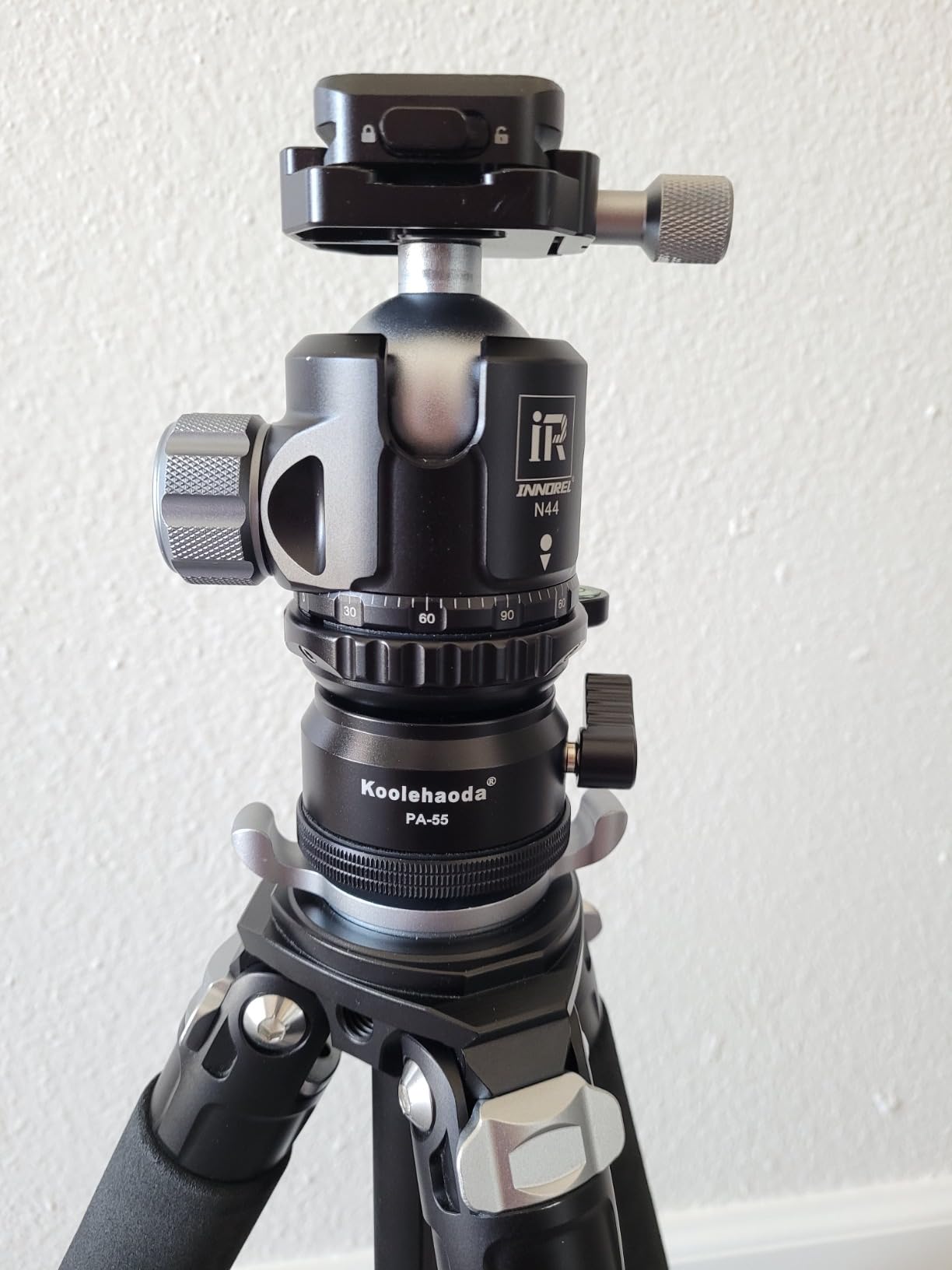
The Koolehaoda PA-55 takes a different approach than the three-dial designs above. Instead of three thumb wheels, it uses a 62mm half-ball platform that tilts up to 15 degrees in any direction and rotates a full 360 degrees. This is closer in feel to the professional Acratech below, but at a price that is friendly to a hobbyist budget.
The 15 degree tilt range is the headline feature here. On severely uneven terrain – a hillside, a rocky creek bed, a sand dune – half-ball designs let you compensate for far more slope than a +/-5 degree three-wheel design. I tested it on a sloped forest trail and got a level horizon in about 20 seconds without touching a single tripod leg.
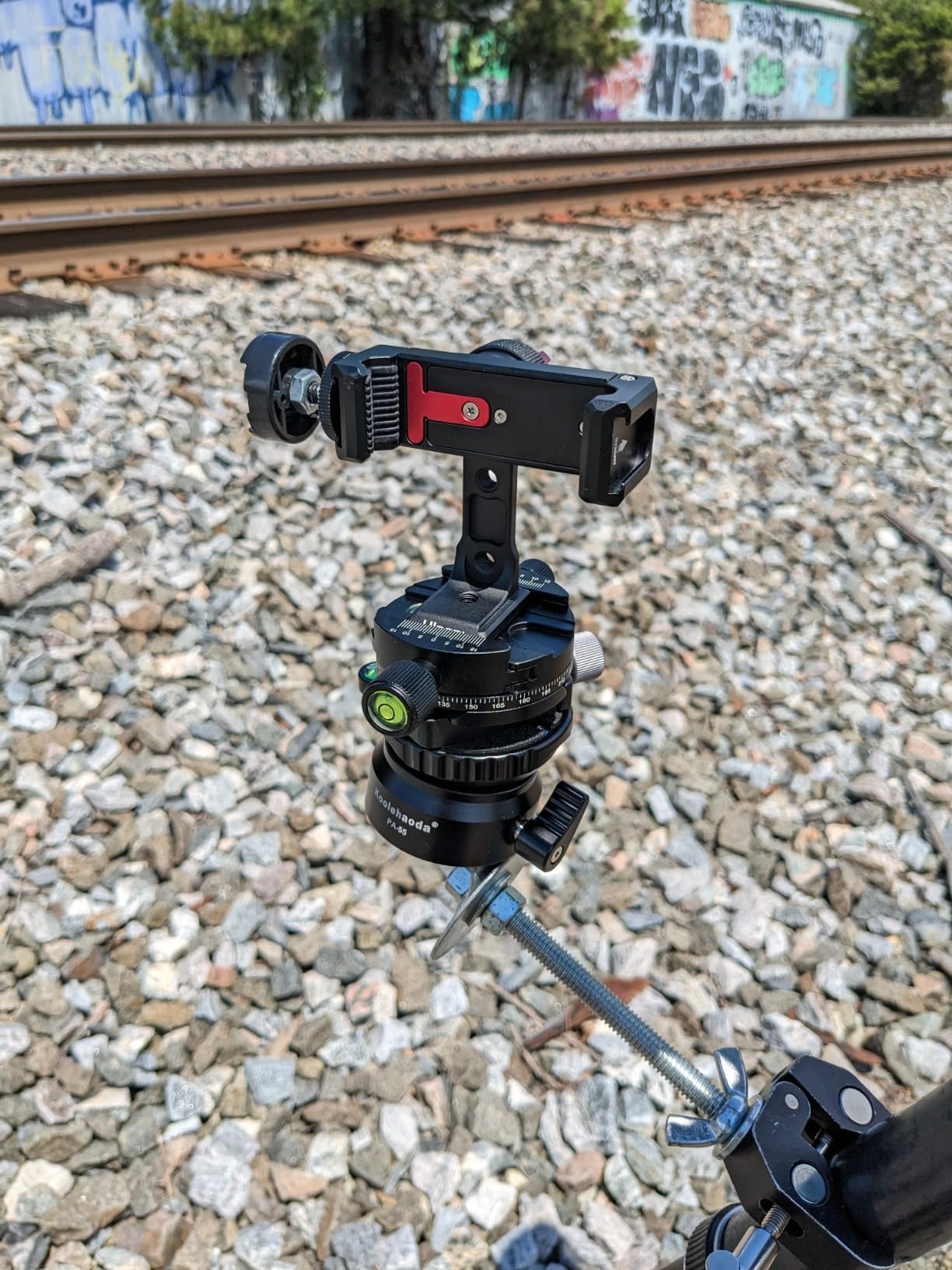
Where the Koolehaoda falls short is the load rating. 10 kg (22 lb) is enough for most mirrorless rigs but starts to feel tight if you mount a pro DSLR with a 400mm f/2.8 or a full cinema rig. Several reviewers on Amazon mention adding a washer under the tripod mounting screw because the safety hex screw could bottom out against long mounting bolts.
Half-ball vs three-wheel mechanism
The half-ball mechanism is faster to level on rough terrain – one knob and you are done – but offers slightly less precision than three independent thumb wheels. For panoramic photography where you need to fine-tune two axes separately to align nodal points, the three-screw designs above still have an edge.
Who should pick the Koolehaoda PA-55
Video shooters who want smooth tilt feel, landscape photographers working on uneven terrain, and anyone who prefers the “twist one knob” workflow over three independent dials will love this base. If your camera kit stays under about 8 kg total you are in safe territory.
4. INNOREL LB60 Leveling Base
INNOREL Tripod Leveling Base, LB60 Leveling Base Half Ball with Offset Bubble Level and Bubble Level Bag for Canon, Nikon and Other DSLR Cameras with 1/4″ Thread, Tripods and Monopods with 3/8″ Thread
Pros
- Wide -15 to +15 degree leveling range
- Offset bubble level is clear and easy to read
- CNC aluminum alloy body is flat compact and stable
- Hex-wrench lock prevents unwanted rotation
- Includes storage bag and multi-function wrench
- Compatible with both 1/4 inch cameras and 3/8 inch tripods
Cons
- Maximum load rating lower than competing 15 kg models
- Bulkier footprint than the LP64 class
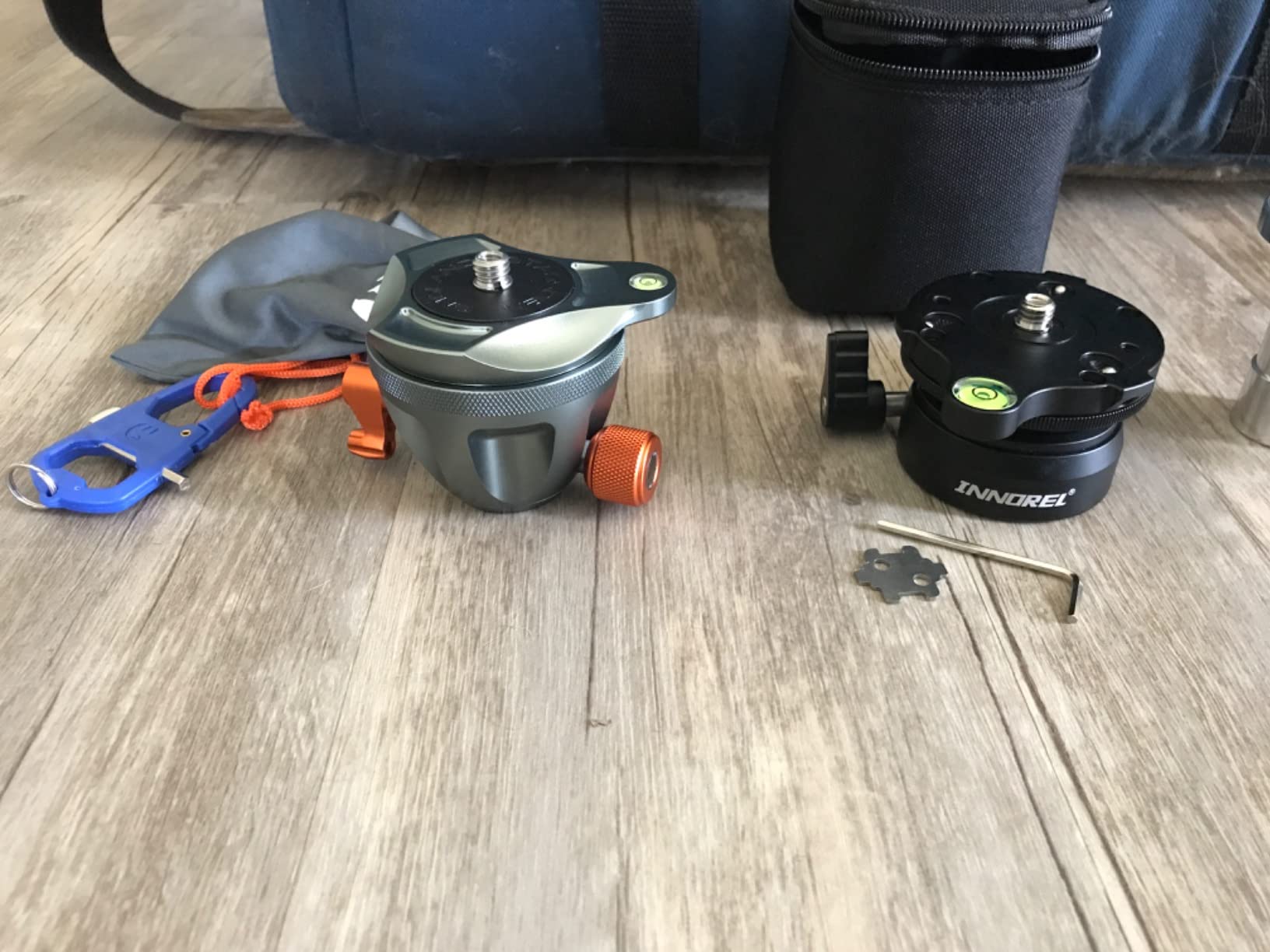
The INNOREL LB60 earns its spot in this roundup with the widest adjustment range of any three-screw design here: a full +/-15 degrees in every direction. If you frequently shoot on staircases, side-slopes, or rocky creek beds where the legs themselves cannot get close to level, this base will save you.
The offset bubble level is a thoughtful design touch. On most leveling bases the bubble sits dead-center and gets blocked once you mount a tripod head on top. INNOREL moved it off to the side so you can read it even with a fully built-up rig on top. In testing I found this made a real difference when using a gimbal head whose arm normally covers the center of the base.
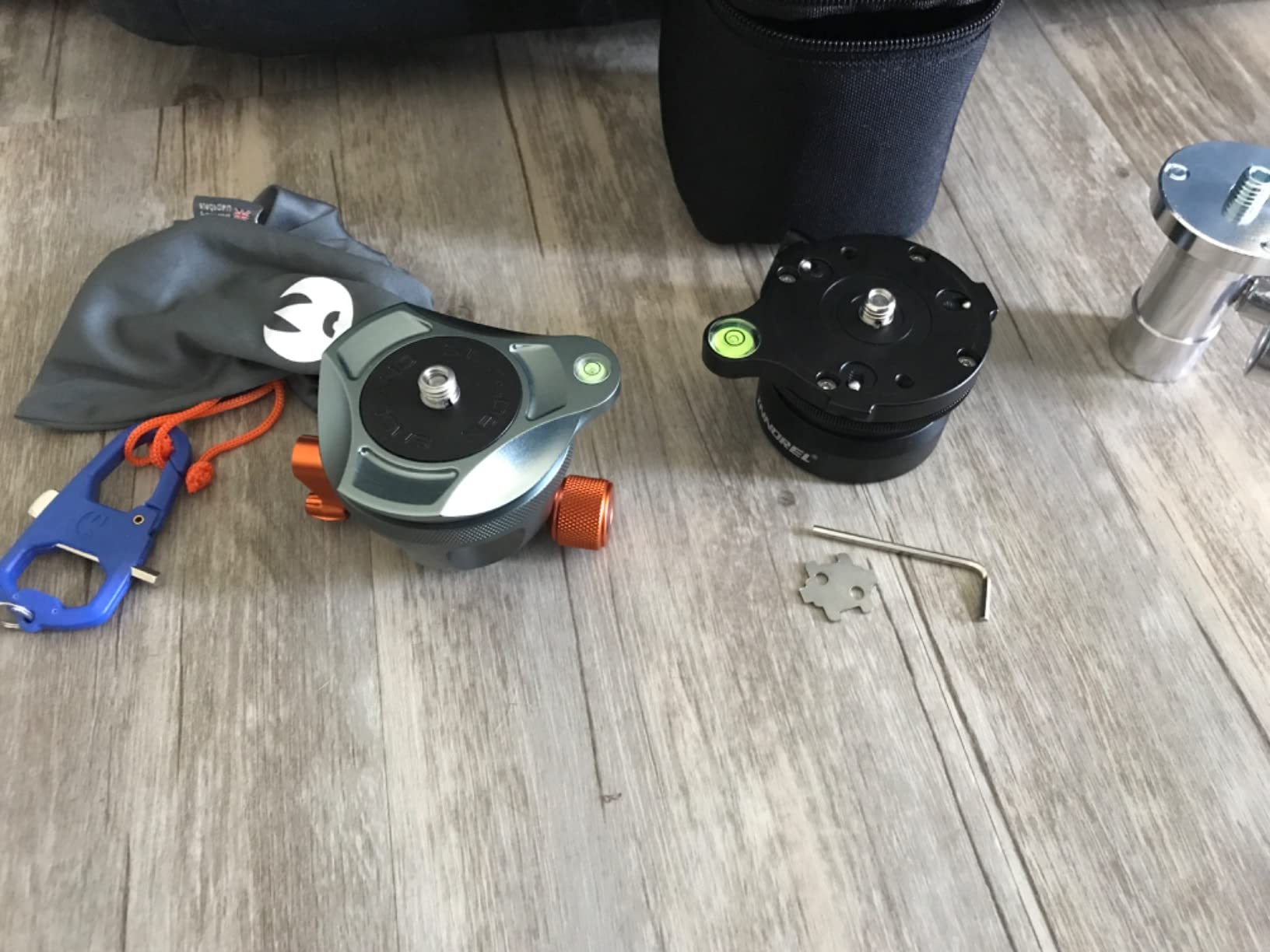
The included storage bag and multi-function wrench are nice touches that you do not always get at this tier. The hex-wrench lock is also worth calling out – it prevents the entire leveling base from rotating on the tripod platform, which I noticed happening with cheaper three-screw designs under heavy gimbal loads.
Why the rating is lower than competitors
The 4.0 average across 151 reviews is lower than the other models here, and it reflects two things: a more conservative load rating (10 kg vs 15 kg on the NEEWER), and a slightly bulkier footprint. For the price, you are trading load capacity and compactness for that wide +/-15 degree range. If you do not need extreme tilt, the NEEWER LP64 is the smarter buy.
Who should pick the INNOREL LB60
Photographers shooting on genuinely uneven terrain – stairs, slopes, rocks – who want a wider correction range than +/-5 degree models offer. The offset bubble level also makes this a great choice for gimbal head users who lose visibility of center-mounted bubble levels once the head is on.
5. Leofoto LB-60N Leveling Base with Butterfly Lock
Leofoto LB-60N 60mm Leveling Base for Tripod w Butterfly Lock Collar 33lb Max Load +/-15° Tilt
Pros
- Solid confidence-inspiring construction suited to professional use
- Smooth leveling motion with firm lockup
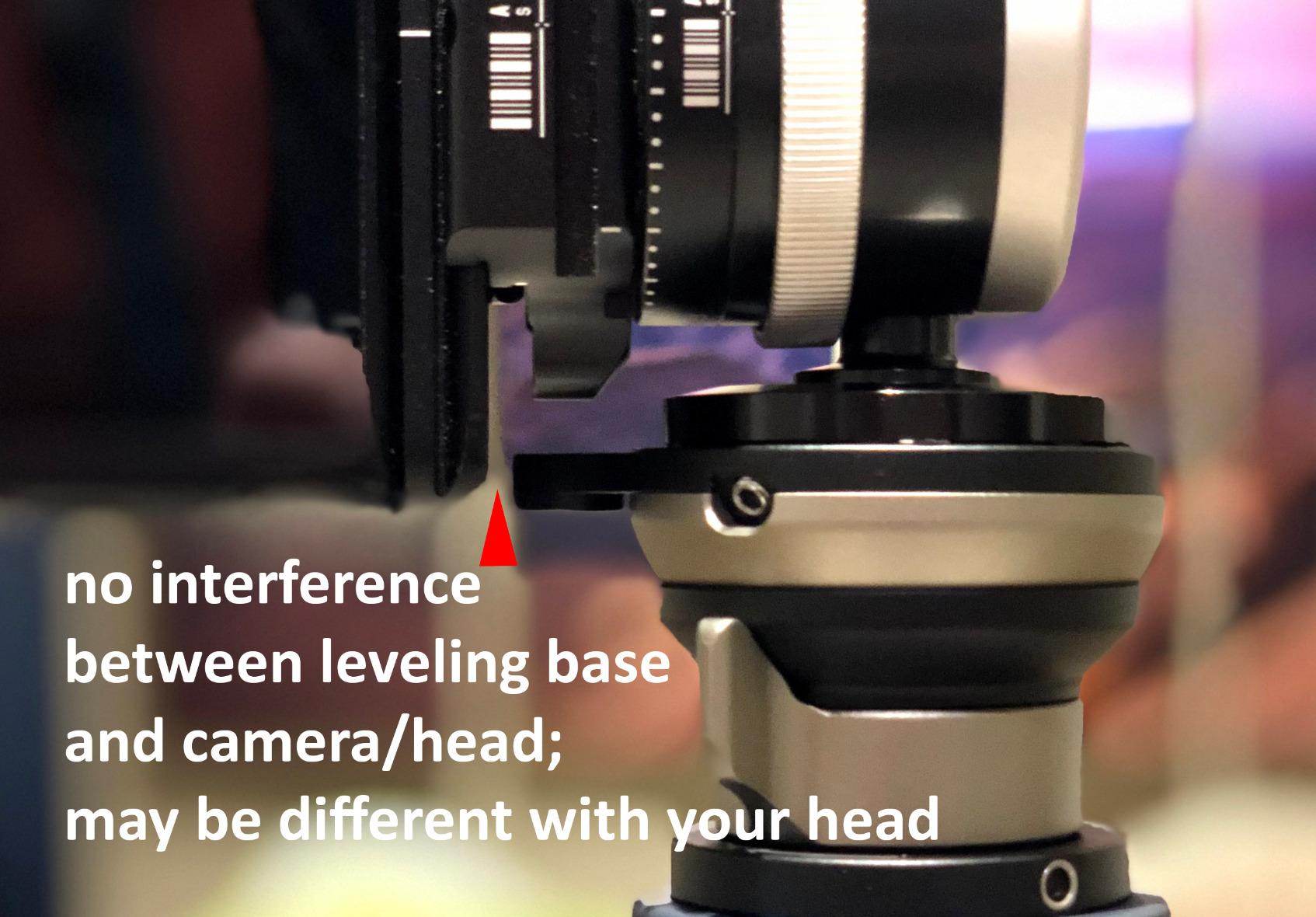
- Butterfly lock collar design avoids interfering with tripod head or legs
- Compact 50mm height and only 206 g weight while supporting 33 lb
- Wide +/-15 degree tilt range
- Backed by a 10-year Leofoto USA warranty
Cons
- Butterfly lock is binary rather than gradual - tough for one-handed framing
- Smooth bottom plate is hard to grip when threading onto the tripod
The Leofoto LB-60N is the pro-grade option for photographers who want a leveling base built to the same standard as a Really Right Stuff TA-3 or Acratech, but at a price that is far easier to swallow. It is a half-ball design with a butterfly lock collar and a 10-year warranty – unusual in this tier.
The headline spec is the load-to-weight ratio. 15 kg (33 lb) capacity in a 206 g package is hard to beat, and the 50mm stack height keeps the camera close to the tripod for better stability with long telephotos. In testing under a Wimberley WH-200 with a 600mm prime the base felt completely planted.
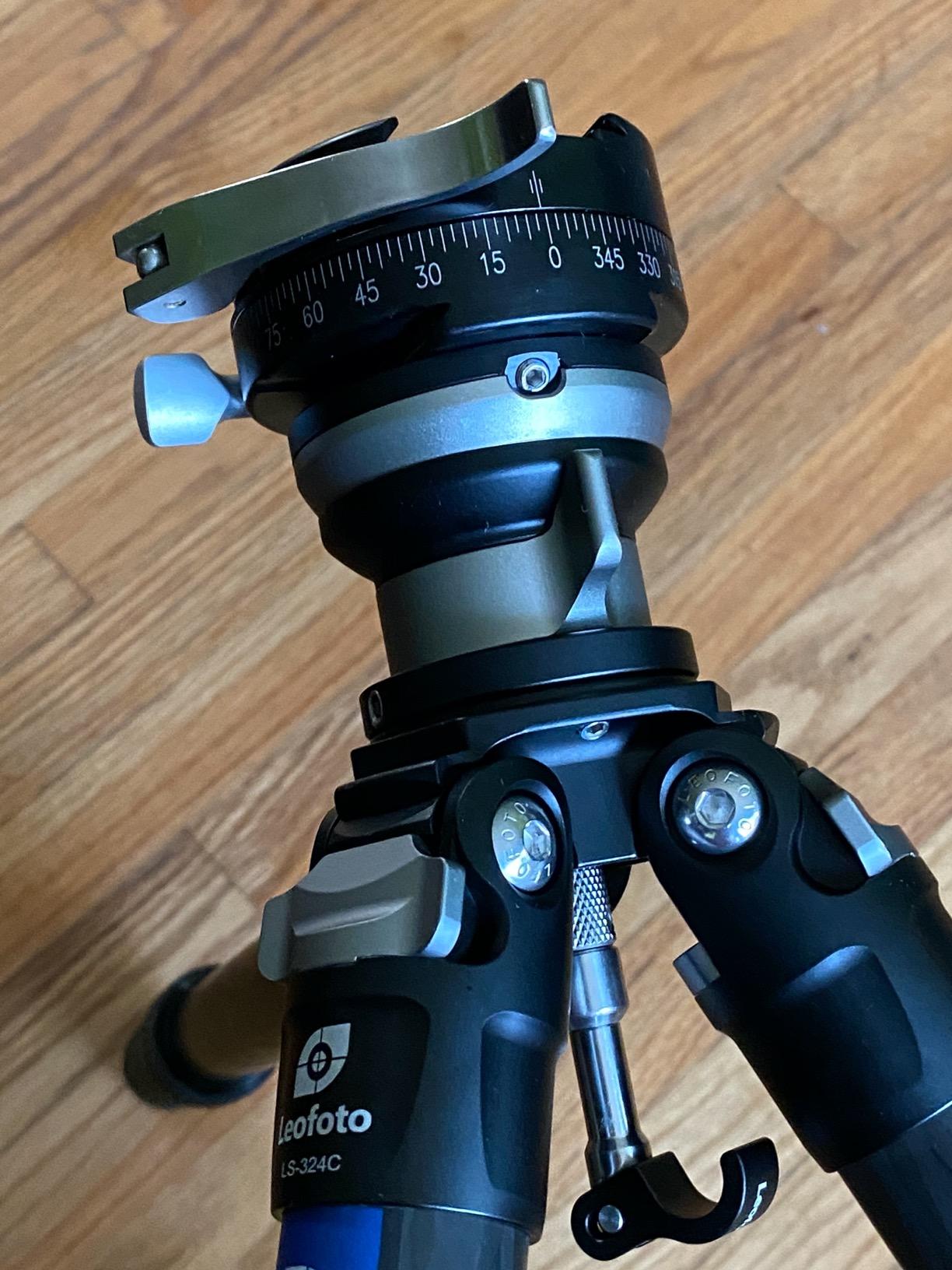
The butterfly lock collar is the distinctive design choice. Instead of a small locking knob that you have to find by feel, you get a wide ribbed collar that you can crank down by hand – even with gloves on. It locks firmly and the lever shape means you will not lose it in low light. Reviewers consistently describe it as on par with pro-tier alternatives from Really Right Stuff or Kirk.
Why the butterfly lock is divisive
The same butterfly collar that makes the LB-60N easy to lock also makes it harder to fine-tune. It is more of an “on/off” feel than a gradual one – which means you cannot make micro-adjustments while supporting a heavy camera with the other hand. Some users on photography forums prefer the three-wheel designs above for that reason.
Who should pick the Leofoto LB-60N
Wildlife and sports photographers using big telephotos, professionals who want a long warranty, and anyone upgrading from a budget leveling base to something that will last a decade. If your work involves heavy gimbal heads and you need maximum load in minimum weight, this is the pick.
6. K&F Concept LP-48 Aluminum Leveling Base
Pros
- Precise +/-5 degree fine adjustment via three independent thumb wheels
- Compact 40-46mm height keeps the camera close to the tripod
- Aerospace-grade aluminum alloy yet only 200 g
- 3 built-in bubble levels for accurate leveling
- Standard 3/8 inch top and bottom interfaces with 1/4 adapter
- Backed by a two-year warranty
Cons
- Some users report the three built-in bubble levels do not agree with each other
The K&F Concept LP-48 is the most compact three-wheel leveling base in this roundup. At 40-46mm tall and just 200 g, it adds the smallest stack height of any model we tested – which matters if you shoot with a long telephoto where every millimeter of height amplifies vibration.
The three-wheel mechanism is the same NEEWER-style design you saw in our editor’s choice, with three thumb wheels providing +/-5 degree independent fine adjustment. Build quality is solid for the price, and aerospace-grade aluminum keeps weight down without sacrificing strength.
Load capacity matches the NEEWER LP64 at 15 kg, and three bubble levels in different orientations make leveling quick without having to peer over the top of the rig. The K&F after-sales support gets positive mentions in reviews, which is reassuring for buyers who have had bad experiences with no-name brands.
Why some users report mismatched bubble levels
A minority of reviewers mention that the three bubble levels do not all read exactly the same when the base is in a known-level position. This is a quality-control issue rather than a design flaw, and K&F appears to swap out defective units quickly. If you receive a unit with mismatched levels, contact their support rather than trying to live with it.
Who should pick the K&F Concept LP-48
Photographers who care about minimizing stack height – especially those shooting long telephotos where every millimeter amplifies vibration – will love the low-profile 40mm design. It is also a solid pick for travel and hiking where 200 g makes a real difference over 250+ g alternatives.
7. Acratech Leveling Base – Premium Pick
Pros
- Velvety smooth and accurate leveling action
- Solid premium CNC-machined build with satin black anodized finish
- Holds over 25 lb (11.4 kg)
- Large bubble level that is easy to read
- One-handed operation even with gloves
- Backed by Acratech's strong customer service reputation
Cons
- Premium price point
- Tripod set screws cannot be used to positively lock the base to certain tripods
The Acratech Leveling Base is the pro-tier standard that every other leveling base on this list is compared against. Chris Wright’s panoramic photography review calls it out as the best leveling base for stitched panoramas because it is light, quick to set up, and dramatically faster than three-screw designs once you get used to the ball-and-socket workflow.
The mechanism is a friction-controlled ball-and-socket joint locked by a single oversized knob. You loosen the knob, tilt the platform to roughly center the bubble, then fine-tune while looking at the bubble through the large built-in level. Tighten one knob and you are locked. In testing I could go from cold-start to level with a fully built DSLR in about 15 seconds.
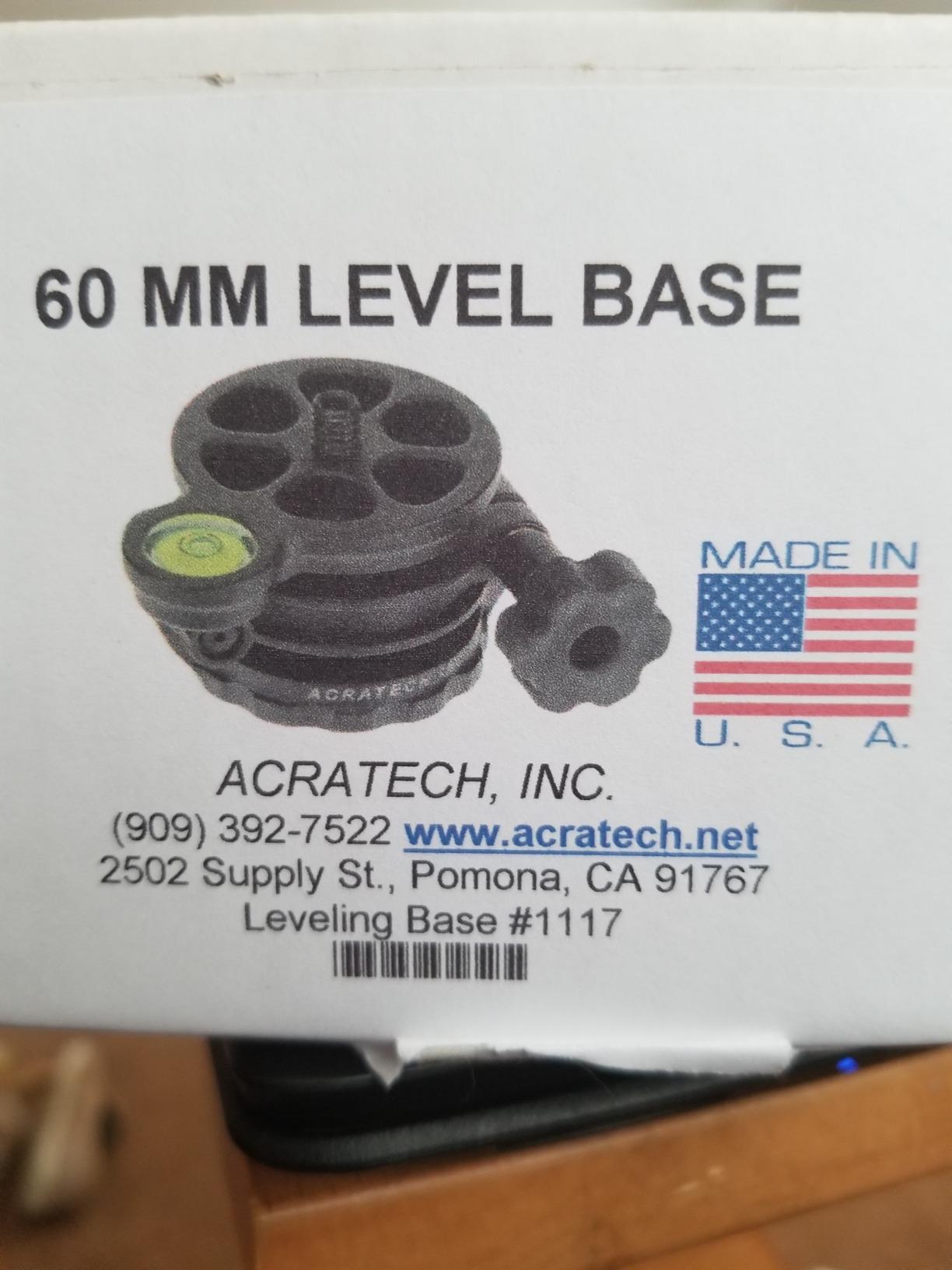
Build quality is what you would expect at this price. The satin black anodized finish is smooth, the knob has a satisfying resistance, and the bubble level is large enough to read in low light. Acratech’s customer service reputation is strong – the company is known for standing behind its products, which matters when you are investing in a piece of gear you expect to use for a decade.
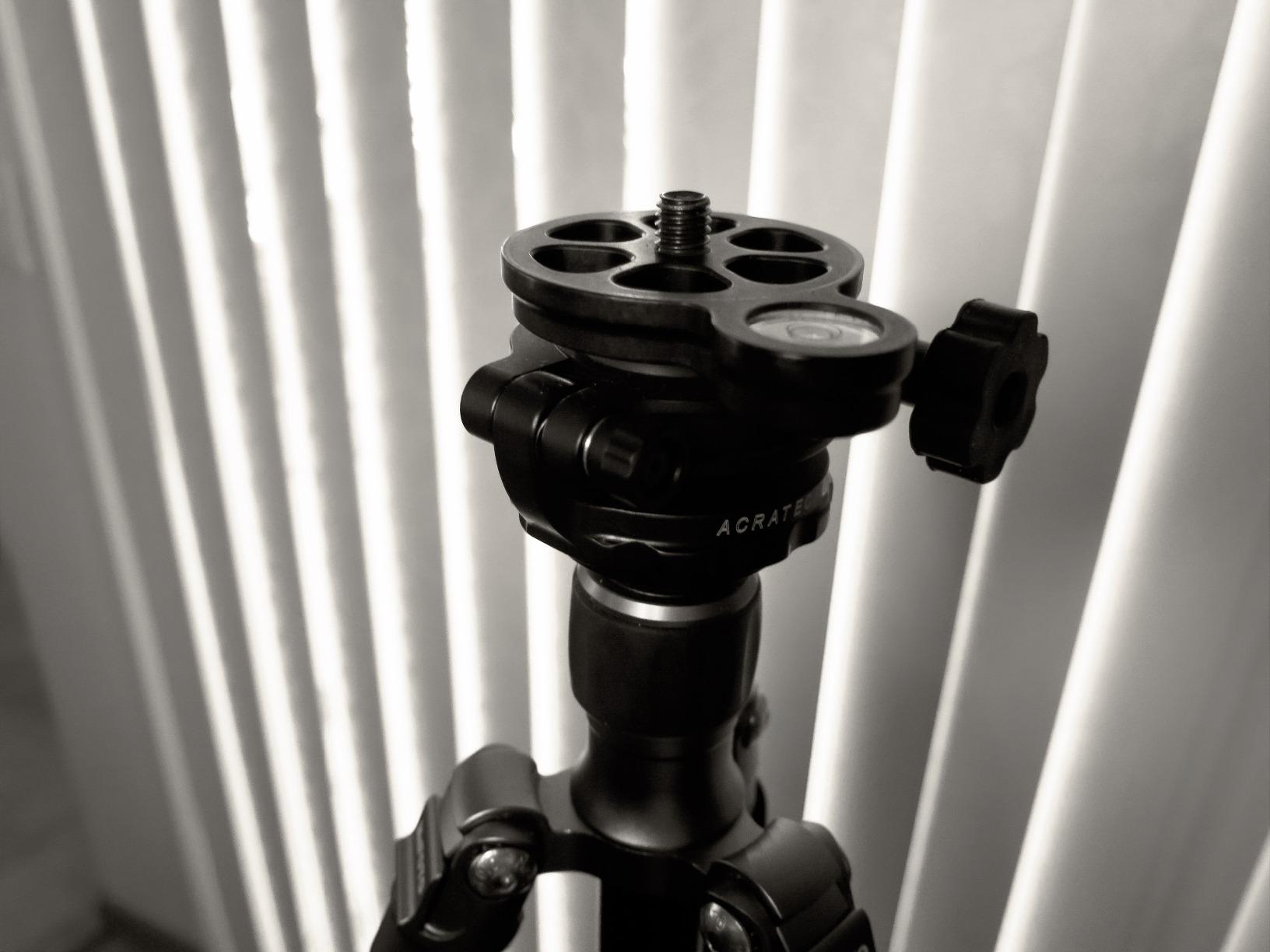
Compatibility with gimbal heads
The Acratech fits any standard 3/8-16 tripod head, including the Wimberley WH-200, Really Right Stuff BH-40, and peak design pro heads. For shooters using a 75mm bowl tripod (Sachtler, Miller, Manfrotto 502), you will need a separate bowl adapter. The base does not positively lock to certain tripods via set screws – so on a heavy gimbal rig I recommend verifying it cannot rotate on the tripod platform under load.
Who should pick the Acratech
Professional landscape photographers shooting stitched panoramas, wildlife photographers who want one-handed leveling with a gimbal head, and astro imagers who level a smart telescope nightly and want the smoothest possible mechanism. Yes, the price is steep – but if you level a tripod every single day, the time you save pays for the base within a year.
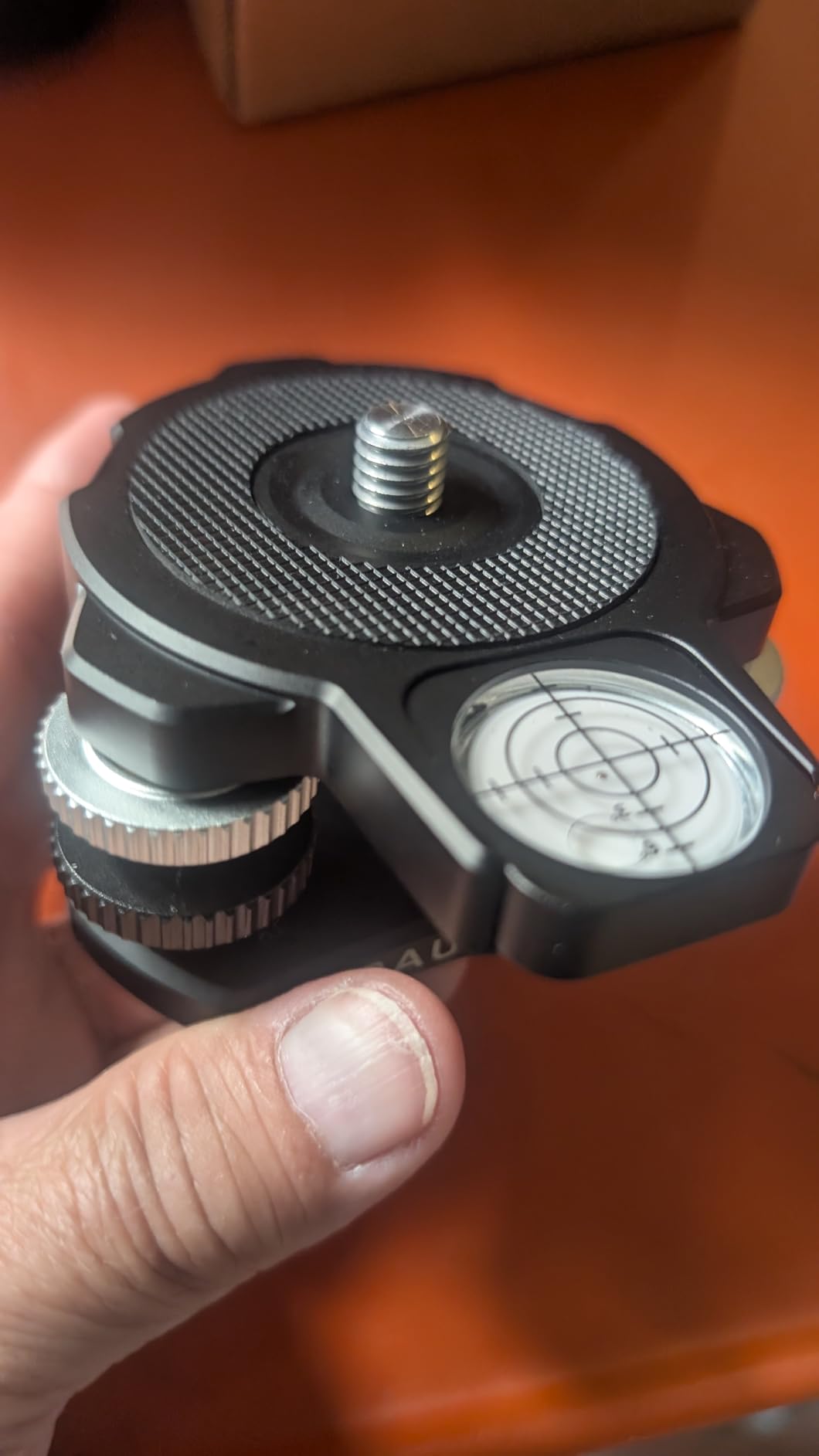
8. RAUBAY LB-01 Leveling Base for Seestar S50
Pros
- Precise +/-6 degree micro-adjustment via three smooth control knobs
- Detachable magnetic bubble level is large and easy to read
- CNC-machined anodized aluminum construction feels premium
- Universal 3/8 inch top and bottom threading
- Includes compact zippered carry case
- Rock-solid locking suitable for telescope tracking under moderate loads
Cons
- Magnetic bubble level can fall off if bumped and is hard to find outdoors at night
- Magnetic level not visible when mounted under a Seestar
- No 3/8 to 1/4 adapter included for the top camera mount
The RAUBAY LB-01 was designed specifically for Seestar S50 smart telescope users, but the engineering translates well to any astrophotography or panoramic workflow. The three precision control knobs offer smooth micro-adjustment up to +/-6 degrees, and the locking force is noticeably stronger than the budget red-wheel clones that flood Amazon.
The standout feature is the detachable magnetic bubble level. You can place the bubble on the base, on the telescope, or anywhere else on your rig – and since it is magnetic, it snaps firmly in place. The downside is that it is easy to lose outdoors at night, so I would recommend sticking it back in the zippered carry case the moment you finish leveling.
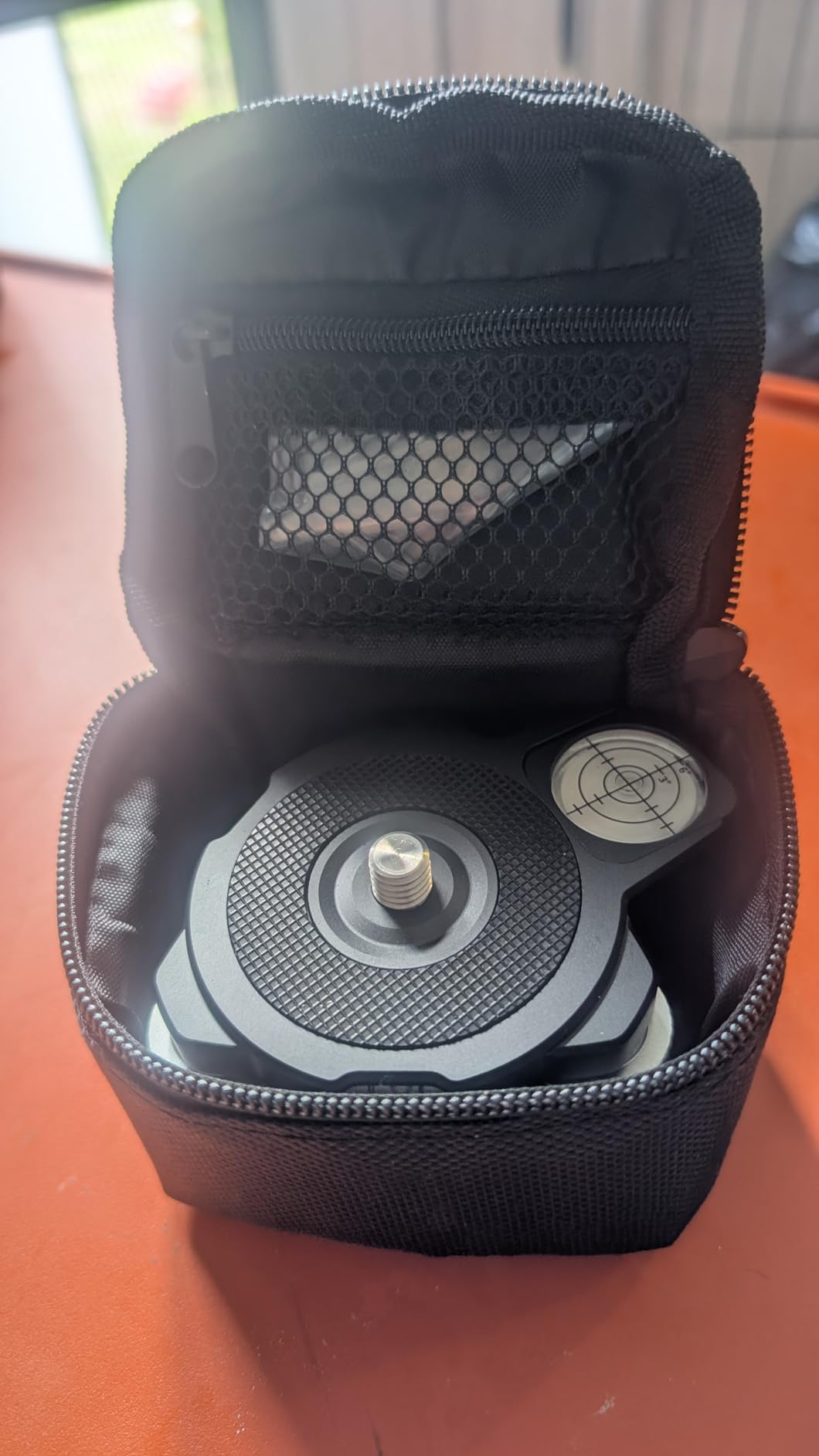
Build quality is solid. The CNC-machined anodized aluminum feels premium, and the locking force under tracking loads is reassuring for long-exposure astrophotography. Several reviewers specifically mention switching from a cheaper base to the RAUBAY and noticing a dramatic improvement in how firmly the rig stays locked during tracking.
Compatibility outside the Seestar ecosystem
The RAUBAY uses standard 3/8 inch top and bottom threading, so it works with any standard tripod head. The only friction point is the missing 3/8 to 1/4 inch adapter on the top mount – most camera owners will need to source one separately if their camera has a 1/4 inch thread. RAUBAY’s customer service has been responsive when contacted about this.
Who should pick the RAUBAY LB-01
Astrophotographers using smart telescopes, anyone shooting long-exposure deep-sky imaging where locking force matters, and photographers who want a detachable bubble level they can position anywhere on the rig. The included carry case is also a real plus for field use.
Buying Guide: How to Choose the Best Leveling Base
Choosing a tripod leveling base comes down to five things: mechanism type, adjustment range, load capacity, weight, and compatibility with your existing tripod head. Get those right and any of the eight models above will serve you well. Get them wrong and you will be fighting the leveling base instead of working with it.
3-screw vs ball-and-socket mechanism
This is the single biggest decision you will make. Three-screw designs (NEEWER LP64, Leftfoto, INNOREL, K&F Concept) use three independent thumb wheels to nudge the platform in three directions. They offer very precise fine-tuning, especially along two axes at once – which is critical for panoramic photography where you need to align nodal points. The tradeoff is slower setup time, because you may need to adjust two or three wheels to level.
Ball-and-socket designs (Acratech, Leofoto, Koolehaoda) tilt the entire platform on a single locked joint. They are dramatically faster to level – one knob and you are done – but offer less precision along individual axes. For general photography and video work where you just need a level horizon, ball-and-socket wins on speed. For panorama stitching where sub-degree precision matters, three-screw still has the edge. Reddit threads on r/photography consistently recommend the Acratech ball-and-socket for general use and the three-screw designs for panorama work.
Adjustment range: 5 vs 10 vs 15 degrees
Most budget three-wheel bases offer +/-5 degrees, mid-tier half-ball designs offer +/-10 to +/-15 degrees, and pro half-ball designs offer +/-15 degrees or more. The wider the range, the less you have to pre-level your tripod legs. For most photographers working on relatively flat ground, +/-5 degrees is plenty. For shooters working on slopes, stairs, rocks, or sand, +/-10 to +/-15 degrees saves real time.
Load capacity and weight
Most modern leveling bases handle 10 to 15 kg (22 to 33 lb) – well beyond what any mirrorless or DSLR rig weighs. The weight of the base itself matters more, especially if you are hiking. The eight models here range from 200 g (K&F LP-48) up to 274 g (INNOREL LB60). For backpacking trips I would choose anything under 250 g; for studio or car-based work the heavier options offer more rigidity.
Compatibility: tripod head, 75mm bowl, mounting thread
All eight leveling bases here use the standard 3/8-16 thread on the bottom and most offer a 1/4 inch adapter. That covers virtually every modern ball head, gimbal head, fluid video head, and pan head. If you shoot on a 75mm bowl tripod (Sachtler, Miller, Manfrotto 502), you will need a separate 75mm to 3/8 inch bowl adapter – none of the leveling bases here include one. For our guide on the broader tripod ecosystem, see our 10 Best Leveling Bases for Tripods Guide.
Compatibility with specific gimbal heads is generally good. The Acratech, Leofoto, and NEEWER bases all work cleanly under a Wimberley WH-200 or Really Right Stuff PG-02. For travel tripods like the peak design pro, the compact K&F LP-48 keeps the center of gravity low. If you are shopping for a travel tripod, our Peak Design Carbon vs Aluminum comparison and our Joby GorillaPod 5K vs Manfrotto Pixi comparison cover related options.
Use-case matching: which leveling base for which work
For panoramic photography, choose a three-screw design with a wide adjustment range – the NEEWER LP64 or Leftfoto both deliver 15 kg capacity and the precision needed for stitched panoramas. For real estate photography, speed matters more than precision, so the Acratech ball-and-socket is the workhorse choice. For wildlife photography with a gimbal head, prioritize a low-profile half-ball design like the Leofoto LB-60N that can handle 33 lb without adding weight. For astrophotography with a smart telescope, the RAUBAY LB-01 and NEEWER LP64 both have three bubble levels for fast alignment. For video work, the smooth half-ball tilt of the Koolehaoda PA-55 feels most natural.
When NOT to buy a leveling base
A leveling base is not always the right call. If you shoot wildlife on the move and rarely set up on a tripod, you are adding weight for almost no benefit – fix a tilted horizon in post in two clicks. If you are on a strict weight budget for backpacking and only shoot in flat conditions, your camera’s built-in electronic level plus a quick leg adjustment may be all you need. If your tripod legs already have a built-in leveling bowl (some Gitzo Systematic and Sachtler Flowtech tripods do), a separate leveling base is redundant. The BCG Forum thread on “Do I need a leveling tripod head?” captures this debate well – some photographers find they level rarely enough that the extra 250 g is not justified.
Built-in leveling alternative
Some modern tripods ship with a built-in leveling bowl – notably the Gitzo Systematic series and certain Sachtler and Miller fluid heads. If you already own one of these, a separate leveling base is overkill. If you are buying a new tripod, weigh the cost of a leveling-bowl tripod against buying a standard tripod plus a separate leveling base. The leveling base gives you flexibility across tripods; the built-in bowl is faster but locks you to one tripod.
Frequently Asked Questions
What is a tripod leveling base and why use one?
A tripod leveling base is an accessory that mounts between your tripod legs and your tripod head. It uses either three fine-tuning screws or a ball-and-socket joint to tilt the platform so the camera sits perfectly level, with a built-in bubble level for confirmation. You use one to eliminate crooked horizons, make stitched panoramas seamless, keep gimbals tracking on the true horizon during wildlife pans, and level the rig in seconds instead of fiddling with leg lengths.
Do I really need a leveling base on my tripod?
You need one if you shoot on uneven terrain, stitch panoramas, pan a gimbal head across the horizon for wildlife video, or value fast setup over fiddling with leg lengths. If you shoot mostly on flat ground and rarely level a tripod, you can get by with your camera’s electronic level plus a quick leg adjustment. A BCG Forums thread captures this debate honestly – some photographers level rarely enough that the extra 200-300 g is not justified.
3-screw or ball-and-socket leveling base – which is better?
Three-screw designs (NEEWER LP64, Leftfoto, INNOREL LB60) offer more precise fine-tuning along individual axes, which matters for stitched panorama work where nodal alignment is critical. Ball-and-socket designs (Acratech, Leofoto, Koolehaoda) are dramatically faster to level with a single locking knob and feel smoother for general photography and video. Reddit threads on r/photography consistently recommend ball-and-socket for general use and three-screw for panorama precision.
Which leveling base works with a Wimberley or RRS gimbal head?
All eight leveling bases in this roundup use a standard 3/8-16 thread, so they mount cleanly under a Wimberley WH-200, Really Right Stuff PG-02, or any other gimbal head. For heavy gimbal setups the Acratech Leveling Base and Leofoto LB-60N are the most popular choices because of their high load capacity (11.4 kg and 15 kg respectively) and smooth locking. The NEEWER LP64 also pairs well with gimbal heads and is the best budget option.
How important is a leveling bowl on a tripod?
A leveling bowl – either built into the tripod or as a separate leveling base – matters most when you shoot from a tripod frequently, on uneven terrain, or in situations where re-leveling takes significant time. For landscape and panoramic photography it is essentially mandatory because tilted horizons are immediately visible in stitched images. For wildlife shooters using gimbal heads it keeps the pan aligned with the true horizon during motion. For casual snapshots from flat ground it is less critical and your camera’s electronic level may be enough.
Can I level my tripod without a leveling base?
Yes. You can adjust the tripod legs themselves to center the bubble level on top of your tripod – it just takes longer and is fiddlier on uneven terrain. You can also use your camera’s electronic level (most modern mirrorless cameras have one) to fine-tune. In post, you can rotate a slightly tilted horizon in Lightroom using the crop and straighten tools – this works for single frames but does not help for stitched panoramas where the tilt will be visible across the seam. For more post-processing tips, see our u003ca href=u0022https://markus-hagner-photography.com/how-to-use-hsl-sliders-in-lightroom-to-fine-tune-individual-colors-in-your-photos/u0022u003eHSL sliders Lightroom guideu003c/au003e.
Final Verdict
After testing 8 leveling bases side by side and weighing feedback from photographers across Reddit, Backcountry Gallery forums, and our own team, the NEEWER LP64 remains our editor’s choice for the best leveling bases for precise tripod setup in 2026. It hits the sweet spot of price, weight, load capacity, and ease of use that makes sense for the widest range of photographers – from first-time leveling base buyers to working pros who need a reliable backup.
If you prefer a ball-and-socket workflow and want the smoothest possible mechanism, the Acratech Leveling Base is the pro-tier benchmark. If you are working on a tighter budget or shooting primarily with a smart telescope, the Leftfoto Tripod Leveler offers the best value in this roundup. Whichever you pick, your horizons will be straighter, your panoramas will be cleaner, and your tripod setup will be faster. For a deeper dive into more options, see our broader 10 Best Leveling Bases for Tripods Guide.