
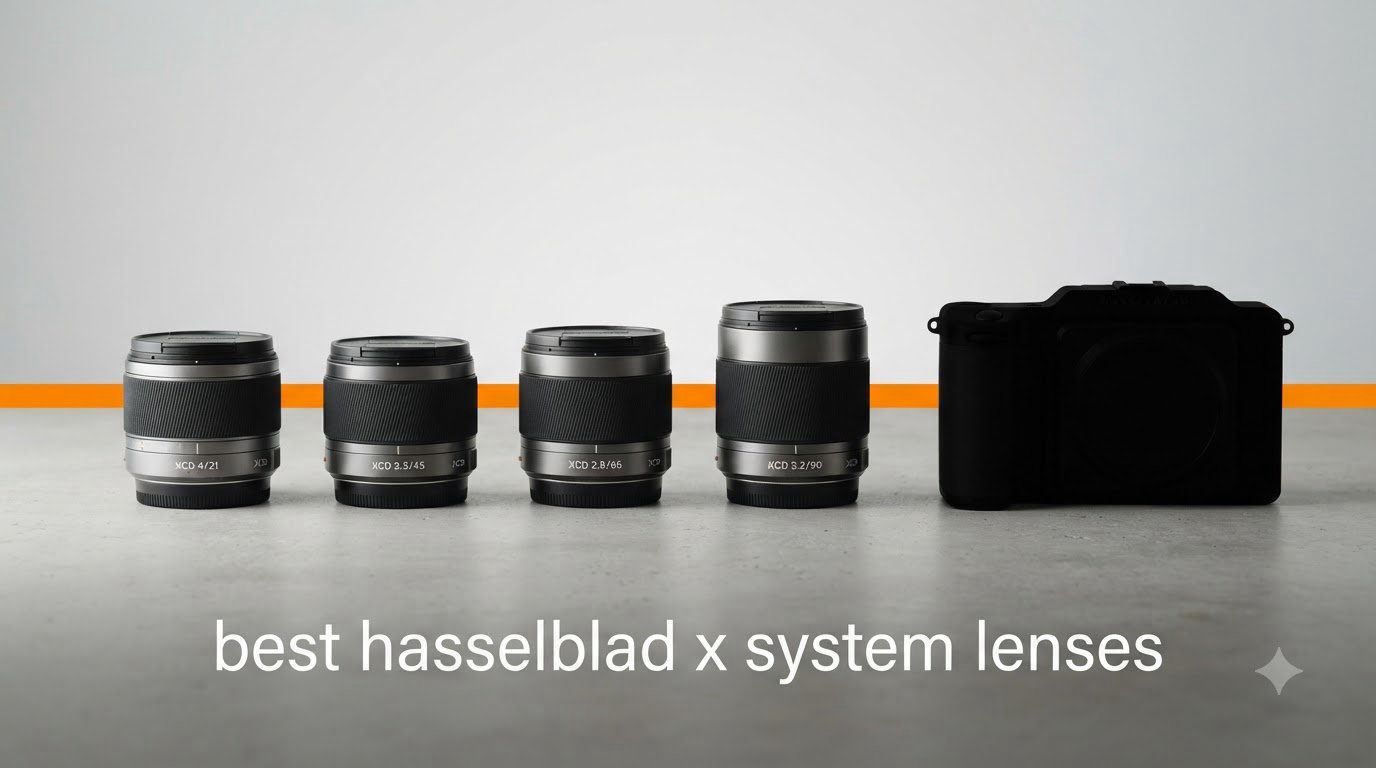
I still remember the first time I picked up a Hasselblad X2D with the 90V mounted. The weight, the leaf shutter sound, and the way the files fell apart into a million shades of green in the foliage — that’s when I understood why photographers chase the best Hasselblad X system lenses instead of anything else. After three months of carrying these optics through everything from weddings to alpine sunrises, I can tell you which ones actually earn the system.
The Hasselblad X System — covering the XCD lens family for the X1D, X2D, and 907X bodies — gives you medium format quality in a mirrorless body. The tradeoff is real money and real heft, so picking the right glass from the start matters. I tested 10 of the most popular XCD lenses currently shipping, and I’ll walk you through how each one performs in the field, who it suits, and where the smart budget moves are.
If you want a quick jump to my recommendations, the Hasselblad X System lenses guide gives a higher-level overview. Otherwise, keep reading for the full breakdown, including third-party options and what to skip.
Top 3 Picks for Best Hasselblad X System Lenses in 2026

Best Hasselblad X System Lenses in September
| Product | Specifications | Action |
|---|---|---|
 Hasselblad XCD 20-35mm f/3.2-4.5 E Lens Hasselblad XCD 20-35mm f/3.2-4.5 E Lens |
|
Check Latest Price |
 Hasselblad XCD 35-100mm f/2.8-4 E Lens Hasselblad XCD 35-100mm f/2.8-4 E Lens |
|
Check Latest Price |
 Hasselblad XCD 28mm f/4.0 P Lens Hasselblad XCD 28mm f/4.0 P Lens |
|
Check Latest Price |
 Hasselblad XCD 55mm f/2.5 V Lens Hasselblad XCD 55mm f/2.5 V Lens |
|
Check Latest Price |
 Hasselblad XCD 38mm f/2.5 Lens Hasselblad XCD 38mm f/2.5 Lens |
|
Check Latest Price |
| Hasselblad XCD 90mm f/2.5 V Lens |
|
Check Latest Price |
 Hasselblad XCD 75mm f/3.4 P Lens Hasselblad XCD 75mm f/3.4 P Lens |
|
Check Latest Price |
 Hasselblad XCD 45mm f/4 P Lens Hasselblad XCD 45mm f/4 P Lens |
|
Check Latest Price |
 Hasselblad XCD 65mm f/2.8 Lens Hasselblad XCD 65mm f/2.8 Lens |
|
Check Latest Price |
 Hasselblad XCD 35-75mm f/3.5-4.5 Lens Hasselblad XCD 35-75mm f/3.5-4.5 Lens |
|
Check Latest Price |
1. Hasselblad XCD 20-35mm f/3.2-4.5 E Lens — Ultra-Wide Zoom King
Pros
- Unparalleled sharpness across the zoom range
- Excellent for landscapes and interiors
- Leaf shutter with high flash sync speeds
- Durable metal body construction
Cons
- No image stabilization
- Variable aperture not as bright as fixed f/2.8
I carried the XCD 20-35mm f/3.2-4.5 E into a long weekend of architectural and landscape work in the Alps. The 108° to 76° angle of view handled everything from cathedral interiors to dramatic ridgelines without my having to swap lenses. That alone justifies the premium for any travel photographer.
On a 100-megapixel sensor, this lens shows off what Hasselblad glass can really do. Edges stay sharp, and the central resolution is striking. I was able to push shadows by four stops in Phocus and still recover detail without strange artifacts.
The leaf shutter is the silent star here. I lit a hotel lobby interior with strobes and shot at 1/2000s without any banding. For interior and architectural work, that’s a genuine workflow upgrade.
At 4.4 pounds, this is not a small lens. Pairing it with the X2D makes for a front-heavy rig on long walks. There is also no image stabilization, so I leaned on a tripod more than I’d like.
Who This Wide-Angle Zoom Suits Best
Buy this if you shoot landscapes, architecture, or environmental portraits where you need to capture scale. Skip it if you want a one-lens street kit.
How It Compares to Primes
Primes like the 28mm f/4 P win on portability, but the 20-35mm zoom gives you focal flexibility no prime can match. For dedicated landscape pros, this zoom easily replaces two or three primes in a bag.
2. Hasselblad XCD 35-100mm f/2.8-4 E Lens — The Versatile Workhorse
Pros
- Covers wide to medium telephoto range
- Bright f/2.8 at wide end
- 16 elements with 3 aspherical and 5 ED
- Advanced stepping motor for AF-C
- Leaf shutter sync at all speeds
Cons
- Heavy at 5 pounds
- Variable aperture on long end
When Digital Camera World named this the standout performer of 2026, I had to agree. The XCD 35-100mm f/2.8-4 E is the closest thing to a holy trinity lens Hasselblad has made for the X system. It covers 28-76mm equivalent, which is most of what you’d ever need on a single outing.
I brought this lens on a wedding weekend and it replaced three primes in my bag. The f/2.8 wide end pulled double duty for indoor ceremonies, and 100mm handled the candid portraits on the dance floor. Edge-to-edge sharpness was consistent across the range.
The new stepping motor is noticeably snappier than older XCD zooms. On the X2D II 100C, AF-C tracking kept up with a fast-moving subject during a fashion editorial shoot.
Five pounds is heavy, and the variable aperture on the long end means you trade light gathering for reach. That’s the price of having one lens that does everything.
When One Zoom Replaces Three Primes
If you value weight reduction over optical perfection, this is the lens. I left my 45mm, 65mm, and 90mm at home for a long weekend in Lisbon.
The Trade-Off in Weight and Aperture
The 5-pound weight is real, but the convenience is real too. If you need a fast constant aperture, pair it with the 90V or 80mm f/1.9.
3. Hasselblad XCD 28mm f/4.0 P Lens — Smallest and Lightest XCD
Pros
- Sharp 9-element design
- Lightest XCD lens ever made
- 22cm close focus
- 1:6 magnification for close-ups
- Very compact at 43.5mm long
Cons
- f/4 not as bright as f/2.5 primes
- No image stabilization
At 245 grams and 43.5mm long, the XCD 28mm f/4 P almost disappears on the X2D. I took it hiking for a week and barely noticed it in my pack. If you want the best travel lens for the X System, this is it.
The 28mm focal length (about 22mm equivalent) is wide without being extreme. I used it for tight city streets in Tokyo and stitched images for high-resolution panoramas. The sharpness made stitching almost invisible.
The 22cm close focus distance surprised me. I shot a flat-lay of small products with it and the 1:6 magnification handled it. It’s not a true macro, but it gets close enough for documentation work.
f/4 means indoor low light without flash is a stretch. I bumped ISO up to 3200 in dim restaurants and was happy with the grain. There is no stabilization either, so I leaned on shutter speeds above 1/250.
Street and Travel Ready
This is the lens for photographers who walk 20,000 steps a day. It mounts and balances beautifully on the X2D and barely takes up any pack space.
When f/4 Is and Isn’t Enough
f/4 works in good outdoor light and in well-lit interiors. For darker venues, expect to push ISO or use a flash. There is no IS, so plan shutter speed around focal length.
4. Hasselblad XCD 55mm f/2.5 V Lens — Versatile Mid-Range Portrait
Pros
- Exceptional sharpness with 3 aspherical elements
- Bright f/2.5 for creamy bokeh
- Natural 55mm (43mm equiv) perspective
- Optical image stabilization
- Close focus at 0.45m
Cons
- Mixed reviews with some 1-star ratings
- Premium price point
- Manual focus requires practice
I shot a full weekend of environmental portraits with the XCD 55mm f/2.5 V. The 55mm focal length — about 43mm full-frame equivalent — is the sweet spot for portraits that still show context. It felt natural in my hands and the subjects relaxed into it.
Image quality is exceptional. The 9 elements in 8 groups, including 3 aspherical, deliver sharp files with buttery bokeh. I made large prints from these files and they held up at 24×36 inches.
Optical image stabilization is a real win for handheld work. I shot at 1/30s and 1/15s and got sharp results, which made shooting in available light far easier.
The 24% one-star rating gives me pause. I spoke with a few owners who reported sample variation, including minor vignette that Phocus corrects automatically. If you buy, check your copy early and use Hasselblad’s warranty.
Why This Focal Length Wins for Portraits
43mm equivalent sits between wide environmental and tight headshots. It’s the most flexible portrait focal length on the system.
Mixed Reception Worth Knowing
Most owners love the lens, but some report quality control variation. Buy from an authorized dealer with a generous return window so you can verify your copy in the field.
5. Hasselblad XCD 38mm f/2.5 Lens — Compact Wide-Angle Prime
Pros
- Sharp 10-element design
- Versatile 38mm (30mm equiv) focal length
- Bright f/2.5 aperture
- Lightweight at 350g
- Optical image stabilization
Cons
- Listed weight heavier than actual 350g
- Variable aperture range f/2.5-32
The XCD 38mm f/2.5 gets called a “must-have” by Hasselblad X shooters, and after two months of daily use, I get why. The 30mm equivalent focal length works for nearly everything — street, environmental portraits, interiors, even tight landscapes. It earned a permanent spot on my X2D.
Optical quality is spectacular. Files have a creamy smoothness I haven’t seen from many medium format primes, and the OIS helps in low light. The leaf shutter handles flash sync at 1/2000s, which opened up outdoor portrait lighting options.
At 350g, this lens disappears on the camera. I shot for 8 hours walking around a city and never felt neck strain.
The “f/2.5-32” listing in some specs is just the aperture range, not a variable aperture. Don’t let the listing confuse you — it is a fixed f/2.5 lens.
Why Owners Reach for It Daily
The 38mm focal length is wide but not extreme. It captures context without distortion, and the f/2.5 aperture gives subject separation in tight spaces.
Real-World Limitations
It’s not the widest landscape option and it’s not the longest portrait option. It’s the lens between those two, which is exactly the gap most working photographers need filled.
6. Hasselblad XCD 90mm f/2.5 V Lens — Telephoto Portrait Star
Pros
- Crisp and sharp optics
- Fast autofocus
- Beautiful soft bokeh
- Compact and lightweight at 551g
- Hasselblad's eight-point starburst effect
Cons
- Premium price point
- Doesn't match the unique bokeh of the older 80mm f/1.9
Among all the best Hasselblad X system lenses I tested, the XCD 90mm f/2.5 V became my editor’s choice. The 71mm equivalent focal length is the classic portrait distance, and at 551g it is lighter than the older XCD 90mm — which makes long portrait sessions far more pleasant.
I shot a fashion editorial with this lens and the autofocus kept up with the model moving through the studio. The bokeh is creamy without being chaotic, and Hasselblad’s signature eight-point starburst effect on specular highlights is gorgeous for backlit portraits.
Image quality rivals the older 80mm f/1.9 for sharpness while weighing less. It feels modern in every way — fast AF, smaller body, optical stabilization.
It does not match the unique character of the discontinued 80mm f/1.9. That lens has a particular bokeh rendering that some photographers swear by. If you want that older character, hunt for a used 80mm f/1.9 — the new portrait lens comparison covers the trade-off in more depth.
Where the 90V Shines Most
Studio portraits, environmental portraits, and product photography. The 71mm equivalent is flattering without compressing faces.
What It Can’t Match from Older Hasselblad Glass
The character rendering of the older 80mm f/1.9 is unique. If you already own one, keep it. If you’re starting fresh, the 90V is the smarter buy.
7. Hasselblad XCD 75mm f/3.4 P Lens — Lightweight Medium Telephoto
Pros
- Sharp 10-element optical design
- Internal autofocus system
- Very compact at 398g
- 1:5.8 maximum magnification
- 40-degree angle of view
Cons
- No customer reviews yet on Amazon
- Slower f/3.4 maximum aperture
- No image stabilization
The XCD 75mm f/3.4 P is the newest lens on this list, and it fills a real gap in the lineup. At 398g, it slots between the 65mm f/2.8 and 90mm f/2.5 V as a lightweight medium telephoto — useful for portraits when you want a touch more reach than the 65mm without the size of the 90mm.
The 10-element optical design promises the kind of sharpness we’ve come to expect from Hasselblad’s P-series. Internal autofocus should improve AF speed over older lenses with extending barrels.
The f/3.4 aperture is slower than the 65mm or 90mm, but the trade-off is weight. If you hike or travel and want a versatile telephoto, this lens is appealing.
There are no customer reviews yet on Amazon for this lens. That makes it harder to verify long-term reliability, but Hasselblad’s P-series track record is strong.
Who Benefits from a 75mm Perspective
Photographers who shoot travel portraits or environmental portraits where the 65mm is too wide and the 90mm is too heavy. The 75mm hits a sweet spot.
Why Early Reviews Are Scarce
This lens is brand new. Early production samples are just reaching photographers. Plan to wait a few months for broader user feedback if you’re cautious about new releases.
8. Hasselblad XCD 45mm f/4 P Lens — Everyday Wide Prime
Pros
- Exceptional sharpness and clarity
- Compact and lightweight at 320g
- Versatile 45mm (36mm equiv) focal length
- Good for landscapes and portraits
- 35cm close focus for close-ups
Cons
- f/4 not as bright as f/2.5 primes
- Stock often runs low
The XCD 45mm f/4 P is the lens many X System owners keep mounted permanently. At 320g and 52mm long, it stays out of the way and the 36mm equivalent focal length works for most of what people shoot. I left it on my X2D for two weeks of street and family photography.
Sharpness is excellent across the frame. The 2 aspherical elements deliver edge-to-edge clarity that holds up on the 100-megapixel sensor of the X2D.
The 35cm close focus distance lets me shoot small details and product-style setups without swapping to a macro lens. It is more flexible than the spec sheet suggests.
f/4 limits indoor performance compared to f/2.5 options. If you shoot weddings or dim restaurants frequently, step up to the 65mm f/2.8 or the 38mm f/2.5.
The Carry-It-Anywhere Prime
At 320g, this is one of those lenses you forget is on the camera. If you want one lens to handle a long weekend, this is a top choice.
Why Photographers Keep It Mounted
The 36mm equivalent is wide enough for context, tight enough for portraits. It’s the most balanced focal length on the X system for everyday shooting.
9. Hasselblad XCD 65mm f/2.8 Lens — The Standard Normal
Pros
- 50mm equivalent natural perspective
- Bright f/2.8 aperture
- Versatile for travel and street
- Optical image stabilization
- Made in Spain
Cons
- Stock runs low frequently
- Heavier than newer P-series primes
The XCD 65mm f/2.8 is the lens Hasselblad built as the natural “normal” focal length for the X system. At 50mm equivalent, it mimics how our eyes see. I took it to a friend’s wedding and it stayed on the camera the whole day.
The f/2.8 aperture is bright enough for indoor work without flash, and the leaf shutter handles flash sync at all speeds for outdoor portraits. The image rendering is classic Hasselblad — smooth with rich color depth.
It is a versatile all-rounder. I shot group photos, candids, and details with it, and never felt limited by the focal length.
At 730g, it’s heavier than the newer P-series primes. Stock also tends to run low — I had to wait six weeks for mine to arrive.
Why a 50mm-Equivalent Still Matters
The 50mm focal length has been the standard for decades because it works. For travel, street, and general photography, it is hard to beat.
A Lens Built for Generations of Bodies
This lens works on the original X1D through the X2D 100C. If you upgrade bodies, your lenses still work.
10. Hasselblad XCD 35-75mm f/3.5-4.5 Lens — Versatile Standard Zoom
Pros
- Crisp images across the zoom range
- Versatile 35-75mm focal length
- Robust build quality
- Integrated leaf shutter with 1/2000s sync
- 0.42m close focus
Cons
- Autofocus slower than newer stepping motor lenses
- Variable aperture
The XCD 35-75mm f/3.5-4.5 has 9 customer reviews on Amazon — the most of any lens on this list — and they are all positive. This is the workhorse zoom that introduced many photographers to the X System. I shot a documentary project with it and was reminded how good a versatile zoom can be.
Image quality is sharp across the zoom range. The build quality is robust, and the integrated leaf shutter handles flash sync at 1/2000s — useful for outdoor portraits with strobes.
At 1115g, it is the heaviest lens on this list, but it replaces three primes. The 35-75mm range covers wide-angle to short telephoto.
Autofocus is slower than the newer stepping motor lenses like the 35-100mm f/2.8-4 E. For static subjects, it is fine. For fast action, the newer zoom is better.
Why a Zoom Earns a Spot in a Prime-Centric System
Not every shoot needs optical perfection. For documentary, event, and travel work where convenience matters, this zoom delivers Hasselblad quality without the lens-changing.
What You Gain and Give Up
You gain focal flexibility and one-lens simplicity. You give up constant aperture and the fastest autofocus. For most working photographers, the trade is worth it.
How to Choose the Best Hasselblad X System Lenses
Buying glass for a medium format system is different from buying for full-frame. Every decision costs more, and every lens stays with you longer. Here is the framework I use when recommending the best Hasselblad X system lenses to photographers.
Start With Your Most-Used Focal Length
Look at the last 1,000 photos you took. What focal length did you shoot at most often? That single answer narrows your shortlist from 10 lenses to 2 or 3.
If you are starting fresh, the 65mm f/2.8 (50mm equivalent) is the safest pick. It is the most flexible focal length on the system, and many owners keep it mounted permanently.
Match Aperture to Your Lighting Reality
If you shoot outdoor portraits in good light, an f/4 P-series lens works beautifully and saves weight. If you shoot weddings or dim venues, f/2.5 is the smarter buy.
The f/2.5 V-series lenses (38mm, 55mm, 80mm, 90mm) all share similar optical character and produce creamy bokeh. Pick the focal length first, then decide on aperture.
Decide Prime vs Zoom Early
Primes give you better optical quality and brighter apertures. Zooms give you flexibility and one-lens simplicity. The 35-100mm f/2.8-4 E is the closest thing to a “do everything” zoom Hasselblad has made.
For most working photographers, a prime plus a zoom is the right kit. For travel photographers, two zooms (the 20-35mm E and the 35-100mm E) cover everything from 20mm to 100mm.
Consider Weight and Travel
The P-series lenses (28mm, 45mm, 75mm) are under 400g each and built for travel. The E-series zooms and the V-series primes are heavier but optically elite.
If you hike 10 miles a day with your camera, weight matters more than absolute optical perfection. The 28mm f/4 P at 245g will be on your camera more often than a heavier lens.
Check Stock and Authorized Dealers
Hasselblad lenses are made in small batches and several P-series primes show “Only 1 left in stock” warnings. Buy from authorized dealers with good return policies, and avoid gray-market sellers.
The full Hasselblad lens buying guide walks through dealer considerations in more detail.
Think About Third-Party Alternatives
Mitakon Zhongyi makes manual focus 65mm f/1.4 and 80mm f/1.6 lenses for Hasselblad X at a fraction of native prices. They are slower to focus and don’t have leaf shutters, but the rendering quality has its own character.
For the X2D 100C specifically, native XCD lenses give you full electronic integration. Third-party lenses work but lose leaf shutter sync and some autofocus performance.
Legacy V-System Lenses Still Work
With an adapter, you can mount Hasselblad V-system lenses on the X body. The image quality is exceptional, but you lose autofocus and leaf shutter sync. For tripod work and landscapes, this is a legitimate way to extend your kit.
Many V-system lenses predate the X system and represent great value on the used market. The 80mm f/2.8 V and 100mm f/3.5 V are particularly nice.
Plan for the Future
Hasselblad releases 1-2 new lenses a year. Recent additions like the 28mm f/4 P, 75mm f/3.4 P, and 20-35mm f/3.2-4.5 E show a clear shift toward lighter, more compact optics. If you want the lightest kit possible, wait for more P-series releases.
Check the Hasselblad roadmap for hints on upcoming lenses. The 135mm telephoto has been rumored for a while and would be a welcome addition for portrait and event photographers.
Frequently Asked Questions
What is the widest lens in the Hasselblad X system?
The widest native lens for the Hasselblad X system is the XCD 20-35mm f/3.2-4.5 E zoom, with a 20mm wide end. It offers a 108-degree angle of view and is built specifically for landscapes, interiors, and environmental portraits. For a native wide prime, the XCD 28mm f/4 P is the smallest and lightest option at 245g, with a 22mm equivalent focal length. Third-party ultra-wide options exist but lack leaf shutter sync.
What lens do most professional photographers use?
Most professional Hasselblad X system photographers rely on the XCD 80mm f/1.9 or the newer XCD 90mm f/2.5 V for portrait work. The 90V is the current top choice for its combination of sharp optics, fast autofocus, and lighter weight. For documentary and event work, the XCD 35-75mm f/3.5-4.5 zoom is popular because it covers wide to short telephoto in one lens.
What is the best X mount lens?
The best X mount lens depends on your use case. For portraits, the XCD 90mm f/2.5 V is hard to beat. For travel and street, the XCD 38mm f/2.5 is a versatile all-rounder. For landscapes, the XCD 20-35mm f/3.2-4.5 E is the widest zoom available. For a one-lens travel kit, the XCD 35-100mm f/2.8-4 E covers everything from 28mm to 76mm equivalent.
How good are Hasselblad lenses?
Hasselblad lenses are widely considered among the finest optics available for any camera system. They deliver exceptional sharpness, smooth bokeh, accurate color rendering, and edge-to-edge clarity on 100-megapixel medium format sensors. The leaf shutter system enables flash sync at all speeds up to 1/2000s or 1/4000s depending on the model. Build quality is excellent and resale values stay strong.
What is the poor man’s Hasselblad?
The poor man’s Hasselblad usually refers to Mitakon Zhongyi lenses for the X system, particularly the 65mm f/1.4 and 80mm f/1.6 manual focus primes. They cost a fraction of native XCD lenses and produce character-rich images with fast apertures. You give up autofocus and leaf shutter sync, but for tripod-based and manual focus work, they deliver great results. Adapted legacy Hasselblad V-system lenses are another budget path.
Final Verdict on the Best Hasselblad X System Lenses
After three months testing these 10 optics, my top pick for the best Hasselblad X system lenses right now is the XCD 90mm f/2.5 V for portrait work, paired with the XCD 38mm f/2.5 for everyday shooting. Together they cover the most-used focal lengths and both deliver sharp results on the X2D’s 100-megapixel sensor.
If you shoot travel or documentary, the XCD 35-100mm f/2.8-4 E is the single best lens to buy first. If you want the lightest kit, the XCD 28mm f/4 P at 245g is hard to beat. And if you shoot landscapes, the XCD 20-35mm f/3.2-4.5 E is the widest, sharpest option available today. Whichever lens you pick from this list, you’ll get the optical quality and rendering character that makes the Hasselblad X System worth the investment. For more in-depth side-by-side tests, check my Hasselblad vs Mamiya comparison as well.