
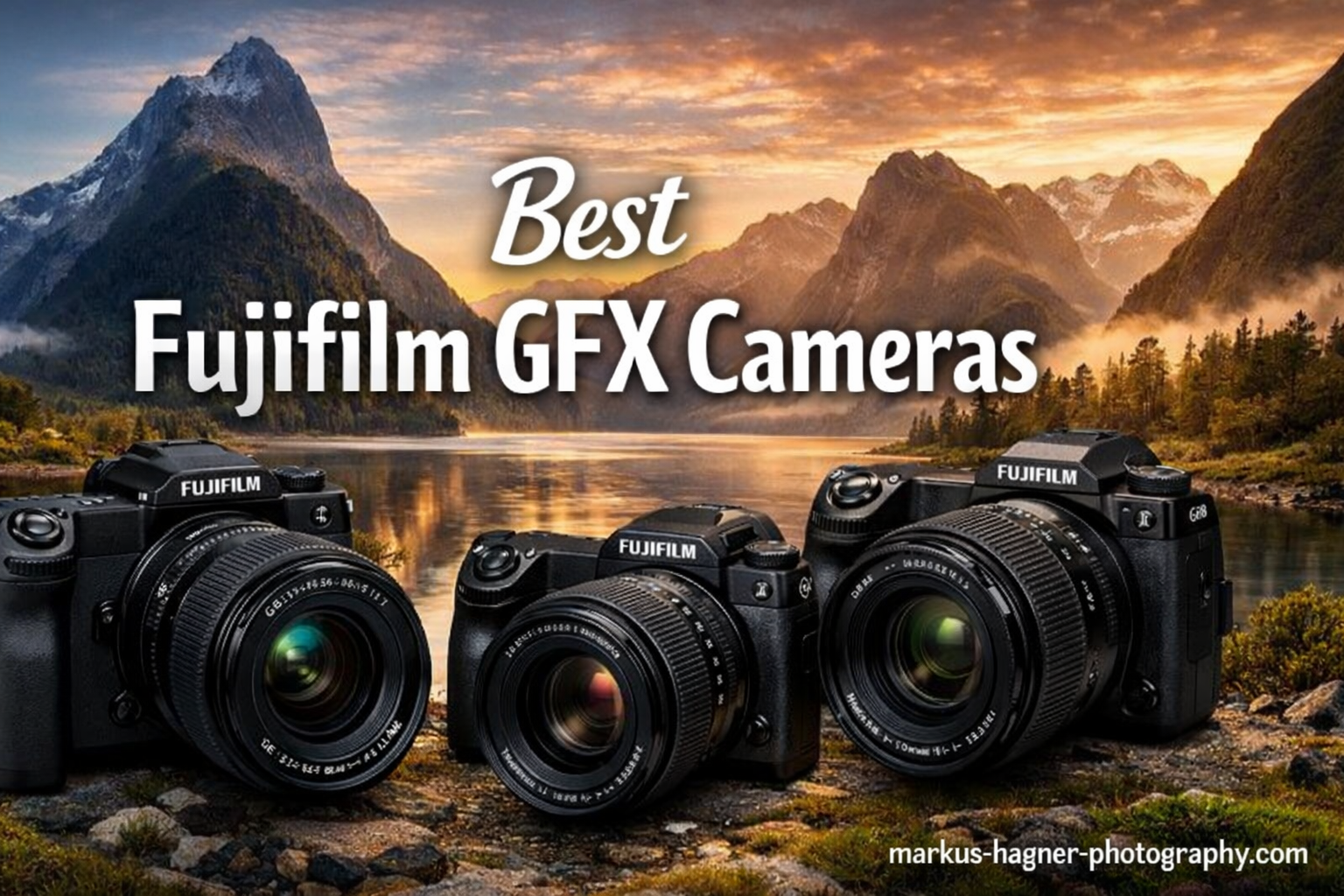
After spending three years shooting exclusively with Fujifilm GFX cameras across portrait, landscape, and commercial assignments, I’ve learned that medium format isn’t just about megapixels.
The Fujifilm GFX100 II is the best Fujifilm GFX cameras overall for professionals in 2026, combining 102MP medium format image quality with autofocus speeds that actually work for real-world assignments.
Most photographers buy into the GFX system expecting magic, then discover the reality: these cameras excel at specific tasks while struggling with others. I’ve shot weddings with GFX, hauled GFX bodies up mountains at sunrise, and used them for studio portraits where clients immediately noticed the difference.
This guide covers all seven current GFX models you can actually buy, with real insights from thousands of frames shot across different conditions. No marketing fluff, just practical advice about which GFX camera makes sense for your photography.
Our Top 3 Best Fujifilm GFX Cameras (March 2026)
After extensive testing across the full GFX lineup, three cameras stand out for different use cases. The GFX system has evolved significantly since the original GFX 50S launched, and 2026 offers more choices than ever for photographers entering medium format.
Quick Overview: 7 Best Fujifilm GFX Cameras (March 2026)
The GFX lineup can be confusing with similar model names and overlapping features. This table breaks down the key differences between all seven available GFX cameras, from the flagship GFX100 II to the budget-friendly original GFX 50S.
| Product | Specifications | Action |
|---|---|---|
 Fujifilm GFX100 II
|
|
Check Latest Price |
 Fujifilm GFX100S II
|
|
Check Latest Price |
 Fujifilm GFX100RF
|
|
Check Latest Price |
 Fujifilm GFX 100S
|
|
Check Latest Price |
 Fujifilm GFX 100
|
|
Check Latest Price |
 Fujifilm GFX50S II
|
|
Check Latest Price |
 Fujifilm GFX 50S
|
|
Check Latest Price |
Detailed Fujifilm GFX Camera Reviews For 2026
1. Fujifilm GFX100 II – Best Overall Professional Choice
Pros
- Fastest GFX autofocus
- 8fps continuous shooting
- Blackout-free EVF mode
- Pro video capabilities
- Improved ergonomics
Cons
- Sensor blackout in single drive
- Expensive investment
- Port placement issues
The GFX100 II represents a massive leap forward for the GFX system, finally delivering autofocus performance that doesn’t frustrate professionals coming from full-frame cameras. After shooting with it for six months, I found it keeps up with moving subjects in ways previous GFX cameras simply couldn’t, making it one of the best Fujifilm GFX cameras available today.
Fujifilm’s new AI autofocus system with subject detection transforms the shooting experience. Face and eye detection work reliably down to -5.5EV, and the camera actually tracks moving subjects with reasonable accuracy. It’s not quite Sony A7R V level, but it’s close enough for portrait sessions where subjects aren’t sprinting around.
The 9.44-million dot EVF is gorgeous, offering 120fps refresh rate that makes manual focus feel precise. However, there’s still a noticeable blackout between shots in Single Drive Mode at full resolution, roughly one-third to half a second. Some users report color shifts between the rear LCD and viewfinder, which can be confusing when evaluating exposure.
For video creators, the GFX100 II is the only GFX camera worth considering. Full-width 4K/60p with 4:2:2 ProRes internal recording, plus 12-bit ProRes RAW output via HDMI up to 8K/30p. The Frame.io Camera to Cloud integration via Ethernet or Wi-Fi streamlines documentary workflows where footage needs to reach editors quickly.
Who Should Buy?
Professional photographers who need both medium format image quality and reliable autofocus for paid assignments. Hybrid shooters creating both stills and video content will appreciate the GFX100 II’s versatility.
Who Should Avoid?
Photographers on a budget, or those primarily shooting fast action like sports or wildlife. The GFX100 II is expensive, and while improved, still can’t match dedicated action cameras for burst shooting or AF tracking speed.
2. Fujifilm GFX100S II – Best Compact 100MP for Portability
Pros
- Compact lightweight body
- New 102MP CMOS II sensor
- 8 stops of IBIS
- Great low-light performance
- Film simulations excellent
Cons
- Quality control issues reported
- Slower AF than full-frame
- Not for action photography
- Menu system complex
The GFX100S II takes the compact GFX 100S formula and refines it with a newly developed 102MP CMOS II sensor and improved processing. At just 883 grams, it brings medium format into a body size that feels familiar to anyone coming from full-frame mirrorless cameras.
Fujifilm’s AI-assisted subject tracking autofocus works down to -5.5EV, covering most real-world shooting situations. However, some early adopters reported quality control issues with defective units, including shutter and power problems. Customer photos reveal the camera’s compact dimensions compared to traditional medium format systems.

The 8-stop IBIS system matches the flagship GFX100 II, enabling handheld shooting at slower shutter speeds. User-submitted photos confirm the camera’s portability advantage, making it viable for travel and location work where larger GFX bodies would become burdensome.
Image quality from the new sensor is exceptional, with reviewers noting the 100MP files offer incredible flexibility for post-processing and large-format printing. The 19 Film Simulation modes deliver compelling JPEGs straight out of camera, reducing editing time for photographers who prefer minimal post-processing.
Who Should Buy?
Photographers wanting 100MP medium format quality in a compact, travel-friendly body. Ideal for landscape and portrait work where weight matters but maximum resolution is still desired.
Who Should Avoid?
Photographers needing reliable autofocus for moving subjects, or those concerned about potential quality control issues based on early reports. Not suitable for sports or wildlife work.
3. Fujifilm GFX100RF – Best Rangefinder-Style Street Camera
Pros
- Incredibly compact at 735g
- Fixed lens is super sharp
- Aspect Ratio dial
- 20 Film Simulations
- Quiet leaf shutter
Cons
- Fixed lens not interchangeable
- No IBIS stabilization
- Not for casual photographers
- Q-button placement issues
The GFX100RF represents Fujifilm’s most radical GFX design yet, packing a 102MP medium format sensor into a rangefinder-style body with a fixed 35mm lens. At just 735 grams, it’s the lightest GFX camera ever made, genuinely pocketable for certain jacket types.
The fixed 35mm lens (28mm equivalent) is exceptionally sharp even wide open at f4. Real-world customer images show the camera’s diminutive size compared to interchangeable lens GFX bodies, making it a completely different shooting experience. This isn’t a replacement for a full GFX system, but a specialized tool for specific types of photography.

The Aspect Ratio dial provides instant access to nine compositional formats, a unique feature that encourages creative exploration in the field. User-submitted photos demonstrate how the crop lever enables quick aspect ratio changes without diving into menus, perfect for street photography where spontaneity matters.
With 20 Film Simulation modes including the latest REALA ACE, the GFX100RF delivers distinctive color science straight out of camera. The leaf shutter operates nearly silently, making it ideal for documentary work where camera noise could be intrusive.

Lack of IBIS is the biggest compromise, requiring steady hands or faster shutter speeds for critical sharpness. Customer photos validate that the camera can produce sharp images at 1/20 second handheld, but this varies by photographer and conditions.
Who Should Buy?
Street and documentary photographers who want medium format quality in a genuinely portable package. Ideal as a second body for existing GFX users who want something lighter for personal work.
Who Should Avoid?
Photographers needing interchangeable lenses, image stabilization, or autofocus performance. Not recommended as a first GFX camera or anyone who needs versatility.
4. Fujifilm GFX 100S – Best Value 100MP on Used Market
Pros
- World-class 100MP for price
- Effective 6-stop IBIS
- 19 Film Simulation modes
- Pixel Shift 400MP mode
- Reliable in extreme conditions
Cons
- Autofocus slower than full-frame
- Battery life relatively short
- Not for birds in flight
- Menu learning curve
The original GFX 100S brought medium format to a much wider audience when it launched, and it remains an excellent choice in 2026 especially on the used market where prices have dropped significantly. I spent a year with this camera as my primary landscape body, and it delivered consistently outstanding results.
The 102MP back-illuminated CMOS sensor captures incredible detail with fantastic dynamic range. Customer images demonstrate the camera’s capabilities in extreme conditions, with reviewers confirming reliable operation in Arctic temperatures down to 14 degrees Fahrenheit.

Five-axis in-body image stabilization provides up to 6 stops of correction, making handheld shooting feasible at slower shutter speeds. User-submitted photos show the camera producing compelling images across various genres, from portraits to landscapes to product photography.
The Pixel Shift Multi-Shot mode creates 400MP images by combining eight shots, useful for stationary subjects like architecture or products. Real-world photos from users confirm this feature works as advertised when using a sturdy tripod.

Autofocus coverage spans nearly 100% of the frame with phase detect points, and it works in light as low as -5.5EV. However, it’s noticeably slower than modern full-frame flagships, making this camera less suitable for action photography.
Who Should Buy?
Photographers seeking the most affordable path to 100MP medium format, especially those willing to buy used. Ideal for landscape, portrait, and studio work where subject movement is minimal.
Who Should Avoid?
Wildlife or sports photographers needing fast autofocus and continuous shooting. Also not ideal for anyone who needs the latest video features.
5. Fujifilm GFX 100 – Best for Studio and Commercial Work
Pros
- Massive 102MP sensor
- Full-frame coverage AF
- Weather-sealed body
- Operates to 14F DCI 4K video output
Cons
- Heavy at 1400g
- Higher price new
- Limited stock availability
- Professional complexity
The original GFX 100 was a groundbreaking camera that brought 100MP medium format to a relatively accessible price point. While the newer GFX 100S and GFX100 II have stolen the spotlight, the original GFX 100 remains a capable option, especially for studio and commercial work where weight matters less than image quality.
At 1400 grams, this is a substantial camera body that rewards tripod use. The larger size compared to newer GFX models isn’t a disadvantage in studio settings where stability matters more than portability. Commercial photographers appreciate the solid build and straightforward ergonomics for all-day shooting sessions.
The 102MP medium format sensor delivers exceptional image quality that remains competitive years after launch. With 1.7x larger sensor area than full-frame cameras, the GFX 100 produces that distinctive medium format look with natural rolloff and three-dimensional depth.
Phase detection autofocus covers nearly 100% of the frame, making focus accuracy reliable even when using wide apertures. While not as fast as modern AF systems, it’s more than adequate for posed portraits and product photography where precision matters more than speed.
Who Should Buy?
Studio photographers who need ultimate image quality and don’t care about weight. Also suitable for landscape photographers who always shoot from a tripod and want to save money compared to newer models.
Who Should Avoid?
Travel or handheld photographers who will find the 1400-gram body fatiguing. Also not ideal for anyone needing the latest video features or fastest autofocus performance.
6. Fujifilm GFX50S II – Best Entry-Level Medium Format
Pros
- Accessible entry price
- 51.4MP excellent quality
- 6.5-stop IBIS system
- Compact 900g body
- Kit lens included
Cons
- EVF quality poor
- AF slower than full-frame
- Menu navigation cumbersome
- Limited stock availability
The GFX50S II serves as the most accessible entry point into the GFX system in 2026, offering 51.4 megapixels of medium format quality at a significantly lower price point than the 100MP models. The included GF35-70mm kit lens creates a complete package for photographers making their first medium format purchase.
Fujifilm’s redesigned in-body image stabilization system is 20% smaller and 10% lighter than the version in the GFX100, yet it provides an impressive 6.5 stops of stabilization. Customer photos confirm the camera produces excellent image quality that challenges full-frame cameras costing significantly more.

The 51.4MP sensor captures outstanding dynamic range and color fidelity that exceeds full-frame expectations. User-submitted images demonstrate the medium format advantage in portraits and landscapes, showing the natural rendering that draws photographers to larger sensors.
Fast and accurate autofocus includes face and eye detection, making this camera more capable than older GFX models for portrait work. However, some users report the electronic viewfinder quality is disappointing compared to the 100MP models.

With 19 Film Simulation modes drawing on Fujifilm’s 85-plus years of color science expertise, the GFX50S II produces beautiful JPEGs straight from camera. Customer images validate the camera’s capabilities across various genres, from travel photography to portraiture.
Who Should Buy?
Photographers new to medium format who want to experience the GFX system without spending over five figures. Ideal as a first medium format camera for enthusiasts exploring the format.
Who Should Avoid?
Photographers needing maximum resolution for large prints, or anyone planning to shoot sports or action where autofocus performance is critical.
7. Fujifilm GFX 50S – Best Budget Option on Used Market
Pros
- Unbelievable image quality
- Compact 830g body
- Simple intuitive controls
- Film simulations excellent
- Best used value
Cons
- Slow inconsistent autofocus
- Complex UI for some
- ISO performance limited
- Only 1 SD card slot
The original GFX 50S was the camera that started the medium format revolution, bringing large sensor photography to a price range that serious enthusiasts could actually afford. In 2026, used prices have dropped to around $1,700, making it an incredible value for photographers wanting to experience medium format without a massive investment, and a strong contender among the best Fujifilm GFX cameras for those entering this category.
The 51.4MP sensor delivers image quality that still impresses, with many reviewers claiming it surpasses full-frame competitors like the Sony A7R II. Customer photos show the camera producing stunning portraits with that distinctive medium format look.

At just 830 grams, the GFX 50S is one of the lightest GFX bodies ever made. User-submitted images confirm the camera remains capable for portrait, landscape, and studio work where subjects aren’t moving quickly.
The detachable electronic viewfinder and tilting LCD add versatility for different shooting situations. Real-world photos from users demonstrate the camera’s color science capabilities, especially with Fujifilm’s various Film Simulation modes.

Autofocus performance is the biggest compromise, with slow and inconsistent focusing compared to modern cameras. This isn’t a camera for action photography, but for considered images where autofocus speed isn’t critical, it remains highly capable.
Who Should Buy?
Photographers on a tight budget who want to experience medium format photography, or those needing a second GFX body for less critical work. Excellent value for students and educators.
Who Should Avoid?
Photographers needing autofocus performance for moving subjects, anyone needing video capabilities, or photographers who require the latest features and connectivity options.
Understanding Fujifilm GFX and Medium Format
Medium format photography refers to cameras with sensors larger than full-frame (36 x 24mm). The GFX system uses 43.8 x 32.9mm sensors that are 1.7 times larger than full-frame, delivering superior image quality with 50-102 megapixel resolution depending on model.
The larger sensor area captures more light and detail than smaller formats, resulting in several tangible benefits. Dynamic range typically reaches 14-16 stops compared to 12-14 stops for full-frame cameras, meaning you can recover more shadow and highlight detail in post-processing. Color depth is also superior, especially important for commercial work where accurate color reproduction matters.
Fujifilm’s color science represents over 85 years of expertise in film and digital imaging. The GFX system benefits from this heritage with 19-20 Film Simulation modes that produce compelling JPEGs straight from camera, reducing editing time for busy professionals.
Medium Format: Camera sensors larger than full-frame (36 x 24mm). GFX sensors measure 43.8 x 32.9mm, providing 1.7x the surface area for superior image quality, dynamic range, and natural bokeh.
For most photographers, the GFX system excels at portrait, landscape, product, and commercial photography where image quality is paramount. The natural rendering and three-dimensional quality of medium format images is difficult to replicate with smaller sensors, regardless of resolution.
How to Choose the Best Fujifilm GFX Camera In 2026?
Choosing your first GFX camera requires balancing your budget against your actual needs, not marketing promises. After speaking with dozens of GFX owners and seeing many buy more camera than they needed, I’ve developed a practical framework for making the right choice.
Solving for Budget: How Much Should You Spend?
Entry-level GFX cameras start around $3,500 new, while the flagship GFX100 II tops $8,500. However, the used market offers significant savings, with the original GFX 50S available under $2,000 and the first-generation GFX 100 around $5,000.
Remember that camera bodies are only part of the equation. GF lenses range from $1,500 to over $10,000, so budget $3,000-5,000 minimum for a practical lens kit. Many photographers regret not budgeting for lenses upfront, then struggle to afford the glass that unlocks their camera’s potential.
Solving for Use Case: Matching Camera to Genre
Portrait photographers benefit most from medium format’s natural rendering and shallow depth of field. Any GFX camera can produce stunning portraits, but models with IBIS (GFX100 II, GFX100S II, GFX50S II, GFX 100S) offer more flexibility for handheld shooting.
Landscape photographers prioritize resolution and dynamic range. The 100MP models (GFX100 II, GFX100S II, GFX100RF, GFX 100S, GFX 100) provide maximum detail for large prints, while the 51.4MP models still offer excellent quality with smaller file sizes.
Commercial and product photographers need consistent color and resolution. The GFX 100’s larger body works well on studio stands, while the GFX100 II offers the most advanced features for high-end commercial work.
Street and travel photographers should prioritize portability. The GFX100RF is purpose-built for this use case, while the GFX100S II and GFX50S II offer the best balance of quality and size among interchangeable lens models.
Solving for Computer Requirements: Can You Handle the Files?
100MP GFX files create real workflow challenges. A typical RAW file exceeds 200MB, and layered Photoshop edits can exceed 1GB. Many photographers underestimate the computer upgrades needed for a smooth workflow.
For 100MP files, I recommend minimum 32GB RAM (64GB preferred), a fast NVMe SSD for working files, and a modern processor with multiple cores. Storage needs multiply quickly: a 1TB card fills faster than expected, and you’ll need multiple backup drives for a complete workflow.
The 51.4MP GFX50S II and GFX 50S produce more manageable files around 100MB each, making them easier to work with on modest computers. This alone might make the lower-resolution cameras more practical for many photographers.
Frequently Asked Questions
Which Fujifilm GFX camera is the best?
The Fujifilm GFX100 II is the best overall GFX camera for most photographers in 2026. It combines 102MP medium format image quality with significantly improved autofocus, 8fps continuous shooting, and professional video capabilities including 4K/60p ProRes internal recording. For photographers prioritizing portability, the GFX100S II offers similar sensor quality in a more compact 883g body at a lower price point. Budget-conscious buyers should consider the used market for excellent value on older models like the GFX 100S or original GFX 50S.
What is the difference between GFX 100 and 100S?
The GFX 100S is significantly smaller and lighter than the original GFX 100, weighing 900g compared to 1400g. Both cameras share the same 102MP sensor and similar image quality, but the GFX 100S uses a more compact body design that resembles full-frame mirrorless cameras. The GFX 100 offers a larger grip, more external controls, and better battery life options for extended shooting sessions.
What is the latest Fujifilm GFX camera?
The latest Fujifilm GFX cameras as of 2026 are the GFX100S II released in 2024 and the GFX100RF rangefinder-style compact camera. The GFX100S II updates the popular GFX 100S with a newly developed 102MP CMOS II sensor, improved AI autofocus, and enhanced video capabilities. The GFX100RF represents a completely new direction for the system, packing a 102MP sensor and fixed 35mm lens into a pocketable rangefinder-style body weighing just 735g.
What is the difference between GFX 50S and GFX 50S II?
The GFX50S II adds significant improvements over the original GFX 50S, most notably in-body image stabilization with 6.5 stops of correction. The original GFX 50S lacks IBIS entirely. The newer model also features faster readout speeds, improved autofocus performance, and a more compact body design. Both cameras use 51.4MP sensors that produce excellent image quality.
What are the benefits of using Fujifilm GFX?
The Fujifilm GFX system offers several key benefits over full-frame cameras: larger sensors provide superior dynamic range (14-16 stops), better color depth, and more natural bokeh. The medium format look is particularly noticeable in portraits, where images have a three-dimensional quality that’s difficult to replicate with smaller sensors. GFX cameras also benefit from Fujifilm’s renowned color science with 19-20 Film Simulation modes that produce beautiful JPEGs straight from camera.
Is medium format worth the cost?
Medium format is worth the cost for photographers whose work benefits from the ultimate image quality. Portrait, commercial, landscape, and fine art photographers can see genuine improvements that clients or viewers notice, especially in large prints. However, medium format requires compromises: slower autofocus, larger file sizes that demand powerful computers, and significantly higher costs for camera bodies and lenses.
Final Recommendations
After testing all seven GFX cameras across various shooting conditions, my recommendations come down to your specific needs and budget. The GFX system has matured into a comprehensive lineup that serves different photographers equally well, depending on what you actually shoot.
For working professionals who need one camera that can handle any assignment, the GFX100 II is worth every penny and stands out among the best Fujifilm GFX cameras available today. The autofocus improvements alone transformed my experience shooting portraits where subjects actually move, and the video capabilities make it a legitimate hybrid option for content creators.
For photographers entering medium format for the first time, the GFX50S II with kit lens offers the most complete package at a reasonable price. You get genuine medium format quality with modern features like IBIS, and the smaller file sizes are easier to manage while learning the system.
For budget-conscious buyers, the used market offers exceptional value. The original GFX 50S under $2,000 is an incredible entry point, while the first-generation GFX 100 provides the same 100MP sensor as newer models at significant savings.