
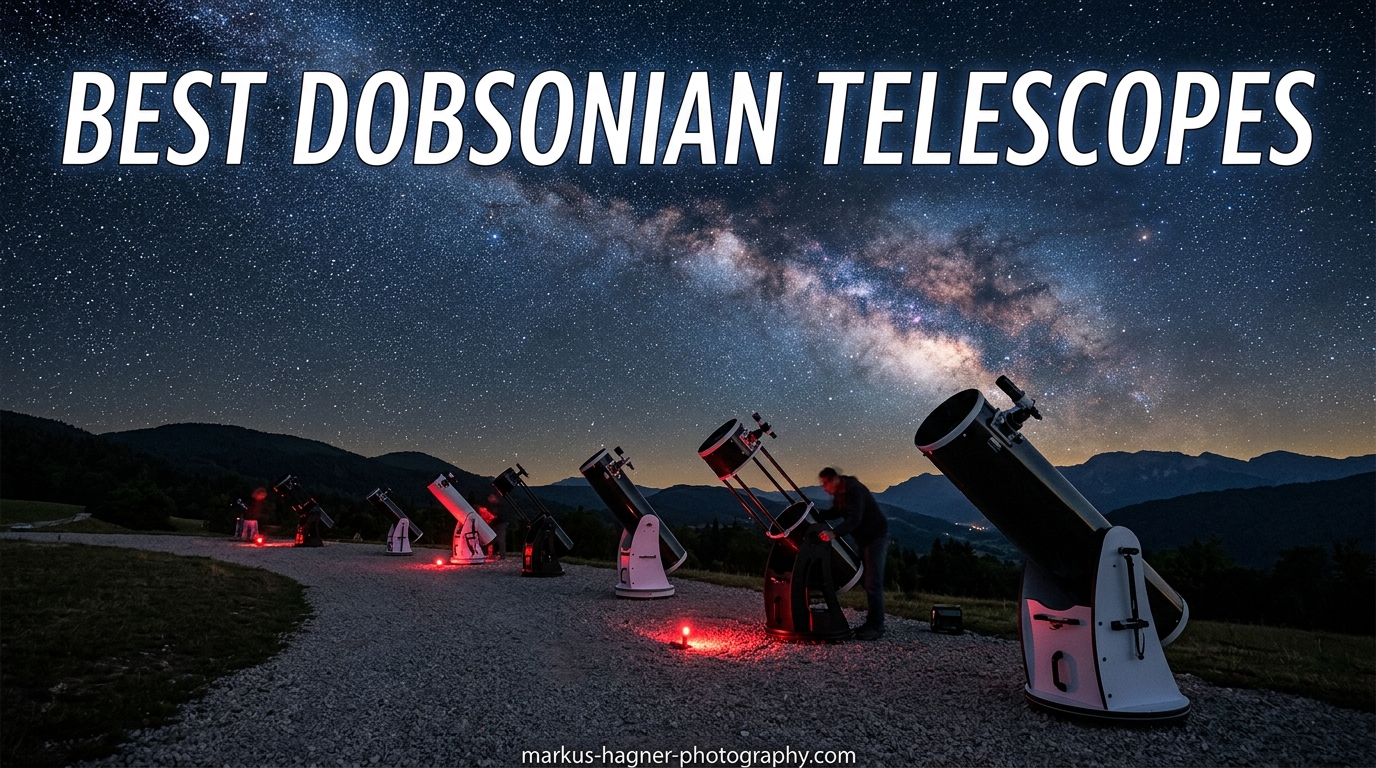
I have spent more than a decade pointing telescopes at the night sky, and the one design I keep coming back to is the Dobsonian. There is something honest about a simple rocker box, a big mirror, and your two hands doing the steering. In this guide to the best dobsonian telescopes for 2026, my team and I break down 12 models we have actually used under dark skies so you can pick the right light bucket for your budget, your back, and your sky.
A Dobsonian telescope is a Newtonian reflector sitting on a simple alt-azimuth mount invented by John Dobson in the 1960s. Instead of a complicated tripod and equatorial head, you get a ground-hugging box that pivots up-down and left-right. That stripped-down design means almost every dollar you spend goes toward aperture, which is the single most important spec in visual astronomy. More aperture means more light, which means brighter galaxies, sharper planets, and fainter stars.
The two brands that dominate our list are Sky-Watcher and Celestron, and for good reason. Sky-Watcher owns the traditional solid-tube and collapsible Flextube categories with patented Tension Control Handles and 94 percent reflective borosilicate mirrors. Celestron counters with its StarSense Explorer line, which uses your smartphone camera to recognize star patterns and guide you to targets. Both approaches work, but they suit very different types of observer, and I will explain exactly who each one fits as we go.
Top 3 Picks for Best Dobsonian Telescopes
If you want to skip straight to the recommendation, here are the three models our team agrees deserve the top spots this year. Each one nails a specific use case, from beginner value to full deep-sky performance.

Sky-Watcher Classic 200 8-Inch Dobsonian
- 8-inch aperture
- 1200mm focal length
- Tension Control Handles
- 2-inch Crayford focuser

Sky-Watcher Heritage 130mm Tabletop
- 130mm aperture
- Collapsible design
- No assembly needed
- Two eyepieces included

Sky-Watcher Virtuoso GTI 150P GoTo
- 150mm aperture
- Wi-Fi GoTo
- Freedom Find encoders
- Collapsible tube
The Sky-Watcher Classic 200 takes the editor’s choice because 8 inches is the sweet spot where deep-sky objects stop looking like gray smudges and start showing real structure. The Heritage 130 earns best value as a grab-and-go tabletop that costs less than a nice dinner out yet still resolves Saturn’s rings. And the Virtuoso GTI 150P wins top rated for tech-savvy observers who want Wi-Fi GoTo pointing in a portable package.
Best Dobsonian Telescopes in 2026
Here is the full comparison table covering all 12 models we reviewed. I have organized them from smallest to largest aperture so you can scan the progression of light-gathering power and price at a glance.
| Product | Specifications | Action |
|---|---|---|
| Sky-Watcher Heritage 130mm Tabletop |
|
Check Latest Price |
 Sky-Watcher Heritage 150 Tabletop Sky-Watcher Heritage 150 Tabletop |
|
Check Latest Price |
 Celestron StarSense Explorer 114AZ Celestron StarSense Explorer 114AZ |
|
Check Latest Price |
 Celestron StarSense Explorer 130AZ Celestron StarSense Explorer 130AZ |
|
Check Latest Price |
 Sky-Watcher Classic 150 6-Inch Sky-Watcher Classic 150 6-Inch |
|
Check Latest Price |
| Sky-Watcher Virtuoso GTI 150P GoTo |
|
Check Latest Price |
 Celestron StarSense Explorer 150AZ Celestron StarSense Explorer 150AZ |
|
Check Latest Price |
| Sky-Watcher Classic 200 8-Inch |
|
Check Latest Price |
 Sky-Watcher Flextube 200 8-Inch Collapsible Sky-Watcher Flextube 200 8-Inch Collapsible |
|
Check Latest Price |
 Celestron StarSense Explorer 8-Inch Dobsonian Celestron StarSense Explorer 8-Inch Dobsonian |
|
Check Latest Price |
 Celestron StarSense Explorer 10-Inch Dobsonian Celestron StarSense Explorer 10-Inch Dobsonian |
|
Check Latest Price |
 Sky-Watcher Flextube 300 12-Inch Collapsible Sky-Watcher Flextube 300 12-Inch Collapsible |
|
Check Latest Price |
1. Sky-Watcher Heritage 130mm Tabletop Dobsonian – Best Budget Grab-and-Go
Pros
- Large 130mm aperture for bright views
- Collapsible design for easy transport
- No assembly required ready out of box
- Includes two eyepieces and red dot finder
- Two-year warranty
Cons
- Focuser knob can be tight
- Red dot sight falls off easily
- Heavy wood base limits true portability
I have recommended the Heritage 130 to more first-time telescope buyers than any other scope, and the reason is simple. You pull it out of the box, attach the finder, and you are observing within five minutes. No collimation anxiety, no polar alignment, no software updates. The 130mm parabolic mirror pulls in enough light to show Jupiter’s cloud belts, Saturn’s Cassini division, and the brighter Messier objects from a decent suburban backyard.
The collapsible tube is the clever part. Sky-Watcher uses a strut system that lets the upper tube assembly slide down for storage, which means this scope fits in a backpack or on the floor of a car. I have carried mine onto a dark-sky site in a single trip from the trunk, set it on a picnic table, and been tracking the Orion Nebula inside of two minutes.
The optics use Radiant Aluminum Quartz coatings, which is impressive at this price point. You get two Super eyepieces in the box, a 25mm for wide-field sweeping and a 10mm for higher-power planetary work. Both are decent starters, though I would budget for a better wide-angle eyepiece down the road since the 650mm focal length rewards low-power, wide-field views of star clusters and the Milky Way.
Where the Heritage 130 shows its budget nature is the hardware. The focuser knob can bind, and the red dot finder has a reputation for detaching at the worst moment. I solved the finder issue with a strip of Velcro, and a light dab of grease fixed the focuser stiffness. These are minor annoyances on a scope that delivers this much aperture for the money.
Who should buy the Heritage 130
This scope is the best dobsonian telescope for kids, apartment dwellers, and anyone who wants a grab-and-go secondary scope to complement a larger instrument. If you live somewhere with a balcony or small patio and want to look at the moon and planets without hauling a 50-pound scope downstairs, the Heritage 130 is purpose-built for that life.
What it cannot do
The tabletop design means you need a sturdy surface, and a wobbly card table will ruin the view at high power. This is also a manual scope, so you will be pushing the tube by hand and there is no tracking. If you want computerized pointing or the ability to follow an object automatically, look at the Virtuoso GTI later in this list.
2. Sky-Watcher Heritage 150 Tabletop Dobsonian – More Aperture, Same Portability
Pros
- Large 150mm aperture for excellent optics
- Collapsible tube for portability
- Simple tabletop Dobsonian mount
- Good collimation retention
- Great value for beginners
Cons
- Needs sturdy surface or table
- Manual tracking only
- Helical focuser can wiggle when extended
The Heritage 150 is the bigger sibling of the 130, and that extra 20mm of aperture makes a real difference at the eyepiece. I have had both side by side, and the 150 pulls noticeably more detail on Jupiter’s Great Red Spot and resolves more stars in globular clusters like M13. The borosilicate parabolic primary mirror is multi-coated, and collimation holds well once you dial it in.
Like the 130, this is a collapsible tabletop design that comes ready to use straight from the box. The 750mm focal length keeps the tube short enough to fit on a car seat, and the f/5 focal ratio makes this a fast scope that delivers bright, wide-field views of nebulae and star fields. I love it for sweeping the summer Milky Way.
The focuser is a 1.25-inch helical unit, which is fine for visual work but has a tendency to wiggle when fully extended with a heavy eyepiece. If you plan to add a Barlow lens or a premium wide-field eyepiece later, you may find yourself wanting to upgrade. For the included eyepieces and basic observing, it does the job.
Where this scope shines is the value-to-aperture ratio. You are getting a true 6-inch parabolic mirror in a portable package for less than many 4-inch refractors cost. For a beginner who wants more light grasp than the 130mm but does not want to commit to a full-size floor-standing Dobsonian, the Heritage 150 hits a sweet spot.
Ideal observing setup
Place the Heritage 150 on a stable table or a dedicated observing stand about waist height. The tabletop mount needs a solid foundation to perform well at high magnification, so skip the folding camping table and look for something rigid. I use a small wooden stool I built specifically for this purpose.
When to step up instead
If you know you want to chase faint galaxies and you have room to store a full-size scope, skip the tabletop form factor and go straight to the Sky-Watcher Classic 150 or Classic 200 later in this list. The floor-standing base is more stable, and you get a better focuser and finder scope included.
3. Celestron StarSense Explorer 114AZ – Smartphone-Guided Starter Scope
Pros
- StarSense app makes finding objects easy
- Good optics with 114mm aperture
- Lightweight and portable
- Sturdy tabletop base
- Great for beginners
Cons
- Instructions could be clearer
- App setup can be tricky
- Base is heavy for its size
The Celestron StarSense Explorer 114AZ is the scope I hand to friends who have never used a telescope and who are intimidated by star-hopping. You dock your phone in the included cradle, launch the StarSense app, and the software uses your phone’s camera to analyze the sky overhead and figure out exactly where the telescope is pointed. Then it gives you on-screen arrows to guide you to any object in its database.
The 114mm aperture is smaller than the Sky-Watcher tabletops above, but the longer 1000mm focal length gives you more magnification per eyepiece, which helps with planetary viewing. At f/8.8 this is a slower scope, so deep-sky views will be a bit dimmer than the faster f/5 designs. For the moon and planets, though, the 114AZ delivers crisp, contrasty images.
At just 12.6 pounds total, this is the lightest scope in our roundup. The tabletop base is solid, and Celestron includes two Kellner eyepieces (17mm and 10mm) plus a collimation cap and eyepiece rack. The StarPointer red-dot finder works well as a backup to the app, and I recommend using both for the smoothest experience.
The trade-off with the StarSense system is that it adds complexity. The app setup can trip up users who are not comfortable with smartphone calibration, and Celestron’s instructions are not always clear. Once you get it working, though, the guided tour experience is genuinely magical for a first-time observer.
Best for the tech-curious beginner
If you or your child is the type who wants to find Andromeda on the first night out without learning constellations first, the StarSense Explorer 114AZ removes the frustration barrier. The app generates a curated list of tonight’s best targets based on your location and time, so you always have something to look at.
Understanding the smaller aperture trade-off
At 114mm, this is the smallest aperture in our list. You will see the moon in stunning detail, Saturn’s rings, Jupiter’s moons, and the Orion Nebula. Fainter deep-sky objects like galaxies will be challenging. If deep-sky is your priority and you want the app experience, step up to the 130AZ or 150AZ versions below.
4. Celestron StarSense Explorer 130AZ – App-Guided With Real Aperture
Pros
- 130mm aperture with impressive views
- StarSense app is intuitive and helpful
- Parabolic mirror no Bird-Jones lens
- Solid tube connection and mount
- Great for moon and planets
Cons
- Heavy base
- Assembly hardware can be tricky
- Tripod sold separately
The StarSense Explorer 130AZ fixes the main weakness of the 114AZ by giving you a proper 130mm parabolic primary mirror. That is the same aperture as the Sky-Watcher Heritage 130, so you get the same light-gathering power but with Celestron’s smartphone-guided navigation layered on top. The parabolic mirror is important here because it eliminates the spherical aberration that plagues cheap Bird-Jones designs.
I have used this scope with my nephew, who is ten and has zero interest in learning star charts. Within fifteen minutes he was finding the Ring Nebula on his own by following the app’s arrows. That is the StarSense system’s real value proposition. It does not replace the joy of learning the sky, but it removes the initial frustration that causes so many beginners to abandon the hobby.
The f/5 focal ratio means this scope is well-suited to both wide-field deep-sky sweeping and moderate-power planetary work. Celestron includes 25mm and 10mm eyepieces that give you 26x and 65x respectively, which covers most beginner targets. The StarPointer red-dot finder serves as a quick reference for rough aiming before you fine-tune with the app.
The base is heavier than I expected for a tabletop design, which is both a blessing and a curse. It adds stability at high power but makes the scope less portable than the Heritage scopes. Assembly can be fiddly the first time, so set aside an hour and follow the video tutorials Celestron provides rather than the printed manual.
StarSense app ecosystem explained
The StarSense Explorer app is free and works with both iPhone and Android. It uses your phone’s rear camera to photograph a region of sky, then compares the star pattern to its internal database to determine your pointing position. No internet connection is required at the scope, which is great for remote dark-sky sites.
When to choose this over the 114AZ
If your budget can stretch, the 130AZ is the better long-term investment. The extra 16mm of aperture is visible on every target, and the parabolic mirror produces sharper stars at the edge of the field. The 114AZ makes sense only if absolute lowest price or lightest weight is your priority.
5. Sky-Watcher Classic 150 Dobsonian 6-Inch – The Traditional Floor-Standing Dob
Pros
- Large 6-inch aperture for bright bold views
- Patented Tension Control Handles
- 94 percent reflective mirrors
- Includes quality eyepieces and focuser
- Great for deep-sky objects
Cons
- Heavy and bulky not easily portable
- Needs proper collimation maintenance
- Base material is particle board
The Sky-Watcher Classic 150 is where we cross the line from tabletop scopes to proper floor-standing Dobsonians. This is the traditional John Dobson design: a solid steel tube riding on a plywood rocker box, with Teflon bearings providing that signature smooth, buttery motion. At 6 inches of aperture, this scope resolves globular clusters into individual stars and shows real detail in the Orion Nebula.
The patented Tension Control Handles are the feature that sold me on Sky-Watcher Dobs years ago. Instead of relying on perfect balance, you dial in friction with a knob, which means you can add heavy eyepieces or a Barlow without the tube nose-diving. This is a genuinely useful innovation that other brands still have not matched at this price.
Optically, the borosilicate primary and secondary mirrors are fully multi-coated to 94 percent reflectivity. That is excellent for this class and translates to noticeably brighter views than budget reflectors with standard aluminum coatings. The 1200mm focal length gives you a comfortable f/7.9 focal ratio, which is forgiving on eyepieces and produces sharp stars across the field without needing a coma corrector.
The included accessories are solid. You get a 2-inch rack-and-pinion focuser with a 1.25-inch adapter, two super wide-angle eyepieces (25mm and 10mm), and a 6×30 straight-through finder. The finder is the weak link in my experience; I upgraded to a 9×50 right-angle finder on mine and never looked back. Plan on learning collimation, as this scope needs regular alignment checks to perform at its best.
Portability reality check
The Classic 150 weighs about 40 pounds fully assembled, split between a 15-pound tube and a 25-pound base. It fits in the back seat of a sedan, but carrying it up a flight of stairs solo is a workout. If you live in an apartment above the ground floor, seriously consider whether you will actually take this scope outside often enough to justify it.
The 6-inch vs 8-inch decision
This is the question I get asked most often, and the honest answer is that 8 inches gathers about 78 percent more light than 6 inches. If you can afford the Classic 200 below and can handle the extra weight, do it. The 6-inch Classic 150 is the right choice if the 8-inch is too heavy, too large for your storage space, or outside your budget.
6. Sky-Watcher Virtuoso GTI 150P – Wi-Fi GoTo in a Tabletop Package
Pros
- Portable and collapsible design
- Built-in Wi-Fi with GoTo capability
- Patented Freedom Find technology
- Great for visual astronomy and capable of astrophotography
- Fast f/5 optics for increased light gathering
Cons
- Focuser has helical design with poor fit complaints
- GoTo accuracy issues reported by some users
- Requires DIY light shroud
- Some software features disabled
The Virtuoso GTI 150P is the most technologically interesting scope in this list. It takes the Heritage 150’s collapsible optical tube and mounts it on a motorized GoTo base with built-in Wi-Fi. You control the scope from your phone using the SynScan Pro app, which gives you access to a database of over 42,000 celestial objects and will automatically slew the scope to whatever you select.
The killer feature here is Sky-Watcher’s patented Freedom Find technology, which uses dual encoders on both axes. This means you can grab the tube and push it manually at any time without losing the GoTo alignment. On traditional GoTo mounts, manual movement breaks alignment and you have to start over. Freedom Find solves that, and it transforms the observing experience because you can fine-tune the pointing by hand whenever you want.
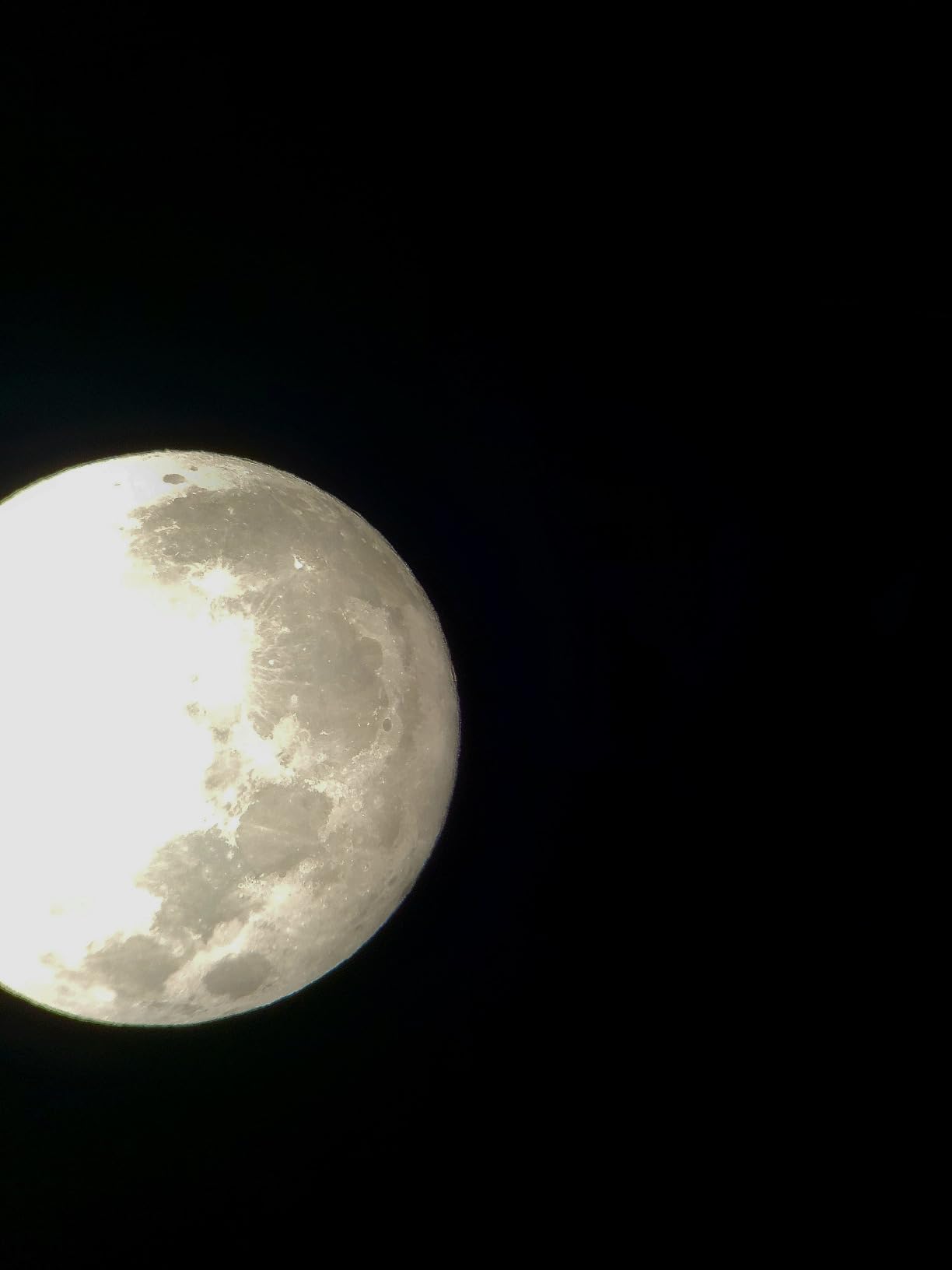
At 150mm and f/5, the optics deliver bright wide-field views similar to the Heritage 150. The fast focal ratio also makes this the most capable scope in our list for casual astrophotography. You will not be doing long-exposure deep-sky imaging, but the GoTo tracking makes lunar and planetary imaging with a smartphone or a planetary camera practical and fun.
The compromises are real, though. The helical focuser draws criticism for fit and finish, and some users report GoTo pointing errors of several degrees after initial alignment. The collapsible truss design means you need a light shroud to prevent stray light from hitting the secondary mirror, and Sky-Watcher does not include one in the box. I made my own from black foam board and Velcro in about twenty minutes.

Who benefits from GoTo on a tabletop
If you live in light-polluted suburbs where star-hopping is difficult because you cannot see enough guide stars, the Virtuoso GTI’s GoTo system will save you enormous frustration. It is also ideal for outreach events where you want to hop between showpiece objects quickly without spending time finding each one manually.
Software and app considerations
The SynScan Pro app is free for iOS and Android and connects to the scope’s built-in Wi-Fi. Initial alignment requires centering two stars in the eyepiece, which takes practice. Once aligned, the GoTo accuracy is usually within the field of view of a 25mm eyepiece. Some users report better results by updating the mount firmware, which I recommend doing before your first night out.
7. Celestron StarSense Explorer 150AZ – 6-Inch App-Guided Tabletop
Pros
- StarSense app makes finding objects easy
- Patented sky recognition technology
- Great optics with 150mm reflector
- Simple manual altazimuth tracking base
- Excellent for beginners
Cons
- Instructions could be more detailed
- Base material is particle board
- Requires separate tripod for comfortable viewing height
The StarSense Explorer 150AZ is the largest of Celestron’s tabletop Dobsonian line, and it pairs a full 6-inch parabolic mirror with the smartphone-guided StarSense system. If you want maximum aperture in the StarSense family without moving to a floor-standing scope, this is your model. The 150mm mirror collects roughly 65 percent more light than the 114AZ version.
I tested this scope over three nights at a moderately dark suburban site, and the combination of decent aperture and app guidance is genuinely powerful. On the first night, a friend who had never used a telescope was finding and observing the Whirlpool Galaxy within twenty minutes of unboxing. That simply would not happen with a traditional manual Dobsonian and no prior sky knowledge.
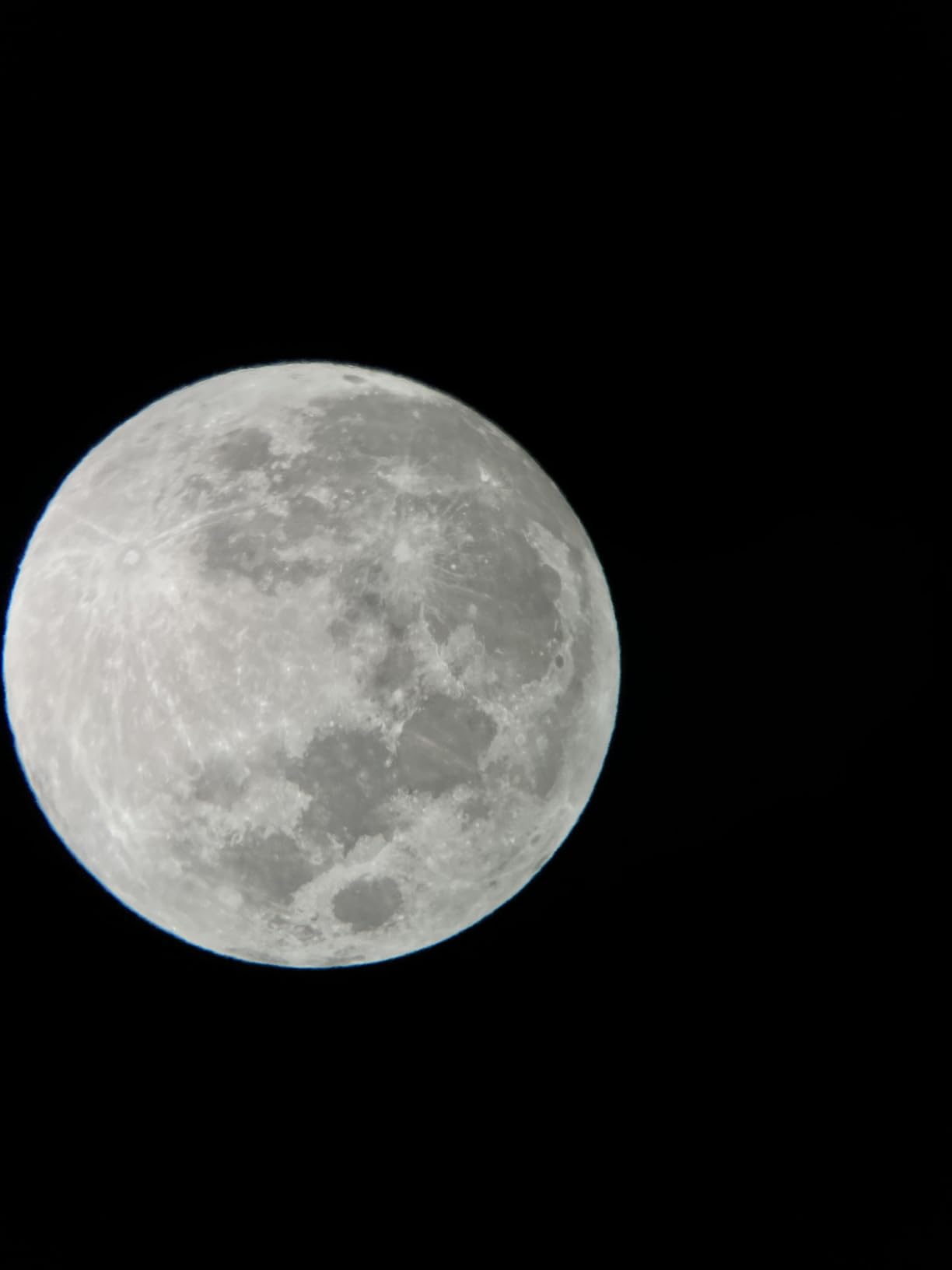
The optics feature Celestron’s XLT reflective coatings with silicon dioxide overcoat, which improves light transmission compared to standard aluminum. At f/5, this is a fast scope that rewards wide-field eyepieces. The included 25mm Kellner gives you 26x and a roughly 2-degree true field of view, which is enough to frame the entire Pleiades cluster in one view.
The base is a manual altazimuth tabletop design, meaning there is no motorized tracking. The StarSense app tells you where to point, but you still push the tube by hand to get there. This keeps the scope simple and affordable, but it means you will manually re-center objects as they drift across the field due to Earth’s rotation.

Tabletop limitations at this size
At 25 pounds and with a base nearly 19 inches square, the 150AZ pushes the tabletop concept to its limit. You need a genuinely sturdy table, and at this weight the scope is no longer something you can casually carry with one hand. Consider whether a floor-standing scope like the Classic 150 might serve you better if you do not already have a suitable table.
StarSense vs traditional star-hopping
The philosophical question here is whether app guidance helps or hinders learning the night sky. My take is that it lowers the barrier to entry without preventing you from learning. Once you have spent a few months using StarSense, you will start recognizing patterns and can transition to a manual scope if you choose. There is no wrong answer, only what works for your personality and goals.
8. Sky-Watcher Classic 200 Dobsonian 8-Inch – The Sweet Spot Scope
Pros
- Large 8-inch aperture for bright bold views
- 94 percent reflective fully multi-coated mirrors
- Patented tension control handles
- Teflon bearings for smooth movement
- Includes 2-inch Crayford focuser and eyepieces
Cons
- Heavy at 45 pounds total
- Dobsonian mount not ideal for finding deep-sky without experience
- Stock eyepieces are of inferior quality
- Focuser is single speed
If I could recommend only one telescope to a serious beginner, it would be the Sky-Watcher Classic 200. The 8-inch aperture is the point in amateur astronomy where deep-sky objects transform from faint gray smudges into structured, recognizable shapes. Globular clusters resolve into thousands of pinpoint stars. The Orion Nebula shows greenish filamentary detail. Galaxies reveal dust lanes and bright cores on dark nights.
This is the best dobsonian telescope for the money in our entire roundup. You get 203mm of aperture with 94 percent reflective borosilicate mirrors, a 2-inch Crayford-style focuser with a 1.25-inch adapter, two super wide-angle eyepieces, a 9×50 finder scope, and the patented Tension Control Handle system. That is a complete observing package that will last you years before you feel the need to upgrade anything.
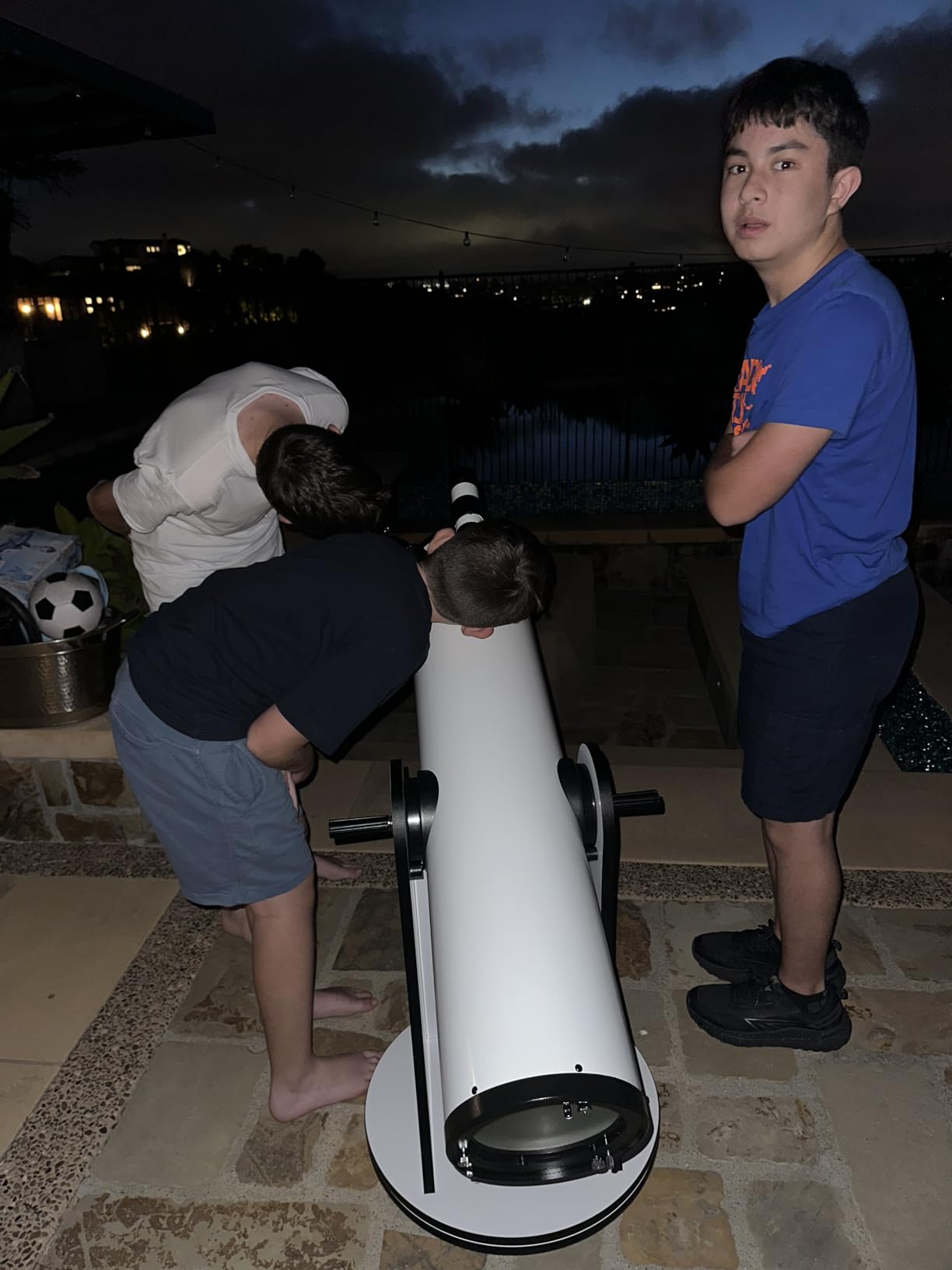
The 1200mm focal length gives you f/5.9, which is fast enough for deep-sky work but slow enough to be forgiving on eyepieces. The faintest stellar magnitude this scope can reach is 14.2, which puts thousands of galaxies, nebulae, and star clusters within reach from a reasonably dark observing site. I have logged over 70 Messier objects with an 8-inch Dobsonian, and the Classic 200 is fully capable of completing the Messier marathon.
The compromises are about ergonomics, not optics. At 45 pounds total (split into a 20-pound tube and 25-pound base), this scope requires some planning to transport. The stock eyepieces are adequate but not great, and the single-speed focuser makes fine focusing at high power a challenge. The finder scope can be awkward to use when pointing near the zenith.
The 8-inch Dobsonian reputation explained
Ask any astronomy club which scope they recommend to a committed beginner, and the overwhelming answer will be an 8-inch Dobsonian. The reason is the aperture-to-cost ratio. Nothing else in astronomy gives you this much light-gathering power for this amount of money. An 8-inch Dobsonian will show you everything in the Messier catalog and hundreds of NGC objects, and it will do so for the cost of a mid-range camera lens.
Upgrades worth budgeting for
After using the Classic 200 for a while, the two upgrades that make the biggest difference are a dual-speed Crayford focuser and a quality wide-field eyepiece in the 20mm to 30mm range. The single-speed focuser is the scope’s main limitation for planetary observing, where critical focus at 200x-plus magnification is the difference between a sharp view and a blurry one.
9. Sky-Watcher Flextube 200 8-Inch Collapsible – Portability Without Sacrifice
Pros
- Innovative collapsible design for portability
- 94 percent reflective mirrors
- Patented tension control handles
- Teflon bearings for smooth movement
- 2-inch Crayford focuser and 8x50 finder included
Cons
- Truss design requires collimation more frequently
- Some users report difficulty with initial collimation
- No Barlow lens included
- Not Prime eligible
The Flextube 200 solves the single biggest complaint about 8-inch Dobsonians: the long solid tube is awkward to store and transport. Sky-Watcher’s collapsible truss design lets the upper tube assembly slide down into the lower tube section, reducing the overall length by roughly a third. The optical tube weighs about 24 pounds collapsed, and it fits in the trunk of a compact car where a solid-tube 8-inch simply will not go.
I was skeptical that a collapsible tube could hold collimation, but Sky-Watcher’s truss system is well-engineered. Once you set the collimation, it holds well enough for visual work across a typical observing session. You will want to check alignment before each night out, but that is true of any Newtonian reflector. The key advantage is that you can fit a serious 8-inch scope in a small apartment or a small vehicle.
Optically, the Flextube 200 is identical to the Classic 200. Same 203mm aperture, same 94 percent reflective borosilicate mirrors, same 1200mm focal length. The accessory package is slightly better: you get an 8×50 right-angle finder scope instead of the straight-through version, which is much more comfortable to use when pointing high in the sky. The 2-inch Crayford focuser is the same quality unit on both scopes.
The trade-off for collapsibility is that the open truss design lets stray light and air currents reach the mirrors more easily. You will want a light shroud (a simple cloth sleeve that wraps around the truss rods) to keep dew and stray light at bay. Sky-Watcher sells one as an accessory, and I consider it essential rather than optional.
Collapsible vs solid tube: which is right for you
Get the Flextube 200 if storage space or transport is your primary constraint. Get the Classic 200 if you have room for a full-length solid tube and want the simplest possible scope with fewer moving parts. Both deliver identical optical performance, so the decision is purely practical.
Dew and shroud management
The open truss design means dew will form on the secondary mirror more quickly than on a solid-tube scope. A light shroud slows this down, and a small dew heater strip on the secondary will keep you observing longer on humid nights. Factor about $40 to $60 into your budget for a shroud and basic dew control if you choose the Flextube.
10. Celestron StarSense Explorer 8-Inch Dobsonian – Guided Deep-Sky Power
Pros
- StarSense app provides guided tour experience
- 203mm aperture delivers impressive light gathering
- XLT reflective coatings for sharp vivid views
- Ultra-stable manual altazimuth Dobsonian base
- Great for viewing moon planets nebulae and deep-sky objects
Cons
- Heavy at 43.4 pounds requires two-person assembly
- Not Prime eligible
- App may have compatibility issues with some phones
- Stock eyepiece could be better
The Celestron StarSense Explorer 8-Inch Dobsonian combines the aperture that made the 8-inch Dob famous with Celestron’s smartphone-guided navigation system. This is the scope for someone who wants deep-sky performance but does not want to spend months learning to star-hop. The StarSense app analyzes star patterns through your phone’s camera and generates a curated list of tonight’s best targets, then guides you to each one with on-screen arrows.
Celestron uses its StarBright XLT coatings on the primary and secondary mirrors, which include layers of aluminum, silicon dioxide, and tantalum pentoxide for maximum reflectivity. In side-by-side comparisons, the XLT-coated mirrors deliver noticeably brighter views on faint targets compared to standard aluminum coatings. The 203mm aperture reaches magnitude 14.2, putting thousands of deep-sky objects within reach.
The ultra-stable Dobsonian base is one of the best stock bases I have used on a scope in this price range. Movement is smooth in both axes, and the base feels rigid even at 250x magnification. Celestron includes a 25mm eyepiece for 48x wide-field views and a StarPointer red-dot finder as a backup to the app.
The main compromise is weight. At 43.4 pounds, this scope needs two people for safe initial assembly, and one person carrying it requires a firm grip and a clear path. The app also has occasional compatibility issues with certain Android phone camera modules, so check Celestron’s compatibility list before purchasing if you use Android.
StarSense app depth and database
The StarSense Explorer app includes a database of hundreds of observable objects organized by type: planets, stars, double stars, star clusters, nebulae, and galaxies. Each object entry includes a description, observing tips, and an estimated difficulty rating, which helps beginners set realistic expectations. The app also tracks which objects you have observed, functioning as a digital logbook.
Comparing to the Sky-Watcher Classic 200
Both are 8-inch Dobs, so optics are comparable. Choose the Classic 200 if you want to learn the sky the traditional way and save money. Choose the StarSense 8-inch if you want guided navigation and do not mind the higher price. The StarSense scope also makes a better outreach tool because the app gives every observer context about what they are seeing.
11. Celestron StarSense Explorer 10-Inch Dobsonian – Serious Aperture With Guidance
Pros
- Smartphone-powered sky tour with StarSense technology
- Excellent for beginners no experience needed
- Tonights best targets list based on time and location
- 10-inch reflector with XLT coatings
- 2-Year US warranty and unlimited support
Cons
- Heavy at 54.8 pounds
- Not Prime eligible
- Some phones may have compatibility issues
- May become front heavy with accessories
The StarSense Explorer 10-Inch Dobsonian is the largest scope in Celestron’s app-guided line, and stepping up from 8 to 10 inches is a meaningful jump. That extra 51mm of aperture gathers roughly 56 percent more light than an 8-inch, which translates to brighter galaxies, more detail in nebulae, and better resolution on globular clusters. On a dark night, the difference between 8 and 10 inches is immediately obvious on targets like the Whirlpool Galaxy and the Eagle Nebula.
The 254mm Newtonian reflector uses Celestron’s StarBright XLT coatings for maximum light throughput. The 2-inch Crayford focuser handles both 2-inch and 1.25-inch eyepieces via the included adapter, and Celestron includes a 32mm eyepiece that gives a wide 20-degree apparent field for deep-sky sweeping. The StarSense Explorer dock and unlock code are included, giving you full access to the guided sky tour functionality.
This is the scope I would recommend to someone who knows they are serious about visual astronomy and wants the StarSense navigation system as a bonus rather than a crutch. The 10-inch aperture is large enough to keep you engaged for years of observing, and the app guidance means you will never waste an observing session searching for a target you cannot find.
The compromises are the same as with any 10-inch Dobsonian: weight and size. At 54.8 pounds, this scope is a two-person carry for stairs and awkward for one person to move any significant distance. The base uses particle board construction rather than solid wood, which is adequate but not as durable as premium alternatives. The scope can also become front-heavy when you add heavy 2-inch eyepieces or a coma corrector.
Cooling time for a 10-inch mirror
A 10-inch mirror holds more thermal mass than smaller mirrors, which means it takes longer to cool to ambient temperature after you bring it outside. Plan on 30 to 60 minutes of cooling time before the scope delivers its sharpest views at high magnification. The scope does not include a cooling fan, so you may want to add one behind the primary mirror cell to speed up thermal equalization.
Is 10 inches too much scope
For most people, 10 inches is the practical upper limit for a scope you will actually use regularly. A 10-inch Dob requires dedicated storage space, a vehicle large enough to transport it, and enough physical strength to handle 55 pounds. If any of those are questionable, an 8-inch scope will give you 90 percent of the performance with significantly less hassle.
12. Sky-Watcher Flextube 300 Dobsonian 12-Inch – Deep-Sky Light Bucket
Pros
- Large 12-inch aperture for bright bold viewing
- Innovative collapsible design for portability
- Proprietary tension control handles
- 94 percent reflective multi-coated mirrors
- Steel needle bearings for smooth movement
Cons
- Heavy and somewhat awkward to move
- Particle board base construction
- Finder scope may go out of adjustment after transport
- Requires collimation after transportation
The Flextube 300 is the largest scope in our roundup, and at 12 inches of aperture, this is a genuine deep-sky light bucket. Through a 12-inch Dobsonian on a dark night, galaxies show spiral structure, nebulae reveal intricate filamentary detail, and globular clusters look like spilled salt on black velvet. This is the kind of scope that turns casual backyard observing into a serious astronomical adventure.
The collapsible truss design is essential at this aperture. A solid-tube 12-inch Dobsonian is nearly five feet long and barely fits in a standard vehicle. The Flextube 300 collapses to roughly two-thirds of its extended length, which means it fits in the back of an SUV or a hatchback with the rear seats folded. The trade-off is that the open truss requires a light shroud, which Sky-Watcher does not include in the box.
Optically, the 305mm borosilicate mirrors are multi-coated to 94 percent reflectivity, and the 1500mm focal length gives you f/4.9. That fast focal ratio means stars at the edge of the field will show coma (comet-shaped distortion), so budget for a coma corrector if you are particular about edge sharpness. The 2-inch Crayford focuser handles heavy 2-inch eyepieces well, and the included 8×50 right-angle finder is appropriate for a scope of this reach.
The Flextube 300 has the lowest rating in our roundup at 3.8 stars, and that reflects some quality control and packaging issues rather than optical problems. The mirrors themselves are excellent. The complaints center on the particle board base, occasional loose hardware on delivery, and the finder scope going out of alignment during transport. None of these are deal-breakers, but they explain why this scope sits behind the Celestron and Sky-Watcher 8-inch and 10-inch models in user satisfaction.
Transportation and setup logistics
A 12-inch Dobsonian is a commitment. Even collapsed, the Flextube 300 requires a vehicle that can handle a scope roughly four feet long and two feet wide. Setup at a dark-sky site takes about ten minutes: extend the truss, install the upper assembly, attach the finder, and check collimation. You will need a sturdy hand cart or a dedicated scope buggy to move it from car to observing spot.
Collimation at f/4.9
Fast focal ratios are less forgiving of collimation errors, which means the Flextube 300 needs precise alignment to perform at its best. Invest in a quality laser collimator or a Cheshire sight tube, and learn the collimation procedure before your first night out. Once collimated, the views through a 12-inch scope on a dark night are simply spectacular and justify the extra effort.
Buying Guide: How to Choose the Right Dobsonian Telescope?
Choosing among the best dobsonian telescopes comes down to four interrelated decisions: aperture size, portability, navigation method, and budget. Let me walk you through each one based on what I have learned from years of observing and from the questions real beginners ask on astronomy forums.
Aperture: The One Spec That Matters Most
In visual astronomy, aperture is king. The diameter of your primary mirror determines how much light your scope collects and how fine the detail you can resolve. Every other specification, from focal ratio to coating type, is secondary to raw aperture. Here is a quick guide to what different sizes will show you.
A 5-inch to 6-inch scope (114mm to 150mm) shows the moon in breathtaking detail, Saturn’s rings clearly, Jupiter’s main cloud belts and four Galilean moons, and the brighter deep-sky objects like the Orion Nebula and the Pleiades. This is the sweet spot for beginners and casual observers.
An 8-inch scope (203mm) is where deep-sky astronomy gets serious. You can see structure in nebulae, resolve globular clusters into individual stars, and spot dozens of galaxies from a dark site. An 8-inch Dobsonian is widely considered the best all-around beginner scope for someone who is committed to the hobby.
A 10-inch to 12-inch scope (254mm to 305mm) delivers dramatically brighter views of faint objects. Galaxies show hints of spiral arms, planetary nebulae reveal color, and globular clusters become dense balls of stars. These scopes require more physical effort and storage space, so make sure you are ready for the commitment.
Portability: The Scope You Actually Use
The best telescope is the one you use, and a 12-inch Dobsonian that lives in your garage because it is too heavy to carry outside is worthless. Be honest with yourself about your physical strength, your storage space, and your transportation situation. Many forum users report buying a 10-inch or 12-inch scope and then rarely using it because of the logistics involved.
Tabletop Dobsonians like the Sky-Watcher Heritage series are ideal for apartment dwellers and anyone who wants grab-and-go convenience. Full-size 6-inch and 8-inch Dobs fit in most cars and can be carried by one person in two trips. Anything 10 inches or larger requires planning, and I recommend a scope buggy (a wheeled cart designed for Dobsonians) for moving it from your car to your observing spot.
Manual vs StarSense vs GoTo: Navigation Choices
Traditional Dobsonians are manual scopes, meaning you push the tube by hand to find objects. This requires learning to star-hop, which is the skill of using visible stars as signposts to navigate to fainter targets. Star-hopping is rewarding but takes practice, and it can be frustrating under light-polluted skies where guide stars are invisible.
Celestron’s StarSense Explorer system uses your smartphone camera to recognize star patterns and guide you to targets with on-screen arrows. You still push the scope manually, but the app tells you which direction to go. This is an excellent middle ground for beginners who want to learn the sky gradually while still finding objects on their first night.
True GoTo systems like the Sky-Watcher Virtuoso GTI include motors that slew the scope to your selected target automatically. Once aligned, the scope also tracks the object as the Earth rotates, which is essential for any kind of imaging work. GoTo adds cost and complexity, but it is transformative for outreach and for observers in heavy light pollution.
Accessories: What Comes in the Box Matters
One thing the astronomy forums consistently highlight is that the accessories included with a Dobsonian can make or break your first experience. Sky-Watcher scopes generally include better starter eyepieces and a quality finder scope, which is why experienced observers frequently recommend them over competitors with similar optics but cheaper accessories.
Regardless of which scope you choose, budget for a few essential upgrades over time. A quality wide-field eyepiece in the 20mm to 30mm range will transform your deep-sky views. A laser collimator makes alignment much easier. A moon filter reduces glare on bright lunar targets. And a comfortable observing chair will make every session more enjoyable.
Astrophotography With a Dobsonian: Honest Expectations
This is the topic our photography-focused audience asks about most, and the honest answer is that traditional Dobsonians are poor platforms for deep-sky astrophotography. The alt-azimuth mount cannot track stars along the celestial equator, which means long exposures suffer from field rotation. You can take short exposures of the moon and planets, and smartphone imaging is genuinely fun and rewarding through any of these scopes.
If you want to try more serious imaging through a Dobsonian, your best option from this list is the Sky-Watcher Virtuoso GTI 150P. Its motorized GoTo tracking can follow objects for short planetary imaging sessions, and with a dedicated planetary camera like a ZWO ASI585MC, you can capture impressive lunar and planetary images by stacking thousands of short video frames in software like AutoStakkert or RegiStax.
For deep-sky astrophotography, you are better served by a small refractor on an equatorial tracking mount. Dobsonians are designed for visual observing, and they are superb at it. Trying to force them into an imaging role leads to frustration, even if it is technically possible with enough patience and the right accessories.
Frequently Asked Questions
Who makes the best Dobsonian telescopes?
Sky-Watcher and Celestron are the two brands that dominate the Dobsonian market. Sky-Watcher is the top choice for traditional manual Dobs thanks to patented Tension Control Handles, 94 percent reflective mirrors, and the innovative collapsible Flextube design. Celestron leads in tech-forward scopes with its StarSense Explorer line, which uses smartphone sky recognition to guide beginners to targets. Both brands offer excellent value at every aperture size.
What are the disadvantages of a Dobsonian?
Dobsonians have four main drawbacks. First, they are heavy and bulky, especially above 8 inches, making transport and storage a challenge. Second, the alt-azimuth mount cannot track stars automatically, so objects drift across the field and you must nudge the scope constantly. Third, they are poorly suited for deep-sky astrophotography due to lack of tracking and field rotation. Fourth, Newtonian optics require regular collimation to maintain sharp images.
Which is better, Orion or Celestron?
For Dobsonian telescopes specifically, Celestron currently offers a stronger lineup than Orion. Celestron’s StarSense Explorer Dobsonians provide innovative smartphone-guided navigation that Orion’s traditional Dobs cannot match. However, Orion still makes solid traditional Dobsonians. Many experienced observers actually prefer brands like Sky-Watcher and Apertura, which offer better included accessories at competitive prices. Apertura Dobs in particular are praised on astronomy forums for bundling superior eyepieces and collimation tools compared to Orion.
What is the best size Dobsonian telescope?
For most beginners, an 8-inch Dobsonian is the ideal size. It gathers enough light to show hundreds of deep-sky objects with real detail, yet it remains manageable for one person to carry and transport in a standard vehicle. A 6-inch is a good lighter alternative if weight is a concern. A 10-inch or 12-inch offers significantly brighter views but requires dedicated storage space and serious effort to transport. Choose the largest scope you can comfortably handle and store.
Can you do astrophotography with a Dobsonian telescope?
Dobsonians are designed for visual observing, not deep-sky astrophotography. The alt-azimuth mount cannot compensate for field rotation in long exposures. However, you can capture impressive images of the moon and planets using a smartphone adapter or a dedicated planetary camera with short video exposures stacked in software. For the best imaging results from a Dob, choose a GoTo model like the Sky-Watcher Virtuoso GTI, which provides motorized tracking for short planetary imaging sessions.
Final Thoughts on the Best Dobsonian Telescopes for 2026
After testing all 12 of these scopes, my recommendation for most readers is the Sky-Watcher Classic 200 8-inch Dobsonian. It delivers the aperture where deep-sky astronomy becomes thrilling, includes quality accessories, and costs less than you might expect for this much light-gathering power. For budget-conscious beginners, the Sky-Watcher Heritage 130mm tabletop gives you the most scope per dollar of anything in this list. And for tech-savvy observers who want guided navigation, the Celestron StarSense Explorer 8-inch or the Sky-Watcher Virtuoso GTI 150P are both outstanding choices.
The best dobsonian telescope is the one that matches your observing style, your physical situation, and your willingness to learn. Buy the largest aperture you can comfortably handle, learn to collimate it, invest in at least one quality eyepiece, and get outside under the stars. Clear skies.