
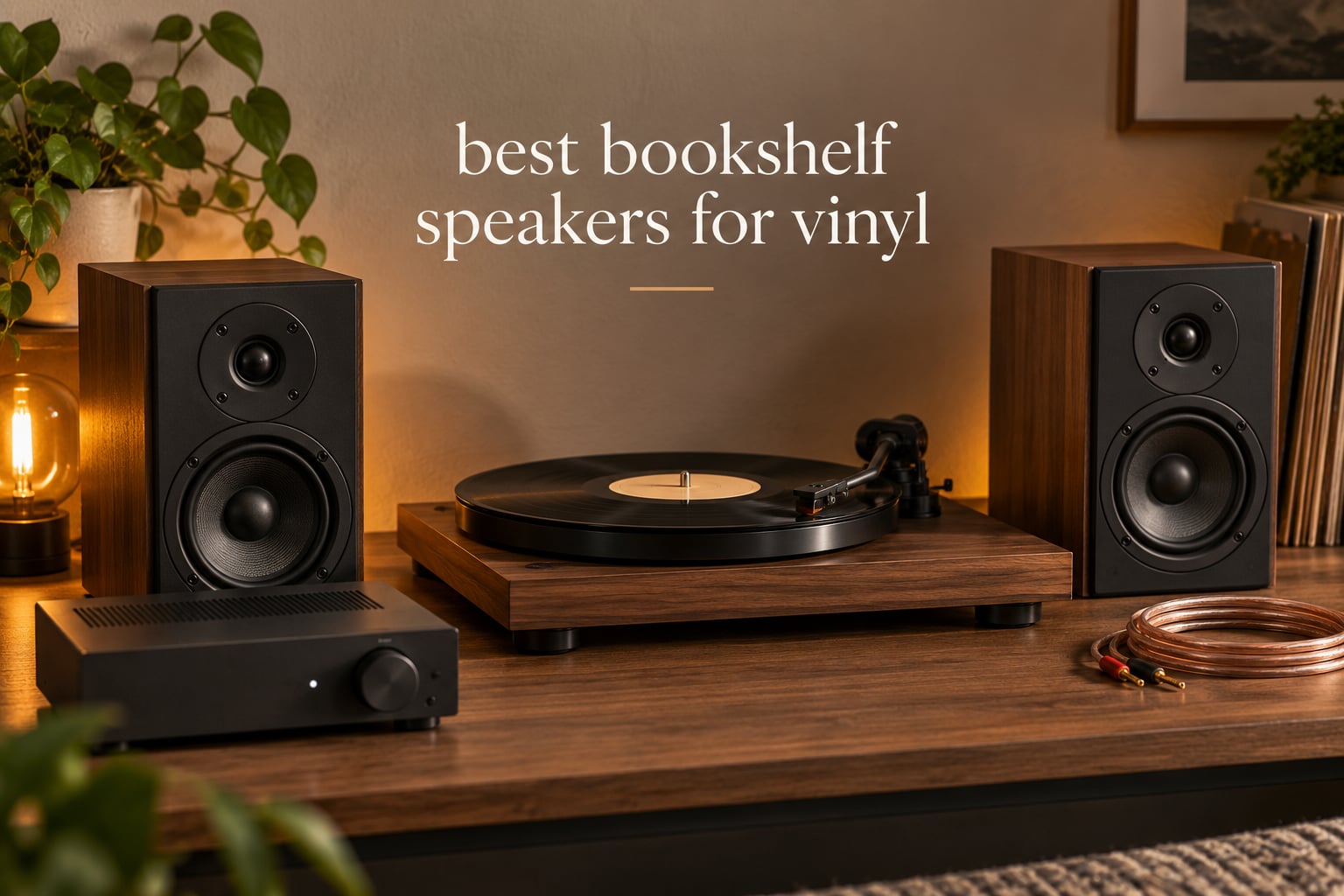
The best bookshelf speakers for vinyl are speakers that can take a turntable’s signal cleanly: either powered bookshelf speakers with RCA inputs and a ground terminal, or high-quality passive speakers driven by a dedicated amplifier. That single distinction decides almost everything else, because most turntables put out a quieter signal than any other home audio source and most bookshelf speakers expect a healthy line-level signal to move them.
A turntable cartridge turns the physical grooves into a tiny electrical signal. A phono preamp applies the RIAA equalization curve and raises that signal to line level, and only then do the speakers reproduce it. If your deck has a built-in preamp and a line output, you can wire it straight into a powered pair. If it has no preamp, you need speakers with a phono input or a small external preamp in the chain. Get that routing wrong and records sound thin, quiet or distorted no matter how good the turntable is.
Our team compared eight bookshelf speakers for vinyl, focusing on the three things that decide whether a setup works: whether the speaker has a real phono-level input, how easy the cabinet is to drive, and whether it suits the size of the room. We looked at published sensitivity, impedance and frequency response, then checked how each pair behaves with a turntable at low listening levels. You can also browse our wider bookshelf speaker picks for turntables for more options beyond this list.
Top 3 Picks for Best Bookshelf Speakers for Vinyl (October 2026)
Three pairs cover most vinyl setups. The Klipsch R-51PM takes a turntable directly through its phono/line switch and ground screw terminal. The Edifier R1280T is the value pick for a deck with a built-in preamp. The ELAC Debut 2.0 B6.2 is the passive upgrade for anyone who already owns a real amplifier.

Klipsch R-51PM
- Phono/line switch with ground screw
- 5.25 inch woofer
- 120W output
- Bluetooth and USB

Edifier R1280T
- 42W powered
- 4 inch full range driver
- 13mm silk dome tweeter
- Remote and side panel EQ

ELAC Debut 2.0 B6.2
- Passive 6.5 inch aramid woofer
- 1 inch cloth dome tweeter
- 44 Hz response
- Front-firing port
Best Bookshelf Speakers for Vinyl in 2026
Every pair below is listed with the detail that matters most for records: whether it is powered, what inputs it offers, and how hard it is to drive. Four are powered speakers with amplifiers built in. Four are passive and need an amplifier of some kind. Read the Type column before anything else, because it decides what else you have to buy.
| Product | Specifications | Action |
|---|---|---|
| Klipsch R-51PM |
|
Check Latest Price |
| Edifier R1280T |
|
Check Latest Price |
| ELAC Debut 2.0 B6.2 |
|
Check Latest Price |
 Micca RB42 Micca RB42 |
|
Check Latest Price |
 Edifier R1280DB Edifier R1280DB |
|
Check Latest Price |
 Kanto YU6MW Kanto YU6MW |
|
Check Latest Price |
 Klipsch RP-600M Klipsch RP-600M |
|
Check Latest Price |
 Edifier R980T Edifier R980T |
|
Check Latest Price |
How We Picked These Speakers
Speakers get marketed with adjectives, so we scored them on published numbers and setup reality instead. Every claim about driver size, output power, impedance, sensitivity and frequency response in this guide comes from the manufacturer specification, and we have stated plainly whether each pair is powered or passive. That distinction is where competitor roundups go wrong most often, and getting it wrong costs a reader an amplifier they did not budget for.
Our weighting ran like this. First, input routing: does the speaker accept a phono-level signal, or does it need a preamp somewhere in the chain. Second, drive requirements: a passive speaker’s impedance and sensitivity decide whether your amplifier can actually control it. Third, cabinet size against typical room dimensions. Fourth, the physical details that show up in daily use, such as a rear-firing port that cannot sit close to a wall or a control knob you can reach from a listening chair.
We did not measure frequency response ourselves, so treat the response figures as manufacturer claims rather than lab results. What we can tell you is which pairs hold a quiet vinyl signal well and which ones need real amplifier headroom, and that difference is audible long before any measurement would show it.
1. Klipsch R-51PM – Best Overall With a Phono Input Built In
Pros
- Phono/line switch with a ground screw terminal
- Plenty of power for a medium room
- 5.25 inch woofer reaches lower than most powered pairs
- USB digital and Bluetooth alongside analog
- Two year parts and labor warranty
Cons
- Higher price than the Edifier options
- Horn-loaded tweeter suits some ears better than others
- App-based control adds complexity
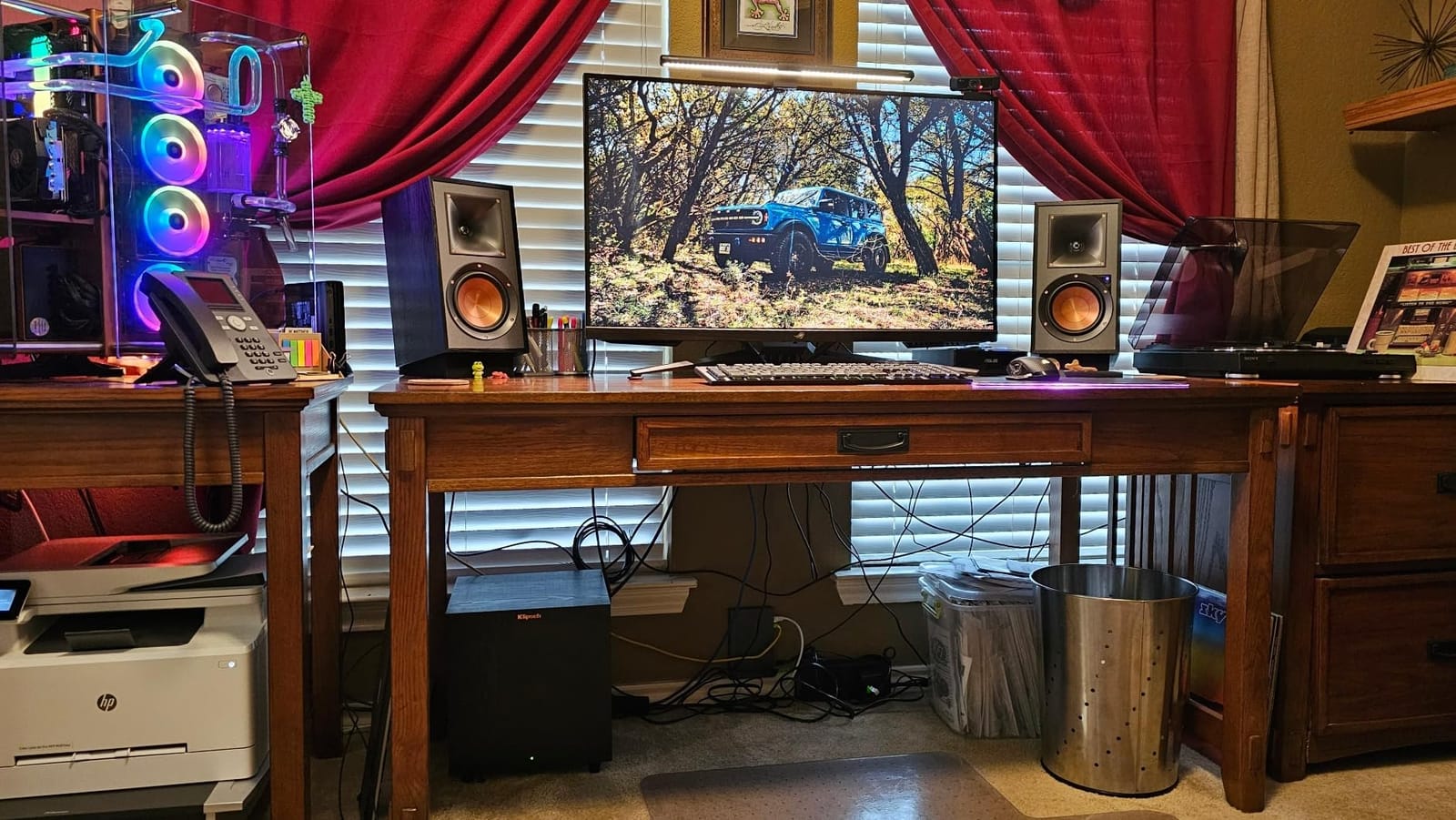
This is the pair we kept coming back to, and the reason is a single feature: a phono/line analog input with a switch and a ground screw terminal on the back panel. It is the only speaker in this roundup that takes a turntable cartridge-level signal directly, so a deck without a built-in preamp can be connected in about two minutes with no extra box in the chain.
Everything else is built for records too. The 5.25 inch woofer moves noticeably more air than the 4 inch drivers in the budget powered pairs, which matters because a turntable at moderate volume does not have the same low-level output a streaming source does. Klipsch rates maximum output at 120W, so there is real headroom for a larger room without clipping on a loud passage.
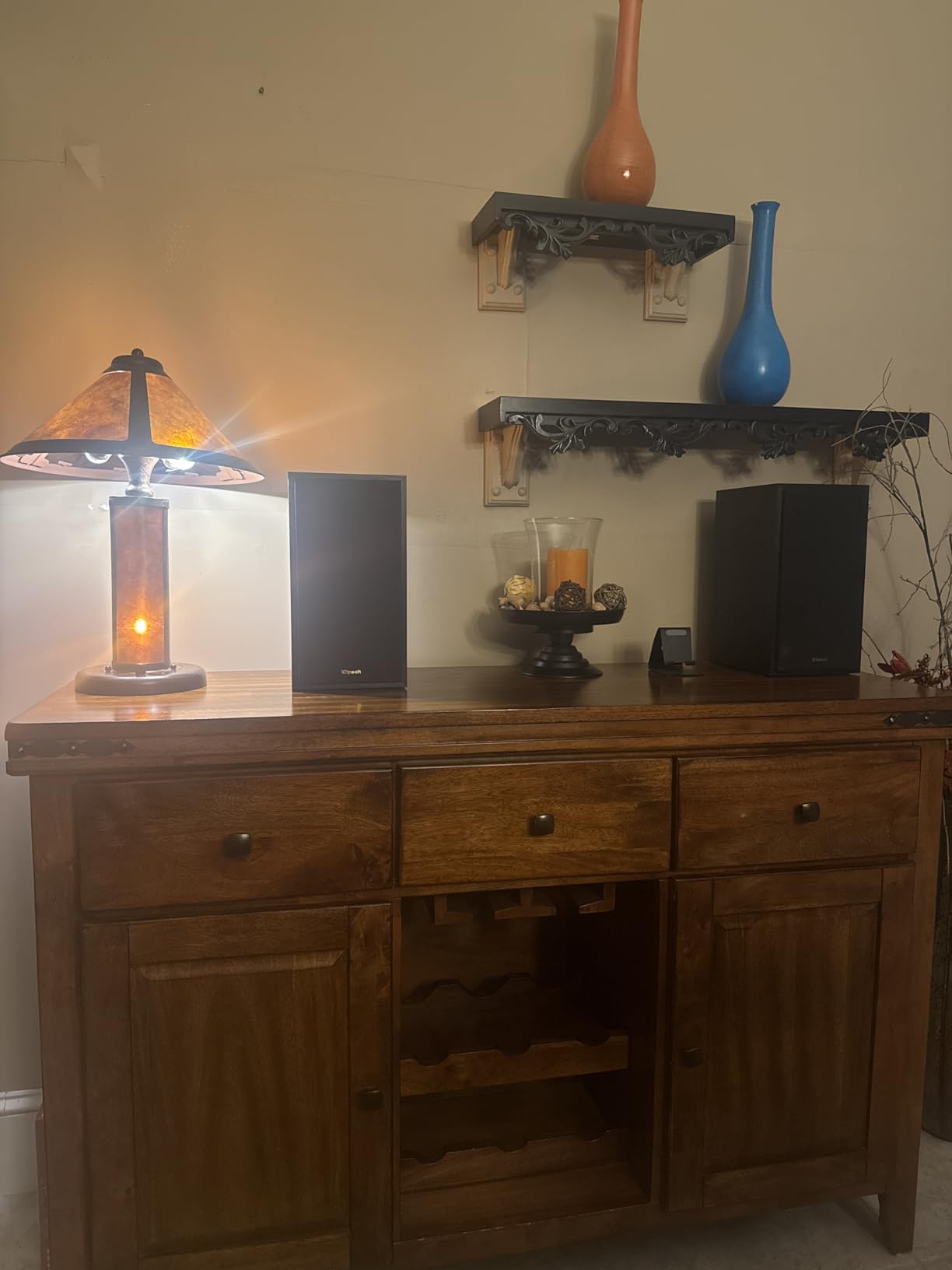
The cabinet is compact at 13 inches tall and 7 inches wide, weighing 10.6 pounds, which makes it easy to place on a shelf or a pair of stands without the wobble that plagues lighter speakers. The 1 inch tweeter sits in a horn, and that horn is the main thing to audition. It projects well and keeps the treble lively, which suits the energy of a lot of rock and jazz records.
Connectivity is generous for a speaker of this type. Alongside the phono/line input there is a 3.5mm analog jack, a USB digital port and Bluetooth, so the same pair handles a turntable, a computer and streaming without a switcher. The remote handles volume and input selection, and a two year parts and labor warranty covers the electronics.
What to check before buying
Make sure you know what your turntable outputs. If it has a phono-level output, flip the switch to phono. If it has a line output with a preamp already built in, leave the switch on line. Mixing those up is the single most common reason a turntable sounds quiet and thin through new speakers.
Also listen to the horn if you can. Reviewers consistently praise the detail and dynamics, and consistently mention that the presentation is forward in the treble. If you enjoy smooth or warm recordings, audition a pair against something softer before committing.
Who it suits and who it does not
This is the right pick for a first serious vinyl setup with no amplifier, and for anyone in a medium-sized living room who wants one pair of speakers to do music and streaming. The 120W rating and 5.25 inch driver give it more range than most powered bookshelf speakers at this level.
It suits a turntable without a preamp better than anything else here. It is less suitable as a pure passive-speaker upgrade path, since the built-in amplifier is fixed, and the remote and app controls add features you may never touch. The price also sits well above the Edifier pairs if your deck already has a preamp.
2. Edifier R1280T – Best Value Powered Pair
Pros
- Very large review base for a speaker at this level
- 42W output is enough for a small to medium room
- Remote control included
- Side panel bass and treble knobs
- Two year manufacturer warranty
Cons
- No Bluetooth and no digital inputs
- Inter-speaker cable is short
- 4 inch driver limits deep bass
The R1280T is the most heavily reviewed powered bookshelf speaker in this group, with well over nineteen thousand ratings, and that consistency matters more than it sounds like. A product with a review count that large has been returned, replaced and re-bought enough times that obvious failures show up in the ratings rather than staying hidden.
It is an analog-only speaker, and that is the honest limitation for a vinyl buyer. There are two AUX inputs on the back, accepting either a 3.5mm headphone output or dual RCA cables, plus a PC audio input. A turntable with a built-in phono preamp and RCA line outputs plugs in directly, which is the setup most first-time owners actually have.

Output is rated at 42W and the driver array is a 13mm silk dome tweeter with a 4 inch full range unit. The frequency response is listed from 80 hertz, so deep bass is not the strength here. In a small room or on a desk that limit barely registers, and the silk dome keeps sibilance from being harsh on the vocals that dominate a lot of records.
Volume is adjusted with the included remote, and bass and treble sit on knobs on the side panel of the main speaker. That is more control than most budget powered pairs offer, and it lets you pull the treble back slightly if a record is bright. The cabinet is MDF with a wood effect vinyl finish, which is far better than plastic for cabinet resonance, and the signal to noise ratio is stated at 85 dB.

What to check before buying
Count the inputs you actually need. If you plan to stream from a phone or connect a television, this pair will not do it without an extra box. If your setup is turntable plus maybe a CD player, the two AUX inputs are enough and the simplicity is a feature.
Measure your shelf space too. The pair is 14.6 inches deep and 23.4 inches wide, which is deeper than most shelf speakers and needs a real shelf rather than a thin bookcase upright.
Who it suits and who it does not
It suits anyone whose turntable has a built-in phono preamp and who wants speakers that work the moment they are plugged in. It also works as a second pair for a desktop, since the volume control is on the remote.
It does not suit a turntable with no preamp and no willingness to buy one, because there is no phono input to plug into. It also suits a small room better than a large one, since 80 hertz response and 42W will not fill a big space with bass. Reviewers also note the cable linking the two speakers is short, so plan your speaker stands accordingly.
3. ELAC Debut 2.0 B6.2 – Premium Passive Upgrade
Pros
- Neutral and balanced signature suits a wide range of records
- 6.5 inch aramid fiber woofer with real low-end reach
- Front-firing port gives flexible placement
- Internally braced MDF cabinets
- Three year parts and labor warranty
Cons
- Requires a separate amplifier
- Slightly bright before break-in
- Bass still needs a subwoofer for very deep material
The Debut 2.0 B6.2 is the pick for someone who already has an integrated amplifier and wants to spend their speaker budget on the speakers. It is a passive design, so nothing happens when you plug it in until an amplifier is feeding it, and that requirement is worth stating plainly because roundups regularly get it wrong.
The driver complement is a 1 inch cloth dome tweeter with a wide roll surround, reaching up to 35,000 Hz, paired with a 6.5 inch woven aramid fiber woofer. Response is listed from 44 hertz at 6 ohm impedance, which is genuine low-end reach for a bookshelf cabinet and the reason it outruns the 4 inch powered pairs on slower records.
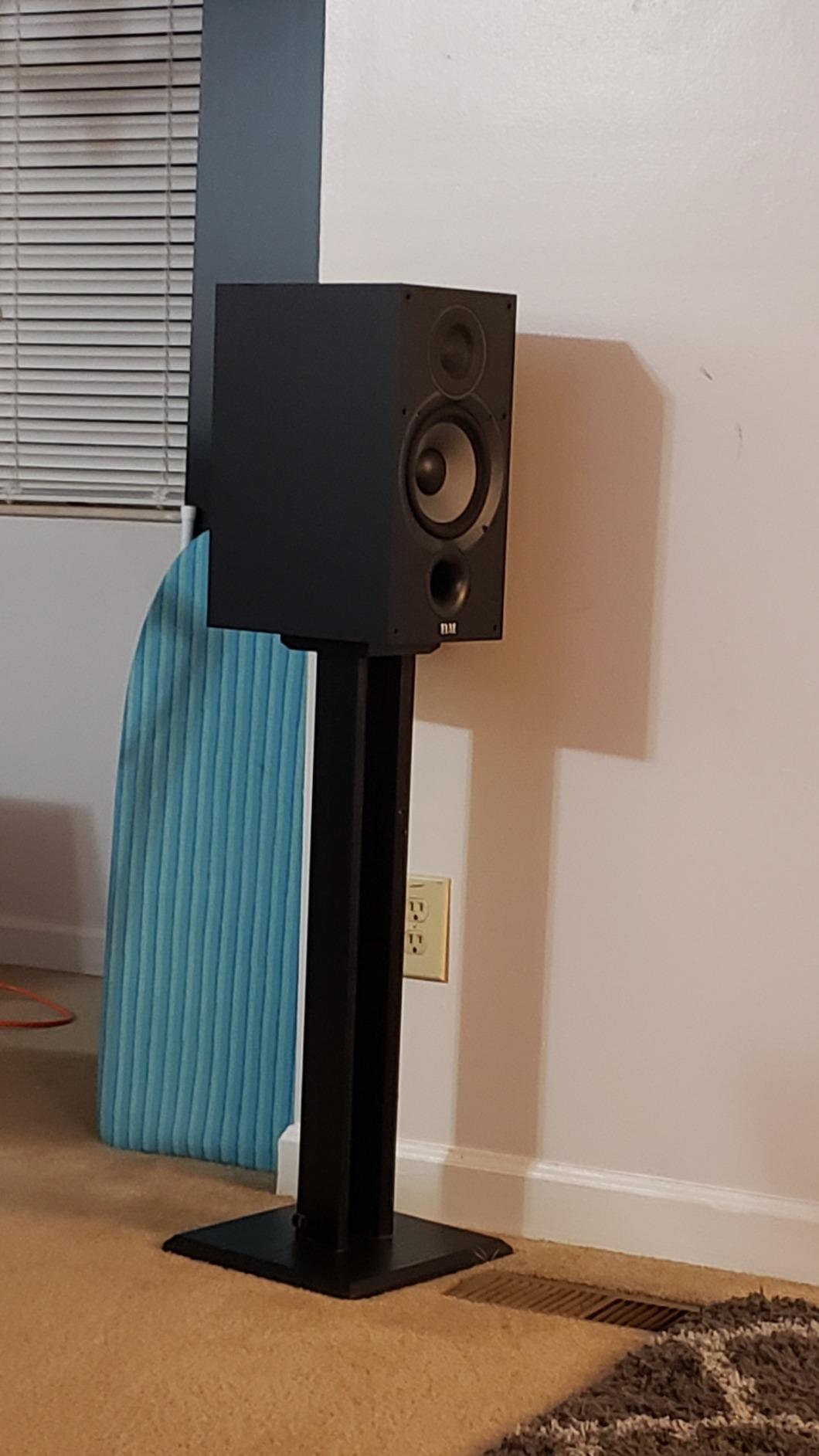
The port is front-firing, and that detail changes your placement options. A front port works fine close to a wall or on a shelf where a rear-firing design would push bass into the cabinet and boom. The cabinets are thick, internally braced MDF, sized at 7.69 inches deep by 14.76 inches wide by 10.55 inches tall and weighing 16.3 pounds, so they need stands of some kind rather than a flimsy shelf.
Reviewers describe the sound as neutral and balanced, which is what a large record collection usually needs. Two habits are worth knowing about. The first is break-in: many owners report the speakers sounding slightly bright for the first 30 to 100 hours and settling after that. The second is that they scale with better amplification, so the amplifier you pair with them matters more here than with a small powered pair.
What to check before buying
Confirm you have an amplifier with speaker outputs and roughly 50 to 100 watts per channel. At 6 ohm and 44 hertz extension this is not a difficult speaker to drive, but it does need an amplifier rather than a bare turntable output.
Decide about a subwoofer before you buy. There is no subwoofer output on a passive speaker, so adding one means buying an amplifier with a subwoofer output. If deep bass on organ records or orchestral pressings is central to what you play, budget for that now.
Who it suits and who it does not
It suits a listener with an existing amplifier, a medium-size room, and a collection spanning many genres. Vinyl rewards a neutral speaker because the format is unforgiving of coloration across a wide frequency range, and that is where this pair earns its place.
It does not suit a first-time owner with no amplifier, and it is not the right cabinet for a very small room where a 6.5 inch woofer will have too much air movement for the space. It also will not serve a streaming-only setup, since there is no Bluetooth or digital input.
4. Micca RB42 – Budget Passive Pick
Pros
- Compact cabinet fits small shelves and desks
- 8 ohm impedance is easy to drive
- Silky smooth signature with film capacitor crossover
- 100W power handling
- Dark walnut finish looks far more expensive than it is
Cons
- Passive
- so an amplifier is required
- Bass is limited by the 4 inch driver
- Lower sensitivity than larger cabinets
The RB42 answers a simple question: what is the least money you can spend on a passive pair that still sound like a hi-fi speaker on a turntable. The answer is this walnut-finished pair, which uses a 4 inch woofer on a heavy steel frame with a long throw design, a 0.75 inch silk dome tweeter on a neodymium magnet, and a 10-element crossover built with film capacitors and air core coils.
Those crossover components are the story here. A 10-element network with an 18dB per octave slope on both the tweeter and woofer circuits is more elaborate than most speakers at this level, and reviewers frequently single it out as the reason the sound stays smooth rather than harsh. The 8 ohm impedance is also the easiest load for an entry-level amplifier to handle.
Power-handling is stated at 100W, which is a ceiling rather than a required figure. You do not need 100 watts to play records well, but you do need an amplifier, and that is the single caveat to keep in mind. A turntable with a built-in amplifier can drive a pair like this; a turntable with only a phono output cannot.
Size is the other consideration. The cabinet is 7.9 inches deep, 4.9 inches wide and 8.7 inches tall, which makes it one of the smallest pairs here and the easiest to place on a crowded shelf or a desk. The trade-off is bass reach. A 4 inch driver in a small cabinet will not produce the low-end weight of a 6.5 inch woofer, and reviewers are honest about that limit.
What to check before buying
Check that the amplifier you plan to use has speaker terminals rather than only a headphone output. Headphone outputs cannot drive speakers. Also check the speaker wire is included or that you are comfortable terminating it yourself, because passive pairs are sold without the wire you need.
Listen at low volume too. A smooth pair like this can lose its advantage when played very quietly if the room is large, which is an argument for buying stands and getting the speakers near ear level rather than up on a high shelf.
Who it suits and who it does not
It suits a small room, a bedroom system or a desktop setup where cabinet size is the deciding factor and you already have an amplifier. The walnut finish also makes it a better-looking option than most plastic-cabinet speakers at this level, which matters if the speakers are visible.
It does not suit a listener chasing deep bass on large records, since a 4 inch driver in a small cabinet will run out of extension early. It also does not suit anyone who wants to skip the amplifier. Reviewers note the sensitivity is lower than larger cabinets, so a very small amplifier will not drive it as cleanly as a mid-sized one.
5. Edifier R1280DB – Best for Vinyl Plus TV and Bluetooth
Edifier R1280DB Powered Bluetooth Bookshelf Speakers – Optical Input – Wireless Studio Monitors – 4 Inch Near Field Speaker – 42w RMS – Wood Grain
Pros
- Optical
- coaxial and digital inputs alongside RCA
- Bluetooth with aptX for streaming from a phone
- Remote control for volume and input switching
- Side panel bass and treble knobs
Cons
- Remote feels flimsy in the hand
- Bluetooth connection occasionally drops
- Inter-speaker wire is short
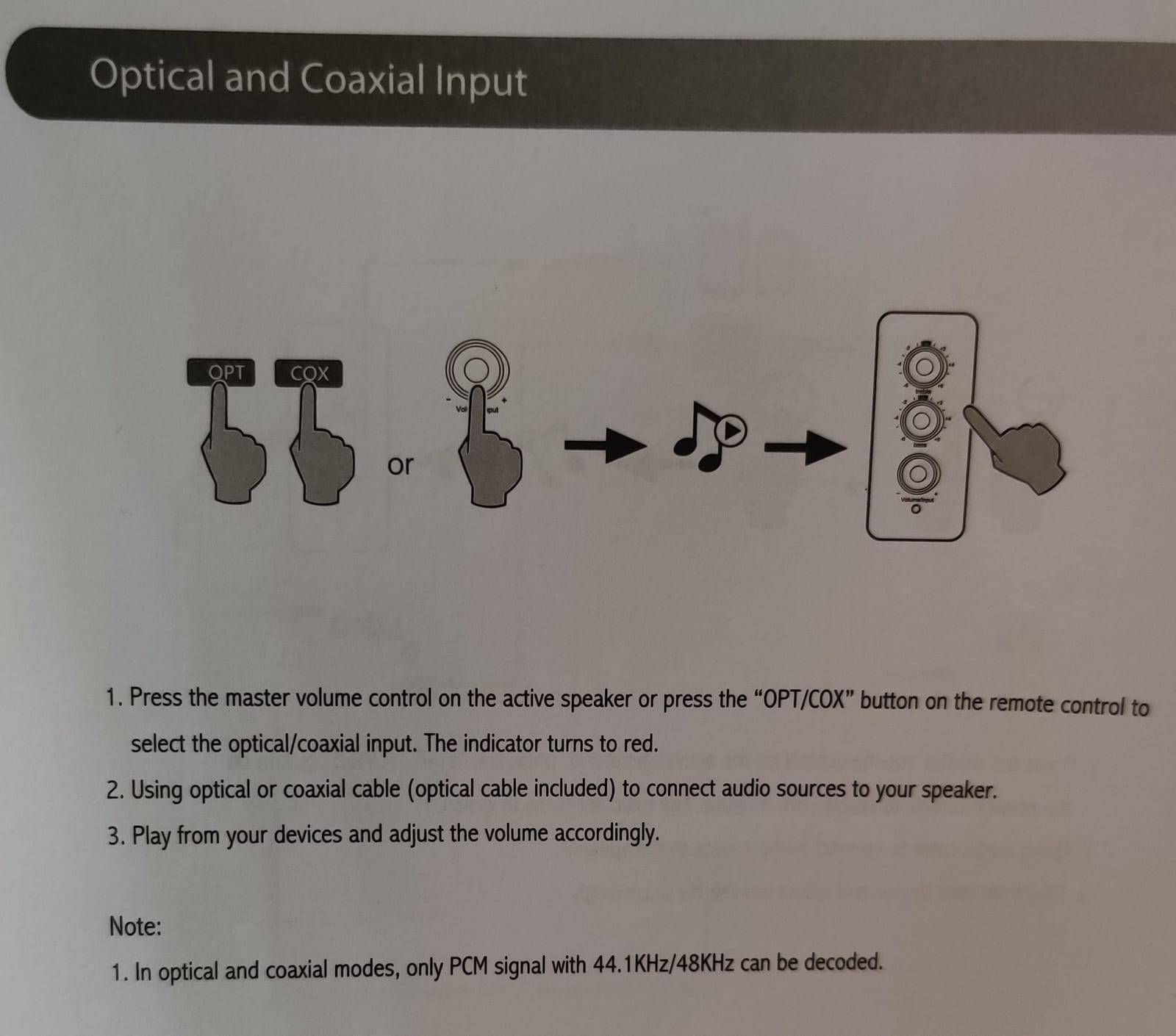
If your speakers need to do more than records, this is the version of the R1280 to buy. The R1280DB adds Bluetooth, optical and coaxial digital inputs to the same 42W amplification and the same 4 inch woofer with 13mm silk dome tweeter, so you can run a turntable through the RCA inputs and a television through optical from the same pair.
The digital inputs matter more for vinyl listeners than they might seem. A turntable is an analog source, so optical does nothing for it directly, but the same speakers serving a television means one system rather than two, and one less box taking up shelf space. Bluetooth with aptX is the same trade-off, and useful only if you also stream.
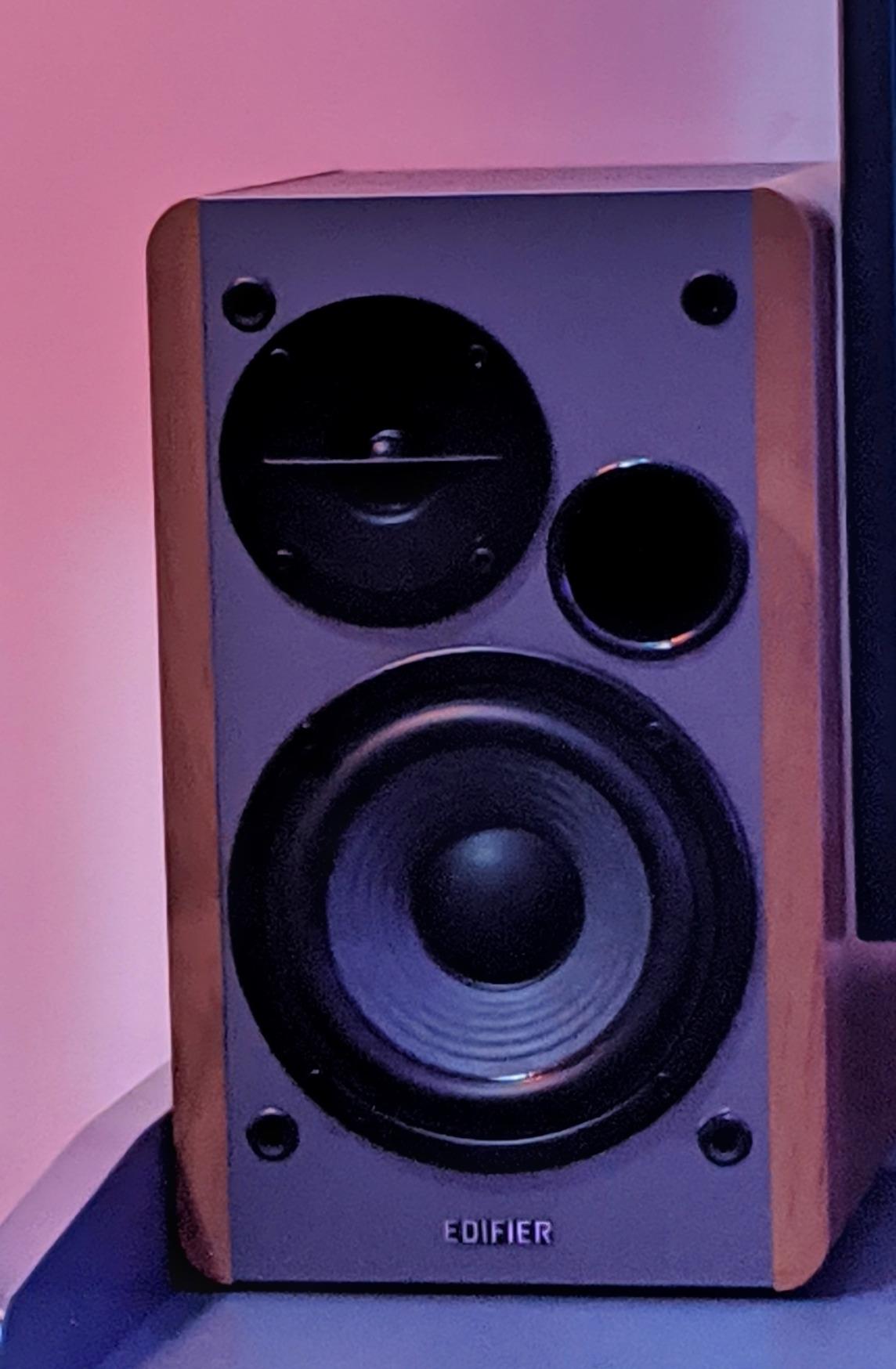
Everything else follows the R1280T pattern. The remote handles volume and input selection, bass and treble sit on knobs on the side panel of the main speaker, and the cabinet is 14.6 inches deep by 19.6 inches wide by 23.4 inches tall, weighing 12.9 pounds. That size makes it a genuine bookshelf speaker rather than a desktop unit, and the width means it needs a shelf with real clearance on each side.
The connection options are broader than any other powered pair here, which is the honest reason to choose it. If your setup is turntable only, the extra inputs are unused capability. If your speakers also serve a television, a game console or a phone, this is the version that covers all of it without an amplifier or a switcher.
What to check before buying
Check that your turntable has line-level RCA outputs, since the digital inputs do not help a cartridge-level signal. If your deck has no built-in preamp, this is the wrong speaker and the Klipsch R-51PM is the right one.
Check your room size as well. With 42W and a 4 inch driver, this pair is at its best in a small to medium room. Pushing it hard in a large space is where the digital inputs will keep working and the bass will not.
Who it suits and who it does not
It suits a mixed system, where records are one source among several and the same speakers handle a television. The optical input in particular is a genuine advantage over analog-only powered pairs, since a television’s own speakers are usually worse than these.
It does not suit a turntable without a preamp, and it does not suit a listener who wants deeper bass than a 4 inch driver can produce. Reviewers also report the remote feels flimsy, that there is no front-facing indicator light to show which input is active, and that the cable linking the two speakers is short.
6. Kanto YU6MW – Biggest Drivers With a Phono Preamp
Kanto YU6MW Powered Bookshelf Speakers with Bluetooth and Phono Preamp | Pair | Matte White
Pros
- Integrated phono preamp connects a preamp-less turntable directly
- 5.25 inch Kevlar drivers with 200W peak output
- Subwoofer output for deeper bass
- Remote with volume
- tone and balance controls
- Automatic standby and power-up
Cons
- Bluetooth is version 4.0
- Cabinet vibration reported at higher volumes
- Large footprint for a desk
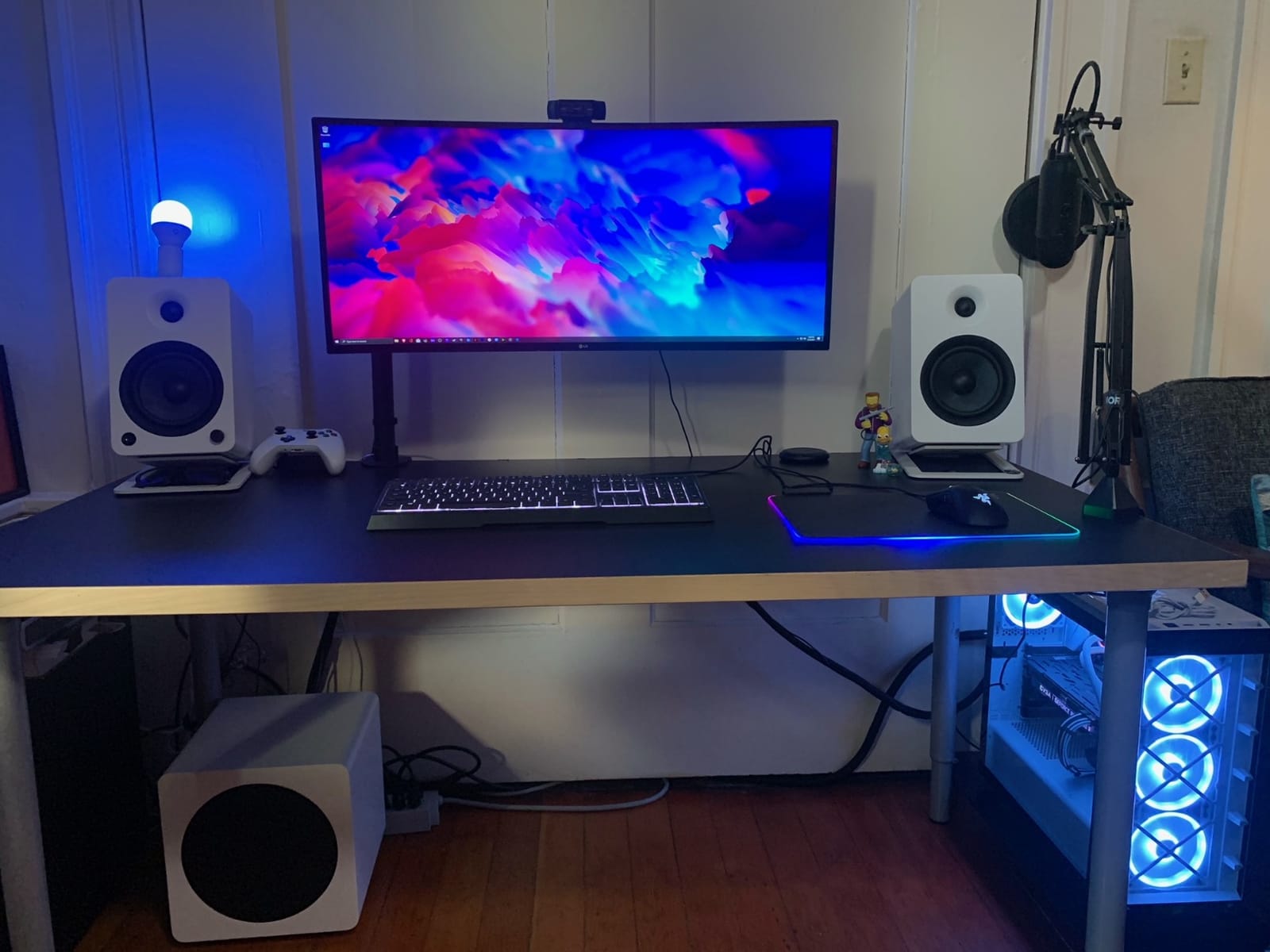
The YU6MW is the most capable powered pair here for a listener who wants one box to do everything. It has an integrated phono preamp, so a turntable without a built-in preamp connects directly. It has 5.25 inch Kevlar drivers with 1 inch silk dome tweeters in a 10.7 inch tall MDF cabinet, and 200W of peak output behind them.
The input list is the widest in this roundup: optical twice, RCA with the phono preamp, 3.5mm and Bluetooth with Qualcomm aptX. There is a subwoofer output, which none of the other powered pairs here offers, so you can add bass later without replacing the amplifier. The remote controls volume, input, tone and balance, and the auto standby and power-up modes save power when the system is idle.
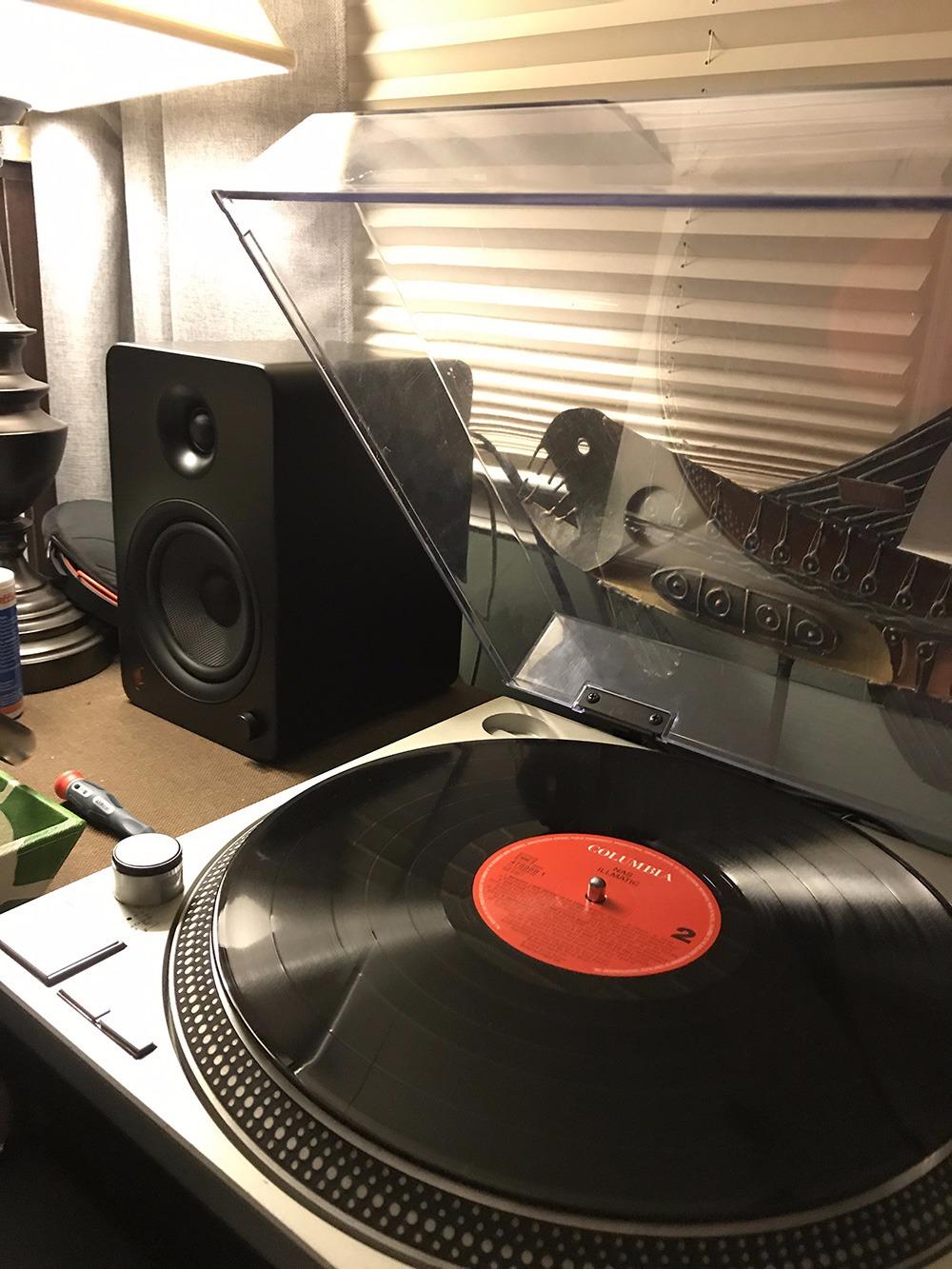
The sound is described as having a wide soundstage and good imaging, which is what you want from a stereo pair for records. Response is listed from 60 hertz, so the 5.25 inch drivers reach meaningfully lower than the 4 inch Edifier pairs. The subwoofer output exists precisely because the cabinet alone will not deliver the deepest bass.
Two things to weigh. Several users report cabinet vibration in the mid-bass region at higher volumes, so this pair wants a stand rather than a hollow shelf. And the Bluetooth version is 4.0, which is older than current, so streaming quality will not match the aptX implementation on newer phones.
What to check before buying
Check your shelf depth and height. At 10.7 inches tall and 8 inches deep, this is the largest powered pair here, and on a crowded shelf the cabinets may crowd each other. Wide separation matters for stereo imaging, so give them room rather than pushing them together.
Check the phono preamp compatibility too. An integrated preamp is designed for moving-coil and moving-magnet cartridges at typical settings, so if you have an unusual cartridge with very low output, look at the preamp controls before connecting.
Who it suits and who it does not
It suits a listener who wants one powered pair to serve a turntable, a television and streaming, and who plans to add a subwoofer later. The balance control on the remote is a nice touch for rooms with awkward acoustics.
It does not suit a very small desk, because of the footprint. It is also the lowest rated pair here at 4.3 stars, and reviewers note a slightly recessed midrange compared with some competitors. If vocals are your priority, audition against another pair before settling.
7. Klipsch RP-600M – Best for a Dedicated Listening Room
Pros
- Highest rated pair here for detail and dynamics
- Titanium LTS tweeter in a Tractrix horn for excellent dispersion
- 6.5 inch spun copper cerametallic woofers with low distortion
- Five year warranty
- Dual binding posts for bi-wiring or bi-amping
Cons
- Passive
- so an amplifier is required
- Rear-firing port needs clearance from the front wall
- Bright and forward signature is not for everyone
The RP-600M is the highest rated passive speaker in this group, and it is the one to buy if you have a dedicated room rather than a shelf above a desk. The driver array is a 1 inch titanium LTS vented tweeter loaded into a hybrid Tractrix horn, above a 6.5 inch spun copper cerametallic woofer. Response is listed from 45 hertz at 8 ohm impedance.
The horn is the reason this speaker measures and behaves the way it does. A horn-loaded tweeter controls dispersion, so the high frequencies stay composed at off-axis listening positions, which means the sound holds up when you are not sitting exactly between the speakers. That is a real advantage for records, where you move around the room more than you do with a film.
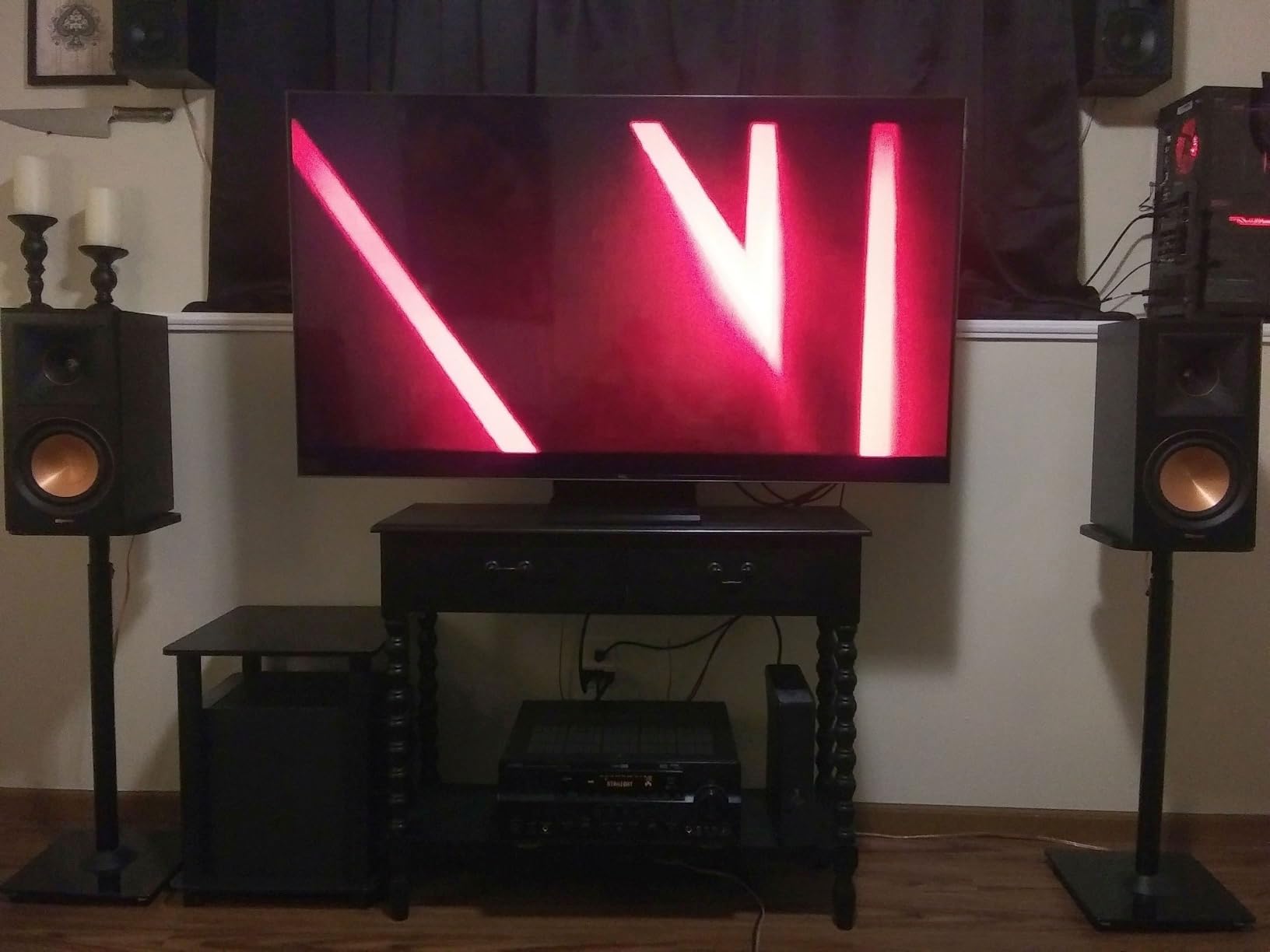
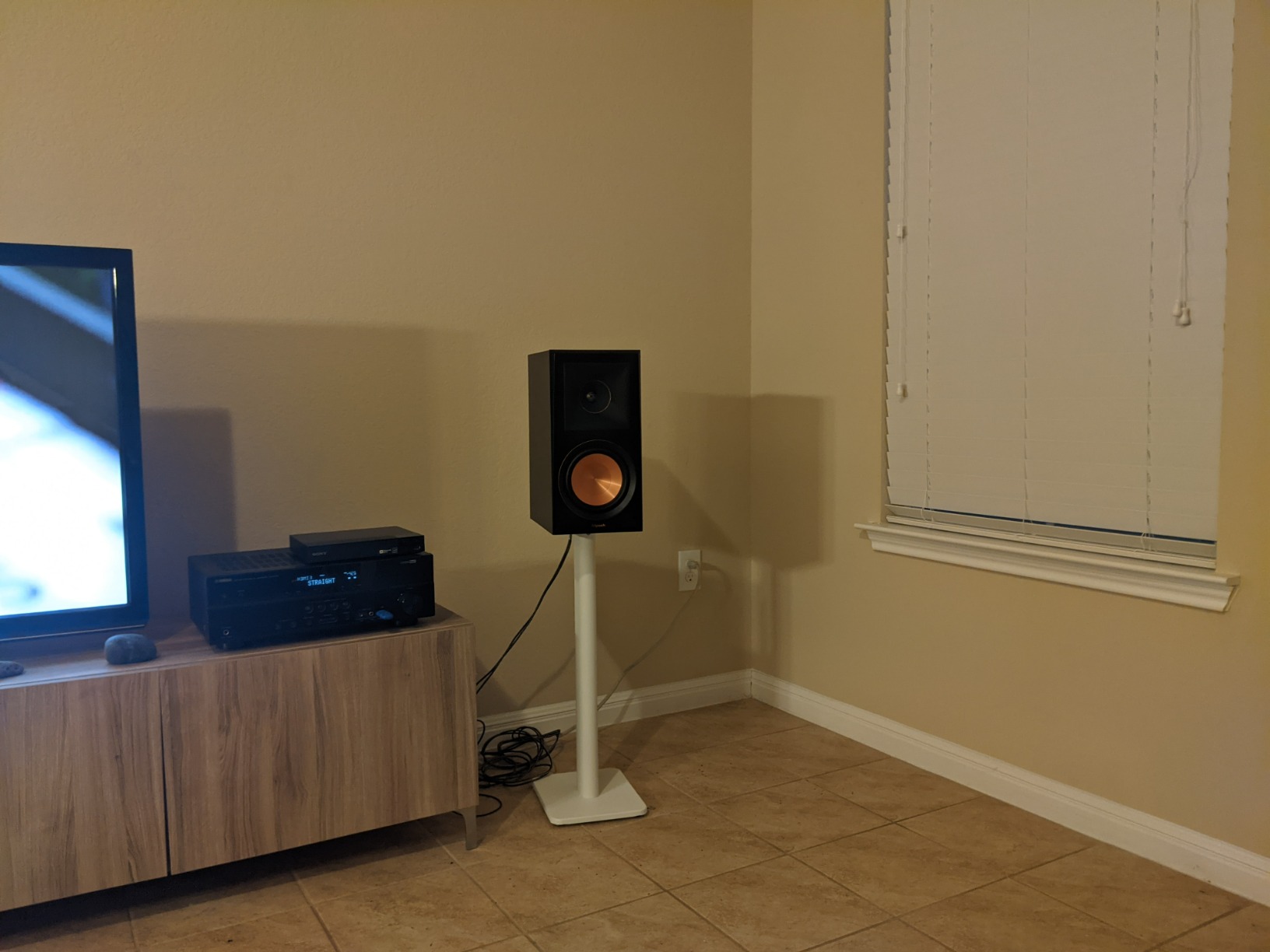
The port is rear-firing, which is the practical caveat. Leave at least 20 to 30 centimeters between the back of the cabinet and the front wall, or the low end will be boomy and the port airflow will be restricted. The cabinet is 11.85 inches deep, 7.95 inches wide and 15.69 inches tall at 16.1 pounds, so it also needs a sturdy stand rather than a light shelf.
Other details worth knowing: dual binding posts allow bi-wiring or bi-amping, the grille attaches magnetically and is removable, and the warranty runs five years, which is the longest here. The high sensitivity also means it works with lower power amplifiers than most passive bookshelf speakers of this size.
What to check before buying
Check the amplifier. This is a passive 8 ohm speaker rated at 100W and it wants real current, so a small desktop amplifier will not control it well. Anything with a decent 50 to 100 watts per channel is a better match.
Check the room before the speakers. The rear-firing port and 6.5 inch woofer both want space, and this pair in a small room will overpower the recording rather than reveal it.
Who it suits and who it does not
It suits a dedicated listening room, a larger medium-size space, and a listener who plays dynamic music at moderate levels. The five year warranty and the horn dispersion make it a good long-term pair that can be moved between rooms.
It does not suit a first setup with no amplifier, and it does not sit close to a wall. The bright, forward signature that makes it exciting on rock and orchestral records can be tiring on softer vocal jazz, so audition if that is most of your collection. For a used-market alternative, the ELAC Debut series and Q Acoustics models come up repeatedly as strong value when bought second-hand.
8. Edifier R980T – Best for a Small Desk Setup
Edifier R980T 4″ Active Bookshelf Speakers – 2.0 Computer Speaker – Powered Studio Monitor (Pair)
Pros
- Least expensive powered pair in this roundup
- 24W RMS suits near-field listening
- Front-flared bass reflex port works close to a wall
- RCA
- 3.5mm and speaker wire all included
- Compact 7.5 inch wide cabinet
Cons
- Plastic enclosure
- No remote control and no Bluetooth
- 24W output is quiet in a large room
The R980T is the smallest and simplest speaker here, and for a desk setup that is exactly right. It is a powered pair rated at 24W RMS with a 4 inch woofer behind a front-flared bass reflex port, and the whole point of the flared front port is that it behaves properly on a desk pushed against a wall.
The cables are the detail that makes it useful for a first vinyl setup. The box includes RCA cables, a 3.5mm cable and speaker wire, along with a 110V to 240V power supply, so you can connect a turntable with line-level outputs and start playing without a second purchase. Two AUX inputs are on the back for a second device.
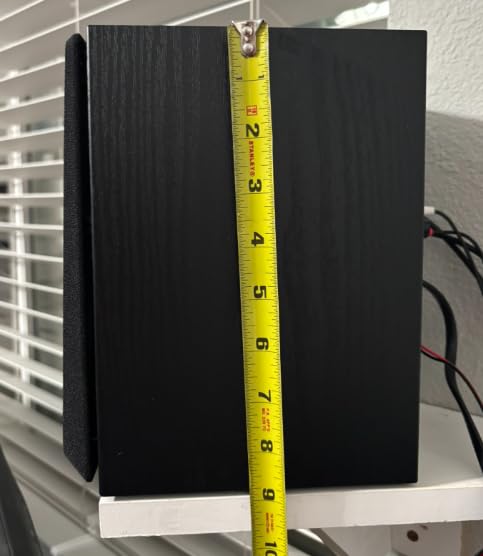
The trade-offs are physical. At 24W RMS this is a quiet pair, which suits near-field listening at arm’s length and does not suit filling a living room. The enclosure is plastic rather than MDF, so cabinet resonance is more likely at higher volume, and the signal to noise ratio is stated at 85 dB, the same figure Edifier quotes on the larger R1280T.
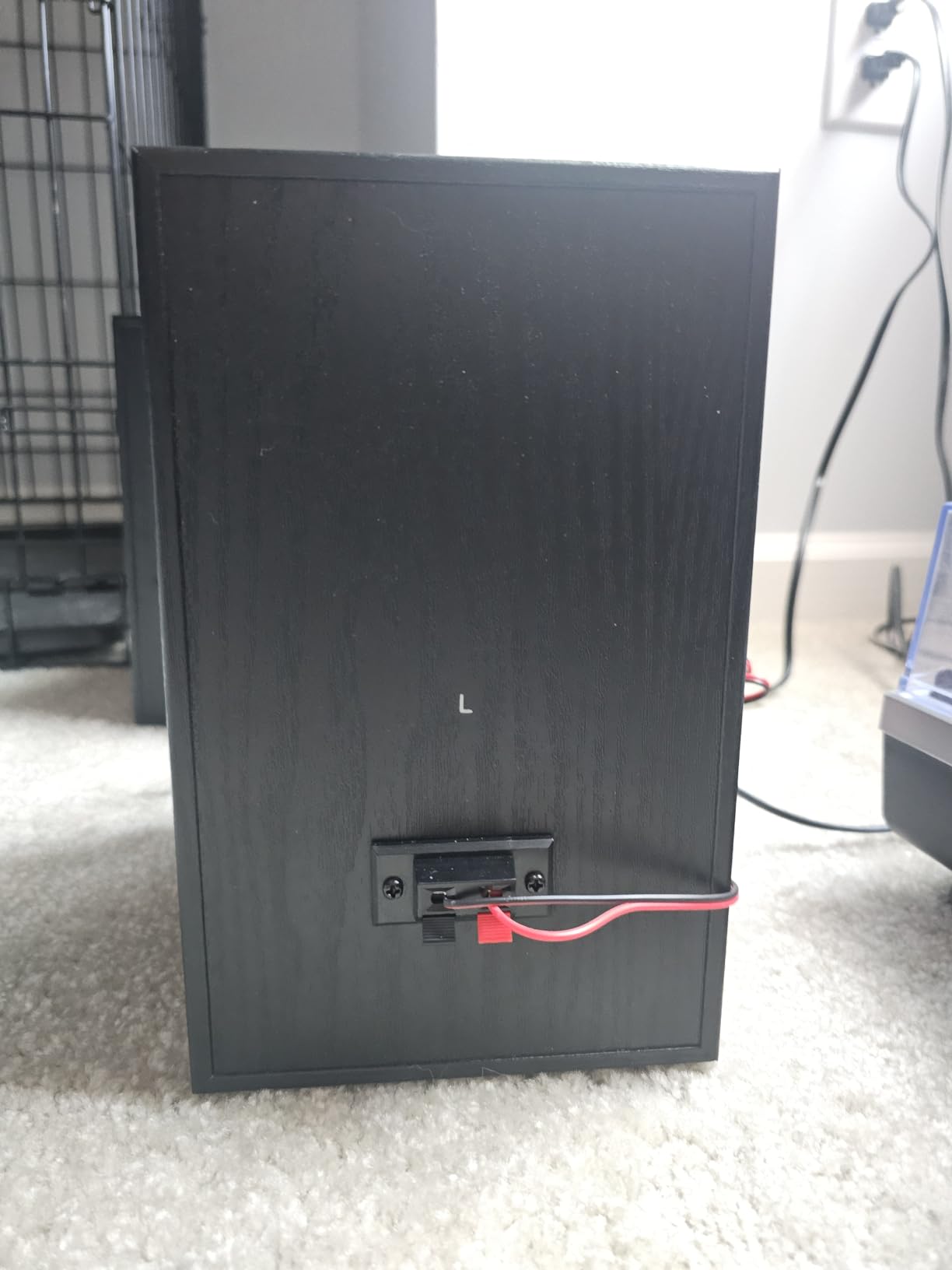
Dimensions are 11.5 inches deep by 7.5 inches wide by 17 inches tall at 7.8 pounds for the pair, so it fits a bookshelf or a desk without rearranging anything. There is no remote and no Bluetooth, so volume is adjusted on the cabinet itself.
What to check before buying
Check how far you listen. If you sit within a few feet, 24W is comfortable. If the speakers are across a room, they will struggle and you should look at a higher-powered pair instead.
Check the enclosure material against your expectations. Plastic is fine for a desk and is the main reason this pair is affordable, but a taller MDF cabinet will sound cleaner at higher volume.
Who it suits and who it does not
It suits a small room, a home office or a dorm setup, and a listener whose turntable has a built-in phono preamp and RCA line outputs. Including the cables makes it a genuine one-box start.
It does not suit a turntable without a preamp, since there is no phono input. It does not suit a large room or anyone who wants to play records at high volume, and the lack of a remote means adjusting volume from the listening chair is not possible. If you outgrow it, the R1280T is the natural next step within the same range.
Powered vs Passive Speakers: What Vinyl Owners Actually Need
Powered speakers have an amplifier built into one or both cabinets, so you connect a source and press play. Passive speakers have no amplifier at all and need one supplied separately. This is the first question to settle, and it is the one most often answered incorrectly in other roundups, including descriptions of passive models as having a built-in amplifier.
For vinyl specifically, a powered pair with a phono input is the lowest-friction route because it removes two boxes from the chain. A passive pair with a good amplifier gives more headroom and better control, and it is the route most listeners end up on once the system is settled.
Where powered wins is simplicity. The amplifier inside is matched to the drivers by the manufacturer, so there is no impedance guesswork, and the whole system is smaller. That matters when your turntable is a plug-and-play model with a built-in preamp and you have no interest in matching components.
Where passive wins is flexibility. You can change amplifier without changing speakers, you can bi-wire or bi-amp where the speakers support it, and the ceiling on sound quality is set by your amp rather than by a fixed onboard circuit. It also means no obsolescence, since a passive speaker works with any amplifier you will ever want to own.
There is one honest caveat on Bluetooth. Forum discussion on this topic is often dismissive of it, and for a vinyl-only system that is fair. Bluetooth adds nothing to a record, since the turntable signal is analog. It is worth paying for only if you genuinely also stream, and speakers that are Bluetooth-only with no RCA input are useless with a turntable.
How to Connect a Turntable to Your Speakers
There are three wiring paths, and which one applies to you depends entirely on what your turntable outputs. Get this right first and the rest is simple cable work.
Path one: turntable with a built-in preamp, to powered speakers. The turntable has a PHONO and a LINE selector on the back. Set the switch to LINE so the built-in preamp does its work, then run RCA cables from the line outputs to an AUX or RCA input on the speaker. This is the setup for the Edifier R1280T, the R1280DB, the R980T and the Kanto YU6MW. Never connect a line output to a phono input, and never connect a phono-level output to a line input without switching the preamp.
Path two: turntable without a preamp, to powered speakers with a phono input. The turntable outputs cartridge-level signal only. The Klipsch R-51PM and the Kanto YU6MW both have an integrated phono preamp, so run RCA cables straight across and engage the phono setting on the speaker. This is the fastest fix for a preamp-less deck, and it costs nothing extra if the speaker already has the input.
Path three: turntable without a preamp, to passive speakers. Here you need two extra things: a small external phono preamp to apply RIAA equalization and raise the signal to line level, and an amplifier to drive the speakers. The preamp goes between the turntable and the amplifier, and the amplifier goes to the speaker terminals. External preamps in this class are inexpensive, and adding one is a normal first upgrade rather than a mistake.
On every path, connect the ground wire. The turntable’s ground terminal is a small post or lug, and the speakers or preamp have a matching ground screw. Attach a ground wire between them and tighten it. Leaving the ground floating is the usual cause of a persistent hum that gets louder when you touch the turntable, and it is the single most common setup mistake in vinyl.
If the sound is quiet and thin, the signal is going into a line input when it needs a phono input. If it is loud and distorted or crackly, a phono-level signal is going into a line input with the preamp switched off. Both problems take seconds to fix once you know which one you have. More amplifier options and setup notes are in our bookshelf speaker deal guide.
Speaker Placement and the 83% Rule
Distance, angle and height change the sound more than most people expect, and no speaker in this roundup reaches its potential on an untidy shelf. The 83% rule is a starting point that gets closer faster than most placement rules, and it works because the front wall is usually the biggest surface in the room.
The rule itself: measure the distance from your furthest speaker to your listening position. Multiply that distance by 0.83, and place the speaker about that distance from the front wall. If a speaker is 10 feet from where you sit, it should sit roughly 8.3 feet from the front wall.
It is a starting point, not a law. A front-ported speaker like the ELAC Debut 2.0 B6.2 is far more forgiving, since its port faces forward and does not need rear clearance. A rear-firing design like the Klipsch RP-600M needs real space behind it, and pulling it off the wall according to the rule is exactly the right move.
Beyond the front wall, three habits do most of the work. First, form an equilateral triangle: the distance between the two speakers should equal the distance from each speaker to your listening position. That places you properly in the stereo image rather than between the speakers or too far back.
Second, toe the speakers in slightly, aiming each one at your chair rather than parallel to the front wall. About 10 to 15 degrees is usually enough. This narrows the apparent width of the soundstage and moves instruments to the positions they were recorded in, which is a particular benefit for a large drum kit or a piano trio on a record.
Third, get the tweeters near ear level. Bookshelf speakers are named for a shelf, not for a shelf at head height, and a pair angled downward at your seated ear position loses treble detail. Speaker stands cost very little and fix this immediately. A thicker pad under each cabinet also isolates it from shelf resonance, which is why boomy bass on a hollow bookcase is a placement problem before it is a speaker problem.
Finally, let the system settle. Speakers and rooms both stabilise after a few hours of use at normal volume, and the break-in behaviour that ELAC owners report over 30 to 100 hours is real. Judge the sound after a few records, not after one side of one.
Matching Speakers to Your Room Size
Room size is the constraint most often ignored, and it is cheap to get right. Bigger speakers in a small room produce boomy, unfocused bass and an unstable image. Smaller speakers in a large room simply cannot fill it.
Small room, under 12 square meters, or a bedroom or office: a 4 inch driver is the right size. The Edifier R980T, the Edifier R1280T and the Micca RB42 all fit this brief, and a powered pair keeps the signal path short. Keep the speakers close to a wall behind them rather than pushing them into the middle of the room.
Medium room, roughly 12 to 25 square meters, a typical living room: a 5.25 inch driver is the sweet spot. The Klipsch R-51PM and the Kanto YU6MW both sit here, and either fills the space with clean output at moderate volume without straining. A 6.5 inch woofer also works if it is front-ported, which is what the ELAC Debut 2.0 B6.2 offers.
Large room or a dedicated listening room, over 25 square meters: a 6.5 inch woofer and a real amplifier. The Klipsch RP-600M and the ELAC Debut 2.0 B6.2 are the two passive options here that suit this, and a subwoofer is worth planning for rather than adding later. A subwoofer paired with floorstanders or a capable passive pair is the answer, not a small bookshelf speaker driven hard.
Our broader roundups cover the wider market if none of these fit your setup, including deals across the bookshelf speaker range and event-day speaker savings.
Frequently Asked Questions
What speakers are best for vinyl?
The best speakers for vinyl are powered active bookshelf speakers with RCA inputs and a ground terminal, because they accept a turntable signal directly with no separate receiver. If you already own an amplifier, passive speakers like the ELAC Debut 2.0 B6.2 or the Klipsch RP-600M give you more headroom and control than any built-in amplifier can.
What are the best speakers for a vinyl player?
Match the speakers to your turntable and room. With a turntable that has a built-in phono preamp, a powered pair such as the Edifier R1280T or the Klipsch R-51PM is the simplest route. With a turntable that has no preamp, choose speakers with an integrated phono input, or add a small external phono preamp between the deck and your amplifier. In a small room, a 4 inch driver is enough; in a medium or large room, move up to 5.25 or 6.5 inch drivers.
What is the 83% rule for speakers?
The 83% rule says that if your furthest speaker is 10 feet from your listening position, that speaker should sit about 8.3 feet from the front wall. Multiplying the listening distance by 0.83 gives the speaker-to-front-wall distance, which reduces the bass reinforcement and boundary reflections that come with pushing speakers against a wall. Treat it as a starting point rather than a law, and note that front-ported speakers are far more forgiving than rear-ported ones.
Are bookshelf speakers good for turntables?
Yes, and they are the correct size for small and medium rooms. The limitation is the room, not the turntable. Bookshelf speakers need either a phono-level input or an external phono preamp in the chain, and passive bookshelf speakers need an amplifier. In a large room, floorstanding speakers or bookshelf speakers paired with a subwoofer will give you the bass reach a small cabinet cannot.
Do I need an amplifier for bookshelf speakers with a record player?
You need an amplifier only if the speakers are passive. Powered bookshelf speakers have the amplifier inside, so a turntable with a built-in preamp connects straight to the RCA inputs. A turntable with no preamp needs either powered speakers with an integrated phono preamp, or a small external phono preamp feeding an amplifier. Connect the ground wire in every case, since an unconnected ground terminal is the usual cause of hum.
Final Recommendation for Vinyl Owners in 2026
The best bookshelf speakers for vinyl depend on one thing: what your turntable outputs. If it has a built-in phono preamp, the Edifier R1280T is the value pick and the Edifier R1280DB is the pick if a television or streaming also needs to be served. If your deck has no preamp, the Klipsch R-51PM takes a cartridge-level signal directly through its phono switch and ground terminal, which makes it the simplest complete vinyl system here.
If you already own an amplifier, stay passive. The ELAC Debut 2.0 B6.2 suits a medium room and is easy to place near a wall, the Micca RB42 is the cheapest way into a passive setup, and the Klipsch RP-600M is the choice for a dedicated room with space behind the speakers. Whatever you pick, set the tweeters near ear level, connect the ground wire, and give the system a few records to settle before you judge it.