
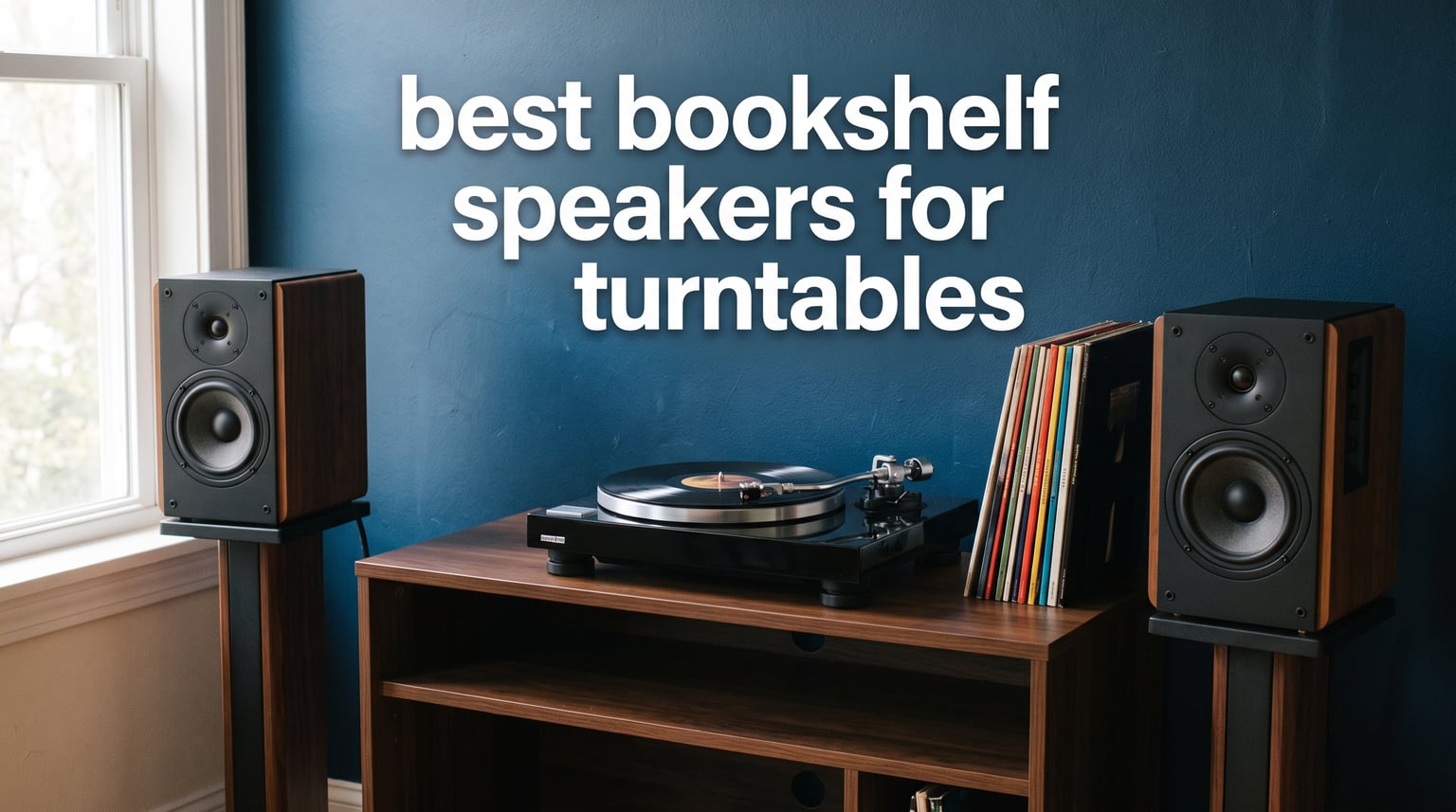
Finding the best bookshelf speakers for turntables comes down to one practical question: where will amplification and phono equalization happen? A good pair can bring out the detail, bass line, and stereo width in records without taking over a small room, but the wrong connection path can leave a new record player setup silent or thin.
Bookshelf speakers are good for turntables because they place two separate channels at ear level while staying compact enough for shelves or stands. For a direct route, choose powered speakers with an RCA input and, if your turntable needs it, a built-in phono preamp; choose passive bookshelf speakers only when you already have or plan to add an amplifier or receiver.
I built this guide around seven supplied models, not vague category picks. It includes all-in-one turntable speakers, traditional passive designs, a studio-monitor option, and compact choices, with the fit for your room and connection path stated plainly.
Our research also points to two issues that matter after checkout: beginners often get stuck on the phono-preamp question, and vinyl listeners report feedback or hum when speakers sit too close to the turntable. The setup advice below addresses both, so you can choose speakers for record player listening that work as a complete system rather than as a promising-looking pair of boxes.
These top 3 picks answer the main turntable setup needs
The Fluance Ri71 is my first choice when you want an amplified pair with RCA, Bluetooth, HDMI ARC, and a subwoofer output. Pick the Kanto YU4 when an integrated phono preamp is the deciding feature, while the Saiyin pair makes sense for a lower-complexity passive system only if an amplifier or receiver is already part of the plan.

Fluance Ri71 Powered Bookshelf Speakers
- 120W amplifier
- AMT tweeters
- RCA and HDMI ARC
- Subwoofer output
These are the best bookshelf speakers for turntables in 2026
This overview separates powered from passive designs because that distinction is more useful than a generic ranking. Powered models contain amplification; the Sony, ELAC, and Saiyin pairs need an external amplifier or receiver before they can play a turntable.
| Product | Specifications | Action |
|---|---|---|
 Sony SS-CS5M2 Sony SS-CS5M2 |
|
Check Latest Price |
 ELAC Debut 3.0 DB53 ELAC Debut 3.0 DB53 |
|
Check Latest Price |
| Fluance Ri71 |
|
Check Latest Price |
| Kanto YU4 |
|
Check Latest Price |
| Saiyin 5 inch Passive |
|
Check Latest Price |
 Edifier MR5 Edifier MR5 |
|
Check Latest Price |
 RIOWOIS Powered Speakers RIOWOIS Powered Speakers |
|
Check Latest Price |
1. Sony SS-CS5M2 is the detail-focused passive choice
Pros
- 3-way design
- Wide-dispersion super tweeter
- 100W maximum input
- Compact cabinet
Cons
- Needs an amplifier
- Wired only
The Sony SS-CS5M2 is a passive pair for listeners who want a traditional separate-component system. Its listed 4.8 rating from 151 reviews is the highest in this group, and its three-driver layout gives it a more ambitious specification than a basic two-way bookshelf speaker.
Sony lists a 5.12-inch woofer, a high-precision tweeter, and a wide-dispersion super tweeter. The stated 53Hz to 50kHz response and bass-reflex enclosure point toward a speaker designed to cover bass and high-frequency detail while keeping the cabinet compact.
I would place this pair on solid stands or a stable shelf with some space behind it, then angle the speakers toward the listening position. The 6-ohm specification and 100W maximum input are facts to take to an amplifier’s speaker-compatibility information rather than a reason to assume any old receiver is a match.
An external amplifier is required before the Sony can play records
The SS-CS5M2 has wired speaker connectivity and no integrated amplifier, Bluetooth connection, or phono stage listed. Connect the turntable to a phono preamp if needed, route that signal to an amplifier or receiver, and run speaker cable from the amplifier to each speaker.
This approach adds boxes and cables, but it also keeps the turntable, amplification, and speakers separate. That is useful when you prefer to choose an amplifier around the system instead of accepting the amplifier built into a powered pair.
Small and medium listening rooms are the natural fit for the Sony pair
The cabinet measures 8.7 by 7 by 13.2 inches, making it one of the more compact full-range passive options here. Its 5.12-inch woofer should be considered alongside the room, the amplifier, and how far you sit from the speakers, not in isolation.
Choose it when spacious high-frequency presentation is a priority and you already welcome a separate amplifier. Skip it if a one-cable, turntable-to-speaker arrangement or wireless streaming is non-negotiable.
2. ELAC Debut 3.0 DB53 is the composed passive upgrade
Pros
- Aramid fiber woofer
- Internal bracing
- Wide dispersion
- Magnetic grilles
Cons
- Needs an amplifier
- Wired only
The ELAC Debut 3.0 DB53 is another passive speaker, but it approaches the job with a 5.25-inch woven aramid-fiber woofer and a 1-inch aluminum dome tweeter. The supplied information also lists a 48Hz to 38kHz response, 6-ohm impedance, and 120W maximum input power.
What stands out to me is the attention paid to cabinet behavior: ELAC lists internal bracing along with a waveguide and phase plug intended to create a wider dispersion pattern. Those details are relevant to vinyl because cabinet vibration can blur the sound before it ever reaches your turntable’s cartridge.
Its 4.7 rating comes from 224 reviews, where reviewers cited clarity, reduced cabinet vibration, and broad dispersion. That is meaningful feedback, although it remains user feedback rather than a guarantee of a particular result in your room.
A receiver or integrated amplifier is the required partner for the ELAC pair
These are passive bookshelf speakers with wired connectivity, so a record player cannot plug in and play by itself. Your system needs amplification, plus a phono preamp somewhere in the chain when the turntable does not provide a line-level output.
Check the amplifier’s supported impedance and its power guidance before connecting the 6-ohm speakers. I also recommend keeping the connections simple at first: turntable to phono stage, phono stage to amplifier, then amplifier to speakers.
A stable stand placement helps the DB53 show its cabinet design
The DB53 is listed at 18 by 8 by 14 inches and 13.34 pounds, so it asks for a shelf or stand that will not wobble. Avoid placing either speaker on the same lightweight furniture as a turntable, because physical vibration can travel into the turntable rather than staying in the speaker cabinet.
This is a strong fit for someone building a passive vinyl system around a good amplifier and who wants a 5.25-inch woofer. It is less appropriate for a beginner who wants phono input, amplification, and streaming inside the speaker pair.
3. Fluance Ri71 is the all-in-one connectivity pick
Pros
- Integrated amplifier
- RCA input
- AMT tweeters
- HDMI ARC
- Subwoofer output
Cons
- Larger powered setup
- Smaller review base
The Fluance Ri71 makes the most direct case for powered bookshelf speakers for vinyl. Its integrated 120W amplifier removes the need for a receiver, and the listed RCA input gives a turntable with a line-level output a clear physical connection.
Fluance pairs 5-inch woven glass-fiber drivers with AMT tweeters, front-firing tuned ports, and an internally braced MDF cabinet. The front ports may be convenient when shelf placement is unavoidable, though every speaker still benefits from breathing room and a solid surface.
This pair also provides Bluetooth aptX HD, HDMI ARC, and a subwoofer output. I like that flexibility for a listener whose turntable shares space with a TV or who wants the option to add lower-frequency support later without changing the main speakers.
A line-level RCA signal connects directly to the Ri71
Use the RCA input when your turntable has a built-in preamp switched on or when an external phono preamp is in the signal path. The product data calls out RCA connectivity but does not list a built-in phono preamp, so a bare phono-level turntable still needs phono equalization before reaching the speakers.
This distinction prevents a common setup error. A phono signal is lower level and needs RIAA equalization; a line-level output is the signal a normal RCA input expects.
A mixed music-and-TV setup is where the Ri71 has extra appeal
HDMI ARC and Bluetooth make the Ri71 broader than a vinyl-only speaker, while the subwoofer output gives a future path for more bass. Its 4.7 rating is based on 50 reviews, a smaller review pool than several other choices here.
Choose the Ri71 if you want active speakers with a serious list of inputs and no separate receiver. Look elsewhere if you specifically need the speaker pair itself to include a phono preamp.
4. Kanto YU4 is the direct phono-preamp solution
Pros
- Integrated phono preamp
- Remote control
- Multiple inputs
- Auto standby
- Bluetooth aptX
Cons
- 4 inch woofer
- No separate amplifier upgrades
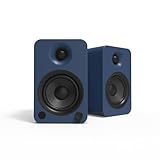
The Kanto YU4 is the cleanest answer for a turntable that lacks its own phono stage. These powered speakers include both amplification and an integrated phono preamp, so the turntable can connect to the appropriate RCA phono input without buying a separate receiver or preamp.
Kanto specifies a 4-inch Kevlar driver, 1-inch silk-dome tweeter, 140W peak power and 70W total RMS, plus a 60Hz to 20kHz response. The smaller driver does not promise the bass reach of the 5-inch designs here, but it supports a notably compact cabinet measuring 7.5 by 5.5 by 8.7 inches.
The input list includes optical, RCA, 3.5mm auxiliary, and Bluetooth with Qualcomm aptX. A supplied remote controls volume, input, tone, and balance, which is practical when the speakers sit away from the turntable.
The built-in phono preamp makes the YU4 easy to connect
Connect a turntable without a built-in preamp to the YU4’s phono connection and follow the speaker manual for grounding and input selection. If your turntable already has a preamp, use the suitable line-level input instead of sending an already amplified signal through a phono stage twice.
That single choice can prevent overload and distorted sound. I would check the turntable’s switch or documentation before changing any cables, because the correct setting is determined by the turntable’s output mode.
Compact rooms benefit most from the YU4 cabinet size
Its compact dimensions and automatic standby are useful for a desk, bedroom, or contained living-room system. Put the pair on stands or isolation pads where possible, rather than directly beside the record player on the same shelf.
The YU4 earns its place for listeners who want fewer components, direct vinyl compatibility, and streaming in one pair. Consider a speaker with a larger woofer or a subwoofer path if deep bass in a larger space matters more than compactness.
5. Saiyin 5 inch Passive is the simple amplifier-based starter
Pros
- 5 inch woofer
- Clear vocal presentation
- Wall mount kit
- Compact passive route
Cons
- Needs an amplifier
- Speaker wire not included
- No wireless connection
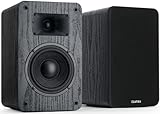
The Saiyin pair offers a passive route with a 5-inch woofer and 20mm silk-dome tweeter. It is listed as handling 40W per speaker, with 4-ohm impedance and a 55Hz to 20kHz response, so its basic requirements are clear: an amplifier or receiver is mandatory.
Its review summary credits the silk tweeter with vocal clarity and the 5-inch woofer with tight bass, while the product listing records a 4.6 rating from 98 reviews. Those are encouraging signals for an entry system, but the supporting electronics determine much of the eventual result.
The supplied wall-mounting kit is a useful inclusion for a room where shelves or stands are limited. I would never mount speakers on the same structure as a turntable without considering vibration, since direct mechanical feedback is the opposite of what a record player needs.
A compatible amplifier is non-negotiable with the Saiyin pair
The 4-ohm impedance deserves a careful check against your amplifier or receiver documentation. Do not connect these directly to a turntable’s RCA leads: passive speakers need amplified speaker-level output, not a low-level source signal.
Speaker wire is also not included according to the supplied data, so account for it as part of the setup. If the turntable has no built-in preamp, the system additionally needs a phono preamp before the amplifier’s normal line input.
A compact secondary system is a sensible role for the Saiyin speakers
The 5-inch woofer gives this pair more cone area than the smaller Kanto and RIOWOIS options, while the 40W-per-speaker handling keeps the focus on modest rooms and sensible amplifier matching. The listed wall hardware can help free floor or furniture space.
Choose Saiyin when you want to learn the separate-component path and already have compatible amplification. Avoid it when Bluetooth, a remote, or direct turntable connection is part of your must-have list.
6. Edifier MR5 is the active choice for adjustment and detail
Pros
- 3-way active system
- Room tuning
- 110W RMS
- Multiple wired inputs
- Bluetooth 6.0
Cons
- Heavy cabinet
- No listed phono preamp
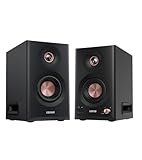
The Edifier MR5 approaches vinyl from a studio-monitor angle. It is an active three-way pair with a 5-inch long-throw woofer, 3.75-inch mid driver, 1-inch silk-dome tweeter, and a stated 110W RMS Class D amplifier.
For a record listener, the notable advantage is adjustment. Edifier lists room acoustic tuning through rear controls or the ConneX app, while the stated 46Hz to 40kHz range, MDF cabinets, and dimpled tweeter waveguide address the goal of controlled, detailed playback.
Connectivity includes RCA, XLR, TRS, auxiliary input, a 3.5mm headphone output, and Bluetooth 6.0 with multi-point connection. Its 4.5 rating is based on 302 reviews, and the pair weighs 10.38 kilograms, so sturdy placement is more than a cosmetic concern.
A phono preamp still belongs ahead of the MR5 RCA input when needed
The MR5 is active, meaning its amplification is built in, but the supplied specifications do not list an integrated phono preamp. A turntable with a line-level output can feed its RCA input; a phono-level turntable needs its own built-in or external phono preamp first.
This is the powered-versus-phono distinction in one product. Powered does not automatically mean phono-ready, so read the input labels rather than assuming that an RCA jack is a phono input.
Room-tuning controls help this speaker adapt to placement limits
The physical rear knobs and app-based room compensation offer more adjustment than the other supplied models. That makes the MR5 worth considering when shelves, nearby walls, or a desk restrict the placement you would prefer.
Choose it for a listening space where you value a three-way active design, input flexibility, and tuning controls. Its weight calls for a firm shelf or stands, and the lack of a listed phono stage means it is not the most stripped-back turntable solution.
7. RIOWOIS Powered Speakers are the compact no-receiver option
Pros
- Built-in amplification
- Compact footprint
- Bluetooth 5.3
- TV-ARC input
- Remote control
Cons
- Small woofer
- No subwoofer output
- Limited large-room headroom
The RIOWOIS pair is a compact powered option made for a record player, desktop, or TV-sharing setup. Its built-in amplifier means no receiver is required, and the supplied features list auxiliary, optical, TV-ARC, and Bluetooth 5.3 inputs with a remote control.
A 2.75-inch woofer and silk-dome horn tweeter sit inside a reinforced MDF cabinet. The data lists 40W in its technical details and 60W maximum output power in product details, so I would treat it as a compact-room speaker rather than trying to fill a large, open area.
The listing reports a 4.4 rating from 579 reviews, the largest review count of this group. That broader response pool makes it a useful option to compare, although its smaller woofer and lack of a subwoofer output set real limits on bass expansion.
A line-level turntable output is the straightforward way to use RIOWOIS
Because the supplied information does not list a built-in phono preamp, connect a turntable with its preamp enabled through the appropriate auxiliary-style line input. Add an external phono preamp when the record player outputs only a phono-level signal.
Bluetooth is useful for streaming from a phone, but vinyl playback should use the wired connection from the turntable’s output chain. This keeps the record player signal on the physical route intended for it.
A desktop or small-room system is the realistic target for RIOWOIS
The 2.75-inch woofer and listed 40W output suit close listening more naturally than a large living room. Its 9.69 by 7.6 by 6.22-inch dimensions make it manageable where space is tight.
Choose RIOWOIS when the priority is a small active system with TV and wireless inputs. Move up to a larger-driver speaker if you want more low-end scale or if you plan to add a subwoofer later.
The right turntable speaker choice starts with the signal path
Start by identifying what comes out of your turntable. A turntable with a switchable built-in preamp can send a line-level RCA signal to an active speaker’s normal RCA or auxiliary input, while a turntable without that preamp needs a phono stage before it reaches a normal line input.
A phono preamp is needed only when no phono stage is already active
A phono cartridge produces a low-level signal that needs amplification and RIAA equalization. That job can happen inside the turntable, inside a speaker such as the Kanto YU4, in a standalone phono preamp, or inside an amplifier or receiver with a phono input.
Use one phono stage, not two. If a turntable has a built-in preamp switched on, feed a line-level input; if it is switched off, route it to a phono input or external phono preamp.
Powered speakers simplify the system while passive speakers expand component choice
Powered bookshelf speakers contain an amplifier, so the Fluance Ri71, Kanto YU4, Edifier MR5, and RIOWOIS pair remove the separate receiver. Their input lists differ, and only the Kanto has a listed built-in phono preamp, so powered does not mean every connection problem disappears.
Passive speakers such as the Sony, ELAC, and Saiyin models need speaker cable and an external amplifier or receiver. I would take the passive route when choosing separate components is part of the enjoyment, not when the goal is the fewest boxes possible.
Speaker distance from the turntable reduces feedback risk
Put speakers on separate stands when possible, with the tweeters near ear height and the pair forming a rough triangle with your listening seat. Do not put speakers on the same shelf as a record player if you can avoid it, especially at higher volume.
Mechanical vibration can feed back through the furniture and into the cartridge, creating rumble or a howl. A sturdy surface, isolation pads, and a little distance between the turntable and each speaker are practical fixes before chasing more complicated causes.
Room size and driver size should guide expectations rather than decide alone
Small rooms and nearfield desks can work well with compact 2.75-inch or 4-inch drivers, while 5-inch designs generally bring more driver area to the task. Placement, wall distance, cabinet construction, and the room itself still affect the result.
For a larger listening space, consider the Fluance Ri71’s subwoofer output or a system that can grow with a separate amplifier and passive speakers. The right answer is the pair that plays comfortably in your space without being forced to work at its limit.
A short connection checklist prevents the most common first-day mistake
First, check whether the turntable output is phono or line level. Second, choose a matching destination: phono input for a phono signal, or RCA/auxiliary input for a line-level signal.
Third, select the input on the powered speaker or amplifier before raising the volume gradually. Finally, place the speakers away from the turntable and check that left and right channels are correctly assigned before judging the sound.
Common turntable speaker questions have direct answers
Are bookshelf speakers good for turntables?
Yes. Bookshelf speakers are a good match for turntables because two speakers create stereo playback in a compact form. The turntable must have a compatible amplification and phono-preamp path: use powered speakers for fewer components, or passive speakers with an amplifier or receiver.
Which speaker is best for a turntable?
The best choice depends on the connection path. Fluance Ri71 is a strong all-in-one powered choice with RCA input and broad connectivity, while Kanto YU4 is the straightforward option when a built-in phono preamp is needed. Sony and ELAC suit a separate amplifier-based system.
Who makes the best sounding bookshelf speakers?
No one brand is best for every room and system. Compare the driver layout, cabinet design, connectivity, room fit, and whether the speaker is powered or passive. In this guide, Sony offers a three-way passive design, ELAC uses an aramid-fiber woofer, and Edifier provides an active three-way system with room tuning.
Can you put speakers on the same shelf as a record player?
You can, but separate stands or surfaces are preferable. Speaker vibration can travel through the shelf into the turntable cartridge and cause feedback, rumble, or a howl. Keep speakers apart from the turntable where possible and use a firm surface or isolation pads.
The best final choice matches your turntable and room
For an active system with broad connections, I would start with the Fluance Ri71; for an integrated phono-preamp route, the Kanto YU4 is the clearer fit. Sony and ELAC are the stronger choices when you want a passive system around a separate amplifier, while the Edifier MR5 adds active three-way design and room tuning.
The best bookshelf speakers for turntables in 2026 are not simply the biggest or most feature-filled pair. Match the phono-preamp path, choose powered or passive based on how many components you want, give the speakers and turntable separate stable positions, and compare the seven options above before making your final call.