
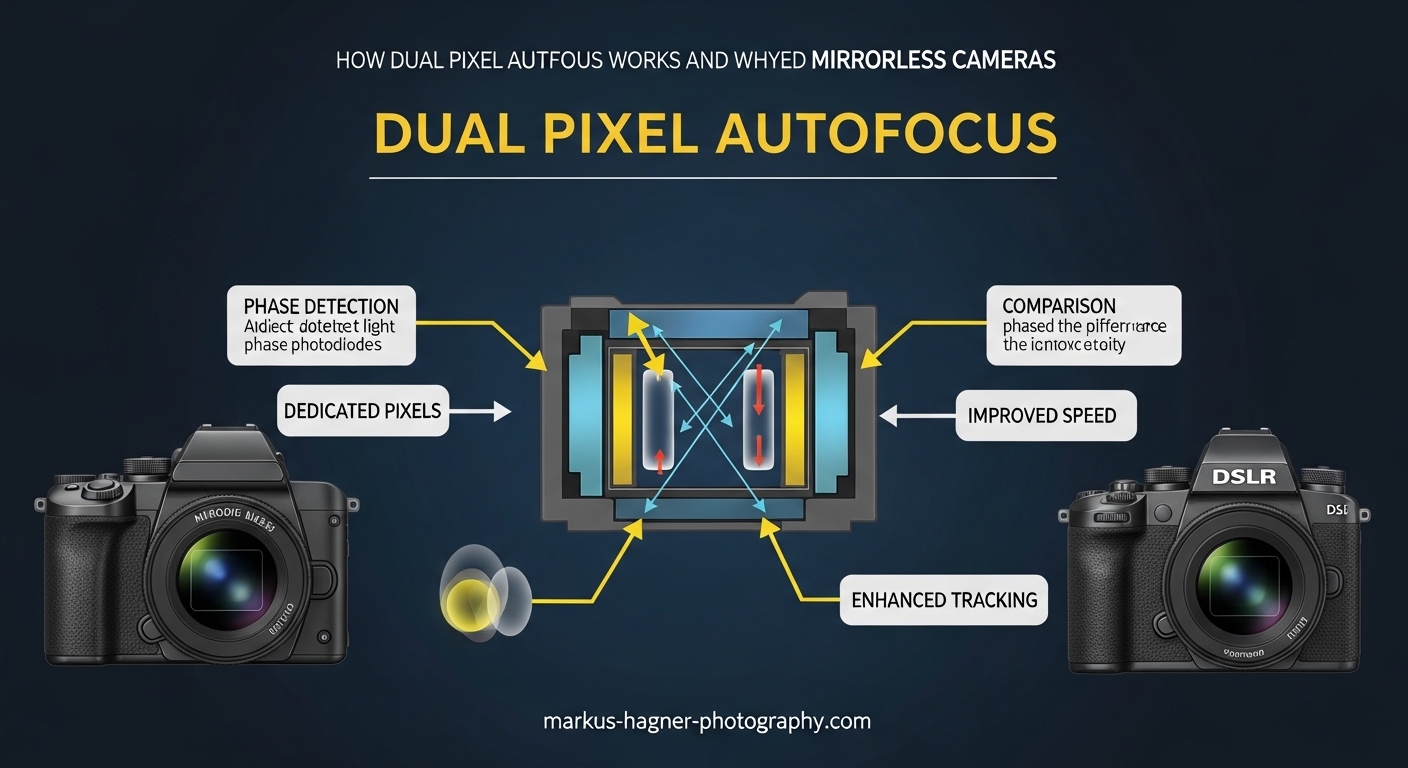
When Canon introduced Dual Pixel Autofocus in 2013, it solved one of the biggest problems holding back mirrorless cameras. Professional photographers had been reluctant to switch from DSLRs because early mirrorless systems struggled with autofocus speed and reliability. Dual Pixel Autofocus changed everything by bringing phase detection performance directly onto the image sensor itself.
In this guide, I’ll explain exactly how Dual Pixel Autofocus works and why this technology became the turning point for mirrorless camera adoption. You’ll learn the technical details behind Canon’s innovative approach and understand why videographers and photographers now consider it essential equipment for professional work.
The significance of this technology extends beyond just technical specifications. It represents a fundamental shift in how cameras approach autofocus, and it directly influenced the entire camera industry’s direction over the past decade. Understanding Dual Pixel AF helps explain why we are where we are today in photography technology.
What Is Dual Pixel Autofocus?
Dual Pixel Autofocus (DPAF) is Canon’s proprietary sensor-based phase detection technology. First introduced with the Canon EOS 70D in 2013, this system splits every single pixel on the image sensor into two independent photodiodes. Each photodiode can read light from a slightly different angle, allowing the camera to detect focus using phase detection across virtually the entire sensor surface.
Unlike traditional autofocus systems that relied on separate AF sensors or contrast detection, Dual Pixel CMOS AF performs both autofocus detection and image capture simultaneously. Every pixel contributes to focusing the image while also recording the actual photograph. This dual-purpose design eliminated the compromise that had held back earlier on-sensor phase detection systems.
The innovation here is significant. Before Dual Pixel Autofocus, on-sensor phase detection required masking some pixels for AF duty. This reduced image quality because those pixels couldn’t capture full color information and required interpolation to fill in missing data. Canon’s solution let every pixel do both jobs without sacrificing image quality, which was a genuine breakthrough in camera technology.
Canon spent years developing this technology before releasing it in the EOS 70D. The engineering challenge was substantial: they needed to create a sensor where each pixel could be split into two photodiodes without reducing light sensitivity or introducing artifacts. The solution involved a sophisticated manufacturing process that creates the dual photodiode structure during sensor fabrication.
The technology has evolved significantly since 2013. Dual Pixel CMOS AF II, found in Canon’s latest mirrorless cameras like the EOS R5 and R6, expands coverage to approximately 100% of the frame vertically and horizontally. It also incorporates deep learning algorithms for improved subject detection and tracking, making the system even more capable for challenging photography situations.
Today, Dual Pixel Autofocus is standard across Canon’s entire mirrorless lineup and appears in their cinema cameras as well. The technology has proven so successful that other manufacturers have developed similar approaches, though Canon remains the only company with true dual photodiode technology across every pixel on the sensor.
How Dual Pixel Autofocus Works
Understanding Dual Pixel Autofocus requires looking at what happens at the pixel level. Each pixel on a DPAF-equipped sensor contains two separate photodiodes rather than one. These photodiodes sit side by side behind a single microlens, receiving light from slightly different angles through the lens. This arrangement is what makes the magic happen.
The concept draws from the same principle as human binocular vision. Just as your two eyes see slightly different images that your brain combines to perceive depth, the two photodiodes in each pixel receive slightly different signals that the camera can compare to determine focus distance. This is the essence of phase detection autofocus.
Here’s how the system determines focus in a step-by-step process:
Step 1: Light Collection
Light enters through the lens and strikes the image sensor. Each pixel’s two photodiodes receive this light from slightly different horizontal angles. The left photodiode sees more of the left side of the lens aperture, while the right photodiode sees more of the right side. This difference is subtle but measurable, and it forms the basis for the entire focusing system.
Step 2: Signal Comparison
The camera reads signals from both photodiodes independently. When the image is out of focus, these two signals differ significantly because each photodiode sees a slightly different version of the scene. The system compares these signals to detect the phase difference between them. In a perfectly focused image, both photodiodes would see identical signals.
Step 3: Phase Difference Calculation
Using parallax principles, the camera calculates the distance and direction needed to achieve focus. The phase difference between the two photodiode signals tells the camera exactly how far out of focus the image is and which direction the lens needs to move. This calculation happens almost instantly, typically in microseconds. The mathematics behind this calculation is similar to how traditional phase detection works, but it happens on the main image sensor rather than a dedicated AF sensor.
Step 4: Lens Movement
The camera sends a command to the lens motor to move by the precise amount calculated. Because phase detection provides both distance and direction information, the lens can move directly to the correct focus position in a single movement. This differs from contrast detection, which must hunt back and forth to find the point of maximum contrast. The directness of this movement is what gives Dual Pixel AF its characteristic speed and decisiveness.
Step 5: Verification and Fine Adjustment
Once the lens reaches the calculated position, the system verifies focus by checking if the two photodiode signals now match. If needed, it makes minor adjustments to achieve perfect focus. The entire process typically completes in a fraction of a second. This verification step ensures accuracy even when the initial calculation isn’t quite perfect.
This approach combines the speed advantages of traditional phase detection with the accuracy benefits of contrast detection. The result is autofocus that’s both fast and precise, without the hunting behavior that plagued early mirrorless cameras. Photographers get the best of both worlds.
The system also handles continuous autofocus exceptionally well. When tracking a moving subject, the camera continuously compares photodiode signals and updates the focus distance in real time. This capability is what makes Dual Pixel AF so effective for video work and action photography.
One technical detail worth understanding: the dual photodiode structure doesn’t reduce image quality because the signals from both photodiodes are combined when recording the actual image. The separation only matters during autofocus detection. Once focus is achieved and the shutter fires, both photodiodes contribute to the final pixel value, maintaining full image quality.
Phase Detection vs Contrast Detection vs Dual Pixel AF
To appreciate what makes Dual Pixel Autofocus special, it helps to understand how it compares to other autofocus technologies. Each approach has distinct characteristics that affect focusing speed, accuracy, and behavior in different shooting situations. Let me break down each system in detail.
Traditional Phase Detection (DSLR)
DSLR cameras use a dedicated autofocus sensor located in the camera body, typically at the bottom of the mirror box. Light reflects off the main mirror and passes through a secondary mirror to reach this separate AF sensor. This sensor contains pairs of detection lines that compare light from opposite sides of the lens to calculate phase difference.
The advantage of traditional phase detection is speed. The system knows exactly how far and in which direction to move the lens, so focusing happens in a single decisive movement. This is why DSLRs have traditionally been preferred for sports and action photography.
However, DSLR phase detection has significant limitations. Coverage only extends to a limited area of the frame, typically clustered around the center in patterns that vary by camera model. Photographers often find themselves restricted to using only certain AF points for the most accurate focusing.
Additionally, the system requires physical alignment between the main sensor and the separate AF sensor. This alignment can drift over time or be affected by impacts, requiring microadjustment calibration for each lens. Many photographers have experienced the frustration of a front-focusing or back-focusing lens that required calibration to correct.
Contrast Detection
Contrast detection autofocus works by analyzing the image directly from the main sensor. It looks for maximum contrast at edges, which corresponds to sharp focus. When an image is out of focus, edges appear soft and contrast is low. As the lens approaches correct focus, edges sharpen and contrast increases. The system racks the lens back and forth until it finds the point of maximum contrast.
The advantage of contrast detection is accuracy. Because it analyzes the actual image data, it can achieve perfect focus without the calibration issues that affect phase detection systems. There’s no possibility of front-focus or back-focus because the system is looking directly at the image sharpness.
The disadvantage is speed. Contrast detection doesn’t know which direction to move the lens or how far to go. It must hunt for focus by moving the lens and checking if contrast improves. This hunting behavior causes the familiar “wobble” effect that made early mirrorless cameras frustrating to use for action photography.
Contrast detection also struggles in low light or with low-contrast subjects. If the image doesn’t have clear edges, the system has difficulty determining when focus is achieved. This can lead to failed focus acquisition or excessive hunting in challenging conditions.
Hybrid AF Systems
Some camera manufacturers developed hybrid systems that combine phase detection points embedded in the sensor with contrast detection. The phase detection points provide initial direction and speed, while contrast detection refines the final focus position. This approach improved performance but still had limitations.
The embedded phase detection points in hybrid systems typically use masked pixels, where some photodiodes are dedicated to AF and don’t contribute to image capture. This requires interpolation to fill in the missing image data, which can affect image quality. Additionally, coverage remains limited to where the phase detection points are located.
Dual Pixel Autofocus
Dual Pixel Autofocus represents a fundamentally different approach. Instead of adding phase detection points to a contrast-based system, Canon built the entire autofocus strategy around dual photodiode technology. This means every pixel on the sensor contributes to phase detection without requiring masking or interpolation.
The following comparison highlights the key differences between these systems:
| Feature | Traditional Phase Detection | Contrast Detection | Dual Pixel AF |
|---|---|---|---|
| Speed | Very Fast | Slow to Moderate | Very Fast |
| Accuracy | Good (can drift) | Excellent | Excellent |
| Coverage Area | Limited (central) | Full Frame | Nearly Full Frame |
| Hunting Behavior | No | Yes | No |
| Low Light Performance | Moderate | Good | Good |
| Video Performance | N/A (mirror blocks sensor) | Poor (wobble) | Excellent |
| Calibration Required | Yes | No | No |
| Image Quality Impact | None (separate sensor) | None | None |
| Subject Tracking | Moderate | Poor | Excellent |
Dual Pixel AF’s ability to provide phase detection across such a wide area while maintaining full image quality is what sets it apart from other approaches. The technology combines the decisive, single-movement focusing of traditional phase detection with the accuracy and coverage of contrast detection.
How Dual Pixel Autofocus Changed Mirrorless Cameras
This is where the story gets particularly interesting. While competitors focus on the technical details of how the system works, the real significance of Dual Pixel Autofocus lies in how it transformed the mirrorless camera market. Understanding this requires looking at the state of mirrorless technology before DPAF arrived and why professional photographers were hesitant to make the switch.
The Mirrorless Problem Before Dual Pixel
Early mirrorless cameras had a significant disadvantage compared to DSLRs. Without a dedicated phase detection AF sensor (there was no mirror to redirect light to one), they relied primarily on contrast detection. This created several problems that held back professional adoption and kept many photographers loyal to their DSLR systems.
First, contrast detection was simply too slow for many professional applications. Sports photographers, wildlife shooters, and wedding photographers couldn’t trust a camera that might hunt for focus at a critical moment. The delay between pressing the shutter and achieving focus meant missing key moments that would never happen again.
The wobble effect during video recording was particularly problematic for videographers. Anyone who tried filming with early mirrorless cameras remembers the distracting focus hunting that occurred whenever the subject moved. Professional video work either required manual focus or switching to DSLRs that couldn’t autofocus during video at all.
Second, even when manufacturers added limited on-sensor phase detection points, these systems had significant compromises. Masked pixels reduced image quality, and coverage remained limited to small areas of the frame. Photographers accustomed to the responsiveness of DSLR phase detection found these early systems frustrating and unreliable.
Third, tracking moving subjects was unpredictable at best. Contrast detection struggled with subjects that didn’t have strong edges, and limited phase detection coverage meant the camera often lost track when subjects moved away from the AF points. Professional photographers simply couldn’t rely on these systems for paying work where failure wasn’t an option.
The gap between DSLR and mirrorless autofocus was so significant that many professionals dismissed mirrorless entirely, regardless of the other advantages like reduced size and weight. Autofocus was considered a non-negotiable requirement, and mirrorless cameras simply didn’t meet the standard.
Why Professionals Hesitated to Switch
The autofocus problem was the primary reason many professionals stayed with DSLRs long after mirrorless cameras offered other advantages. I’ve spoken with countless photographers who loved the size and weight benefits of mirrorless but couldn’t trust the autofocus for paying work. Their livelihoods depended on getting the shot, and they weren’t willing to risk that on unproven technology.
Wedding photographers told me they missed key moments while their cameras hunted for focus during ceremonies. The first kiss, the bouquet toss, the ring exchange—these moments happen once and are gone. If the camera isn’t ready, the photographer fails their client.
Sports shooters found that tracking erratic movement was unreliable with early mirrorless cameras. A football player changing direction suddenly, a tennis player at the net, a basketball player driving to the hoop—these situations demanded autofocus that could keep up, and early mirrorless systems couldn’t.
Wildlife photographers, who often work in challenging light conditions at dawn and dusk, found mirrorless cameras couldn’t match DSLR performance in low light. When photographing a rare bird in the forest or a predator at dusk, having reliable autofocus isn’t convenient—it’s essential.
Canon’s DSLR users had grown accustomed to the responsive, reliable autofocus of cameras like the EOS 5D Mark III and EOS-1D X. These cameras were trusted tools that performed consistently in demanding situations. The EOS 70D’s Dual Pixel Autofocus showed what was possible in Live View mode, but what photographers really wanted was this technology available all the time in a dedicated mirrorless system.
Dual Pixel AF as the Game-Changer
When Canon launched the EOS R system in 2018, Dual Pixel Autofocus was at the heart of the design philosophy. Unlike competitors who had developed various hybrid approaches, Canon committed fully to Dual Pixel technology. Every RF-mount camera would feature comprehensive on-sensor phase detection without compromise.
This wasn’t a quick decision. Canon had been developing and refining Dual Pixel technology since the EOS 70D, learning from five years of real-world use. By the time they entered the full-frame mirrorless market, they had a mature, proven autofocus system ready to deploy.
The decision paid off immediately. The original EOS R, despite some criticisms about features and ergonomics, earned praise for its autofocus performance. Photographers found they could trust the camera in situations where previous mirrorless systems had failed. Dual Pixel AF tracked subjects reliably, maintained focus during video recording, and responded quickly enough for action photography.
The EOS R5 and R6, released in 2020, took this further with Dual Pixel CMOS AF II. These cameras expanded AF coverage to approximately 100% of the frame and added deep learning-based subject detection. Suddenly, mirrorless cameras weren’t just matching DSLR autofocus performance—they were exceeding it in many situations.
Professional photographers who had been skeptical of mirrorless began to take notice. The autofocus barrier that had kept them with DSLRs was finally gone. Canon had delivered on the promise that mirrorless advocates had been making for years: smaller, lighter cameras with professional-grade autofocus.
The Competitive Landscape
Sony had pioneered full-frame mirrorless with the a7 series starting in 2013, but early models relied heavily on contrast detection. The a7R II introduced phase detection points on the sensor in 2015, improving performance significantly, but coverage remained limited compared to Canon’s approach. Sony’s system improved with each generation, and current models like the a7 IV offer excellent autofocus performance that many professionals trust.
Nikon entered the full-frame mirrorless market later with the Z6 and Z7 in 2018. Their hybrid AF system combined phase detection points with contrast detection, similar to Sony’s approach. While competent, it took several generations before Nikon’s mirrorless autofocus matched Canon’s Dual Pixel performance in terms of coverage and tracking reliability.
Panasonic took a different approach with Depth from Defocus (DFD) technology, which used contrast detection with sophisticated algorithms to predict focus distance. While innovative, this system still exhibited hunting behavior in certain situations and couldn’t match the decisive performance of true phase detection.
What set Canon apart was the consistency of the Dual Pixel approach. Rather than adding phase detection points to a contrast-based system, Canon built the entire autofocus strategy around dual photodiode technology. This meant every pixel contributed to AF performance, resulting in broader coverage and more reliable tracking across the entire frame.
Other manufacturers have since developed their own on-sensor phase detection systems, but Canon’s implementation remains unique in its comprehensiveness. No other company has achieved true dual photodiode capability across every pixel on the sensor.
What Made the Difference for Professionals
Several specific capabilities made Dual Pixel AF the technology that finally convinced professionals to switch to mirrorless cameras. These weren’t just incremental improvements—they were fundamental changes that addressed the core concerns preventing adoption.
Continuous Focus During Video: Unlike DSLRs that couldn’t autofocus during video recording, and unlike contrast-based systems that produced visible wobbling, Dual Pixel AF delivered smooth, natural focus transitions. Videographers suddenly had a reliable autofocus option for documentary and event work. This alone convinced many video professionals to switch to Canon mirrorless cameras.
Subject Tracking Across the Frame: The wide AF coverage meant photographers could place subjects anywhere in the frame and maintain focus. Combined with eye detection and subject recognition, this made tracking people, animals, and vehicles remarkably reliable. Photographers weren’t restricted to using only central AF points anymore.
Low Light Performance: Dual Pixel AF maintained performance in challenging lighting conditions where early mirrorless systems struggled. The system worked down to extremely low EV levels, making it viable for wedding receptions, indoor sports, and wildlife photography at dawn or dusk. Professionals could trust the camera in any lighting situation.
Servo AF Reliability: Continuous autofocus during burst shooting became trustworthy. Photographers could capture action sequences with confidence that focus would track the subject frame after frame. The hit rate improved dramatically compared to earlier mirrorless systems.
No Calibration Required: Because phase detection happens on the image sensor itself, there’s no alignment between separate sensors to maintain. The front-focus and back-focus issues that plagued DSLR users became a thing of the past. Every lens focuses accurately without microadjustment.
Real-World Benefits of Dual Pixel Autofocus
Technical specifications only tell part of the story. The real value of Dual Pixel Autofocus becomes clear when looking at how photographers and videographers use it in practice. Based on extensive forum discussions and user experiences, several use cases stand out as particularly compelling.
Video Production
Videographers consistently praise Dual Pixel AF as the most reliable autofocus system for video work. The smooth focus transitions without hunting behavior make it suitable for professional productions where manual focus isn’t practical or desirable. Documentary filmmakers, in particular, appreciate being able to trust the camera to maintain focus on moving subjects.
Users on forums report that Canon’s C300 cinema camera with Dual Pixel AF has become standard equipment for reality TV and documentary production. The ability to let the camera handle focus while the operator concentrates on composition and movement is invaluable for run-and-gun shooting styles where there’s no time for second takes.
One professional videographer described the experience this way: “I used to rely entirely on manual focus for professional work because I couldn’t trust autofocus. With Dual Pixel AF, I can trust the camera to track subjects smoothly during interviews and b-roll. It’s not about being lazy or taking shortcuts—it’s about being able to focus on storytelling instead of technical mechanics.”
The lack of hunting also means footage is more usable. With contrast detection, the moments when the camera hunts are typically unusable and must be cut. With Dual Pixel AF, focus transitions are smooth and professional-looking, making more of the captured footage usable in the final edit.
Wedding and Event Photography
Wedding photographers work in unpredictable conditions with moving subjects and constantly changing light. Dual Pixel AF’s ability to track faces and eyes across the frame has transformed how these photographers work. They can now shoot with confidence in situations that would have challenged earlier autofocus systems.
The eye detection feature deserves special mention. When photographing people, the camera automatically identifies and tracks eyes, maintaining sharp focus on the most important part of the image. This works reliably even when subjects are moving through crowds, when lighting is changing, or when the photographer is repositioning for a better angle.
Wedding photographers on forums frequently mention the confidence they now have shooting ceremonies. The first kiss, the ring exchange, the exit—these moments happen quickly and don’t repeat. Having autofocus that can track subjects reliably means capturing moments that might have been missed with earlier systems.
Wildlife and Sports Photography
Fast-moving subjects have always challenged autofocus systems. Dual Pixel AF, combined with the deep learning subject detection in newer Canon cameras, has made mirrorless genuinely viable for wildlife and sports photography. The system can recognize and track animals, vehicles, and athletes with impressive reliability even in challenging conditions.
Users report that the 100% frame coverage is particularly valuable for wildlife, where subjects may appear anywhere in the frame with little warning. Unlike DSLR systems that required keeping subjects within the AF point cluster, mirrorless cameras with Dual Pixel AF can track subjects across the entire image area. A bird taking flight from an unexpected direction, an animal suddenly appearing from cover—these situations that would have challenged DSLR photographers are now handled automatically.
The subject recognition capabilities in Dual Pixel CMOS AF II take this further. The camera can distinguish between different types of subjects—people, animals, vehicles—and apply specialized tracking algorithms optimized for each. Animal recognition has been particularly valuable for wildlife photographers, as the camera can identify eyes and faces of various species.
Real Estate and Architectural Photography
Real estate photographers frequently work on tripods using Live View to compose shots carefully. Dual Pixel AF makes this workflow efficient because autofocus works reliably in Live View mode. Photographers don’t need to switch between viewfinder and Live View AF systems or worry about microadjustment calibration affecting their results.
The Live View advantage is significant for this type of work. Being able to compose on the rear screen, zoom in to check details, and have autofocus work reliably throughout the process streamlines the entire shooting experience. Many real estate photographers report that Dual Pixel AF has significantly improved their efficiency on location.
Trust and Reliability
A common theme in user discussions is trust. Photographers who’ve switched to Dual Pixel AF cameras report that they simply don’t worry about autofocus anymore. The system works reliably enough that they can concentrate on composition, timing, and subject interaction rather than technical concerns about whether the camera will focus correctly.
This psychological shift matters more than any technical specification. When a photographer trusts their equipment, they can perform at a higher level. They can take creative risks, focus on connecting with subjects, and respond to fleeting moments without hesitation. Dual Pixel AF gave professionals the confidence to rely on mirrorless cameras for critical work.
Forum users frequently mention that they no longer even think about autofocus during shoots. The camera simply does its job, allowing them to focus entirely on creating compelling images. This seamless integration of technology into the creative process is the ultimate goal of any camera system, and Dual Pixel AF achieves it impressively.
The Future of Dual Pixel Technology
Dual Pixel Autofocus continues to evolve. The current generation, Dual Pixel CMOS AF II, incorporates several improvements over the original system that point toward future development directions. Understanding where the technology is heading helps photographers make informed decisions about equipment investments.
Deep learning integration represents the most significant recent advancement. Canon’s latest cameras can recognize specific subject types—people, animals, vehicles—and apply specialized tracking algorithms optimized for each. This AI-assisted focusing makes the camera smarter about what it’s tracking, improving hit rates for challenging subjects that move unpredictably.
The EOS iTR AF X system in cameras like the EOS R5 combines Dual Pixel AF with color and depth information to track subjects more intelligently. The camera can follow a specific person through a crowd, maintain focus on a bird against a complex background, or track a racing car through partially obscuring elements. This combination of phase detection and intelligent subject recognition represents a significant advancement.
Processing speed improvements have also enhanced performance. The latest DIGIC processors can analyze the phase detection data faster, enabling more responsive tracking and smoother focus transitions. This is particularly noticeable when shooting at high frame rates, where the camera must recalculate focus many times per second.
Looking further ahead, Canon has filed patents for Quad Pixel AF technology. This would split each pixel into four photodiodes rather than two, potentially enabling more sophisticated depth mapping and improved low-light performance. While not yet in production cameras, this technology could represent the next evolution of on-sensor phase detection.
Quad Pixel AF could enable true depth sensing across the entire frame, which would have applications beyond autofocus. Computational photography features like synthetic depth of field adjustment, improved subject isolation, and enhanced bokeh effects could all benefit from more detailed depth information.
Computational photography will likely play an increasing role in future developments. Future iterations may combine Dual Pixel depth information with AI processing to predict subject movement, anticipate focus changes, and achieve even higher accuracy in challenging conditions. The autofocus system of the future may be as much about software as hardware.
Integration with lens technology is another area of development. Canon’s latest lenses include high-speed motors and communication protocols optimized for Dual Pixel AF, enabling faster response and more precise movement. This coordination between body and lens technology will continue to improve overall system performance.
Frequently Asked Questions
How does dual pixel autofocus work?
Dual Pixel Autofocus works by splitting each pixel on the image sensor into two separate photodiodes. These photodiodes receive light from slightly different angles through the lens. The camera compares signals from both photodiodes to calculate phase difference, which tells the system exactly how far and in which direction to move the lens for accurate focus. This happens in a single decisive movement without the hunting behavior typical of contrast detection.
What is Dual Pixel CMOS AF?
Dual Pixel CMOS AF is Canon’s proprietary autofocus technology where every pixel on the CMOS image sensor contains two independent photodiodes. This allows each pixel to perform both autofocus detection and image capture simultaneously. Introduced in 2013 with the Canon EOS 70D, it provides fast, accurate phase detection autofocus across nearly the entire sensor area without sacrificing image quality.
Do mirrorless cameras have better autofocus?
Modern mirrorless cameras with on-sensor phase detection like Dual Pixel AF can match or exceed DSLR autofocus performance. They offer advantages including wider AF coverage (up to 100% of the frame), no need for microadjustment calibration, and superior video autofocus. However, early mirrorless cameras relying on contrast detection were slower and less reliable than DSLRs. The technology has advanced significantly since 2026, and current professional mirrorless cameras deliver excellent autofocus performance.
Is Dual Pixel AF good for video?
Yes, Dual Pixel AF is excellent for video recording. It provides smooth, natural focus transitions without the hunting or wobbling behavior common with contrast detection systems. Videographers can trust the camera to track moving subjects reliably, which is particularly valuable for documentary work, event coverage, and run-and-gun shooting styles. Many professional videographers specifically choose Canon cameras for their Dual Pixel AF performance during video recording.
Conclusion
Dual Pixel Autofocus represents more than just an incremental improvement in camera technology. By solving the fundamental autofocus problem that held back mirrorless cameras for years, it enabled the transition from DSLRs that many photographers had been anticipating. The ability to deliver phase detection speed and accuracy across virtually the entire sensor area, without compromising image quality, was genuinely innovative and changed expectations for what camera autofocus could achieve.
For video work, Dual Pixel AF has become the standard against which other systems are measured. Its smooth, reliable performance during recording makes it invaluable for professionals who need trustworthy autofocus in dynamic situations. Documentary filmmakers, event videographers, and content creators have all benefited from this technology.
Wedding photographers, wildlife shooters, and sports photographers have discovered that mirrorless cameras with Dual Pixel AF can handle demanding professional work reliably. The days of missing critical moments due to focus hunting are largely behind us. Subject tracking across the entire frame, combined with intelligent eye detection, has opened creative possibilities that were difficult or impossible with earlier autofocus systems.
As Canon continues developing Dual Pixel technology with AI integration, expanded coverage, and improved processing, the system keeps getting better. What began as a solution for Live View focusing in DSLRs has become the foundation of Canon’s entire mirrorless camera strategy and a key differentiator in the market.
Understanding how Dual Pixel Autofocus works helps explain why mirrorless cameras finally became viable for professional work—and why this technology matters for anyone serious about photography or videography. It’s a reminder that sometimes the most important innovations aren’t the most obvious ones, but rather the technologies that quietly remove barriers and enable new possibilities.