
Choosing between electronic and mechanical shutter can make or break your shot. I learned this the hard way during a wedding shoot when my silent electronic shutter captured beautiful ceremony moments, then produced unusable banding during the reception’s LED-lit first dance. That experience taught me something critical: understanding electronic shutter vs mechanical shutter isn’t just technical trivia—it’s practical knowledge that directly impacts your photography results.
In this guide, I’ll explain exactly how each shutter type works, their pros and cons, and the specific scenarios where one clearly outperforms the other. After 15 years of shooting everything from wildlife to weddings, I’ve made every shutter-related mistake possible so you don’t have to.
Whether you’re a wildlife photographer needing silence, a sports shooter chasing maximum burst rates, or a wedding photographer balancing both, choosing the right shutter type matters. By the end of this article, you’ll know exactly when to reach for electronic and when mechanical is the safer bet.
How Mechanical Shutters Work
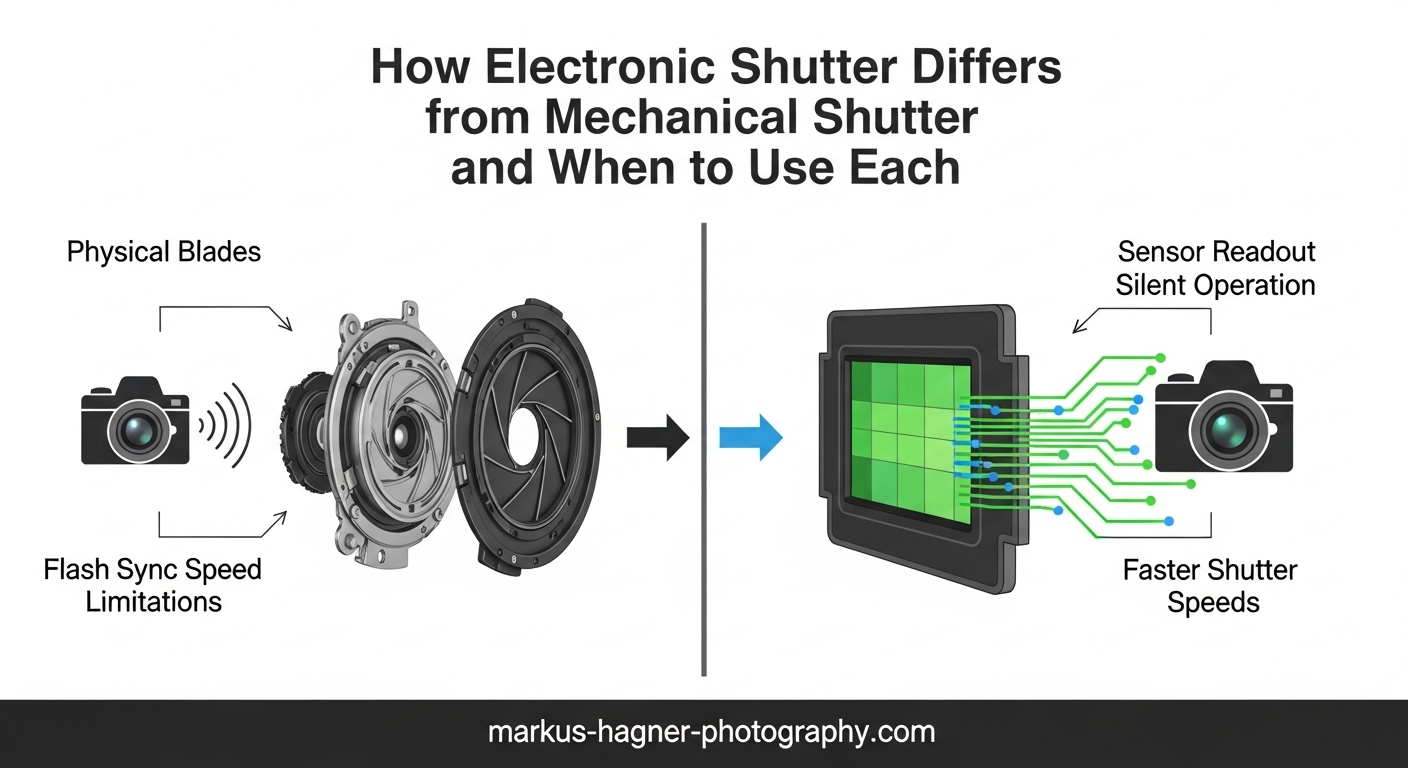
A mechanical shutter uses two physical curtains—front and rear—that travel across your sensor to control exposure. Think of it like a window shade that opens and closes. When you press the shutter button, the front curtain slides open, exposing the sensor to light. After the exposure time ends, the rear curtain slides across to block the light again.
The gap between these two curtains determines your shutter speed. At 1/1000 second, the rear curtain starts moving before the front curtain has finished crossing the frame, creating a narrow slit that travels across the sensor. At slower speeds like 1/60 second, the front curtain fully opens before the rear curtain begins closing.
Here’s what makes mechanical shutters reliable: the physical curtains traverse the frame in roughly 1/200 to 1/250 second on most cameras. This means the entire sensor gets exposed at slightly different times, but the window is narrow enough that it rarely causes problems. Professional cameras like the Canon R5 or Sony A1 have even faster curtain travel times, reducing this effect further.
The trade-off for this mechanical precision is complexity. Moving parts wear out over time—shutters are typically rated for 150,000 to 500,000 actuations depending on your camera model. They also make noise (that familiar “click”) and create subtle vibration from the physical movement.
This curtain system has been refined over decades of camera development. It’s proven technology that works consistently across virtually every shooting situation, which is why most photographers default to mechanical shutter without thinking about it.
How Electronic Shutters Work
An electronic shutter eliminates moving parts entirely. Instead of physical curtains, it controls exposure by turning the image sensor’s pixels on and off electronically. The process works like this: first, the sensor resets all pixels to start fresh. Then it begins collecting light for your chosen exposure time. Finally, it reads out the image data line by line.
This line-by-line readout is where things get interesting—and where problems can emerge. Unlike a mechanical shutter where the physical curtain sweeps across quickly, electronic shutters read the sensor from top to bottom sequentially. This readout speed varies dramatically between cameras.
On older or mid-range cameras, a full sensor readout might take 1/15 to 1/30 second. That’s significantly slower than a mechanical curtain sweep. During this time, anything moving in your frame gets recorded at slightly different moments as each line is read. The result? The infamous rolling shutter effect.
Modern stacked sensor cameras like the Sony A1 or Canon R3 have dramatically faster readout speeds—around 1/200 second or faster. This narrows the gap between electronic and mechanical performance significantly, making electronic shutter viable for many more situations.
What you gain with electronic shutter is freedom from mechanical wear, completely silent operation, and the ability to reach incredibly fast shutter speeds (1/32,000 second on many cameras compared to 1/8000 mechanical limits). But these benefits come with caveats I’ll explain shortly.
The key difference comes down to this: mechanical shutters physically block and reveal light, while electronic shutters control when each pixel records light. Both achieve exposure, but the method creates different characteristics that matter in real-world shooting.
Rolling Shutter vs Global Shutter: Understanding the Difference
The rolling shutter effect is the most significant drawback of electronic shutters on traditional sensors. Because the sensor reads line by line from top to bottom, fast-moving subjects or quick camera movements can appear distorted. Propellers look bent, vertical lines lean at angles, and sports balls appear elongated.
Rolling shutter becomes problematic when your subject moves significantly during the sensor readout time. If your camera takes 1/30 second to read the entire sensor and a race car crosses your frame in that time, the top of the car gets recorded earlier than the bottom—creating a slanted or warped appearance.
Global shutter represents the ideal solution. A true global shutter reads all pixels simultaneously, capturing the entire frame at exactly the same instant. No rolling shutter distortion, regardless of subject speed. However, global shutter sensors have historically been expensive and limited to cinema cameras.
Stacked sensor technology bridges this gap for still photography. By stacking memory directly on the sensor, data can be read much faster—dramatically reducing rolling shutter without the cost of true global shutter. If you’re shopping for a camera where electronic shutter matters, stacked sensor models like the Sony A1, Canon R3, or Nikon Z9 should be on your list.
For wildlife and sports photographers wondering whether rolling shutter will affect their work: it depends on your specific subjects. Birds in flight rarely show noticeable distortion. But helicopters, golf swings, or anything with rotating elements will show the effect clearly.
The severity of rolling shutter varies by camera model. Entry-level mirrorless cameras might have readout times of 1/15 second, while professional stacked sensor bodies read out in 1/200 second or faster. That’s a 13x difference in how susceptible you are to distortion.
Pros and Cons of Mechanical Shutter
Mechanical shutters remain the default choice for most photographers, and for good reason. Here’s my honest assessment after years of shooting with both:
Advantages of Mechanical Shutter
No rolling shutter distortion. The physical curtain sweeps fast enough that even rapid subjects get captured cleanly. This matters enormously for sports, wildlife with fast wing beats, or any scene with rotating elements like propellers and helicopter blades.
Full flash compatibility. Mechanical shutters work with flash at any sync speed your camera supports (typically 1/200 to 1/250 second). Electronic shutters often have severe flash limitations or don’t work with flash at all, making mechanical essential for studio and event work.
No banding under artificial light. LED and fluorescent lights flicker at high frequencies. Mechanical shutters capture the full frame quickly enough that you rarely see this. Electronic shutters can produce horizontal bands of varying exposure that are difficult or impossible to fix in post.
Better image quality on many cameras. Some cameras drop from 14-bit to 12-bit RAW files when using electronic shutter. This reduces dynamic range and color depth, particularly noticeable in high-contrast scenes where you need maximum latitude for adjustments.
Consistent behavior across all situations. Mechanical shutter works the same way whether you’re shooting in bright sunlight, under stadium lights, or with multiple strobes. It’s predictable and reliable when stakes are high.
Disadvantages of Mechanical Shutter
Noise and vibration. That satisfying click isn’t always welcome. During wedding ceremonies, theater performances, or street photography, the mechanical sound can be disruptive and draw unwanted attention to yourself.
Limited burst rates. Physical curtains can only move so fast. High-end cameras max out around 10-12 fps with mechanical shutter, while electronic shutter can reach 20-30 fps or higher. For certain sports and wildlife situations, this limitation costs you shots.
Wear and eventual failure. Shutters are rated for a specific number of actuations. Heavy shooters can wear out a shutter in 2-3 years, requiring an expensive service replacement that might cost several hundred dollars.
Shutter shock. On some cameras, the mechanical movement causes subtle vibration that can slightly blur images at certain shutter speeds (typically 1/60 to 1/125 second). Electronic front curtain shutter solves this, but it’s an extra setting to manage.
Pros and Cons of Electronic Shutter
Electronic shutter offers compelling advantages for specific situations, but requires understanding its limitations to use effectively:
Advantages of Electronic Shutter
Completely silent operation. For wedding ceremonies, street photography, wildlife that spooks easily, or any situation where discretion matters, electronic shutter is invaluable. I’ve captured moments that would have been impossible with a loud mechanical click.
Extended camera lifespan. With no moving parts to wear out, electronic shutter has no actuation limit. If you shoot thousands of frames daily, you’ll never face a shutter replacement. This alone can save substantial money over your camera’s life.
Higher burst rates. Without mechanical limitations, cameras can shoot 20, 30, even 120 fps on some models. Sports and wildlife photographers can capture fleeting moments—a bird taking flight, a soccer ball crossing the line—that mechanical shutter would miss.
Ultra-fast shutter speeds. Most electronic shutters reach 1/32,000 second—four times faster than typical mechanical limits of 1/8000. This lets you shoot wide apertures like f/1.4 in bright sunlight without ND filters, perfect for outdoor portraits with dreamy backgrounds.
No vibration. Without physical curtains moving, there’s zero risk of shutter-induced blur. This matters for macro photography, long lenses on tripods, and any situation where maximum sharpness is critical.
Disadvantages of Electronic Shutter
Rolling shutter distortion. Fast subjects or quick pans can produce warping that ruins shots. On non-stacked sensor cameras, this is a real concern for sports, wildlife, and any rapidly moving subjects. What looks fine on the LCD might be unusable on a larger screen.
Banding under artificial light. LED and fluorescent lights flicker 50-60 times per second (or faster with some LEDs). Electronic shutter’s slow readout can capture these flickers as visible horizontal bands across your image. You often don’t see this until reviewing photos later.
Flash limitations. Many cameras don’t support flash with electronic shutter at all, or limit you to very slow sync speeds. If flash photography is important to your work—portraits, events, studio work—this is a significant restriction.
Potential image quality reduction. Some cameras reduce bit depth or dynamic range with electronic shutter. This varies by model—check your camera’s specifications or test carefully before relying on electronic shutter for critical work.
AF performance can suffer. On some cameras, autofocus tracking works differently with electronic shutter. Phase-detection points might have different coverage, and continuous AF performance can drop slightly. Test your specific camera to understand the impact.
When to Use Mechanical Shutter
After years of shooting with both shutter types, I default to mechanical shutter and switch to electronic only when I have a specific reason. Here’s when mechanical is clearly the better choice:
Flash photography. Any situation requiring flash—studio work, event receptions, portraits with fill flash—demands mechanical shutter. The flash sync reliability alone makes it worth the noise. Don’t risk missing important shots to flash sync issues.
Fast-moving subjects with rotating elements. Helicopters, propeller planes, golf swings, tennis serves, or anything with spinning components will show rolling shutter distortion with electronic shutter. Mechanical captures these cleanly without the warped propeller effect.
Shooting under LED or fluorescent lighting. Indoor sports arenas, corporate events, modern venues with LED lighting—all prone to banding with electronic shutter. Mechanical shutter avoids this entirely. If you’re shooting indoors under artificial light, mechanical is safer.
Maximum image quality. If your camera drops bit depth with electronic shutter (check your manual), mechanical preserves full dynamic range and color depth. This is critical for landscape, portrait, and commercial work where every bit of quality matters.
Panning shots. When you’re tracking a moving subject with a horizontal pan, electronic shutter’s slow readout can create strange distortions in the background. Mechanical shutter handles panning cleanly, keeping your subject sharp and background smooth.
As your default setting. If you’re unsure which to use, mechanical is the safer choice. It works in every situation without unexpected artifacts. Electronic shutter has specific failure modes that can ruin shots if you’re not paying attention to conditions.
When to Use Electronic Shutter
Electronic shutter isn’t a compromise—it’s the superior choice for specific situations. Here’s when I deliberately switch from mechanical to electronic:
Silent shooting required. Wedding ceremonies, theater performances, classical concerts, wildlife that spooks easily, street photography where discretion matters—any situation where a click would be disruptive. I’ve captured candid moments that would have disappeared with a mechanical shutter sound.
Maximum burst rates needed. When every fraction of a second matters—like a bird taking flight, a soccer player heading the ball, or a goal-scoring moment—the 20-30 fps that electronic shutter enables can mean the difference between getting the shot and missing it entirely.
Bright daylight with wide apertures. Want that f/1.4 look in full sun? Electronic shutter’s 1/32,000 second capability lets you shoot wide open without ND filters. Perfect for outdoor portraits with beautifully blurred backgrounds in harsh midday light.
Extending camera lifespan. If you’re a high-volume shooter capturing thousands of frames weekly, electronic shutter eliminates wear on the mechanical assembly. Your camera body will last significantly longer, and you’ll avoid expensive shutter replacement costs.
Bracketing and high-speed sequences. For HDR brackets, focus stacking, or any situation where you need rapid sequences without mechanical delay, electronic shutter is faster and more consistent. The lack of vibration also helps maintain perfect alignment between frames.
Stacked sensor cameras. If you’re shooting with a Sony A1, Canon R3, Nikon Z9, or similar stacked sensor camera, electronic shutter performance approaches mechanical quality. Many professional sports photographers use electronic exclusively on these bodies, getting the best of both worlds.
Special Considerations: Flash, Banding, and Image Quality
Three technical factors trip up photographers more than any others when choosing shutter type. Let me address each directly with practical guidance:
Flash Photography Limitations
Flash and electronic shutter have a complicated relationship. The problem: electronic shutter’s slow readout means the entire frame isn’t exposed simultaneously. Flash, by contrast, fires in a brief instant. The result is usually only part of the frame receives flash illumination, leaving dark bands where the flash didn’t sync.
Most cameras simply disable flash when electronic shutter is active. Some allow it but limit sync speeds severely—often to 1/30 second or slower. If flash is important to your work, test your specific camera and flash combination before relying on it for important shoots.
Practical advice: I always switch to mechanical shutter when I know flash will be involved. The reliable sync speed and full-frame illumination make it worth any noise concerns. For wedding receptions where I mix ambient and flash, mechanical is non-negotiable.
Banding Under Artificial Light
Banding is the most frustrating electronic shutter problem because you often don’t see it until reviewing images later—when it’s too late. LED and fluorescent lights don’t produce constant illumination—they flicker on and off at high frequency (typically 50-60 Hz for fluorescent, potentially much higher for some modern LEDs).
When your electronic shutter reads the sensor slowly enough to span multiple flicker cycles, you’ll see horizontal bands of lighter and darker exposure across your image. It’s often subtle on the camera’s LCD but becomes obvious when editing on a larger screen.
To avoid banding: use mechanical shutter under artificial light whenever possible, test your venue before important shoots by shooting a blank wall at your intended settings, or look for cameras with flicker detection that can synchronize with light frequencies. Some cameras display a warning when flicker is detected.
The frequency of the lighting matters too. Standard 50/60 Hz flicker is predictable, but some LED venues use high-frequency drivers that create faster, harder-to-detect flicker. If you see banding, the only reliable fix is switching to mechanical shutter.
Bit Depth and Dynamic Range
Some cameras reduce RAW bit depth when using electronic shutter—typically dropping from 14-bit to 12-bit. This matters for high-contrast scenes where you need maximum dynamic range for post-processing recovery of shadows and highlights.
The reduction is real but its impact varies. 14-bit files contain 16,384 tonal levels per channel; 12-bit files contain only 4,096. That’s a 75% reduction in tonal information. For most photography, this difference is subtle. For critical commercial work, landscape photography with extreme contrast, or situations demanding maximum dynamic range, it can be significant.
Check your camera’s specifications carefully. Sony cameras often maintain 14-bit with electronic shutter on their higher-end models. Canon has historically dropped to 12-bit with electronic shutter, though newer models like the R5 have improved this. Nikon and Fujifilm vary by model. Test your specific camera to see if you can spot the difference in your typical shooting scenarios.
For most photographers, the bit depth difference won’t be visible in final images. But if you’re pushing files hard in post—recovering deep shadows or pulling back bright highlights—that extra bit depth gives you more latitude.
Electronic Front Curtain Shutter (EFCS): The Hybrid Option
Many photographers overlook electronic front curtain shutter (EFCS), but it solves a specific problem elegantly. EFCS replaces the mechanical front curtain with an electronic start while keeping the mechanical rear curtain to end the exposure.
Why does this matter? Shutter shock—that subtle vibration from the front curtain opening—can cause slight blur at certain shutter speeds (typically 1/60 to 1/125 second on cameras prone to it). EFCS eliminates this vibration while maintaining full compatibility with flash and avoiding any rolling shutter distortion.
EFCS is ideal for: landscape and studio work on tripods where any vibration matters, macro photography where even tiny movements blur fine detail, and general shooting where you want mechanical shutter benefits without the front-curtain vibration risk.
It’s become my default setting on cameras that support it. You get the image quality benefits of mechanical shutter, flash compatibility, no rolling shutter, and reduced vibration—all without the noise of a full mechanical cycle. Think of it as the best compromise between mechanical and electronic for most still photography.
One limitation: EFCS typically has the same maximum shutter speed as mechanical (usually 1/8000), not the faster speeds available with full electronic. And like mechanical, it still uses the rear curtain, so there’s still some sound and eventual wear—just significantly less than full mechanical operation.
Electronic Shutter Differs from Mechanical Shutter and When to Use Each: Quick Reference
For quick decisions during shoots, here’s my practical field guide to choosing the right shutter type:
Use Mechanical Shutter when:
- Shooting with flash (studio, events, portraits with fill)
- Under LED or fluorescent lighting (indoor venues, arenas)
- Capturing fast action with rotating elements (props, golf swings)
- Maximum image quality is critical (bit depth, dynamic range)
- Doing panning shots with subject movement
- You’re unsure which to choose (mechanical is the safe default)
Use Electronic Shutter when:
- Silence is required (ceremonies, performances, discreet street work)
- Maximum burst rate is needed (20-30+ fps for action moments)
- Shooting wide aperture in bright light (1/32,000 second capability)
- You’re a high-volume shooter extending camera lifespan
- On a stacked sensor camera (Sony A1, Canon R3, Nikon Z9)
- Doing focus stacking or HDR brackets (no vibration between frames)
Use EFCS when:
- On a tripod for landscapes or macro (eliminates shutter shock)
- Want mechanical benefits with reduced vibration
- Shooting at problematic shutter speeds (1/60 to 1/125)
Frequently Asked Questions
When should I not use electronic shutter?
Avoid electronic shutter when shooting with flash, under LED or fluorescent lighting that may cause banding, when capturing fast-moving subjects prone to rolling shutter distortion (like propellers or golf swings), or when your camera drops bit depth from 14-bit to 12-bit in electronic mode. Mechanical shutter is the safer default choice for these situations.
Is mechanical or electronic shutter better?
Neither is universally better. Mechanical shutter is more versatile and reliable for most situations, working with flash and avoiding banding. Electronic shutter excels when silence is required, for maximum burst rates, and for ultra-fast shutter speeds up to 1/32,000 second. Most photographers should default to mechanical and switch to electronic only when its specific advantages are needed.
Does an electronic shutter wear out?
No, electronic shutters have no moving parts and therefore no wear limit or actuation rating. This is a significant advantage for high-volume shooters who might wear out a mechanical shutter’s 150,000-500,000 rated actuations in 2-3 years of heavy use. Using electronic shutter extends your camera’s overall lifespan by preserving the mechanical assembly.
What causes banding with electronic shutter?
Banding occurs when electronic shutter’s slow sensor readout captures multiple cycles of flickering artificial light. LED and fluorescent lights don’t produce constant illumination—they flicker on and off at high frequency. As the sensor reads line by line, it captures moments of both bright and dim illumination, creating horizontal bands across your image. Mechanical shutter’s faster full-frame exposure typically avoids this problem entirely.
Can I use flash with electronic shutter?
On most cameras, flash either doesn’t work at all with electronic shutter or has severe limitations like very slow sync speeds (often 1/30 second or slower). This happens because electronic shutter reads the sensor slowly line by line, while flash fires in an instant—resulting in only partial frame illumination. For reliable flash photography, always use mechanical shutter instead.
Conclusion
Understanding how electronic shutter differs from mechanical shutter gives you control over your photography that most shooters never develop. The key insight: mechanical shutter is your reliable default, working in every situation without surprises. Electronic shutter is a powerful tool for specific moments when silence, speed, or longevity matter more than universal compatibility.
My recommendation after years of shooting both: set mechanical shutter (or EFCS if available) as your default. Switch to electronic deliberately when you need silent operation or maximum burst rates. Test your specific camera’s behavior with artificial light and flash before relying on electronic shutter for critical work.
The best shutter choice isn’t about finding one perfect option—it’s about knowing when each serves your creative vision. Now you have that knowledge. Go shoot.