
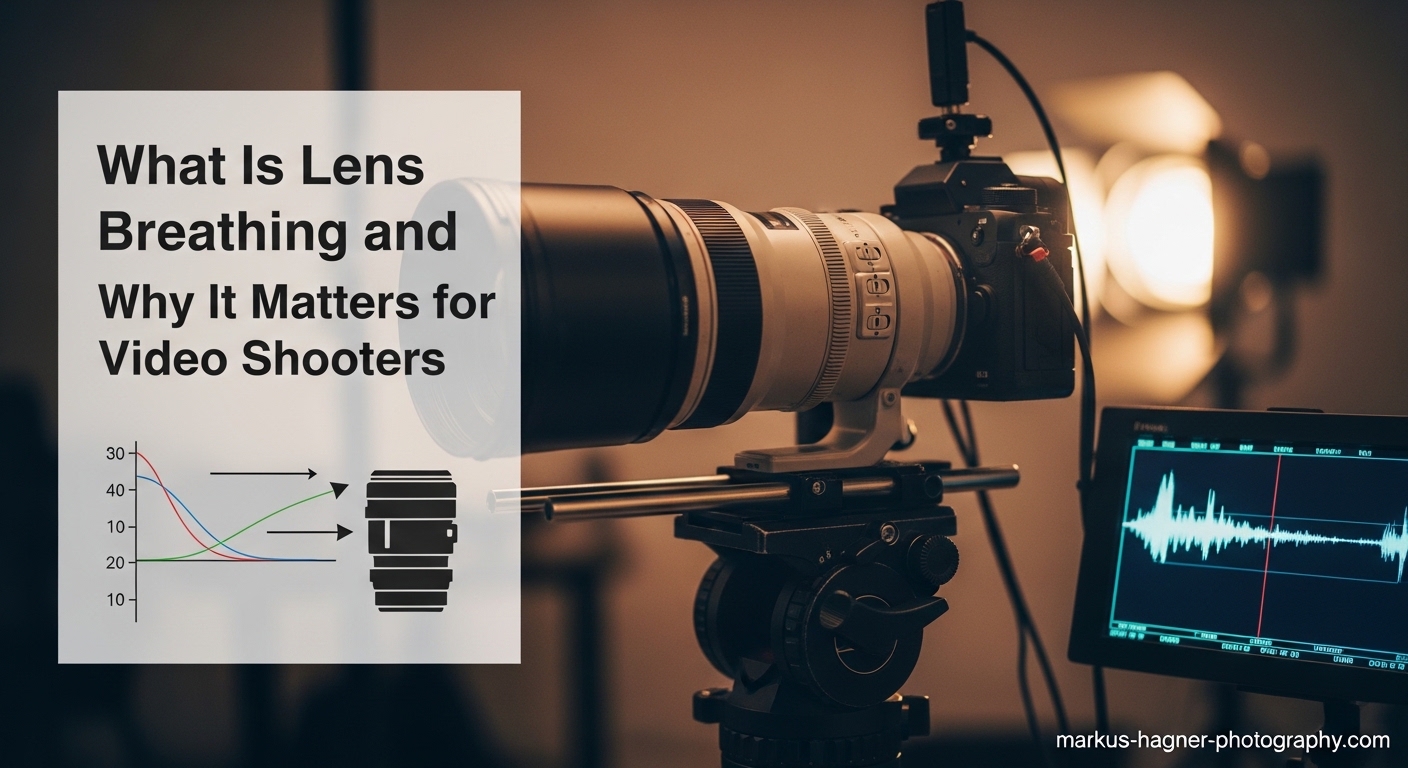
If you have ever pulled focus during a video shoot and noticed the image subtly zooming in or out, you have witnessed lens breathing in action. This optical phenomenon is one of those technical details that separates amateur-looking footage from professional results. For video shooters, understanding lens breathing can mean the difference between smooth, invisible focus transitions and jarring, distracting footage that pulls viewers out of the moment.
In this guide, I will explain exactly what lens breathing is, why it happens, and when it actually matters for your video work. You will also learn practical methods to test for breathing and techniques to minimize its impact on your productions.
What Is Lens Breathing?
Lens breathing is the change in a lens’s field of view that occurs when adjusting focus from one distance to another. When you shift focus from a nearby subject to one farther away (or vice versa), the image appears to zoom slightly in or out, even though you have not touched the zoom ring. This happens because the effective focal length changes during focus adjustment.
The term “breathing” comes from how the image seems to inhale or exhale as focus transitions between distances. In some lenses, this effect is barely noticeable. In others, the field of view shift can be dramatic enough to ruin a carefully composed shot.
Think of it this way: you frame a shot perfectly with your subject at the left third of the frame. You pull focus from foreground to background, and suddenly your subject has shifted position within the frame. That subtle but visible movement is lens breathing at work.
The severity varies significantly between lenses. Some modern photo lenses exhibit minimal breathing, while older designs or budget options can show dramatic field of view changes. Cinema lenses are specifically designed to eliminate this issue almost entirely, which is one reason they cost significantly more than still photography lenses.
Why Does Lens Breathing Happen?
To understand why lenses breathe, you need to understand how focusing systems work internally. When you adjust focus on a lens, internal elements move to change where the light converges on your sensor or film plane. This is called internal focusing, and it is the standard design for most modern lenses.
Here is the technical reality: moving lens elements to achieve focus at different distances can alter the effective focal length of the lens. When focus elements shift forward or backward within the lens barrel, they change the magnification and angle of view. This is not a flaw in the design but rather a trade-off that lens manufacturers make to achieve other goals like compact size, fast autofocus, or lower production costs.
Older lens designs often used a different approach called unit focusing, where the entire lens moved forward and backward to achieve focus. This design showed minimal breathing because all elements moved together, preserving the focal length relationship. However, unit focusing made lenses larger, heavier, and slower to autofocus.
Modern internal focusing designs move only specific element groups, which allows for faster autofocus and more compact lens bodies. The trade-off is that the relationship between elements changes during focus, which can alter the effective focal length and cause visible breathing.
Different lens designs breathe differently. Wide-angle lenses often show more noticeable breathing than telephoto lenses. Zoom lenses may breathe differently at various focal lengths. Prime lenses with simpler optical designs sometimes breathe less than complex zoom configurations.
Why Lens Breathing Matters for Video Shooters
Lens breathing is primarily a video production concern because video involves continuous recording where focus transitions happen in real time. In still photography, you capture single frames, so any field of view change during focus is invisible to the viewer. But in video, every focus pull becomes part of the final footage.
The most obvious problem occurs during focus pulling and focus racking. When you smoothly shift focus from one subject to another, visible breathing makes the transition look unprofessional. The frame appears to zoom during the focus change, which can be distracting to viewers and break the immersive quality of your footage.
Interview and dialogue scenes are particularly vulnerable. Many videographers use focus pulls to shift attention between speakers or to reveal reactions. If the image visibly zooms during these transitions, it draws attention to the camera work rather than the content. What should be an invisible technique becomes a noticeable flaw.
Professional productions have higher standards for this kind of thing. If you are delivering content for broadcast, commercial clients, or streaming platforms, visible breathing can signal amateur production values. Clients may not know the technical term, but they notice when focus pulls look jumpy or when framing shifts unexpectedly.
That said, breathing is not always a critical issue. In run-and-gun documentary work, quick cuts, and fast-paced editing, viewers often do not notice subtle breathing. Many successful YouTubers and content creators use lenses with noticeable breathing without their audiences complaining. The context matters significantly.
Breathing becomes most problematic in controlled, deliberate shooting situations. Slow dolly shots, steady interview setups, product videos, and narrative work all demand cleaner focus transitions. If you are carefully composing shots and using focus as a storytelling tool, breathing can undermine your creative intentions.
Another consideration is how breathing affects autofocus performance in video. Many modern cameras use autofocus for video, and the breathing effect can become more pronounced when the camera is making constant micro-adjustments. What looks like a smooth autofocus transition might include subtle breathing that would not occur with a manual focus pull.
How to Test for Lens Breathing
Testing your lenses for breathing is straightforward and requires minimal equipment. Here is a step-by-step method I use to evaluate any lens before using it for critical video work:
Step 1: Set up your camera on a tripod. Stability is essential for an accurate test. Any camera movement will mask or exaggerate the breathing effect.
Step 2: Position a subject with clear vertical lines. A bookshelf, window frame, or grid pattern works well. You want reference points that will clearly show any framing shift.
Step 3: Frame your shot with the subject at infinity focus. Position an object far away (at least 20-30 feet) and focus on it. Note the position of vertical lines at the edges of your frame.
Step 4: Pull focus to minimum focus distance. Shift focus to the closest possible distance without moving the camera. Watch the edges of your frame carefully.
Step 5: Observe the field of view change. If the vertical lines at the frame edges shift position significantly, your lens has noticeable breathing. Minimal or no shift indicates well-controlled breathing.
For a more rigorous test, record video while performing the focus pull. Play it back and watch the edges of the frame. You can also import the footage into an editing program and compare frame grabs from the start and end of the focus transition.
Some videographers use a percentage system to rate breathing severity. If the field of view changes by less than 2%, breathing is considered minimal and usually acceptable. Changes of 5% or more are noticeable and may be problematic for professional work. Extreme cases can show 10% or greater shifts.
Testing zoom lenses at different focal lengths is important because breathing characteristics can vary throughout the zoom range. A lens might breathe minimally at 24mm but show significant breathing at 70mm.
How to Minimize or Eliminate Lens Breathing
The most effective solution for lens breathing is using lenses designed to minimize or eliminate it. Cinema lenses are engineered specifically for video production and typically show imperceptible breathing. The trade-off is cost: cinema lenses are significantly more expensive than still photography lenses.
However, buying cinema lenses is not your only option. Many modern photo lenses incorporate breathing compensation into their optical design. Nikon’s Z-mount lenses, Canon’s RF lenses, and Sony’s GM series often exhibit minimal breathing. Research and reviews can help you identify which still lenses perform well for video work.
Several camera manufacturers now offer in-camera breathing compensation features. Nikon includes this in their Z-series cameras, while Canon and Sony have similar options in certain models. These features use software to digitally correct the field of view change during focus transitions. While not a perfect solution, they can significantly reduce visible breathing.
If you already own lenses with noticeable breathing, shooting technique adjustments can help. First, consider whether the breathing actually matters for your specific project. For fast-paced content with quick cuts, viewers rarely notice. Second, try to minimize focus pull distance when possible. Shorter focus transitions show less breathing than full-range pulls.
Manual focus often provides more control over breathing than autofocus. When you pull focus manually, you can time your movements to minimize the visible impact. Some focus pull techniques, like starting the pull slower and accelerating, can make breathing less noticeable to viewers.
Framing adjustments can also help. If you know your lens breathes, compose your shots with some margin at the edges. This gives you room to crop in post-production if the framing shift becomes problematic. Shooting in 4K and delivering in 1080p provides extra flexibility for reframing.
Some editors use post-production techniques to correct breathing. This involves keyframing a subtle digital zoom that counteracts the field of view change. While possible, this approach is time-consuming and can reduce image quality if pushed too far.
For budget-conscious videographers, some older lens designs breathe less than modern equivalents. Vintage manual focus lenses often use optical designs with minimal breathing. The trade-off is typically slower maximum aperture and lack of modern features like autofocus and image stabilization.
Cinema Lenses vs Photo Lenses for Video
The fundamental difference between cinema and photo lenses comes down to design priorities. Cinema lenses are built for video production, with breathing control as a core requirement. Photo lenses prioritize size, weight, autofocus speed, and cost, with breathing treated as a secondary concern.
Parfocal zoom capability is another key difference. A parfocal lens maintains focus throughout its zoom range, while most photo lenses are varifocal, meaning focus shifts when you zoom. Cinema zooms are always parfocal, which matters for video shooters who zoom during recording.
Should you invest in cinema lenses? The answer depends on your work. If you are doing commercial production, narrative filmmaking, or any project where focus pulls are prominent, cinema lenses can be worth the investment. For documentary work, corporate videos, and online content, many photo lenses perform adequately.
Renting cinema lenses for specific projects is often a practical middle ground. You get the performance when you need it without the massive upfront investment.
Frequently Asked Questions
What is lens breathing?
Lens breathing is the change in a lens’s field of view that occurs when adjusting focus from one distance to another. As you shift focus, the image appears to zoom slightly in or out because the effective focal length changes during the focus adjustment.
Why does lens breathing happen?
Lens breathing occurs because internal lens elements move during focusing, which changes the effective focal length. Modern internal focusing designs prioritize fast autofocus and compact size, but the trade-off is that element movement can alter magnification and field of view.
Does focus breathing matter for photography?
Focus breathing rarely matters for still photography because you capture single frames. Any field of view change during focusing is invisible in the final image. It only becomes a concern for video, where focus transitions are recorded as part of the footage.
How do I know if my lens has bad breathing?
Test by setting up your camera on a tripod with vertical lines at the frame edges. Focus from infinity to minimum distance and watch if the framing shifts. Significant movement of edge elements indicates noticeable breathing. Recording the test and comparing frame grabs makes the effect easier to measure.
Can focus breathing be fixed in post-production?
Focus breathing can be partially corrected in post by keyframing a subtle digital zoom that counteracts the field of view change. However, this is time-consuming and can reduce image quality. In-camera breathing compensation features and lens selection are more effective solutions.
Do expensive lenses always have less breathing?
Not necessarily. Price reflects many factors including build quality, optical performance, and features. Some expensive photo lenses still exhibit noticeable breathing because they are optimized for still photography. Cinema lenses, which are designed specifically for video, offer the best breathing control regardless of the brand.
Conclusion
Lens breathing is an optical characteristic that matters significantly for video shooters but rarely affects still photographers. Understanding what causes breathing, how to test for it, and when it actually impacts your work empowers you to make better gear choices and shooting decisions.
For most video work, moderate breathing is acceptable and often goes unnoticed by viewers. Focus on your content first, and upgrade to breathing-controlled lenses when your projects demand professional-grade focus transitions.