
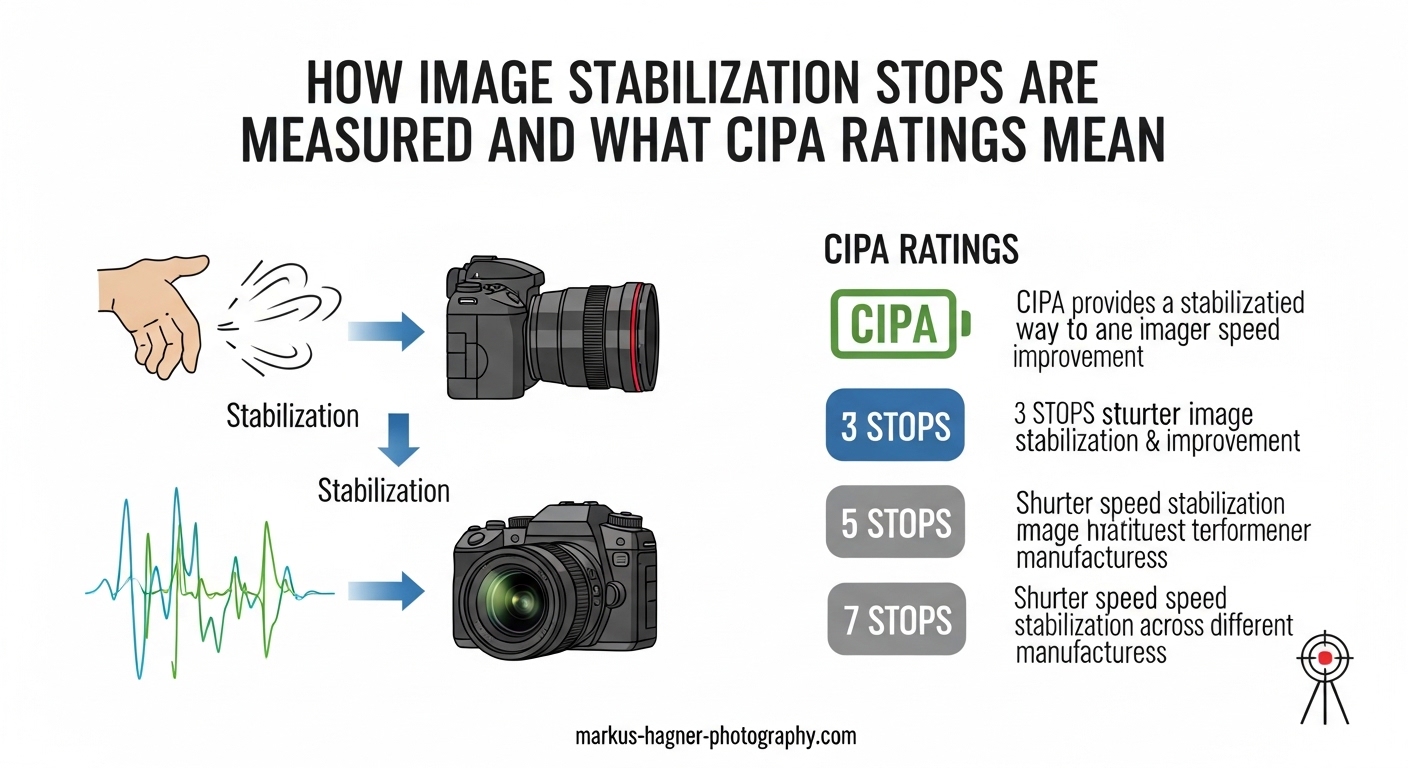
When you shop for cameras and lenses, you will often see manufacturers claiming “5 stops of image stabilization” or “CIPA-rated 7-stop stabilization.” But what do these numbers actually mean? Understanding image stabilization stops and CIPA ratings helps you cut through marketing hype and make informed decisions about your gear.
In this guide, I will explain exactly how image stabilization stops are measured, what CIPA ratings tell you about real-world performance, and how to use this information when choosing camera equipment. Whether you are comparing IBIS systems or evaluating a new telephoto lens, you will have the knowledge to interpret these specifications correctly.
What Does a Stop Mean in Photography?
Before diving into image stabilization, you need to understand what a “stop” means in photography. A stop is simply a unit of measurement that represents a doubling or halving of light. When you increase exposure by one stop, you are letting in twice as much light. When you decrease by one stop, you are cutting the light in half.
This concept applies across all exposure settings. Opening your aperture from f/8 to f/5.6 is one stop brighter. Raising ISO from 100 to 200 is one stop more sensitive. And slowing your shutter speed from 1/500s to 1/250s is one stop more light hitting the sensor.
How Stops Apply to Shutter Speed
Since image stabilization directly affects usable shutter speeds, understanding the stop progression is essential. Each stop doubles the previous shutter speed time:
Stop progression for shutter speeds:
1 stop = 2x longer shutter speed (1/60s becomes 1/30s)
2 stops = 4x longer (1/60s becomes 1/15s)
3 stops = 8x longer (1/60s becomes approximately 1/8s)
4 stops = 16x longer (1/60s becomes approximately 1/4s)
5 stops = 32x longer (1/60s becomes approximately 1/2s)
6 stops = 64x longer (1/60s becomes approximately 1s)
7 stops = 128x longer (1/60s becomes approximately 2s)
8 stops = 256x longer (1/60s becomes approximately 4s)
When a manufacturer claims their lens has “5 stops of stabilization,” they mean you can theoretically shoot at shutter speeds 32 times longer than normal while maintaining acceptable sharpness.
Exposure Values (EV) in Stabilization
You may also see stabilization ratings expressed in Exposure Values or EV. In the context of image stabilization, EV and stops mean the same thing. A rating of “5.0 EV compensation” equals “5 stops of stabilization.” The CIPA standard specifically uses EV notation in its technical documentation, though most marketing materials use the more consumer-friendly “stops” terminology.
The Inverse Focal Length Rule: Your Baseline
To understand what stabilization adds, you first need to know the baseline for handheld shooting. The inverse focal length rule provides a starting point for the slowest shutter speed you can use without stabilization.
The rule is simple: your minimum handheld shutter speed should be the reciprocal of your focal length. Shooting with a 50mm lens? Try to stay at 1/50s or faster. Using a 200mm telephoto? You need at least 1/200s to avoid visible camera shake.
This rule works reasonably well for most photographers under normal conditions. However, individual hand steadiness varies significantly. Some photographers can shoot slower than this rule suggests, while others need faster speeds. Factors like age, caffeine consumption, fatigue, and shooting posture all affect your personal baseline.
For crop sensor cameras, apply the rule to your equivalent focal length. A 50mm lens on an APS-C camera (1.5x crop factor) behaves like a 75mm lens, so aim for 1/75s or faster without stabilization.
How CIPA Measures Image Stabilization
CIPA stands for Camera & Imaging Products Association, a Japanese industry group that sets standardized testing methods for camera equipment. Their stabilization testing standard, CIPA DC-X011, has become the industry benchmark for measuring image stabilization effectiveness.
What Is CIPA?
The Camera & Imaging Products Association includes major manufacturers like Canon, Nikon, Sony, Fujifilm, Olympus (now OM System), and Panasonic. These companies agreed to use the CIPA DC-X011 methodology when advertising stabilization ratings, making comparisons between brands more meaningful.
Without standardization, each manufacturer could test stabilization under whatever conditions made their products look best. CIPA ratings ensure that when Canon claims 5 stops and Sony claims 5.5 stops, both used the same testing methodology.
The CIPA Testing Process Step by Step
The CIPA stabilization test follows a specific methodology designed to simulate real-world handheld shooting:
Step 1: Mount the camera on a vibration simulator. The camera is placed on a certified shaking platform, often a hexapod robot that can reproduce precise vibration patterns mimicking natural hand tremors. This ensures consistent, repeatable testing conditions.
Step 2: Position the test chart. A specialized test chart (often based on ISO 12233 standards) is placed at a distance equal to 20 times the focal length of the lens being tested. For a 50mm lens, the chart sits 1 meter away. For a 200mm lens, it is positioned 4 meters distant.
Step 3: Capture test images without stabilization. The camera shoots multiple frames at progressively slower shutter speeds while the vibration platform simulates hand shake. Technicians analyze each image to determine at what shutter speed blur becomes unacceptable.
Step 4: Enable stabilization and repeat. The same test runs with image stabilization activated. Again, the system identifies the slowest shutter speed that produces acceptably sharp results.
Step 5: Calculate the rating. CIPA compares the two threshold shutter speeds (with and without stabilization) and expresses the difference in Exposure Values. If stabilization lets you shoot 4 stops slower with the same sharpness, that system receives a 4.0 EV (or 4-stop) rating.
How CIPA Calculates Stop Ratings
The mathematical relationship is straightforward. CIPA measures the ratio between the longest acceptable exposure time with stabilization versus without stabilization, then converts this ratio to EV using logarithms.
If the unstabilized threshold is 1/125s and the stabilized threshold is 1/4s, the ratio is 31.25x. Log base 2 of 31.25 equals approximately 5 stops. This means the stabilization system earned a 5-stop CIPA rating.
Acceptable sharpness in CIPA testing is determined by analyzing edge blur on the test chart. Images must maintain sufficient detail at the pixel level to count as “sharp enough.” This threshold is consistent across all tests but may not match your personal standards for critical work.
Practical Examples: Putting Stops Into Context
Abstract numbers become clearer with concrete examples. Let us walk through what different stop ratings mean for actual shooting scenarios.
Stop Calculation Reference
The table below shows how different stabilization ratings affect your minimum handheld shutter speed:
Starting at 1/125s (typical for 100mm lens):
3 stops = shoot at 1/15s
4 stops = shoot at 1/8s
5 stops = shoot at 1/4s
6 stops = shoot at 1/2s
7 stops = shoot at 1s
8 stops = shoot at 2s
Starting at 1/500s (typical for 400mm lens):
3 stops = shoot at 1/60s
4 stops = shoot at 1/30s
5 stops = shoot at 1/15s
6 stops = shoot at 1/8s
7 stops = shoot at 1/4s
8 stops = shoot at 1/2s
Real-World Examples by Focal Length
24mm wide-angle: Without stabilization, aim for 1/24s (or practically, 1/30s). With 5 stops of stabilization, you could theoretically shoot at about 1 second handheld. In practice, expect solid results around 1/2 to 1/4 second.
85mm portrait lens: Your baseline is approximately 1/85s (round to 1/100s). Five stops of stabilization extends this to roughly 1/3 second, though 1/2 to 1 second becomes achievable for some shooters.
200mm telephoto: Normally requires 1/200s minimum. With 5 stops of help, you are looking at 1/6 second handheld. This makes telephoto shooting in fading light much more practical without a tripod.
400mm+ super-telephoto: These lenses demand 1/400s or faster without stabilization. Even 5 stops only gets you to about 1/12s, which is still challenging. This is why wildlife and sports photographers using long lenses often want every stop of stabilization they can get.
How to Interpret CIPA Ratings
CIPA ratings provide valuable comparison data, but understanding their limitations helps you set realistic expectations.
Comparing Ratings Across Brands
Because CIPA standardizes the testing methodology, you can meaningfully compare stabilization ratings between different manufacturers. A Canon lens rated at 5 stops and a Sony lens rated at 5 stops underwent similar testing procedures.
However, pay attention to what exactly is being rated. Lens-based optical stabilization (IS, VR, OSS) may rate differently than in-body image stabilization (IBIS). Some systems combine both, with the camera coordinating lens and sensor movement for even better results.
When a camera body claims a specific CIPA rating, that typically applies to a specific test lens. Your actual results with different lenses may vary. Check whether the rating applies to IBIS alone or to a combined IBIS-plus-lens system.
Lab Results vs Real-World Performance
Here is the uncomfortable truth: your real-world results will almost certainly fall short of the advertised CIPA rating. This is not necessarily deceptive marketing; it reflects the gap between controlled laboratory conditions and actual shooting.
The CIPA test uses a standardized vibration pattern that represents typical hand shake. But your hands are unique. Some photographers have naturally steadier hands than the CIPA baseline, while others (particularly after coffee or during long shoots) shake more than the test assumes.
Most experienced photographers recommend subtracting 1-2 stops from the CIPA rating for realistic expectations. If a lens claims 7 stops, assume you will reliably get 5-6 stops in practice. This buffer accounts for real-world variables like shooting angle, breathing, wind, and fatigue.
Environmental factors matter too. Cold weather makes hands shakier. High-stress situations increase tremors. Shooting from awkward positions (kneeling, leaning) reduces stability compared to standing comfortably with proper technique.
Limitations of Image Stabilization
Image stabilization is powerful, but it is not magic. Understanding when it cannot help prevents disappointment.
Moving subjects: Stabilization only counteracts camera movement. If your subject is moving, stabilization does nothing to freeze that motion. A running person, flying bird, or swaying flower will still blur at slow shutter speeds regardless of your stabilization rating.
Very long exposures: At some point, even the best stabilization cannot compensate for extended exposures. Shooting at several seconds handheld rarely works well regardless of the CIPA rating.
Tripod use: Many stabilization systems should be turned off when shooting from a tripod. The system may attempt to correct for vibrations that do not exist, actually introducing blur. Some modern systems detect tripod use automatically, but check your manual.
Panning motion: Standard stabilization can fight against intentional panning. Most systems have a panning mode that disables stabilization in one axis while maintaining it in the perpendicular direction.
Frequently Asked Questions
What does 5 stops of image stabilization mean?
What is CIPA rating?
What does 8 stops of image stabilization mean?
Is CIPA rating accurate in real-world use?
How many stops of stabilization do I need?
Conclusion
Understanding how image stabilization stops are measured and what CIPA ratings mean empowers you to make better gear decisions and set realistic expectations for your photography. A stop represents a doubling of usable shutter speed time, and CIPA DC-X011 provides a standardized way to measure this capability across different cameras and lenses.
Remember that CIPA ratings come from laboratory tests using standardized conditions. Your real-world results will vary based on your personal hand steadiness, shooting conditions, and technique. The practical approach is to subtract 1-2 stops from manufacturer claims when planning your handheld shooting strategy.
When evaluating camera equipment, use CIPA ratings as a starting point for comparison rather than an absolute guarantee. Test stabilization performance yourself under conditions matching your typical shooting scenarios. This hands-on approach, combined with your new understanding of the measurement methodology, will help you get the most from your image stabilization system.