
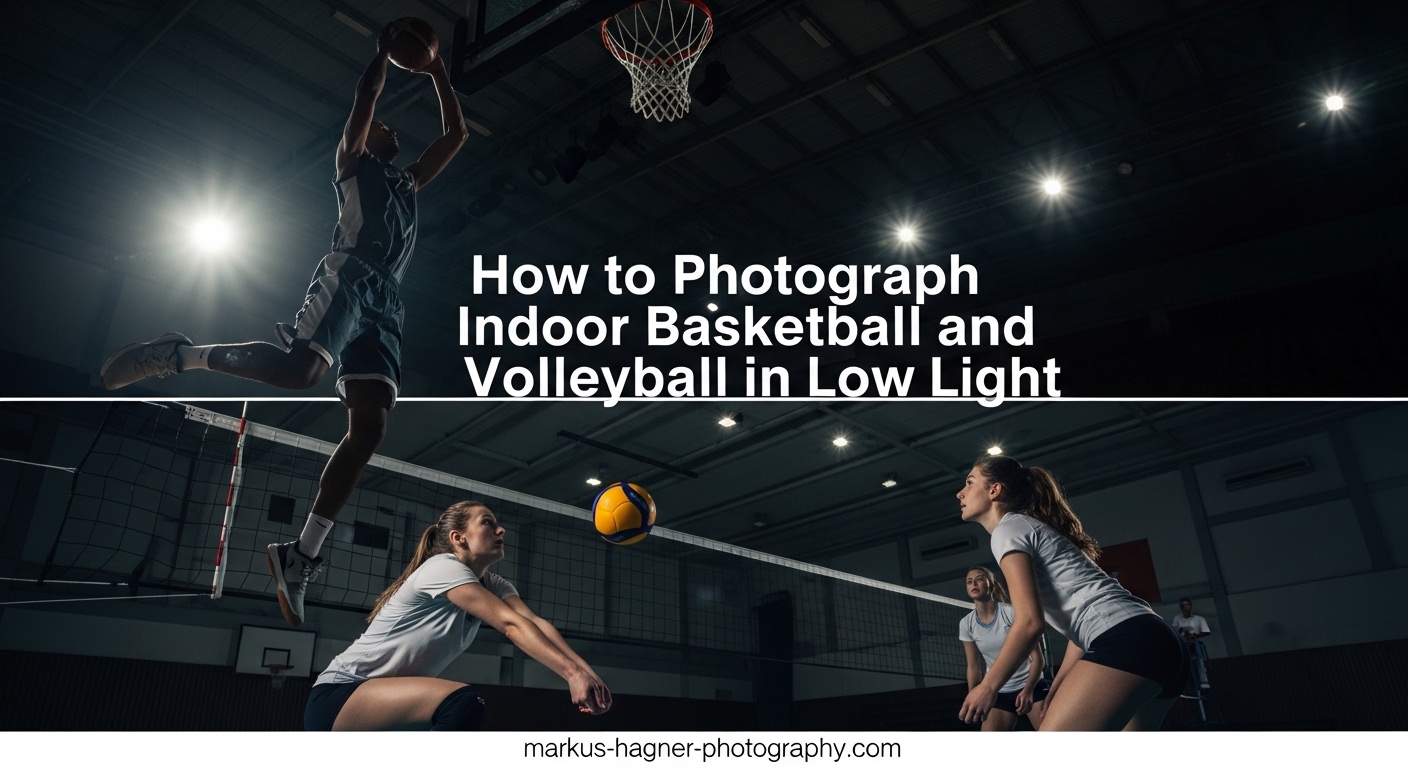
Learning how to photograph indoor basketball and volleyball in low light is one of the toughest challenges in sports photography. Gym lighting is typically terrible for cameras, with dim fluorescent or LED fixtures that force you into high ISO territory. Meanwhile, players are sprinting, jumping, and changing direction constantly. After shooting hundreds of indoor games across high school gyms and college arenas, I have developed a reliable system that delivers sharp, well-exposed action shots even in the worst lighting conditions.
The core formula is straightforward: use a fast lens (f/2.8 or wider), keep your shutter speed at 1/400 or faster to freeze motion, and push your ISO to 1600-6400 as needed. Set your camera to continuous autofocus (AI Servo on Canon, AF-C on Nikon and Sony), shoot in burst mode, and position yourself where the action happens most. Master these fundamentals and you will capture images that stand out from the blurry, dark shots most parents get from the bleachers.
Essential Equipment for Indoor Sports Photography
Your lens choice matters more than your camera body for indoor sports. A fast telephoto lens with a maximum aperture of f/2.8 or wider is the single most important piece of gear you can own for this type of photography. The classic 70-200mm f/2.8 lens has been the workhorse of sports photographers for decades because it offers the reach to fill the frame with players while letting in enough light to maintain usable shutter speeds.
If budget is a concern, prime lenses offer excellent value. A 50mm f/1.8 or 85mm f/1.8 lets in two to three times more light than an f/2.8 zoom, allowing you to drop your ISO significantly. The trade-off is you lose zoom flexibility and need to move around more. I started with a 50mm f/1.8 and shot from the baseline for years before upgrading to a 70-200mm f/2.8.
For camera bodies, look for models with strong high-ISO performance. Full-frame sensors typically handle noise better than crop sensors, but modern APS-C cameras have improved dramatically. Any camera made in the last 5-6 years can shoot clean images at ISO 3200-6400. What matters more is autofocus speed and buffer depth for continuous shooting.
Camera Settings for Low Light Indoor Sports
Getting your exposure right in gyms requires understanding the exposure triangle and making deliberate trade-offs. You need a fast enough shutter speed to freeze action, a wide enough aperture to let in light, and an ISO that balances sensitivity with acceptable noise. Here is how I approach each setting.
Shutter Speed: The Priority Setting
Shutter speed is non-negotiable for sports photography. You need at least 1/400 second to freeze running and jumping action. For basketball, I prefer 1/500 second as my minimum because players move in unpredictable bursts. Volleyball allows slightly more flexibility since the action often concentrates around the net, but 1/400 should still be your floor.
If your images show motion blur on hands, feet, or the ball, your shutter speed is too slow. Motion blur cannot be fixed in post-processing, so always prioritize this setting over ISO. A noisy but sharp photo is infinitely better than a clean but blurry one.
Aperture: Wide Open or Nearly So
Open your lens to its widest aperture. If you have an f/2.8 lens, shoot at f/2.8. If you have an f/1.8 prime, you might stop down slightly to f/2 or f/2.2 for a bit more depth of field, but do not go beyond f/2.8 in typical gym lighting or your shutter speed will suffer.
The shallow depth of field at wide apertures actually helps separate players from busy gym backgrounds. Those distracting banners, scoreboards, and spectators behind your subject will blur into soft bokeh, drawing attention to the athlete.
ISO: Embrace the Noise
This is where many beginners hesitate, but you must accept higher ISO values as a fact of indoor sports life. In a typical high school gym, expect to shoot at ISO 3200-6400. Better-lit college arenas might allow ISO 1600-3200. In really dark gyms, I have pushed to ISO 12,800 with usable results.
Modern noise reduction software like Topaz DeNoise or DxO PureRAW can clean up high-ISO images remarkably well. The key is getting the exposure right in camera. Underexposed images at high ISO show more noise than properly exposed ones, so do not try to protect highlights at the expense of your overall exposure.
Focus Mode: Continuous Autofocus is Essential
Switch your autofocus to continuous mode. Canon calls this AI Servo, while Nikon and Sony use AF-C. This mode constantly adjusts focus as your subject moves toward or away from you, which is exactly what happens in basketball and volleyball.
Pair continuous autofocus with burst mode (continuous drive mode). When a player drives to the basket or goes up for a spike, hold down the shutter and fire off a burst of 5-10 frames. Your odds of capturing the perfect moment increase dramatically when you have multiple shots to choose from.
Back-Button Focus: A Game Changer
I strongly recommend setting up back-button focus. This separates focusing from the shutter button, assigning focus to a button on the back of your camera (usually AF-ON or the asterisk button). With this setup, you can hold the back button to track a player continuously, then press the shutter whenever you want to fire without the camera trying to refocus.
Back-button focus lets you lock focus on a spot (like the basket or net), wait for action to arrive there, and fire without your camera hunting. It also prevents the camera from refocusing when you recompose between plays. Once you try it, you will never go back to shutter-button focusing for sports.
White Balance for Gym Lighting
Gym lighting creates some of the worst color casts you will encounter. Fluorescent lights give everything a greenish tint. Old sodium vapor lamps create orange-yellow casts. Mixed lighting produces inconsistent colors across the frame.
Set a custom white balance before the game starts. Most cameras let you photograph a white or gray card and use that as your reference. If you cannot do that, shoot in RAW format and adjust white balance in post-processing. Auto white balance rarely gets gym lighting right.
Basketball Photography Techniques
Basketball presents unique challenges because the action moves quickly up and down the court with frequent direction changes. Understanding player positioning and game flow helps you anticipate where the best shots will happen.
Best Positions for Basketball
The baseline is the classic basketball photography position. Sitting or kneeling near the basket gives you head-on views of players driving to the hoop, posting up, and going for rebounds. Try positioning yourself about 10-15 feet from the basket along the baseline for the best angles on layups and close-range shots.
The corners of the court offer excellent angles for jump shots and three-point attempts. From here you can capture players squaring up to shoot with good face visibility. Mid-court positions work well for capturing the fast break and transition plays.
Key Moments to Capture
Focus on high-action moments that tell the story of the game. Layups and drives to the basket are money shots because they show intensity and athleticism. Look for the moment of release when the shooter extends their arms. Jump shots capture players at the peak of their leap with the ball leaving their hands.
Do not ignore the non-action moments. Player reactions after big plays, coach interactions during timeouts, and bench celebrations all add narrative depth to your coverage. These moments often make the most compelling images because they show genuine emotion.
Anticipating the Action
Watch the game flow to predict where action will develop. When a player catches the ball in the post, expect a move toward the basket. When a guard penetrates the lane, look for kick-out passes or shots. Understanding basic basketball strategy helps you position yourself before the action happens.
Volleyball Photography Techniques
Volleyball differs from basketball because the action concentrates around the net with more vertical movement. The ball moves faster and the plays are shorter, but the predictable court geometry makes positioning easier.
Best Positions for Volleyball
Position yourself near the net on either side of the court. This gives you clear views of blocks, spikes, and digs. An elevated position (standing a few rows up in the bleachers) often works better than courtside for volleyball because it lets you shoot down into the action at the net.
The end line position offers a straight-on view of the net action. From here you can capture servers, setters, and back-row players. This angle shows the full height of jumps and the geometry of the game.
Orientation: Vertical vs Horizontal
Vertical orientation works well for volleyball because so much of the action happens above the net. When players jump to block or spike, a vertical frame captures their full extension. Keep your camera rotated 90 degrees and be ready to switch to horizontal for wide court action.
Key Moments in Volleyball
The spike is the signature volleyball shot. Watch the setter to anticipate who will receive the ball, then track the hitter approaching for the approach and jump. The moment of contact at the peak of the jump creates the most dramatic images.
Blocks offer excellent photo opportunities because you get two players jumping at the net simultaneously. The tension and athleticism in these moments translate well to still images. Serves, digs, and celebrations round out your volleyball coverage.
Capturing Team Dynamics
Volleyball has built-in pauses that basketball lacks. Use timeouts and side changes to capture team huddles, coach instructions, and player interactions. These moments show team chemistry and the emotional side of the sport.
Focus Techniques and Positioning Strategies
Even with the right camera settings, your autofocus technique determines whether you get sharp shots. Indoor sports challenge autofocus systems with low contrast, rapid subject movement, and cluttered backgrounds.
Autofocus Point Selection
Use a single autofocus point or a small cluster of points rather than full-area autofocus. This gives you precise control over what the camera locks onto. Place your active point on the player’s torso or face for the sharpest focus.
Some photographers prefer expanded autofocus points or zone focus modes that use several points around your selected point. This helps when players move erratically but requires more processing power from your camera.
Pre-Focusing Technique
When you know action will occur in a specific spot, pre-focus on that location. In basketball, focus on the rim before a player drives toward it. In volleyball, focus on the top of the net before a spike develops. When the action arrives, your lens will not have to hunt for focus.
Back-button focus makes pre-focusing easy. Focus on your target spot, release the back button to lock focus, and wait. Press the shutter when action enters your zone of sharp focus.
Tracking vs Zone Defense
You can either track individual players as they move around the court or stake out a zone and wait for action to come to you. Tracking produces more varied shots but requires constant focus adjustment. Zone defense gives you fewer angles but more consistent results.
I typically use a hybrid approach. I stake out positions at the baseline or near the net, then track players as they move through my shooting zone. This combines the benefits of both strategies.
Post-Processing Tips for Noisy Images
Even with the best technique, indoor sports photos will have some noise. Post-processing can dramatically improve your results when applied thoughtfully.
Noise Reduction Workflow
Apply noise reduction as one of your first editing steps. Software like Topaz DeNoise, DxO PureRAW, or the built-in noise reduction in Lightroom and Capture One can clean up high-ISO images while preserving detail. Be careful not to over-apply noise reduction or your images will look plastic and lose texture.
Sharpening should come after noise reduction. The goal is to restore edge definition without amplifying noise. Use masking to limit sharpening to edges rather than smooth areas where noise lives.
Exposure Adjustments
Do not be afraid to brighten your images in post. A slight exposure boost (0.3 to 0.7 stops) can help bring out shadow detail and make your subject pop. Watch your highlights though; gym lights can blow out easily if you push too hard.
How to Photograph Indoor Basketball and Volleyball in Low Light: FAQ
How to shoot sports photography in low light?
Use a fast lens with f/2.8 aperture or wider, set your shutter speed to at least 1/400 second to freeze action, and raise your ISO to 1600-6400 as needed. Switch to continuous autofocus mode (AI Servo or AF-C) and shoot in burst mode to capture multiple frames of fast action.
What is the best camera setting for indoor sports photography?
Start with manual mode at f/2.8 (or your widest aperture), 1/500 shutter speed, and ISO 3200. Use continuous autofocus, back-button focus, and burst drive mode. These settings give you the best balance of frozen action and acceptable noise in typical gym lighting.
How do you photograph basketball indoors?
Position yourself along the baseline near the basket or in the corners of the court. Use a 70-200mm lens at f/2.8, shutter speed of 1/500, and ISO 3200-6400. Track players with continuous autofocus and shoot bursts during drives, jump shots, and rebounds.
How to take good photos indoors with low light?
Open your aperture to its widest setting, slow your shutter speed only as much as your subject allows, and increase ISO until you get proper exposure. For moving subjects, maintain at least 1/400 second shutter speed. Use continuous autofocus and shoot RAW for maximum editing flexibility.
Conclusion
Photographing indoor basketball and volleyball in low light comes down to a few fundamental principles: use fast glass, maintain action-freezing shutter speeds, accept higher ISO values, and master continuous autofocus. The 70-200mm f/2.8 lens remains the gold standard, but budget alternatives like fast primes can deliver excellent results when you position yourself strategically.
Remember that knowing how to photograph indoor basketball and volleyball in low light is only half the equation. Understanding the sports themselves helps you anticipate action and position yourself where the best moments will unfold. Study the games, learn player tendencies, and practice your timing. Every gym presents different lighting challenges, so arrive early, test your settings during warmups, and adjust as needed.
Most importantly, keep shooting. Your first few indoor games will produce plenty of missed focus and motion blur. That is normal. With practice, you will develop an instinct for the right settings and positions. Before long, you will be capturing sharp, dramatic action shots that freeze the intensity of indoor sports for everyone to see.