
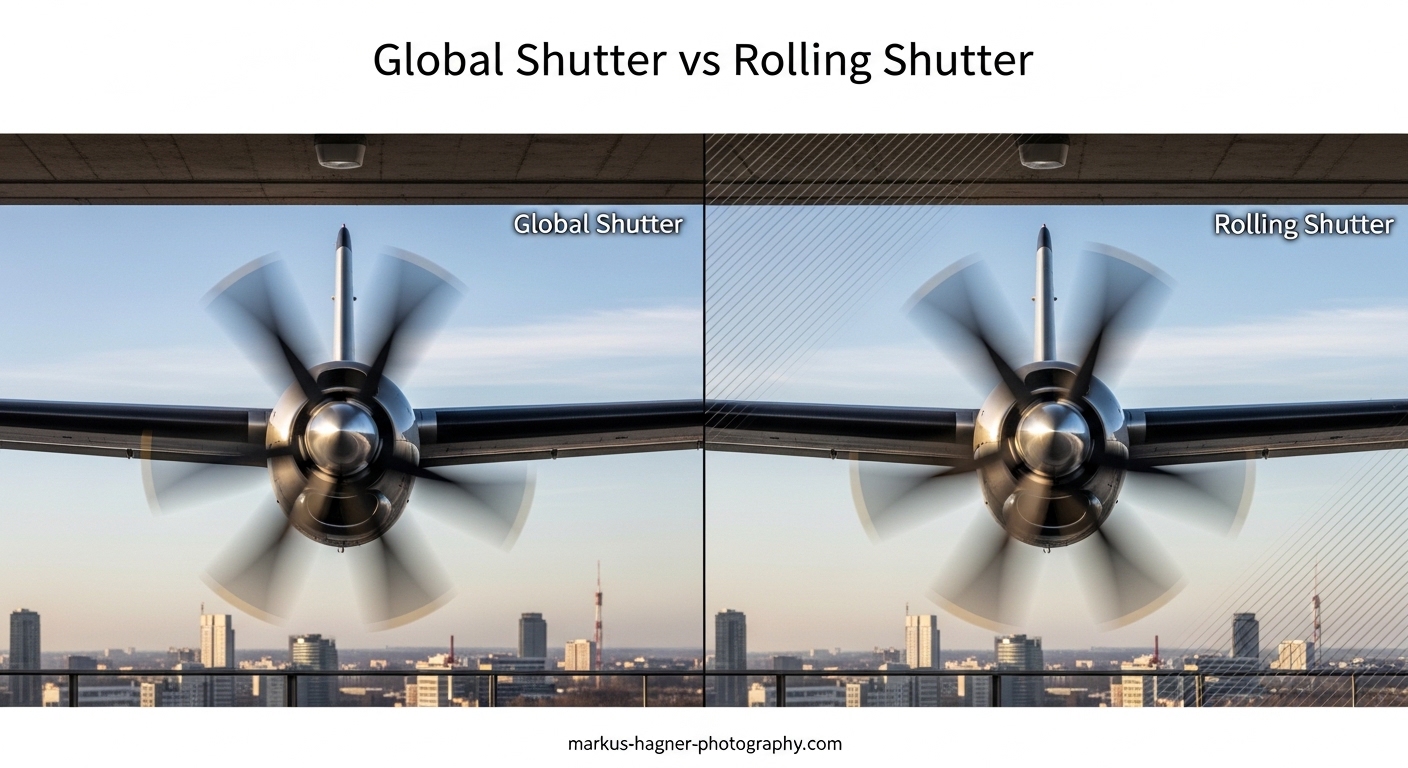
If you have ever noticed buildings leaning strangely in your photos or video footage that looks like it was shot through wobbly jelly, you have encountered the difference between global shutter and rolling shutter. Global shutter captures the entire image simultaneously by exposing all sensor pixels at once, while rolling shutter captures images row-by-row with a time delay between each row. This fundamental difference in how your camera reads light affects everything from sports photography to drone footage.
Understanding global shutter vs rolling shutter matters because it directly impacts your image quality, especially when photographing fast-moving subjects or shooting video. The wrong shutter type can introduce distortion that ruins otherwise perfect shots. In this guide, I will explain exactly how each shutter works, when each matters, and help you decide which technology you actually need for your photography.
What Is Rolling Shutter?
Rolling shutter is the most common image capture method found in modern CMOS sensors. Instead of capturing the entire scene at once, a rolling shutter reads the sensor row by row, starting from the top and scanning downward. Each row gets exposed and read out at a slightly different moment in time.
Think of it like a scanner moving across a document. The top of your image gets captured milliseconds before the bottom. This sequential readout creates a tiny time gap between the first row and the last row of pixels. For static scenes, this delay is invisible. But when your subject moves quickly or your camera pans rapidly, that time difference becomes visible as distortion.
Most digital cameras today use rolling shutter because CMOS sensors with this technology are affordable, power-efficient, and offer excellent image quality. The sensor readout speed has improved dramatically over the years, with modern cameras reading their sensors much faster than older models. However, even the fastest rolling shutters still have some degree of sequential capture.
Rolling Shutter Artifacts: The Jello Effect and More
The rolling shutter effect shows up in several recognizable ways. Once you know what to look for, you will spot these artifacts everywhere. Photographers on forums consistently report that once they notice rolling shutter distortion, they cannot unsee it.
The Jello Effect (Wobble)
The most infamous rolling shutter artifact is the jello effect. When you pan your camera quickly or shoot handheld with slight movements, vertical lines in your scene start to wobble. Buildings appear to sway, horizon lines undulate, and the entire image looks unstable. This happens because each row captures a slightly different position as the camera moves during the readout.
Skew Distortion
Skew occurs when photographing fast-moving subjects. A car driving past at speed will appear stretched diagonally rather than maintaining its proper shape. Propellers and fan blades bend into curved shapes instead of straight lines. This motion distortion happens because the subject moves between the time the top and bottom rows are captured.
Partial Exposure and Flash Banding
When using flash or electronic flash with rolling shutter, you may encounter flash banding. If the flash fires while the sensor is mid-readout, only some rows will receive the flash illumination. This creates a visible horizontal band across your image where the exposure suddenly changes. Professional event photographers often struggle with this when mixing ambient light with flash.
Vertical Lines Becoming Diagonal
Fast horizontal motion turns vertical lines diagonal. A fence post photographed from a moving car will lean in the direction of travel. This skew distortion is particularly noticeable in drone photography and videography, where the camera itself is in constant motion.
What Is Global Shutter?
Global shutter takes a fundamentally different approach to image capture. Instead of reading rows sequentially, a global shutter exposes and reads every pixel on the sensor simultaneously. All pixels start and end their exposure at exactly the same moment.
This simultaneous capture eliminates the time delay that causes rolling shutter artifacts. Fast-moving subjects appear exactly as they are, with no distortion regardless of their speed or direction. Buildings stay vertical, propellers look like propellers, and handheld footage remains stable.
Global shutter technology originally came from CCD sensors, which naturally captured all pixels at once. When the industry shifted to CMOS sensors for their better performance and lower cost, global shutter became harder to achieve. Modern global shutter CMOS sensors require specialized circuitry to store charge from every pixel before readout, which adds complexity and cost to the sensor design.
Global Shutter vs Rolling Shutter: Key Differences
The main difference between global and rolling shutter comes down to timing. Global shutter captures everything at once, while rolling shutter captures over time. This single distinction creates cascading effects on image quality, performance, and cost.
Capture Method
Global shutter exposes all pixels simultaneously using electronic circuitry that starts and stops exposure across the entire sensor at the same instant. Rolling shutter exposes and reads each row sequentially, creating a slight time delay between the top and bottom of the frame.
Readout Speed
Rolling shutter readout speed varies significantly between cameras. Consumer cameras might take 20-30 milliseconds to read the entire sensor, while professional cinema cameras can read in under 5 milliseconds. Global shutter effectively has zero readout delay since all pixels capture simultaneously.
Motion Handling
Global shutter handles motion perfectly. Fast subjects, rapid panning, and camera vibration all render without distortion. Rolling shutter struggles with motion, introducing jello effect, skew, and wobble depending on the speed and direction of movement.
Flash Synchronization
Global shutter syncs with flash at any shutter speed. You can use extremely fast shutter speeds with electronic flash without banding. Rolling shutter has limited flash sync speeds and can produce banding artifacts when the flash fires during sensor readout.
High-Speed Photography
Global shutter enables extremely fast shutter speeds, sometimes up to 1/40,000 second. This makes it ideal for capturing splashes, impacts, and other split-second moments. Rolling shutter cameras typically max out at lower speeds due to their sequential readout nature.
Pros and Cons: Which Shutter Type Wins?
Neither shutter type is universally better. Each has distinct advantages and trade-offs that make them suitable for different situations. Understanding these pros and cons helps you choose the right tool for your work.
Rolling Shutter Advantages
Rolling shutter sensors offer excellent low light performance. Because they lack the extra circuitry required for global shutter, each pixel can be larger and more efficient at gathering light. Many photographers report that rolling shutter sensors deliver about one stop better noise performance compared to equivalent global shutter sensors.
Dynamic range tends to be better on rolling shutter sensors. The simpler pixel design allows for greater tonal range and better highlight recovery. For landscape and portrait photographers who prioritize image quality over motion handling, rolling shutter often produces superior results.
Cost is the most significant advantage. Rolling shutter cameras cost substantially less than global shutter equivalents. This technology is mature, widely available, and mass-produced, making it accessible to photographers at every budget level.
Rolling Shutter Disadvantages
Motion distortion is the primary drawback. Fast action, quick pans, and camera vibration all introduce visible artifacts. Drone photographers particularly struggle with rolling shutter because propeller vibration constantly affects the footage.
Flash synchronization is limited. You cannot use ultra-fast shutter speeds with flash, and banding can occur at certain sync speeds. This restricts creative options for event and studio photographers.
Once you notice rolling shutter artifacts, they become distracting. Many photographers report that learning about jello effect and skew makes them see these flaws everywhere in their older work.
Global Shutter Advantages
Perfect motion handling is the headline feature. Fast-moving subjects render accurately without distortion. Sports photographers, wildlife shooters, and action videographers benefit enormously from this capability.
Flash synchronization works at any speed. You can freeze motion with electronic flash at 1/8000 second or faster without banding. This opens creative possibilities for high-speed flash photography.
Handheld footage looks more professional. The elimination of wobble and jello effect makes handheld video appear more stable and cinematic. Filmmakers consistently praise global shutter for making camera movements look beautiful.
Global Shutter Disadvantages
Low light performance suffers. Global shutter sensors typically deliver about one stop worse noise performance compared to rolling shutter equivalents. The extra circuitry required for simultaneous capture reduces pixel efficiency and increases read noise.
Dynamic range is often lower. The specialized global shutter design can limit the tonal range a sensor captures. For photographers who need maximum dynamic range, rolling shutter frequently performs better.
Cost is prohibitive for many photographers. Global shutter cameras command premium prices, often costing thousands more than equivalent rolling shutter models. The technology remains expensive to manufacture at scale.
Availability is limited. Fewer camera models offer global shutter, restricting your options when shopping for new gear.
When to Choose Global Shutter vs Rolling Shutter
For most photographers, rolling shutter handles 90% of shooting situations perfectly well. Static subjects, moderate action, and controlled lighting all work beautifully with rolling shutter technology. The artifacts only appear when you push the limits with fast motion or rapid camera movement.
Choose Global Shutter If You:
Shoot fast sports or wildlife photography where subjects move rapidly across the frame. Birds in flight, racing cars, and athletes in motion all benefit from distortion-free capture.
Work as a drone photographer. Propeller vibration constantly affects camera stability, making rolling shutter artifacts nearly unavoidable. Global shutter is essentially essential for professional drone work.
Create handheld video content. Filmmakers shooting documentary, run-and-gun style, or action sequences appreciate how global shutter eliminates the distracting wobble that plagues rolling shutter footage.
Do high-speed flash photography. If you need to freeze extremely fast motion with electronic flash, global shutter gives you the synchronization flexibility rolling shutter cannot match.
Work in machine vision or industrial inspection. Manufacturing and scientific applications require precise, distortion-free capture that only global shutter provides.
Rolling Shutter Works Fine If You:
Photograph landscapes, portraits, or still life. Static subjects never trigger rolling shutter artifacts, so you get all the image quality benefits without any downsides.
Shoot video from a tripod or gimbal. Stable camera platforms minimize the vibration and movement that cause jello effect and wobble.
Work in low light conditions. The superior noise performance and dynamic range of rolling shutter sensors produces better results when light is limited.
Have a limited budget. Rolling shutter cameras offer excellent value, letting you invest in better lenses or lighting instead of paying a premium for global shutter technology.
How to Minimize Rolling Shutter Artifacts
If you shoot with a rolling shutter camera, several techniques can reduce or eliminate unwanted distortion. These practical tips come from professional photographers who work around rolling shutter limitations daily.
Slow down your camera movements. Quick pans and fast tilts exaggerate rolling shutter effects. Move the camera smoothly and deliberately to keep the time delay between rows less noticeable.
Use a gimbal or image stabilization. Reducing camera vibration significantly decreases jello effect in video. Modern in-body stabilization helps, but a proper gimbal works even better.
Choose higher shutter speeds carefully. Faster shutter speeds reduce motion blur but can make rolling shutter more apparent. Find the balance that works for your subject.
Shoot at slower frame rates if possible. Higher frame rates like 60fps or 120fps often have slower sensor readout, making rolling shutter worse. Standard 24fps or 30fps typically read faster and show fewer artifacts.
Fix it in post-processing. Software like Adobe Premiere Pro, DaVinci Resolve, and Final Cut Pro include rolling shutter correction tools. These can significantly reduce distortion, though they cannot fix severe cases.
Frequently Asked Questions
Is global shutter better than rolling shutter?
Neither is universally better. Global shutter eliminates motion distortion but costs more and has worse low light performance. Rolling shutter offers better image quality and value for most photographers but can produce artifacts with fast motion. Choose global shutter for action and video work, rolling shutter for landscapes and portraits.
What are the disadvantages of global shutter?
Global shutter sensors typically have about one stop worse noise performance than rolling shutter equivalents. Dynamic range is often lower. Cameras with global shutter cost significantly more and fewer models are available. The technology remains expensive to manufacture compared to mature rolling shutter designs.
Why don’t more cameras have global shutter?
Global shutter technology costs significantly more to manufacture than rolling shutter. The specialized circuitry required for simultaneous pixel capture reduces sensor efficiency and increases production complexity. Most photographers do not need global shutter for their typical work, so manufacturers prioritize the image quality and affordability of rolling shutter designs.
What are the disadvantages of rolling shutters?
Rolling shutter produces motion distortion including jello effect (wobble), skew (diagonal lines), flash banding, and partial exposure artifacts. These problems appear with fast-moving subjects, rapid camera movement, and flash photography. Drone photography is particularly affected due to constant vibration.
Why is global shutter so expensive?
Global shutter requires additional electronic circuitry at every pixel to store charge before simultaneous readout. This increases sensor complexity, reduces manufacturing yields, and requires more sophisticated production processes. Lower production volumes also mean higher per-unit costs compared to mass-produced rolling shutter sensors.
Final Thoughts
Understanding global shutter vs rolling shutter helps you make smarter gear decisions and get better results from whatever camera you own. The core distinction is simple: global shutter captures everything at once, while rolling shutter scans row by row. This difference matters most when photographing fast action, shooting handheld video, or working from drones.
For most photographers in 2026, rolling shutter remains the practical choice. The superior low light performance, better dynamic range, and lower cost make it the right tool for landscapes, portraits, and everyday photography. Global shutter shines for specialists who need distortion-free capture of fast motion or who work in challenging conditions like drone videography.
Whichever technology you use, understanding its limitations helps you work around them. Slow your camera movements, use stabilization, and process artifacts in post when needed. The best camera is always the one you know how to use effectively.