
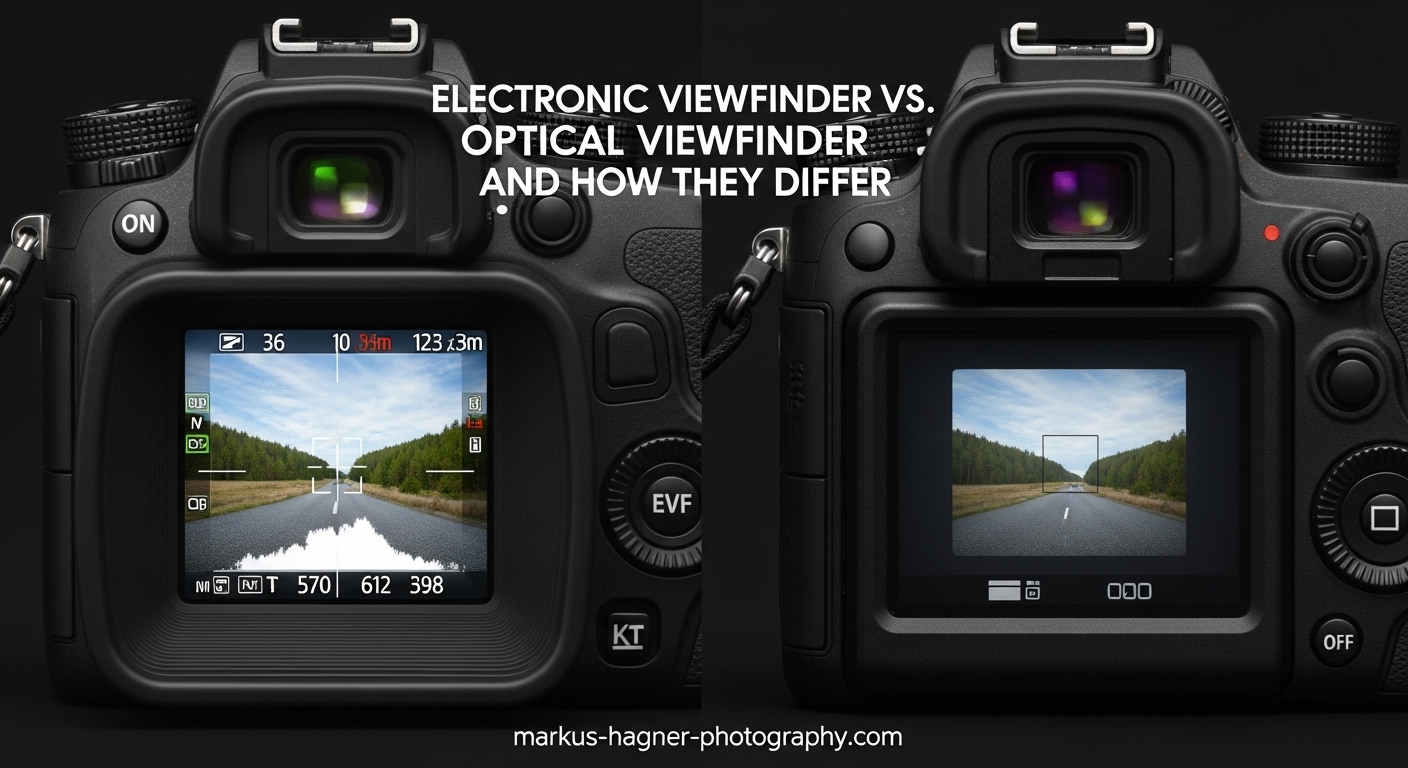
When you look through a camera to compose your shot, you’re using a viewfinder. But not all viewfinders work the same way. The debate between electronic viewfinder vs optical viewfinder has divided photographers since mirrorless cameras gained popularity. Understanding the difference between these two technologies will help you choose the right camera for your photography style and make you a better photographer.
In this guide, I’ll explain exactly how each viewfinder type works, their strengths and weaknesses, and which one suits different photography scenarios. After shooting with both DSLRs and mirrorless cameras for over 15 years, I’ve experienced the advantages and frustrations of both systems firsthand.
What Are Viewfinders and Why Do They Matter?
A viewfinder is the window you look through to frame and compose your photograph. It shows you what the lens sees and helps you track your subject. While smartphones and some compact cameras rely solely on rear LCD screens, dedicated cameras almost always include a viewfinder for good reason.
Using a viewfinder stabilizes your camera against your face, reducing shake compared to holding the camera at arm’s length to view the LCD. This three-point contact (two hands plus your face) creates a more stable shooting platform, especially in low light where slower shutter speeds are necessary.
Viewfinders also block out ambient light and distractions, letting you focus entirely on composition. In bright sunlight, an LCD screen can become nearly impossible to see clearly, while a viewfinder remains visible regardless of lighting conditions.
What Is an Optical Viewfinder (OVF)?
An optical viewfinder shows you the actual light coming through your lens using mirrors and prisms. You’re seeing the real scene with your own eyes, not a digital representation. This is the traditional system used in DSLR (Digital Single-Lens Reflex) cameras.
When you look through an optical viewfinder, light enters through the lens, bounces off a reflex mirror, travels through a pentaprism or pentamirror, and reaches your eye. The image you see is optically identical to what the lens captures, just redirected upward to the viewfinder eyepiece.
What Is an Electronic Viewfinder (EVF)?
An electronic viewfinder is essentially a tiny high-resolution display screen built into the camera. Instead of seeing the actual light from the scene, you’re viewing a digital video feed captured by the camera’s image sensor and displayed on a small OLED or LCD panel.
With an EVF, you’re seeing what the sensor sees, processed and displayed in real-time. This digital approach enables features impossible with optical viewfinders, like exposure preview, live histograms, and focus peaking overlays.
How Optical Viewfinders Work: The Traditional Approach
Optical viewfinders have been the standard for serious photography for decades. The technology relies on a clever arrangement of mirrors and prisms to redirect light from the lens to your eye without any digital processing.
The DSLR Mirror Mechanism Explained
Inside a DSLR camera, a hinged mirror sits at a 45-degree angle in front of the image sensor. When you look through the viewfinder, this mirror reflects incoming light upward toward the focusing screen and then through the pentaprism, which corrects the image orientation so you see it right-side-up and correctly oriented.
When you press the shutter button, the mirror flips up out of the way, allowing light to reach the sensor for the actual exposure. This mirror movement is what gives DSLRs their characteristic “click” sound and creates the brief viewfinder blackout during exposure.
The reflex mirror also directs a portion of light to a separate autofocus sensor, which handles phase-detection autofocus. This dedicated AF sensor enables fast, accurate focusing even when the main sensor isn’t receiving light.
Pentaprism vs Pentamirror
Not all optical viewfinders are created equal. Higher-end DSLRs use a solid glass pentaprism, which provides a brighter, clearer view with better contrast. Entry-level DSLRs often use a pentamirror, which is a hollow assembly of mirrors that’s lighter and cheaper to manufacture but produces a slightly dimmer image.
The difference in brightness can be significant. A good pentaprism viewfinder typically provides around 95-100% frame coverage with 0.7x to 0.75x magnification, while pentamirror viewfinders often feel more tunnel-like with slightly lower magnification and brightness.
Advantages of Optical Viewfinders
Zero Lag: Because you’re seeing actual light traveling at the speed of light, there’s absolutely no delay between what happens in front of the camera and what you see. This makes optical viewfinders ideal for action photography where timing is critical.
Natural, Unfiltered View: You see the scene as your eyes would naturally perceive it, without digital processing, color shifts, or resolution limitations. Many photographers find this more comfortable for extended shooting sessions.
No Battery Drain: The optical system works without power. Your viewfinder is always available, even when the camera is turned off or the battery is depleted.
Better Performance in Low Light: While the viewfinder image gets dim in low light, it never becomes grainy or noisy. You’re seeing the actual light levels, which some photographers prefer for judging ambient conditions.
No Viewfinder Blackout in Some Models: High-end DSLRs with fast mirror mechanisms minimize the blackout time during continuous shooting, allowing you to track subjects more effectively.
Disadvantages of Optical Viewfinders
No Exposure Preview: You can’t see how your exposure settings will affect the final image until you take the shot. This requires more experience to judge lighting and exposure compensation mentally.
Viewfinder Blackout: During exposure, the mirror flips up and the viewfinder goes dark. In continuous shooting mode, this creates a strobing effect that can make tracking fast-moving subjects challenging.
Limited Information Display: While optical viewfinders can display basic shooting information like shutter speed and aperture through LCD overlays, they can’t show the rich overlays that EVFs provide.
Bulk and Weight: The mirror box and pentaprism add significant bulk to the camera body, making DSLRs larger and heavier than their mirrorless counterparts.
Difficulty in Very Low Light: When light levels drop significantly, the optical viewfinder becomes too dark to see through clearly, making composition difficult.
How Electronic Viewfinders Work: The Digital Revolution
Electronic viewfinders take a fundamentally different approach. Instead of redirecting light to your eye, they capture light on the image sensor, process it digitally, and display it on a tiny screen that you view through an eyepiece magnifier.
Sensor-to-Display Technology Explained
Here’s what happens when you look through an EVF: Light enters the lens and strikes the image sensor continuously. The sensor reads this data and sends it to the camera’s image processor, which converts it into a video signal. This signal drives a small high-resolution OLED or LCD panel positioned behind the eyepiece optics.
The entire process happens in milliseconds. Modern EVFs refresh at 60 to 120 frames per second, providing a smooth, responsive view. Higher refresh rates reduce motion blur when panning and make tracking moving subjects feel more natural.
EVF resolution has improved dramatically over the years. Early EVFs had around 230,000 dots and looked pixelated. Current flagship cameras offer EVFs with 3.6 to 9.4 million dots, providing a detailed, sharp image that rivals optical viewfinders for clarity.
OLED vs LCD Electronic Viewfinders
Most high-end EVFs use OLED (Organic Light-Emitting Diode) technology rather than traditional LCD panels. OLEDs offer several advantages: true blacks (since pixels can turn completely off), faster response times, and better color reproduction. LCD EVFs are typically found in budget cameras and can suffer from motion blur during fast camera movements.
Advantages of Electronic Viewfinders
Exposure Simulation (What You See Is What You Get): The EVF shows you exactly how your exposure settings will affect the final image. If your image is underexposed, you’ll see a dark viewfinder image. Adjust exposure compensation, and you see the change in real-time. This feature alone has saved me thousands of wasted shots.
Live Histogram and Focus Peaking: EVFs can overlay a live histogram showing the distribution of light values in your scene. Focus peaking highlights in-focus edges with colored outlines, making manual focus dramatically easier and more accurate.
Low Light Amplification: In dark conditions, an EVF can electronically boost the signal, brightening the viewfinder image beyond what your eyes could naturally see. This makes composition possible in near-darkness where an optical viewfinder would be useless.
Unlimited Information Overlays: EVFs can display virtually any information the camera knows: zebras for overexposure warnings, electronic levels for horizons, grid lines, focus point indicators, and even playback of captured images without removing your eye from the viewfinder.
White Balance and Picture Style Preview: You see how your white balance settings affect colors in real-time. If you’re shooting black and white, the EVF displays the scene in monochrome, helping you visualize the final result.
Compact Camera Design: Without the mirror box and pentaprism, mirrorless cameras with EVFs can be significantly smaller and lighter than DSLRs.
Disadvantages of Electronic Viewfinders
Battery Consumption: EVFs are power-hungry. Continuous sensor readout and display operation drain batteries much faster than optical systems. You might get 800-1000 shots from a DSLR battery but only 300-400 from a similar mirrorless camera.
Potential for Lag: Even with fast processors, there’s always some delay between the sensor capture and display update. In fast action situations, this lag can affect timing, though modern EVFs have reduced this to mere milliseconds.
Grain in Low Light: When the EVF boosts the signal in low light, digital noise becomes visible in the viewfinder. The image can look grainy or muddy, making it harder to judge fine details and focus accuracy.
Dynamic Range Limitations: EVFs cannot display the full dynamic range the sensor captures. Bright highlights may appear blown out in the EVF even when they’re properly exposed in the final image, potentially misleading your exposure decisions.
Eye Strain Concerns: Some photographers report headaches or eye fatigue after extended EVF use, particularly with lower-quality displays or when the refresh rate causes subtle flicker. The experience of staring at a screen rather than a natural scene affects different people differently.
Complete Dependence on Power: Without battery power, the EVF is completely non-functional. You have no way to compose your shot if the battery dies.
Electronic Viewfinder vs Optical Viewfinder: Head-to-Head Comparison
Let me break down the key differences between these two viewfinder technologies across the factors that matter most to photographers. This comparison will help you understand which approach suits your needs.
Response Time and Lag: Optical viewfinders operate at the speed of light with zero perceptible lag. Electronic viewfinders have improved dramatically, with high-end models achieving lag times under 10 milliseconds, but they can never match the instant response of optical systems. For sports, wildlife, and fast action, this difference matters.
Battery Life: This is where optical viewfinders dominate. A DSLR with optical viewfinder can shoot all day on a single battery. Mirrorless cameras with EVFs typically need battery swaps or spares for intensive shooting sessions. If you shoot in remote locations without charging access, this is a significant consideration.
Exposure Accuracy: Electronic viewfinders win decisively here. The ability to see exposure changes in real-time dramatically reduces trial and error. Beginners especially benefit from this immediate feedback, but even experienced photographers make fewer exposure mistakes with EVF preview.
Low Light Performance: This is nuanced. EVFs can amplify light, making dark scenes visible. However, the amplified image becomes noisy and may not accurately represent exposure. OVFs show actual light levels, which some photographers prefer for judging ambient conditions, but they can become too dark to see through in extreme low light.
Manual Focus Capability: EVFs with focus peaking and magnification make manual focus significantly easier and more precise. Optical viewfinders require more skill and often need you to swap to Live View mode for critical manual focus work.
Physical Size and Weight: Mirrorless cameras with EVFs are typically 20-40% smaller and lighter than equivalent DSLRs. If you travel light or hike to your shooting locations, this difference adds up.
Eye Comfort: This varies by individual. Some photographers find optical viewfinders more comfortable for all-day shooting. Others adapt quickly to EVFs and appreciate the additional information. If you wear glasses, both systems have considerations around eye relief that we’ll address separately.
Information Display: EVFs can show virtually unlimited information overlays without obscuring the image. OVFs are limited to basic LCD overlays and cannot display things like histograms or focus peaking.
Quick Reference Comparison
- Lag: OVF wins (zero lag) vs EVF (minimal but present)
- Battery Life: OVF wins significantly
- Exposure Preview: EVF wins decisively
- Low Light Visibility: EVF amplifies light, OVF shows actual levels
- Manual Focus: EVF wins with focus peaking and magnification
- Size/Weight: EVF cameras typically smaller and lighter
- Eye Comfort: Personal preference, varies by individual
- Information Display: EVF offers unlimited overlays
Choosing the Right Viewfinder for Your Photography Style
Neither viewfinder type is universally better. The right choice depends entirely on what, how, and where you shoot. Let me break down recommendations by photography genre and shooting style.
Best Viewfinder for Action and Sports Photography
For fast-moving subjects where timing is everything, optical viewfinders still hold an advantage. The zero-lag response means you see the action as it happens, not milliseconds later. Sports and wildlife photographers who track erratic subjects often prefer the seamless, real-time view of an OVF.
That said, modern high-end EVFs with 120Hz refresh rates and minimal lag have narrowed this gap significantly. Many professional sports photographers have successfully transitioned to mirrorless systems. The decision often comes down to personal preference and the specific demands of your subject matter.
Best Viewfinder for Landscape Photography
Landscape photographers are split. Those who value exposure accuracy and precise manual focus often prefer EVFs for the live histogram, focus peaking, and exposure preview. Being able to verify your exposure before releasing the shutter saves time and ensures you capture the image you envisioned.
However, landscape photographers who work in extreme conditions (very cold, remote locations) sometimes prefer OVF cameras for their superior battery life. When you’re miles from civilization and temperatures drain batteries faster, the efficiency of an optical system matters.
Best Viewfinder for Low Light Photography
This depends on what you’re shooting in low light. For astrophotography and night landscapes, EVF amplification can be invaluable for composing shots in near-darkness. You can actually see what you’re framing rather than guessing.
For events and weddings in dim venues, EVF exposure preview helps nail proper exposure in challenging mixed lighting. However, the noise in amplified EVF images can make it difficult to judge image quality and focus accuracy in very dark conditions.
Best Viewfinder for Beginners Learning Photography
For photographers learning exposure and composition, electronic viewfinders offer significant advantages. The immediate feedback of exposure preview helps beginners understand the relationship between aperture, shutter speed, and ISO. When you change settings and see the result instantly, the learning process accelerates dramatically.
Live histograms teach newcomers to read light distribution. Focus peaking builds confidence in manual focus. The WYSIWYG approach reduces frustration and wasted shots. Most photography instructors now recommend EVF cameras for students for these educational benefits.
Considerations for Glasses Wearers
If you wear glasses, both viewfinder types present challenges. Eye relief (the distance you can hold your eye from the viewfinder while still seeing the full frame) matters significantly. Most viewfinders offer around 15-22mm of eye relief, which may not be enough for some glasses.
Dioptric adjustment allows you to correct the viewfinder focus for your vision, but the range is typically limited to -3 to +1 diopters. If your prescription falls outside this range, you’ll need to keep your glasses on while shooting.
For glasses wearers, look for viewfinders with longer eye relief (22mm or more) and larger eyepieces that don’t press uncomfortably against your glasses. Some photographers prefer EVFs because the higher magnification can make it easier to see the full frame with glasses, while others prefer the optical clarity of OVF. This is genuinely a personal preference that requires hands-on testing.
Hybrid Viewfinders: The Middle Ground
Before concluding, I should mention a third option that few photographers know about. Fujifilm’s X100 series and a few other cameras offer hybrid viewfinders that can switch between optical and electronic modes. In optical mode, you see through the lens optically but with digital overlays. Switch to electronic mode, and you get full EVF functionality with exposure preview and focus peaking.
This hybrid approach offers the best of both worlds, though it’s limited to specific camera models with fixed or specific lenses. For photographers who refuse to compromise, a hybrid viewfinder might be worth seeking out.
Frequently Asked Questions
Is an optical viewfinder better than an electronic viewfinder?
Neither is universally better. Optical viewfinders excel for action photography due to zero lag and superior battery life. Electronic viewfinders excel for exposure accuracy, manual focus assistance, and learning photography. Your choice should depend on what you photograph most often.
Is an electronic viewfinder good?
Yes, electronic viewfinders offer significant advantages including real-time exposure preview, live histograms, focus peaking, white balance preview, and low light amplification. Modern high-resolution EVFs provide a clear, detailed view that helps photographers make better exposure and composition decisions before pressing the shutter.
Why use an optical viewfinder?
Photographers choose optical viewfinders for zero lag (critical for action photography), no battery drain, natural unfiltered viewing that doesn’t cause eye strain for some users, better visibility in bright daylight, and the traditional shooting experience. Many professionals prefer the optical connection to their subject.
What is the purpose of an electronic viewfinder?
An electronic viewfinder displays a real-time digital feed from the camera sensor, showing exactly what the final image will look like including exposure, white balance, and depth of field effects. It enables exposure simulation, information overlays, focus assistance features, and composition in low light conditions.
Final Thoughts on Electronic Viewfinder vs Optical Viewfinder
The electronic viewfinder vs optical viewfinder debate doesn’t have a single correct answer. Both technologies offer genuine advantages, and both have passionate advocates among professional photographers. The best viewfinder is the one that supports how you shoot.
If you photograph fast action, value battery life, or prefer a natural viewing experience, an optical viewfinder might be your preference. If you want exposure preview, focus assistance, or you’re learning photography, an electronic viewfinder offers compelling benefits.
My advice is to try both. Visit a camera store and spend time shooting with each type. The viewfinder is your primary interface with your camera, and personal comfort matters more than any technical specification. Choose the system that feels right for your eyes and your photography.