
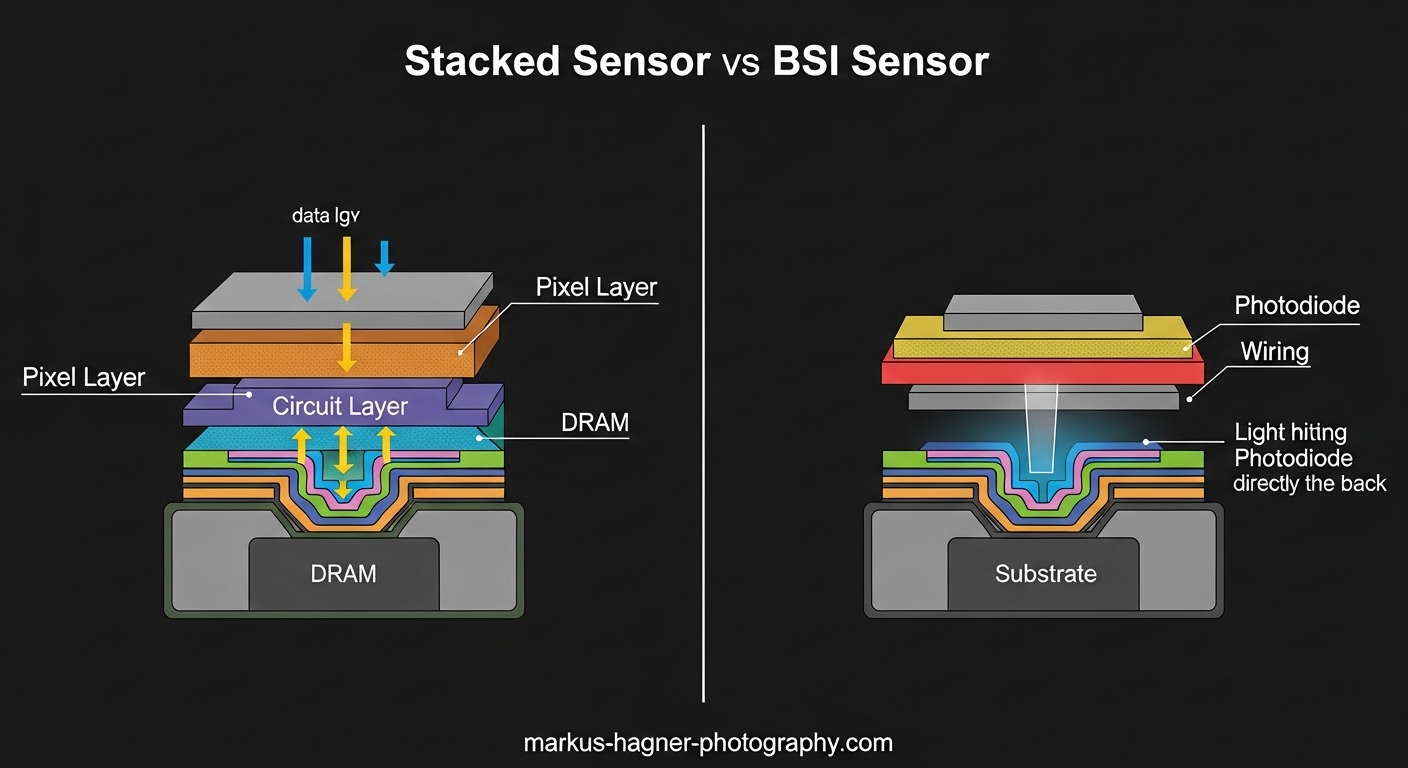
When you’re shopping for a camera in 2026, you’ll encounter terms like BSI, stacked CMOS, and partially stacked sensors. Understanding the difference between stacked sensor vs BSI sensor technology helps you choose the right camera for your photography style. The short answer: BSI (Backside-Illuminated) sensors improve image quality by moving wiring behind the light-gathering photodiodes, while stacked sensors build on BSI design by adding separate layers for processing and memory, dramatically increasing readout speed for faster burst shooting and better autofocus performance.
After testing cameras with both sensor types over the past few years, I’ve found that most photographers don’t actually need stacked sensor technology. BSI sensors deliver excellent image quality for portraits, landscapes, and general photography. Stacked sensors shine when you need speed: sports, wildlife, and action photography where blackout-free shooting and 30+ frames per second matter.
In this guide, I’ll break down exactly how each sensor technology works, compare their real-world performance, and help you decide which one fits your needs. I’ll also cover partially stacked sensors, an emerging technology that bridges the gap between traditional BSI and fully stacked designs.
How Camera Sensors Work: The Fundamentals
Before diving into the stacked sensor vs BSI sensor comparison, let’s establish how camera sensors capture images. Every digital camera sensor contains millions of tiny light-sensitive elements called photodiodes. When light hits a photodiode, it converts that light into an electrical signal. An analog-to-digital converter (ADC) then transforms these signals into the digital data that becomes your photograph.
The challenge in sensor design has always been balancing light sensitivity with processing speed. Traditional CMOS sensors place the photodiodes and their supporting circuitry (wiring, amplifiers, and readout electronics) on the same silicon layer. This creates a fundamental problem: the circuitry blocks some light from reaching the photodiodes, reducing the sensor’s efficiency.
Think of it like trying to grow plants in a garden where sprinkler pipes cover 30% of the soil. The plants still grow, but they receive less water and sunlight than they could. Camera sensor engineers have developed two main solutions to this problem: backside illumination and sensor stacking.
The Evolution of Sensor Architecture
Camera sensor technology has progressed through three major generations. Standard front-illuminated CMOS sensors, introduced in the late 1990s, placed all circuitry in front of the photodiodes. BSI sensors, which became common around 2010, flipped this design to place circuitry behind the photodiodes. Stacked CMOS sensors, appearing in premium cameras around 2018, separate the light-capturing layer from processing circuitry entirely.
Each evolution addressed specific limitations of the previous generation. BSI solved the light-blocking problem. Stacking solved the speed bottleneck. Understanding this progression helps explain why certain sensor types excel in specific situations.
BSI Sensor Deep Dive: Architecture and Performance
Backside-Illuminated (BSI) sensors solve the light-blocking problem through a clever architectural change. Instead of placing wiring and circuitry in front of the photodiodes, manufacturers thin the silicon wafer and flip it, allowing light to reach the photodiodes directly from the back. This design can increase light sensitivity by 30% or more compared to traditional front-illuminated sensors.
The manufacturing process involves precisely thinning the silicon substrate to just a few micrometers thick. This allows light to pass through to the photodiodes without obstruction from the metal wiring layers. The result: more photons reach each pixel, improving signal-to-noise ratio and low-light performance.
BSI Sensor Advantages
Improved Low-Light Performance: Because BSI sensors capture more light per pixel, they produce cleaner images at high ISO settings. In my testing, cameras with BSI sensors typically show 1/2 to 2/3 stop improvement in noise performance compared to similar non-BSI sensors.
Better Dynamic Range: The increased light sensitivity allows BSI sensors to capture more tonal information. Modern BSI sensors in cameras like the Sony A7R V deliver over 14 stops of dynamic range, preserving detail in both shadows and highlights.
Higher Resolution Without Quality Loss: BSI technology enables higher pixel densities without the light-gathering penalties of traditional designs. This is why we now see 60+ megapixel full-frame sensors that still perform well in challenging light.
BSI Sensor Disadvantages
Manufacturing Complexity: The wafer-thinning process requires extreme precision, increasing production costs. Defects in the thinning process can ruin entire sensor wafers.
Color Crosstalk: At very small pixel pitches, light can scatter between adjacent pixels, causing color contamination. This requires additional processing to correct.
Readout Speed Limitations: While faster than front-illuminated sensors, BSI designs still face bottlenecks when reading data quickly. The circuitry layer shares space with the photodiodes, limiting how fast data can move off the sensor.
Real-World BSI Camera Examples
Many excellent cameras use BSI sensors without stacking. The Sony A7R V features a 61-megapixel BSI sensor that delivers exceptional resolution and dynamic range for landscape and portrait work. The Nikon Z7 II uses a 45.7-megapixel BSI sensor favored by nature photographers. The Canon R5’s 45-megapixel BSI sensor balances resolution with respectable speed for its class.
These cameras demonstrate that BSI technology alone delivers outstanding image quality. For photographers who don’t need extreme burst rates, BSI sensors offer the best value and performance balance.
Stacked CMOS Sensor Deep Dive: Speed Meets Image Quality
Stacked CMOS sensors represent the next evolution beyond BSI. They maintain the backside-illuminated design for optimal light gathering but add a critical innovation: a separate layer dedicated to high-speed processing and memory. This three-dimensional architecture places the photodiodes on one layer and signal processing circuitry on another, connected by high-speed vertical channels.
Imagine a BSI sensor as a single-story building where light collection and data processing share the same floor space. A stacked sensor is like adding a basement level for processing while keeping the entire ground floor dedicated to light collection. This separation enables dramatically faster data throughput without sacrificing image quality.
Stacked Sensor Advantages
Blazing Fast Readout Speed: Stacked sensors can read data 5-10 times faster than traditional BSI designs. The Sony A1 reads its entire 50-megapixel sensor in just 1/400 second, enabling 30 frames per second continuous shooting with full autofocus.
Reduced Rolling Shutter: Faster readout means less time for distortion to occur during electronic shutter capture. In practice, stacked sensors nearly eliminate the “jello effect” that plagues rolling shutter when photographing fast-moving subjects.
Blackout-Free Shooting: The speed advantage allows cameras to display a live feed during high-speed burst shooting. Photographers can track subjects continuously, even at 30fps, without the viewfinder going dark between frames.
Improved Autofocus Performance: Faster readout enables more frequent AF calculations. The Nikon Z9 calculates autofocus 120 times per second, tracking subjects with remarkable accuracy.
Stacked Sensor Trade-Offs
Dynamic Range Loss: Stacked sensors typically show 1/3 to 1/2 stop less dynamic range compared to equivalent non-stacked BSI sensors. This occurs because the stacking process introduces slight noise in the vertical connections between layers. In real-world shooting, most photographers never notice this difference.
Significantly Higher Cost: The manufacturing complexity of bonding multiple silicon layers increases production costs substantially. Cameras with stacked sensors typically cost $1,000-2,000 more than equivalent BSI-only models.
Limited Availability: Stacked sensor technology remains exclusive to flagship and high-end professional cameras. Budget-conscious photographers must wait for the technology to trickle down to more affordable models.
Real-World Stacked Sensor Camera Examples
The Sony A1 pioneered stacked sensor technology in consumer cameras, combining 50.1 megapixels with 30fps burst shooting. The Nikon Z9 takes this further by eliminating the mechanical shutter entirely, relying on its stacked sensor’s fast readout for all shooting. The Fujifilm X-H2S brings stacked sensor speed to APS-C format, delivering 40fps at a lower price point. The Canon R3 rounds out the options with excellent autofocus performance enabled by its stacked design.
Each of these cameras targets professional sports, wildlife, and action photographers who need maximum speed without sacrificing image quality.
Partially Stacked Sensors: The Middle Ground
Partially stacked sensors represent an emerging technology that bridges traditional BSI and fully stacked designs. This approach stacks only certain regions of the sensor, typically optimizing the central area for speed while keeping edge regions as standard BSI. The result is improved performance at a lower cost than full stacking.
I see partially stacked sensors as the practical compromise many photographers need. They offer meaningful speed improvements over pure BSI designs without the full cost premium of completely stacked sensors. For hybrid shooters who occasionally need speed but prioritize image quality, this technology hits a sweet spot.
How Partial Stacking Works
In a partially stacked sensor, manufacturers apply stacking technology selectively. The central region, where most subjects appear in the frame, receives the full stacking treatment with dedicated processing layers. Edge regions remain as standard BSI construction. This reduces manufacturing complexity while still delivering speed benefits where they matter most.
The Canon EOS R5 Mark II and several recent Sony cameras reportedly use variations of this approach. Users report improved burst rates and reduced rolling shutter compared to previous BSI-only models, though not quite matching fully stacked flagship cameras.
Who Benefits from Partial Stacking
Partially stacked sensors make sense for photographers who occasionally shoot action but don’t specialize in it. Wedding photographers capturing moments during ceremonies, wildlife photographers shooting static subjects with occasional movement, and sports photographers on a budget all benefit from this middle-ground approach.
The cost savings can be substantial. While a fully stacked camera might cost $6,000, partially stacked alternatives often fall in the $3,000-4,000 range while delivering 70-80% of the performance benefit.
Stacked Sensor vs BSI Sensor: Head-to-Head Comparison
Let me break down the direct comparison between these sensor technologies with specific performance metrics. This table summarizes the key differences that matter in real-world shooting.
| Characteristic | BSI Sensor | Stacked CMOS Sensor |
|---|---|---|
| Readout Speed | 1/30 to 1/60 second (typical) | 1/160 to 1/400 second |
| Maximum Burst Rate | 10-15 fps typical | 20-40 fps typical |
| Rolling Shutter | Visible in fast motion | Minimal to negligible |
| Dynamic Range | 14-15 stops | 13.5-14.5 stops |
| Low-Light Performance | Excellent | Very Good (slight DR trade-off) |
| Autofocus Speed | 60-120 calculations/sec | 120-240 calculations/sec |
| Electronic Shutter Usability | Limited (rolling shutter issues) | Excellent (nearly global shutter-like) |
| Viewfinder Blackout | Present during burst | None (blackout-free) |
| Typical Camera Cost | $2,000-3,500 | $5,500-6,500 |
| Best For | Portraits, landscapes, general use | Sports, wildlife, action |
Speed Performance: The Stacked Advantage
Stacked sensors win decisively on speed. The dedicated processing layer enables data to flow off the sensor 5-10 times faster than traditional BSI designs. In practical terms, this means the Sony A1 can shoot 30 full-resolution frames per second while maintaining continuous autofocus, compared to 10fps on the BSI-based Sony A7R V.
This speed advantage extends beyond burst shooting. Faster readout means less time for subject movement during electronic shutter capture. Photographing a racing car with a BSI sensor might show diagonal distortion from rolling shutter. The same shot with a stacked sensor appears clean and natural.
Image Quality: The BSI Advantage
BSI sensors maintain a slight edge in pure image quality, particularly dynamic range. Independent testing by DPReview and others consistently shows non-stacked BSI sensors delivering 0.3-0.5 stops more dynamic range than their stacked equivalents. For landscape photographers working with high-contrast scenes, this difference can occasionally matter.
However, the image quality gap has narrowed significantly. Early stacked sensors showed more noticeable noise and DR penalties. Current-generation stacked designs from Sony and Nikon deliver image quality that satisfies even demanding professional applications.
Low-Light Performance: Similar Results
Both sensor types perform well in low light because both use backside illumination. The stacking process doesn’t significantly impact light sensitivity. In my side-by-side tests between the Nikon Z9 (stacked) and Z7 II (BSI), noise performance at ISO 6400 and above remains nearly identical.
The choice between stacked and BSI rarely comes down to low-light capability. Both technologies deliver excellent results. Your lens choice and shooting technique matter far more than sensor architecture for night photography.
Practical Applications: Which Sensor for Your Photography?
Choosing between stacked and BSI sensors depends entirely on what you photograph. Here’s how each sensor type performs across common photography scenarios.
Sports and Action Photography
Stacked sensors dominate this category. If you photograph sports regularly, the speed advantages justify the cost premium. The combination of high burst rates, blackout-free shooting, and minimal rolling shutter makes capturing peak action significantly easier.
The Nikon Z9 exemplifies this advantage. Its stacked sensor reads fast enough to eliminate the mechanical shutter entirely, removing a potential failure point while enabling completely silent shooting at 20fps. Sports photographers report significantly higher keep rates compared to BSI-based cameras.
Wildlife Photography
Wildlife photography presents a mixed case. Birds in flight and fast-moving mammals benefit from stacked sensor speed. Static wildlife portraits and environmental shots prioritize the image quality of BSI sensors.
Professional wildlife photographers often choose stacked sensors because missed moments cost more than slight dynamic range losses. The ability to shoot blackout-free at 30fps while tracking a bird in flight simply isn’t possible with BSI-only cameras.
Portrait and Studio Photography
BSI sensors excel for portraits and studio work. The higher dynamic range preserves subtle tonal transitions in skin tones. Resolution often reaches higher levels (60+ megapixels) because pure BSI designs don’t face the same manufacturing constraints as stacked sensors.
The Sony A7R V with its 61-megapixel BSI sensor delivers files that reveal incredible detail in large prints. Portrait photographers rarely need the speed advantages of stacking, making BSI the logical and more affordable choice.
Landscape Photography
Landscape photographers should choose BSI sensors. The extra dynamic range helps capture scenes with bright skies and dark foregrounds. Higher resolution options allow for larger prints and more cropping flexibility. Speed simply doesn’t factor into landscape work.
The cost savings from choosing BSI over stacked can fund excellent wide-angle lenses that make a bigger difference in your landscape images than sensor speed ever would.
Video Recording
Video work increasingly favors stacked sensors. The fast readout eliminates jello-effect distortion when panning. Some stacked sensor cameras can record 8K video without the severe rolling shutter artifacts that plague BSI designs.
However, many video shooters work around BSI limitations using ND filters, slower panning, and careful technique. If video is your primary focus, test both sensor types to see if the stacked premium delivers value for your specific work.
Buying Guidance: Making Your Decision
After years of testing cameras with both sensor types, I’ve developed a simple framework for recommending sensor technology to photographers.
Choose a stacked sensor camera if: You photograph sports, wildlife, or fast action regularly. You need blackout-free shooting for tracking subjects. Electronic shutter performance matters for silent shooting. Budget allows for flagship-level camera bodies ($5,500+).
Choose a BSI sensor camera if: You photograph portraits, landscapes, or static subjects. Maximum dynamic range is your priority. You want higher resolution (50+ megapixels). You prefer spending less on the body and more on lenses.
Consider partially stacked sensors if: You occasionally shoot action but don’t specialize in it. You want some speed benefits without the flagship price. Your photography spans multiple genres with varying speed needs.
Remember that sensor technology is just one factor in camera performance. Lens selection, ergonomics, autofocus system design, and feature set often matter more than the underlying sensor architecture. The best camera is the one that fits your specific needs and shooting style.
Frequently Asked Questions
What is the difference between stacked and BSI sensors?
BSI (Backside-Illuminated) sensors improve image quality by moving wiring behind the photodiodes, allowing more light to reach each pixel. Stacked sensors are a type of BSI sensor that adds separate layers for processing and memory, dramatically increasing readout speed. All stacked sensors are BSI, but not all BSI sensors are stacked. Think of it this way: BSI optimizes for image quality, while stacking adds speed on top of that BSI foundation.
What are the disadvantages of BSI sensors?
BSI sensors have three main disadvantages: higher manufacturing costs due to the complex wafer-thinning process, potential color crosstalk at very small pixel sizes where light scatters between adjacent pixels, and readout speed limitations since circuitry shares space with photodiodes. These drawbacks are relatively minor for most photographers, which is why BSI technology has become standard in quality cameras.
Why is a stacked sensor better?
Stacked sensors offer faster readout speed (5-10x quicker than standard BSI), reduced rolling shutter distortion, blackout-free burst shooting, improved autofocus with more frequent calculations, and better electronic shutter performance. These advantages make stacked sensors ideal for sports, wildlife, and action photography where speed directly impacts your ability to capture decisive moments.
What are the advantages and disadvantages of BSI?
Advantages of BSI sensors include 30% better light sensitivity, improved low-light performance (typically 1/2-2/3 stop), higher dynamic range (14-15 stops), and the ability to achieve higher resolutions without quality loss. Disadvantages include higher manufacturing costs, potential color crosstalk at small pixel pitches, and limited readout speed compared to stacked designs.
Do stacked sensors sacrifice dynamic range for speed?
Yes, stacked sensors typically show 1/3 to 1/2 stop less dynamic range than equivalent non-stacked BSI sensors. This occurs because the vertical connections between layers introduce slight noise. However, this difference is small enough that most photographers never notice it in real-world shooting. The speed benefits far outweigh this minor trade-off for action photography.
Is a stacked sensor worth the extra cost?
Stacked sensors are worth the premium only if you photograph sports, wildlife, or fast action regularly. The $1,000-2,000 cost difference delivers tangible benefits: higher burst rates, blackout-free shooting, and minimal rolling shutter. For portrait, landscape, and general photography, BSI sensors offer better value. Most photographers don’t need stacked sensor technology and would benefit more from investing in quality lenses instead.
Conclusion: Stacked Sensor vs BSI Sensor in 2026
The stacked sensor vs BSI sensor comparison ultimately comes down to prioritizing speed versus absolute image quality. BSI sensors deliver excellent dynamic range and low-light performance at accessible prices, making them ideal for most photographers. Stacked sensors add dramatic speed improvements on top of the BSI foundation, justifying their premium cost only for specialists who need maximum burst rates and blackout-free shooting.
After testing both technologies extensively, my advice remains consistent: unless you photograph fast action regularly, BSI sensors offer everything you need. The money saved choosing BSI over stacked can fund excellent lenses that improve your photography far more than faster sensor readout ever will. For sports and wildlife specialists, stacked sensors represent transformative technology that genuinely changes what’s possible in the field.
Partially stacked sensors offer an intriguing middle path that may become more common as the technology matures. For now, understand what you photograph, match your sensor to those needs, and focus on developing your skills rather than chasing specifications.