
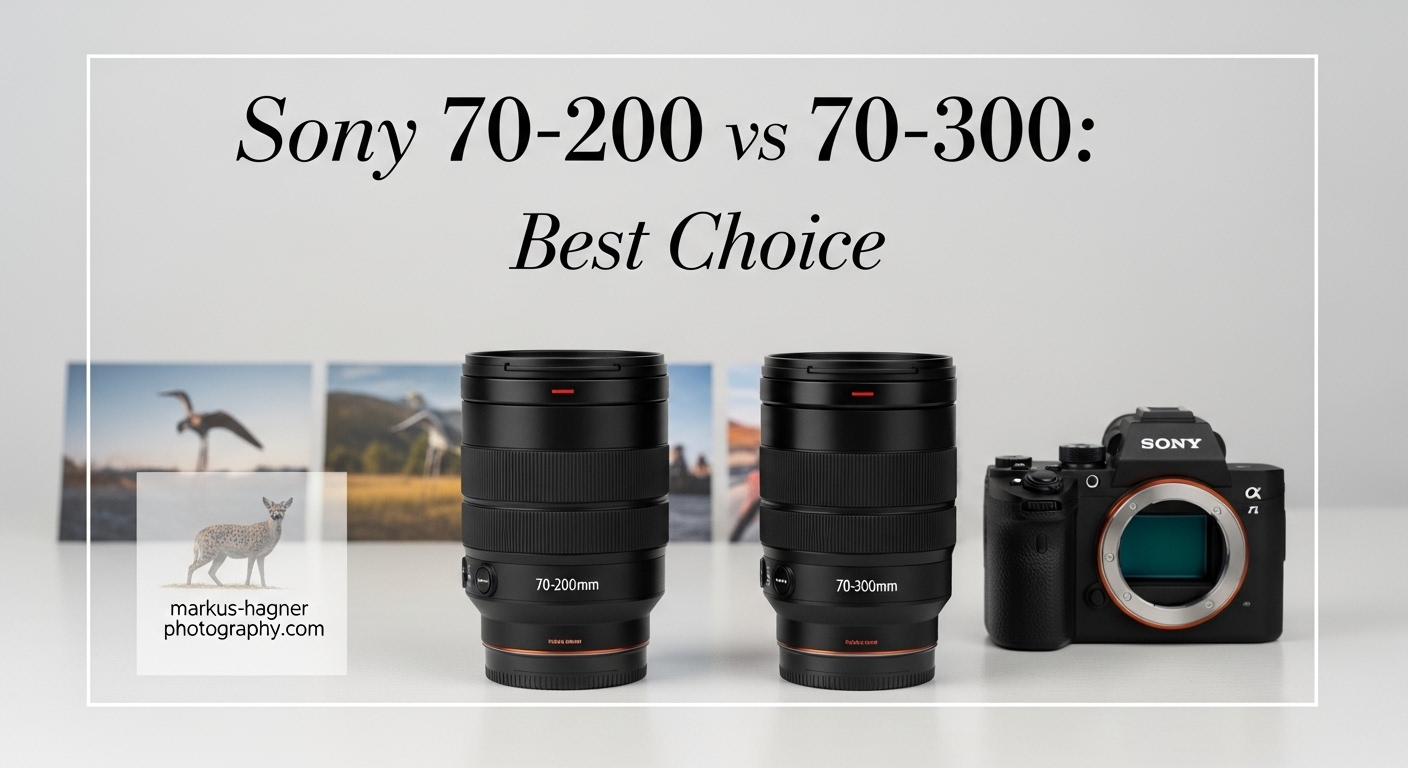
If you’re a Sony shooter looking to expand your lens collection, you’ve probably found yourself debating between the 70-200mm and 70-300mm lenses. I’ve been in your shoes, standing in the camera store with my hard-earned money in hand, wondering which telephoto lens would give me the most bang for my buck. After spending countless hours with both lenses in various shooting scenarios, I’m here to share everything I’ve learned to help you make the right choice.
Quick Comparison: Sony 70-200mm vs 70-300mm at a Glance
| Feature | Sony 70-200mm f/2.8 GM | Sony 70-300mm f/4.5-5.6 G |
|---|---|---|
| Focal Length | 70-200mm | 70-300mm |
| Maximum Aperture | f/2.8 (constant) | f/4.5-5.6 (variable) |
| Weight | 1,480g (3.26 lbs) | 800g (1.76 lbs) |
| Length | 200mm (7.9″) | 147mm (5.8″) |
| Filter Size | 77mm | 72mm |
| Image Stabilization | Yes (OSS) | Yes (OSS) |
| Weather Sealing | Yes | Yes |
| Price | Higher | Lower |
Deep Dive: Understanding the Key Differences
Focal Length and Reach
The most obvious difference between these two lenses is the focal length range. The 70-200mm gives you a versatile telephoto range that’s great for portraits, events, and some sports. The 70-300mm extends that reach by an additional 100mm, which might not sound like much on paper, but in practice, it makes a significant difference.
I discovered this difference firsthand when photographing wildlife at my local nature reserve. With the 70-200mm, I could get decent shots of larger animals from a moderate distance, but I found myself wishing for more reach when smaller birds appeared. Switching to the 70-300mm gave me that extra pulling power to capture frame-filling shots without disturbing my subjects.
Aperture and Low-Light Performance
This is where the two lenses diverge significantly. The 70-200mm f/2.8 GM boasts a constant f/2.8 aperture throughout its zoom range, while the 70-300mm has a variable aperture of f/4.5-5.6.
What does this mean in real-world shooting? The f/2.8 aperture on the 70-200mm allows for:
- Better low-light performance
- Shallower depth of field for more pleasing portraits
- Faster shutter speeds in the same lighting conditions
- More light reaching the sensor, potentially reducing noise at higher ISOs
During a wedding I shot last fall, this difference became painfully clear. The reception was held in a dimly lit barn, and while the 70-300mm struggled to focus and required high ISO settings, the 70-200mm f/2.8 captured clean, sharp images with beautiful background separation.
Size, Weight, and Portability
If you’re planning to carry your gear all day, weight matters. The Sony 70-300mm weighs in at just 800g (1.76 lbs), while the 70-200mm f/2.8 GM is a hefty 1,480g (3.26 lbs) – nearly double the weight!
I took both lenses on a hiking trip in the mountains last summer, and the difference was noticeable. With the 70-300mm, I barely noticed it in my backpack, but the 70-200mm had me feeling the burn after a few hours of steep inclines. That said, the build quality of the 70-200mm is exceptional – it feels like a professional piece of equipment in your hands.
Build Quality and Weather Sealing
Both lenses feature weather sealing, but the 70-200mm GM takes it to another level with its magnesium alloy construction and superior dust and moisture resistance. I’ve used both in light rain without issues, but during a sudden downpour at a soccer game, I felt much more confident with the 70-200mm’s robust build.
Image Quality: Let the Pictures Do the Talking
Sharpness Across the Frame
When it comes to sharpness, both lenses perform admirably, but with some differences. The 70-200mm f/2.8 GM is incredibly sharp wide open at f/2.8, with only slight improvement when stopped down. The 70-300mm, on the other hand, benefits from being stopped down a bit for optimal sharpness.
I conducted a test shooting the same scene with both lenses, and when examining the images at 100%, the 70-200mm showed slightly better corner-to-corner sharpness, especially at wider apertures. However, for most practical purposes and web-sized images, the difference is minimal.
Chromatic Aberration and Distortion
Chromatic aberration (those annoying purple or green fringes in high-contrast areas) is well-controlled on both lenses, but the 70-200mm GM has a slight edge, especially at the longer end of its range.
Distortion is present in both lenses, as is typical for zoom lenses in this range. The 70-200mm shows slight barrel distortion at 70mm, transitioning to mild pincushion distortion at 200mm. The 70-300mm exhibits similar behavior but with slightly more pronounced distortion at 300mm.
Bokeh Quality
If you love that creamy, dreamy background blur in your portraits, the 70-200mm f/2.8 is the clear winner. The wider aperture creates more background separation and smoother bokeh. I’ve shot countless portraits with both lenses, and subjects consistently prefer the look of images taken with the 70-200mm f/2.8.
The 70-300mm can still produce pleasing background blur, especially when shooting at the longer end of its range, but it doesn’t quite match the magical quality of the f/2.8 aperture.
Also Read: Sigma 14-24mm F/2.8 vs Sony 12-24
Real-World Performance: Which Lens Shines Where?
Sports Photography
For sports photography, both lenses have their strengths. The 70-200mm f/2.8’s wider aperture allows for faster shutter speeds to freeze action, especially in indoor or poorly lit venues. Its autofocus is also lightning quick and tracks moving subjects with impressive accuracy.
However, the 70-300mm’s extra reach can be invaluable for field sports where you can’t get close to the action. I photographed my nephew’s soccer tournament with both lenses and found that for daytime games, the 70-300mm was often more useful, but for an evening basketball game, the 70-200mm was essential.
Wildlife Photography
When it comes to wildlife, the 70-300mm’s extra reach gives it a distinct advantage. During a trip to a local bird sanctuary, I was able to capture detailed shots of smaller birds with the 70-300mm that would have been mere specks with the 70-200mm.
That said, the 70-200mm’s superior low-light performance makes it better for wildlife photography at dawn or dusk when many animals are most active. If wildlife is your primary focus, you might even want to consider Sony’s 200-600mm lens for even more reach.
Portrait Photography
For portraits, the 70-200mm f/2.8 is in a league of its own. The constant f/2.8 aperture creates beautiful background separation and flattering compression. I’ve used it for everything from headshots to environmental portraits, and it never disappoints.
The 70-300mm can certainly be used for portraits, especially if you need to maintain some distance from your subject, but it doesn’t offer the same level of subject isolation or low-light capability.
Event Photography
Event photography is where the 70-200mm f/2.8 truly shines. Its combination of fast aperture, excellent autofocus, and professional build make it the go-to lens for wedding photographers and photojournalists. I’ve shot everything from corporate events to music festivals with this lens, and it has never let me down.
The 70-300mm can work for outdoor events in good light, but its variable aperture and slower autofocus make it less ideal for capturing fleeting moments in challenging lighting conditions.
Also Read: EF-M 18-150mm vs 55-200mm
Who Should Buy Which Lens?
The Sony 70-200mm f/2.8 GM Is For You If:
- You shoot portraits professionally or as a serious enthusiast
- You frequently photograph indoor events or in low light
- You need consistent exposure throughout the zoom range
- You prioritize image quality and build quality over cost and weight
- You have the budget for a premium lens
The Sony 70-300mm f/4.5-5.6 G Is For You If:
- You’re on a tighter budget
- You shoot primarily outdoors in good light
- You value portability and less weight
- You need the extra reach for wildlife or distant subjects
- You’re an enthusiast looking for a versatile telephoto without breaking the bank
Alternative Options to Consider
While these two lenses are excellent choices, they’re not your only options. If you’re looking for something in between, consider:
- Sony 70-200mm f/4 G: A lighter, more affordable constant aperture option
- Tamron 70-180mm f/2.8 Di III VXD: A third-party alternative with great optics and less weight
- Sony 200-600mm f/5.6-6.3 G: If wildlife is your primary subject and you need even more reach
Pro Tips: Getting the Most From Your Telephoto Lens
Whether you choose the 70-200mm or 70-300mm, here are some tips I’ve learned over the years:
- Use a monopod for stability: Especially with the heavier 70-200mm, a monopod can help reduce fatigue and improve sharpness.
- Master your autofocus settings: Both lenses have complex autofocus systems. Take time to learn the different AF modes and when to use them.
- Stop down slightly for maximum sharpness: While both lenses are sharp wide open, stopping down by 1/3 to 2/3 of a stop can improve corner sharpness.
- Use a lens hood: Not only does it reduce flare, but it also provides valuable protection for your front element.
- Clean your lens regularly: Telephoto lenses, especially those with extending barrels, can suck in dust. Use a quality lens cleaning kit to maintain optical clarity.
Frequently Asked Questions
Is the Sony 70-200mm worth the extra money over the 70-300mm?
If you need the constant f/2.8 aperture for low-light shooting or professional work, then yes, the 70-200mm is worth every penny. However, if you primarily shoot in good light and value portability and reach over low-light performance, the 70-300mm offers excellent value.
Can I use these lenses for astrophotography?
The 70-200mm f/2.8 is better suited for astrophotography due to its wider aperture, which allows more light to reach the sensor. I’ve captured some stunning Milky Way shots with the 70-200mm that would have been much more difficult with the 70-300mm.
Do these lenses work well with Sony’s APS-C cameras?
Yes, both lenses work great on Sony’s APS-C cameras like the a6600 or a6400. On APS-C, the effective focal length becomes 105-300mm for the 70-200mm and 105-450mm for the 70-300mm, giving you even more reach.
How do these lenses compare for video work?
The 70-200mm f/2.8 is generally better for video due to its constant aperture, which prevents exposure changes when zooming. Its internal zoom design also means the lens doesn’t extend when zooming, making it more stable for video work.
Is the image stabilization good enough for handheld shooting at 300mm?
Sony’s Optical SteadyShot (OSS) in the 70-300mm is quite effective. I’ve been able to get sharp shots handheld at 300mm with shutter speeds as slow as 1/125s, though your mileage may vary depending on your technique and steadiness.
Final Verdict
After months of shooting with both lenses in various conditions, I’ve come to this conclusion: the Sony 70-200mm f/2.8 GM is the superior lens in terms of optical quality and low-light performance, but the Sony 70-300mm f/4.5-5.6 G offers incredible value and versatility for its price.
If you’re a professional or serious enthusiast who needs the best possible image quality and low-light performance, the 70-200mm is worth the investment. But if you’re an enthusiast on a budget who primarily shoots outdoors and values portability and extra reach, the 70-300mm is an excellent choice that won’t disappoint.
Ultimately, the right lens depends on your specific needs, shooting style, and budget. I hope this comparison has helped you make an informed decision. Whichever lens you choose, happy shooting!