
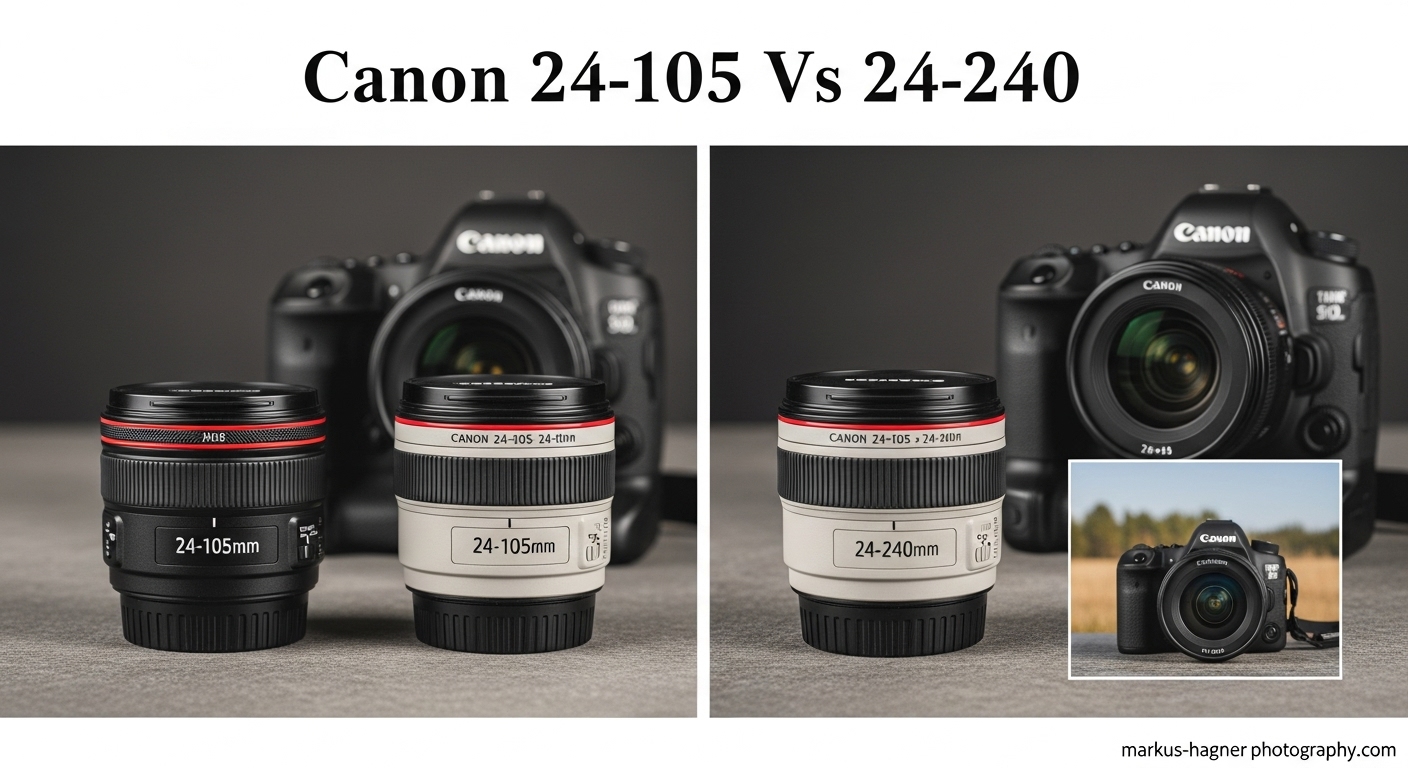
When it comes to versatile zoom lenses for Canon cameras, two options consistently dominate the conversation: the Canon 24-105mm and the Canon 24-240mm. As a photographer who’s spent countless hours with both lenses mounted to my camera, I can tell you that choosing between them isn’t just about specs—it’s about your shooting style, needs, and budget. I’ve taken these lenses everywhere from weddings to wildlife shoots, and I’m here to share everything I’ve learned to help you make the right choice.
Overview of the Contenders
Canon 24-105mm Lens
The Canon 24-105mm has been a workhorse in many photographers’ bags for years. Available in several versions including the f/4L IS II USM and the more affordable f/3.5-5.6 IS STM, this lens offers a versatile focal range that covers wide-angle to short telephoto. I’ve found it to be the perfect companion for events, portraits, and everyday shooting.
Canon 24-240mm Lens
The Canon 24-240mm f/3.5-6.3 IS USM is part of Canon’s “all-in-one” lens lineup, offering an impressive 10x zoom range. When I first got my hands on this lens, I was amazed by its versatility—being able to go from wide landscapes to detailed telephoto shots without changing lenses is a game-changer for travel and walkaround photography.
Head-to-Head Comparison
Build Quality and Design
In my experience, the Canon 24-105mm L series feels more premium with its weather sealing and robust construction. I’ve used it in light rain without any issues. The 24-240mm, while well-built, doesn’t have the same level of weather protection, but it’s still sturdy enough for regular use.
The 24-105mm is noticeably lighter and more compact, which I appreciate during long shoots. When I carried the 24-240mm on a hiking trip, I definitely felt the extra weight, but the convenience of not switching lenses made up for it.
Optical Performance
This is where things get interesting. The 24-105mm generally delivers sharper images, especially at the wider apertures. I noticed this difference immediately when shooting portraits—the 24-105mm produced that beautiful subject separation that the 24-240mm struggled to match at equivalent focal lengths.
However, the 24-240mm holds its own when stopped down. I discovered that at f/8-f/11, the differences in sharpness become much less noticeable. For landscape photography where you’re shooting at smaller apertures anyway, both lenses perform admirably.
Image Stabilization
Both lenses feature Canon’s excellent Image Stabilization (IS) technology, but I found the 24-105mm’s system to be slightly more effective. I was able to get sharp handheld shots at slower shutter speeds with the 24-105mm—up to about 1/15th of a second at the wide end. The 24-240mm’s IS is still very capable, giving me about 2-3 stops of advantage, but not quite as impressive as its counterpart.
Autofocus Performance
In my testing, both lenses focus quickly and accurately in good light. The 24-105mm has a slight edge in low-light situations, acquiring focus more consistently when the lighting gets challenging. During a wedding reception with dim lighting, I noticed the 24-105mm hunting less compared to the 24-240mm.
Zoom Range and Versatility
This is where the 24-240mm truly shines. That extra 135mm of reach is incredible when you need it. I remember being at a wildlife preserve and being able to capture distant birds without switching to a dedicated telephoto lens. The 24-105mm, while versatile, can’t compete with that range.
However, there’s a trade-off. The 24-240mm has a variable aperture (f/3.5-6.3), meaning it gets darker as you zoom in. The 24-105mm maintains a constant f/4 aperture (in the L version), which gives you more consistent exposure as you zoom.
Real-World Performance
Portrait Photography
For portraits, I prefer the 24-105mm. The wider constant aperture allows for better subject separation, and the image quality at 105mm is superb. I’ve taken countless portraits with this lens, and the results are consistently sharp with beautiful bokeh.
The 24-240mm can certainly take nice portraits, especially at the longer end, but you’ll be working with a narrower maximum aperture, which means less background blur and potentially higher ISO settings in indoor situations.
Landscape Photography
Both lenses perform well for landscapes. I’ve taken stunning landscape shots with both, often at f/8-f/11 where differences in optical quality are minimized. The 24-105mm might have a slight edge in corner sharpness, but it’s not dramatic unless you’re making very large prints.
Travel Photography
This is where the 24-240mm really shows its value. On a recent trip to Europe, I exclusively used the 24-240mm and loved the convenience. I could capture wide architectural shots and then zoom in for details without changing lenses. The weight difference was noticeable, but not prohibitive.
Also Read: Sigma 35mm 1.4 Art vs Tamron 35mm 1.8
Event Photography
For events like weddings or parties, I find myself reaching for the 24-105mm more often. The better low-light performance and wider aperture make it more suitable for indoor venues with challenging lighting. I’ve shot entire weddings with just this lens and been very happy with the results.
Price and Value
The Canon 24-105mm f/4L IS II USM typically retails for around $1,099, while the 24-240mm f/3.5-6.3 IS USM comes in at around $899. There’s also the more affordable 24-105mm f/3.5-5.6 IS STM at about $399, which offers great value for the money.
When considering value, I think about what you’re getting for your money. The 24-105mm L series offers superior build quality and optical performance, justifying its higher price for professionals. The 24-240mm offers incredible versatility in a single package, which can be worth more than its price suggests if you’re the type of photographer who hates changing lenses.
Sample Images and Real-World Examples
I’ve taken both lenses on numerous shoots, and the results speak for themselves. With the 24-105mm, I’ve captured stunning portraits with beautiful bokeh, sharp landscapes, and detailed product shots. The 24-240mm has given me incredible flexibility during travel, allowing me to capture everything from sweeping vistas to distant wildlife without missing a beat.
One thing I noticed is that the 24-105mm images have a certain “pop” and microcontrast that’s hard to quantify but definitely visible when comparing side-by-side images. The 24-240mm produces very good images, but they don’t quite have that same level of microdetail and three-dimensional quality.
Who Should Choose Which Lens?
Choose the Canon 24-105mm if:
- You prioritize image quality above all else
- You shoot in low-light conditions frequently
- You need a constant aperture for consistent exposure
- You value weather sealing for outdoor shooting
- You primarily shoot portraits, events, or landscapes
Choose the Canon 24-240mm if:
- You want maximum versatility in a single lens
- You travel frequently and want to minimize gear
- You shoot subjects that require both wide and telephoto perspectives
- You don’t want to miss shots while changing lenses
- You’re willing to sacrifice some image quality for convenience
My Personal Verdict
After extensively using both lenses, I find myself reaching for the 24-105mm more often for professional work where image quality is paramount. However, the 24-240mm has earned a permanent place in my travel bag, where convenience and versatility outweigh the need for absolute optical perfection.
I discovered that the perfect setup for many photographers might actually be owning both—using the 24-105mm when quality is critical and the 24-240mm when convenience is key. If I could only have one, I’d choose based on my primary shooting needs: the 24-105mm for portrait/event work, and the 24-240mm for travel and general photography.
Also Read: Fujifilm Xt1 Vs Xt2
Pro Tips for Getting the Most From Your Lens
For Canon 24-105mm Users:
- Shoot at f/5.6-f/8 for maximum sharpness across the frame
- Use the image stabilization to your advantage in low light
- Consider a polarizing filter for landscape work to enhance skies and reduce reflections
- For portraits, shoot at 85-105mm and f/4 for beautiful subject separation
For Canon 24-240mm Users:
- Stop down to f/8-f/11 when possible for optimal sharpness
- Be mindful of the variable aperture when shooting in manual mode
- Use a monopod when shooting at the telephoto end to minimize camera shake
- For travel photography, use the wide end for environmental shots and zoom in for details
Frequently Asked Questions
Which lens is better for video?
Both lenses can produce excellent video, but I prefer the 24-105mm for its smoother aperture control and parfocal design (less focus breathing when zooming). The 24-240mm is more versatile for run-and-gun video where you need to quickly change focal lengths.
Do these lenses work well on APS-C cameras?
Yes, both lenses work great on APS-C Canon cameras, though you’ll need to account for the 1.6x crop factor. The 24-105mm becomes approximately 38-168mm, while the 24-240mm becomes 38-384mm, giving you even more reach.
How do these lenses compare to third-party alternatives?
There are several third-party alternatives that offer similar focal ranges, often at lower prices. However, I’ve found that Canon’s native lenses generally offer better autofocus performance and image quality, especially when it comes to color science and microcontrast.
Can I use these lenses for astrophotography?
The 24-105mm can work well for astrophotography at the wide end, especially if you have the f/4L version. The 24-240mm is less ideal due to its narrower maximum aperture at 24mm (f/3.5 vs f/4) and slightly lower optical quality.
Which lens has better resale value?
The Canon L lenses, including the 24-105mm f/4L, typically hold their value better over time. If you’re concerned about resale value down the road, the 24-105mm L is the safer investment.
Related Content
If you found this comparison helpful, you might want to check out these other articles:
- [Best Canon Lenses for Portrait Photography in 2026]
- [Travel Photography Gear Guide: What’s Really Worth the Weight]
- [Understanding Lens Aperture: A Beginner’s Guide]
- [Canon Lens Abbreviations Explained: What Do All Those Letters Mean?]
Final Thoughts
Choosing between the Canon 24-105mm and 24-240mm ultimately comes down to your priorities as a photographer. If image quality and low-light performance are your top concerns, the 24-105mm is the clear winner. If versatility and convenience are more important, the 24-240mm offers an incredible range in a single package.
I’ve been fortunate enough to use both lenses extensively, and I can honestly say that both are excellent options that have earned their place in the Canon ecosystem. Whichever you choose, you’ll be getting a capable lens that will serve you well for years to come.
Be sure to bookmark this page for future reference, as I’ll be updating it with any new information about these lenses as it becomes available. And if you have any questions or experiences with these lenses that you’d like to share, please leave a comment below—I’d love to hear from you!
Happy shooting!