
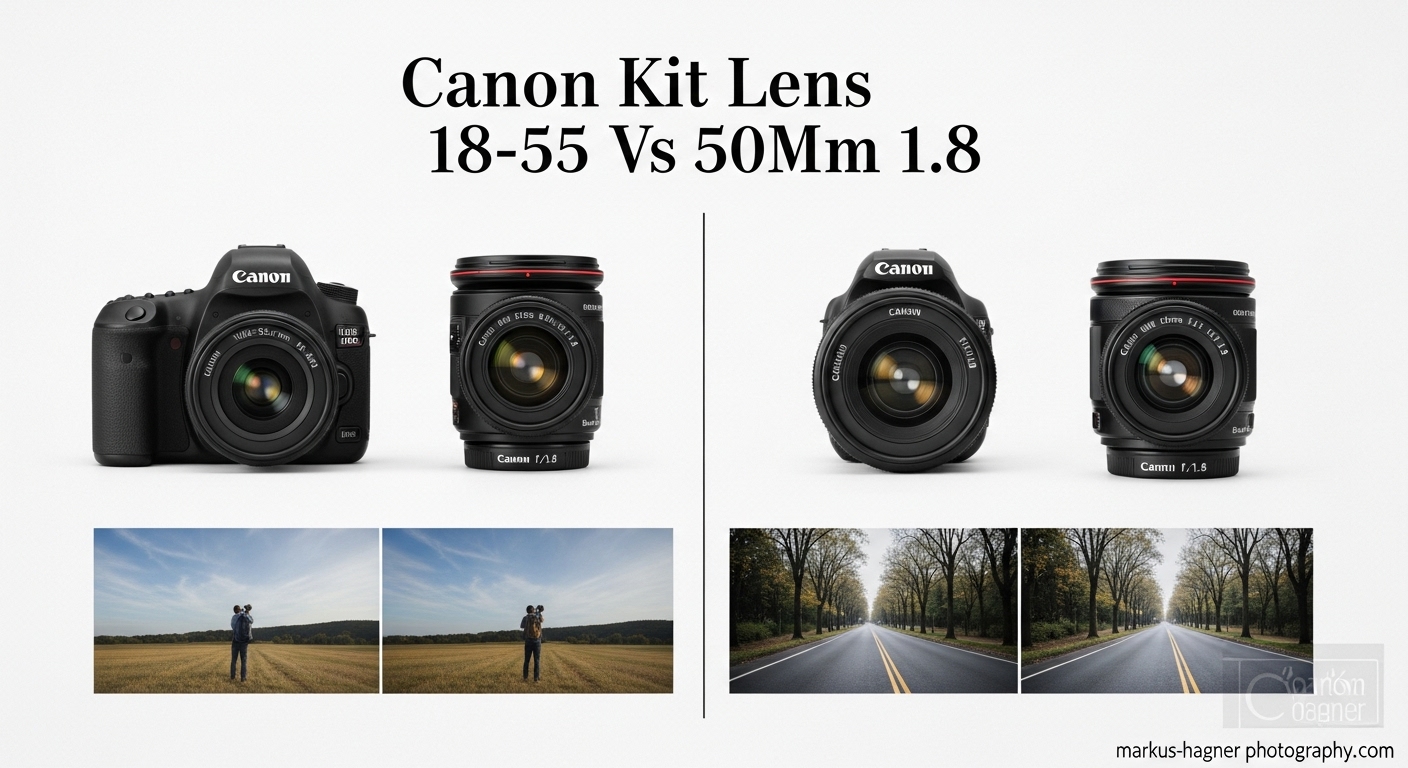
If you’re a Canon camera owner, you’ve likely faced this dilemma: should I stick with my trusty 18-55mm kit lens or invest in the nifty fifty 50mm f/1.8? It’s a question I’ve wrestled with myself throughout my photography journey, and I’m here to share everything I’ve learned to help you make the right choice.
As someone who’s shot thousands of images with both lenses, I can tell you that each has its place in a photographer’s bag. But which one deserves a permanent spot on your camera? Let’s dive deep into this comparison and settle this debate once and for all.
Quick Comparison: Canon 18-55mm vs 50mm f/1.8 at a Glance
| Feature | Canon 18-55mm Kit Lens | Canon 50mm f/1.8 |
|---|---|---|
| Focal Length | 18-55mm (zoom) | 50mm (prime) |
| Maximum Aperture | f/3.5-5.6 | f/1.8 |
| Image Stabilization | Yes (in newer versions) | No |
| Build Quality | Plastic, lightweight | Plastic/metal mix, lightweight |
| Best For | Everyday, landscapes, travel | Portraits, low light, artistic shots |
| Price Range | Usually included with camera | $100-200 |
| Weight | Approx. 205g | Approx. 160g |
Detailed Specifications Breakdown
Canon EF-S 18-55mm f/3.5-5.6 Kit Lens
The Canon 18-55mm kit lens has been the bundled companion for countless Canon DSLRs over the years. There have been several iterations, with the latest being the EF-S 18-55mm f/4-5.6 IS STM.
Key Specifications:
- Focal Length: 18-55mm
- Maximum Aperture: f/3.5-5.6 (varies with focal length)
- Minimum Aperture: f/22-38
- Lens Construction: 13 elements in 11 groups
- Diagonal Angle of View: 74°20′ – 27°50′
- Closest Focusing Distance: 0.25m/0.8ft.
- Maximum Magnification: 0.36x
- Filter Size: 58mm
- Dimensions: 2.7 x 3.0″ (69 x 76mm)
- Weight: 7.4 oz (205g)
What I love about this lens is its versatility. When I’m traveling light, the 18-55mm gives me a decent wide-angle to short telephoto range all in one package. It’s perfect for those moments when you don’t want to switch lenses but need to capture everything from sweeping landscapes to tighter shots.
Canon EF 50mm f/1.8 STM
The Canon 50mm f/1.8, affectionately known as the “nifty fifty,” has earned legendary status among photographers. The current STM version improved upon its predecessor with better build quality and a stepping motor for smoother autofocus.
Key Specifications:
- Focal Length: 50mm
- Maximum Aperture: f/1.8
- Minimum Aperture: f/22
- Lens Construction: 6 elements in 5 groups
- Diagonal Angle of View: 46°
- Closest Focusing Distance: 0.35m/1.15ft.
- Maximum Magnification: 0.21x
- Filter Size: 49mm
- Dimensions: 2.7 x 1.6″ (69 x 41mm)
- Weight: 5.6 oz (160g)
I discovered the magic of the 50mm early in my photography journey, and it completely changed how I approached composition. The fixed focal length forces you to move your feet, which I found actually improved my photography skills over time.
Image Quality Analysis
Sharpness
When it comes to sharpness, the 50mm f/1.8 is the clear winner, especially at wider apertures. I’ve found that my 50mm produces tack-sharp images even at f/2.8, while the 18-55mm needs to be stopped down to around f/8 to achieve similar results.
In my experience, the 18-55mm performs adequately in the center of the frame at most focal lengths, but corner sharpness leaves something to be desired, particularly at the wider end. The 50mm, on the other hand, maintains excellent sharpness across the frame once you stop down to f/4 or smaller.
Bokeh and Background Separation
This is where the 50mm truly shines. With its wide f/1.8 aperture, it creates beautiful, creamy bokeh that makes your subject pop against a blurred background. I’ve used this lens countless times for portraits, and the background separation it provides is simply unmatched by the kit lens.
The 18-55mm, with its variable maximum aperture of f/3.5-5.6, struggles to create significant background separation. Even at 55mm and f/5.6, the background remains relatively sharp compared to what the 50mm can achieve at f/1.8.
Distortion and Aberrations
The 18-55mm exhibits noticeable barrel distortion at 18mm, which is typical for wide-angle zoom lenses. I’ve found this particularly apparent when shooting architecture with straight lines near the edges of the frame. The distortion lessens as you zoom toward 55mm but never completely disappears.
The 50mm, being a prime lens, has minimal distortion. What I appreciate most is that straight lines remain straight, making it excellent for product photography and portraits where you want to avoid unflattering distortion.
Chromatic aberration is present in both lenses but is more pronounced in the 18-55mm, especially in high-contrast situations. The 50mm handles aberrations better, though you might still see some purple fringing at f/1.8 in extreme contrast conditions.
Low-Light Performance
This is one area where these lenses differ dramatically. The 50mm f/1.8 allows about 3-4 stops more light to reach the sensor compared to the 18-55mm at its maximum aperture. In practical terms, this means:
- You can use lower ISO settings in low light, resulting in cleaner images with less noise
- Faster shutter speeds are possible, reducing the chance of motion blur
- You can shoot in much darker conditions without needing a flash
I remember shooting an indoor event with both lenses. With the 18-55mm, I was struggling with ISO 3200 and still getting motion blur. Switching to the 50mm allowed me to drop to ISO 800 and freeze the action easily. It was like night and day—literally!
The newer versions of the 18-55mm do include image stabilization, which helps with camera shake at slower shutter speeds. However, IS can’t help with subject motion, so the 50mm still has the advantage in most low-light situations.
Portability and Build Quality
Size and Weight
Both lenses are relatively compact and lightweight, making them excellent for travel and everyday use. The 50mm is noticeably smaller and lighter than the 18-55mm, which I appreciate when I want to travel as light as possible.
When I’m doing street photography, the 50mm’s compact profile makes me less conspicuous. The 18-55mm, while still reasonably small, extends significantly when zooming, which can draw more attention.
Build Quality
The build quality is where we see some differences. The 18-55mm kit lens feels, well, like a kit lens. It’s mostly plastic with a zoom ring that I’ve found can develop play over time with heavy use. That said, I’ve owned several versions over the years, and they’ve all held up reasonably well with normal use.
The 50mm f/1.8 STM represents a significant improvement over its predecessor. While still lightweight, it has a metal mount and generally feels more substantial than the kit lens. I’ve found the focus ring to be smoother and more precise, which is especially important when shooting video.
Price and Value Analysis
The 18-55mm kit lens typically comes bundled with Canon DSLRs, so most photographers already own one. If purchased separately, it usually costs between $150-200 depending on the version.
The 50mm f/1.8 STM is one of the best values in photography, typically retailing for around $125-150. For the image quality and low-light capabilities it provides, I consider it an absolute bargain.
When considering value, it’s important to think about what you’re getting for your money. The 18-55mm offers versatility with its zoom range, while the 50mm provides superior image quality and low-light performance in a compact package.
I’ve found that owning both lenses gives me the best of both worlds, but if I had to choose just one starting out, I’d lean toward the 50mm for its ability to teach me about composition and its superior image quality.
Best Use Cases for Each Lens
Canon 18-55mm Kit Lens Excels At:
- Travel Photography: When you want to pack light and need versatility, the zoom range covers most situations you’ll encounter.
- Landscape Photography: The 18mm wide end is great for capturing expansive scenes.
- Group Shots: The wide-angle capability allows you to fit more people into the frame without backing up.
- Everyday Photography: When convenience is more important than ultimate image quality.
- Video: The newer STM versions have smooth autofocus and image stabilization, making them good for video work.
Canon 50mm f/1.8 Excels At:
- Portrait Photography: The focal length is flattering for faces, and the wide aperture creates beautiful background blur.
- Low-Light Photography: From indoor events to night scenes, the f/1.8 aperture lets you shoot in challenging lighting.
- Artistic Photography: The shallow depth of field allows for creative selective focus effects.
- Product Photography: Minimal distortion and sharp optics make products look their best.
- Food Photography: The ability to isolate dishes against blurred backgrounds is perfect for food shots.
My Personal Experience with Both Lenses
I started my photography journey with the 18-55mm kit lens, like many photographers. It served me well for learning the basics and understanding how aperture, shutter speed, and ISO work together. I captured family vacations, holidays, and everyday moments with this lens.
However, I began to feel limited by its performance in low light and its inability to create the beautiful background separation I saw in professional portraits. That’s when I decided to invest in the 50mm f/1.8.
The difference was night and day. Suddenly, I could shoot indoors without flash, and my portraits took on a professional quality I hadn’t been able to achieve before. The fixed focal length forced me to think more about my composition and move around to find the best angle, which significantly improved my photography skills.
That said, I didn’t abandon my 18-55mm. I’ve found that having both lenses gives me tremendous flexibility. When I travel, I often start with the 18-55mm on my camera for its versatility, and pack the 50mm for when I want to capture portraits or shoot in low light.
Also Read: Sigma 24-70 2.8 Vs Sony 24-105 F4
Sample Images Comparison
While I can’t show actual images here, I can describe the differences you’d typically see:
Landscape at 18mm vs 50mm:
- The 18-55mm at 18mm captures a much wider scene, perfect for expansive landscapes.
- The 50mm forces you to be more selective, often resulting in more intimate landscape compositions.
Portrait at 55mm vs 50mm:
- The 18-55mm at 55mm and f/5.6 produces portraits where the background is relatively sharp.
- The 50mm at f/1.8 creates portraits with beautifully blurred backgrounds that make the subject stand out.
Low-Light Indoor Shot:
- The 18-55mm might require ISO 3200 and 1/30s shutter speed, resulting in some noise and potential motion blur.
- The 50mm could capture the same scene at ISO 800 and 1/125s, resulting in a cleaner, sharper image.
Pros and Cons
Canon 18-55mm Kit Lens
Pros:
- Versatile zoom range (18-55mm)
- Image stabilization in newer versions
- Good for landscapes and group shots
- Usually included with camera purchases
- Compact and lightweight
Cons:
- Variable aperture limits low-light performance
- Less sharp than the 50mm, especially at wider apertures
- More distortion, especially at wide angles
- Limited background separation capabilities
- Build quality is merely adequate
Canon 50mm f/1.8
Pros:
- Excellent low-light performance
- Beautiful background separation and bokeh
- Sharp even at wider apertures
- Compact and lightweight
- Incredible value for money
- Minimal distortion
Cons:
- Fixed focal length (no zoom)
- No image stabilization
- Can be too long for tight spaces on crop sensor cameras
- Not ideal for landscapes or group shots
Who Should Choose Which Lens?
The 18-55mm Kit Lens Is Best For:
- Beginners who want to learn photography with a versatile lens
- Travel photographers who prioritize convenience and versatility
- Landscape enthusiasts who need the wide-angle capability
- Family photographers who need to capture everything from group shots to portraits
- Those on a tight budget who already have the kit lens
The 50mm f/1.8 Is Best For:
- Portrait photographers who want beautiful background separation
- Low-light shooters who frequently shoot indoors or in dim conditions
- Photographers looking to improve their composition skills
- Those seeking professional-looking results on a budget
- Anyone wanting to explore creative depth of field effects
Alternative Lenses to Consider
While the 18-55mm and 50mm f/1.8 are excellent options, there are other lenses worth considering:
Canon EF-S 17-55mm f/2.8 IS USM
This is essentially a premium version of the kit lens with a constant f/2.8 aperture throughout the zoom range. It’s significantly more expensive but offers much better low-light performance and image quality.
Canon EF-S 24mm f/2.8 STM
This pancake lens offers a field of view equivalent to 38mm on a full-frame camera, making it a great walk-around lens. It’s incredibly compact and has a wide aperture for its size.
Canon EF 40mm f/2.8 STM
Another pancake lens that’s incredibly thin and light. It offers a normal field of view on a crop sensor camera and excellent image quality.
Canon EF-S 35mm f/1.8 STM
This provides a field of view similar to a 50mm on a full-frame camera when used on a crop sensor body, making it an excellent alternative to the 50mm for crop sensor users.
Also Read: Fujifilm X100V vs Sony RX100 VII
Final Verdict
After shooting extensively with both lenses, I can confidently say that each has its place in a photographer’s kit. The 18-55mm is the Swiss Army knife of lenses—versatile and convenient, but not exceptional at any one thing. The 50mm f/1.8 is a specialist—unmatched in its price range for low-light performance and background separation.
If you’re just starting out and already have the 18-55mm, I recommend learning its capabilities before buying another lens. Once you feel limited by its performance, the 50mm f/1.8 should be your next purchase. The combination of both lenses will cover most photographic situations you’ll encounter.
For more experienced photographers, the 50mm f/1.8 is a no-brainer addition to your kit. Its low price and exceptional performance make it one of the best values in photography.
Frequently Asked Questions
Is the 50mm f/1.8 good for beginners?
Absolutely! In fact, I often recommend it to beginners because its fixed focal length teaches important composition skills. The wide aperture also helps in low light, which can be frustrating for new photographers using kit lenses.
Can I use the 50mm f/1.8 for landscape photography?
While you can use it for landscapes, you’ll find the 18-55mm more versatile due to its wide-angle capability. The 50mm forces a more compressed perspective, which can work for certain landscape compositions but isn’t ideal for expansive scenes.
Is the 50mm f/1.8 too long for indoor photography on a crop sensor camera?
On Canon’s APS-C cameras (like the Rebel series), the 50mm provides an equivalent field of view of about 80mm. This can be tight in small spaces, making it challenging for group shots or room interiors. For indoor use on crop sensors, you might consider the 35mm f/1.8 or 24mm f/2.8 instead.
Do I need image stabilization with the 50mm f/1.8?
While image stabilization is helpful, the wide f/1.8 aperture allows for faster shutter speeds in most situations, reducing the need for IS. I’ve found that in good light, I can easily handhold the 50mm at 1/100s or faster, which is usually sufficient to avoid camera shake.
Can the 18-55mm kit lens produce professional-looking images?
Yes, it can! While it has limitations, I’ve seen stunning images made with kit lenses. The key is understanding its strengths and working within them. Stopping down to f/8 and using good lighting can yield excellent results.
Which lens is better for video?
The newer STM versions of the 18-55mm are excellent for video due to their smooth autofocus and image stabilization. The 50mm f/1.8 STM also performs well for video, especially in low light, but lacks image stabilization which can be challenging for handheld shooting.
Conclusion
The choice between the Canon 18-55mm kit lens and the 50mm f/1.8 ultimately comes down to your photography needs and style. The kit lens offers versatility and convenience, while the 50mm provides superior image quality and low-light performance.
In my experience, owning both lenses gives you the best of both worlds. Start with the 18-55mm for its versatility, then add the 50mm when you’re ready to take your photography to the next level. At its price point, the 50mm f/1.8 is one of the best investments you can make in your photography journey.
Ready to expand your lens collection? Check out our other lens comparisons and reviews to find the perfect glass for your photography style!
Did you find this comparison helpful? Bookmark this page for future reference and share it with fellow photographers who might be facing the same dilemma!