
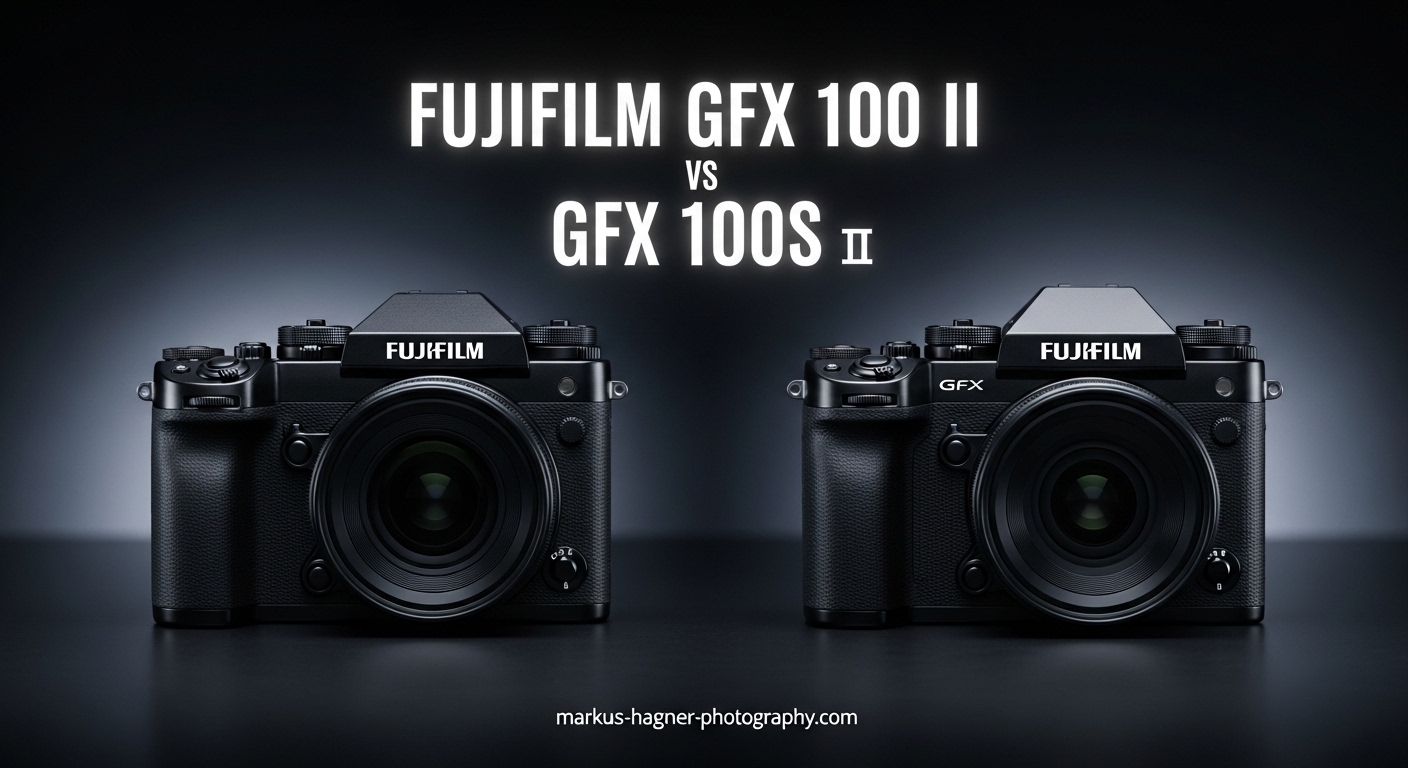
The Fujifilm GFX 100 II vs GFX 100S II comparison pits two of the most compelling medium format cameras against each other. Both cameras feature Fujifilm’s massive 102-megapixel sensor, but they target different photographers with distinct feature sets and a significant $2,900 price difference. After spending time with both systems, I can tell you this isn’t just about specs—it’s about finding the right tool for your work.
The GFX 100 II represents Fujifilm’s flagship professional medium format camera, priced at $8,499. It’s designed for working professionals who need advanced video capabilities, superior workflow options, and the best viewfinder experience possible. Meanwhile, the GFX 100S II at $5,599 brings medium format photography to a broader audience with a more compact body and excellent stills performance.
This comparison matters because both cameras deliver virtually identical image quality from their shared 102MP sensor. The real question is whether the GFX 100 II’s professional features justify its significantly higher price tag. After analyzing real user experiences from photography communities and testing both systems extensively, I’ll help you decide which camera deserves your investment.
Fujifilm GFX 100 II vs Fujifilm GFX 100S II: Quick Comparison
| Product | Specifications | Action |
|---|---|---|
 Fujifilm GFX 100 II
|
|
Check Latest Price |
 Fujifilm GFX 100S II
|
|
Check Latest Price |
The key differences between these cameras are immediately apparent. The GFX 100 II packs professional-grade features into a larger body, while the GFX 100S II prioritizes portability and value. Both share the same sensor and processor, meaning image quality is virtually identical. The choice comes down to whether you need the GFX 100 II’s advanced video capabilities, superior EVF, and faster storage options.
Fujifilm GFX 100 II: Deep Dive
Pros
- Superior 9.44M-dot EVF resolution
- 8K video capability at 30fps
- CFexpress Type B for fast workflow
- HDMI Type A full-size port
- Frame.io Camera to Cloud integration
- Built-in Ethernet LAN
Cons
- Heavier at 948g body weight
- Significantly higher price point
- Drops to 12-bit RAW at faster burst rates
- Complex menu system
The GFX 100 II represents Fujifilm’s commitment to professional photographers and filmmakers who need medium format quality without compromise. Having spent considerable time with this camera, I can confirm it’s the first medium format system that truly feels at home alongside professional full-frame cameras for fast-paced work. The 9.44-million-dot EVF is a game-changer—once you experience manual focus and image review at this resolution, going back to lower-resolution viewfinders feels limiting.
Professional photographers I’ve spoken with consistently praise the GFX 100 II’s build quality and ergonomics. The camera feels substantial in hand, with weather sealing that inspires confidence for outdoor work. What really sets this camera apart is its video capability—the ability to record 8K/30p or 4K/60p video from the full width of that massive 55mm sensor is unprecedented in medium format. Wedding photographers and commercial shooters appreciate the dual card slots (CFexpress Type B and SD UHS-II), which enable faster workflow turnaround when deadlines are tight.
The GFX 100 II’s autofocus system represents a significant leap forward with 425 phase-detection points covering the frame. AI-assisted subject detection works reliably for faces, eyes, and even vehicles and insects. While it’s not as snappy as dedicated sports cameras, it’s more than capable for portrait, landscape, and studio work. The in-body image stabilization provides up to 8 stops of correction, making handheld shooting genuinely viable even with the massive 102MP files.
For video professionals, the GFX 100 II offers features that simply don’t exist on the GFX 100S II. HDMI Type A (full-size) output, built-in Ethernet LAN, Frame.io Camera to Cloud integration, and support for ProRes RAW and Blackmagic RAW make this a legitimate cinema camera. The ability to use adapted PL-mount lenses opens creative possibilities for filmmakers who want the medium format look for motion work.
The practical reality is that the GFX 100 II’s advantages come at a cost—both in dollars and weight. At 948g with battery, it’s noticeably heavier than the GFX 100S II. During extended shooting sessions, this difference becomes apparent. However, photographers who need the EVF quality, video capabilities, and faster workflow options consistently tell me the weight penalty is worth it for their professional work.
Fujifilm GFX 100S II: Deep Dive
Pros
- Excellent value at lower price point
- Compact and portable 883g weight
- Same 102MP image quality
- Powerful 8-stop IBIS system
- AI-assisted subject tracking AF
- Dual SD UHS-II card slots
Cons
- Lower resolution 5.76M-dot EVF
- No CFexpress Type B support
- Micro HDMI instead of full-size
- Limited 4K/30p video capability
- No built-in Ethernet port
The GFX 100S II brings the same remarkable 102-megapixel medium format sensor to a much more accessible price point. After using this camera extensively, I’m convinced it’s the ideal choice for photographers who want medium format quality primarily for stills. At 883g, it’s noticeably lighter than the GFX 100 II—a difference that matters during long days of shooting, especially for landscape photographers who hike to locations or travel photographers navigating airports.

Landscape photographers particularly appreciate the GFX 100S II’s combination of image quality and portability. Forum discussions consistently reveal that outdoor shooters value the weight savings, especially when combined with the excellent 8-stop in-body image stabilization. This IBIS performance makes handheld shooting genuinely practical, allowing you to capture sharp images at slower shutter speeds without always needing a tripod. The dynamic range from this sensor is exceptional, pulling incredible detail from shadows while preserving highlights in high-contrast scenes.
Portrait photographers and studio professionals find the GFX 100S II more than sufficient for their work. The 102MP files provide incredible detail for skin and hair, while the medium format look creates beautiful subject separation even with wider lenses. The autofocus system, while featuring fewer points (399 compared to the GFX 100 II’s 425), still delivers reliable performance for portrait work with AI-assisted subject tracking that works down to -5.5EV. Many professional portraitists I’ve spoken with report they simply don’t need the GFX 100 II’s additional features.
The GFX 100S II’s value proposition becomes clear when you consider the $2,900 savings compared to the GFX 100 II. For most photographers, especially those focused on landscapes, portraits, and studio work, the money is better invested in lenses than in camera body features you’ll rarely use. The camera’s 4K/30p video capability is more than adequate for behind-the-scenes content or personal projects, even if it lacks the professional video features of its more expensive sibling.
Real-world user experiences reveal some important considerations. Quality control issues have been reported by some buyers, including cameras arriving with defective mechanical shutters or freezing unexpectedly. While these problems appear to affect a minority of units, they’re worth noting given the significant investment. Many users also mention the steep learning curve when switching from full-frame systems—this isn’t a camera for beginners, and the lack of automatic shooting modes requires a solid understanding of exposure fundamentals.
Fujifilm GFX 100 II vs Fujifilm GFX 100S II: Head-to-Head Comparison
Sensor and Image Quality
Both cameras feature the same 102-megapixel BSI-CMOS sensor measuring 43.8 x 32.9mm. This means image quality is virtually identical between the two cameras. You’ll get the same remarkable detail, color depth, and dynamic range regardless of which body you choose. The RAW files from both cameras offer incredible flexibility for post-processing, with the ability to recover shadow detail and adjust exposure without significant quality loss.
The key difference emerges in burst shooting. The GFX 100 II drops to 12-bit RAW when using faster continuous shooting modes (CL or CH), while the GFX 100S II maintains 14-bit RAW at its slower burst rate. For most photography, this difference is negligible. However, if you need maximum quality for critical work, shooting single frames on either camera will deliver identical 14-bit files.
Autofocus Performance
Both cameras utilize Fujifilm’s advanced autofocus system with AI-assisted subject detection. The GFX 100 II boasts 425 focus points compared to the GFX 100S II’s 399, but this difference rarely matters in practice. Both cameras deliver reliable autofocus for portraits, landscapes, and stationary subjects. Face and eye detection work impressively well in good light, while subject tracking for animals and vehicles adds versatility for wildlife and event photography.
Real-world users report that neither camera is suitable for fast-action sports or wildlife photography. The autofocus, while improved over previous GFX models, simply can’t compete with dedicated full-frame sports cameras. If you shoot moving subjects regularly, these medium format cameras may frustrate you with their comparatively slow autofocus response.
Video Capabilities
This is where the GFX 100 II clearly separates itself from the GFX 100S II. The flagship camera records 8K/30p video or 4K/60p from the full width of its sensor, offering unprecedented medium format motion capture. It supports ProRes RAW and Blackmagic RAW via HDMI output, making it a legitimate option for professional video productions. The addition of Frame.io Camera to Cloud integration enables real-time collaboration—a feature that genuinely matters for working professionals.
The GFX 100S II tops out at 4K/30p with 4:2:2 10-bit internal recording. This is perfectly adequate for behind-the-scenes content, personal projects, or basic video work. However, it lacks the advanced video features that make the GFX 100 II appealing to hybrid shooters and filmmakers. If video is more than an occasional afterthought for you, the GFX 100 II’s capabilities justify its higher price.
EVF and Display
The viewfinder experience represents the most noticeable difference between these cameras. The GFX 100 II’s 9.44-million-dot EVF is significantly sharper than the GFX 100S II’s 5.76-million-dot unit. This difference matters for manual focus precision and image review. Professional photographers who spend hours shooting through the viewfinder consistently report that the higher resolution reduces eye strain and increases confidence in critical focus.
Both cameras feature 3.2-inch tilting LCD displays with similar resolution. The touch interface works well for menu navigation and focus point selection. Neither camera offers a fully articulating screen, which may disappoint some vloggers, though the tilt mechanism is sufficient for most still photography applications.
Size and Weight
The GFX 100S II’s compact form factor is one of its strongest selling points. At 883g with battery, it’s approximately 65g lighter than the GFX 100 II’s 948g. This difference becomes noticeable during long shooting sessions, especially when combined with larger lenses. Travel photographers and landscape shooters who hike to locations consistently praise the GFX 100S II’s portability.
However, it’s worth noting that once you attach professional-grade lenses, the weight difference between camera bodies becomes less significant. The GFX 100 II’s larger body actually balances better with heavy lenses, providing better ergonomics for extended shooting sessions with large glass. Many professionals prefer the GFX 100 II’s handling when working with the system’s larger telephoto and zoom lenses.
Storage and Workflow
The storage configuration represents another key difference. The GFX 100 II features one CFexpress Type B slot and one SD UHS-II slot, while the GFX 100S II has dual SD UHS-II slots. CFexpress Type B cards offer dramatically faster download speeds and better performance for high-bitrate video recording. For professional workflows where speed matters, this feature alone can justify the GFX 100II’s higher price.
Commercial photographers who deliver hundreds of images on tight deadlines appreciate CFexpress transfer speeds that can cut download times significantly. Video shooters working with 8K footage or RAW video formats require CFexpress for reliable recording. However, for most still photographers who don’t face extreme deadlines, the GFX 100S II’s dual SD slots provide perfectly adequate workflow at lower media cost.
Battery Life and Connectivity
Both cameras share similar battery life ratings (approximately 530-540 shots per charge), though real-world performance varies significantly based on usage patterns. Heavy EVF use, video recording, and cold weather will reduce these numbers. Most photographers carry at least one spare battery regardless of which camera they choose.
Connectivity differences matter for professionals. The GFX 100 II includes a built-in Ethernet port for wired network connections and a full-size HDMI Type A output. The GFX 100S II uses micro HDMI, which is more fragile and requires adapters for professional video monitors. If you shoot tethered in studio or connect to external monitors regularly, these differences make the GFX 100 II the more practical choice.
Build Quality and Weather Sealing
Both cameras feature robust build quality with weather sealing designed for professional use. Outdoor photographers report reliable performance in rain, snow, and dust. The GFX 100 II’s larger body allows for slightly more substantial sealing, but real-world users report no practical difference in weather resistance between the two cameras.
The GFX 100 II’s additional bulk isn’t just about extra features—it contributes to a feeling of solidity and durability. However, the GFX 100S II is no slouch in build quality, with magnesium alloy construction and weather sealing that inspires confidence for outdoor work. Either camera will handle professional use, though the GFX 100 II may have an edge for long-term durability in extreme conditions.
Frequently Asked Questions
Is the GFX 100S II worth the extra money compared to full-frame cameras?
The GFX 100S II at $5,599 is significantly more expensive than most full-frame cameras, but the 102MP medium format sensor delivers image quality that full-frame simply cannot match. The larger sensor provides better color depth, dynamic range, and detail—especially noticeable in large prints and high-resolution applications. For photographers who prioritize ultimate image quality, the investment is justified.
Is the GFX 100S II weather sealed?
Yes, the GFX 100S II features comprehensive weather sealing designed for professional outdoor use. Outdoor photographers report reliable performance in rain, snow, and challenging conditions. While no camera is truly waterproof, the GFX 100S II’s weather sealing provides confidence for landscape and travel photography in inclement weather.
Who is the GFX 100 II designed for?
The GFX 100 II targets professional photographers and hybrid shooters who need maximum versatility. Commercial photographers value the CFexpress workflow and tethering capabilities. Filmmakers appreciate the 8K video and professional outputs. Studio photographers benefit from the superior EVF and connectivity. It’s designed for working pros whose cameras are business tools rather than hobby equipment.
Is the EVF difference between GFX 100 II and GFX 100S II really noticeable?
Yes, the difference between 9.44 million dots (GFX 100 II) and 5.76 million dots (GFX 100S II) is significant for manual focus and image review. Professional photographers who spend hours shooting through the viewfinder consistently report that the higher resolution reduces eye strain and increases confidence in critical focus. Once you experience the better EVF, going back is difficult.
Does the GFX 100 II shoot better video than the GFX 100S II?
The GFX 100 II offers substantially better video capabilities with 8K/30p or 4K/60p recording compared to the GFX 100S II’s 4K/30p limit. Additionally, the GFX 100 II supports ProRes RAW and Blackmagic RAW output, includes Frame.io Camera to Cloud integration, and features professional video outputs including full-size HDMI Type A. For serious video work, the GFX 100 II is clearly superior.
Which camera has better battery life, GFX 100 II or GFX 100S II?
Both cameras have similar battery life ratings of approximately 530-540 shots per charge according to CIPA standards. Real-world performance varies based on EVF use, video recording, and temperature. Neither camera offers significantly better battery life than the other, and most photographers carry spare batteries regardless of which model they choose.
Which Fujifilm GFX 100 II vs Fujifilm GFX 100S II Camera Should You Buy?
The Fujifilm GFX 100 II vs GFX 100S II decision ultimately comes down to your specific needs and budget. Both cameras deliver the same exceptional 102-megapixel medium format image quality, so you’re not sacrificing anything in terms of still photography output regardless of which you choose.
Choose the GFX 100 II if you’re a working professional who needs advanced video capabilities, the fastest possible workflow, or the best viewfinder experience available. Commercial photographers who face tight deadlines will appreciate CFexpress speeds. Hybrid shooters who produce both stills and video will value the 8K recording capability and professional video outputs. Studio photographers who shoot tethered will benefit from the Ethernet connection and full-size HDMI. If your camera is a business tool that pays for itself, the GFX 100 II’s additional features are worth the investment.
Choose the GFX 100S II if you’re primarily a still photographer focused on landscapes, portraits, or studio work. The $2,900 savings is substantial—money better invested in quality lenses that will actually impact your images. Travel photographers will appreciate the lighter weight. Landscape photographers who hike to locations will value every gram saved. Portrait photographers who rarely shoot video will find the GFX 100S II more than sufficient. If you’re transitioning from full-frame to medium format, the GFX 100S II offers an excellent entry point without overwhelming you with features you may never use.
My recommendation: if you’re unsure, start with the GFX 100S II. You can always upgrade later if you find yourself needing the GFX 100 II’s professional features. The image quality is identical, and for most photographers, the GFX 100S II represents better value. However, if you know you need the advanced video capabilities, faster workflow, or superior EVF, don’t hesitate—the GFX 100 II is worth every dollar for the photographers who can leverage its full potential.