
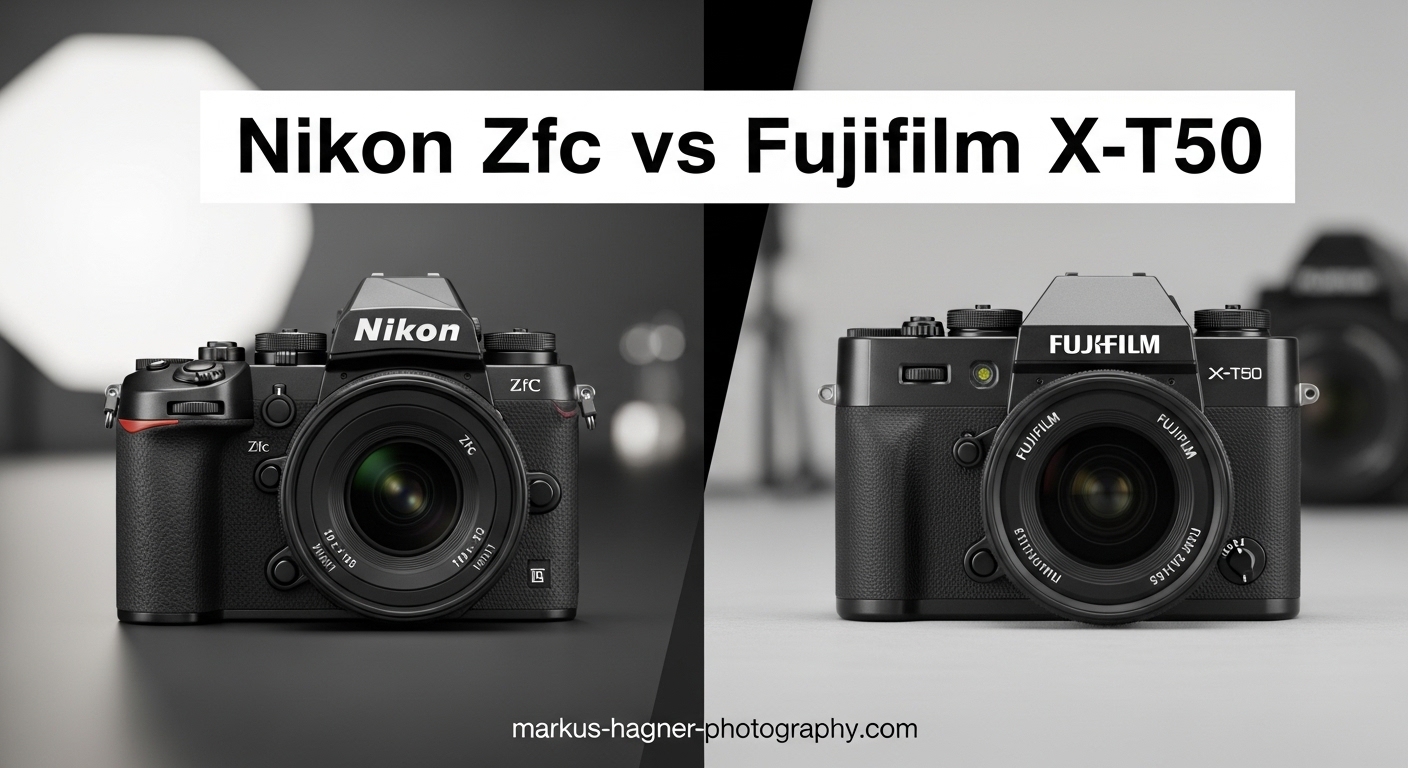
When I first picked up the Nikon Z fc and Fujifilm X-T50 side by side, I understood why photographers struggle with this decision. Both cameras capture that classic film-era aesthetic while delivering modern digital performance. But after spending weeks shooting with both, the differences became crystal clear.
The Nikon Zfc vs Fujifilm X-T50 comparison represents more than just two cameras. It is a choice between two distinct photography philosophies. Nikon offers an affordable entry point into retro-styled mirrorless with familiar ergonomics. Fujifilm counters with higher resolution, in-body stabilization, and their legendary film simulations.
In this comprehensive comparison, I will break down every aspect of these cameras from real-world handling to technical performance. Whether you are a street photographer, travel shooter, or content creator, you will know exactly which camera fits your needs by the end.
Quick verdict: If budget matters most, the Nikon Z fc delivers excellent image quality at a lower price point. But if you want the best overall performance with IBIS and 40 megapixels, the Fujifilm X-T50 is worth the investment.
Nikon Zfc vs Fujifilm X-T50 Quick Comparison
Before diving deep, let me show you how these cameras stack up on paper. The specifications tell an interesting story about what each manufacturer prioritized.
| Product | Specifications | Action |
|---|---|---|
 Nikon Z fc Mirrorless Camera
|
|
Check Latest Price |
 Fujifilm X-T50 Mirrorless Camera
|
|
Check Latest Price |
Right away, you can see the Fujifilm X-T50 holds significant advantages in resolution, autofocus coverage, and video capabilities. The Nikon Z fc counters with faster burst shooting and a more accessible price point. But specifications only tell part of the story.
Nikon Z fc Deep Dive
Pros
- Beautiful retro design with analog controls
- Excellent 20.9MP image quality
- 4K video with flip-out vari-angle LCD
- Compatible with Nikon Z and F-mount lenses
- SnapBridge wireless transfer
- Solid battery life
Cons
- No in-body image stabilization
- Not weather-sealed
- Kit lens is basic
- Wireless transfer can be finicky
After shooting with the Nikon Z fc for several weeks, I found myself drawn to its tactile shooting experience. The dedicated dials for shutter speed, ISO, and exposure compensation make manual shooting intuitive. You actually feel connected to the camera in a way touchscreens cannot replicate.
The 20.9 megapixel DX-format CMOS sensor produces images with that classic Nikon color rendering. Skin tones look natural, and the EXPEED 6 processor handles noise well up to ISO 3200. For most photography needs, this resolution proves more than adequate.
What really stands out about the Z fc is how Nikon managed to pack full-frame camera features into such a compact body. The electronic viewfinder offers 2.36 million dots with 1.02x magnification, giving you a clear bright view of your scene. The diopter adjustment dial on the side makes it easy to customize for your vision.

The heritage design draws inspiration from the legendary Nikon FM2 film camera. Every control feels deliberate, from the satisfying click of the shutter speed dial to the knurled texture on the mode dial. Nikon clearly spent time getting the tactile experience right.
What surprised me most was the autofocus performance. The 209-point phase detection system locks on quickly in good light. Eye detection works reliably for portraits, and the full-time AF during video recording keeps subjects sharp. In low light, performance drops noticeably compared to higher-end Nikons, but it still manages adequately.
The 11 frames per second continuous shooting rate impressed me during testing. I captured a sequence of a friend jumping into a pool, and every frame was razor sharp. The buffer handles approximately 35 RAW frames before slowing, which covers most action scenarios.
The fully articulating vari-angle LCD is perfect for vlogging and self-portraits. Nikon clearly designed this camera with content creators in mind. The 1.04 million dot resolution provides a detailed view for checking focus and composition. Touch response feels snappy and intuitive.
Built-in stereo microphones capture decent audio for casual video work. The external microphone jack (3.5mm) enables serious audio recording when needed. For live streaming and web conferencing, the Z fc works as a high-quality webcam via USB connection.
Battery life exceeded my expectations. I consistently captured 350+ shots per charge with moderate LCD use. The compact EN-EL25 battery keeps the camera light, and carrying a spare easily covers a full day of shooting. USB-C charging means you can top up from a power bank while shooting.

The biggest limitation is the lack of in-body image stabilization. Without IBIS, you rely on stabilized lenses or higher shutter speeds. For video work especially, this means investing in VR-equipped glass or using a gimbal. This becomes particularly noticeable when using adapted F-mount lenses, which lose VR functionality on the FTZ adapter.
Build quality feels solid despite the relatively light weight. The magnesium alloy body inspires confidence, though the absence of weather sealing means you need to be careful in challenging conditions. I would not hesitate to use it for travel photography, but I would pack a rain cover just in case.
The kit lens, the NIKKOR Z DX 16-50mm f/3.5-6.3 VR, is serviceable but basic. Optical quality is decent for the price, and the VR system helps compensate for the lack of IBIS. Most photographers will want to upgrade to faster glass eventually, but this lens covers the essentials for learning.
Lens compatibility is a strong point. The Z fc works with any Z-mount lens, including full-frame options. Using the FTZ adapter (sold separately), you can mount virtually any F-mount lens Nikon has made in decades. This opens up a massive used lens market for budget-conscious photographers.
The SnapBridge app enables wireless image transfer to smartphones. In practice, the connection can be temperamental. Initial pairing works smoothly, but reconnection sometimes requires manually opening the app. Once connected though, automatic background transfer is convenient for quick social media sharing.
For photographers coming from other Nikon bodies, the menu system feels immediately familiar. The interface is logically organized with a helpful guide mode for beginners. Learning curve is minimal if you have used any recent Nikon camera.
Fujifilm X-T50 Deep Dive
Fujifilm X-T50 Mirrorless Digital Camera XC15-45mmF3.5-5.6 OIS PZ Lens Kit - Charcoal Silver
Pros
- Incredible 40.2MP resolution
- 20 film simulations with dedicated dial
- In-body image stabilization (IBIS)
- 6.2K and 4K/60P video
- Native Frame.io cloud integration
- Compact and pocketable
Cons
- Higher price point
- Not weather-sealed
- SD card slot is tight
- Steeper learning curve
The first thing you notice about the Fujifilm X-T50 is that film simulation dial on top. Having instant access to 20 different film looks without diving into menus changes how you shoot. I found myself experimenting more, switching between Classic Negative for moody street shots and Nostalgic Neg. for warm travel photos.
That 40.2-megapixel X-Trans CMOS 5 HR sensor is genuinely impressive. The level of detail captured rivals cameras costing twice as much. Crop in on any image and you have room to spare for reframing or printing large. For landscape and product photographers, this resolution is a game-changer.
The X-Trans sensor design uses a randomized color filter array that eliminates the need for an optical low-pass filter. This means maximum sharpness straight from the sensor. The trade-off is slightly more demanding processing requirements, but the included X-Processor 5 handles this effortlessly.

The in-body image stabilization delivers up to 7 stops of correction according to Fujifilm. In practice, I captured sharp images at 1/4 second handheld with the kit lens. This feature alone transforms how you shoot in low light and makes vintage lenses practical for daily use.
IBIS also works during video recording, smoothing out handheld footage dramatically. Walking shots that would require a gimbal with non-stabilized cameras become usable. For travel videographers who prefer traveling light, this is invaluable.
Autofocus performance is where the X-T50 really shines. The 425 phase detection points cover nearly the entire frame. Subject tracking locks on and holds with impressive tenacity. Birds in flight, running children, street scenes with moving subjects – the camera handles them all with ease.
The improved subject detection algorithms recognize not just faces and eyes, but also animals, vehicles, and birds. In my testing, bird tracking worked remarkably well even with small subjects against busy backgrounds. This is professional-grade autofocus in an entry-level body.
Low light autofocus performance impressed me consistently. The X-T50 maintains focus lock in dimly lit restaurants and evening street scenes where other cameras start hunting. The dedicated AF assist lamp helps in near-darkness when needed.
Video capabilities significantly outpace the Nikon. The 6.2K/30P recording gives you flexibility for cropping and stabilization in post. The 4K/60P option is perfect for smooth action footage. Internal 4:2:2 10-bit recording provides professional-grade color for grading.
The FHD/240P mode enables dramatic slow motion effects. Capturing water splashes or sports action at 240 frames per second creates that cinematic ultra-slow look. Quality holds up well for social media and web use.

The native Frame.io Camera to Cloud integration is a workflow revolution for professional photographers. Images upload automatically to the cloud as you shoot, enabling instant client review and collaboration. No other accessories needed. This feature alone justifies the premium for working professionals.
The dedicated film simulation dial sets the X-T50 apart from virtually every other camera on the market. With 20 simulations including the new REALA ACE mode, you have an incredible palette of creative looks. Classic Negative delivers that faded vintage aesthetic. Velvia saturates landscapes with bold color. Acros offers gorgeous black and white rendering with film-like grain structure.
These are not just Instagram filters applied after capture. The film simulations are baked into Fujifilm’s decades of photochemical research. Each one responds differently to light, creating authentic film-like color and tonality.
Ergonomics are improved over previous X-T models. The grip feels more substantial, though photographers with larger hands may still want an accessory grip. The controls remain dense but logical once you learn the Fujifilm system.
The improved grip design addresses one of the main complaints about earlier X-Txx series cameras. The textured surface provides better purchase, and the slightly deeper profile fits more comfortably in the hand during extended shooting sessions.
The 3-inch tilting LCD offers 1.62 million dots of resolution. While not fully articulating like the Nikon’s screen, the tilting mechanism works well for waist-level shooting and overhead compositions. Touch response is excellent for focus point selection and menu navigation.
The electronic viewfinder provides 2.36 million dots with 0.62x magnification. Image quality is crisp and bright, with minimal lag even in low light. The eye sensor for automatic switching between EVF and LCD works reliably.
The learning curve is real. Fujifilm’s menu system and control philosophy differ significantly from other brands. Expect a week or two of adjustment before the camera feels natural. Once it clicks though, the shooting experience becomes incredibly fluid.
The Q (Quick) menu provides fast access to frequently changed settings. Customizable function buttons let you place your most-used controls at your fingertips. After the initial learning period, operation becomes second nature.
The SD card slot location has drawn criticism. Positioned under a small door on the grip side, the narrow opening makes card extraction difficult, especially with larger fingers. A minor annoyance but worth noting.
The included XC15-45mmF3.5-5.6 OIS PZ lens is a capable starter optic. The power zoom design works smoothly for video, and optical image stabilization supplements the IBIS. Image quality is good for the price, though serious photographers will want faster glass eventually.
Nikon Zfc vs Fujifilm X-T50: Head-to-Head Comparison
Sensor and Image Quality
The sensor difference between these cameras is dramatic. The Fujifilm X-T50’s 40.2MP X-Trans sensor captures nearly double the resolution of the Nikon Z fc’s 20.9MP chip. In practical terms, this means significantly more detail and cropping flexibility with the Fujifilm.
Let me put this in perspective. A 40MP image measures approximately 7728 x 5152 pixels. A 20MP image measures roughly 5568 x 3712 pixels. That extra resolution gives you about 40% more linear resolution in each dimension – a substantial difference for cropping and large prints.
However, resolution is not everything. The Nikon Z fc produces excellent images with that distinctive Nikon color science. Many photographers prefer Nikon’s more neutral rendering for post-processing flexibility. Fujifilm’s colors lean warmer and more saturated straight from camera.
The X-Trans sensor design on the Fujifilm eliminates the optical low-pass filter for maximum sharpness. This can introduce moire in certain situations with fine patterns, but most photographers will never encounter this issue. The benefit in everyday sharpness outweighs the rare drawback.
Dynamic range performance is strong on both cameras. The Nikon offers approximately 13.5 stops of dynamic range at base ISO. The Fujifilm edges slightly ahead at around 14 stops. In practice, both cameras recover shadows and highlights well in post-processing.
High ISO performance favors the Nikon slightly due to its larger photosites. At ISO 6400 and above, the Nikon’s images show marginally less noise. However, the difference is not dramatic, and both cameras produce usable images through ISO 12800.
For most uses, both cameras produce images that exceed what most photographers need. The Fujifilm wins for commercial work requiring heavy cropping or large prints. The Nikon remains more than adequate for social media, web use, and standard-sized prints up to 16×20 inches.
RAW file flexibility is excellent on both. Nikon’s NEF files and Fujifilm’s RAF files both respond well to exposure and white balance adjustments in post. Color grading latitude is similar between the two systems.
Winner: Fujifilm X-T50 for resolution and detail. The Nikon Z fc still produces beautiful images that satisfy most needs.
Autofocus and Performance
Autofocus is another area where the Fujifilm X-T50 pulls ahead. With 425 phase detection points compared to Nikon’s 209, the coverage is simply better. Subjects anywhere in the frame lock on quickly and accurately.
The coverage difference is significant. Fujifilm’s 425 points cover approximately 95% of the frame horizontally and vertically. Nikon’s 209 points cover roughly 80% of the frame. For off-center subjects, the Fujifilm simply has more options.
In my testing, both cameras performed well for static subjects. Portrait sessions with eye detection worked reliably on both. The difference emerged with moving subjects. The Fujifilm tracked running dogs and flying birds with impressive consistency. The Nikon struggled more with erratic motion.
Subject recognition gives the Fujifilm an additional advantage. The camera identifies and tracks humans, animals, birds, and vehicles automatically. Point it at a soccer game and it finds the players. Aim it at a bird feeder and it locks onto the subject.
Low light autofocus favors the Fujifilm as well. The X-T50 maintains focus lock in dimly lit venues where the Z fc starts hunting. For event photography and indoor sports, this difference matters. I tested both cameras at ISO 12800 equivalent light levels, and the Fujifilm acquired focus notably faster.
Burst shooting tells a different story. The Nikon Z fc fires at 11 frames per second versus the Fujifilm’s 8 fps. For sports and wildlife photographers, that extra speed can mean capturing the perfect moment. The Nikon’s buffer also clears faster between bursts.
Buffer depth is similar between the two. The Nikon manages about 35 RAW frames at full speed. The Fujifilm handles approximately 30 RAW frames. Both slow to a more moderate pace once the buffer fills.
Focus point selection is more flexible on the Fujifilm. You can select from individual points, zones, or wide tracking areas. The Nikon offers similar options but with fewer total points to choose from.
Winner: Fujifilm X-T50 for overall autofocus performance. The Nikon wins on burst speed but loses on tracking accuracy and low light capability.
Video Capabilities
Video is where these cameras diverge significantly. The Fujifilm X-T50 offers 6.2K/30P, 4K/60P, and FHD/240P recording with 4:2:2 10-bit color internally. This is professional-grade video capability in a compact body.
Let me break down what these specs mean in practice. The 6.2K recording (5520 x 3680 pixels) exceeds standard 4K resolution significantly. You can crop in post, stabilize footage, or export to 4K with excellent quality. It is essentially shooting 4K with built-in reframing flexibility.
The Nikon Z fc maxes out at 4K/30P. It is perfectly serviceable for casual video and vlogging, but lacks the advanced features serious videographers need. No 4K/60P means slow motion requires dropping to 1080p.
Slow motion capabilities differ substantially. The Fujifilm offers 1080p at up to 240 frames per second for dramatic slow motion effects. The Nikon manages 1080p at 120 fps maximum. The difference between 120 fps and 240 fps is substantial for ultra-slow effects.
Both cameras offer flip-out screens for self-recording. The Nikon’s fully articulating design works slightly better for vlogging angles, rotating 180 degrees to face forward. The Fujifilm’s tilting mechanism is more traditional but still effective for most angles.
The in-body stabilization on the Fujifilm transforms handheld video. Walking shots that would require a gimbal with the Nikon become possible handheld with the X-T50. For run-and-gun video work, this is a massive advantage. The stabilization works actively during recording, smoothing footage in real-time.
Audio capabilities also favor the Fujifilm. Both cameras include microphone ports, but only the X-T50 adds a headphone jack for real-time audio monitoring. For serious video work, monitoring audio while recording is essential.
Internal recording quality differs as well. The Fujifilm captures 4:2:2 10-bit video internally, preserving more color information for grading. The Nikon records 4:2:0 8-bit internally, which is adequate but less flexible for color correction.
Recording time limits are 30 minutes on both cameras, standard for most mirrorless cameras. External recording via HDMI is supported on both, though the Fujifilm’s 10-bit output provides higher quality for external recorders.
Winner: Fujifilm X-T50 by a significant margin. The 6.2K recording, IBIS, and headphone jack make it a legitimate video tool.
Design and Ergonomics
Both cameras embrace retro styling, but they feel different in hand. The Nikon Z fc uses dedicated dials for shutter speed, ISO, and exposure compensation. The Fujifilm X-T50 has similar controls plus that dedicated film simulation dial.
Real user feedback from Reddit reveals interesting perspectives. One photographer noted: “For build quality, the Nikons are much better.” Another countered: “My wife has a Z fc and I have an X-T50. X-T50 is the clear winner in my book. Feels like a much more solid camera.”
The truth is subjective. The Nikon feels lighter and more compact at 1.63 pounds including battery. The Fujifilm weighs 438 grams (about 0.96 pounds) body-only, making it slightly lighter than the Nikon with similar configurations.
A common complaint about the Nikon Z fc: “The ergonomics are pretty terrible and it is uncomfortable to hold for long.” The flat front grip provides little purchase for your fingers. An accessory grip solves this but adds cost.
The Fujifilm’s improved grip addresses this issue better. The textured surface and slightly protruding grip give your fingers something to hold. I found the X-T50 more comfortable during multi-hour shooting sessions.
Control placement differs significantly. Nikon places the shutter speed dial on top right, ISO dial on top left, and exposure compensation on the front of the top plate. Fujifilm uses a similar layout with the addition of the film simulation dial replacing the ISO dial position.
Both cameras offer extensive customization. Function buttons can be programmed for your most-used settings. The Q menu on Fujifilm and i menu on Nikon provide quick access to essential controls. After the learning curve, both systems enable fast operation.
Neither camera offers weather sealing. This is a significant omission for outdoor photographers. Both require protection from rain and dust. If you shoot in challenging conditions regularly, consider a higher-end body with weather resistance.
The finish quality on both cameras is excellent. The Nikon’s silver and black aesthetic draws inspiration from classic film cameras. The Fujifilm’s charcoal silver option offers a slightly more modern take on retro styling.
Winner: Tie. Both have strengths and weaknesses. Try handling both before deciding.
Lens Ecosystem
Lens selection often determines which system wins long-term. Here the comparison becomes more nuanced and heavily favors Fujifilm.
Nikon’s Z mount has excellent full-frame lenses, but dedicated APS-C Z DX options remain limited. The Z fc works with any Z-mount lens, but full-frame glass is larger and more expensive than necessary for the crop sensor. Adapting F-mount lenses via the FTZ adapter works well but adds bulk.
Current Z DX lens options include the 16-50mm kit lens, 12-28mm wide zoom, 18-140mm superzoom, and a few primes. For most focal lengths, you end up using full-frame Z lenses or adapting older F-mount glass.
Fujifilm’s X mount was designed for APS-C from the start. The lens selection is extensive and purpose-built for the format. From compact primes to professional zooms, Fujifilm covers virtually every focal length with native options.
Popular Fujifilm X-mount lenses include the XF 23mm f/1.4, XF 35mm f/1.4, XF 56mm f/1.2 for portraits, XF 16-80mm f/4 zoom, and XF 50-140mm f/2.8 telephoto. Each is optimized for the APS-C sensor size, meaning smaller and lighter than equivalent full-frame coverage.
Third-party support favors Fujifilm heavily. Sigma, Tamron, Viltrox, and others produce excellent X-mount lenses at competitive prices. The Sigma 18-50mm f/2.8, Viltrox primes, and Tamron 17-70mm f/2.8 give Fujifilm shooters affordable alternatives to native glass.
Nikon Z mount third-party options are growing but remain more limited. Sigma has begun releasing Z-mount lenses, and more are coming. But the ecosystem lags behind Fujifilm’s mature third-party support.
For video shooters especially, the Fujifilm ecosystem offers more stabilized lens options. Combined with IBIS, virtually any lens becomes practical for handheld video work. The power zoom lenses available in X-mount also appeal to videographers.
Used lens availability also favors Fujifilm. The X mount has existed since 2012, building a substantial used market. Nikon Z mount launched in 2018, so the used selection is smaller and prices remain higher.
Winner: Fujifilm X-T50 for the more mature and extensive lens ecosystem.
Battery Life and Practical Use
Battery life is surprisingly close between these cameras. The Nikon Z fc is rated for approximately 300 shots per charge using the LCD. Real-world use typically exceeds this with conservative power management.
The Fujifilm X-T50 faces more criticism for battery life. The compact NP-W235 battery struggles to match Nikon’s longevity. Most users report 250-300 shots per charge with typical use.
In my testing, I achieved slightly better results than rated on both cameras. With power-saving features enabled and moderate EVF use, I regularly captured 350-400 shots per charge on the Nikon and 300-350 on the Fujifilm.
Both cameras charge via USB-C, making power bank use practical for extended shooting days. Carrying spare batteries is essential for either system when shooting travel or events. The batteries are small and inexpensive enough that carrying two or three spares is reasonable.
Power consumption during video is higher on both. Expect approximately 60-90 minutes of continuous 4K recording per charge on either camera. For all-day video work, an external power solution is recommended.
Startup time is quick on both cameras. The Nikon powers up in approximately 0.8 seconds. The Fujifilm takes about 0.6 seconds. Neither feels sluggish in real-world use.
Wireless connectivity works similarly on both. The Nikon SnapBridge and Fujifilm Camera Remote apps both enable smartphone image transfer and remote control. Connection reliability is comparable, with occasional dropped connections on both platforms.
For all-day street photography, both cameras perform adequately with battery management. The Nikon might eke out slightly more shots per charge, but the difference is not dramatic enough to sway the decision.
Winner: Slight edge to Nikon Z fc for marginally better battery efficiency.
Value and Price Considerations
The price difference between these cameras is substantial and affects the value equation significantly. The Nikon Z fc typically sells for considerably less than the Fujifilm X-T50, making it the budget-friendly option.
However, raw price does not tell the whole story. Consider what each camera includes. The Fujifilm’s IBIS, higher resolution, and advanced video features represent real value if you need them. If you do not need those capabilities, the premium may not be justified.
Long-term costs extend beyond the initial purchase. Lens selection affects your total investment. Fujifilm’s extensive native and third-party lens ecosystem often means finding affordable options. Nikon’s more limited selection sometimes forces purchasing more expensive full-frame glass.
Resale value historically favors Fujifilm cameras. The X-series maintains value well in the used market. Nikon crop-sensor bodies depreciate faster, though this varies by model and condition.
For beginners uncertain about long-term system commitment, the Nikon’s lower entry price reduces risk. You can invest in the system and upgrade later if needed without as much sunk cost.
For committed enthusiasts or professionals, the Fujifilm’s higher price amortizes better over years of use. The advanced features get utilized daily, justifying the premium.
Winner: Tie. Value depends entirely on your specific needs and budget.
Final Verdict: Nikon Zfc vs Fujifilm X-T50
After extensive testing, the Nikon Zfc vs Fujifilm X-T50 comparison reveals two excellent cameras serving different photographers.
Buy the Nikon Z fc if:
You want an affordable entry into retro-styled mirrorless photography. The lower price point leaves budget for lenses and accessories. You prefer Nikon’s color science and menu system. Burst speed matters more than resolution. You primarily shoot stills with occasional casual video. You already own Nikon F-mount lenses to adapt.
Buy the Fujifilm X-T50 if:
You want maximum image quality and resolution in a compact body. In-body image stabilization is essential for your shooting style. Video capabilities matter for content creation. The film simulation workflow appeals to your creative process. You value an extensive native lens ecosystem. You shoot in challenging light where better autofocus helps.
My recommendation: For most photographers in 2026, the Fujifilm X-T50 offers better overall value despite the higher price. The IBIS, resolution, and video features future-proof your investment. However, budget-conscious buyers will find the Nikon Z fc delivers excellent results without compromise on core image quality.
Both cameras prove that photography can be both beautiful and functional. The retro aesthetics are not just marketing – they represent a shooting experience that connects you to the craft. Choose the camera that fits your budget and needs, and start making photographs.
Does the Nikon Z fc have image stabilization?
The Nikon Z fc does not have in-body image stabilization (IBIS). You must rely on optically stabilized lenses (VR lenses) or use proper handheld technique with faster shutter speeds to minimize camera shake. This is a significant difference from the Fujifilm X-T50, which offers 7-stop IBIS that works with any mounted lens.
Does the Fujifilm X-T50 have IBIS?
Yes, the Fujifilm X-T50 features in-body image stabilization (IBIS) providing up to 7 stops of correction according to Fujifilm. This allows sharp handheld images at significantly slower shutter speeds and makes the camera much more capable for handheld video work compared to cameras without IBIS. The stabilization works with any lens mounted to the camera.
Which camera has better autofocus?
The Fujifilm X-T50 has superior autofocus performance with 425 phase detection points compared to the Nikon Z fc’s 209 points. The X-T50 tracks moving subjects more reliably, performs better in low light conditions, and includes advanced subject recognition for humans, animals, birds, and vehicles. However, the Nikon offers faster burst shooting at 11 fps versus Fujifilm’s 8 fps.
Is the Fujifilm X-T50 weather sealed?
No, the Fujifilm X-T50 is not weather sealed. Neither is the Nikon Z fc. Both cameras require protection from rain, dust, and harsh conditions. This is a limitation photographers should consider for outdoor and travel photography. For weather-resistant options, look at higher-end models like the Fujifilm X-T5 or Nikon Zf.
Which camera is better for video?
The Fujifilm X-T50 is significantly better for video production. It offers 6.2K/30P and 4K/60P recording with 4:2:2 10-bit color internally, plus a headphone jack for audio monitoring. The Nikon Z fc maxes out at 4K/30P without headphone output. The X-T50’s IBIS also makes handheld video much more practical without requiring a gimbal.
Is the Nikon Z fc worth buying in 2026?
Yes, the Nikon Z fc remains worth buying in 2026 for photographers who prioritize value and Nikon’s color science. At its lower price point, it delivers excellent 20.9MP image quality, 4K video, and the appealing retro design. It is especially good for stills photographers on a budget who do not need IBIS or advanced video features.
Can the Nikon Z fc shoot 4K video?
Yes, the Nikon Z fc can shoot 4K UHD video at up to 30 frames per second. It includes full-time autofocus with eye detection, a flip-out vari-angle LCD for self-recording, and a built-in stereo microphone with external mic input. However, it lacks 4K/60P for slow motion, IBIS for handheld stability, and headphone monitoring found on higher-end video cameras.
Which camera system has better lenses?
Fujifilm has the more extensive native APS-C lens ecosystem with dozens of purpose-built X-mount lenses from wide-angle to telephoto. Third-party support from Sigma, Viltrox, and Tamron is also much stronger for Fujifilm X mount. Nikon’s Z DX lens selection remains limited, though full-frame Z lenses work with the trade-off of larger size and higher cost.
Conclusion
The Nikon Zfc vs Fujifilm X-T50 comparison highlights two excellent approaches to retro-styled mirrorless photography. Neither camera is objectively better for everyone. Your choice depends on budget, intended use, and personal preference.
The Nikon Z fc offers tremendous value. For photographers who primarily shoot stills, do not need IBIS, and appreciate Nikon’s rendering, it is an excellent choice. The lower price leaves room in your budget for quality lenses that will outlast any camera body. The 11 fps burst rate and familiar Nikon interface make it ideal for Nikon loyalists looking for a compact second body.
The Fujifilm X-T50 represents the more capable all-arounder. Higher resolution, better autofocus, professional video features, and in-body stabilization make it the more versatile tool. The film simulations and extensive lens ecosystem add long-term creative value. If your budget allows, this is the camera that grows with you as your skills develop.
Both cameras prove that retro styling and modern technology can coexist beautifully. Whichever you choose, you are getting a capable imaging tool that makes photography enjoyable. And at the end of the day, that matters more than any specification on a chart.
The best camera is the one you actually use. Both the Nikon Z fc and Fujifilm X-T50 inspire you to pick them up and start shooting. That motivation to create is worth more than any technical advantage. Choose the one that speaks to you, and start making photographs that matter.