
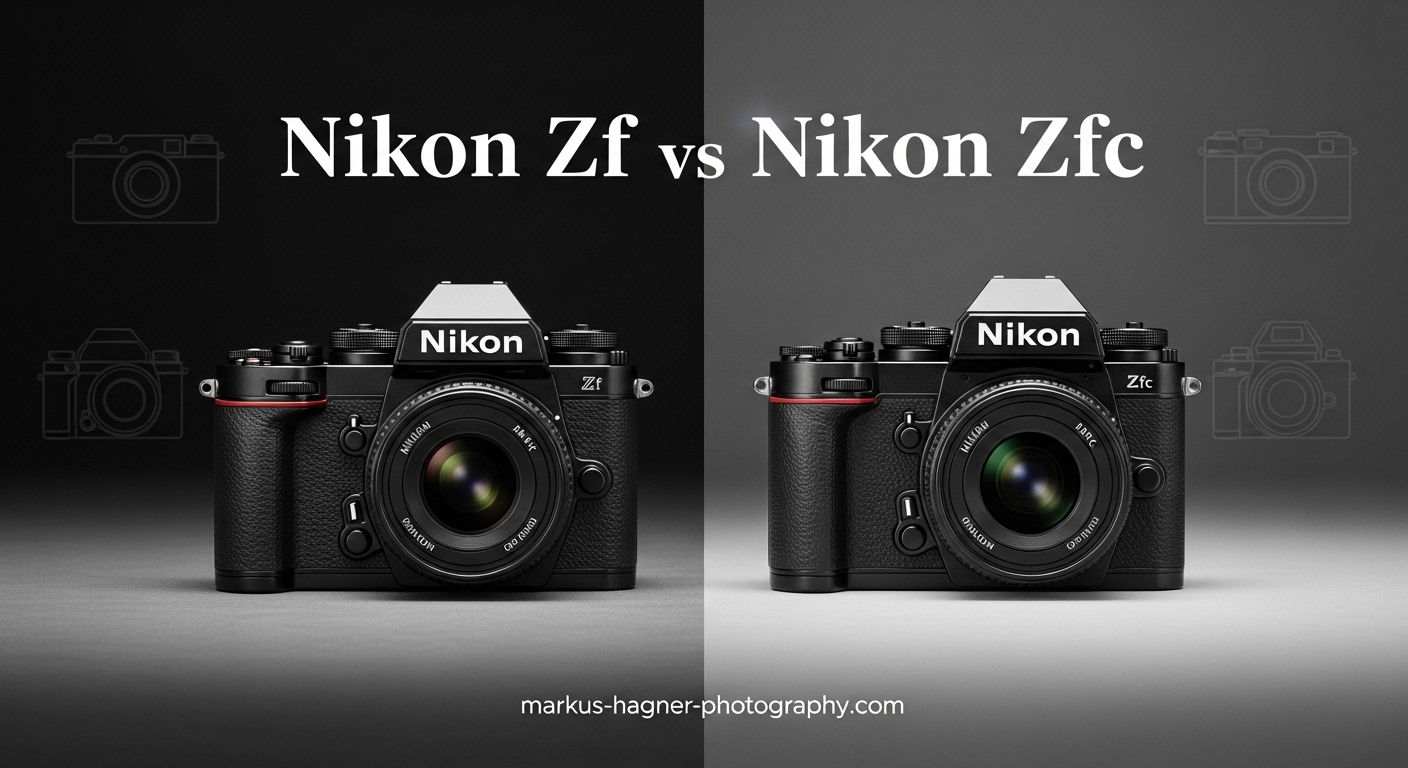
When I first picked up both the Nikon Zf and Nikon Zfc, I immediately understood why photographers agonize over this decision. Both cameras share that gorgeous FM2-inspired design with tactile dials that make you want to shoot them. But under those similar retro skins, these are fundamentally different cameras targeting different photographers.
The Nikon Zf vs Nikon Zfc comparison comes down to one core question: Do you want a professional-grade full-frame camera that costs around $2,000, or an enthusiast-focused APS-C camera at half that price? The Zf brings a 24.5MP full-frame sensor, 5-axis in-body stabilization, 4K 60p video, and weather sealing. The Zfc offers a 20.9MP APS-C sensor, no IBIS, and 4K 30p video in a much lighter package.
After spending considerable time with both cameras, I can tell you that neither is universally “better.” The Zf is technically superior in almost every way, but the Zfc might actually be the smarter choice depending on your needs, budget, and shooting style. Let me break down exactly what you get with each camera and help you decide which one deserves your money.
Nikon Zf vs Nikon Zfc: Quick Comparison
Here’s how these two retro-styled mirrorless cameras stack up side by side across their key specifications:
| Product | Specifications | Action |
|---|---|---|
 Nikon Zf
|
|
Check Latest Price |
 Nikon Zfc
|
|
Check Latest Price |
The comparison above shows the fundamental differences. The Zf delivers full-frame image quality with stabilization and advanced video features, while the Zfc offers excellent image quality in a more portable, budget-friendly package. The sensor size difference alone represents a massive gap in capabilities.
Forum discussions consistently highlight that users choosing between these cameras are really deciding between maximum image quality versus value and portability. One Reddit user who owned both noted that while the Zf produces noticeably better files, they actually preferred shooting with the Zfc for everyday carry because of its lighter weight.
Nikon Zf: The Full-Frame Powerhouse
Nikon Z f | Full-Frame Mirrorless Stills/Video Camera with Iconic Styling | Nikon USA Model
Pros
- Exceptional 24.5MP full-frame image quality
- Outstanding 5-axis IBIS with 8 stops stabilization
- Advanced autofocus with 3D tracking and subject recognition
- Pixel shift technology for 96MP stills
- Superb low light performance
- Weather-sealed magnesium alloy body
Cons
- Heavy at 710g without grip
- Poor ergonomics without accessory grip
- Menu system could be better organized
- Second card slot is microSD not full SD
The moment you lift the Nikon Zf, you feel that substantial 710g weight. This isn’t a camera trying to be compact. It’s a serious tool built around a full-frame BSI CMOS sensor that delivers exceptional image quality across an impressive ISO range. I’ve shot in challenging light conditions where the Zf simply produced files I couldn’t match with smaller sensors.
The 24.5MP resolution hits a sweet spot for most photography needs. You get enough detail for significant cropping while keeping file sizes manageable. But what really sets the Zf apart is that EXPEED 7 processor, the same one found in Nikon’s flagship cameras. This gives you subject recognition that tracks nine different subject types, from people to animals to vehicles, with uncanny accuracy.

The in-body image stabilization deserves special attention. Nikon claims up to 8 stops of compensation, and in real-world shooting, I found this genuinely transformative. Handheld shots at shutter speeds that would normally require a tripod came out sharp. This matters enormously for street photography and travel where tripods aren’t practical.
Video capabilities on the Zf are genuinely impressive. You get oversampled 4K from 6K capture, 4K 60p for slow motion effects, and 10-bit internal recording with N-Log and HLG profiles. The headphone and microphone jacks are properly positioned, and the vari-angle screen makes framing easy from any angle. For hybrid shooters, the Zf handles video duties competently alongside stills work.
The build quality feels premium throughout. The magnesium alloy body with brass dials exudes quality, and the weather sealing gives you confidence shooting in adverse conditions. My main criticism is the grip situation. Without an accessory grip, the Zf is uncomfortable during extended sessions. Budget for the grip if you choose this camera.

Battery life proved adequate for a full day of moderate shooting, though heavy users will want a spare. The dual card slots offer backup security, though the second slot using microSD instead of full SD feels like an odd compromise. Still, for the image quality and features packed into this retro-styled body, these are minor complaints in what is otherwise an exceptional camera.
Nikon Zfc: The Lightweight Value Champion
Pros
- Excellent 20.9MP APS-C image quality
- Compact and lightweight at 445g
- Intuitive retro controls with analog dials
- Great battery life for its class
- Flip-out vari-angle touchscreen
- Vlogger-friendly design
- Significantly lower price point
Cons
- No in-body image stabilization
- APS-C sensor limits low light performance
- No weather sealing
- Requires grip for comfortable handling
Pick up the Nikon Zfc after handling the Zf, and the weight difference is immediately apparent. At 445g, this camera feels almost impossibly light for something so capable. That lightness transforms how you use it. The Zfc becomes an everyday carry camera that you actually bring along, not something that stays home because it’s too heavy.
The 20.9MP APS-C sensor delivers image quality that surprised me. In good light, results are sharp and detailed with Nikon’s characteristic color science. The EXPEED 6 processor may be older than what’s in the Zf, but it handles the 209-point autofocus system competently. Eye detection for people works reliably, and overall AF performance feels snappy for most situations.

The retro control scheme is where the Zfc truly shines. Those top-deck analog dials for shutter speed, ISO, and exposure compensation make photography tactile and engaging. You see your settings at a glance without diving into menus. For photographers who learned on film cameras or simply appreciate direct control, this interface feels natural and satisfying.
Where the Zfc shows its budget positioning is in what it lacks. There’s no in-body image stabilization, which means you’ll need stabilized lenses or higher shutter speeds for sharp handheld shots. The APS-C sensor, while capable, can’t match full-frame for low light work or achieving shallow depth of field with equivalent framing. And there’s no weather sealing, so you’ll want to be careful in challenging conditions.
Video capabilities cover the basics well. 4K 30p recording is solid, and the flip-out vari-angle screen combined with full-time AF with eye detection makes this camera genuinely vlogger-friendly. The built-in stereo microphone is adequate for casual video work, though serious video creators will want to add an external mic.

The lens situation for APS-C Z mount remains a consideration. While you can use any Z mount lens, DX-specific options are more limited than full-frame choices. Many Zfc owners end up using FX lenses, which work fine but add size and weight that partially negate the camera’s compact advantages. Still, with the FTZ adapter, you gain access to Nikon’s extensive F-mount lens ecosystem.
Nikon Zf vs Nikon Zfc: Head-to-Head Comparison
Sensor and Image Quality
The sensor difference represents the most fundamental distinction between these cameras. The Zf’s 24.5MP full-frame BSI CMOS sensor captures significantly more light and offers better dynamic range than the Zfc’s 20.9MP APS-C sensor. In practical terms, this means cleaner files at high ISOs, more latitude for recovering shadows and highlights, and the ability to achieve shallower depth of field.
The crop factor matters for lens selection too. With the Zfc’s APS-C sensor, a 35mm lens behaves like a 52mm full-frame equivalent. This can be advantageous for telephoto reach but limits wide-angle options. Forum users consistently note that the full-frame sensor is the primary reason to choose the Zf if image quality is your top priority.
The Zf also offers pixel shift multi-shot technology, combining multiple exposures to create 96MP stills with exceptional detail and minimal noise. Landscape and product photographers will appreciate this capability, which the Zfc simply cannot match.
Image Stabilization
This comparison point often decides the purchase for many photographers. The Zf features a sophisticated 5-axis in-body image stabilization system providing up to 8 stops of compensation. This is genuinely transformative for handheld shooting, allowing sharp images at shutter speeds previously requiring a tripod.
The Zfc has no IBIS whatsoever. You’re entirely dependent on optical stabilization in lenses or your own steady hands. For photographers who shoot moving subjects at fast shutter speeds, this matters less. But for low light work, video, or any situation requiring slower shutter speeds, the absence of IBIS is a significant limitation.
Real-world feedback from Zfc owners confirms that the lack of stabilization is their biggest complaint. Many compensate by purchasing stabilized lenses, which adds to the total system cost and partially closes the price gap with the Zf.
Autofocus Performance
The Zf benefits from Nikon’s latest autofocus technology, with 273 focus points and subject recognition that tracks nine different subject types. The 3D tracking system, borrowed from Nikon’s professional bodies, locks onto subjects and follows them with impressive reliability. Low light autofocus sensitivity down to -10EV means the Zf can focus in near-darkness.
The Zfc offers 209 focus points with solid performance for its class. Eye detection for people works well, and the autofocus is fast and accurate in good light. However, low light AF sensitivity is limited to -3EV, meaning the camera struggles more as light levels drop. The processor is also previous-generation, lacking some of the advanced subject recognition found in the Zf.
For most photography situations, both cameras focus competently. The Zf pulls ahead significantly for challenging scenarios like very low light, fast-moving subjects, or situations requiring sophisticated subject tracking.
Video Capabilities
Video creators will find clear differences between these cameras. The Zf offers oversampled 4K from 6K capture for maximum quality, plus 4K 60p recording for slow motion effects. Internal 10-bit recording with N-Log and HLG profiles provides professional grading flexibility. You also get headphone and microphone jacks properly positioned for video work.
The Zfc records 4K at 30p maximum, which is adequate for most content creation but limits slow motion options. There’s no 10-bit recording or log profile support, restricting post-processing flexibility. The built-in stereo microphone works for casual video, and the flip-out screen makes self-framing easy for vloggers.
For serious video work, the Zf is clearly superior. For casual video, social media content, or vlogging, the Zfc handles the job competently at a much lower price point.
Design, Build, and Handling
Both cameras share the FM2-inspired retro aesthetic with analog dials on the top deck. This design language is a major selling point, appealing to photographers who appreciate tactile controls and classic styling. However, the build quality differs significantly.
The Zf features a magnesium alloy body with brass dials and comprehensive weather sealing. At 710g, it feels substantial and premium. The Zfc uses more plastic in its construction, weighs just 445g, and lacks weather sealing. Some users describe the Zfc as feeling “almost too light,” though others appreciate the reduced weight for all-day carry.
Both cameras suffer from the same ergonomic issue: minimal grip. Without an accessory grip, neither camera is comfortable for extended sessions. This is a consistent complaint across forums and reviews, and most serious owners of either camera end up adding a grip.
Price and Value
The price difference between these cameras is substantial. At roughly half the cost of the Zf, the Zfc represents remarkable value for photographers who don’t need full-frame image quality or IBIS. You get excellent image quality, a beautiful retro design, and capable performance for significantly less money.
The Zf commands its premium price through genuinely superior capabilities. The full-frame sensor, IBIS, advanced autofocus, better video, and weather sealing all contribute to a more versatile tool. Whether those features justify doubling your camera budget depends entirely on your photography needs and financial situation.
Forum discussions reveal that many photographers struggle with this exact question: Is the Zf worth twice the price? The consensus suggests that if you need any of the Zf’s advantages, particularly IBIS or superior low light performance, the extra cost is justified. If those features don’t matter for your photography, the Zfc offers tremendous value.
Frequently Asked Questions
What is the main difference between the Nikon Zf and Zfc?
The main difference is sensor size: the Nikon Zf has a 24.5MP full-frame sensor while the Zfc has a 20.9MP APS-C sensor. The Zf also features 5-axis in-body image stabilization, 4K 60p video, weather sealing, and costs roughly twice as much as the Zfc, which lacks IBIS and weather sealing.
Does the Nikon Zfc have image stabilization?
No, the Nikon Zfc does not have in-body image stabilization (IBIS). You must rely on optically stabilized lenses or use faster shutter speeds for sharp handheld shots. This is one of the biggest differences compared to the Zf, which offers up to 8 stops of stabilization.
Is the Nikon Zf better than the Zfc for low light photography?
Yes, the Nikon Zf is significantly better for low light photography. Its full-frame sensor captures more light, offers better high ISO performance, and features autofocus sensitivity down to -10EV compared to the Zfc’s -3EV. Combined with IBIS, the Zf handles challenging light much more effectively.
Which camera is better for beginners, Zf or Zfc?
The Nikon Zfc is generally better for beginners due to its lower price point, lighter weight, and simpler feature set. The intuitive retro controls with analog dials make learning photography more engaging. However, beginners serious about photography and with the budget may prefer the Zf for its superior capabilities and room to grow.
Is the Nikon Zf worth the extra cost over the Zfc?
The Zf is worth the extra cost if you need full-frame image quality, in-body stabilization, better low light performance, professional video features, or weather sealing. If these capabilities don’t align with your photography needs, the Zfc offers excellent value at roughly half the price while still delivering beautiful images.
Can you use full-frame lenses on the Nikon Zfc?
Yes, you can use full-frame FX Z mount lenses on the Nikon Zfc. The APS-C sensor will crop the image, effectively multiplying the focal length by 1.5x. Many Zfc owners use FX lenses, though this adds some size and weight that partially offsets the camera’s compact advantages.
Verdict: Which Camera Should You Buy?
After extensively comparing the Nikon Zf vs Nikon Zfc, here’s my straightforward recommendation based on different photographer profiles:
Buy the Nikon Zf if: You need maximum image quality, frequently shoot in low light conditions, require in-body stabilization for handheld work, shoot video seriously, need weather sealing for outdoor work, or plan to invest in full-frame Z mount lenses for long-term system building. The Zf is the camera for enthusiasts and professionals who want retro styling without compromising on capability.
Buy the Nikon Zfc if: You’re budget-conscious and want excellent value, prioritize lightweight portability for travel or street photography, primarily shoot in good lighting conditions, don’t need IBIS, are content with APS-C image quality, or want to enter the Nikon Z system without a major investment. The Zfc delivers beautiful photos in a package you’ll actually want to carry everywhere.
Both cameras share that wonderful retro design that makes photography feel special again. Both produce excellent images within their respective sensor classes. The decision really comes down to whether the Zf’s additional capabilities are worth the extra cost and weight for your specific photography needs.
For what it’s worth, photographers I’ve spoken with who chose the Zfc rarely regret their decision. They appreciate the lighter weight and lower cost while still producing work they’re proud of. Those who chose the Zf value the extra headroom in challenging conditions and the professional-grade features. Either choice is defensible depending on your priorities.