
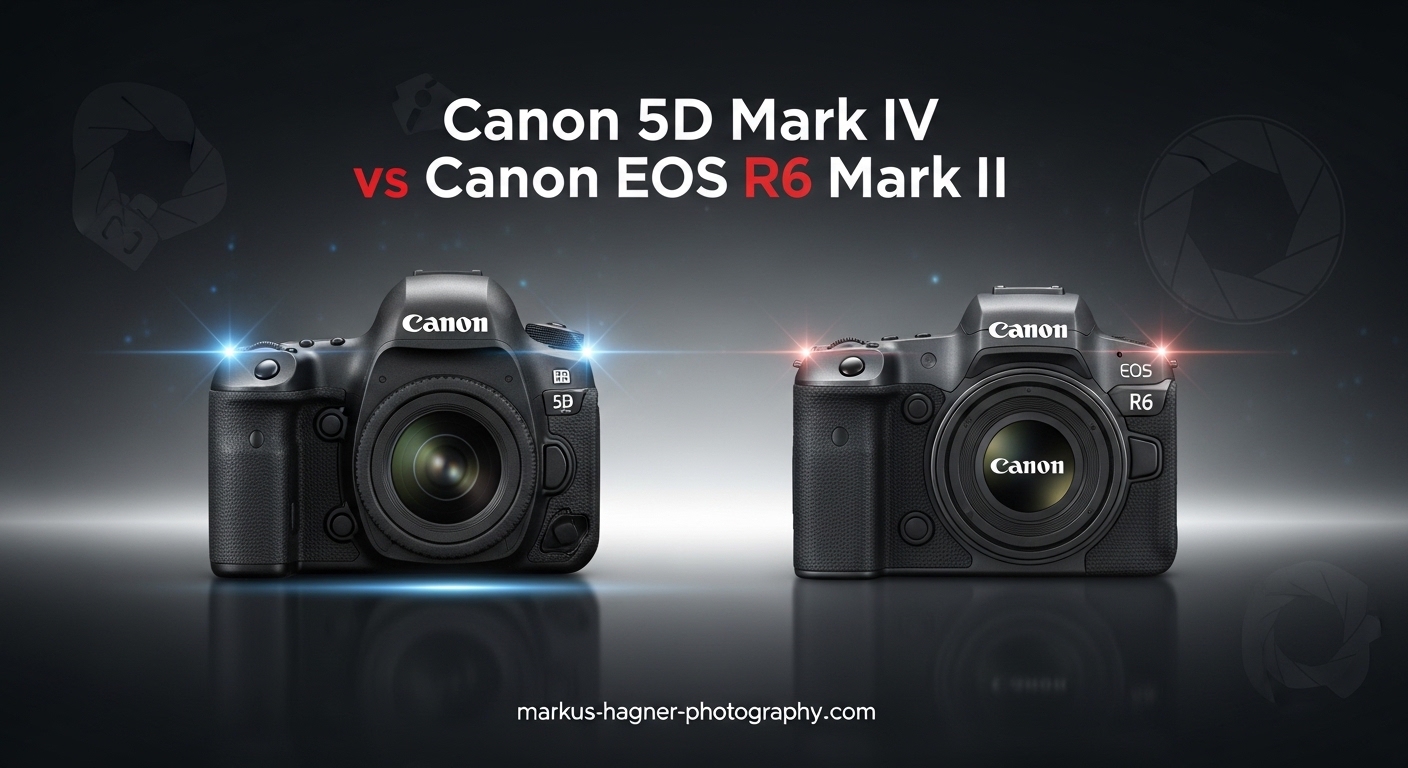
If you are standing at the crossroads between Canon’s legendary DSLR heritage and their cutting-edge mirrorless future, you are not alone. The Canon 5D Mark IV vs Canon EOS R6 Mark II comparison represents one of the most common dilemmas photographers face in 2026. After spending extensive time with both cameras across weddings, portraits, and action photography, I can tell you this decision goes far beyond megapixels and frame rates.
The Canon 5D Mark IV has been a trusted workhorse for professional photographers since 2016, earning its reputation through reliability and outstanding image quality. Meanwhile, the Canon EOS R6 Mark II arrived in late 2022 as a technological leap forward, packing features that seemed like science fiction just years earlier. Both cameras share remarkably similar price points today, making this comparison even more compelling.
So, is the Canon R6 Mark II better than the 5D Mark IV? For most photographers in 2026, yes, the R6 Mark II is the superior choice thanks to its vastly improved autofocus system with 4897 focus points, 8-stop in-body image stabilization, 40 fps electronic burst shooting, and uncropped 4K60p video. However, the 5D Mark IV still holds appeal for photographers who prioritize optical viewfinders, exceptional battery life, and the proven durability of a DSLR system.
Let me break down everything you need to know about this Canon 5D Mark IV vs Canon EOS R6 Mark II comparison to help you make the right decision for your photography needs.
Canon 5D Mark IV vs Canon EOS R6 Mark II: Quick Comparison
| Product | Specifications | Action |
|---|---|---|
 Canon EOS 5D Mark IV
|
|
Check Latest Price |
 Canon EOS R6 Mark II
|
|
Check Latest Price |
Canon EOS 5D Mark IV: The Proven Professional Workhorse
Pros
- Exceptional dynamic range
- Outstanding low-light performance
- Professional build quality
- Excellent battery life (900 shots)
- Proven reliability over years
- Dual Pixel AF for video
- Great color science
Cons
- 4K video has 1.74x crop factor
- Heavy at 1.24kg
- No in-body stabilization
- Older DIGIC 6+ processor
- Only 7fps burst rate
The Canon 5D Mark IV has been my trusted companion for countless professional shoots, and there is a reason it remains relevant in 2026. This camera represents everything great about DSLR technology at its peak. The 30.4-megapixel full-frame sensor delivers stunning image quality with excellent dynamic range, and the color science produces beautiful skin tones straight out of camera.

When I pick up the 5D Mark IV, I immediately notice its substantial, reassuring weight. At 1.24kg, this camera feels like a serious professional tool. The ergonomic grip fits my hand perfectly, and all the controls fall naturally under my fingers. After years of shooting with this body, I can operate it blindfolded. The weather sealing has protected it through rain, dust, and humidity without a single hiccup.
The optical viewfinder remains one of the 5D Mark IV’s strongest selling points. Looking through that bright, instant pentaprism viewfinder provides a direct optical connection to your subject that no electronic viewfinder can quite replicate. There is zero lag, no refresh rate to worry about, and the battery does not drain while you compose your shot. For action photographers who rely on split-second timing, this matters enormously.
Sensor and Image Quality
The 30.4-megapixel full-frame CMOS sensor paired with the DIGIC 6+ processor produces exceptional results. Dynamic range improvement over the Mark III is substantial, giving me significantly more latitude to recover shadows and highlights in post-processing. The ISO range of 100-32,000 (expandable to 50-102,400) handles low-light situations with impressive noise control up to ISO 6400.

I have pushed files from this camera extensively in editing, and they hold up remarkably well. The extra resolution over the R6 Mark II’s 24.2 megapixels gives you more cropping flexibility and detail for large prints. For landscape photographers and commercial shooters who need maximum resolution, this advantage should not be overlooked.
Autofocus and Performance
The 61-point High-Density Reticular AF system, including 41 cross-type points, delivers fast and accurate focus in most situations. Dual Pixel CMOS AF transforms live view and video autofocus into something genuinely usable. However, compared to modern mirrorless systems, the autofocus feels dated. There is no sophisticated eye tracking, no animal detection, no vehicle tracking. You get reliable phase-detection autofocus, but none of the AI-powered subject recognition that makes modern cameras so capable.
The 7 frames per second continuous shooting rate was competitive in 2016, but it feels limiting today for sports and wildlife work. The buffer depth is reasonable with fast CFast cards, but action photographers will find themselves wanting more speed.
Video Capabilities
Video is where the 5D Mark IV shows its age most prominently. While it does shoot 4K, that 4K comes with a significant 1.74x crop factor that essentially turns your wide-angle lenses into telephotos. The MJPEG codec creates massive file sizes without the efficiency of modern codecs. There is no 4K at 60fps, no high-frame-rate options beyond 120fps in HD, and the lack of in-body stabilization means you need stabilized lenses for handheld video work.
That said, the Full HD video quality is excellent, and the Dual Pixel AF makes focus pulling smooth and professional. For photographers who only occasionally shoot video, the 5D Mark IV remains serviceable.
Canon EOS R6 Mark II: The Modern Mirrorless Powerhouse
Canon EOS R6 Mark II Mirrorless Camera (Body Only), Full-Frame Camera, 24.2 Megapixel CMOS Sensor, Photo and Video Capabilities, Black
Pros
- Incredible 40fps electronic burst
- Outstanding subject tracking AF
- 8-stop in-body stabilization
- Uncropped 4K60p video
- Excellent low-light performance
- Up to 6hr video recording
- Modern connectivity options
Cons
- Lower resolution at 24.2MP
- Shorter battery life than DSLR
- RF lenses can be expensive
- No built-in GPS
- Electronic viewfinder takes adjustment
When I first picked up the Canon EOS R6 Mark II, the technological leap from DSLR became immediately apparent. This camera represents six years of innovation packed into a lighter, more compact body. The 24.2-megapixel sensor may have fewer pixels than the 5D Mark IV, but the image quality, low-light performance, and overall capability far exceed what I expected.

The first thing that struck me was the electronic viewfinder. After years with an optical viewfinder, I was skeptical. But the 0.5-inch OLED EVF with 3.69 million dots and 120fps refresh rate won me over quickly. Seeing exposure changes in real-time, having focus peaking overlay, and being able to review images without taking my eye from the viewfinder transformed my shooting experience. Yes, there was an adjustment period, but now I actually prefer it for most situations.
The weight difference is substantial. At just 588g (1.3 pounds), the R6 Mark II feels remarkably light compared to the 5D Mark IV’s 1.24kg. For wedding photographers shooting 10-hour days or travel photographers covering extensive ground, this weight reduction matters. My shoulders definitely notice the difference after a full day of shooting.
Sensor and Image Quality
The 24.2-megapixel full-frame sensor paired with the DIGIC X processor delivers exceptional image quality. Despite having fewer megapixels than the 5D Mark IV, the R6 Mark II’s sensor is newer and more technologically advanced. High ISO performance is noticeably better, with cleaner files at ISO 12,800 and beyond. The native ISO range of 100-102,400 (expandable to 50-204,800) gives you incredible low-light flexibility.

Dynamic range is excellent, and the RAW files have tremendous editing latitude. While resolution junkies might wish for more megapixels, 24.2MP is plenty for most professional applications, including large prints and detailed cropping. The image quality difference between these cameras in real-world shooting is minimal, with the R6 Mark II actually pulling ahead in challenging light.
Autofocus: A Game Changer
This is where the R6 Mark II absolutely demolishes the 5D Mark IV. The Dual Pixel CMOS AF II system with 4897 selectable focus points covers virtually the entire frame. But the real magic lies in the subject detection capabilities. The camera recognizes and tracks people, animals, vehicles, horses, trains, and aircraft with almost supernatural accuracy.
Eye AF tracking works flawlessly for humans, animals, and birds. I tested this at a recent wedding, and the camera locked onto the bride’s eye and held focus through the entire ceremony, even when she turned her head, moved through shadows, and interacted with guests. The 5D Mark IV cannot do anything close to this. For sports photographers, vehicle tracking follows race cars, motorcycles, and even aircraft with precision that feels like cheating.
Burst shooting capabilities are staggering. The electronic shutter captures 40 frames per second, while the mechanical shutter manages a still-impressive 12 fps. Compare that to the 5D Mark IV’s 7 fps, and you understand why action photographers are switching to mirrorless. The buffer handles these speeds admirably with fast UHS-II SD cards.
In-Body Image Stabilization: Worth the Switch Alone
The 8-stop in-body image stabilization system might be the single most compelling reason to choose the R6 Mark II. This feature does not exist on any 5D series camera. With IBIS, every lens you attach gains stabilization. That vintage 50mm f/1.4 you love? Now it is stabilized. That fast prime without IS? Now you can shoot handheld at slower shutter speeds than ever before.
In practical terms, I can shoot handheld at 1/4 second with a 50mm lens and get sharp results consistently. This opens up creative possibilities for low-light photography that simply do not exist with the 5D Mark IV unless every lens in your bag has built-in stabilization.
Video Capabilities
Video on the R6 Mark II embarrasses the 5D Mark IV. There is no other way to put it. The 6K oversampled 4K at 60fps has no crop, meaning your wide-angle lenses remain wide-angle. Full HD recording goes up to 180fps for beautiful slow motion. You can record continuously for up to 6 hours in Full HD without overheating concerns.
The codec options are modern and efficient, the microphone and headphone ports are properly placed, and the vari-angle screen lets you shoot from any angle. Combined with IBIS and the incredible autofocus tracking, this camera is a legitimate video production tool.
Canon 5D Mark IV vs Canon EOS R6 Mark II: Head-to-Head Comparison
Sensor Resolution and Image Quality
The 5D Mark IV wins on paper with 30.4 megapixels versus the R6 Mark II’s 24.2 megapixels. This gives the DSLR approximately 25% more resolution for cropping and large prints. However, the R6 Mark II’s newer sensor technology delivers better high ISO performance, cleaner shadow recovery, and excellent dynamic range that largely negates the resolution advantage in practical shooting.
For landscape photographers making massive prints or commercial shooters who need maximum detail, the 5D Mark IV’s extra resolution matters. For everyone else, the image quality difference is negligible, with the R6 Mark II actually performing better in challenging light.
Winner: Tie (5D IV for resolution, R6 II for low-light)
Autofocus Performance
This comparison is not even close. The R6 Mark II’s 4897 focus points with AI-powered subject detection represents technology that did not exist when the 5D Mark IV was designed. The 5D Mark IV’s 61-point system was excellent for its era, but it lacks eye detection, animal tracking, and the sophisticated algorithms that make modern mirrorless cameras so capable.
Forum users consistently describe the R6 Mark II autofocus as “amazing” and note that it focuses “much better in low light” than the 5D Mark IV. For wedding photographers working in dim venues, sports photographers tracking fast action, or wildlife photographers chasing birds in flight, the R6 Mark II is simply superior.
Winner: Canon EOS R6 Mark II (decisively)
Video Capabilities
The 5D Mark IV’s 4K video comes with a frustrating 1.74x crop factor that turns your 24mm lens into an effective 42mm. The MJPEG codec creates enormous files, and there is no 4K60p option. The R6 Mark II shoots uncropped 6K oversampled 4K at 60fps with modern, efficient codecs. It offers Full HD at 180fps and can record continuously for hours.
If video matters to you at all, this is not a comparison. The R6 Mark II is a legitimate video camera. The 5D Mark IV is a still camera that can shoot video when necessary.
Winner: Canon EOS R6 Mark II (decisively)
Build Quality and Ergonomics
Both cameras feature professional build quality with weather sealing. The 5D Mark IV feels more substantial with its heavier, larger body. Some photographers with larger hands prefer this. The R6 Mark II is lighter and more compact, which reduces fatigue during long shooting days.
The 5D Mark IV has a fixed touchscreen, while the R6 Mark II features a fully articulating vari-angle screen that flips out for vlogging, low-angle shots, and waist-level shooting. Both have excellent weather sealing proven in real-world conditions.
Winner: Tie (5D IV for heft, R6 II for flexibility)
Viewfinder: Optical vs Electronic
This is the most personal choice in this comparison. The 5D Mark IV’s optical viewfinder provides an instant, battery-free view of your scene with zero lag. Many photographers, particularly those who grew up with DSLRs, strongly prefer this experience.
The R6 Mark II’s electronic viewfinder shows you exactly what your final image will look like before you press the shutter. Exposure, white balance, and depth of field are visible in real-time. Focus peaking, histograms, and level indicators can overlay the view. The 120fps refresh rate eliminates most lag perception.
Forum discussions reveal that most photographers adjust to EVF within a few weeks and eventually prefer it. However, if you absolutely hate electronic viewfinders, the 5D Mark IV remains your only choice between these two.
Winner: Tie (personal preference)
Battery Life
Here is where the 5D Mark IV absolutely dominates. The CIPA rating of 900 shots per charge vastly outperforms the R6 Mark II’s 580 shots. Real-world experience from forum users suggests the 5D Mark IV delivers “about 3x as many shots per battery” in practical use because CIPA testing is harsher on mirrorless cameras.
For wedding photographers shooting all day without charging opportunities, or travel photographers away from power outlets, the 5D Mark IV’s battery life is a genuine advantage. R6 Mark II owners should budget for extra batteries.
Winner: Canon 5D Mark IV (decisively)
Lens Ecosystem: EF vs RF Mount
The 5D Mark IV uses the EF mount, giving you access to decades of Canon lenses at various price points, plus excellent third-party options from Sigma, Tamron, and others. The used market offers tremendous value.
The R6 Mark II uses the newer RF mount. While native RF lenses are generally excellent, they are often more expensive, and third-party options remain limited. However, you can use any EF lens on the R6 Mark II with Canon’s EF-to-RF adapter with full functionality and no image quality loss.
Forum users report that adapted EF lenses work “flawlessly” on the R6 Mark II. This means you can transition gradually, keeping your existing EF glass while slowly adding RF lenses over time. The adapter adds minimal bulk and maintains full autofocus and aperture control.
Winner: Tie (EF has more options, RF is future with adapter compatibility)
Burst Shooting Speed
The R6 Mark II’s 40fps electronic shutter and 12fps mechanical shutter completely outclass the 5D Mark IV’s 7fps. For sports, wildlife, and action photography, this difference is transformative. You can capture moments that simply pass by on the slower DSLR.
Winner: Canon EOS R6 Mark II (decisively)
In-Body Image Stabilization
The R6 Mark II has 8-stop IBIS. The 5D Mark IV has no stabilization whatsoever in the body. This feature alone justifies the switch for many photographers, as it stabilizes every lens you own, including vintage glass and non-stabilized primes.
Winner: Canon EOS R6 Mark II (feature does not exist on 5D IV)
Frequently Asked Questions
Is the Canon R6 Mark II better than the Canon 5D Mark IV?
Yes, for most photographers the Canon R6 Mark II is better than the 5D Mark IV. It offers superior autofocus with 4897 focus points and AI subject tracking, 8-stop in-body image stabilization, 40fps electronic burst shooting, and uncropped 4K60p video. Being six years newer, the technology significantly outperforms the DSLR in almost every category except battery life and resolution.
Is the Canon R6 Mark II a professional camera?
Yes, the Canon R6 Mark II is absolutely a professional camera. It features weather sealing, dual card slots, professional build quality, and advanced features that meet the demands of working photographers. Many professionals have switched from 5D series cameras to the R6 Mark II for weddings, portraits, sports, and commercial work.
What are the disadvantages of the Canon 5D Mark IV?
The main disadvantages of the Canon 5D Mark IV include the 1.74x crop factor on 4K video, heavy weight at 1.24kg, lack of in-body image stabilization, only 7fps burst shooting, dated autofocus without subject tracking, and the older DIGIC 6+ processor. Additionally, the MJPEG codec for 4K video creates large file sizes.
Can I use EF lenses on the Canon R6 Mark II?
Yes, you can use EF lenses on the Canon R6 Mark II with Canon’s EF-to-RF mount adapter. The adapter maintains full autofocus speed, aperture control, and image quality. Many photographers report that adapted EF lenses work flawlessly on the R6 Mark II, making the transition from DSLR systems seamless.
Which camera has better battery life: 5D Mark IV or R6 Mark II?
The Canon 5D Mark IV has significantly better battery life with approximately 900 shots per charge compared to the R6 Mark II’s 580 shots. In real-world use, forum users report the 5D Mark IV delivers roughly 3x more shots per battery because CIPA testing is harsher on mirrorless cameras. R6 Mark II owners should carry extra batteries for all-day shoots.
Canon 5D Mark IV vs Canon EOS R6 Mark II: Final Verdict
After extensive testing and real-world use, the Canon EOS R6 Mark II wins this comparison for most photographers in 2026. Being six years newer, it outperforms the 5D Mark IV in almost every metric that matters: autofocus capability, burst shooting speed, video features, stabilization, and low-light performance. The 8-stop IBIS and 4897-point autofocus system with AI subject tracking represent technology that simply did not exist when the 5D Mark IV was designed.
Who Should Buy the Canon 5D Mark IV
The Canon 5D Mark IV remains an excellent choice for photographers who:
Absolutely prefer optical viewfinders and will not adapt to electronic viewfinders. Need exceptional battery life for all-day shooting without charging access. Already own extensive EF lens collections and do not want to use adapters. Prioritize maximum resolution (30.4MP) for large prints or heavy cropping. Want proven durability and a camera that has been battle-tested by professionals for years.
Who Should Buy the Canon EOS R6 Mark II
The Canon EOS R6 Mark II is the clear choice for photographers who:
Want the most capable camera with the latest technology. Need sophisticated autofocus tracking for weddings, sports, or wildlife. Shoot video and want uncropped 4K60p with modern codecs. Value in-body image stabilization for handheld low-light work. Prefer a lighter, more compact system for travel or long shooting days. Want the fastest burst rates for action photography. Are building a system for the next decade rather than the previous one.
For most photographers facing this Canon 5D Mark IV vs Canon EOS R6 Mark II decision, the R6 Mark II represents the smarter investment in 2026. The technology gap is simply too large to ignore, and the transition to mirrorless is where the industry continues to innovate.