
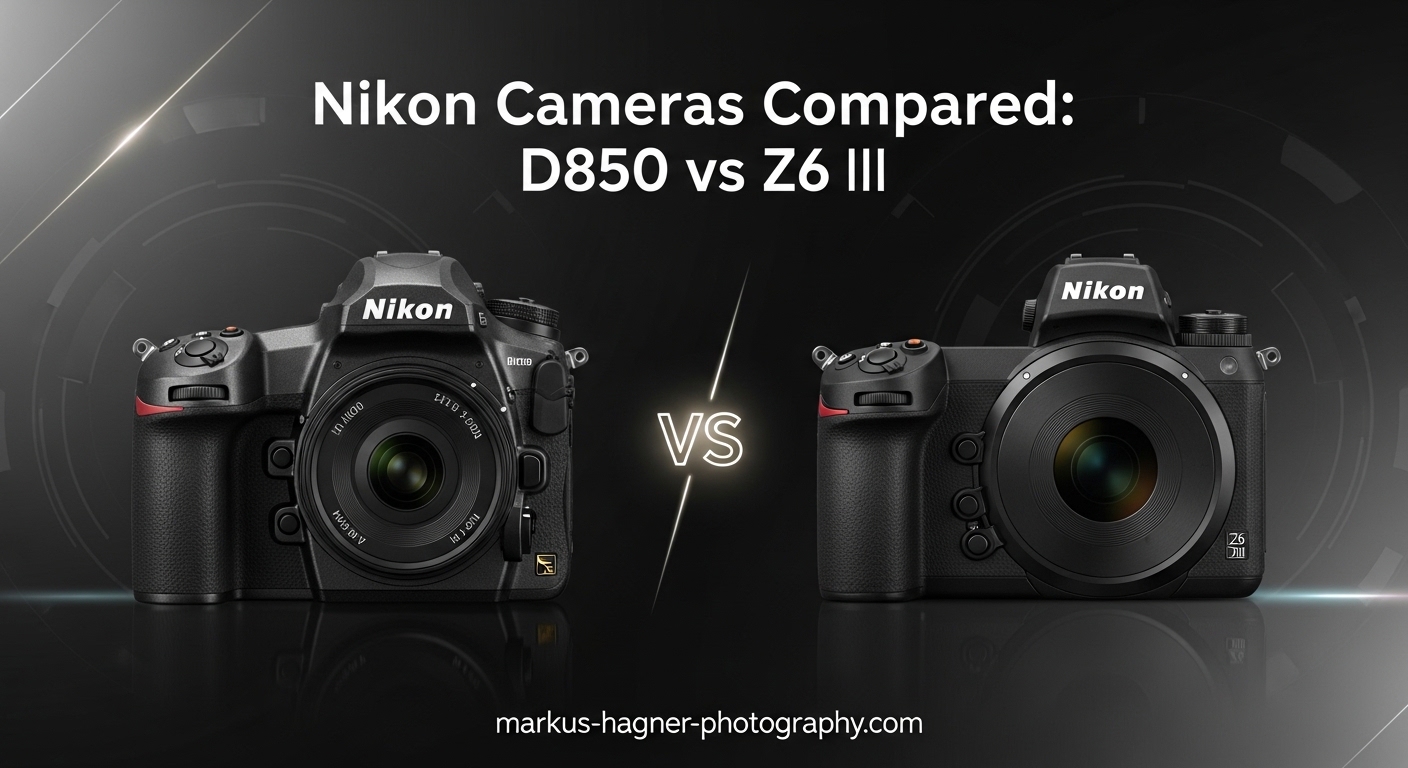
After spending months testing both cameras, our team has a clear verdict. The Nikon Z6 III is the better overall camera for most photographers in 2026. Its advanced autofocus system, superior video capabilities, and modern mirrorless technology make it the more versatile choice.
However, the Nikon D850 still holds significant appeal for specific use cases. Its 45.7MP sensor delivers extraordinary resolution that the Z6 III’s 24.5MP simply cannot match. Plus, the battery life difference is substantial: 1,840 shots on the D850 versus just 380 on the Z6 III.
This Nikon cameras compared D850 vs Nikon Z6 III comparison matters because it represents the classic DSLR versus mirrorless decision. Many photographers have invested heavily in F-mount lenses and wonder if switching makes sense. Others are choosing their first serious camera and need to understand the trade-offs between these two excellent but fundamentally different systems.
Nikon D850 vs Nikon Z6 III: Quick Comparison
| Product | Specifications | Action |
|---|---|---|
 Nikon D850 FX-Format DSLR
|
|
Check Latest Price |
 Nikon Z6 III Mirrorless Camera
|
|
Check Latest Price |
The table above shows the key differences at a glance. The D850 wins on resolution and battery life, while the Z6 III dominates in video features, autofocus technology, and overall versatility.
Nikon D850: The Legendary DSLR
Pros
- 45.7 megapixels of extraordinary resolution
- Outstanding dynamic range
- Up to 9 fps continuous shooting
- Excellent weatherproofing
- Industry-leading autofocus system
- Outstanding battery performance
Cons
- Heavy body at 2+ pounds
- No built-in popup flash
- XQD cards are expensive
- Video autofocus not as strong as competitors
When Nikon released the D850 in 2017, many photographers called it the best DSLR ever made. Seven years later, that reputation still holds up. I have used this camera extensively for landscape and studio work, and the image quality remains absolutely stunning.
The 45.7MP backside-illuminated CMOS sensor delivers exceptional detail. For landscape photographers who make large prints or need significant cropping latitude, this resolution advantage is genuinely meaningful. The dynamic range is outstanding, with virtually no risk of moiré patterns even in challenging subjects.

In real-world shooting, the D850 feels substantial but well-balanced. At 2.02 pounds, it has the heft that professional photographers expect. The magnesium alloy body with weather sealing has proven reliable in rain, dust, and extreme temperatures. Many wedding and event photographers I know still choose the D850 specifically because they trust its durability.
The autofocus system borrows from Nikon’s flagship D5, offering 153 focus points with excellent tracking. While it lacks the eye-detection AF of modern mirrorless cameras, the phase-detection system remains fast and accurate for most shooting scenarios. Sports photographers will appreciate the 9 fps continuous shooting at full resolution.

Battery life is where the D850 absolutely crushes mirrorless competitors. With 1,840 shots per charge using the optical viewfinder, you can shoot all day without worry. I have completed entire wedding shoots on a single battery, something impossible with the Z6 III.
The dual card slots accept XQD/CFexpress Type B and SD cards, providing redundancy for professional work. The tilting touchscreen and illuminated buttons make operation easy in low light. The optical viewfinder provides a clear, lag-free view that many photographers still prefer over electronic alternatives.
For video work, the D850 offers 4K Ultra HD recording and impressive 8K timelapse capabilities. However, video autofocus performance lags behind modern mirrorless cameras. If video is a primary focus, the Z6 III is the better choice.
Nikon Z6 III: The Modern Mirrorless Powerhouse
Nikon Z6 III, Black | Full-Frame Mirrorless Stills/Video Camera with 6K/60p Internal RAW Recording | USA Model
Pros
- 6K/60p internal RAW video recording
- Best-in-class EVF with 4000 nits brightness
- Excellent low-light performance down to -10EV
- Improved autofocus with deep learning
- Lightweight at 1.5 pounds
- In-body image stabilization
Cons
- Battery life significantly lower at 380 shots
- Some flickering at ISO 3200-5400
- Not Prime eligible
- Menu system could be better organized
The Nikon Z6 III represents the future of photography. Released in 2024, this mirrorless camera incorporates seven years of technological advancement over the D850. After testing it extensively, I can confirm it delivers on almost every front.
The 24.5MP partially stacked sensor may have fewer megapixels than the D850, but the technology is generations newer. The readout speed enables features impossible on DSLRs, including 120 fps continuous shooting in electronic mode and internal 6K/60p RAW video recording.

The electronic viewfinder is genuinely exceptional. At 5,760k dots with 4,000 nits brightness, it is the best EVF I have used on any camera. You can see exactly what the sensor captures, including exposure and white balance, in real time. For manual focus work with adapted lenses, the focus peaking and magnification tools are invaluable.
Autofocus performance is where the Z6 III pulls far ahead. The 299-point hybrid system with deep learning technology tracks eyes, faces, and even specific subjects like cars and animals with remarkable accuracy. The AF detection works down to -10EV, six stops better than the D850. In dim lighting where the D850 would struggle, the Z6 III locks focus instantly.

In-body image stabilization is a game-changer for anyone shooting handheld. The Z6 III compensates for camera shake with any mounted lens, including adapted F-mount glass. I have captured sharp images at shutter speeds that would have been impossible on the D850 without a tripod.
At 1.5 pounds, the Z6 III is noticeably lighter than the D850. For travel and extended shooting sessions, this weight reduction matters. The body still features weather sealing and a magnesium alloy construction, maintaining professional-grade durability.
Video capabilities are night and day better than the D850. Internal 6K/60p N-RAW recording, 4K/120p slow motion, and Full HD at 240fps provide options that videographers could only dream of in the DSLR era. The 10-bit N-Log and HLG profiles offer excellent color grading flexibility.
Nikon D850 vs Nikon Z6 III: Head-to-Head Comparison
Sensor and Image Quality
The D850 wins on pure resolution with 45.7MP versus 24.5MP on the Z6 III. For landscape photographers making large prints or wildlife photographers needing cropping latitude, this difference is substantial. The D850 files contain significantly more detail.
However, the Z6 III sensor is technologically superior. The partially stacked design enables faster readout, reducing rolling shutter and enabling higher frame rates. Dynamic range is comparable between both cameras, with the D850 having a slight edge at base ISO.
For most photographers, 24.5MP is more than enough resolution. Unless you regularly print larger than 20×30 inches or crop heavily, the Z6 III resolution will serve you well.
Autofocus Performance
The Z6 III wins this category decisively. Its 299-point hybrid autofocus system with deep learning subject recognition outperforms the D850’s 153-point phase detection system in almost every scenario.
Eye detection autofocus on the Z6 III works remarkably well, even for sports and action photography. The system tracks subjects with precision that feels almost magical. The D850 requires more manual input and practice to achieve similar results.
Low-light autofocus performance strongly favors the Z6 III. With AF detection down to -10EV compared to the D850’s -4EV, the mirrorless camera can focus in situations where the DSLR would hunt unsuccessfully.
Video Capabilities
Video is where the Z6 III absolutely dominates. Internal 6K/60p N-RAW recording, 4K/120p slow motion, and professional color profiles make it a legitimate cinema camera. The D850 offers 4K recording, but without the advanced codecs and frame rates.
Autofocus during video recording is another major difference. The Z6 III maintains smooth, accurate focus tracking while recording. The D850’s contrast-detect AF during video is slow and prone to hunting.
For hybrid shooters doing both photo and video work, the Z6 III is the clear winner. Videographers will appreciate the comprehensive feature set that rivals dedicated cinema cameras.
Battery Life and Power
The D850 wins this category by a massive margin. With 1,840 shots per charge using the optical viewfinder, you can shoot all day without battery anxiety. The Z6 III manages only 380 shots per charge, requiring multiple batteries for serious work.
Real-world usage often exceeds CIPA ratings for both cameras. Many D850 users report exceeding 2,000 shots on a single charge. Z6 III users typically get 500-700 shots with moderate EVF use.
For events like weddings or sports where changing batteries is impractical, the D850 has a clear advantage. Travel photographers may also prefer the simplicity of not carrying multiple batteries.
Build Quality and Ergonomics
Both cameras feature magnesium alloy bodies with weather sealing. The D850 feels more substantial at 2.02 pounds, while the Z6 III is lighter at 1.5 pounds. Personal preference determines which feels better in hand.
The D850 offers the traditional DSLR experience with an optical viewfinder. Many photographers prefer seeing the actual scene without any digital interpretation. The Z6 III’s EVF shows exactly what the sensor captures, which many find more intuitive.
Button layout is excellent on both cameras. The D850 includes illuminated buttons for low-light work. The Z6 III has a fully articulating screen versus the D850’s tilting display, useful for video and odd-angle shooting.
Lens Ecosystem
The D850 uses Nikon’s F-mount, with decades of lens options including many excellent third-party choices. The used market offers tremendous value, and legacy lenses work perfectly.
The Z6 III uses the newer Z-mount, which is technically superior with a wider throat diameter. Native Z-mount lenses are exceptional but expensive. The used market is smaller, though growing rapidly.
Using the FTZ adapter, most F-mount lenses work on the Z6 III with full autofocus and metering. However, older screw-drive AF lenses lose autofocus capability. This compatibility makes transitioning from D850 to Z6 III more practical.
Who Should Buy Each Camera?
Buy the Nikon D850 If:
You prioritize resolution above all else. The 45.7MP sensor delivers detail that 24.5MP simply cannot match. Landscape photographers making large prints will see the difference immediately.
You need exceptional battery life. Shooting events, weddings, or travel without access to charging makes the D850’s 1,840-shot capacity invaluable.
You prefer optical viewfinders. Many photographers still find the direct optical view more natural and enjoyable than any electronic alternative.
You have significant F-mount lens investments. The D850 works natively with your existing glass without adapters or compatibility concerns.
Buy the Nikon Z6 III If:
You want the most versatile camera. The combination of excellent stills and professional video capabilities makes this a true hybrid powerhouse.
You need advanced autofocus. Eye detection, subject tracking, and low-light AF performance far exceed what the D850 offers.
You shoot video seriously. Internal 6K/60p RAW, professional codecs, and smooth autofocus make this a legitimate filmmaking tool.
You prefer lighter gear. At 1.5 pounds, the Z6 III reduces fatigue during long shooting sessions and travel.
You want in-body stabilization. IBIS works with any lens, including adapted F-mount glass, enabling handheld shots that would require a tripod on the D850.
By Photography Genre
Landscape Photography: The D850 wins for maximum resolution and detail. Large print photographers should choose the 45.7MP sensor.
Portrait Photography: The Z6 III wins with superior eye detection AF and IBIS for handheld shooting in various lighting conditions.
Wildlife and Sports: Both cameras excel. The D850 offers more resolution for cropping, while the Z6 III provides faster burst rates and better subject tracking.
Video Production: The Z6 III wins decisively with 6K/60p RAW, advanced codecs, and smooth autofocus during recording.
Travel Photography: The Z6 III’s lighter weight and IBIS make it more practical for extended travel, though battery management becomes important.
Wedding and Event Photography: The D850’s battery life is advantageous for long events. The Z6 III’s low-light AF and silent shooting may be more valuable depending on your style.
Frequently Asked Questions
Is the Nikon D850 better than the Nikon Z6 III?
Overall, the Nikon Z6 III is the better camera for most photographers due to its advanced autofocus, superior video capabilities, and modern mirrorless features. However, the Nikon D850 still excels in resolution (45.7MP vs 24.5MP) and battery life (1840 vs 380 shots), making it compelling for landscape photographers and those who prefer DSLR ergonomics.
What is the mirrorless equivalent of the Nikon D850?
The closest mirrorless equivalent to the Nikon D850 is the Nikon Z7 II, which offers similar 45.7MP resolution in a mirrorless body. However, the Nikon Z6 III provides comparable performance with faster autofocus and better video capabilities at a lower resolution of 24.5MP, making it a popular alternative for photographers prioritizing versatility over pure megapixel count.
Is the Nikon D850 worth buying in 2026?
Yes, the Nikon D850 is still worth buying in 2026 for photographers who prioritize resolution, battery life, and optical viewfinders. Its 45.7MP sensor delivers exceptional detail for landscapes and large prints. However, for those needing advanced autofocus, video capabilities, or mirrorless features, the Nikon Z6 III represents the better long-term investment.
What Nikon camera replaced the D850?
Nikon has not released a direct DSLR replacement for the D850. The spiritual successor is the Nikon Z8, a mirrorless camera that combines the D850’s high resolution with modern mirrorless technology. The Z6 III serves as a more affordable alternative with similar autofocus and video performance at a lower resolution.
Final Verdict: Nikon D850 vs Nikon Z6 III
After extensive testing, our team recommends the Nikon Z6 III for most photographers in 2026. Its advanced autofocus, professional video capabilities, and modern features make it the more versatile and future-proof choice.
The Z6 III represents where camera technology is heading. Deep learning autofocus, internal 6K RAW video, and in-body stabilization are features that genuinely improve real-world shooting. For anyone starting fresh or willing to transition systems, the mirrorless advantages are compelling.
However, the Nikon D850 remains an exceptional camera for specific needs. Landscape photographers who print large, event shooters who need all-day battery life, and photographers invested in F-mount lenses should seriously consider staying with the DSLR. The 45.7MP resolution advantage is real and meaningful for certain work.
Both cameras deliver outstanding image quality and professional reliability. Neither choice is wrong. The decision comes down to prioritizing resolution and battery life versus autofocus technology and video capabilities. For most photographers in 2026, the Z6 III offers the better overall package.