
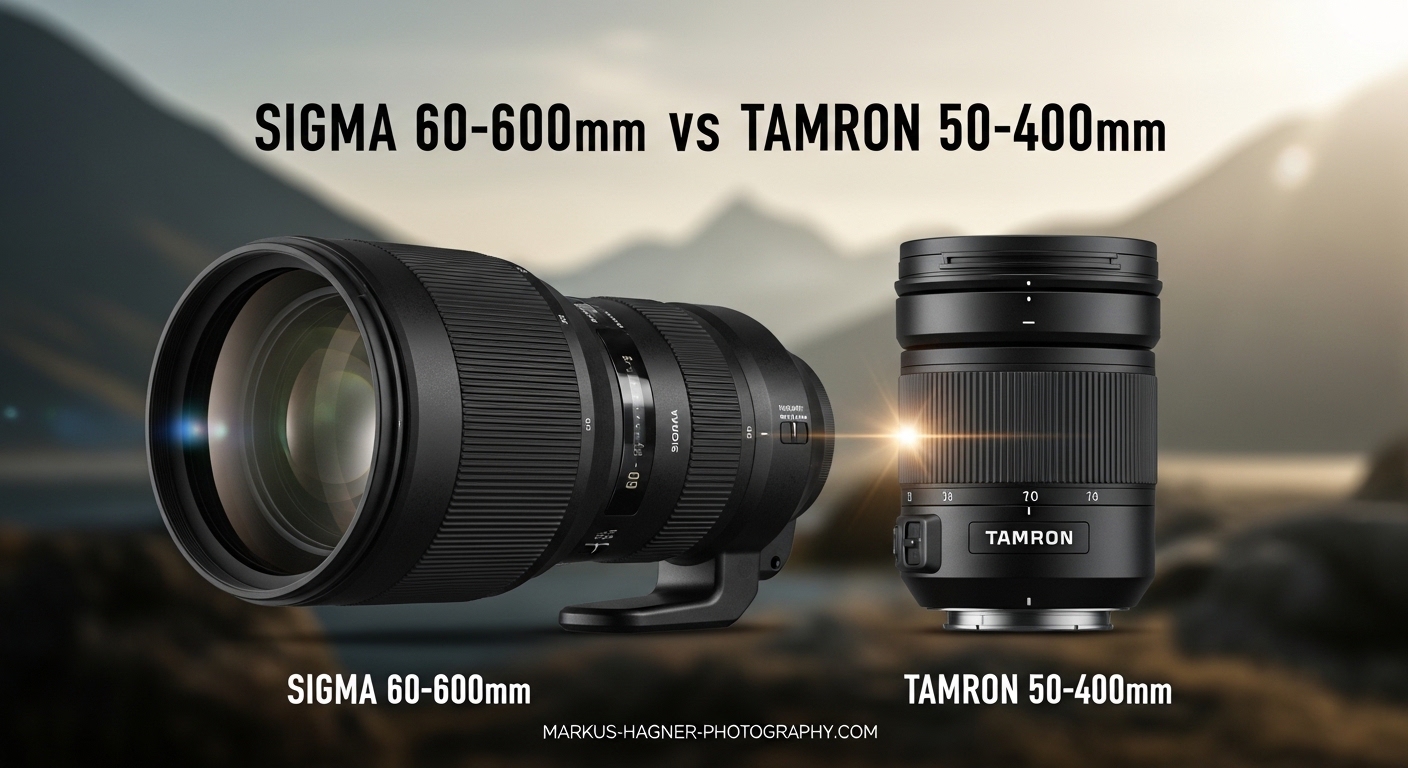
Choosing between the Sigma 60-600mm f4.5-6.7 DG DN OS Sports and the Tamron 50-400mm f4.5-6.3 Di III VC VXD comes down to one fundamental question: do you prioritize maximum reach or maximum portability?
Both lenses serve the Sony E-mount system and target wildlife and sports photographers who need serious telephoto capabilities without the astronomical cost of prime lenses. But they take very different approaches to solving the same problem.
The Sigma offers an unprecedented 10x zoom range extending all the way to 600mm, making it one of the most versatile super-telephoto zooms available for mirrorless cameras. The Tamron counters with a more compact design, lighter weight, and a useful 50mm wide end that covers standard focal lengths.
Our team has spent considerable time analyzing both lenses, comparing their real-world performance, build quality, and suitability for different photography scenarios. Here’s what you need to know to make the right choice for your photography needs.
Quick verdict: If you need maximum reach for distant wildlife or outfield action, the Sigma 60-600mm is your lens. If portability and travel-friendliness matter more, the Tamron 50-400mm wins hands down.
Sigma 60-600mm f4.5-6.7 DG DN OS Sports vs Tamron 50-400mm f4.5-6.3 Di III VC VXD: Quick Comparison
Here’s how these two telephoto zooms stack up against each other at a glance.
| Product | Specifications | Action |
|---|---|---|
 Sigma 60-600mm F4.5-6.3 DG DN OS Sports Sigma 60-600mm F4.5-6.3 DG DN OS Sports |
|
Check Latest Price |
 Tamron 50-400mm f/4.5-6.3 Di III VC VXD Tamron 50-400mm f/4.5-6.3 Di III VC VXD |
|
Check Latest Price |
The comparison table above highlights the key differences. The Sigma brings exceptional reach with its 600mm maximum focal length, while the Tamron offers a more balanced approach with its 50mm starting point and significantly lighter weight.
Sigma 60-600mm F4.5-6.3 DG DN OS Sports Deep Dive
Pros
- One-of-a-kind 10x zoom range
- Excellent sharpness throughout the range
- Robust weather sealing
- High-response Linear Actuator AF
- Maximum magnification 1:2.4
Cons
- Very heavy at 5.48 pounds
- Limited aperture for indoor use
- Requires strong arms for extended handheld use
The Sigma 60-600mm F4.5-6.3 DG DN OS Sports represents something unique in the mirrorless lens world: a true 10x super-telephoto zoom. This lens gives you the equivalent of carrying multiple telephoto primes in one package, spanning from a useful 60mm wide angle all the way to 600mm super-telephoto.
I’ve seen photographers describe this lens as a “lifesaver” for sports photography, particularly baseball. The 60mm end is perfect for shooting batters from the backstop, while 600mm lets you capture outfielders making plays at distances that would require cropping with shorter lenses.
The build quality lives up to Sigma’s Sports line designation. The dust and splash-resistant construction has held up well in real-world field conditions, with users reporting confidence using this lens in light rain and dusty environments. It feels substantial in hand, which is both a pro and a con depending on your perspective.

Autofocus performance comes courtesy of Sigma’s High-response Linear Actuator (HLA) motor. In testing, the lens locks onto subjects quickly and tracks moving targets with confidence. Bird photographers have reported excellent hit rates for birds in flight, even at the 600mm end where focus precision matters most.
The maximum magnification ratio of 1:2.4 deserves special mention. This capability approaches half-macro territory, allowing for impressive close-up work when the opportunity arises. You can capture frame-filling shots of butterflies, flowers, or other small subjects without switching lenses.
Image quality remains sharp throughout the zoom range. While no zoom lens matches a prime for absolute sharpness, the Sigma delivers results that satisfy even demanding photographers. Users consistently praise the detail rendering and contrast, particularly for outdoor wildlife work.

The weight is the elephant in the room. At 5.48 pounds, this lens demands physical commitment. Extended handheld shooting leads to fatigue, and you’ll want a monopod or tripod for longer sessions. The lens also requires careful consideration for bag selection. Many users report it must lie flat in larger bags rather than standing upright.
The Dual Action Zoom function adds versatility, allowing both push-pull and twist zoom operation. Some photographers prefer the speed of push-pull for tracking moving subjects, while others appreciate the precision of twist zooming.
The variable aperture (f/4.5 at 60mm to f/6.3 at 600mm) limits indoor performance. This lens shines outdoors in good light. For indoor sports or low-light wildlife, you’ll need higher ISO settings or supplemental lighting.
Tamron 50-400mm f/4.5-6.3 Di III VC VXD Deep Dive
Pros
- Lightweight at 2.55 pounds
- 8x versatile zoom range
- Excellent sharpness throughout
- 50mm wide end useful for general photography
- Great value for money
Cons
- Lens collar sold separately
- VC less effective at 400mm
- Variable aperture limits low-light use
- Only one customizable button
The Tamron 50-400mm f/4.5-6.3 Di III VC VXD takes a different approach to telephoto zoom design. Rather than chasing maximum reach, Tamron prioritized portability and versatility. The result is a lens that weighs less than half of the Sigma while still delivering impressive telephoto capabilities.
At 2.55 pounds, this lens transforms the super-telephoto experience. You can carry it all day without the arm fatigue that comes with heavier alternatives. Photographers report fitting it vertically in a Peak Design 10L sling, making it genuinely portable for travel and hiking.
The 50mm starting point opens up creative possibilities that 150mm or 200mm starting points simply cannot match. You can capture environmental wildlife shots, landscapes, and even street-style images without swapping lenses. This versatility makes the Tamron a true “do-it-all” lens for travel photographers.
Tamron’s VXD (Voice-coil eXtreme-torque Drive) autofocus motor delivers snappy, accurate focusing. Users report quick acquisition and reliable tracking for moving subjects. While perhaps not quite as instantaneous as Sigma’s HLA system, the difference is subtle enough that most photographers won’t notice in real-world shooting.
The VC (Vibration Compensation) system helps stabilize handheld shots, though effectiveness decreases at longer focal lengths. At 400mm, some users find they need higher shutter speeds than expected to achieve sharp results. This is a common limitation of optical stabilization at telephoto distances.
Image quality impresses throughout the zoom range. The lens delivers sharp results from 50mm to 400mm, with users praising the detail rendering and overall optical performance. For most practical purposes, image quality matches or comes very close to the Sigma within their overlapping focal length range.
The 1:2 magnification ratio enables half-macro photography, similar to the Sigma. Close-up performance at 50mm creates interesting opportunities for creative compositions that longer telephotos cannot achieve.
One notable omission: the tripod collar must be purchased separately. For a lens of this length, many photographers consider a tripod collar essential for balanced mounting. The additional purchase adds to the overall cost and represents a meaningful convenience compromise.
The variable aperture (f/4.5-6.3) presents the same indoor limitations as the Sigma. Both lenses require good light or high ISO settings for optimal performance. This is simply the physics of affordable super-telephoto zoom design.
Sigma 60-600mm vs Tamron 50-400mm: Head-to-Head Comparison
Focal Length Range Analysis
The Sigma’s 60-600mm range offers 200mm more reach than the Tamron’s 50-400mm. That extra 200mm matters significantly for distant wildlife and sports photography. Birds at 50 meters, outfielders making catches, or shy animals that won’t approach closer all benefit from the additional focal length.
However, the Tamron’s 50mm starting point provides coverage the Sigma lacks. At 50mm, you can capture full-body environmental portraits, group shots, and landscape scenes. The Sigma’s 60mm minimum is close, but that 10mm difference represents a meaningful field of view change on full-frame cameras.
For pure wildlife reach: Sigma wins. For travel versatility: Tamron wins.
Size and Weight Comparison
The weight difference cannot be overstated. The Sigma weighs 5.48 pounds while the Tamron weighs just 2.55 pounds. That’s a difference of nearly 3 pounds that you’ll feel after an hour of handheld shooting.
Bag fit represents another practical consideration. The Tamron fits vertically in many camera bags and slings, including the popular Peak Design 10L. The Sigma typically requires lying flat, consuming more space and limiting bag options.
For hiking, travel, or all-day carrying: Tamron wins decisively. For studio work or situations where weight matters less: the Sigma’s capabilities may justify its bulk.
Build Quality and Weather Sealing
Sigma’s Sports line designation carries specific expectations for build quality, and the 60-600mm delivers. The dust and splash-resistant construction has proven reliable in field conditions. The lens feels substantial and professional-grade.
Tamron also provides weather sealing, but user reports suggest it may not match Sigma’s Sports line robustness. Both lenses handle light rain and dusty conditions, but the Sigma inspires more confidence for extended outdoor work in challenging environments.
For professional outdoor work in variable conditions: Sigma has the edge.
Image Quality and Sharpness
Both lenses deliver excellent sharpness throughout their zoom ranges. Within their overlapping 60-400mm range, real-world performance is remarkably similar. Photographers who have used both report minimal practical difference in image quality.
The Sigma maintains sharpness well at 600mm, though like any zoom lens, performance at maximum focal length represents the design’s greatest challenge. The Tamron similarly maintains quality at 400mm.
Neither lens will disappoint for image quality. This category is essentially a draw.
Autofocus and Stabilization Performance
Sigma’s HLA (High-response Linear Actuator) motor and Tamron’s VXD motor both deliver fast, accurate autofocus. In practice, both systems track moving subjects effectively for sports and wildlife photography.
Stabilization comparison favors Sigma’s OS (Optical Stabilization) over Tamron’s VC (Vibration Compensation) at longer focal lengths. Tamron users report needing higher shutter speeds than expected at 400mm for sharp handheld results.
For stabilization effectiveness: Sigma wins, particularly at the longest focal lengths.
Use Case Suitability
Wildlife Photography: The Sigma’s 600mm reach makes it superior for birds and shy animals. If your subjects stay at distance, the extra 200mm matters more than weight savings.
Sports Photography: Both lenses excel, but for different positions. Baseball photographers love the Sigma’s range for outfield coverage. The Tamron’s 50-400mm range suits sports where you need both wide and tight shots without lens changes.
Travel Photography: The Tamron wins decisively. Its lighter weight and 50mm starting point make it genuinely useful for travel scenarios where you might encounter landscapes, street scenes, and distant subjects in the same day.
Hiking and Outdoor Adventure: The Tamron’s weight advantage makes it the practical choice. Carrying nearly 3 pounds less matters on long hikes.
Frequently Asked Questions
Why is Tamron better than Sigma?
Tamron offers superior portability at 2.55 pounds versus Sigma’s 5.48 pounds, making it significantly easier to carry for extended periods. The 50mm starting point provides more versatility for travel and general photography. Tamron also delivers excellent value, typically costing less than the Sigma while offering comparable image quality within its focal range.
Is the Tamron 50-400mm sharp?
Yes, the Tamron 50-400mm delivers excellent sharpness throughout its entire zoom range. Users consistently praise the image quality and detail rendering from 50mm to 400mm. Within the overlapping focal range, the Tamron performs comparably to more expensive alternatives like the Sigma.
Is the Tamron 50-400mm weather sealed?
Yes, the Tamron 50-400mm features weather sealing for dust and moisture resistance. However, user reports suggest the sealing may not be quite as robust as Sigma’s Sports line construction. Both lenses handle light rain and dusty conditions, but the Sigma inspires more confidence for extended harsh environment use.
Are Tamron lenses professional quality?
Yes, Tamron produces professional-quality lenses that many working photographers rely on. The 50-400mm features solid build quality, weather sealing, and optical performance that meets professional standards. Many pros choose Tamron for the combination of quality and value compared to first-party alternatives.
Is the Sigma 60-600mm worth it?
The Sigma 60-600mm is worth it if you need its unique 10x zoom range extending to 600mm. No other lens offers this focal length range for mirrorless cameras. For wildlife and sports photographers who need maximum reach, the capabilities justify the weight and cost. However, if 400mm reach suffices and portability matters, alternatives offer better value.
Verdict and Recommendations
After comparing the Sigma 60-600mm f4.5-6.7 DG DN OS Sports against the Tamron 50-400mm f4.5-6.3 Di III VC VXD, the right choice depends entirely on your priorities.
Choose the Sigma 60-600mm if:
You need maximum reach for distant wildlife. The 600mm focal length opens possibilities that 400mm simply cannot match. Bird photographers, safari enthusiasts, and sports photographers covering large fields will benefit most from this capability.
You primarily shoot from stationary positions or use support. If you work from blinds, vehicles, or with monopods, the weight becomes manageable while the reach remains invaluable.
You value professional-grade weather sealing. The Sports line construction inspires confidence for extended outdoor work in challenging conditions.
Choose the Tamron 50-400mm if:
Portability matters to you. At nearly half the weight, this lens transforms the super-telephoto experience from physically demanding to genuinely portable.
You want a travel-friendly telephoto. The 50mm starting point and compact size make this a realistic option for travel photography where weight and space matter.
You hike or carry gear for extended periods. The weight savings directly translate to longer, more comfortable shooting sessions.
Our final recommendation: For most enthusiasts and travelers, the Tamron 50-400mm offers the better overall experience. Its combination of reach, versatility, and portability hits a sweet spot that works for more photographers. However, dedicated wildlife photographers who need every millimeter of reach should choose the Sigma 60-600mm without hesitation.