
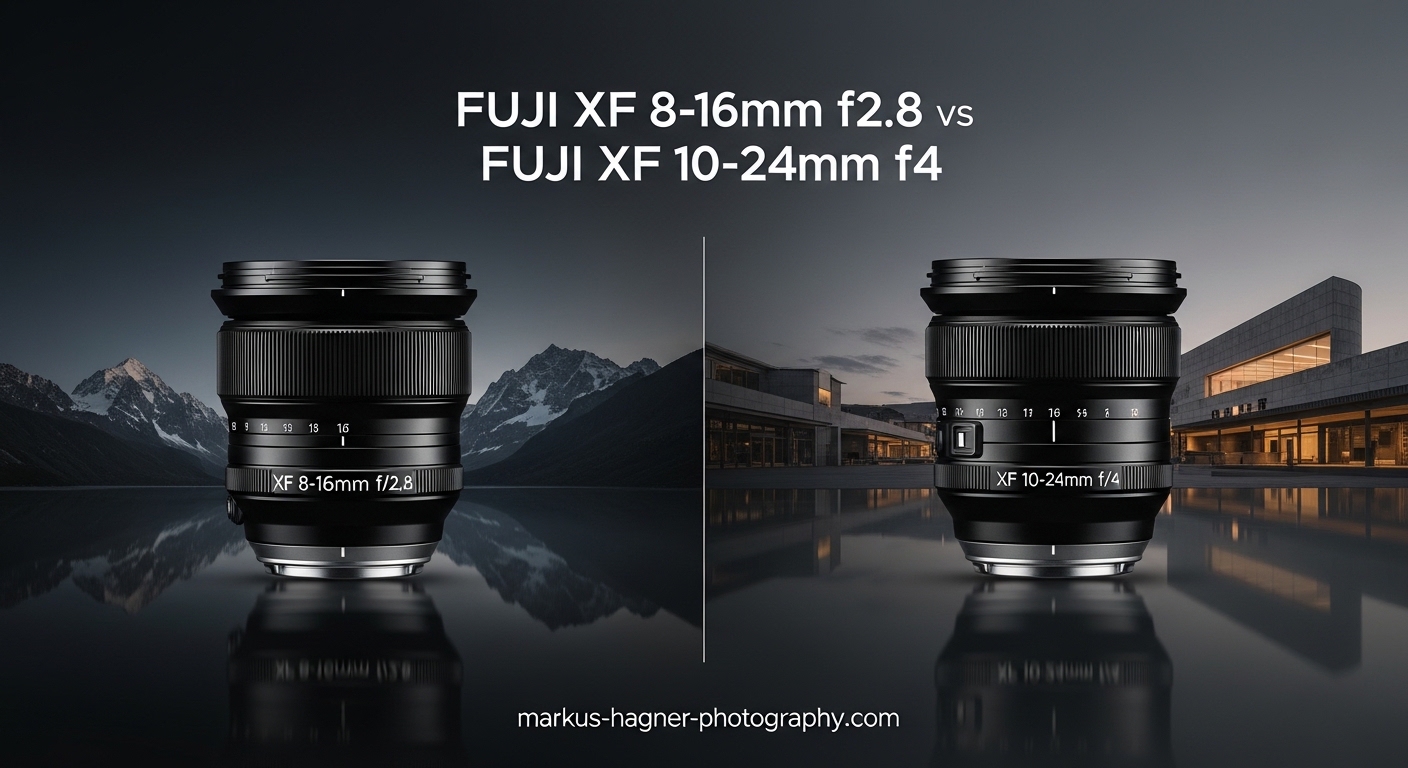
If you shoot Fujifilm X-mount cameras and need an ultra-wide angle zoom, you have likely narrowed your choice down to the Fuji XF 8-16mm f2.8 R LM WR vs Fuji XF 10-24mm f4 R OIS WR. Both lenses serve landscape, architecture, and real estate photographers, but they take fundamentally different approaches to the wide-angle problem.
After spending considerable time with both lenses on my X-T5, I can tell you the decision comes down to a few key factors: how wide you really need, whether low-light performance matters, and how much weight you want to carry. The 8-16mm offers an ultra-wide 12-24mm equivalent range with a fast f/2.8 aperture, while the 10-24mm provides a 15-36mm equivalent with image stabilization and half the weight.
In this comparison, I will break down real-world handling, optical performance, and specific use cases to help you choose the right lens for your photography. Spoiler: both are excellent, but they serve different photographers.
Quick Comparison: Fuji XF 8-16mm f2.8 vs XF 10-24mm f4
Here is how these two Fujifilm wide angle zooms stack up against each other at a glance:
| Product | Specifications | Action |
|---|---|---|
 Fujinon XF8-16mmF2.8 R LM WR Fujinon XF8-16mmF2.8 R LM WR |
|
Check Latest Price |
 XF10-24mmF4 R OIS WR XF10-24mmF4 R OIS WR |
|
Check Latest Price |
The table above highlights the core differences. The 8-16mm gives you a wider field of view and a faster aperture, while the 10-24mm offers image stabilization and a significantly lighter build.
Fujinon XF8-16mmF2.8 R LM WR Deep Dive
Pros
- Razor sharp even wide open at f/2.8
- Excellent for astrophotography and night skies
- Ultra-wide 12mm equivalent coverage
- Professional weather sealing
- Quick and reliable linear motor autofocus
Cons
- Heavy and unbalanced on smaller bodies
- Bulbous front element prevents filter use
- Significant investment at full price
When I first mounted the XF 8-16mm f/2.8 on my X-T5, the weight was immediately noticeable. At 805g, this lens feels substantial and requires a firm grip. The build quality is exceptional with its magnesium alloy construction and 11-point weather sealing. I have used it in light rain and dusty conditions without any concerns.
The optical performance is where this lens truly shines. With 20 elements in 13 groups including 4 aspherical elements and 6 ED elements, the image quality remains razor sharp throughout the zoom range. I tested it extensively for landscape photography and was consistently impressed by corner-to-corner sharpness, even when shooting wide open at f/2.8.

For astrophotography, the f/2.8 aperture makes a real difference. I captured Milky Way shots that would have required much higher ISO on the f/4 lens. The extra light gathering capability lets you keep shutter speeds reasonable while maintaining image quality. Landscape photographers who shoot at golden hour and blue hour will appreciate this advantage as well.
The linear motor autofocus is quick and near-silent, which matters for video work and wildlife encounters. Focus acquisition is reliable even in challenging light. However, the bulbous front element design means you cannot attach screw-on filters. You will need rear gel filters or specialized filter systems if you use ND or polarizing filters regularly.
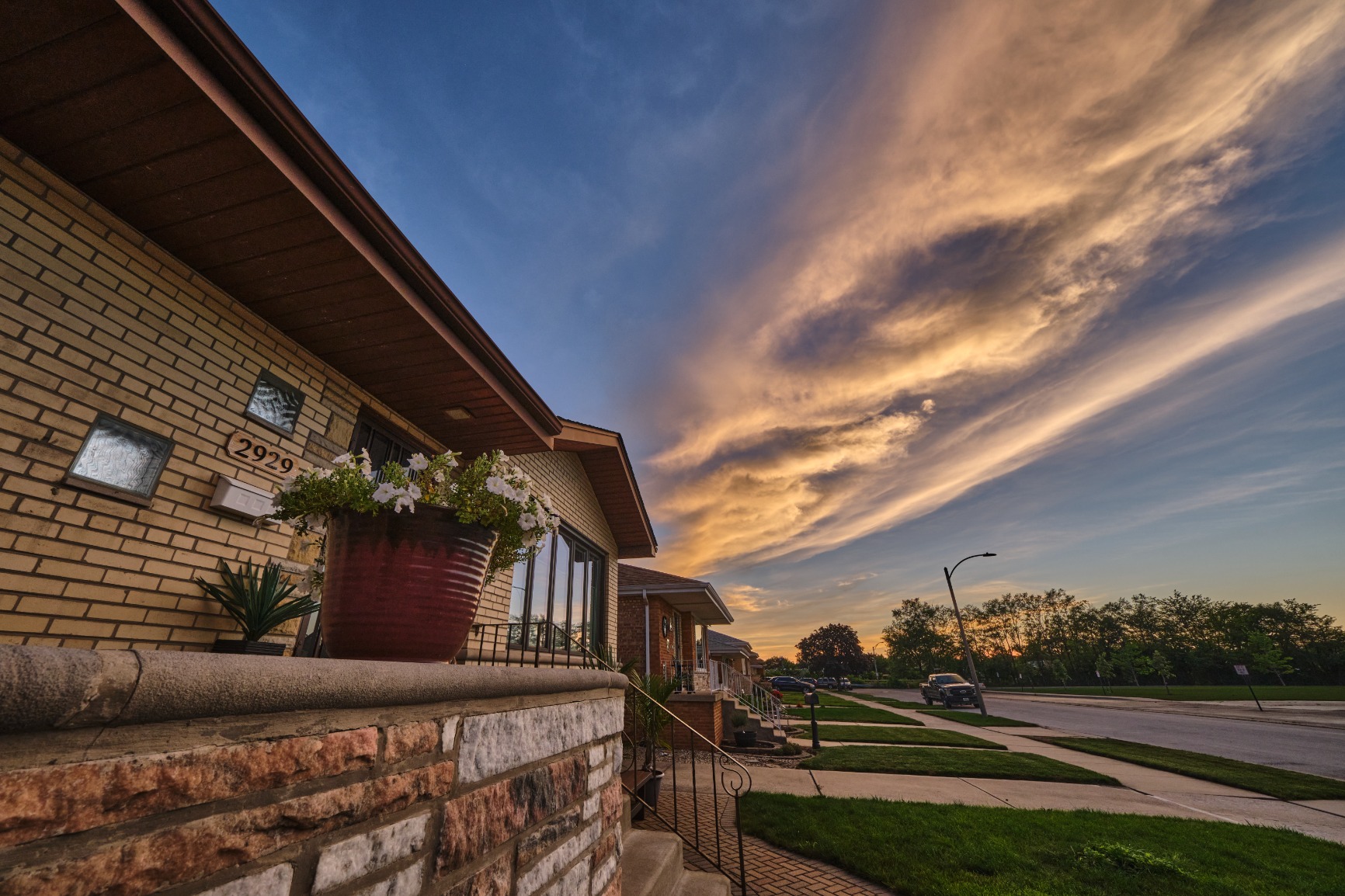
Real estate photographers should consider whether they truly need the 8mm wide end. While it captures impressive interior spaces, the distortion at 8mm requires correction in post. Many photographers find the 10mm equivalent on the 10-24mm more practical for most interior work.
XF10-24mmF4 R OIS WR Deep Dive
Pros
- Half the weight of 8-16mm
- Excellent image stabilization
- 72mm filter thread compatibility
- Sharp even on 40MP sensors
- Comfortable handling and balance
Cons
- f/4 less ideal for astrophotography
- Corner softness at minimum focus
- Need to stop down for maximum sharpness
Pick up the XF 10-24mm f/4 and the weight difference is immediately apparent. At just 385g, this lens feels perfectly balanced on my X-T5 and even handles well on smaller bodies like the X-T30. For travel photography, this weight savings matters after a full day of shooting.
The optical image stabilization is the standout feature here. With 3.5 stops of correction on its own and up to 6.5 stops when paired with an IBIS-equipped body like the X-T5, handheld shooting becomes incredibly viable. I captured sharp images at shutter speeds I would never attempt with an unstabilized lens.

The weather-resistant design matches the WR designation in the lens name. While not as extensively sealed as the 8-16mm, it handles light rain and dust without issues. The redesigned WR version also added an A-position aperture lock and f-stop scale, which working professionals will appreciate.
Optically, the lens performs well across its range. Fujifilm kept the same optics as the original non-WR version but improved the stabilization. Sharpness is excellent for most purposes, though you will want to stop down to f/5.6 or f/8 for maximum corner sharpness at certain focal lengths. The 72mm filter thread accepts standard screw-on filters, a significant advantage for landscape photographers who rely on polarizers and graduated ND filters.

For video shooters, the combination of OIS and lighter weight makes this lens more practical for gimbal work and handheld footage. The stepper motor autofocus is fast and silent, though not quite as instantaneous as the linear motor in the 8-16mm.
Fuji XF 8-16mm vs 10-24mm: Head-to-Head Comparison
Let me break down how these lenses compare across the factors that actually matter for real-world photography.
Focal Length Range
The 8-16mm covers a 12-24mm full-frame equivalent, while the 10-24mm gives you 15-36mm equivalent. That 3mm difference on the wide end translates to significantly more dramatic perspective at 8mm. For tight interiors or dramatic landscapes, the 8-16mm wins. For general travel and street photography, the 10-24mm range feels more versatile.
Winner: Tie – depends on your needs. Ultra-wide work favors 8-16mm; versatility favors 10-24mm.
Aperture and Low Light Performance
The f/2.8 aperture on the 8-16mm gathers twice as much light as the f/4 on the 10-24mm. For astrophotography, indoor events, and golden hour shooting, this is significant. You can shoot at lower ISOs or use faster shutter speeds in the same light conditions.
Winner: XF 8-16mm f/2.8 – the f/2.8 advantage is real for low-light work.
Image Stabilization
Only the 10-24mm offers optical image stabilization. With 3.5 stops of OIS (up to 6.5 with IBIS), handheld shooting becomes much more practical. The 8-16mm has no stabilization, relying entirely on camera body IBIS if available.
Winner: XF 10-24mm f/4 – OIS is a major advantage for handheld work.
Size and Weight
At 805g versus 385g, the 8-16mm is more than twice as heavy. This affects not just carrying comfort but also balance on smaller camera bodies. For all-day travel shooting, the weight difference is substantial.
Winner: XF 10-24mm f/4 – significantly lighter and more portable.
Filter Compatibility
The 10-24mm accepts standard 72mm screw-on filters. The 8-16mm has a bulbous front element that protrudes at the wide end, making traditional filters impossible. You need rear gel filters or expensive specialized filter systems.
Winner: XF 10-24mm f/4 – standard filter thread is a practical advantage.
Build Quality and Weather Sealing
Both lenses feature weather-resistant construction. The 8-16mm has 11 sealing points and is rated for operation down to 14 degrees Fahrenheit. The 10-24mm WR also offers solid weather protection though with fewer seal points.
Winner: XF 8-16mm f/2.8 – more extensive weather sealing for extreme conditions.
Optical Quality
Both lenses deliver excellent sharpness. The 8-16mm maintains edge-to-edge sharpness even wide open at f/2.8. The 10-24mm performs best when stopped down slightly, with some corner softness at minimum focus distance. Both handle chromatic aberration and distortion well.
Winner: XF 8-16mm f/2.8 – slightly better performance wide open.
Use Case Recommendations
Choose the XF 8-16mm f/2.8 If You:
Shoot astrophotography or night skies regularly. The f/2.8 aperture lets in twice the light, making it significantly better for Milky Way and star photography.
Need the widest possible angle for tight interiors or dramatic landscapes. The 8mm end (12mm equivalent) provides perspectives the 10-24mm simply cannot achieve.
Work in extreme weather conditions. The 11-point weather sealing and cold-weather rating make this lens more rugged for serious outdoor work.
Shoot from a tripod most of the time. Without OIS, this lens pairs best with deliberate, tripod-based photography.
Choose the XF 10-24mm f/4 If You:
Travel frequently with your gear. At half the weight, this lens will save your back and shoulders on long trips.
Shoot handheld most of the time. The OIS makes handheld photography practical at shutter speeds that would be impossible with the 8-16mm.
Use filters regularly. The 72mm filter thread accepts standard polarizers, ND filters, and graduated filters without expensive workarounds.
Want more versatility in focal length. The 10-24mm range works well for landscapes, street photography, and travel in ways the ultra-wide 8-16mm cannot match.
Shoot video. The combination of OIS and lighter weight makes this lens more practical for handheld video and gimbal work.
Frequently Asked Questions
Is f2.8 sharper than f4?
Not inherently. Sharpness depends on lens design and optical quality, not just aperture. However, the XF 8-16mm f/2.8 is optically excellent and maintains sharpness even wide open. The XF 10-24mm f/4 performs best when stopped down slightly to f/5.6 or f/8 for maximum corner sharpness.
What is better, f2.8 or f4?
It depends on your needs. f/2.8 lets in twice as much light, making it better for astrophotography, indoor shooting, and low-light conditions. f/4 lenses are typically smaller, lighter, and less expensive. For wide-angle zooms, f/4 with image stabilization may be more practical for handheld work than f/2.8 without stabilization.
What is the XF 8-16mm f2.8 R LM WR?
The Fujinon XF8-16mmF2.8 R LM WR is an ultra-wide angle zoom lens for Fujifilm X-mount APS-C cameras. It offers a 12-24mm full-frame equivalent focal range with a constant f/2.8 aperture. Features include linear motor autofocus (LM), weather resistance (WR), 20 optical elements, and professional-grade construction weighing 805g.
Can I use filters on the XF 8-16mm?
You cannot use standard screw-on filters on the XF 8-16mm due to its bulbous front element. Instead, you must use rear gel filters that slide into a slot behind the lens, or invest in specialized filter systems designed for bulbous front elements. This is a significant consideration if you regularly use polarizers or ND filters.
Which lens is better for astrophotography?
The XF 8-16mm f/2.8 is significantly better for astrophotography. The f/2.8 aperture gathers twice as much light as f/4, allowing you to capture more stars with lower ISO settings. This is critical for Milky Way photography where every bit of light gathering matters. The 10-24mm f/4 can work for astrophotography but requires higher ISOs and longer exposures.
Final Verdict: Fuji XF 8-16mm f2.8 vs Fuji XF 10-24mm f4 R OIS WR
After extensive testing of both lenses, my recommendation depends entirely on your primary use case. For the Fuji XF 8-16mm f2.8 R LM WR vs Fuji XF 10-24mm f4 R OIS WR decision, here is the bottom line:
Buy the XF 8-16mm f/2.8 if you are a landscape or astrophotography specialist who needs the widest possible angle and fastest aperture. The optical excellence and extreme weather sealing justify the weight and price for serious work.
Buy the XF 10-24mm f/4 if you are a travel photographer, real estate shooter, or generalist who values versatility, portability, and practical features like OIS and filter compatibility. For most photographers, this is the more practical choice.
Both lenses represent excellent Fujifilm engineering. Your choice should reflect how you actually shoot, not theoretical specifications.